
The popular advice is to pick the penetration test software with the largest scanner library or the most autonomous marketing. That shortcut fails because a scanner, an exploitation framework, an attack-path validator, and a reporting system perform different jobs. A useful stack must match the target, the amount of tester involvement, the evidence a customer or auditor needs, the deployment boundary, the cadence of reassessment, and the provider's ability to deliver repeatably.
For MSSPs and security teams, the practical question isn't “Which tool is best?” It's “Which part of the assessment workflow must this tool improve?” NIST Special Publication 800-115 formalized testing as a lifecycle covering planning, execution, and post-execution activities, including discovery, scanning, exploitation validation, log review, documentation, and reporting (NIST's technical guide). The OWASP Web Security Testing Guide similarly separates pre-engagement, intelligence gathering, threat modeling, vulnerability analysis, exploitation, post-exploitation, and reporting.
The ten options below are therefore compared by the job they perform in a penetration-testing program. Each entry covers its strongest use case, operating implications, pricing visibility, advantages, limitations, and the point where expert judgment remains necessary.
Table of Contents
- 1. ThreatExploit AI
- 2. Pentera
- 3. Horizon3.ai NodeZero
- 4. Burp Suite Professional and DAST Enterprise
- 5. Invicti
- 6. Fortra Core Impact
- 7. HCL AppScan
- 8. OWASP ZAP
- 9. Metasploit Framework
- 10. AttackForge
- Top 10 Penetration Testing Tools: Feature Comparison
- Build the Stack Around the Engagement
1. ThreatExploit AI
ThreatExploit AI is the closest option in this list to an end-to-end, partner-oriented penetration-testing service layer. It's designed for MSSPs, MSPs, telecom providers, hosting companies, cloud providers, and compliance firms that need to turn testing capacity into a repeatable customer workflow rather than run isolated tools from an analyst workstation.
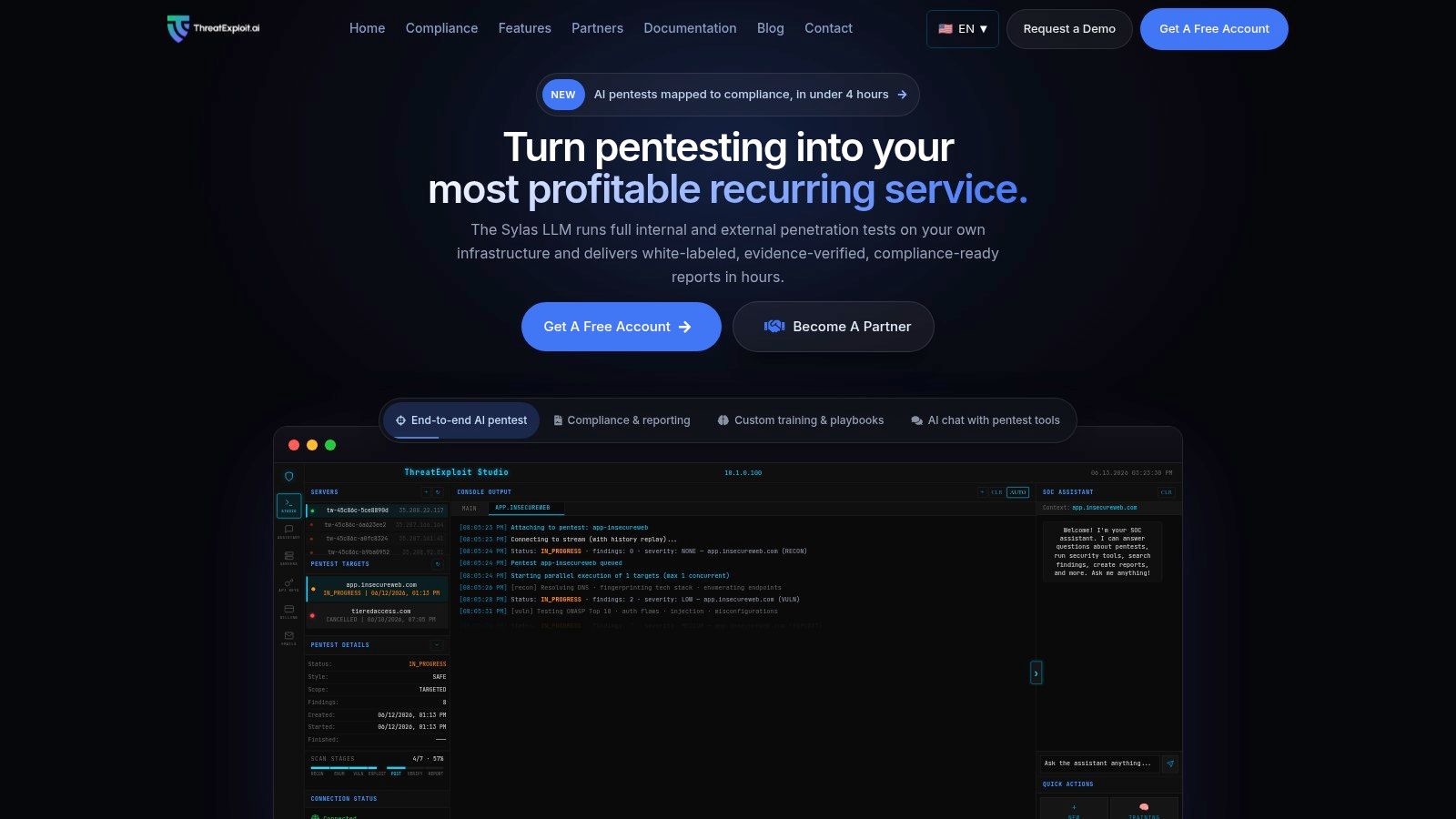
The platform combines a pentest-trained large language model with the ROOT agentic controller, which coordinates autonomous subagents across reconnaissance, vulnerability discovery, exploitation, verification, evidence collection, and reporting. Its toolchain orchestrates more than 60 tools, including Nmap, SQLMap, and Nuclei, across web applications, REST and GraphQL APIs, internal and external networks, and cloud environments such as AWS, Azure, and GCP.
ThreatExploit AI's operational advantage is the connection between execution and delivery. It produces PDF and JSON reports with executive and technical views, screenshots, remediation guidance, risk scoring, and mappings for HIPAA, SOC 2, PCI-DSS, CMMC, ISO 27001, GLBA, and GDPR. The platform states that typical workflows can produce full reports in under four hours, while its product materials report approximately 95% finding verification and 94% overall accuracy. Those figures are product claims, so a buyer should validate them against its own authorized targets and review process rather than treat them as a universal benchmark.
Where the partner model fits
Dedicated, non-multi-tenant partner-scoped servers, regional deployment across America, Europe, and Asia, role-based access, API keys, CI/CD integration, API access, and a VS Code extension make the platform relevant to providers managing multiple customer environments. A partner dashboard supports customer onboarding, test configuration, and multi-tenant reporting. Starter, Professional, Team, and Enterprise tiers, a free trial, volume discounts, reseller economics, optional on-premise deployment, SLAs, and dedicated support give procurement teams several possible operating models.
Procurement question: Ask ThreatExploit AI to demonstrate how scope, authorization, activity logs, evidence, uncertainty, and retesting are preserved for one complete customer engagement.
The principal limitation is also important. Autonomous execution doesn't replace senior testers in highly targeted assessments, complex business-logic work, bespoke exploit chains, or strategic risk interpretation. Public pricing isn't transparent because partner pricing is adjusted to testing volume and quoted on request, which makes side-by-side cost comparison slower.
Best fit: MSSPs and consultancies seeking end-to-end automation, recurring testing, evidence-backed reports, and partner-scale delivery.
2. Pentera
Pentera is built for continuous security validation rather than deep, open-ended manual exploit development. Its agentless platform emulates end-to-end attack paths across internal environments, external exposure, and Active Directory, helping teams test whether existing controls prevent realistic sequences of compromise.
That distinction matters for security operations. A vulnerability scanner can identify a weakness, but an attack-path validation platform asks whether an attacker can use available conditions to progress through an environment. Pentera's exposure-management views and prioritized findings are therefore useful when the buyer needs operational direction, not a long unranked inventory.
Delivery and governance
Agentless operation can simplify assessments across Active Directory and hybrid environments because the provider isn't deploying a persistent agent to every system. For service providers, licensing and partner support make it a candidate for repeatable customer validation, especially where the service is framed around recurring control checks instead of a traditional consultant-led engagement.
The platform is strongest when the scope is known and the customer wants evidence that defensive controls work under controlled attack conditions. It can reduce dependence on manual testing for baseline validation and make retesting easier to operationalize after changes.
Pricing is quote-only, so teams should model the cost against customer count, assessment frequency, deployment effort, and analyst review time. The product also shouldn't be treated as a substitute for creative exploitation of unusual application logic or a bespoke red-team objective.
Best fit: Security teams and providers validating internal, external, and Active Directory attack paths repeatedly.
3. Horizon3.ai NodeZero
Horizon3.ai NodeZero takes an autonomous testing approach with a particularly practical emphasis on verification and remediation. It supports internal and external penetration tests, password audits, and phishing impact testing, so its scope extends beyond a single network scan or web application assessment.
The platform uses cloud-hosted, isolated, ephemeral infrastructure for each test. That model is valuable for providers that need separation between customer engagements and want to avoid treating a shared testing environment as an implicit trust boundary. Portal-based orchestration supports scheduling, test execution, and one-click verify and retest workflows.
Why retesting changes the buying decision
The most useful output isn't always the initial finding. IT stakeholders also need to know whether a patch, configuration change, password reset, or segmentation adjustment resolved the attack path. NodeZero's guided evidence and remediation support make that remediation loop easier to explain to infrastructure teams.
Its internal network and Active Directory capabilities are a strong match for organizations that want to demonstrate lateral movement risk in a controlled manner. Password audits and phishing impact testing can add broader validation, although those activities still require explicit authorization, careful communication, and customer-specific rules of engagement.
Pricing is quote-only, which can complicate procurement for smaller consultancies. Autonomous testing also won't fully replace expert-led creative exploitation where business context, unusual workflows, or complex chains determine impact.
Best fit: Teams that want cloud-delivered autonomous testing, clear internal attack-path evidence, and fast proof that remediation worked.
4. Burp Suite Professional and DAST Enterprise
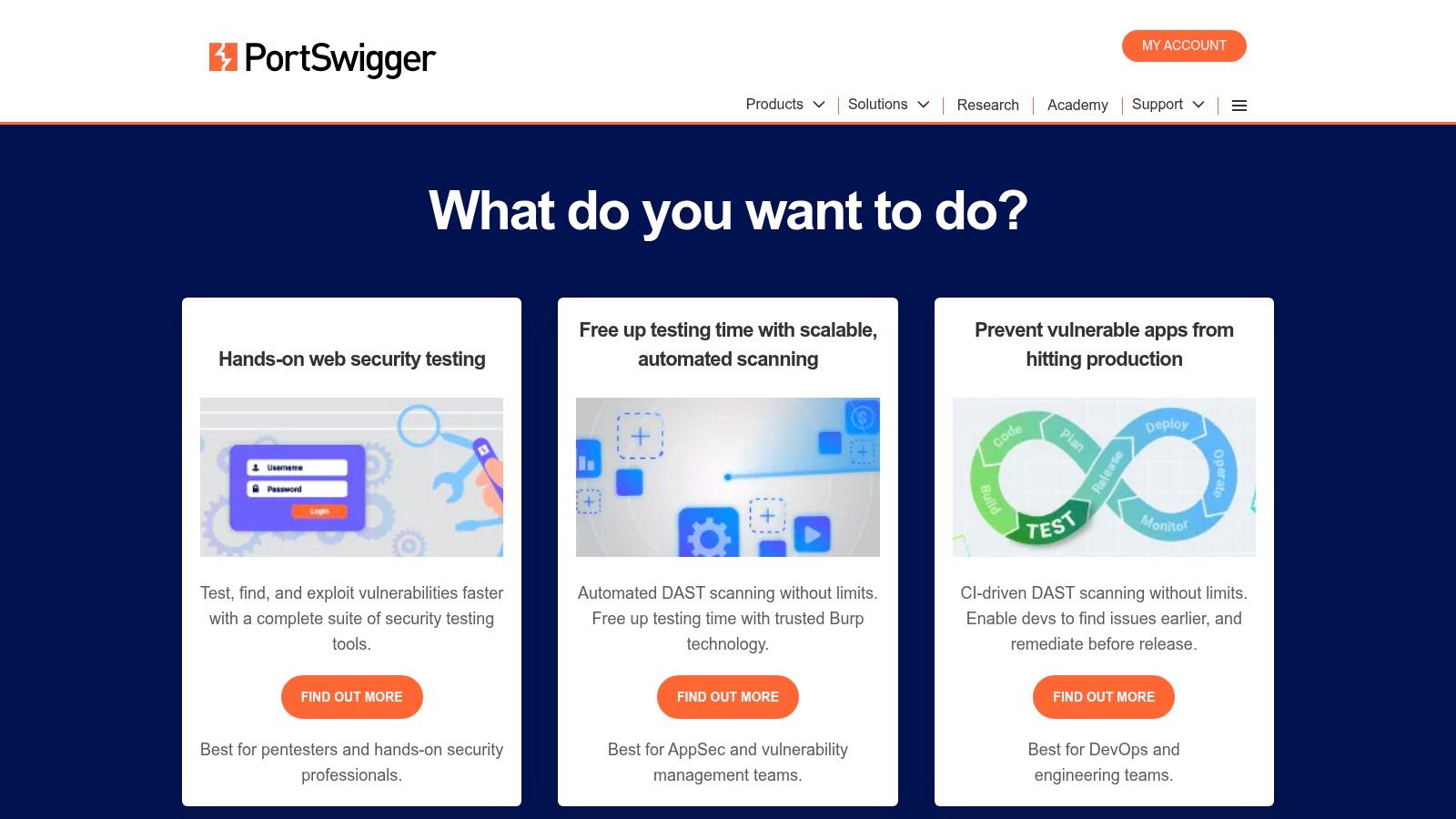
Burp Suite remains a core choice for web application penetration testing because it serves both manual testers and automation teams. Burp Suite Professional provides an intercepting proxy, Intruder, Repeater, scanning capabilities, extensions, and scripting support. DAST Enterprise adds scheduled dynamic scanning, centralized management, and CI/CD-oriented workflows.
Its value comes from flexibility rather than autonomous breadth. A consultant can intercept a request, manipulate parameters, replay a transaction, extend the tool through the BApp Store, and build a testing method around the application's behavior. An enterprise team can standardize scheduled web assessments and integrate results into a broader AppSec process.
A better role than “full pentest platform”
Burp is primarily a web testing system, not a complete network, cloud, or Active Directory penetration-testing platform. That focus is an advantage when the engagement centers on authentication, authorization, session handling, API behavior, input validation, or business logic. It becomes a limitation when the provider needs one system to manage infrastructure attack paths, cloud control-plane exposure, customer onboarding, and final report production.
Teams exploring automation should also define what the scanner can prove and what still requires manual interpretation. Guidance on automated web application penetration testing is useful for separating automated discovery from confirmed impact.
Professional licensing is more accessible for individual testers, while DAST Enterprise pricing is quote-only and less transparent. Burp's widespread use, training ecosystem, extensions, and scripting make it one of the strongest specialist tools for web engagements, but delivery teams may still need a reporting platform around it.
Best fit: Web application consultants and AppSec teams that need deep manual control with scalable DAST workflows.
5. Invicti
Invicti is a DAST and application-security platform focused on web applications and APIs. Its advanced crawling and scripting support help it move through complex applications, while API testing extends coverage beyond traditional browser-driven journeys.
The product's defining workflow is finding validation. IAST through AcuSensor supplies additional application context intended to distinguish exploitable issues from scanner noise and reduce false positives. For an enterprise AppSec team, that can improve prioritization because developers receive findings with more context than a basic request-and-response alert.
Strong application coverage, limited engagement breadth
Invicti is a strong choice when the primary question is whether a large portfolio of web applications and APIs contains actionable security defects. Its broader AppSec capabilities support correlation, risk scoring, prioritization, and enterprise documentation. That makes it more suitable for a program with many applications than for a one-off consultant who needs a flexible exploitation workbench.
It isn't a full network or cloud penetration-testing suite. A provider testing exposed VPNs, Active Directory, cloud permissions, or internal lateral movement would need complementary tools and human-led methods. The distinction is important because application scan depth doesn't automatically translate into infrastructure attack-path coverage.
Pricing is generally quote-based, with limited public list pricing. Buyers should request a demonstration using representative authenticated applications, APIs, crawling constraints, and report formats. They should also measure analyst review effort, not just the number of issues returned.
Best fit: Enterprise application-security programs prioritizing web and API coverage, validation, and centralized risk management.
6. Fortra Core Impact
Fortra Core Impact is a commercial penetration-testing framework for teams that need controlled exploitation and post-exploitation workflows across network, client-side, and web scenarios. Unlike a focused DAST product, it supports a broader engagement shape, including attack execution, collaboration, scheduling, and reporting.
Its Rapid Penetration Tests provide wizard-driven flows for common testing activities. That standardization can help junior consultants execute approved procedures consistently, while experienced testers retain access to more powerful exploit and post-exploitation capabilities. Multi-user collaboration is relevant to consultancies coordinating an engagement across several analysts or workstreams.
Power requires a stronger operating model
Core Impact is designed for end-to-end professional services delivery, so its reporting and team features can reduce fragmentation between testing and customer output. It's a better fit than a pure scanner when the engagement needs validated exploitation across infrastructure and applications.
The same capability creates governance demands. Rules of engagement, target authorization, credentials, notification procedures, stop conditions, and evidence retention need to be defined before execution. NIST treats the assessment plan and rules of engagement as foundational controls, not administrative extras (NIST's testing guidance).
Pricing is quote-only and may be difficult for smaller teams to justify. Core Impact also isn't an autonomous, modern attack-path service by default. It gives testers a capable framework, but expert judgment remains central to selecting exploits, controlling impact, interpreting access, and presenting risk.
Best fit: Professional penetration-testing teams conducting hybrid infrastructure and application engagements with structured collaboration.
7. HCL AppScan
HCL AppScan is an enterprise application-security family that combines SAST, DAST, and IAST across on-premises and cloud deployment models. AppScan Standard, Enterprise, AppScan 360º, and AppScan on Cloud give organizations options for balancing centralized governance, data control, and SaaS delivery.
Its main advantage is program breadth within application security. A large organization can consolidate different testing modalities, maintain reporting across application portfolios, and support development and security stakeholders through documented workflows. On-premises deployment can matter where application data, assessment traffic, or internal processes can't move freely into a hosted service.
Governance over manual exploitation
HCL AppScan is better suited to governed application testing at scale than to manual penetration testing. DAST depth can support dynamic assessment, while SAST and IAST add earlier and more contextual signals. That combination helps an enterprise establish a broader application-security program, but it doesn't turn the platform into a substitute for a consultant exploring complex business logic or chaining unusual vulnerabilities.
Pricing transparency varies by product and deployment model, with enterprise tiers typically quote-based. Procurement teams should compare not only license cost but also administration, integration, workflow ownership, findings triage, and the reporting effort required to turn application signals into customer-ready penetration-test evidence.
For MSSPs, the question is whether AppScan supports a reusable service model or primarily serves internal governance. The answer depends on tenant separation, customer reporting, deployment boundaries, and the provider's ability to operate the chosen edition across distinct engagements.
Best fit: Enterprises needing governed SAST, DAST, and IAST coverage across application portfolios.
8. OWASP ZAP
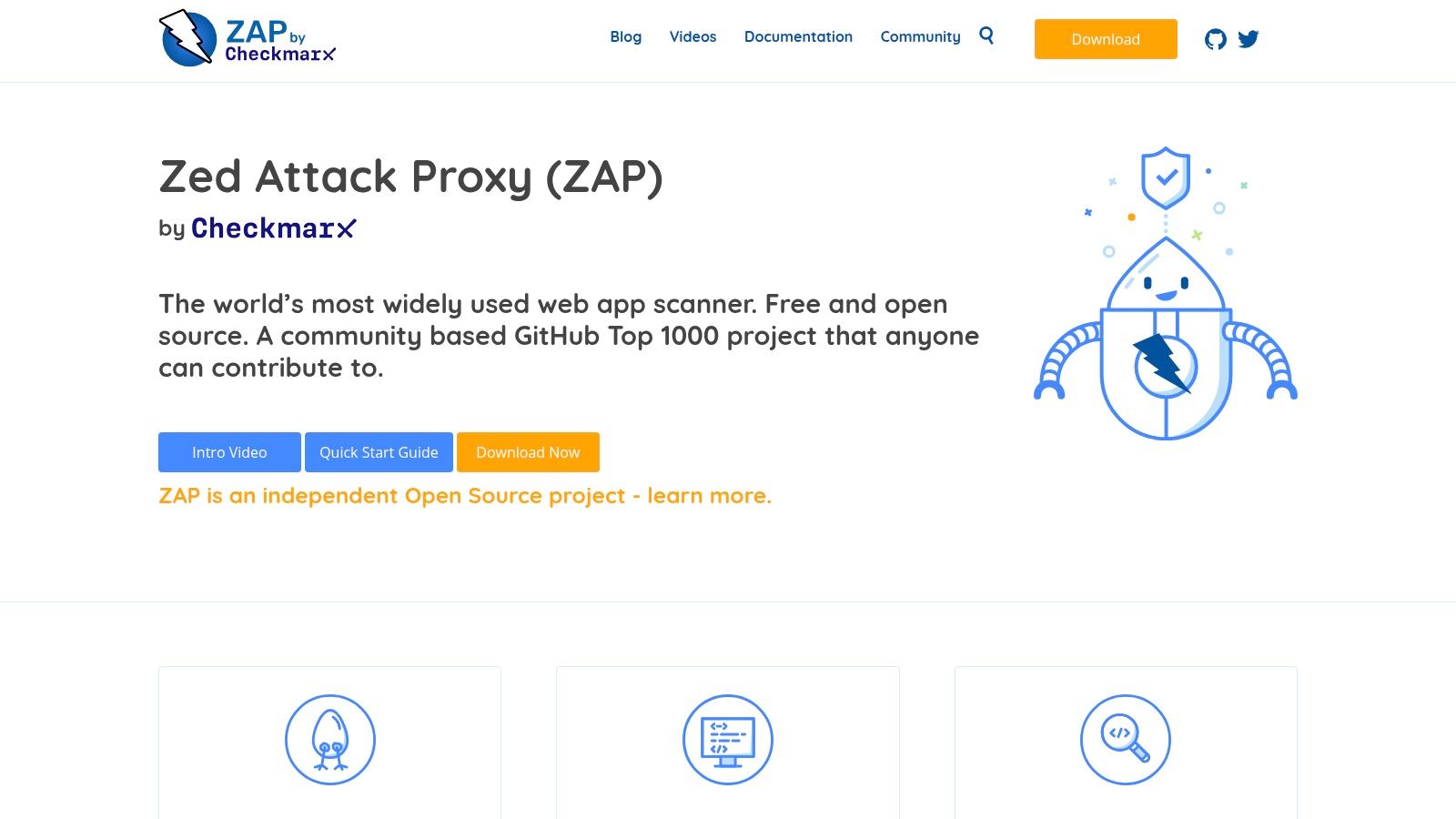
OWASP ZAP is the practical entry point for teams that need a free, open-source web testing and DAST tool. It provides a man-in-the-middle proxy, spider and crawler functions, passive and active scanning, fuzzing, authentication helpers, scripting, a REST API, Docker images, and an add-on ecosystem.
The zero license cost changes the economics, but it doesn't eliminate operating cost. A consultant or internal team must tune contexts, authentication, scan policies, exclusions, add-ons, and output handling. Without that work, recurring scans can produce noise that consumes the very analyst capacity the tool was meant to preserve.
The value is in customization
ZAP works well in CI/CD and headless environments because teams can automate it through its API and container images. It also gives consultants a modifiable foundation for custom checks and repeatable baseline testing. That makes it a useful component in a broader stack, especially when a team has scripting ability and doesn't need turnkey enterprise orchestration.
It isn't a complete network or cloud penetration-testing suite. Nor does free licensing provide customer-ready evidence, tenant management, or mature reporting automatically. Teams should define how they'll verify findings, attach request and response evidence, preserve logs, and convert results into an assessment report.
A useful application-security reference is the OWASP Application Security Verification Standard, which can help teams align automated checks with a broader verification approach.
Best fit: Budget-conscious consultants and development teams that can tune, automate, and review an open-source web testing stack.
9. Metasploit Framework
Metasploit Framework is an exploitation and validation framework, not a complete penetration-testing delivery platform. Its modules, payloads, auxiliary functions, integrations, documentation, and community support let authorized testers move from a suspected weakness to a controlled demonstration of exploitability and impact.
That role is distinct from vulnerability discovery. A scanner may identify a service or potential condition. Metasploit can help a tester validate whether a supported exploit works under the approved scope, what access it provides, and whether the result supports a defensible finding. It can also connect with discovery workflows, including scan data from tools such as Nmap.
Evidence and authorization come first
The framework's value depends on the tester's judgment. Module selection, payload choice, session handling, cleanup, lateral movement limits, and stop conditions all require governance. A powerful offensive tool can create operational risk if a consultant treats a successful module run as permission to continue beyond the rules of engagement.
The proof-of-concept exploit guidance illustrates why a demonstration should explain reproducibility and impact without becoming an unsupported claim. Metasploit can supply technical validation, but it doesn't automatically decide whether the result matters to the business or how it should be communicated to an executive audience.
The open-source Framework is free to use and benefits from extensive training resources. Commercial product information should be evaluated separately because the current focus for many buyers is the open-source framework itself. Reporting, customer portals, multi-tenant management, and recurring-service orchestration require complementary systems.
Best fit: Authorized testers who need a mature framework for exploit validation, controlled impact demonstration, and post-exploitation work.
10. AttackForge
AttackForge addresses the part of penetration testing that many technical tool comparisons overlook, engagement management and reporting. It centralizes scoping, project workflows, test-case execution, quality assurance, collaboration, vulnerability management, imports, analytics, and client-ready report generation.
Its vulnerability library supports CWE and CAPEC mapping, customizable templates, and normalized findings. Integrations and import support for tools such as Burp, Nessus, and Qualys let a consultancy bring technical results into one governed delivery process rather than rewrite them manually across separate documents.
The reporting system is part of the test
AttackForge's API, described as having 150+ endpoints, supports integrations and partner onboarding, while tenant-based deployment can help consultancies structure customer operations. Its pricing has a low-entry orientation and is more transparent than many enterprise security products, although advanced program reporting and asset modules are reserved for higher tiers.
The trade-off is clear. AttackForge isn't an autonomous exploit engine, so it won't discover or validate attack paths on its own. Its value appears after tools and testers generate findings, when the consultancy must verify quality, assign ownership, map controls, track remediation, and deliver separate technical and executive views.
That reporting discipline aligns with FedRAMP guidance, which expects scope, deviations from approved rules of engagement, attack vectors, threat models, test dates, actual tests, results, risk ratings, recommendations, and evidence in the assessment record (FedRAMP penetration-test guidance).
Best fit: Consultancies and internal red teams that need repeatable scoping, QA, finding normalization, governance, and customer reporting.
Top 10 Penetration Testing Tools: Feature Comparison
| Product | Core features / Coverage ✨ | Quality & verification ★ | Price & delivery 💰 | Target audience 👥 | Unique selling point ✨ |
|---|---|---|---|---|---|
| ThreatExploit AI 🏆 | Autonomous end‑to‑end PTES (recon→exploit→report); web, network, cloud; 60+ toolchain | ★★★★★ (~94–95% verification; reports in <4h) | Tiered per‑test (Starter→Enterprise); free trial; on‑prem option 💰 | MSSPs, MSPs, telecoms, hosting, compliance firms 👥 | Dedicated partner‑scoped infra; compliance‑mapped, evidence‑backed PDFs/JSON ✨ |
| Pentera | Agentless continuous security validation; attack‑path emulation | ★★★★ (prioritized, evidence‑backed paths) | Quote‑based; service‑provider licensing 💰 | Enterprise security teams, MSSPs, ops 👥 | Exposure management & AD/hybrid focus ✨ |
| Horizon3.ai NodeZero | Autonomous internal/external pentests; password audits; phishing tests | ★★★★ (strong AD/internal; verify/retest UX) | Quote‑based; ephemeral per‑test infra 💰 | IT/SOC teams, MSSPs, red teams 👥 | One‑click verify/retest and isolated ephemeral infra ✨ |
| Burp Suite (Pro / DAST) | Manual + automated web toolkit: proxy, scanner, Repeater, extensions | ★★★★★ (industry standard for web testing) | Pro paid; DAST/Enterprise quote 💰 | Web app pentesters, dev/secops teams 👥 | Extensible BApp ecosystem; Burp AT AI helpers ✨ |
| Invicti (Acunetix/Netsparker) | DAST + API scanning; advanced crawling; IAST (AcuSensor) | ★★★★ (high scan accuracy; fewer false positives) | Quote‑based enterprise plans 💰 | AppSec teams, large orgs 👥 | AcuSensor IAST for validated findings and prioritization ✨ |
| Fortra Core Impact | Commercial exploit & post‑exploit framework; RPTs and team workflows | ★★★★ (mature exploit workflows) | Quote‑based; enterprise focus 💰 | Consultancies, professional pentest teams 👥 | Wizard‑driven Rapid Penetration Tests (RPTs) for repeatable flows ✨ |
| HCL AppScan | Consolidated SAST/DAST/IAST; on‑prem & SaaS deployment options | ★★★★ (governance & broad modality coverage) | Enterprise tiers / quote 💰 | Large enterprises, compliance/governance teams 👥 | Mixed testing modalities with centralized reporting ✨ |
| OWASP ZAP | Free MITM proxy, active/passive scanning, CI/CD friendly, add‑ons | ★★★ (community‑driven; tunable; requires tuning) | Free (open source) 💰0 | Consultants, developers, small teams 👥 | Zero license cost; highly extensible via add‑ons/scripts ✨ |
| Metasploit Framework | Exploit + payload + post‑exploitation modules; scanner integrations | ★★★★ (industry standard for exploit validation) | Free OSS (commercial Pro legacy) 💰 | Pentesters, red teams, researchers 👥 | Massive exploit module library and integrations ✨ |
| AttackForge | Pentest project & reporting management; vuln library; tool imports | ★★★★ (reduces reporting lead time; governance) | Transparent, low‑entry pricing; tenant options 💰 | Consultancies, internal red teams, managers 👥 | CWE/CAPEC vuln library, rich import/API for workflow automation ✨ |
Build the Stack Around the Engagement
There isn't one universal winner because these products don't solve the same problem. ThreatExploit AI, Pentera, and NodeZero sit closest to autonomous or continuous validation. Burp Suite, Invicti, HCL AppScan, and OWASP ZAP focus primarily on web or application-security testing. Core Impact and Metasploit Framework give testers controlled exploitation capabilities. AttackForge manages the engagement and turns findings into governed deliverables.
Start with target type. A web and API consultancy may need Burp Suite or Invicti, while a development team building pipeline checks may prefer OWASP ZAP. An organization validating Active Directory and internal attack paths should evaluate Pentera or NodeZero. A provider conducting infrastructure exploitation with experienced consultants may need Core Impact or Metasploit. An MSSP delivering recurring, multi-customer assessments should examine whether ThreatExploit AI's partner dashboard, dedicated infrastructure, APIs, reporting formats, and customer separation match its operating model.
Then assess automation depth. Discovery and scanning are easier to automate than business-logic reasoning, strategic risk interpretation, and bespoke exploit chains. OWASP's seven-stage framework includes pre-engagement, intelligence gathering, threat modeling, vulnerability analysis, exploitation, post-exploitation, and reporting, so a platform that only returns scan findings covers only part of the work. A credible automated workflow must preserve authorization, scope, activity logs, reproducible evidence, uncertainty labels, remediation guidance, and retesting.
Governance deserves equal weight. Agentic systems must be treated as privileged security infrastructure, not as harmless software. Buyers should ask about sandboxing, scoped credentials, tenant isolation, egress controls, approval gates, immutable logs, prompt-injection resistance, emergency shutdown, and safeguards against silent scope expansion. Independent research has described ToolHijacker attacks achieving up to 96.7% attack success against MetaTool with GPT-4o (the academic survey), which makes tester-system security part of the buying decision.
A practical shortlist
- Choose ThreatExploit AI when you need partner-oriented, end-to-end automation across web, network, and cloud targets, evidence-backed reports, compliance mappings, recurring testing, and dedicated infrastructure. Validate its reported verification and accuracy claims with your own authorized proof of concept, and account for quote-based pricing.
- Choose Pentera or NodeZero when the main outcome is recurring control validation and attack-path evidence across internal or external environments. Compare isolation, retesting, customer workflows, and analyst review effort.
- Choose Burp Suite, Invicti, HCL AppScan, or OWASP ZAP when application coverage, API testing, CI/CD integration, crawling, or development workflow matters more than full infrastructure exploitation.
- Choose Core Impact or Metasploit Framework when expert testers need exploit validation and controlled post-exploitation. Neither removes the need for authorization, cleanup, human review, and report construction.
- Choose AttackForge when the technical tools are already in place but scoping, QA, finding normalization, customer reporting, and program analytics consume too much delivery time.
Pricing transparency is another differentiator. OWASP ZAP and Metasploit Framework have no software license cost, but configuration, specialist labor, governance, and reporting still create operating costs. Many commercial platforms, including ThreatExploit AI, Pentera, NodeZero, Invicti, Core Impact, and enterprise editions of Burp Suite, use quote-based pricing or customized tiers. Ask each vendor to price the same authorized workload, then include onboarding, integrations, retesting, storage, support, report review, and customer administration.
The strongest stack is often complementary. An MSSP might use an autonomous platform for recurring validation, Burp Suite for manual web testing, Metasploit for controlled exploit confirmation, and AttackForge for final delivery. ThreatExploit AI is especially relevant when the provider wants to scale complete testing workflows without hiring senior pentesters for every baseline engagement. Focused tools remain better for specialized application work, deep exploit development, and cases where expert creativity and business context determine the result.
Run an authorized proof of concept before signing. Measure target coverage, verified evidence, false-positive review workload, retesting, report quality, scope controls, tenant isolation, integration effort, approval gates, and total operating effort. The right platform is the one your team can operate safely, explain to customers, and repeat when the environment changes, not the one with the most impressive feature list.
ThreatExploit AI combines autonomous reconnaissance, exploitation, verification, evidence collection, and reporting across web, network, and cloud environments for security providers that need repeatable delivery. To evaluate its partner-oriented approach against the penetration test software options above, visit ThreatExploit AI and test how its reporting, controls, integrations, and recurring assessment workflow fit your authorized engagements.