
Most advice about a proof of concept exploit is outdated. It treats public exploit code as a harmless research artifact, something analysts can file beside a CVE and revisit after the vendor releases a patch. That approach fails when the code gives an attacker a usable path into an internet-facing service before the organization has confirmed exposure.
A PoC isn't automatically a weaponized attack, but it is operational intelligence. It can show that a vulnerability is reachable, reveal the assumptions an attacker needs, and expose whether a defensive control works. For penetration testers, the job isn't to run every script found online. The job is to validate exploitability safely, prove impact with observable evidence, and communicate risk without overstating what the code demonstrates.
Table of Contents
- The Collapsing Window Between Disclosure and Exploitation
- Differentiating PoC Code from Weaponized Exploits
- The Mechanics of Reliable Exploit Generation
- Safe Verification in Client Testing Environments
- Transforming Exploit Verification into Pentest Evidence
- Scaling Validation with Automated Pentesting Platforms
- Redefining the Vulnerability Management Lifecycle
The Collapsing Window Between Disclosure and Exploitation
The old sequence was comfortable: a vendor disclosed a vulnerability, defenders reviewed the advisory, a PoC appeared later, and threat actors eventually adapted it. That sequence no longer deserves to be treated as a dependable operating model. A decade-long analysis found public PoC exploits for 31% of vulnerabilities between 2014 and 2023, while 72.9% of vulnerabilities known to be exploited in the wild were associated with a PoC exploit, according to VulnCheck's analysis of exploitation over the decade.
The same analysis recorded public PoCs growing at an average rate of 11.8% per year, compared with 14.1% annual growth in disclosed CVEs and 19.7% annual growth in vulnerabilities known to be exploited in the wild. Those figures don't mean every published script works, or that every PoC will become a production attack. They do show that PoC code belongs to the mainstream vulnerability lifecycle, not a niche corner of academic research.
A more recent dataset found that 26% of CVEs with 2025 identifiers had public PoC code or exploit details by the end of that year, covering 10,480 unique CVEs, as reported in Cybri's vulnerability statistics analysis. More than 98% of the exploits tracked in 2025 were PoC code rather than fully weaponized flaws. For an MSSP, that distinction matters, but it shouldn't become an excuse to defer triage. A fragile exploit can still prove that a control is missing.
Disclosure isn't the same as safety
The practical danger is the gap between publication and action. One analysis identified a PoC exploitability gap, where code was publicly usable before defenders treated the vulnerability as urgent. In a dataset covering 63,862 CVEs issued from January 1, 2024 to September 30, 2025, public PoCs existed for 2.6%, with 56% of those PoCs appearing in under seven days. The same analysis measured an average 15.2-day delay between CVE disclosure and NVD publication, according to Recorded Future's vulnerability trends research.
That delay creates a bad operational habit. Teams wait for the NVD entry, a mature scanner plugin, or a vendor severity score before they decide whether to test. A public PoC may arrive while those workflows are still catching up. The responsible response isn't panic. It's controlled validation against systems that matter.
Treat the PoC as a trigger for verification
A PoC should raise the priority of three questions:
- Is the vulnerable component present? Asset inventory, package manifests, service banners, and deployment records can answer this without sending exploit traffic.
- Is the vulnerable path reachable? Configuration, authentication boundaries, network exposure, and application behavior determine whether the code can reach its intended target.
- Can the claimed impact be reproduced safely? A tester needs a verifier, an agreed test window, and a rollback plan before active execution.
The Cloud Security Alliance reported that the exploit window had compressed from months to days or hours, and that 32.1% of newly tracked exploits in 2025 appeared on or before public disclosure in its 2026 analysis of AI and vulnerability exploitation. It also reported AI systems generating working PoC code for published CVEs in 10 to 15 minutes, at about $1 per attempt. Those claims appear in the Cloud Security Alliance paper on the collapsing exploit window. Automation makes validation more urgent, but it doesn't remove the need for authorization and evidence.
Operational rule: Public PoC availability should start a validation workflow. It shouldn't be treated as proof that the target is exploitable, and it shouldn't be dismissed as harmless by default.
Differentiating PoC Code from Weaponized Exploits
A proof of concept and a weaponized exploit can target the same vulnerability while serving completely different purposes. The PoC tries to answer, “Can I reach and trigger the vulnerable condition?” A weaponized exploit tries to answer, “Can I do this reliably, stealthily, repeatedly, and at scale?”
A public script may send one carefully constructed request and produce a crash, an error change, a benign callback, or a visible state change. That can be enough to establish the vulnerable code path. It may still fail against a different operating system, library version, authentication state, proxy, compiler option, or application configuration.
A weaponized exploit usually carries additional engineering. It may include target discovery, environment checks, multiple delivery paths, retry logic, payload staging, evasion, persistence, and recovery when the first attempt fails. Those capabilities turn a demonstration into an operational intrusion tool. The existence of the former doesn't prove the latter.
A useful comparison
| Attribute | Proof of concept exploit | Weaponized exploit |
|---|---|---|
| Primary purpose | Demonstrate that a specific flaw can be triggered | Achieve a reliable operational objective |
| Payload | Minimal, often limited to a crash, callback, or controlled effect | Designed for execution, access, collection, or persistence |
| Reliability | May depend on exact versions and assumptions | Built to handle target variation and failure |
| Visibility | Often noisy and easy to observe | May include stealth and evasion |
| Evidence value | Proves a technical condition when verified | Demonstrates a broader attack capability |
| Testing posture | Controlled and narrowly scoped | Potentially destructive or unauthorized outside an engagement |
The table helps prevent a common reporting error: translating “public PoC exists” directly into “remote code execution is confirmed.” A script that displays an alert box proves less than one that creates a controlled marker under an authorized test account, and both prove less than a stable payload that reaches a defined business asset. Analysts should describe the exact result, not the most dramatic possible interpretation.
For a deeper distinction between identifying a weakness and demonstrating exploitation, use this vulnerability versus exploit comparison. It reinforces a point that matters in client conversations: a scanner finding is a hypothesis, while a validated PoC is evidence of a specific behavior under defined conditions.
Don't overreact to an unverified repository
GitHub popularity, a recent commit, and an impressive README don't establish exploit validity. Public code can be incomplete, copied from another project, tied to a lab-only configuration, or written to assert success without checking whether the target changed state.
The opposite mistake is just as serious. A PoC that fails in one environment isn't proof that the vulnerability is absent. It may require a specific code path, an overlooked prerequisite, or a corrected request format. Record the failed assumptions and test conditions. A credible assessment separates not vulnerable, not reachable, PoC incompatible, and not yet verified.
The Mechanics of Reliable Exploit Generation
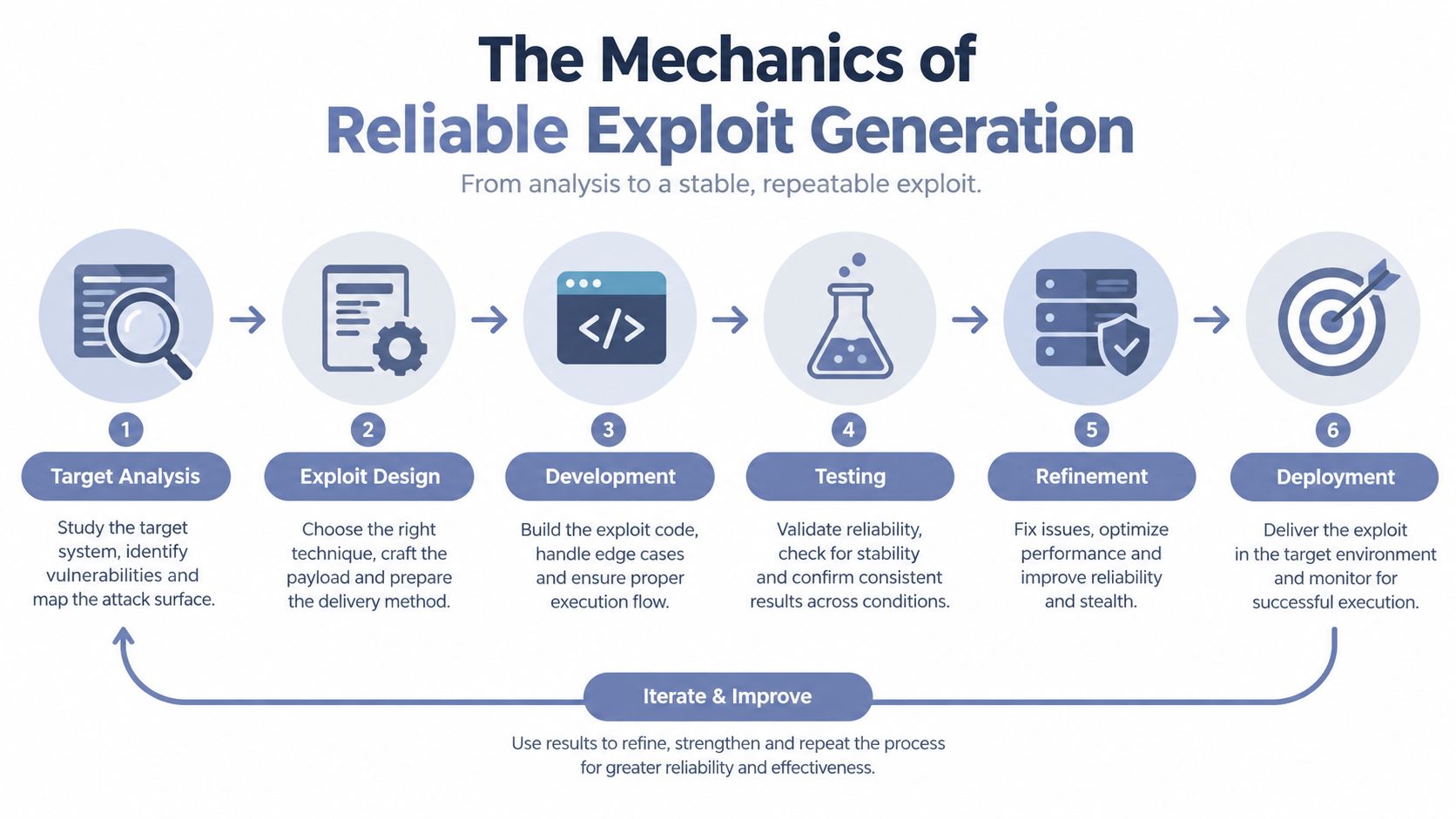
Copying a script and running it against a client target is not exploit validation. Reliable generation follows a closed loop in which the tester understands the vulnerable path, constructs a minimal trigger, executes it in a controlled environment, and checks whether the claimed effect occurred.
Research on automated PoC generation describes this process as executable code that must be validated through repeated feedback. Static analysis can identify the relevant vulnerable path, dynamic execution can confirm triggerability, and iterative refinement can keep the payload aligned with the actual application behavior. The PoCGen research on npm vulnerabilities divides the workflow into vulnerability understanding, exploit generation, exploit validation, and prompt refinement.
Start with the code path, not the signature
A vulnerability signature tells you what researchers believe is wrong. It doesn't tell you whether the client's deployment reaches that condition. Start by identifying:
- The input boundary. Determine where attacker-controlled data enters, such as a request parameter, serialized object, package input, file parser, or API field.
- The vulnerable operation. Trace how that data reaches the sink or flawed logic. Static analysis is valuable here because it exposes the path even when the public PoC hides it behind helper functions.
- The environmental prerequisites. Check versions, feature flags, authentication requirements, dependencies, permissions, and runtime settings.
- The observable effect. Define what success looks like before execution. It might be a controlled file marker, a unique application response, a callback to an approved observer, or a verifier result.
- The failure boundary. Decide what must stop the test, including unexpected privilege changes, service instability, data access outside scope, or signs of propagation.
This process avoids signature matching. A request that resembles a public exploit may reach the application and return a success string without ever executing the vulnerable branch.
Execution has to close the loop
The validator should compare the expected effect with an independent observation. If the PoC claims command execution, a returned banner alone isn't enough. If it claims authentication bypass, the test needs evidence that the session crossed the intended authorization boundary. If it claims a denial-of-service condition, the tester should use a reversible, monitored test and capture service behavior without turning a validation exercise into an outage.
PoC-Gym's evaluation of Java security vulnerabilities illustrates why this discipline matters. Static-analysis-guided generation improved success rates by 21% versus the prior baseline, but manual inspection found 71.5% of generated PoCs invalid, according to the PoC-Gym evaluation. A high apparent success rate can therefore conceal artifacts that never exercise the claimed vulnerability.
Refine the smallest working payload
The safest reliable PoC is usually the smallest one that proves the required impact. Remove unnecessary payload stages, persistence, credential collection, lateral movement, and destructive actions. Then test the reduced version in a lab that matches the client's relevant versions and configuration.
This approach works particularly well for package ecosystems and complex Java applications, where a published exploit may depend on class paths, transitive dependencies, serialization behavior, or a runtime detail that isn't obvious from the command line. Static analysis explains why the path should work. Dynamic tracing demonstrates whether it does work. Neither replaces the other.
A PoC isn't reliable because it was published. It's reliable when its verifier can distinguish a real state change from a convincing-looking response.
Academic work on exploit validation also emphasizes programmatic checks, observable side effects, and verifier logic rather than blind assertions. The research on executable exploit validation supports a practical standard for testers: every automated result should carry the evidence needed to explain why the system was classified as exploitable.
Safe Verification in Client Testing Environments
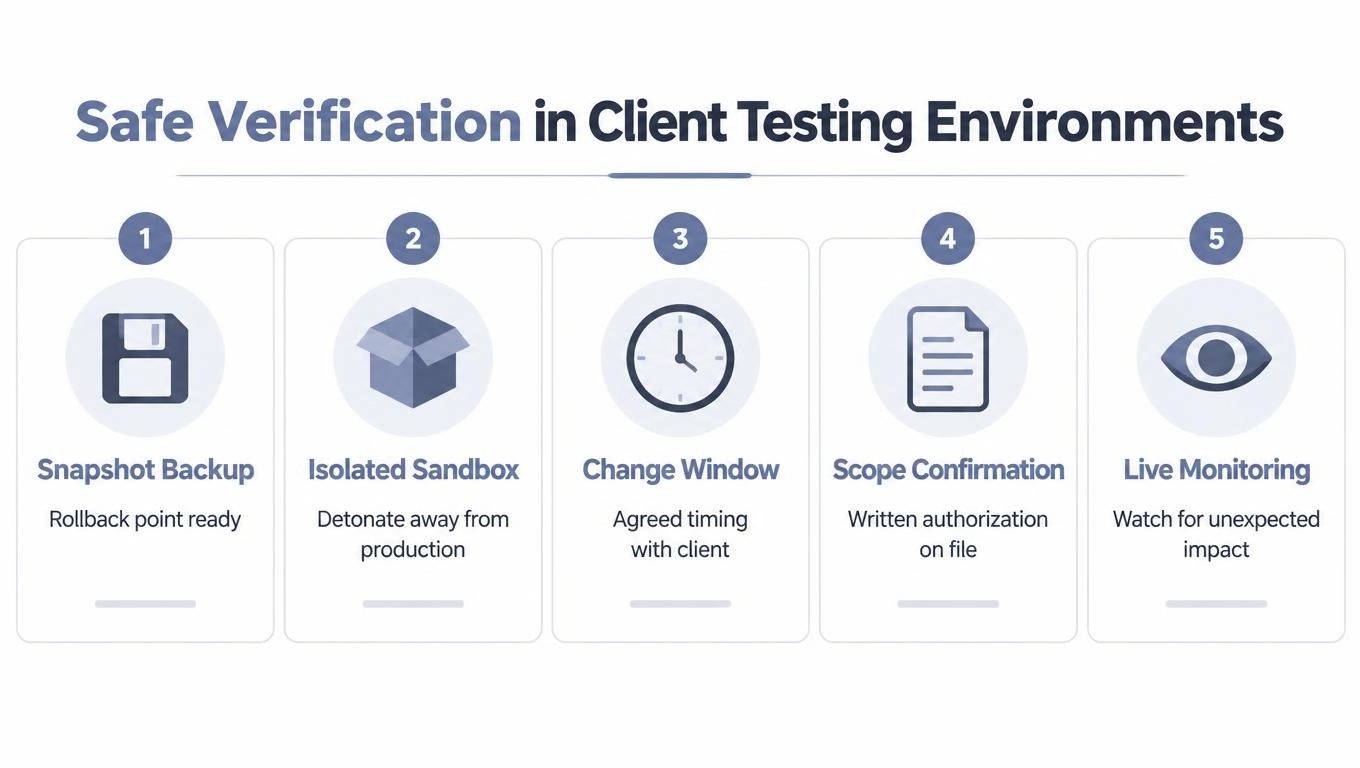
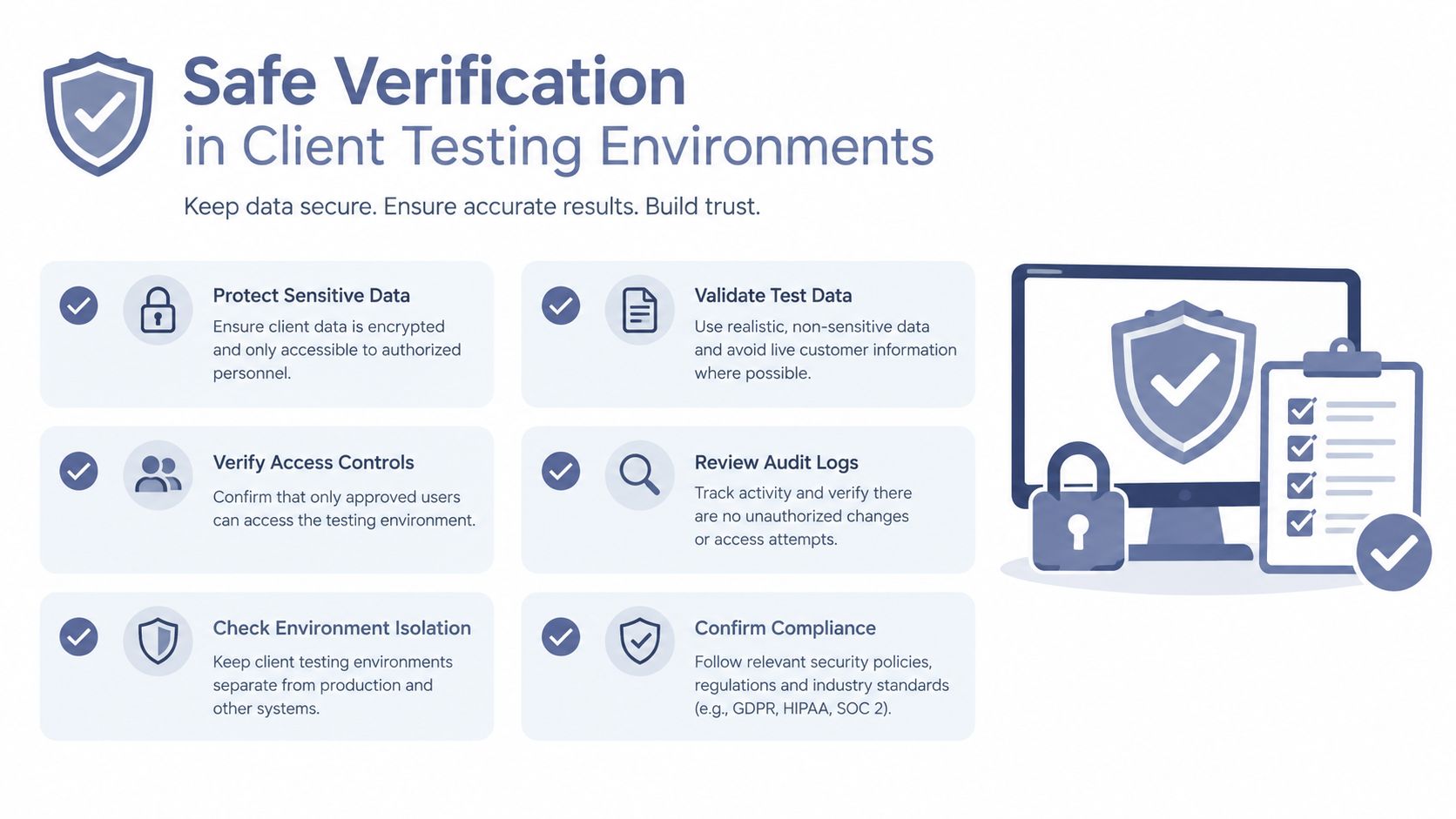
A client authorization letter doesn't make unsafe execution acceptable. It defines permission, not a substitute for engineering controls. Before running a proof of concept exploit, the tester should know what may be touched, when the test may run, how the client will observe it, and how the team will restore the original state.
Establish the rules before execution
Use a written preflight rather than relying on an informal message in a ticket:
- Confirm authorization: Record the exact assets, applications, accounts, techniques, and test dates covered by the engagement.
- Separate production from staging: Prefer a representative test environment. If production testing is necessary, define the permitted payload and maximum effect.
- Create a rollback point: Take an approved snapshot or backup where the client's architecture supports it, and confirm who can restore it.
- Define stop conditions: Stop if the service becomes unstable, data outside scope appears, privileged access expands unexpectedly, or monitoring detects unplanned behavior.
- Assign a contact: The tester needs a named client contact who can approve a pause or emergency rollback.
- Monitor the target: Capture application logs, endpoint telemetry, network events, and service health before, during, and after the attempt.
A non-destructive payload is preferable, but “non-destructive” must be defined in the context of the target. Replacing a reverse shell with a harmless DNS callback can reduce risk, provided the callback is approved and doesn't expose sensitive information. A benign file creation command can demonstrate execution when the test account and path are controlled, but it still requires permission to write and a cleanup plan.
Verify effects without creating new risk
Don't use a payload merely because it returns a familiar success message. Build a verifier that checks an observable consequence through an independent channel. For example, the test can look for a unique marker in an approved location, confirm a controlled callback, compare authorization behavior before and after the request, or inspect a specific application event generated by the test.
The verifier should also record negative evidence. If the request returns an error, capture the error and the surrounding conditions. If the callback never arrives, record the expected network route, timing, and monitoring result. That distinction helps the report say “the PoC did not verify under the tested conditions” rather than making the unsupported claim that the vulnerability is absent.
For API engagements, teams often need to validate authorization behavior without exposing client data. A practical reference for designing those controls is the SigOS approach to API security, particularly where API permissions and observable behavior must be tested without treating real customer records as disposable test material.
Handle false positives as a workflow problem
False positives don't come only from bad scanners. They also come from PoCs that assert success, exploit attempts that trigger a generic error, and testers who confuse a reachable endpoint with a vulnerable execution path. A documented validation workflow, including preconditions, execution trace, verifier output, and cleanup, makes those errors easier to catch.
Teams building repeatable triage can also use this resource on reducing false positives in security testing as a reference for separating detection from proof. The useful principle is simple: don't promote a finding to confirmed exploitation until the evidence demonstrates the stated impact.
Safety boundary: If the only way to prove the flaw requires destructive access, stop and renegotiate the test. A report that protects the client is more valuable than a dramatic demonstration.
Transforming Exploit Verification into Pentest Evidence
A successful execution is not yet a good finding. The report must let a technical reader reconstruct what happened, understand the security consequence, and distinguish observed impact from reasonable inference. That requires evidence collected during the test, not a narrative assembled from memory afterward.
A report-ready demonstration should usually include:
- Target context: Asset identifier, application or service, relevant version, authentication state, and test timestamp.
- Precondition evidence: The request, configuration, package, endpoint, or feature that made the vulnerable path relevant.
- Reproduction steps: Minimal instructions that another authorized tester can follow without unnecessary destructive payloads.
- Execution output: Sanitized command output, HTTP exchanges, application responses, or verifier results.
- Impact evidence: A screenshot, controlled marker, audit event, privilege transition, or other observable effect that supports the finding.
- Cleanup confirmation: The action taken to remove test artifacts and return the environment to its prior state.
Penetration testing guidance commonly distinguishes vulnerability discovery from exploitation by requiring an active demonstration that the issue is real and has security impact. A practical overview of penetration testing phases describes the role of screenshots, command output, sample payloads, and step-by-step reproduction instructions in helping clients verify the result and rule out a false positive.
Separate facts from interpretation
Write the finding in layers. First state what the tester observed. Then explain what that observation means. Finally identify the risk that follows if an attacker can reproduce the same path.
For example, “the test account reached the administrative function without the required authorization response” is an observation. “The endpoint failed to enforce the intended authorization boundary” is an interpretation grounded in that observation. “An attacker with the same access conditions could perform unauthorized administrative actions” is a risk statement. The wording becomes less credible when it jumps straight to the most severe outcome without recording the intermediate proof.
The demonstration should remain minimal and controlled. Guidance on proof-of-concept demonstrations in penetration testing frames a report-ready PoC as a non-destructive test that proves exploitability and observable impact within the client's agreed constraints. That standard is useful because it aligns technical rigor with client safety.
Make evidence machine-readable
Automation improves reporting only when it preserves the relationship between an action and its result. Store the original request, the target condition, the verifier logic, timestamps, screenshots, and cleanup events together. Redact secrets and personal data before the report leaves the testing environment.
A structured evidence record also supports review. A senior tester can ask whether the verifier proved execution, whether the screenshot shows the claimed state, and whether the impact language matches the observed result. For teams concerned with trustworthy automated decisions, the cross-checked AI answers standard offers useful context for treating verification and source checking as part of the output rather than an optional editorial step.
Scaling Validation with Automated Pentesting Platforms
Manual PoC validation becomes a capacity constraint long before an MSSP runs out of vulnerability data. A senior tester still has to inspect the code, reproduce the lab condition, adapt the request, define a safe payload, monitor execution, collect evidence, review the result, and write the finding. Repeating that sequence across many customers creates pressure to skip verification or to treat scanner output as proof.
Automation can reduce repetitive work, but only if it treats exploitation as a controlled workflow rather than a button that launches arbitrary code. An effective automated penetration testing platform should coordinate reconnaissance, precondition checks, exploit execution, verifier logic, evidence capture, cleanup, and human review. The system also needs to know when not to proceed, not just how to send the next request.
What automation should handle
A useful automated testing workflow can:
- Normalize target context: Match the finding to an asset, version, route, dependency, or cloud resource before executing.
- Select a constrained PoC: Prefer the least invasive payload that can prove the required effect.
- Run in dedicated infrastructure: Isolate customer testing and make network and execution boundaries visible to the operator.
- Capture evidence automatically: Preserve screenshots, command output, request data, verifier results, and timestamps.
- Map confirmed findings: Connect the result to the client's reporting and compliance requirements without turning a theoretical issue into a confirmed breach.
- Escalate uncertainty: Send ambiguous, destructive, or high-impact cases to a human tester instead of forcing a binary answer.
This model does not remove expert judgment. It shifts expert attention to edge cases, authorization decisions, payload review, and findings where impact exceeds the safe automation boundary. That is a better use of senior capacity than manually copying the same evidence into reports.
Measure quality, not just throughput
A platform that produces more findings is not automatically helping an MSSP. Managers should examine the percentage of results with reproducible evidence, the rate of analyst overrides, the number of findings downgraded after review, and whether cleanup completed successfully. They should also inspect whether the system can explain why a PoC failed, rather than hiding uncertainty behind a generic “not vulnerable” label.
ThreatExploit AI is one platform built for security service providers that combines reconnaissance, exploitation, verification, and reporting across web, network, and cloud environments. Its stated capabilities include orchestration through the PTES phases, evidence-backed reports in PDF and JSON, screenshots, and compliance mapping. Teams evaluating any automated pentesting product should test those claims against their own authorization model, target types, evidence standards, and escalation process.
The right operating model is supervised autonomy. Let agents perform repeatable checks and collect artifacts, while human testers approve risky actions, review confirmed impact, and own the client-facing conclusion. Automation should make evidence more consistent, not make accountability disappear.
Redefining the Vulnerability Management Lifecycle
A public PoC changes the question a vulnerability manager should ask. The question isn't whether a CVE has a high score or whether a scanner has added a plugin. The useful question is whether the organization can establish exposure, validate the relevant path, and prioritize a safe response before an attacker does.
A practical lifecycle begins with passive triage. Confirm the affected component, deployment, exposure, and compensating controls without sending exploit traffic. If the asset is irrelevant or unreachable, document that result. If the asset is exposed and the vulnerable path appears plausible, move the issue into controlled validation.
Use evidence to set priority
A verified PoC deserves a different treatment from a version-only match. The response should reflect what the test proved:
- Component present, path unreachable: Remediate according to exposure and asset importance, but don't claim confirmed exploitation.
- Path reachable, PoC unverified: Investigate prerequisites, adapt the test in a lab, and preserve the uncertainty in the ticket.
- Impact verified under authorized conditions: Escalate remediation, containment, monitoring, and stakeholder notification according to the client's incident process.
- Public PoC plus signs of live abuse: Treat the issue as an incident-response concern, not a routine vulnerability queue item.
That framework avoids two costly extremes. Teams shouldn't declare compromise because an exploit repository exists. They also shouldn't wait for a patch, an NVD entry, or a fully weaponized payload when a controlled test can establish the relevant exposure.
The long-term improvement comes from connecting vulnerability intelligence to continuous testing. Each new public PoC should trigger asset matching, sandbox validation where appropriate, evidence collection, and a decision that a named owner can act on. Each confirmed result should feed remediation verification, so the team tests not only whether the patch was installed but whether the vulnerable behavior has disappeared.
The senior tester's standard remains straightforward: prove the path, limit the effect, record the evidence, and state only what the test established. Public PoC code is neither harmless by definition nor proof of compromise. It is a signal that deserves disciplined operational attention.
ThreatExploit AI automates reconnaissance, exploitation, verification, and evidence-backed reporting for web, network, and cloud penetration tests, with outputs designed for security service providers. If your team needs repeatable PoC validation without sacrificing scope controls and report quality, visit ThreatExploit AI to evaluate the platform for your testing workflow.