
A lot of pentest teams are sitting in the same spot right now. The client wants a web application assessment for an upcoming audit, the delivery team can run a strong engagement, and everyone assumes the final PDF will be enough. Then the compliance lead asks the question that changes the whole scope: which control objectives does each finding verify?
That's where the OWASP Application Security Verification Standard stops being theory and starts becoming operational. In penetration testing, ASVS is useful because it gives you a shared verification model that connects what testers do, what developers fix, and what auditors expect to see. It turns a pentest from a point-in-time attack simulation into a traceable control validation exercise.
For MSSPs, consultancies, and internal offensive security teams, that changes scoping, access, evidence handling, and reporting. It also changes how you think about automation. A scanner can find issues. A mature pentest process has to show which requirements were tested, how they were tested, what evidence supports the result, and where human judgment was required.
Table of Contents
- The Pentest Engagement That Started With a Question
- What the OWASP Application Security Verification Standard Actually Is
- How the ASVS Verification Levels Stack Up
- Inside the Fourteen Chapters of ASVS Requirements
- Sample Controls and Test Cases for ASVS Level 1
- Mapping ASVS to HIPAA, SOC 2, PCI-DSS, ISO 27001, and GDPR
- Designing Test Cases That Produce Auditor-Ready Evidence
- Validating ASVS Controls With Automated Pentesting Platforms
- Running an ASVS-Aligned Engagement From Scoping to Report
- Choosing Between ASVS Level 2 and Level 3 for Clients
- Quick Reference for ASVS Levels and Chapters
- Common ASVS Mistakes and How to Avoid Them
The Pentest Engagement That Started With a Question
Tuesday morning. Fintech client. SOC 2 audit in motion.
The CISO opens with a familiar request: they want a classic black-box web application test against their customer portal and supporting API. They already know the portal is internet-facing, they've got test credentials ready, and they want the report turned around quickly so the audit binder stays on track. On paper, that sounds straightforward.
Then question lands. “Will a standard pentest report satisfy the auditor, or do we need something mapped to controls?”
Where the scoping call usually turns
That question is where weak engagement design gets exposed. A conventional penetration test can absolutely identify exploitable issues, but many reports still die as standalone PDFs. Engineering reads them. Security tracks remediation in a separate system. Compliance teams build a different spreadsheet to map exceptions and evidence. Nobody is lying, but nobody has end-to-end traceability either.
In a regulated environment, that gap matters. Auditors don't just want proof that testing happened. They want to follow the chain from finding to requirement to control objective and back again.
Practical rule: If the client mentions SOC 2, HIPAA, PCI, or ISO during scoping, don't treat ASVS as an optional appendix. Treat it as part of the engagement design.
Why ASVS changes the conversation
That's why I push back when a client asks whether a black-box engagement is “enough.” Enough for what? If the goal is opportunistic vulnerability discovery, maybe. If the goal is auditable application security verification, you need a structure that ties each tested behavior to a known security requirement.
ASVS gives pentest teams that operating layer. Instead of handing over a list of bugs, you can deliver evidence aligned to requirement IDs, organized by verification depth, and usable across multiple compliance conversations. That matters even more when automated pentest platforms are involved, because platform output becomes far more valuable when each artifact can be tagged to a verification objective instead of dumped into a generic findings list.
The practical consequence is simple. Choose the ASVS target level before kickoff, not after exploitation. That decision affects required access, testing depth, evidence collection, review time, and price.
What the OWASP Application Security Verification Standard Actually Is
The OWASP Application Security Verification Standard is a community-maintained OWASP project that defines security requirements for verifying web applications and related services. It has been continuously supported since 2008, with ASVS 4.0 released in 2019, followed by 4.0.1 in March 2019, 4.0.2 in October 2020, and 4.0.3 in October 2021. OWASP documents 4.0.3 as the latest stable release before the next major evolution to 5.0.0, and that release history is recorded on the OWASP ASVS project page.
What it does inside the OWASP ecosystem
Pentesters often confuse OWASP assets because they serve different jobs.
- OWASP Top 10 is an awareness document. It tells you what classes of risk matter.
- OWASP Testing Guide helps shape methodology.
- OWASP SAMM deals with software security maturity.
- ASVS defines what you verify in the application itself.
That distinction matters during an engagement. If a client asks whether the app is vulnerable to broken access control, the Top 10 helps frame the risk. ASVS helps define the verification requirement and evidence expectation.
What ASVS is not
ASVS isn't a certification body, and it isn't a magical checklist that developers can complete once and forget. In practice, it works best as a common reference point for security architects, pentesters, appsec engineers, and auditors.
It also isn't limited to one style of testing. You can use it to scope dynamic testing, authenticated testing, architecture review, manual code review, and design validation. What changes is the level you target and the proof you can realistically collect.
ASVS works when both sides use the same requirement language. The pentest lead talks in verification IDs. The auditor talks in control evidence. The client sees a single thread instead of three disconnected workstreams.
For penetration testing teams, that shared language is the value. It lets you frame the engagement as a verifiable security assessment instead of a one-off exercise driven only by tool output.
How the ASVS Verification Levels Stack Up
The level discussion gets oversimplified all the time. Teams talk about ASVS as if it's just a harder checklist each time you move upward. It's more useful to think of each level as a different engagement model with different evidence requirements, access assumptions, and tester responsibilities.
OWASP's developer guidance describes ASVS as a hierarchical model with four levels of rigor, including Level 1 as the minimum baseline, Level 2 as the standard level for most applications, Level 3 for advanced or high-value systems, and older ASVS materials also describing Level 4 for critical systems requiring internal verification. That hierarchy is described in the OWASP Developer Guide ASVS overview.
The side-by-side view that helps during scoping
| Level | Typical engagement shape | Access expectation | What usually verifies it |
|---|---|---|---|
| Level 1 | Black-box or light authenticated pentest | Minimal access | Dynamic testing, configuration checks, manual validation |
| Level 2 | Full application assessment | Test accounts plus internal material | Pentesting plus source, design, and configuration review |
| Level 3 | High-assurance review | Broad internal access | Deep manual assessment, architecture review, threat model review |
| Level 4 | Niche internal assurance cases | Internal verification context | Specialized review for highly critical systems |
The key line most teams should remember
ASVS explicitly defines three security verification levels, and Level 1 is described as “completely penetration testable”. It is the only level that can be verified without source code, documentation, or developer access. The same ASVS material states that Level 2 and Level 3 assessments typically require access to documentation, source code, configuration, and the people involved in development, as shown in the ASVS 4.0 PDF.
That one distinction should drive your proposal language. If the client only wants external black-box testing, don't imply Level 2 or Level 3 attestation.
Why cumulative levels matter in real pentesting
ASVS levels are cumulative. A requirement at Level 1 still applies at Level 2 and Level 3. Higher levels add rigor. They don't replace lower-level controls. That cumulative model is reflected in an independent ASVS summary.
In practice, that means two things:
- Higher-level claims inherit lower-level obligations. You don't skip cookie flags because you're doing architecture review.
- Lower-level evidence rarely survives higher-level scrutiny. A black-box check that suggests access control is working doesn't replace a role-matrix review, code path inspection, or business workflow abuse test.
For pentest leads, the gap between Level 1 and Level 3 is not just “more time.” It's a different standard of proof.
Inside the Fourteen Chapters of ASVS Requirements
ASVS 4.0.3 contains 286 verification requirements and spans 14 chapters, covering areas such as architecture, authentication, session management, access control, cryptography, error handling, data protection, communications, malicious code, business logic, files and resources, and configuration. OWASP's developer guidance documents that structure and the three cumulative assurance levels in the ASVS section of the OWASP Dev Guide.
For pentesters, that chapter structure is the fastest way to build a mental map. Don't think in terms of 286 separate lines at first. Think in layers of an application.
The chapter map most testers actually use
| Chapter | Topic | What pentesters usually look for |
|---|---|---|
| V1 | Architecture, Design and Threat Modeling | Trust boundaries, security assumptions, component separation |
| V2 | Authentication | Login controls, credential handling, identity flows |
| V3 | Session Management | Session lifetime, invalidation, cookie security |
| V4 | Access Control | Forced browsing, privilege escalation, object authorization |
| V5 | Validation, Sanitization and Encoding | Injection, XSS, unsafe parsing, output handling |
| V6 | Stored Cryptography | Key use, secret storage, unsafe crypto choices |
| V7 | Error Handling and Logging | Information leakage, audit trail quality |
| V8 | Data Protection | Sensitive data exposure, classification gaps, retention behaviors |
| V9 | Communications | TLS posture, plaintext transport, secure channel handling |
| V10 | Malicious Code | File upload abuse, unsafe execution paths, trust of active content |
| V11 | Business Logic | Workflow abuse, race conditions, transaction bypass |
| V12 | Files and Resources | File permissions, path traversal, object storage exposure |
| V13 | API and Web Service | REST and service-layer validation, method abuse, schema handling |
| V14 | Configuration | Default settings, exposed admin functions, hardening gaps |
How this helps plan a penetration test
A good lead can split testing by chapter family instead of by tool. Burp Suite might drive V2 through V5, but that doesn't mean those chapters are “Burp work.” V1 often needs architecture review meetings. V11 often needs manual abuse-case thinking. V14 frequently depends on deployment behavior and operational hardening.
That is why ASVS works well in penetration testing. It mirrors how applications are built. Identity is one layer. Session handling is another. Business logic sits above technical controls. APIs introduce their own attack surface and verification path.
When a report is organized by chapter and requirement ID, remediation gets cleaner. App teams know whether they need to fix code, configuration, or architecture instead of reading every issue as a generic “web vuln.”
One practical note matters here. The chapter numbering above reflects ASVS 4.0.3, which is the stable baseline most practitioners still see in current workflows and tooling.
Sample Controls and Test Cases for ASVS Level 1
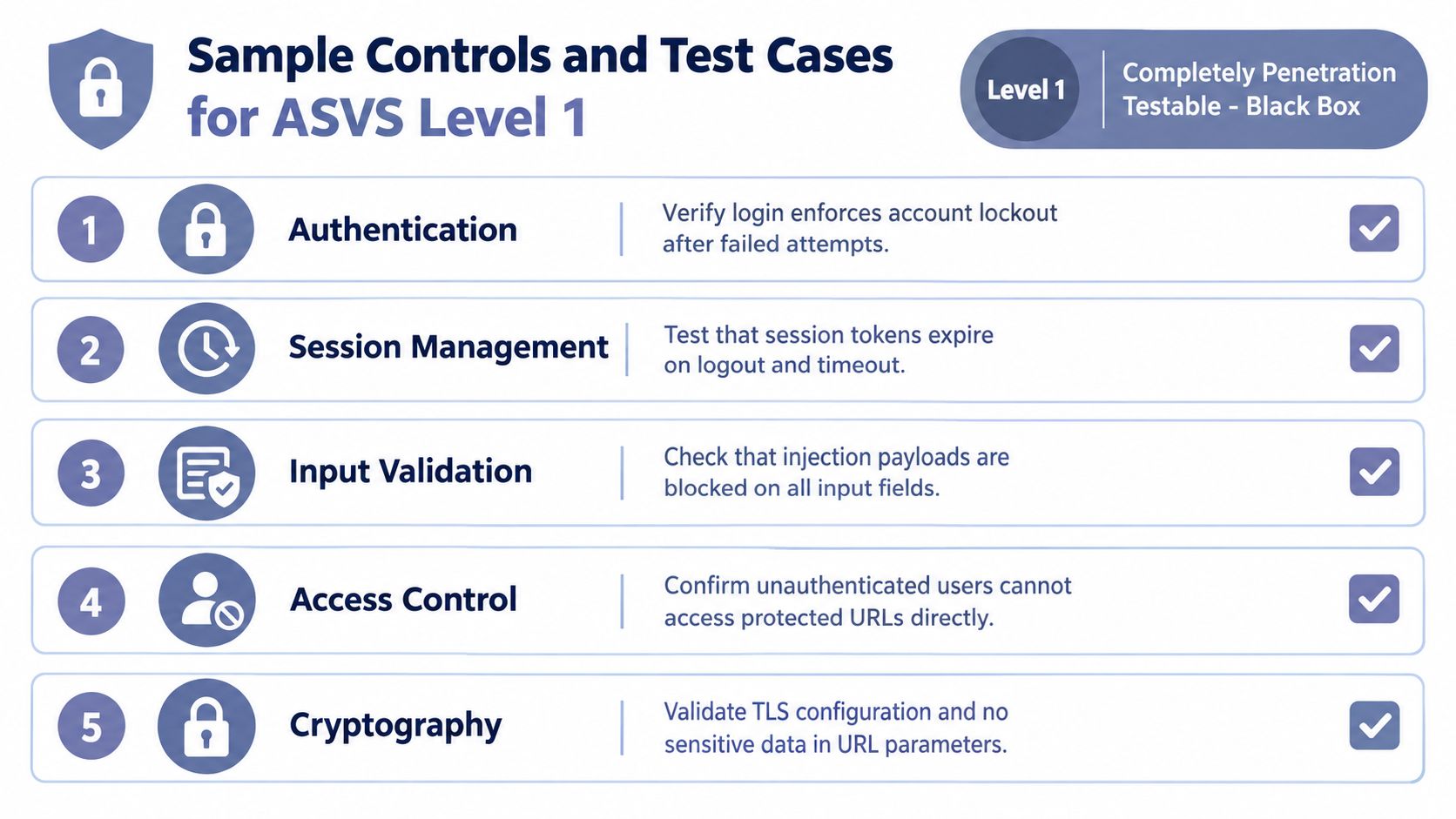
Level 1 is where many pentest teams start, and that's appropriate because it's the only level ASVS explicitly frames as fully testable from the outside. If you're running a classic web application engagement with limited internal access, this is the level that aligns naturally with black-box and light authenticated testing.
What a Level 1 test case should look like
Every Level 1 check needs a clear pass/fail condition that a tester can demonstrate from the running application.
Default credential rejection
Try known default or weak administrative combinations on exposed login interfaces in the approved test scope. A pass means the application rejects them and no hidden service accepts them. A fail means any interface allows access with default or predictable credentials.TLS enforcement on reachable endpoints
Request application pages and API routes over insecure transport where permitted in the test plan. A pass means the application consistently forces secure transport and doesn't leak sensitive workflow steps over plaintext paths. A fail means a usable function remains exposed without proper transport protection.Cookie attribute verification
Inspect session cookies after authentication and after privilege changes. A pass means cookies expected to protect authenticated state carry secure flags appropriate to the browser context, including Secure, HttpOnly, and where applicable SameSite. A fail means missing attributes allow easier theft, misuse, or cross-site abuse.
Runtime flaws you can validate quickly
A Level 1 sweep should also exercise the obvious input and authorization pathways.
- Reflective input handling by probing search fields, error parameters, and user-facing forms for reflected script execution or unsafe rendering.
- Direct access control checks by requesting protected URLs before login, after logout, and with lower-privilege accounts.
- Session invalidation behavior by logging out, timing out, and replaying prior tokens where safely permitted.
Field note: If a test case can't produce a screenshot, capture, or replayable request from the outside, it probably doesn't belong in your Level 1 evidence set.
Sequencing a small SaaS Level 1 pass
For a modest SaaS application, I'd usually sequence Level 1 work like this:
| Phase | Focus | Typical output |
|---|---|---|
| Discovery | Crawl pages, identify auth paths, enumerate API routes | Surface map |
| Unauthenticated checks | Access control probes, header review, TLS behavior | Baseline captures |
| Authenticated checks | Session handling, input validation, role changes | Request and response evidence |
| Manual confirmation | Reproduce candidate flaws cleanly | Verified findings |
That workflow is compact enough for a short engagement window, but still disciplined enough to generate evidence an auditor can follow.
Mapping ASVS to HIPAA, SOC 2, PCI-DSS, ISO 27001, and GDPR
One reason ASVS works so well in penetration testing is that application controls rarely belong to only one compliance framework. Authentication, session security, access control, secure transport, and logging all show up again and again under different names. A well-structured ASVS-aligned pentest gives compliance teams one technical evidence stream they can reuse in several audit narratives.
That doesn't mean ASVS replaces those frameworks. It means it gives you a practical application-security control layer that can be mapped into them.
ASVS to Compliance Framework Crosswalk
| ASVS Requirement | HIPAA | SOC 2 | PCI-DSS 4.0 | ISO 27001 Annex A | GDPR Art. 32 |
|---|---|---|---|---|---|
| V2 Authentication | Supports user identity verification and access safeguards | Supports logical access criteria | Supports user authentication requirements | Supports identity and access management controls | Supports appropriate technical measures for access security |
| V3 Session Management | Supports session protection for systems handling regulated data | Supports secure session handling under common control expectations | Supports secure session and authenticated access behavior | Supports secure operation of applications | Supports confidentiality and resilience of processing |
| V4 Access Control | Supports least-privilege and role-based restrictions | Supports access provisioning and restriction expectations | Supports restriction of access to cardholder data functions | Supports access restriction and segregation principles | Supports limiting unauthorized disclosure |
| V5 Validation and Encoding | Supports integrity and safe handling of application input | Supports system protection against exploitable input paths | Supports secure coding expectations around injection defenses | Supports secure development and application control practices | Supports measures that reduce compromise risk |
| V9 Communications | Supports transmission security | Supports secure transmission handling | Supports encrypted transmission expectations | Supports network and communications security | Supports encryption and confidentiality measures |
| V14 Configuration | Supports secure system setup and maintenance | Supports change and hardening expectations | Supports secure configuration obligations | Supports secure configuration management | Supports ongoing integrity and resilience of systems |
Where the mapping helps and where it doesn't
For pentest delivery, this crosswalk is useful because it keeps the technical finding anchored to a recognizable application requirement before it gets translated into framework language. That's more defensible than writing a broad compliance statement with no test trace behind it.
A compliance lead also needs the surrounding narrative. PCI-DSS still cares about cardholder data environment boundaries. GDPR still expects lawful processing and governance context that application testing alone won't prove. ISO 27001 still expects risk treatment linkage and control ownership. If you need a practical view of that broader governance layer, Vigil Security on risk en compliance is a useful reference.
How to build the actual matrix
The cleanest method is to create a single matrix where each ASVS-tested control points to the frameworks the client cares about, the evidence artifact collected, and the remediation owner. If your team is still building that structure manually, a compliance matrix reference is a good model for how to lay it out.
The key is discipline. Don't say a finding “covers HIPAA and SOC 2.” Show which ASVS requirement was tested, what evidence proves the result, and which framework clauses that requirement supports.
Designing Test Cases That Produce Auditor-Ready Evidence
A pentest finding becomes audit-grade evidence when the tester can show exactly what was tested, under what conditions, with what artifact trail, and why the result maps to a requirement. That's the difference between “scanner says pass” and a defensible verification record.
The easiest way to structure that is to treat each ASVS requirement as a four-part test case.
Anatomy of an ASVS-Aligned Test Case
| Component | Purpose | Example Artifact |
|---|---|---|
| Requirement ID | Anchors the test to the ASVS control | Requirement reference in the workpaper |
| Precondition | States what must exist before testing | Test account, role, endpoint, feature flag |
| Execution steps | Shows how the tester performed verification | Manual requests, payload list, tool workflow |
| Evidence artifact | Proves the result and supports the verdict | Screenshot, request/response capture, config excerpt |
What good evidence includes
Take a password-policy verification under an authentication requirement. A weak result is a note that “password controls were reviewed.” A strong result includes the account creation attempt, the weak password submission, the application response, and any observed policy text or administrative configuration that explains the behavior.
For input validation, the same principle applies. If you're checking unsafe handling in a search field or JSON parameter, your evidence should include the payload, the route, the response behavior, and your reasoning for classifying the result as pass, fail, or inconclusive. For cryptographic storage or communication confidentiality checks, include what was observed, how it was observed, and why that observation satisfies or misses the requirement.
Auditor-ready evidence shows the tester's reasoning, not just the tester's conclusion.
Make the evidence reusable
Strong teams build artifacts once and reuse them in engineering, audit, and risk workflows. That means including:
- Method clarity so another tester can replay the validation
- Verdict rationale so compliance teams understand the conclusion
- Remediation linkage so developers know what to change
- Framework mapping so the control can be reused outside the pentest report
If your reporting process is still fragmented, a guide to compliance documentation is a practical template for how to package evidence so it survives external review.
Validating ASVS Controls With Automated Pentesting Platforms
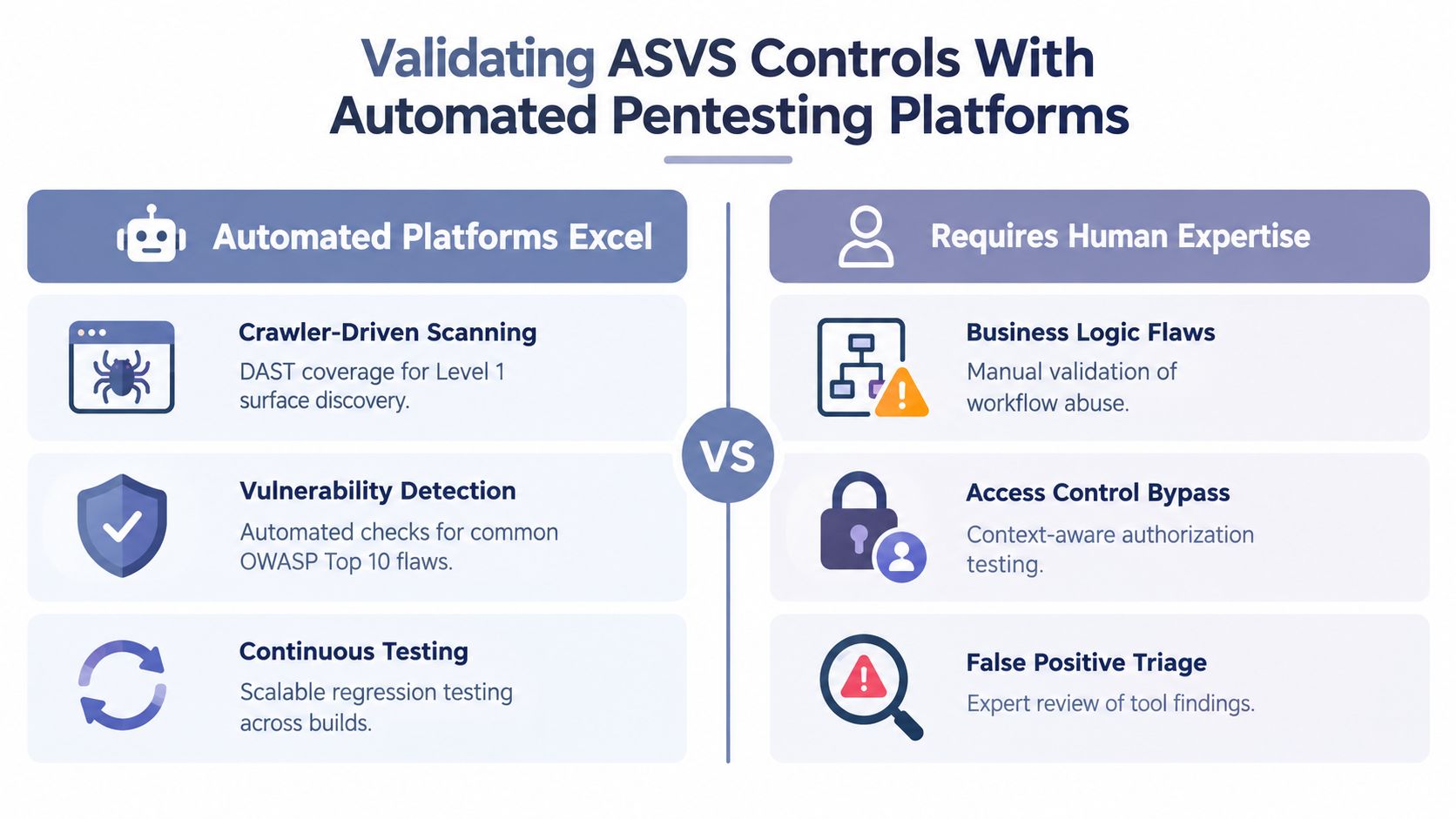
Automated pentesting platforms are useful for ASVS work, but only when the team is honest about what they can prove and what they can only suggest. In a penetration testing program, automation is strongest when it handles repeatable runtime verification, evidence capture, and reporting consistency. It gets weak when the requirement depends on architecture intent, code behavior that isn't externally observable, or business logic that needs context.
Where automation does real work
For Level 1, automated platforms can usually do meaningful validation around:
- Surface discovery through crawling, endpoint enumeration, and authenticated route mapping
- Common input flaws such as reflected injection paths, weak headers, and misconfigurations
- Session and transport checks including cookie inspection, redirect handling, and secure channel verification
- API behavior where repeatable request schemas and access checks can be exercised consistently
That makes platforms useful as the operating layer between scanning and evidence collection. A system like Burp Suite Enterprise can automate broad DAST coverage. Nuclei can probe configuration patterns. A platform such as ThreatExploit AI can orchestrate automated penetration testing across web targets and produce evidence-backed findings with compliance mappings, which is especially relevant when ASVS results need to be reported alongside broader framework references.
A more detailed overview of that operating model is covered in this automated penetration testing resource.
Here's a concise visual summary before going deeper.
Where the platform stops and the human starts
Automation can flag likely access control issues. It usually can't determine whether a cross-tenant data flow is a legitimate delegated workflow or a broken authorization model without business context. It can observe odd transaction sequences. It usually can't conclude whether a core business rule has been subverted unless a tester understands the process the client intended.
That gap widens fast above Level 1. Level 2 and Level 3 bring in source review, design validation, threat modeling, and architecture assumptions. Those aren't scanner problems. They're assessor problems.
The strongest delivery model is hybrid. Let the platform do discovery, repetition, capture, and consistency. Let the human tester decide what the evidence means.
Running an ASVS-Aligned Engagement From Scoping to Report
An ASVS-aligned engagement runs better when the workflow is explicit from the start. If you leave the requirement mapping until the report stage, the team ends up retrofitting evidence to controls, which is exactly where quality drops.
Scope the engagement around verification level
Start with four scoping decisions:
- Target ASVS level based on risk and expected assurance.
- Application boundary including domains, APIs, admin panels, and third-party exclusions.
- Authentication approach such as test accounts, SSO staging access, or external-only coverage.
- Known exclusions like payment processors, unmanaged mobile clients, or out-of-scope tenant paths.
Those answers define more than logistics. They define what claims the final report can support.
Configure evidence before testing starts
Before the first request is sent, load the requirement set you intend to assess and decide how evidence will be tagged. Mature teams map each requirement to:
- the test method,
- the expected artifact,
- the potential compliance references,
- and the reviewer who will sign off on manual verification.
That pre-work keeps the platform output clean and keeps manual testing from becoming a pile of screenshots with no control trace.
Execute in layers and report in one deliverable
A practical ASVS engagement often runs in four passes:
| Phase | Activity | Output |
|---|---|---|
| Preparation | Requirement selection, account setup, exclusions review | Approved scope matrix |
| Automated execution | Crawl, fingerprint, baseline checks, candidate finding generation | Initial evidence set |
| Manual verification | Reproduce, exploit where appropriate, review logic and authorization paths | Confirmed findings |
| Reporting | Map findings to ASVS IDs and framework references | Unified report package |
The final deliverable should serve three audiences at once. Engineering needs technical details and remediation guidance. Security leadership needs a concise risk view. Compliance needs requirement traceability and evidence references. When the report is designed that way from the start, one engagement supports all three instead of forcing three separate reporting exercises.
Choosing Between ASVS Level 2 and Level 3 for Clients
The hardest advisory call in many appsec engagements is not whether the client needs ASVS. It's whether they need Level 2 or Level 3.
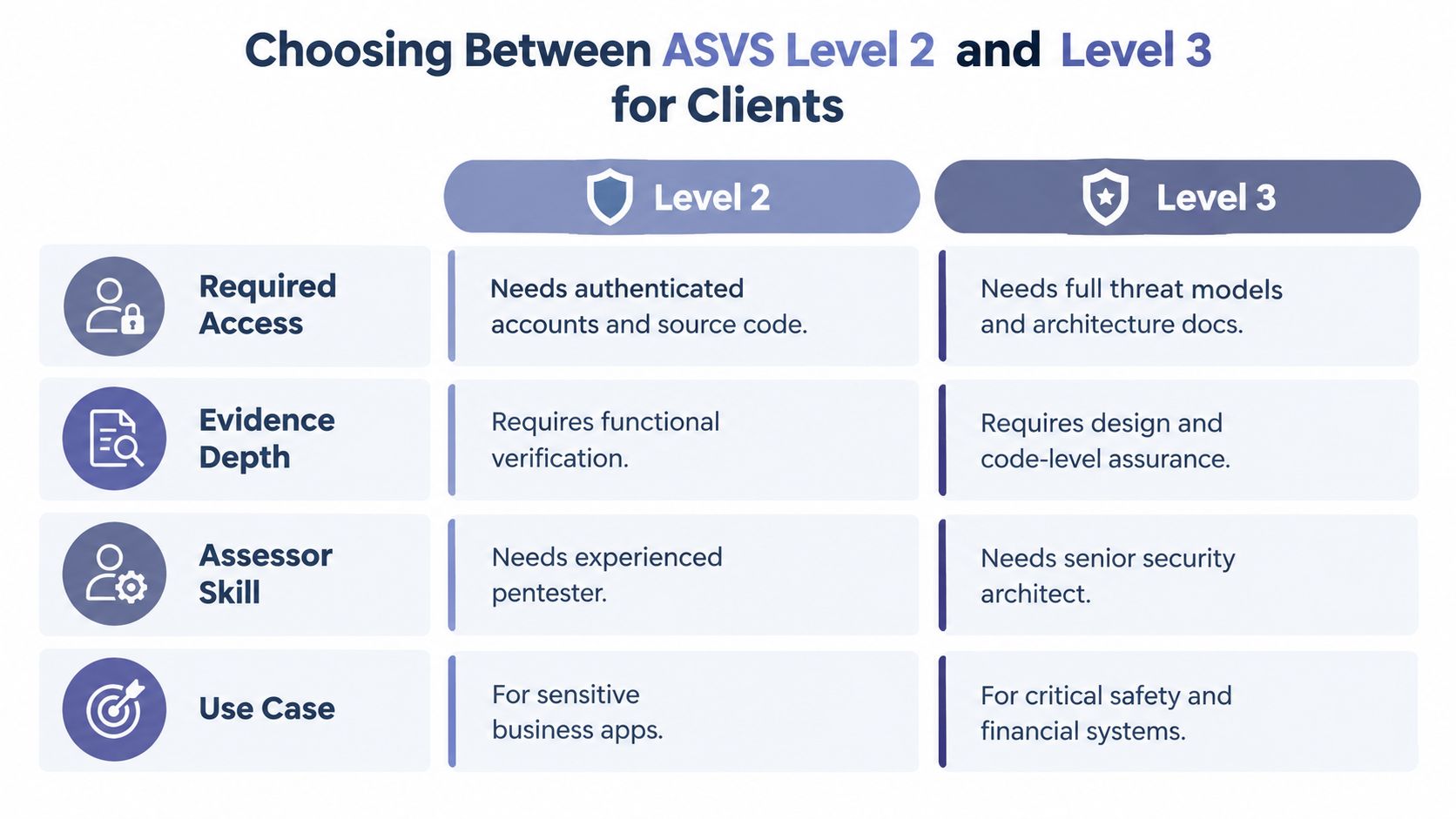
Level 2 is the practical default for many production applications that handle sensitive business data. It expects more than runtime probing. You'll usually need authenticated roles, configuration insight, and at least some internal design context. A serious SaaS pentest starts to look like an application assessment rather than just a vulnerability hunt.
The practical split
| Dimension | Level 2 | Level 3 |
|---|---|---|
| Access required | Authenticated accounts and internal review material | Broader documentation, threat models, deeper internal access |
| Evidence depth | Functional and implementation verification | Design and high-assurance verification |
| Assessor profile | Senior pentester or appsec consultant | Senior tester plus architecture-level judgment |
| Typical fit | Regulated SaaS and enterprise business apps | Critical finance, healthcare, identity, or safety-sensitive systems |
What usually makes the decision for you
If the client can provide role-based accounts, architecture notes, and development contacts but not a full design review package, Level 2 is often the right target. If the application sits at the center of money movement, regulated health workflows, or critical trust decisions, Level 3 becomes much easier to justify because design flaws matter as much as exploitable runtime bugs.
The mistake is selling Level 3 as “more testing.” It's more assurance work. That means review sessions, developer interviews, and design scrutiny. If those inputs aren't available, don't label the engagement Level 3.
Quick Reference for ASVS Levels and Chapters
This is the operational lookup I'd keep near the engagement workspace. It answers two questions fast. Which level fits the assessment? Which chapter covers the control family I need to test?
ASVS Levels and Chapters Quick Reference
| ASVS Level | Pass Criteria | Chapter | Topic | Example Control |
|---|---|---|---|---|
| Level 1 | Minimum baseline verified through externally testable controls | V1 | Architecture, Design and Threat Modeling | Review trust boundaries and exposed design assumptions where observable |
| Level 2 | Includes Level 1 plus stronger internal verification for most applications | V2 | Authentication | Verify login, credential handling, and identity protections |
| Level 3 | Includes Levels 1 and 2 plus high-assurance requirements | V3 | Session Management | Verify secure session lifecycle and invalidation |
| Level 4 | Older internal-verification concept for critical systems | V4 | Access Control | Verify role enforcement and object authorization |
| Level 1 through 4 | Levels stack cumulatively, not as replacements | V5 | Validation, Sanitization and Encoding | Test for unsafe input and output handling |
| V6 | Stored Cryptography | Check how secrets and sensitive values are protected | ||
| V7 | Error Handling and Logging | Review error leakage and security event records | ||
| V8 | Data Protection | Check exposure of regulated or sensitive data | ||
| V9 | Communications | Verify transport protection and secure channel use | ||
| V10 | Malicious Code | Check for unsafe file or active content handling | ||
| V11 | Business Logic | Test workflow abuse and transaction manipulation | ||
| V12 | Files and Resources | Verify safe file access and resource controls | ||
| V13 | API and Web Service | Test API-specific validation and authorization behavior | ||
| V14 | Configuration | Check hardening, defaults, and exposed management functions |
How to use this in practice
Print this view or drop it into the engagement notes. During scoping, start with the left side. During execution, live in the right side.
If a tester says, “I found a session issue,” the report should know that belongs under V3. If the client asks whether a higher target level includes baseline controls, the answer is yes because ASVS levels stack cumulatively.
Common ASVS Mistakes and How to Avoid Them
The most common failure is treating ASVS like a compliance checklist instead of a verification standard. Teams mark requirement rows green without proving the design assumptions behind them. The fix is simple. Require evidence and tester rationale for every attested control, not just a status value.
The second mistake is skipping V1 work. Pentesters jump straight into runtime checks, but architecture and trust-boundary problems can invalidate the comfort of a clean DAST run. Put design review questions into kickoff and insist on at least a minimal architecture walkthrough for any Level 2 or above engagement.
A third problem shows up in access planning. Teams underestimate what Level 2 needs, then discover midstream that they have one generic user account, no admin view, and no documentation. Solve that before day one with an access matrix sign-off that lists roles, accounts, environment assumptions, and reviewer contacts.
The fourth mistake is overclaiming automation. A platform can produce strong candidate evidence, but Levels 2 and 3 still need manual judgment. Separate automated coverage from manual attestation in the final report so the client can see what was tested by tool, what was confirmed by human review, and what remains out of scope.
The last mistake is version drift. Pin the engagement to one ASVS release at kickoff and keep tooling, reporting, and client expectations aligned to that same version.
ThreatExploit AI gives security providers a way to run automated penetration testing with evidence-backed findings and compliance mappings that fit ASVS-style reporting workflows. If you need a platform that helps connect web application test output to auditor-ready deliverables across multiple frameworks, visit ThreatExploit AI.