
Enterprises spent an average of $164,400 on manual penetration-testing assessments in 2024, equal to 12.9% of their total IT-security budget, according to the Cloud Security Alliance's summary of the Global State of Pentesting survey. That money only buys a security decision if the report proves what was tested. A long list of scanner hits does not do that.
The Penetration Testing Execution Standard is the lifecycle that makes coverage checkable. It runs from written permission through intelligence, threat choices, candidate weaknesses, confirmed access, measured impact, and a report a client can act on. Each phase leaves an artifact the next phase must use. If an early artifact is missing, the final report looks thinner than the invoice.
That matters whether a senior tester or an automated engine does the work. The same seven outputs tell you whether the engagement stayed in scope, which paths were tried, and which findings are still only guesses.
Table of Contents
- The Seven PTES Phases at a Glance
- Where PTES Came From and Why Its Structure Matters
- Setting Boundaries and Gathering Intelligence First
- Threat Modeling and Vulnerability Analysis for Choosing Targets
- Proving Real Impact Through Exploitation and Post-Exploitation
- Reporting Turns Evidence Into Decisions
- Set Bounded Autonomy Rules Before You Launch
The Seven PTES Phases at a Glance
| Phase | Question it answers | Output a client can check |
|---|---|---|
| Pre-engagement | What are we allowed to test? | Signed scope, rules of engagement, contacts |
| Intelligence gathering | What do we know about the target? | Asset inventory, domains, ranges, technologies |
| Threat modeling | Which attack paths matter most? | Prioritized attack hypotheses |
| Vulnerability analysis | Where are the weaknesses? | Candidate findings still to be tested |
| Exploitation | Can the weakness actually be used? | Confirmed access with evidence |
| Post-exploitation | What could an attacker reach next? | Business impact, privilege and data-access evidence |
| Reporting | What should the client fix first? | Executive and technical report with remediation |
The first two phases set boundaries and knowledge. Pre-engagement writes the permission. Intelligence gathering fills the inventory the permission covers. Phases three and four choose targets. Threat modeling ranks paths. Vulnerability analysis turns those paths into candidates, not confirmed bugs. Phases five and six prove impact. Exploitation shows the weakness can be used. Post-exploitation shows what that access reaches. Phase seven communicates the chain as risk and a fix order.
Each output is the input to the next phase. A vague scope produces a messy inventory. A messy inventory produces attack hypotheses you cannot defend. Unranked hypotheses produce a pile of candidates. Candidates without an exploit attempt stay theoretical. Access without a measured next step never becomes business impact. A report built on any of those gaps reads like a scan export with extra prose.
Practical rule: Open any provider's report and ask whether it shows one checkable output for every row. If a row is missing, that part of the test was not finished.
Where PTES Came From and Why Its Structure Matters
Before a shared method existed, penetration testing was a bag of techniques that changed with the person holding the keyboard. Two teams could face the same external range and walk away with different coverage, different evidence, and no shared way to say the work was done. One team might stop at open ports. Another might chain a login flaw into data access and never write down why that path was chosen.
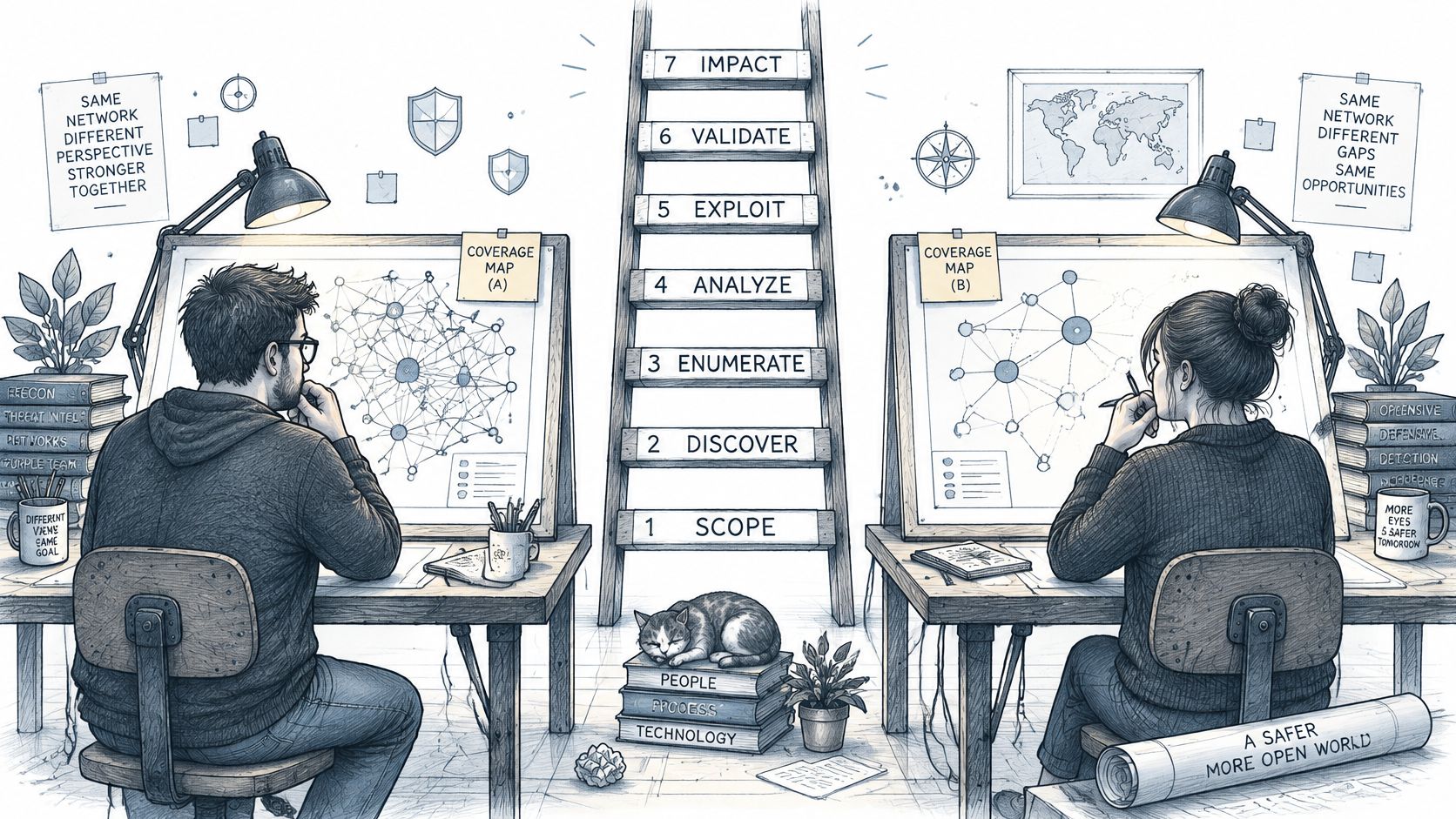
The Penetration Testing Execution Standard is a community-driven methodology that emerged around 2010, with related descriptions placing its initial development as early as 2009. It turned that informal collection of technical activities into a repeatable engagement lifecycle with a defined start, sequence, and finish. The seven phases connect authorization and scope-setting with technical testing and business-oriented communication.
Why the sequence stays useful
The model stays relevant because it applies across web applications, networks, and cloud targets without requiring a particular vendor, scanner, programming language, or market. The high-level lifecycle stays stable. Companion technical guidelines hold the procedures and tool suggestions, so methods can change without rewriting the milestones.
Think of a flight checklist. It does not make the pilot less skilled. It makes every flight traceable and complete, including the items a busy crew would otherwise skip. When a proposal cites the standard, the useful question is not whether the term appears. It is which of the seven phases the work covered, and what evidence exists for each.
Setting Boundaries and Gathering Intelligence First
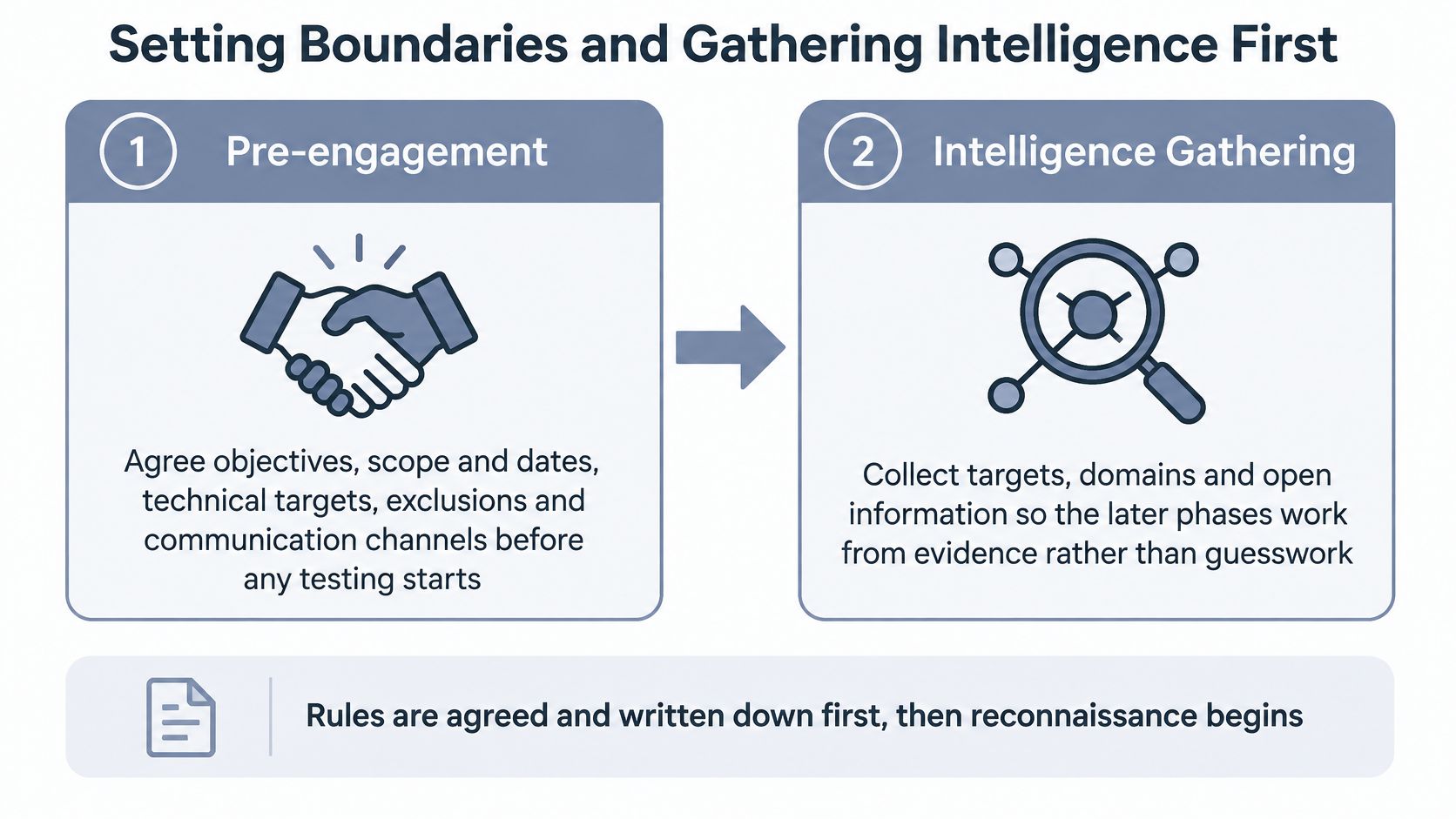
A penetration test begins with a boundary, not a scan. The PTES Technical Guidelines place pre-engagement first because authorization, scope, objectives, communication plans, and constraints determine what the later phases can safely test. Rules of engagement specify which assets are in bounds, when testing may occur, and who to contact if a service is disrupted. They can also prohibit denial-of-service testing, social engineering, credential attacks, physical testing, or destructive actions.
Scope should name targets and define the testing mode and schedule before launch. That matters for automated testing, too: discovering another hostname does not grant permission to test it.
Six steps before active testing
- Set objectives and success criteria. State whether the engagement is measuring exposure, exploitability, or a business-impact scenario. This determines what evidence later phases must produce.
- Name assets, ranges, and domains. A reviewer can compare a specific list with the test logs. “The production estate” leaves too much room for interpretation.
- Record exclusions and third-party services. A hosted login, SaaS platform, or shared infrastructure stays out of scope until its provider's testing policy and any required authorization are addressed.
- Document rules of engagement and escalation contacts. Record what is forbidden, who should be contacted, and what conditions require testing to stop.
- Gather intelligence passively. Public records, DNS, certificates, and metadata can help build an initial view without probing systems.
- Allow active enumeration only on authorized assets. Port scans, service probes, and authenticated checks should wait until the target is confirmed in scope. Attack surface mapping helps organize the assets that need to be considered.
For example, reconnaissance for an external storefront test may reveal a login hosted on a platform the customer does not own. Keep that host out of scope until the platform's testing policy is followed and any required authorization is obtained. Otherwise, the activity risks crossing a legal boundary and makes the evidence trail harder to interpret.
A useful checkable output from this phase is a scope document listing authorized targets, exclusions, permitted methods, schedule, and escalation contacts. A provider should also be able to explain which intelligence collection is passive and which actions actively touch systems.
Before testing begins, ask who has authorized it, which assets are named, what is excluded, who receives escalation calls, and which methods are passive or active. Those answers turn a boundary into something a reviewer can check against the test record.
Threat Modeling and Vulnerability Analysis for Choosing Targets
Authorization written up front still constrains what reconnaissance and exploitation may touch. Threat modeling is where that inventory becomes a short list of attack hypotheses. The PTES Technical Guidelines treat that sequence as causal. Scope limits the later work. Modeling converts collected intelligence into prioritization criteria. Vulnerability analysis then tests those hypotheses. It does not yet prove them.
One store, two very different paths
Say an online retailer has an admin login on a forgotten subdomain and an outdated plugin on that host. Customer records sit behind the admin role. An outsider with no credentials can reach the subdomain from the internet. That is one path worth testing. The same company also runs a marketing brochure site with no accounts and no sensitive data. That site can sit at the bottom of the list, or off it, even if a scanner flags an old library.
Rank paths with four questions, not a generic severity label.
- Asset value: Customer records, admin panels, build pipelines, and payment flows outrank a static page.
- Outside exposure: A host reachable without a VPN beats an internal console that needs a corporate login.
- Number of steps: A two-step path is tested before a six-step chain that depends on several guesses.
- Earlier findings: A leaked staging credential or a broken access check can move a lower path up the list.
Candidates are not confirmed bugs
Vulnerability analysis mixes automated scanning with manual checks. Look for misconfigurations, outdated components, weak authentication, injection flaws such as SQL injection and XSS, and broken access control. The output is a list of candidate findings still to be tested. A scanner line that says “possible injection” is a hypothesis. It is not a vulnerability you hand to a client.
For an automated platform, each phase should leave machine-readable artifacts: approved target lists, discovered services, modeled attack paths, and validated findings. Downstream steps then cannot leave scope unnoticed or promote an unverified hypothesis into a client-facing issue. MSSPs get repeatable workflows and a clean split between discovery and verification.
A useful report shows which assets were ranked and why, not only which hosts responded to a probe.
Proving Real Impact Through Exploitation and Post-Exploitation
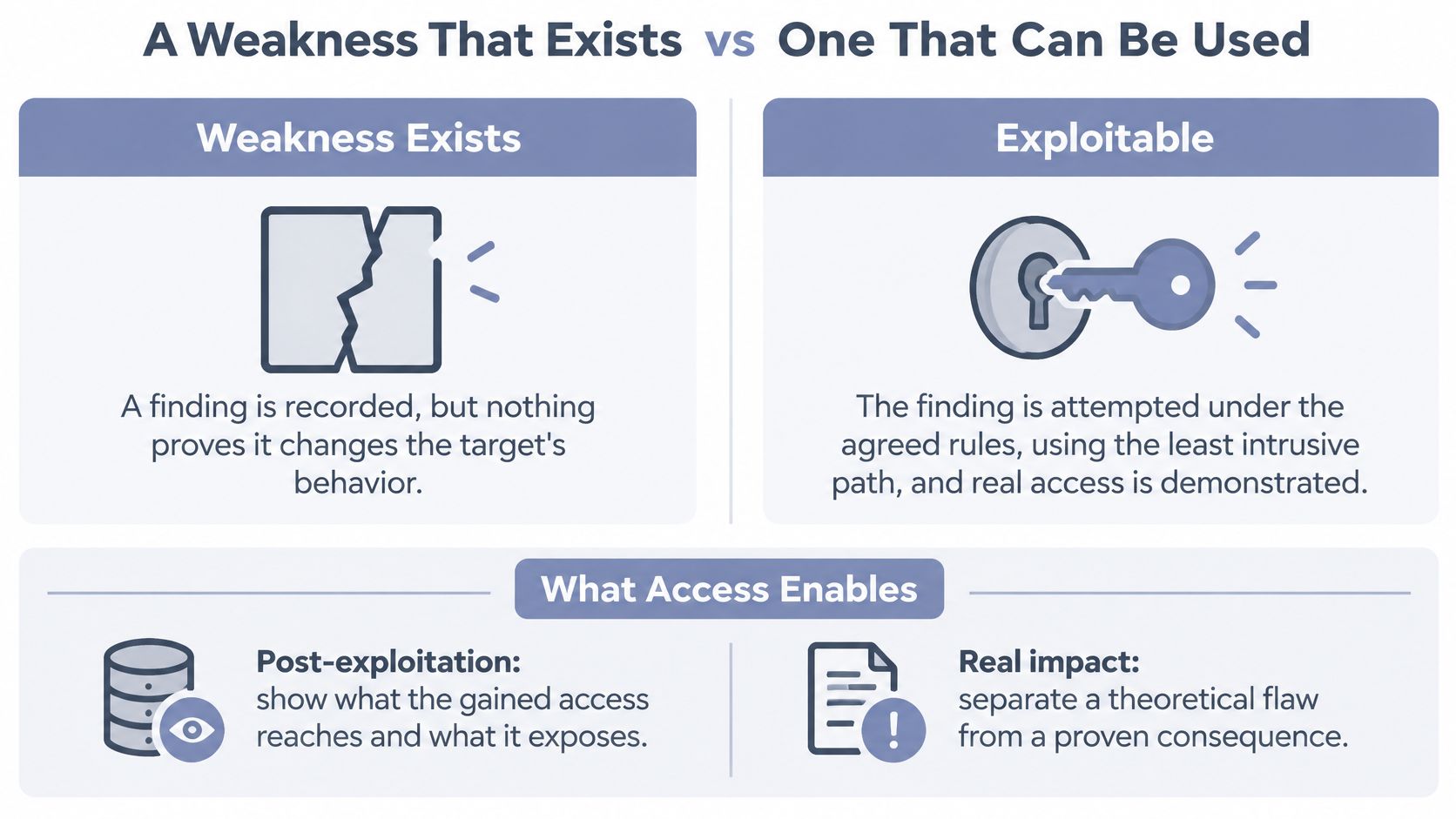
A weakness that exists and a weakness you can use are different findings. Exploitation attempts the candidates under the signed rules, using the least intrusive proof that confirms access, then stops. You are not there to damage the target. You are there to show the behavior changed.
Keep the request and response, timestamps, a masked screenshot, and the exact in-scope asset. That bundle is what a later reader uses to reproduce the result. A proof of concept exploit written this way is evidence, not a trophy.
Staging access that reaches customer data
Say a staging application accepts a weak password and grants admin. From that session a service account can read customer records in a connected store. The test reads one masked record, confirms the read, and stops. The business impact is not “admin on staging.” It is that a staging foothold reaches customer data. Post-exploitation is the measurement of that reach: privilege escalation, lateral movement between hosts or accounts, persistence, and sensitive-data access.
| Property | Verified finding | Theoretical finding |
|---|---|---|
| Status | Exploited under the rules with access confirmed | Scanner output or inference only |
| Evidence | Request, response, timestamps and masked screenshot attached | None beyond the scanner output |
| Impact | Shown by post-exploitation evidence | Not demonstrated |
| Reportable as | Confirmed vulnerability with reproduction steps | Candidate finding requiring validation |
When the test stops
Stop when the rules say so, when production is disrupted, or when the next step would exceed the agreed objectives. Reading one masked record meets a data-access objective. Dumping the table does not. Creating a persistent backdoor is out unless the rules explicitly allow persistence testing and name the cleanup.
You should now be able to mark each item in a report as exploited or only suspected. If the evidence column is empty, treat the item as a candidate and ask for validation before you schedule a fix sprint around it.
Reporting Turns Evidence Into Decisions
Reporting is an execution activity, not a document you reconstruct after the test ends. NIST SP 800-115 states that reporting occurs simultaneously with the other major testing phases, so testers record activities and evidence during planning, discovery, and attack. The final report describes identified vulnerabilities, assigns risk ratings, and provides mitigation guidance. An executive view of business risk sits beside a technical remediation view, with affected assets, scope, evidence, and the reason behind each severity.
Build the file from those notes. A memory rewrite drops timestamps, mixes in-scope and out-of-scope hosts, and invents a story for a screenshot nobody labeled.
Who reads which part
| Audience | What they need | Where it sits in the report |
|---|---|---|
| Board or executive team | Business risk and priorities | Executive summary with top risks |
| Engineering or development lead | Exact reproduction steps and fix | Technical findings with evidence |
| Compliance or auditor | Control mapping and test scope | Scope statement, mapped findings and dates |
| Security operations | Attack path timeline and indicators | Exploitation timeline and evidence log |
A useful report also separates three statements that get collapsed too often. What was tested is the scope and the methods that ran. What was found is the verified set, with candidates labeled as candidates. What could not be tested is the residual list: blocked paths, excluded third parties, and assumptions nobody could check. Calling an untested path “clean” is how a fast automated report gets mistaken for a full assessment.
Hand the executive summary to a board member and the technical section to an engineer without rewriting either. If you have to translate, the report is not finished.
How those notes become a client-ready file is covered in evidence-based report writing. Include remediation guidance and a retest recommendation so the next engagement can show which items closed.
Set Bounded Autonomy Rules Before You Launch
The standard assumes a human tester who can change tactics and still stay inside the rules. An autonomous agent does not get that judgment for free. Conventional guidance does not spell out machine-readable authorization boundaries, approval gates, stop conditions, evidence provenance, or accountability when the agent changes course.
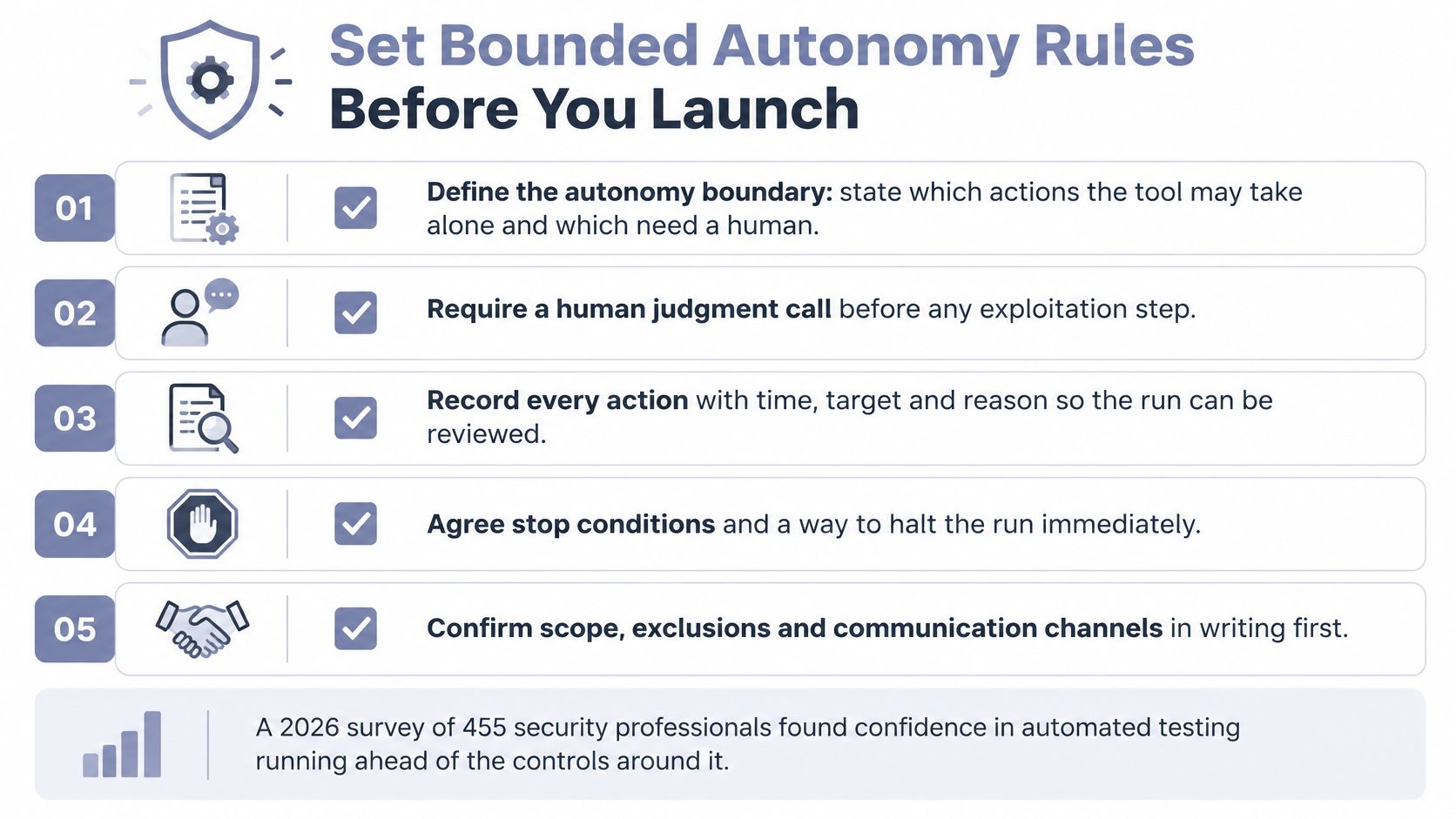
A 2026 survey of 455 security professionals found that confidence in fully automated testing fell from 29% in 2025 to 9%, while 47% preferred a hybrid human-and-automation model. The same study reported that 78% had experienced automated tools missing significant vulnerabilities. More autonomy is not the outcome to optimize. Bounded autonomy is.
What the system may do alone
Automation can cover reconnaissance, low-risk validation, evidence collection, and report drafting. High-impact exploitation, destructive actions, privilege escalation, and cross-tenant movement need explicit policy controls or a human approval. Teams watching how agents browse and act on the web can explore agentic AI traffic trends from Clearcote Labs to see why those gates belong in the rules, not in a post-incident note.
Write the controls before launch.
- Scope bound to assets and identities. Tie every action to a named target and an identity that was authorized.
- Rate limits and prohibited actions. Cap request volume, and forbid denial of service, data destruction, and anything the rules already ban.
- Human escalation triggers. Require a person before high-impact exploitation or any step that leaves the original host.
- Immutable logs and reproducible evidence. Record time, target, and reason so a reviewer can replay the run.
- A customer-visible authorization record. For each engagement, the customer must confirm and attest that they are authorized to test the specified targets and scope.
Submitting a target starts an AI engine that runs all 7 PTES phases on its own, covering reconnaissance, exploitation, and verification. That speed is only defensible if the authorization record exists first.
The coverage ledger
Keep a ledger of tested assets, identities, trust boundaries, blocked paths, and untested assumptions. The ledger is what separates “no vulnerability observed under tested conditions” from “coverage not achieved.” Autonomous systems can look strong on a single vertical step and still fail to chain across systems and accounts. Without the ledger, a short report creates false confidence.
Before you start, answer four questions. Who authorized each target? Which actions need a human? What stops the run? Where is the log that proves the run stayed in scope? If any answer is missing, do not launch.
ThreatExploit AI gives security service providers an automated penetration testing engine that follows this same seven-phase lifecycle, with evidence your clients can check instead of a raw finding list. Scope, authorization, and stop conditions stay in your hands while reconnaissance, verification, and reporting run on dedicated infrastructure. See how that works for your next engagement at ThreatExploit AI.