
The email arrives on a Tuesday. A client's security lead wants the penetration test report forwarded to their authorizing official by Friday so it can go into the authorization package. You open the PDF you delivered three weeks ago: 41 findings, severity ratings, a clean executive summary. Nowhere does it say which system sits in scope, what impact level that system carries, or which control each finding touches.
That gap is where a lot of good testing work loses its value. The test itself was fine. The evidence wasn't shaped for the decision it was supposed to support.
NIST SP 800-37 defines those decisions, and treating it as compliance paperwork misses the point. It tells you what an authorization needs, who signs it, and what happens to your evidence when the system changes the week after you deliver.
Table of Contents
- NIST SP 800-37 at a Glance and the Seven RMF Steps
- How Categorization Sets the Depth of Testing
- Roles and Artifacts Behind Each Authorization
- Turning Pentest Findings into RMF Evidence
- Continuous Monitoring Without Testing Everything
- Authorization Boundaries for Cloud and Third-Party Systems
- Pre-Engagement Checklist for MSSPs and Consultancies
- Decide Which Evidence to Automate First
NIST SP 800-37 at a Glance and the Seven RMF Steps
A client forwards last quarter's pentest the morning a cloud provider revises its inherited control set. The PDF still lists findings. It does not say whether those findings still describe the system an authorizing official is about to sign.
Which RMF step does this evidence feed? That question decides whether a report survives review. Without an answer, you have a well-written document about vulnerabilities and no path to the authorization decision.
NIST Special Publication 800-37 Revision 2 is that decision framework. It was finalized on December 20, 2018, replacing Revision 1 from February 2010, and it defines the Risk Management Framework for information systems and organizations as a system life cycle approach to security and privacy, as the NIST SP 800-37 Rev. 2 publication sets out. Public drafts in 2017 and 2018 preceded the final text. The change was structural.
NIST added a Prepare step and expanded a six-step cycle into seven. Prepare operates at both organizational and system levels. It sets risk context, priorities, roles, assets, authorization boundaries, information types, and protection needs before anyone selects a control. The other six steps kept the substance of the earlier version.
| Step | Core question | Key output |
|---|---|---|
| Prepare | What context, roles and boundaries must exist before controls are chosen? | Risk strategy, authorization boundary and role assignments |
| Categorize | How much harm would a compromise cause? | System categorization at low, moderate or high impact |
| Select | Which controls apply to this system? | Control baseline and documented tailoring decisions |
| Implement | Are the selected controls in place? | Implemented controls with documented configuration |
| Assess | Do the controls work as intended? | Security assessment report with findings tied to control IDs |
| Authorize | Is the remaining risk acceptable? | Authorization decision with residual risk summary |
| Monitor | Are controls still effective after change? | Updated risk view and ongoing monitoring reports |
A pentest report goes stale in two rows of that table. Monitor asks whether controls still work after change, and a finding tied to one engagement date does not answer that by itself. Third-party inheritance fails the same way. A provider package can cover part of the boundary on Monday and drift by Friday, while the report still describes the old inheritance.
Keep the table in view while you scope. Each row names the artifact the client should already hold or has to build with you. I would treat a pentest report as an Assess artifact first and a security product second. State which control failed, for which system, at which impact level, and record the condition that would retire the finding: a control change, a boundary change, or an inherited control the provider no longer asserts. Federal programs inherit this lineage directly, and how FISMA and NIST interact is the background to read before a scoping call with a customer who assumes their cloud provider's package covers them. Mapping findings is easier with the catalog open on a second screen. NIST 800-53 control mapping is the reference most assessors keep there.
Between engagements, tie each finding to the step it supports and to the change that would make it outdated. That keeps the authorization package current without treating one test as coverage for Monitor for the rest of the year.
How Categorization Sets the Depth of Testing
Categorization is the first decision that changes a scope, and it's usually made before you're in the room. Three ratings, three different engagements.
| Impact level | Typical potential harm | Control baseline | Testing depth implication |
|---|---|---|---|
| Low | Limited adverse effect on operations or individuals | Low baseline | Scoped external checks and targeted validation |
| Moderate | Serious adverse effect on operations, assets or individuals | Moderate baseline | Authenticated testing, exploitation of key paths and access control checks |
| High | Severe or catastrophic adverse effect | High baseline | Full scope including chained attacks, business logic and retesting after fixes |
NIST ties the rating to the potential impact of a compromise on organizational operations, assets and individuals, then states that the rating drives both the initial control baseline and the rigor of the assessment, per the SP 800-37 Rev. 2 publication. That's the mechanism you're working with. The impact level sets the baseline, and the baseline sets how much verification the assessor needs to see.
The same code base gets different treatment at different ratings. A marketing site running on the same web application, categorized low, can be covered by unauthenticated checks, a pass over exposed admin paths and a TLS review. The payment flow inside that application, categorized moderate, needs authenticated accounts at two privilege levels, object-level authorization checks against other users' records, exploitation of checkout and stored payment method paths, and a copy of the logs your test generated.
Say a client asks you to test one application twice under two categorizations. The first engagement closes with scoped external validation. The second needs evidence that a real user, with real credentials, could reach another customer's data, plus proof the control now stops it after the fix. Same target, same tools, roughly double the work, and the second report is the one an authorizing official can act on.
Ask before you scope: what would a compromise of this system actually cost the organization, in operations, money and harm to individuals?
If nobody on the call can answer that, categorization isn't finished and your scope is a guess. Asset inventories usually lag reality, and which systems and suppliers matter most is a reasonable primer for the client who has categorized nothing yet.
Roles and Artifacts Behind Each Authorization
An authorization isn't a document. It's a decision by a named person, supported by records that other named people maintain. A test touches several of those records, and knowing which one you're feeding changes how you write.
| Role or artifact | Owner | When it appears | What a pentest contributes |
|---|---|---|---|
| Authorizing official | Accepts residual risk | Authorize | Summary of verified risk and business impact |
| System owner | Operates the system and owns its controls | Prepare through Monitor | Remediation status and owner assignments |
| Information system security officer | Maintains security documentation | Implement and Monitor | Evidence logs and configuration records |
| Security control assessor | Runs the independent assessment | Assess | Test plan, procedures and results |
| System security plan | Documents how each control is met | Select and Implement | Control statements supported by test evidence |
| Security assessment report | Records assessment outcomes | Assess | Findings tied to specific control IDs |
| Plan of action and milestones | Tracks weaknesses, owners and dates | Assess through Monitor | Finding IDs, severity and retest status |
| Authorization decision | Grants or denies authorization | Authorize | Residual risk summary for the decision |
One finding, three records
Take a finding where an authenticated user can pull another tenant's invoice PDF by changing an identifier in the request. In the security assessment report it appears as a failed access control check, tied to the access control family and the specific requirement the system was supposed to meet. In the plan of action and milestones it becomes a tracked item with an owner, a date and a severity. In the authorization decision it becomes part of the residual risk the authorizing official accepts, or the reason they decline.
What closes it isn't a developer's note saying the fix shipped. It's a retest showing the request now returns an authorization error, with the request pair attached to the same finding ID.
Keep the independence question in view as well. The assessor is meant to be separate from the team that built and configured the system, so a test run by the same engineers who hardened it weakens the finding even when the result is accurate. That's a documentation problem you can avoid by naming the roles at kickoff.
Practical rule: before the engagement starts, confirm who receives the report and which artifact each finding feeds. A report with no named recipient goes into a folder.
The system owner signs for remediation they own. The security officer keeps evidence current between assessments. The authorizing official needs a summary they can read in five minutes. Write the same finding three ways and none of them end up arguing about format during an audit.
Turning Pentest Findings into RMF Evidence
A finding from last quarter is still in the authorization package. The control it was mapped to is now partly inherited from a cloud identity service, and the request pair has no date. The authorizing official is reading a result that no longer describes the system in front of them.
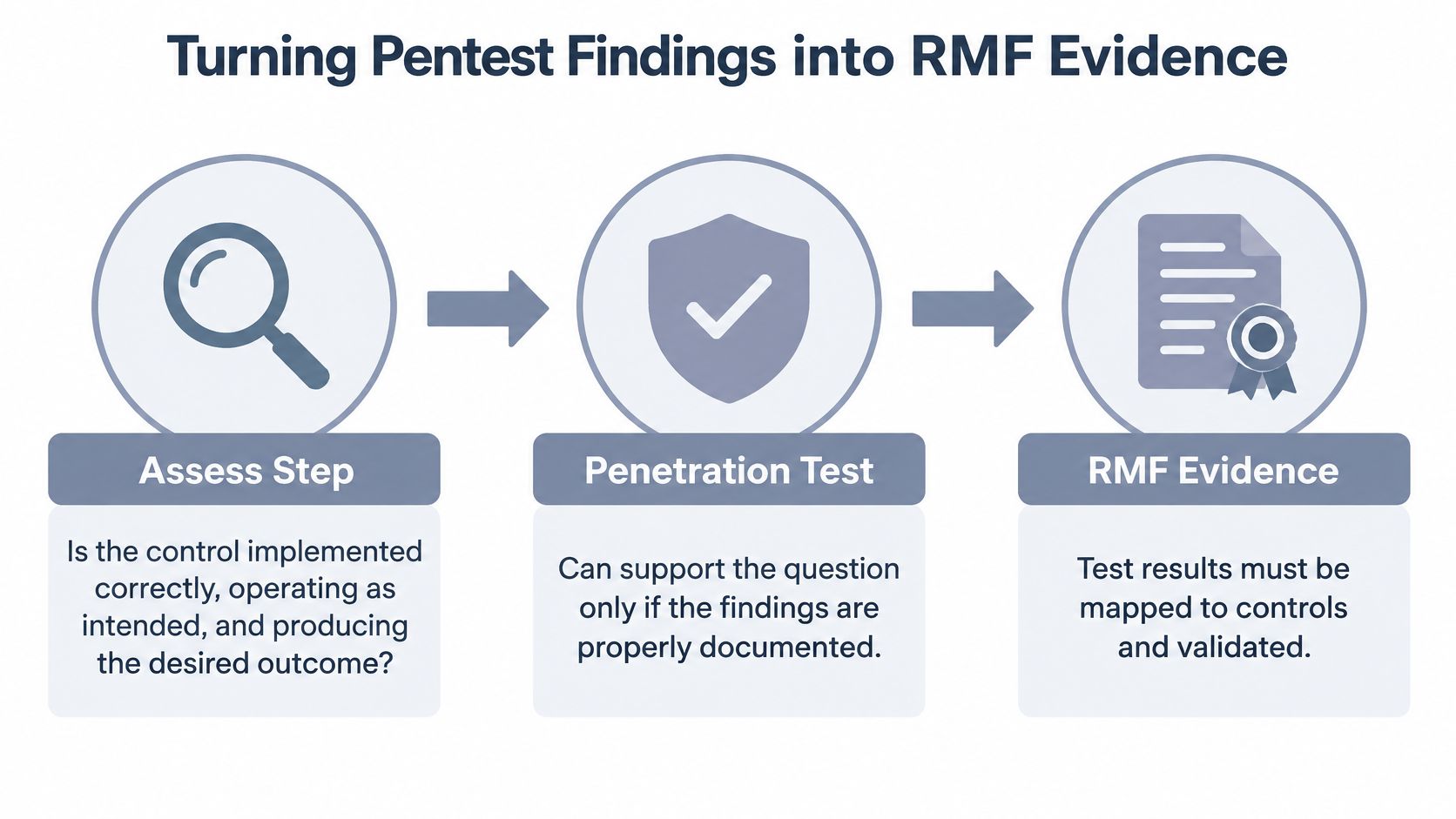
The Assess step asks one question of every control: is it implemented correctly, operating as intended, and producing the desired outcome against the system's stated requirements, as NIST's assessment guidance frames it. A penetration test can answer that question only when the report documents scope, procedures, test conditions, affected controls, observed results, and the evidence behind them. Those fields are also what go stale. An inherited control can change without a new exploit, and an undated screenshot still looks current.
NIST treats developmental testing and evaluation as a separate assessment activity during development and integration, citing design and code reviews, application scanning, and regression testing. It describes an objective third-party review as independent verification that requirements were correctly defined and implemented, according to the NIST SP 800-37 Rev. 2 draft text. Scanning finds candidates. Controlled exploitation, then a later check against the same requirement, shows whether the weakness is real and still relevant.
| Test activity | Control family | Evidence to keep |
|---|---|---|
| Authentication and session testing | IA (Identification and Authentication) | Login attempts, session token behavior and lockout results |
| Access control and object-level authorization checks | AC (Access Control) | Request pairs showing unauthorized access |
| Input validation and injection testing | SI (System and Information Integrity) | Payload, response and reproduction steps |
| Configuration and hardening review | CM (Configuration Management) | Configuration excerpts and version details |
| TLS and network exposure checks | SC (System and Communications Protection) | Cipher output and port scan results |
| Vulnerability scanning with verification | RA (Risk Assessment) | Scanner output with manually verified status |
| Test planning and reporting | CA (Assessment, Authorization and Monitoring) | Rules of engagement, test plan and assessment report entry |
A workflow that survives review
- Scope to the authorization boundary, not the IP list. Start from the systems named in the plan, and mark which controls the system implements itself versus which it inherits from a provider. A report that tests outside the boundary, or skips an inherited path that the boundary still relies on, will not hold up.
- Map each test objective to a control ID before testing begins. Doing it afterwards turns into guesswork, and guessed mappings are the ones assessors reject.
- Record conditions. Note accounts and roles used, timing, test data, and whether the target was production or a rebuild. Without those details, a reviewer cannot tell whether the result reflects how the system runs now.
- Capture evidence while you test, and date it. Store request and response pairs, timestamped screenshots, and target log excerpts as you go. Reconstructed evidence is obvious, and an undated capture cannot show whether it still matches the inherited configuration.
- Verify exploitability, then retest after each fix and after a material inheritance change. The second run is what converts a finding into closure. Providers often skip it to protect margin, and that is also how a closed item reopens when a supplier changes a control.
- Carry each verified result into the security assessment report and the plan of action and milestones. Use the same finding ID in both places, with the evidence date and a note on what was tested versus inherited. Otherwise the two records drift, and the weakness stays open in one of them.
The common slip is a finding that is real and severe but unattached to a control ID and missing a reproducible sequence. An assessor cannot treat it as evidence of a failed control, so it lands as an observation and drops out of the package. What a deliverable needs to contain is already in the table above: the test activity, the control family, and the evidence to keep. A provider sales page, including this compliance-driven security testing guidance from Accelerate IT Services Inc., describes a testing offer. It does not replace those rows.
The test of a good finding is blunt. Could a second assessor reproduce it from the report alone, on a rebuilt environment, without asking you a question, and tell whether the evidence is still current?
Continuous Monitoring Without Testing Everything
Continuous monitoring is not a scanner running on a schedule. NIST links monitoring to ongoing assessment and ongoing authorization, notes that near-real-time risk management can't be fully achieved without automated support tools, and still makes clear that automation itself isn't mandatory, as the NIST RMF Monitor step FAQs explain. The obligation is defensible awareness of material risk, not nightly coverage of every endpoint.
Continuous means the evidence stays current. It doesn't mean the testing never stops.
NIST's draft work on testable controls and security capabilities for continuous monitoring points the same direction, toward measurable, machine-consumable control evidence instead of narrative assessment text. That shift changes what a provider sells. A report is a snapshot. A maintained evidence stream is the product.
The events that should trigger a retest
- A release that changes an API or authentication flow. Retest the session handling and object-level authorization paths you validated last time, and tell the system owner and the officer maintaining the documentation.
- A cloud configuration or identity policy change. Re-verify access paths and logging, because a policy edit can widen who reaches what.
- A new third-party integration or supplier. Extend scope to the new interface and record who supplied evidence for the controls on their side.
- A newly published vulnerability in a component inside the boundary. Confirm exploitability against your version before it enters the plan of action and milestones.
- An incident. Reassess the controls the incident touched, then update the authorization package rather than waiting for the annual cycle.
Cadence follows from those triggers. Evidence refreshes continuously where automation exists, targeted retests follow each material change, and a full engagement runs on the schedule the authorization package sets. A quarterly test can be strong evidence and still go stale within weeks of a cloud migration.
Decide what counts as material change before the next engagement starts, write it into the rules of engagement, and both sides stop negotiating scope after an outage. Providers selling recurring assessments rather than one-time reports build continuous penetration testing into the retainer for exactly this reason.
Authorization Boundaries for Cloud and Third-Party Systems
A customer inherits the provider's physical and hypervisor controls, then changes an identity policy on a Tuesday afternoon. The inherited half of the report stays valid only while the provider's evidence is still current. The customer half goes stale the moment that policy, an API permission, or a data flow changes, and nobody records a new authorization decision.
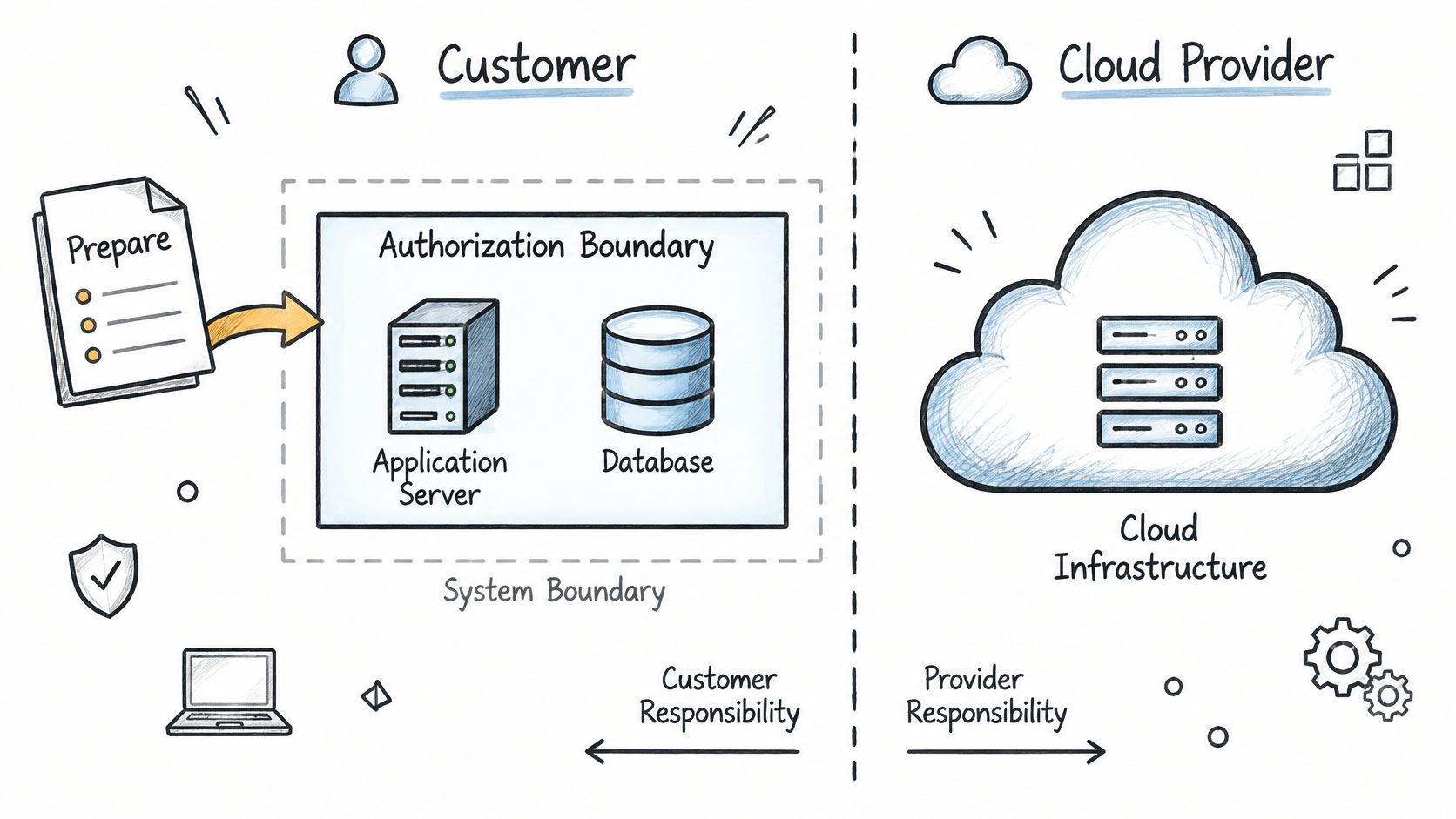
Revision 2 separates the authorization boundary from the older, interchangeable use of system boundary and adds a dedicated Authorization Boundary task inside Prepare, as the NIST SP 800-37 Rev. 2 text documents. That same RMF material expects ongoing assessments and reviews of external suppliers rather than a one-time questionnaire, and it ties the expectation to supply chain risk management and supplier assessment controls.
Two positions on inheritance
The provider's position is defensible. A large cloud provider's compliance package supports inherited controls, and a customer can rely on it for those controls instead of testing them again.
The customer's position is the one I would defend in an assessment. That package does not authorize the customer's system. It supports inherited controls only. The customer still has to assess its own configuration, interfaces, data flows, and residual risk. Teams that treat a provider's report as blanket coverage often find, during assessment, that nobody tested the customer-configured half of the same control. Between engagements, keep a date on every inherited artifact. When the date is older than the last material change on the customer side, the finding is no longer evidence. It is a claim waiting to be rechecked.
Split shared responsibility into five pieces before you test: provider inheritance, customer-configured controls, compensating controls, evidence freshness, and tenant isolation. Each piece gets an owner and a date. Tenant isolation deserves its own test objective in multi-tenant environments, because a provider's certification never covers your application's data separation.
When a provider cannot supply testable evidence for a logging control, the sequence is short. Document the gap with the control ID. Propose a compensating control the customer can operate and verify. Record the residual risk for the authorizing official rather than absorbing it in the report. Schedule the next check of that compensating control for the date the evidence expires, not for the next annual package.
Put three questions to every third party before you scope anything: what evidence can you supply, how recent is it, and who tested it?
Pre-Engagement Checklist for MSSPs and Consultancies
Teams that deliver these reports at volume lose engagements on the same handful of details. The fix is a checklist that runs before every scope call, not a longer statement of work.
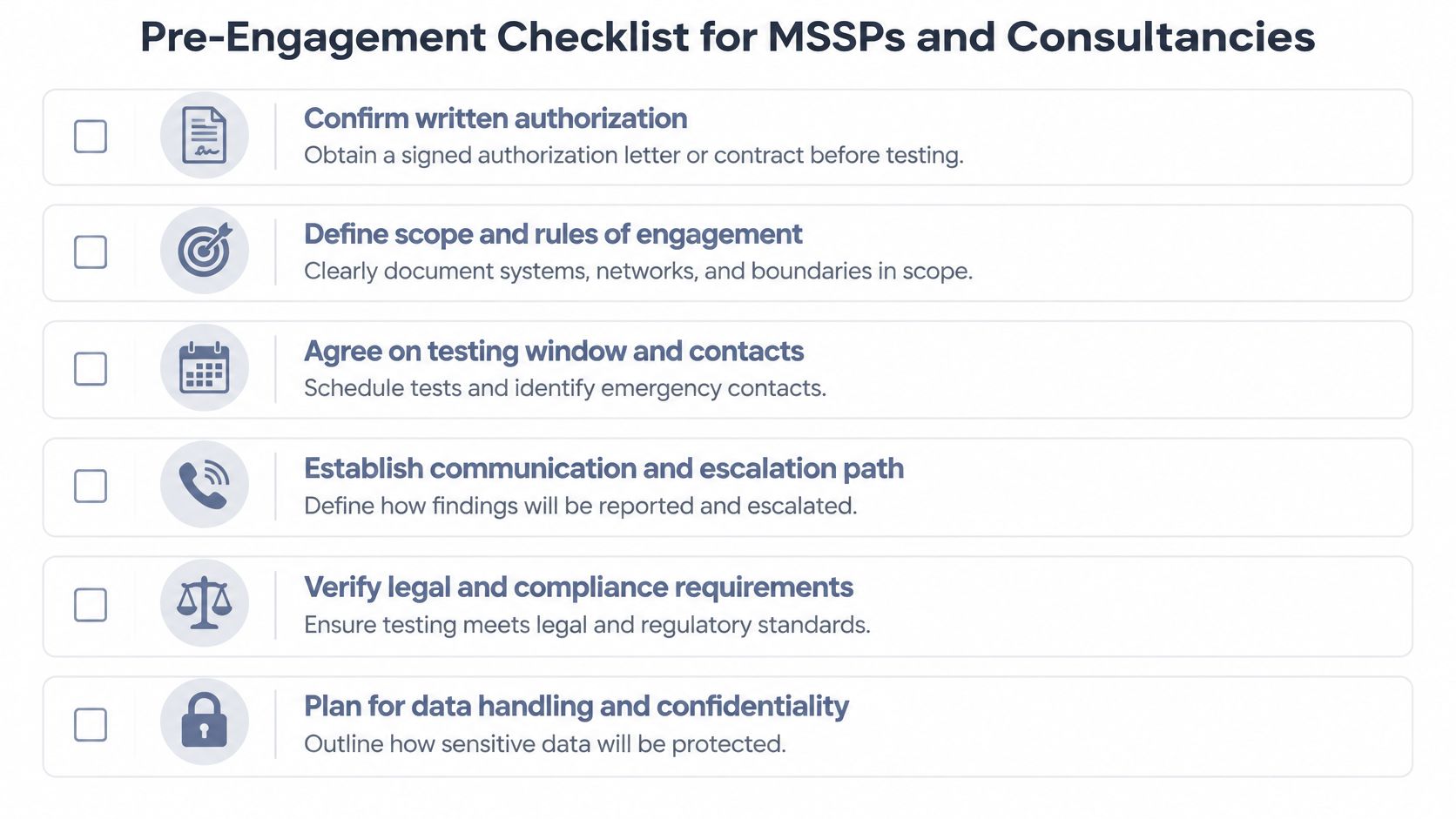
- Written authorization and proof of control. Collect an ownership record, a signed authorization or a rules-of-engagement document, plus domain or asset control proof where the client can supply it. Without it, a test can be stopped mid-engagement and the tester carries the liability.
- The authorization boundary, component by component. List cloud services, managed databases, SaaS dependencies and identity providers. A boundary that stops at the firewall produces a report that understates third-party risk.
- The impact level and the baseline that follows. Record both, plus the tailoring decisions. Skip it and you can't justify the depth of testing or the price attached to it.
- Named recipients. Identify the authorizing official, the system owner and the assessor who will read the output. A report addressed to nobody gets archived.
- A control ID for every planned test objective, plus the agreed evidence format. Agree it up front so findings arrive with a home instead of a debate.
- Change triggers and retest scope. Define what forces a retest and how deep it goes. Left open, every retest becomes a negotiation after an incident.
- Exclusions, testing windows and the live-system rule. State what happens if a test degrades a production service, and who gets called first. Real engagements include a rollback plan for anything that touches stateful components.
- The artifact each finding feeds. Security assessment report, plan of action and milestones, or both. Confirm it before testing so nobody rewrites your findings into a shape you never validated.
The documentation expectations differ by client and by regulator, and this overview of penetration testing requirements covers the common ground for providers delivering at volume.
Keep the completed checklist in the engagement file. Same questions, same order, every client, and the answers stop depending on who happened to run the kickoff.
Decide Which Evidence to Automate First
Automate the repeatable work, keep the judgment calls human, and don't confuse the two when a deadline lands.
The automated side is boring on purpose: asset and attack surface inventories, change detection between engagements, configuration and version checks, evidence capture with timestamps, and mapping each verified finding to control IDs across frameworks. These tasks are wide, frequent and unforgiving when done from memory. A human re-reading a cloud console for the fourth time in a quarter will miss the identity policy change that opened a path.
The human side is where machines still guess: business logic abuse, multi-step attack chains that cross three services, the final verdict on whether a finding is exploitable in this environment, and every risk acceptance decision. I would never let an automated verdict on business impact reach an authorizing official without a person signing it.
Automate breadth. Verify depth by hand. Then let one record serve the assessor and the authorizing official.
ThreatExploit AI, the platform we operate, sits on the automated side of that split. It runs the seven PTES phases from reconnaissance through exploitation and verification, and its reports carry executive summaries for management alongside detailed technical findings for remediation teams. It produces compliance-mapped output for frameworks including SOC 2, PCI-DSS and ISO 27001. Before any test starts, ThreatWinds may require documents proving authorization to test a target, such as ownership records, a signed authorization or rules-of-engagement document, or domain and asset control validation. And be clear about the limits: ThreatWinds does not warrant that the service will detect all vulnerabilities, that findings will be free of false positives or false negatives, or that testing will not affect target systems. Those caveats are the reason every high-impact finding gets confirmed by hand before it enters an authorization package.
Start with one pilot rather than a portfolio rollout. Pick a single moderate-impact system, map its control families, run one automated cycle and one human-verified cycle over the same scope, and compare the evidence each produces. If the automated run covers the control IDs and the human pass confirms the findings that matter, you have a model you can repeat across clients. If it doesn't, you've learned that on one system instead of twenty.
ThreatExploit AI runs reconnaissance, exploitation, verification and reporting as one automated cycle, then maps verified findings to the controls your client's authorizing official will ask about, with executive summaries for management and technical detail for remediation teams. If your next engagement needs an evidence package that connects to the RMF instead of a standalone vulnerability list, visit ThreatExploit AI and run a test against a system you own to see what the output looks like.