
Three days before an assessor arrives, an MSSP discovers that its last penetration test is fourteen months old. The report is polished, the policies are signed, and the evidence folder is full, but nobody can show whether the exposed application path still resists exploitation after months of cloud changes, identity updates, and supplier activity.
That situation is common because many teams still treat NIST 800-53 compliance as an annual documentation project. In practice, assessors need more than control statements. They need evidence that controls operate within the system being assessed, including evidence from vulnerability monitoring, penetration testing, access paths, configurations, and inherited services. Automated testing can help, but only when its findings are verified, tied to the right controls, and delivered in a format that an assessor can use.
Table of Contents
- The Reality of NIST 800-53 Compliance Deadlines
- Understanding Control Families and Baseline Requirements
- Navigating the Compliance Assessment Workflow
- Why Documentation-Only Compliance Fails Modern Assessments
- Mapping Controls to Evidence Through Automated Testing
- Continuous Compliance in Cloud and Multi-Tenant Environments
- Building a Compliance-Ready Testing Strategy
The Reality of NIST 800-53 Compliance Deadlines
The assessor arrives on Monday. On Friday, the security lead opens the previous penetration test and finds that it describes an environment that no longer exists. The application has moved behind a new gateway, an API has gained additional functionality, a cloud provider now handles part of the infrastructure, and the provider's inherited-control documentation was never connected to the current System Security Plan.
The team can still submit the old report, but it creates uncomfortable questions. Which assets were tested? Which vulnerabilities were retested? Did the test cover the current authentication flow? Can the provider demonstrate that the control is operating now, rather than showing that someone tested a previous version of the system?
Practical rule: Treat every major system, identity, boundary, and supplier change as a potential evidence event, not merely as a ticket to close.
NIST SP 800-53 Revision 5 was published on September 23, 2020, superseding Revision 4, published on January 22, 2015. The revision history also records draft milestones in 2016, 2017, and 2020, which helps explain why Rev. 5 is now the major modern baseline for federal security and privacy controls. NIST's announcement describes the revision as a structural change, including one catalog for security and privacy and a dedicated Supply Chain Risk Management family. (NIST's announcement of SP 800-53 Revision 5)
That history matters to penetration-testing providers because compliance expectations evolve with the environment. A report that only lists vulnerabilities without showing scope, evidence, validation, and control relevance leaves the client to perform the hardest part of the audit preparation.
For smaller organizations, a practical orientation to scoping and control selection can be found in NIST control mapping for SMBs. The useful takeaway is not to copy a checklist blindly. It's to establish which systems, services, and control responsibilities belong in the engagement.
An annual test still has value. It can satisfy a formal assessment requirement and provide an independent review. It shouldn't be the only verification mechanism, though. A recurring model gives the provider a way to test material changes, preserve evidence over time, and identify when a previously valid conclusion no longer reflects system behavior.
Understanding Control Families and Baseline Requirements
NIST SP 800-53 Rev. 5 organizes the catalog into 20 control families, compared with 17 families in earlier versions. That expansion reflects broader coverage across governance, privacy, assessment, configuration, system protection, and supply-chain concerns. The catalog isn't a simple list where every organization implements every item in the same way.
NIST defines three security control baselines, low-impact, moderate-impact, and high-impact, along with a privacy baseline that applies regardless of impact level. The baseline gives an organization a starting point, but the system's risk profile, boundaries, mission, data, and inherited common controls determine the practical scope. (NIST SP 800-53 Rev. 5)
Impact determines testing depth
A low-impact system may require a different testing emphasis from a high-impact system. That doesn't mean a lower-impact environment gets a superficial test. It means the organization should explain why specific controls were selected, adapted, inherited, or excluded, and then align testing with the consequences of failure.
For a penetration-testing provider, the baseline should influence the engagement design:
- Low impact: Confirm the system boundary, exposed interfaces, authentication paths, and basic protection mechanisms. Evidence should show what was tested and what wasn't.
- Moderate impact: Add deeper validation of authorization, segmentation, logging, configuration exposure, vulnerability remediation, and third-party dependencies.
- High impact: Plan for stronger independence, more formal evidence handling, broader attack-path analysis, and careful review of inherited controls and system interconnections.
The exact test plan still depends on the organization's tailoring decisions. A baseline isn't permission to run the same scan against every client and call the result compliant.
Inheritance changes the engagement
Common controls may be inherited from an enterprise security team, cloud provider, managed identity service, or other supplier. The system owner remains responsible for understanding what is inherited, what is shared, and what must be implemented locally. A penetration test can validate the customer-controlled portion, but it can't automatically prove that a provider's claimed control operates as described.
A strong scope document separates:
| Responsibility | Evidence to collect |
|---|---|
| Customer-controlled application | Test scope, attack paths, findings, remediation, retest evidence |
| Shared service | Responsibility matrix, service configuration, relevant provider evidence |
| Provider-controlled infrastructure | Attestation or assessment evidence, service boundaries, exceptions |
| Cross-boundary workflow | Logs, authorization behavior, network paths, and test results |
The NIST control families resource can help teams organize the catalog before they decide which technical tests support each family. The important operational decision is to map controls to real system behavior, not to assume that a family name alone tells you what evidence an assessor needs.
Navigating the Compliance Assessment Workflow
A reliable assessment workflow starts before the penetration tester opens a tool. The provider and system owner need a shared definition of the system, its data flows, its external connections, and the controls that the engagement is intended to support.
Start with scope and ownership
Document the system boundary first. Include applications, APIs, cloud resources, administrative interfaces, identity providers, third-party connections, and shared services. Then identify who owns each component and whether the control is customer-implemented, inherited, or shared.
Next, connect the test plan to the selected controls. NIST SP 800-53 compliance isn't one-size-fits-all. The organization selects and tailors controls according to the system's impact and risk profile, including inherited common controls. (NIST's control selection and tailoring guidance)
Build monitoring into the test calendar
RA-5, Vulnerability Monitoring and Scanning, requires scans at an organization-defined frequency or through an organization-defined random process. It also requires scanning when new vulnerabilities affecting systems are identified and reported. (NIST RA-5 guidance)
That requirement supports a layered approach:
- Routine discovery: Maintain an accurate view of exposed applications, APIs, hosts, and services.
- Change-triggered validation: Retest after material releases, architecture changes, identity changes, or newly disclosed vulnerabilities.
- Exploit verification: Confirm whether a finding is reachable and exploitable in the client's environment.
- Remediation validation: Retest the original path and document whether the risk was reduced.
- Assessment packaging: Preserve timestamps, scope, evidence, finding status, and control references.
A compliance checker such as Purple compliance checker can be useful for a focused compliance review, but a checker shouldn't replace a scoped penetration test. It may identify configuration or policy gaps, while an assessor may still need evidence that a realistic attack path was tested.
NIST SP 800-53A requires an assessment plan defining the scope, procedures, environment, team, and roles. Its supplemental guidance also identifies penetration testing of key information system components as a typical assessor action. (NIST SP 800-53A)
The provider should therefore deliver more than a vulnerability export. The assessment package needs to show what was tested, how it was tested, what evidence supports the conclusion, and which control implementation or assessment objective the result informs.
Why Documentation-Only Compliance Fails Modern Assessments
A signed policy can establish intent. It can't prove that an access restriction works, that a vulnerable endpoint is unreachable, or that an alert is generated when an attack reaches a protected component.
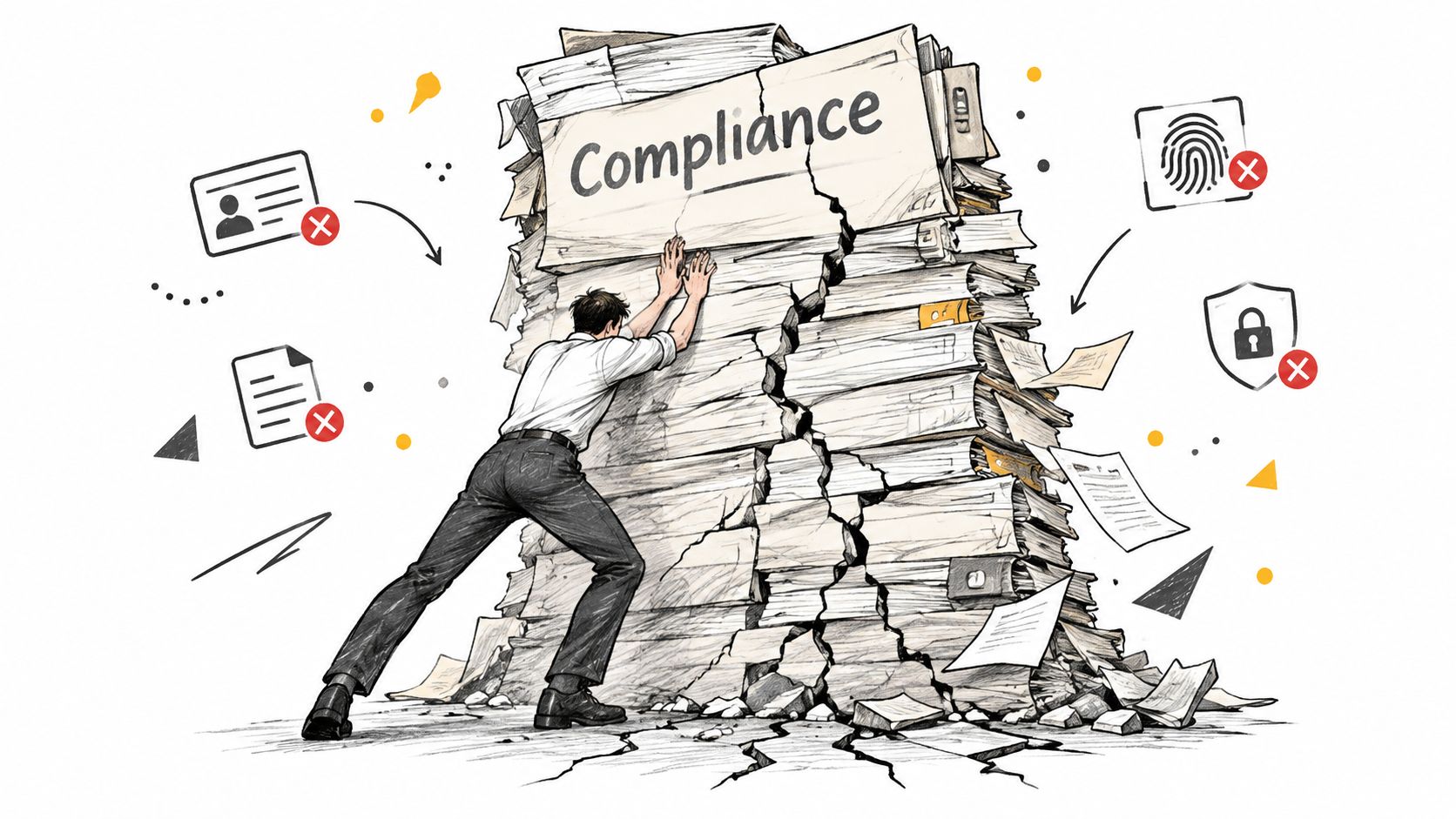
The documentation-only approach fails because it answers the weaker question, “Do we have the control?” The stronger question is, “Can we prove the control works under realistic conditions?” Assessors increasingly examine operating effectiveness, which means a policy needs support from logs, test results, configuration evidence, tickets, screenshots, and retesting.
Evidence must reflect actual operation
A penetration test can help establish whether technical controls resist the attack paths they are intended to manage. For example, testing may reveal that an authorization rule exists in a policy but fails under a particular API sequence, or that segmentation appears correct until a service account reaches an unintended administrative path.
Privacy introduces another boundary. Revision 5 integrates privacy controls into the catalog, but recent NIST-linked commentary emphasizes that those controls aren't a complete substitute for broader OMB privacy obligations. A provider should avoid claiming that a technical penetration test proves full privacy compliance. It can validate selected technical behavior, while legal, governance, data-use, and organizational obligations require separate evidence.
Teams should browse compliance documentation with a skeptical eye. A useful document repository connects each artifact to a system, control, owner, date, and assessment question. A folder of undated policies and generic screenshots creates volume without much audit value.
What assessors can challenge
Assessors may challenge evidence when:
- Scope is unclear: The report doesn't identify tested components or exclusions.
- Results aren't verified: Findings are copied from scanners without confirming exploitability.
- Control mapping is vague: The report names a framework but doesn't explain the control relationship.
- Evidence is stale: The artifact predates significant system or configuration changes.
- Inheritance is assumed: The customer treats a provider statement as proof of local implementation.
- Remediation is untested: A closed ticket exists, but no retest demonstrates that the weakness was removed.
Automated testing doesn't solve these problems automatically. It improves the operating model when it captures reproducible evidence, preserves test context, and gives the assessor a traceable path from control requirement to observed behavior.
Mapping Controls to Evidence Through Automated Testing
Manual penetration testing and automated testing solve different problems. Manual work is strong at judgment, novel attack chains, business-logic abuse, and situations where an experienced tester must adapt to ambiguous behavior. Automation is strong at repeatability, recurring execution, broad discovery, evidence capture, and consistent reporting across many customer environments.
The wrong comparison is “manual or automated.” The useful comparison is manual alone versus a combined evidence pipeline.
| Approach | Strength | Trade-off |
|---|---|---|
| Manual assessment | Deep reasoning and flexible exploitation | Capacity constraints and variable evidence structure |
| Automated testing | Repeatable checks and faster recurring validation | Requires careful authorization, scope, and result review |
| Hybrid engagement | Automation handles repeatable coverage while specialists investigate complex paths | Needs a clear handoff and consistent data model |
NIST SP 800-53A's assessment guidance makes testing key system components a normal assessor activity. A provider should reflect that expectation in the report structure, not bury technical results in an appendix.
Turn a finding into an assessment artifact
A compliance-ready finding should connect several layers:
- Observed condition: What the tester found in the application, network, API, cloud service, or identity path.
- Reproduction evidence: Screenshots, request and response context, logs, or other proof that the condition existed.
- Impact and attack path: What an attacker could reach or change, stated without exaggeration.
- Control relationship: The relevant NIST family and control reference, with an explanation of how the result informs assessment.
- Remediation status: The owner, action, current state, and retest result.
- Residual risk: What remains if the fix is partial, compensating, inherited, or deferred.
For example, a verified authorization weakness can support analysis of access control implementation. A segmentation failure can inform boundary protection and system and communications protection. A vulnerable component may support vulnerability monitoring and configuration-management evidence. The report shouldn't imply that one finding proves an entire family is compliant.
A compliance matrix helps maintain that distinction. It should show which controls the test supports, which evidence was collected, which controls remain outside the engagement, and where another evidence source is required.
ThreatExploit AI is one option for providers that need automated penetration testing across web applications, REST and GraphQL APIs, internal and external networks, and cloud environments. Its stated workflow coordinates reconnaissance, exploitation, verification, and reporting, with PDF and JSON outputs that include technical detail, executive views, screenshots, and compliance references. The provider still needs to define authorization, scope, review procedures, and the limits of automated evidence before delivering the report.
Continuous Compliance in Cloud and Multi-Tenant Environments
Cloud and multi-tenant environments make control inheritance a living problem. A customer may rely on a cloud provider for infrastructure protections, an identity platform for authentication, an MSSP for monitoring, and a SaaS supplier for a business workflow. Each relationship introduces a boundary where responsibility can be misunderstood.
SP 800-53 Rev. 5 contains 1,196 controls and enhancements across 20 families, as described in recent coverage of the catalog's scale. (Discussion of NIST 800-53 inheritance and supply-chain challenges) At that scale, manual scoping decisions become a recurring operational risk. Teams may maintain a responsibility matrix, but fail to update it when services, tenants, permissions, or deployment patterns change.
Make inheritance testable
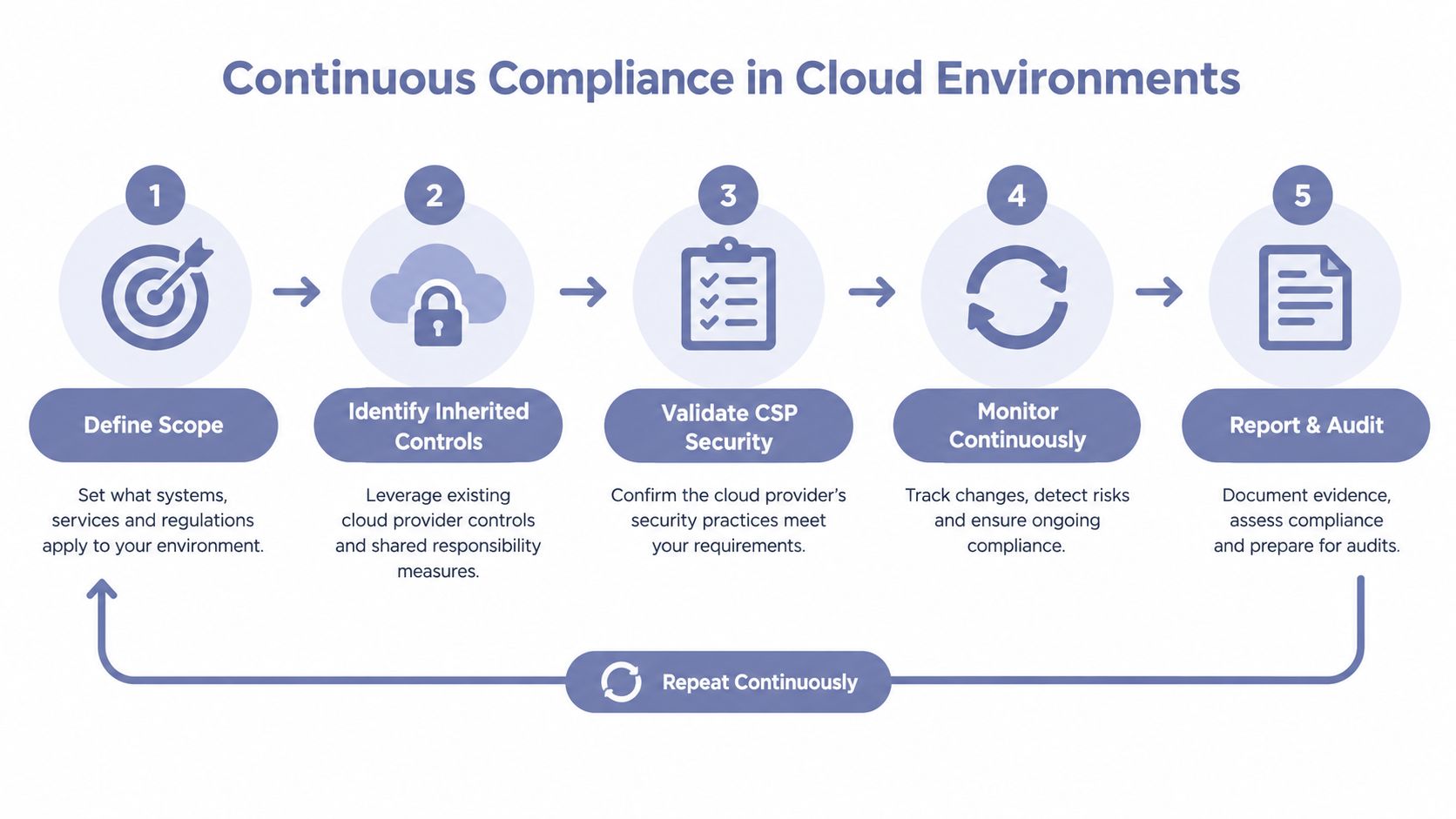
A useful continuous model links each control to an owner and an evidence source:
- Define scope: Record assets, tenants, environments, data flows, and test authorization.
- Identify inherited controls: Mark provider, shared, and customer responsibilities separately.
- Validate provider security: Review available provider evidence and test customer-controlled integration points.
- Monitor continuously: Repeat vulnerability checks, exposure discovery, configuration validation, and targeted penetration tests.
- Report and audit: Preserve evidence, map changes to controls, and update the system documentation.
The loop matters. A report can reveal that an inherited control is not sufficient for the customer's actual architecture. The customer then needs to revisit scope, responsibility, or compensating measures rather than filing the report.
A hybrid cloud security resource can help teams think about the interaction between on-premises systems, cloud services, and shared boundaries. For MSSPs, the practical opportunity is to turn that architecture into a repeatable service: maintain tenant-specific scope, run authorized tests on a schedule or after material changes, and keep evidence separate so one customer's data never appears in another customer's report.
Continuous monitoring doesn't mean launching intrusive exploitation without control. It means defining safe test windows, rate limits, exclusions, escalation paths, and evidence retention. The provider must also distinguish a newly discovered exposure from a confirmed exploitable weakness, then communicate both clearly.
This model is more useful than producing one annual report because it shows how the environment behaves over time. It also exposes inheritance gaps earlier, when the system owner can still change a supplier contract, alter a permission, or request stronger evidence from a cloud provider.
Building a Compliance-Ready Testing Strategy
Security providers should stop treating the penetration test and the compliance package as separate deliverables. The test should be designed from the start to produce evidence that supports the client's selected controls, while the compliance team should define the evidence questions before the technical work begins.
A practical strategy has four operating principles:
- Scope before tooling: Confirm boundaries, authorization, assets, tenants, exclusions, and inherited responsibilities.
- Test behavior, not paperwork: Use exploitation and verification to examine whether relevant technical controls operate as intended.
- Map conservatively: Tie findings to the controls they directly inform, and identify evidence that requires another assessment activity.
- Retest continuously: Schedule recurring validation and trigger focused testing after material changes or newly identified vulnerabilities.
Point-in-time assessments remain necessary for many authorization and audit processes. They provide a formal snapshot and can support an assessment package. They don't provide durable assurance when the system changes shortly afterward.
The report should let an assessor move from a control question to verified system evidence without asking the client to reconstruct the engagement from scattered files.
For MSSPs and consultancies, this approach creates a more dependable delivery process. Automated reconnaissance and repeatable checks can handle routine coverage, while senior testers focus on business logic, chained exploitation, unusual trust relationships, and high-impact decisions. Structured findings can then feed technical remediation, executive reporting, and the customer's control evidence without producing three disconnected versions of the truth.
The strongest service isn't “a compliance report” generated after a scan. It's a recurring testing program that shows what was in scope, what the tester verified, which controls the evidence supports, what changed, and what remains uncertain. That standard builds credibility because it acknowledges the limits of each test instead of claiming that a single artifact proves the entire NIST 800-53 program.
For providers building this capability, start with one representative customer environment. Map the selected controls, define evidence fields, run an authorized test, review the report with a compliance practitioner, and refine the workflow before rolling it across tenants. That disciplined rollout is more valuable than buying automation and leaving the mapping model undefined.
ThreatExploit AI helps security service providers automate penetration testing across web, network, and cloud environments while producing evidence-backed reports with structured compliance mappings. Visit ThreatExploit AI to evaluate how recurring testing, verification evidence, and client-ready reporting can fit into your NIST 800-53 compliance engagements.