
Your kickoff is booked, the client expects testing to start Monday, and nobody can produce signed authorization for the cloud account in scope. The tester is ready. The tools are ready. The engagement is not. That stall is where penetration testing requirements become real, because the missing signature, unclear boundary, or absent test account will stop work faster than any firewall. Treat requirements as delivery decisions you lock before execution, not paperwork you assemble after the report.
Table of Contents
- Why Penetration Testing Requirements Are Really Operational Decisions
- Building the Rules of Engagement That Actually Run the Test
- What PCI DSS 11.3 Actually Requires Beyond an Annual Test
- Mapping Regulatory and Certification Regimes to Delivery Cadence
- Coverage Requirements Across Web, Network, and Cloud
- Moving From Annual Evidence to Change-Aware Testing
- Reporting Requirements That Serve Every Stakeholder From One Test
- A Reusable Procurement and Delivery Checklist
Why Penetration Testing Requirements Are Really Operational Decisions
A signed contract doesn't make a test runnable. On delivery day, your lead still needs four answers. What's in scope, which vantage point are you testing from, what evidence will you capture, and what event triggers the next test? If any answer is vague, you'll either under-test the estate or create risk you weren't authorized to create.
Consider a routine MSSP engagement that unravels at kickoff. The statement of work says external testing. The client's payment application sits behind a web application firewall, the API uses separate tokens, and the cardholder environment depends on segmentation nobody listed. The tester can scan the perimeter and produce a report, but that report won't answer the auditor's actual questions about internal paths, authenticated abuse, or whether segmentation works.
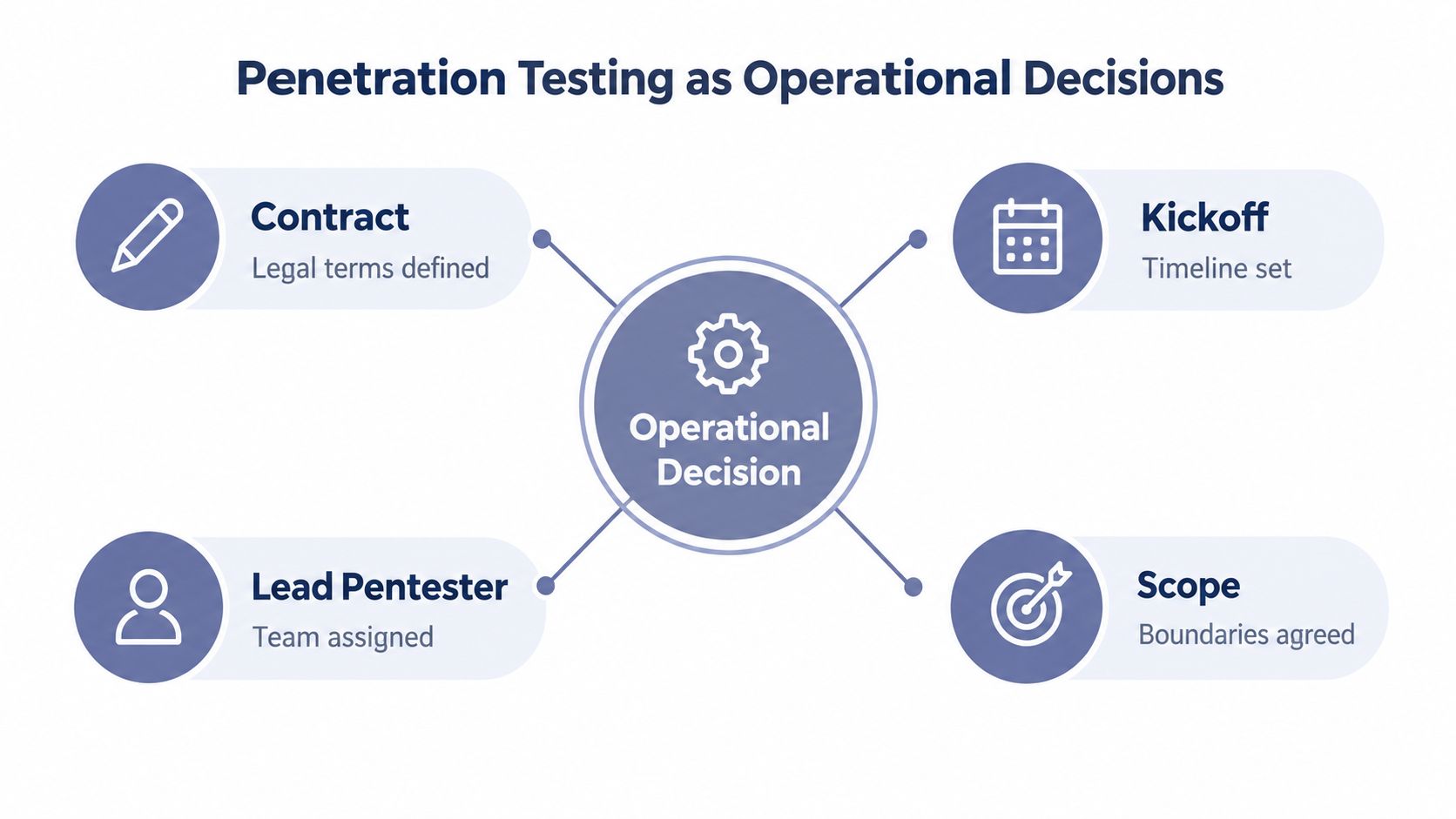
The Four Decisions Behind Every Requirement
- Scope: Name systems, applications, cloud accounts, APIs, and exclusions. An unnamed asset is an untested asset, whatever the cover page claims.
- Vantage point: Decide whether you're testing externally, internally, unauthenticated, authenticated, or through the cloud control plane. Each perspective reveals different attack paths.
- Evidence: Define proof before you start. Auditors don't just want findings, they want methodology, scope, timestamps, reproduction detail, remediation, and retest results.
- Cadence: Tie frequency to regulation and change, not habit. Annual testing may satisfy a baseline while missing a material change made the following week.
An annual pentest completed statement proves a date. It doesn't prove coverage.
Regulated buyers raise the stakes further. A healthcare client pairing testing with HIPAA-compliant website protection still needs you to define which web properties, hosting boundaries, and data flows your test covers. Don't let a framework label substitute for those decisions. Make them explicitly, record the trade-offs, and price the engagement accordingly.
Building the Rules of Engagement That Actually Run the Test
Don't start with scanning. Start with a formally approved Rules of Engagement, or ROE. NIST SP 800-115 guidance on assessment planning expects the ROE to define systems and networks in scope, authorized personnel, permitted test types and intensity, schedule and logistics, data handling, and incident handling before execution.
Treat that document as an execution gate. If a field is missing, the test doesn't run.
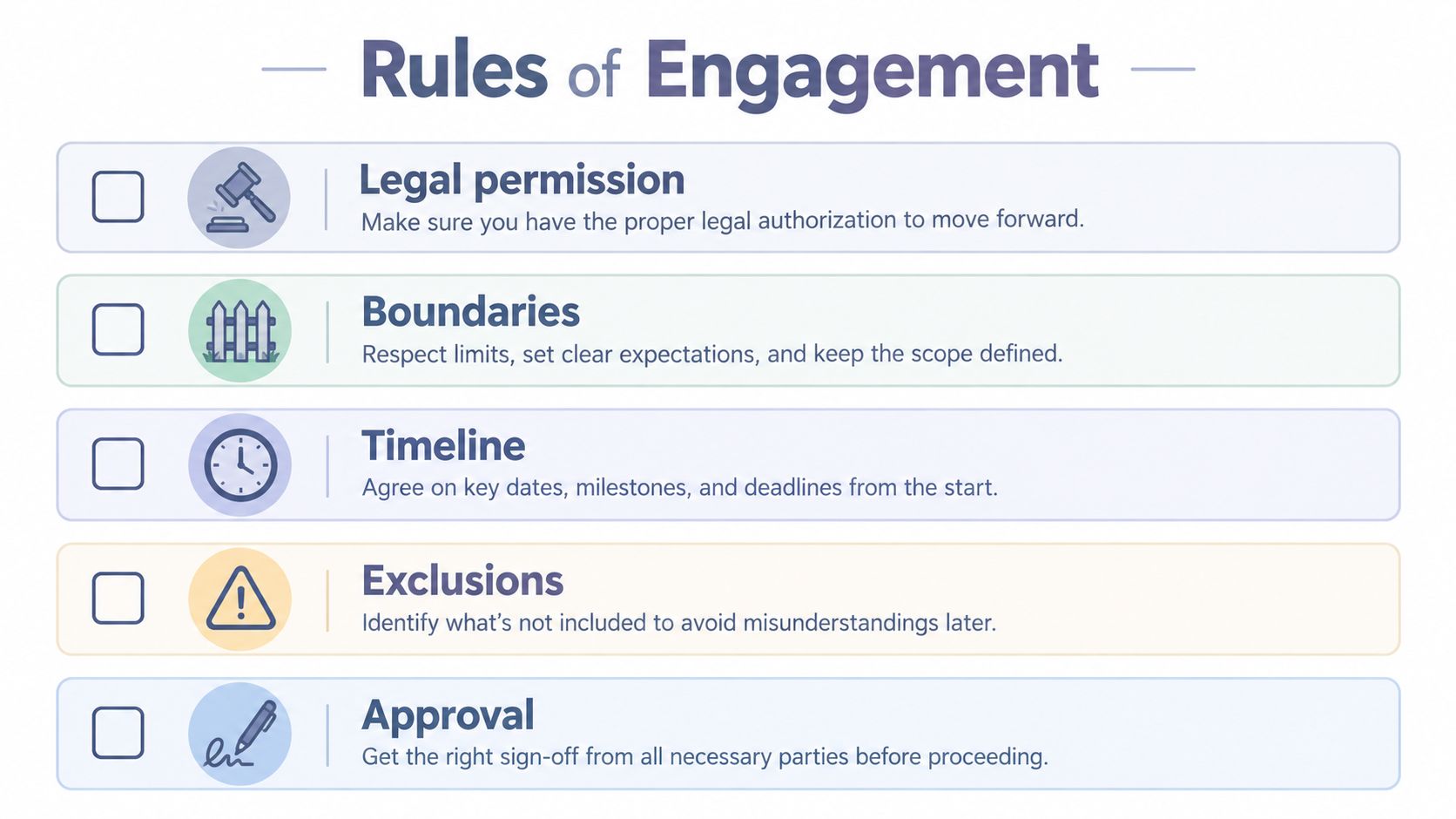
Fields That Must Exist Before Active Testing
- Scope and ownership: List targets and verify who owns them. This matters acutely in cloud and multi-tenant environments, where a range or hosted service can contain assets belonging to different customers.
- Authorization: Name the approver and the personnel permitted to test. Verbal permission from a project contact isn't legal cover for intrusive work.
- Permitted intensity: State allowed techniques, prohibited actions, rate limits, and whether exploitation, credential attacks, or social engineering are in bounds.
- Windows and source addresses: Record maintenance windows, testing hours, and source IPs so defenders can distinguish your activity from an incident.
- Stop and escalation rules: Define emergency contacts, communication paths, stop conditions, and what happens if you encounter regulated data or production instability.
- Evidence handling: Set retention, sanitization, storage, and destruction rules before you collect requests, responses, screenshots, or credentials.
Hard gate: No target discovery until scope, authorization, time window, emergency contact, and prohibited actions are approved and logged.
Build those fields into your tooling and workflow, not just your kickoff deck. A structured penetration test plan template and planning guide helps you turn the ROE into repeatable checks your delivery team clears on every engagement. Retrofitting authorization after exploitation isn't governance. It's exposure.
What PCI DSS 11.3 Actually Requires Beyond an Annual Test
PCI DSS is often sold as an annual pentest plus scanning. That shorthand will get you into trouble. Under PCI DSS penetration testing guidance for Requirements 11.3.1 and 11.3.2, organizations must test at least once every 12 months and after any significant infrastructure or application upgrade, modification, or new system component installation.
The image below captures the scoping conversation you should have before anyone promises that annual date.

Four Obligations Auditors Check Separately
Vantage point comes first. You need internal and external perspectives where the requirement applies. An external-only test can't validate what an attacker or malicious insider reaches after landing inside the network.
Methodology is not scanning. Penetration testing requires active analysis and controlled exploitation to validate whether weaknesses are usable. Quarterly internal and external vulnerability scans are separate obligations, as this comparison of PCI DSS, SOC 2, and ISO 27001 testing makes clear. Don't relabel a scan report and call it a pentest.
Significant change reopens the engagement. A change may be significant when it could affect network security or permit access to cardholder data. Adding a web server, creating a subnetwork, or modifying an application can trigger targeted testing. Your PCI DSS penetration testing delivery workflow should connect change tickets to retest decisions automatically.
Segmentation must be proved. Where segmentation isolates the cardholder data environment, Requirement 11.3.4 requires testing to validate that controls are operational, effective, and isolate in-scope systems from out-of-scope systems. That is a different test from hunting for unpatched hosts on a flat network.
The video below is useful for aligning delivery and client teams on why depth matters more than a calendar entry.
If your scope excludes APIs, cloud identity paths, or segmentation boundaries, say so plainly and explain the residual risk. A QSA will find the gap eventually. You should find it first.
Mapping Regulatory and Certification Regimes to Delivery Cadence
Don't run every client on the same annual cycle. You'll over-test stable, low-risk assets and under-test regulated environments that change constantly. Map the regime to cadence, trigger events, personnel constraints, and approval gates before you quote.
| Regime | Core cadence | Trigger events | Special requirement | Approval gate |
|---|---|---|---|---|
| PCI DSS | At least every 12 months | Significant infrastructure or application change | Validate segmentation where it isolates cardholder data | Documented scope and remediation evidence |
| DORA | Annual testing for critical or important functions, plus threat-led testing every three years for selected significant entities | Material ICT and resilience changes | Intelligence-driven simulation for qualifying entities | Regulatory planning tied to critical functions |
| FedRAMP | Initial and recurring testing during continuous monitoring | Changes within the authorized cloud environment | ROE developed under NIST SP 800-115 Appendix B | Authorizing Official approval before testing |
| UK NCSC CHECK | Frequent testing during development and before key release points | New services, public beta, or processing real user data | Qualified, cleared personnel and audited report quality | Agreed scope covering target and techniques |
DORA makes the layered model explicit. The French AMF overview of DORA obligations describes annual testing for ICT systems supporting critical or important functions, while certain significant entities must also perform threat-led penetration testing at least once every three years. The three-year exercise doesn't replace annual resilience testing. It sits on top of it.
FedRAMP adds a governance constraint many providers underestimate. Under FedRAMP penetration test guidance for cloud service providers, the ROE must be developed in accordance with NIST SP 800-115 Appendix B and approved by the Authorizing Official before testing begins. A customer request alone doesn't authorize the work.
Personnel Can Be Part of the Requirement
The UK goes further. NCSC CHECK information for buyers states that every CHECK Team Leader must hold at least the Principal Cyber Security Professional title in Security Testing, every Team Member at least Practitioner, and both must hold valid SC clearance. NCSC also audits reports. Staffing, clearance, and report quality are delivery requirements, not marketing credentials.
The CHECK Scheme Standard on agreed scope and attack activities also requires company and customer agreement on scope, including the system and possible activities such as monitoring communications, brute-force attempts, and exploitation of bugs and loopholes. For broader governance context, the Vigil Security risk compliance guide is a useful companion when you're translating regime language into client controls.
Build your delivery calendar from this matrix. Then budget for approvals and qualified staff before you promise dates.
Coverage Requirements Across Web, Network, and Cloud
A test that covers the web app but ignores identity, segmentation, and the cloud control plane isn't thorough. It's partial, and you should label it that way. Buyers inherit these layers together, so scope them together wherever the attack paths connect.
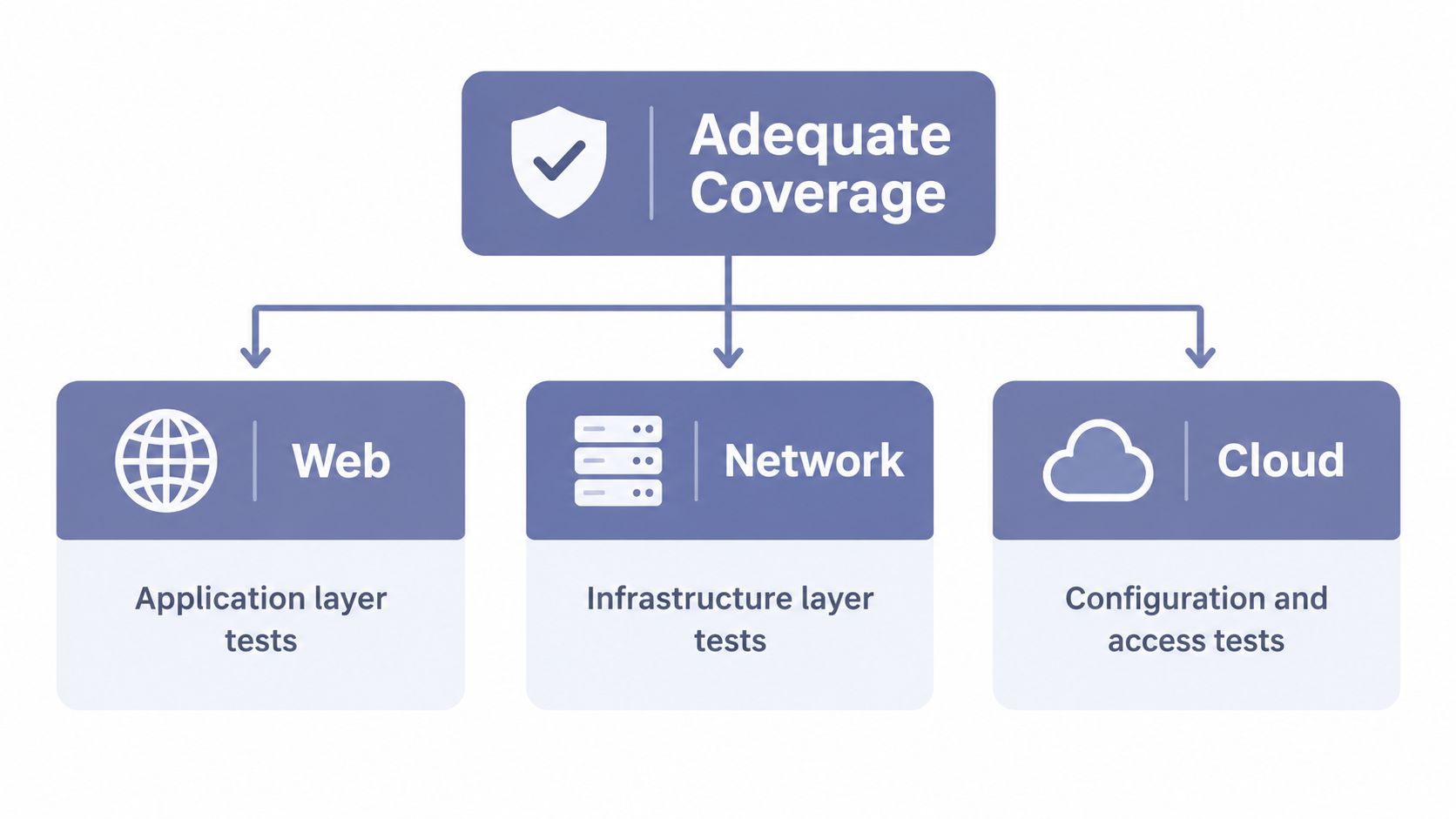
Web and API Coverage
Use the OWASP Web Security Testing Guide introduction and testing framework as your coverage spine. It organizes testing across authentication, authorization, session management, input validation, business logic, cryptography, client-side behavior, configuration, and APIs. Signature checks alone won't find workflow abuse, object-level authorization failures, or chained flaws that need stateful interaction.
Preserve context. Test with separate low-privilege and administrative identities, maintain session state, track object identifiers and tokens, and record request sequences. Every finding should carry the affected endpoint, required privilege, sanitized request and response, observed impact, test case, and timestamp.
Network and Cloud Coverage
- External network: Validate exposed services, perimeter controls, and reachable attack paths into sensitive environments.
- Internal network: Test segmentation, lateral movement, authenticated access, and whether a foothold reaches crown-jewel systems.
- Cloud control plane: Review IAM permissions, tenant boundaries, exposed storage, network configuration, and ephemeral workloads, because clean application code doesn't fix an over-privileged role.
- APIs and browser flows: Cover both. APIs often expose the data and actions that the interface merely presents.
If you can't reproduce it with evidence, don't report it as a verified vulnerability. Report it as an inference and say what would confirm it.
Use tools such as Nmap, Nuclei, SQLMap, and browser instrumentation where they fit, but don't confuse tool output with coverage. Coverage means a named domain was tested from a named perspective and produced evidence a reviewer can replay.
Moving From Annual Evidence to Change-Aware Testing
An annual report filed for twelve months creates false assurance in an estate that changes weekly. Keep the periodic independent assessment, but stop pretending it's sufficient on its own. Your default operating model needs three layers.
Three Cadences You Should Be Able to Deliver
Baseline assurance is the scheduled, scoped assessment that satisfies the governing regime and gives the client a comparable point-in-time result. It's necessary. It isn't timely.
Event-triggered testing runs after material architectural, identity, application, or segmentation changes. New APIs, rewritten authorization, cloud permission changes, and fresh internet exposure shouldn't wait for next year's slot. This analysis of penetration testing for compliance cadences reinforces why fixed annual cycles struggle against weekly or daily operational change.
Continuous validation covers high-risk or rapidly changing assets with repeatable checks, regression testing, reconnaissance, and evidence collection. A structured continuous penetration testing operating model helps providers connect deployments and asset changes to testing without rebuilding the engagement each time.
Draw the automation line clearly. Automate reconnaissance, repeatable checks, evidence capture, finding regression, and retests. Keep human judgment for business-logic abuse, chained attack paths, subtle authorization flaws, exploit safety, and risk acceptance. Automation that floods engineers with unverified noise isn't scale. It's transferred labor.
Platforms in this space include ThreatExploit AI, which conducts reconnaissance, exploitation, verification, and reporting across web, network, and cloud targets. Evaluate any such platform on ROE enforcement, evidence quality, scope controls, and how cleanly humans can escalate ambiguous findings. Speed matters only if the output survives engineering and audit scrutiny.
Sell continuous testing as risk control, not as a premium report subscription. The client gets earlier detection. You get a governed, repeatable delivery motion tied to real change.
Reporting Requirements That Serve Every Stakeholder From One Test
Reporting isn't what happens after testing. It's a design constraint that determines what you capture during testing. Build one evidence set, then render it differently for four audiences.
What Each Audience Actually Needs
- Executives: Business impact, exposed functions, priority order, and what risk remains if remediation slips. They don't need packet detail.
- Engineers: Reproducible steps, affected endpoints or hosts, privilege context, sanitized requests and responses, screenshots, and precise remediation guidance.
- Auditors: Scope statement, exclusions, methodology, authorization evidence, timestamps, evidence chain, remediation status, and retest results.
- Regulators and framework reviewers: Findings mapped to the controls they enforce, with enough traceability to connect a technical issue to an obligation.
That mapping is now table stakes for regulated buyers. Your reporting should be able to present the same verified finding against HIPAA, SOC 2, PCI-DSS, CMMC, ISO 27001, GLBA, and GDPR where those frameworks apply to the client. Don't force every mapping onto every report. Do make the underlying evidence structured enough that you aren't rewriting findings manually for each audience.
Separate verified exploitation from potential exposure. State the vantage point, test identity, prerequisites, and observed impact on every material finding. If you inferred risk from a banner or configuration but didn't validate exploitability, label it accordingly. Engineers trust reports that distinguish proof from suspicion, and auditors trust providers who document exclusions instead of hiding them.
Reporting rule: One evidence chain, multiple views. Never maintain four inconsistent versions of the truth.
Close the loop with retesting. A finding isn't finished when a ticket closes. It's finished when your team repeats the relevant test, confirms the fix, and records the result against the original evidence.
A Reusable Procurement and Delivery Checklist
Use this checklist before you sign the next statement of work. If you can't answer an item, you're not ready to test.
- Authorization ready: Signed ROE lists scope, approver, personnel, windows, source addresses, prohibited actions, emergency contacts, and stop conditions.
- Scope explicit: Web, API, internal, external, cloud control plane, segmentation, identities, and exclusions are named in writing.
- Regime mapped: Cadence, change triggers, personnel qualifications, approval gates, and framework reporting are tied to the client's actual obligations.
- Evidence defined: Each finding will include reproduction detail, privilege context, affected asset, impact, timestamp, remediation, and retest outcome.
- Change process agreed: Material deployments, identity changes, new exposure, and segmentation changes trigger targeted retesting between baseline assessments.
- Handling rules set: Retention, sanitization, storage, and destruction requirements are documented before evidence collection begins.
Turn the completed checklist, ROE, and retest records into reusable client artifacts with technical documentation software where that helps your team keep delivery records consistent. Consistency is what lets you defend the same engagement to a CISO, a QSA, and a regulator without rewriting your position each time.
Stop selling penetration testing as a once-a-year report and start delivering scoped, evidence-backed validation that follows real change. ThreatExploit AI helps security service providers run automated testing across web, network, and cloud environments and produce compliance-mapped reports clients can use. Visit the platform, evaluate it against your ROE, coverage, and retest requirements, and put your next engagement on a stronger operating model.