
NIST's SP 800 publication index listed 231 matching records in 2025, including publications in the SP 800 series. Security teams need exactly one of them with any regularity: SP 800-53, the catalog federal agencies, FedRAMP cloud providers and a growing share of private enterprises use to demonstrate that their controls work.
The trouble starts after the download. NIST 800-53 controls are written as requirements an organization satisfies, not as tests a scanner runs. A pentest report saying "critical SQL injection on the checkout endpoint" and a control file saying "SI-10 satisfied" can describe the same system on the same afternoon, and neither document proves the other is true.
Reading the structure the way an assessor reads it changes how you write findings. Families route the work, identifiers pin the claim, baselines set the bar, and assessment methods decide whether a technical result becomes evidence anyone will accept.
Table of Contents
- Control Families at a Glance
- Control Identifiers, Parameters and Common Misreadings
- Choosing a Baseline and Tailoring Controls
- How to Implement Controls Step by Step
- Assessment Methods That Turn Testing Into Evidence
- CA-8 Penetration Testing Requirements in Practice
- What Release 5.2.0 Changes for Your Evidence
- Confirm Your Control Mapping Before Your Next Assessment
Control Families at a Glance
Controls in NIST 800-53 group into twenty families, each carrying a two-letter code, and that code is the first filter to apply when a technical finding lands in front of you. You don't need every control number memorized. You need to know which family owns the behavior you just observed.
| Family ID | Family name | Typical penetration-testing evidence |
|---|---|---|
| AC | Access Control | Attempts to reach restricted functions without or with low privileges |
| AT | Awareness and Training | Usually interviews and training records; limited technical testing |
| AU | Audit and Accountability | Whether attacker actions generate logs and whether logs can be altered |
| CA | Assessment, Authorization, and Monitoring | Scope, rules of engagement and test reports supporting CA-8 |
| CM | Configuration Management | Authenticated configuration scans against hardening baselines |
| CP | Contingency Planning | Backup restoration and recovery evidence; usually outside pentest scope |
| IA | Identification and Authentication | Credential guessing, MFA bypass attempts and session token checks |
| IR | Incident Response | Whether test activity was detected and handled through the response process |
| MA | Maintenance | Remote maintenance access paths and their authentication |
| MP | Media Protection | Document and records review; limited technical testing |
| PE | Physical and Environmental Protection | Facility access testing where selected under CA-8(3) |
| PL | Planning | Documented security plans and rules of engagement |
| PM | Program Management | Governance documents and interviews rather than exploitation |
| PS | Personnel Security | Interviews and screening records; outside technical testing |
| PT | PII Processing and Transparency | Data flow review and tests of personal data exposure |
| RA | Risk Assessment | Vulnerability scan output, triage record and risk scoring |
| SA | System and Services Acquisition | Developer testing evidence and third-party component review |
| SC | System and Communications Protection | TLS configuration, segmentation and network exposure tests |
| SI | System and Information Integrity | Patch-level findings, input validation and integrity checks |
| SR | Supply Chain Risk Management | Vendor documents and supplier component review |
Read it as a routing sheet rather than a compliance artifact. A finding that an unauthenticated user reached an administrative page belongs to AC. The same user reusing one password across forty hosts belongs to IA. A TLS 1.0 endpoint still answering on 443 is SC, an outdated library with a public exploit is SI, and the scan that produced all four is RA, because RA owns the vulnerability scanning and risk scoring behind the test.
Two families a scanner cannot touch
Some families never yield an exploit. PT covers how personal data is processed, justified and communicated, so its evidence is a data-flow review, a privacy impact assessment and confirmation that notices match reality. PM covers governance: risk strategy, insider threat programs, how the architecture scales across the enterprise. Both are proven with documents and interviews.
That distinction protects you. A pentest report claiming PT coverage because it found a database column named customer_email overstates what was tested, and an auditor who knows the family will ask for the privacy assessment instead.
Mapping rule: pick the family, then the control, then the enhancement. Working backwards, hunting for a control whose title sounds like your finding, produces duplicates and dead ends.
Control Identifiers, Parameters and Common Misreadings
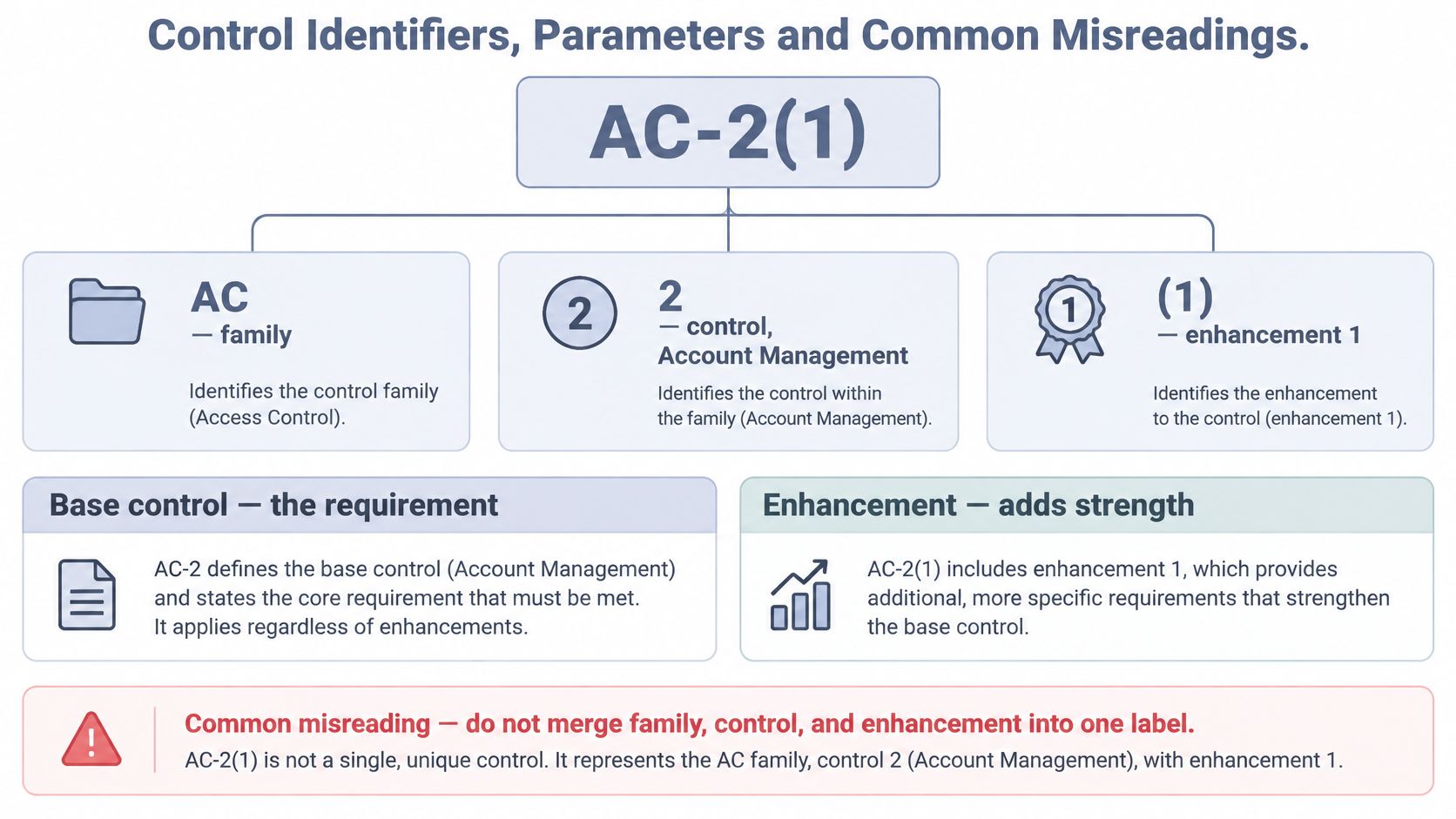
AC-2(1) is a good identifier to learn on. AC is the family, Access Control. 2 is the base control, Account Management. (1) is enhancement one, which adds automated support for managing those accounts. Read in that order and the label stops looking like a serial number and starts reading like a sentence.
The base control states the requirement. Enhancements add strength on top of it. Organization-defined parameters are the blanks the organization fills in, such as a review frequency or a password lifetime. NIST's SP 800-53 Rev. 5 is built to be used as a risk-based control catalog rather than a fixed checklist, with controls and enhancements organized into security and privacy families and published in machine-readable OSCAL formats, including JSON, XML and YAML.
That split between requirement and parameter carries more weight than it sounds. The control text stays fixed across every system you own. The parameter values move with system scope, risk tolerance, architecture and mission. A shared-services platform and an isolated lab can both claim AC-2 while holding wildly different review intervals, and both can be correct. Because the catalog ships in OSCAL, the identifiers survive export into a GRC tool unchanged, which is the whole point of a normalized mapping model.
For a provider running one catalog across many customers, each tenant's parameter values belong in a separate, version-controlled store. Reusing one customer's values in another customer's report is the fastest way to fail a spot check.
Four misreadings that cost you an audit
- A vulnerability proves the control failed. It doesn't. An injection finding tells you input handling at one endpoint was bypassable on the day of test. It says nothing about whether the implementation is sound elsewhere, whether the parameter for review frequency was met, or whether a compensating control caught the attempt. Name the objective you tested and what the test didn't cover.
- One finding maps to one control. A single weak authentication flow can touch IA, AC and SC at once, and plenty of controls have no technical test at all. Map every control the evidence supports, then state which ones went untested.
- Parameter values are universal. They're per system and per customer. A value carried across a tenant boundary becomes a false statement about someone else's system.
- A passing scan means the control passes. A clean authenticated scan says the settings it checked matched the baseline. It says nothing about the policy objective, the interview objective, or whether a human reads the logs it generated.
Every row in a control-mapped finding should carry six things in the same place: the exact control or enhancement, the affected asset, the test method, the observed result, the evidence location and the residual limitation. Six fields, one row. Anything shorter is a vulnerability note wearing a control number as a costume.
Choosing a Baseline and Tailoring Controls
Nobody implements the whole catalog. SP 800-53B sorts controls into impact baselines based on the potential harm to confidentiality, integrity and availability, and most organizations start from one of three tiers.
| Baseline | Approximate controls and enhancements |
|---|---|
| Low | Roughly 150 |
| Moderate | Roughly 290 |
| High | Roughly 370 |
Those counts are working estimates rather than fixed targets. They move with each catalog release, and they move again once you tailor, which is why the number that matters is the one written in your system security plan.
The three tailoring moves
Scoping out. A fully cloud-hosted service with no data center of its own still inherits PE controls in the Moderate baseline. Scoping them out is legitimate. Leaving the reason unrecorded isn't, because the assessor will ask why a control disappeared.
Adding. A system exposed to a specific threat may need stronger logging than the baseline asks for. Note the addition, the threat behind it and the owner.
Setting parameter values. The account review interval is yours to choose. A High system might review privileged accounts monthly where a Moderate one reviews quarterly. NIST doesn't pick that number for you, and the number you pick is the one the assessor tests.
Baseline and tailoring decisions belong in the system security plan, because that's the document assessors test against. The NIST SP 800-37 risk management framework shows how those records hold together across the authorization lifecycle.
One consequence for testing follows directly. A penetration test is only meaningful relative to the baseline it was scoped against. A report listing findings with no baseline reference leaves the reader unable to judge whether a gap matters here or would be tolerable in a Low impact system.
How to Implement Controls Step by Step
Once the baseline is settled, implementation turns into bookkeeping with teeth. Organizations rarely fail here because their tools are weak. They fail because nobody can produce a dated record of what was done, by whom, on which system.
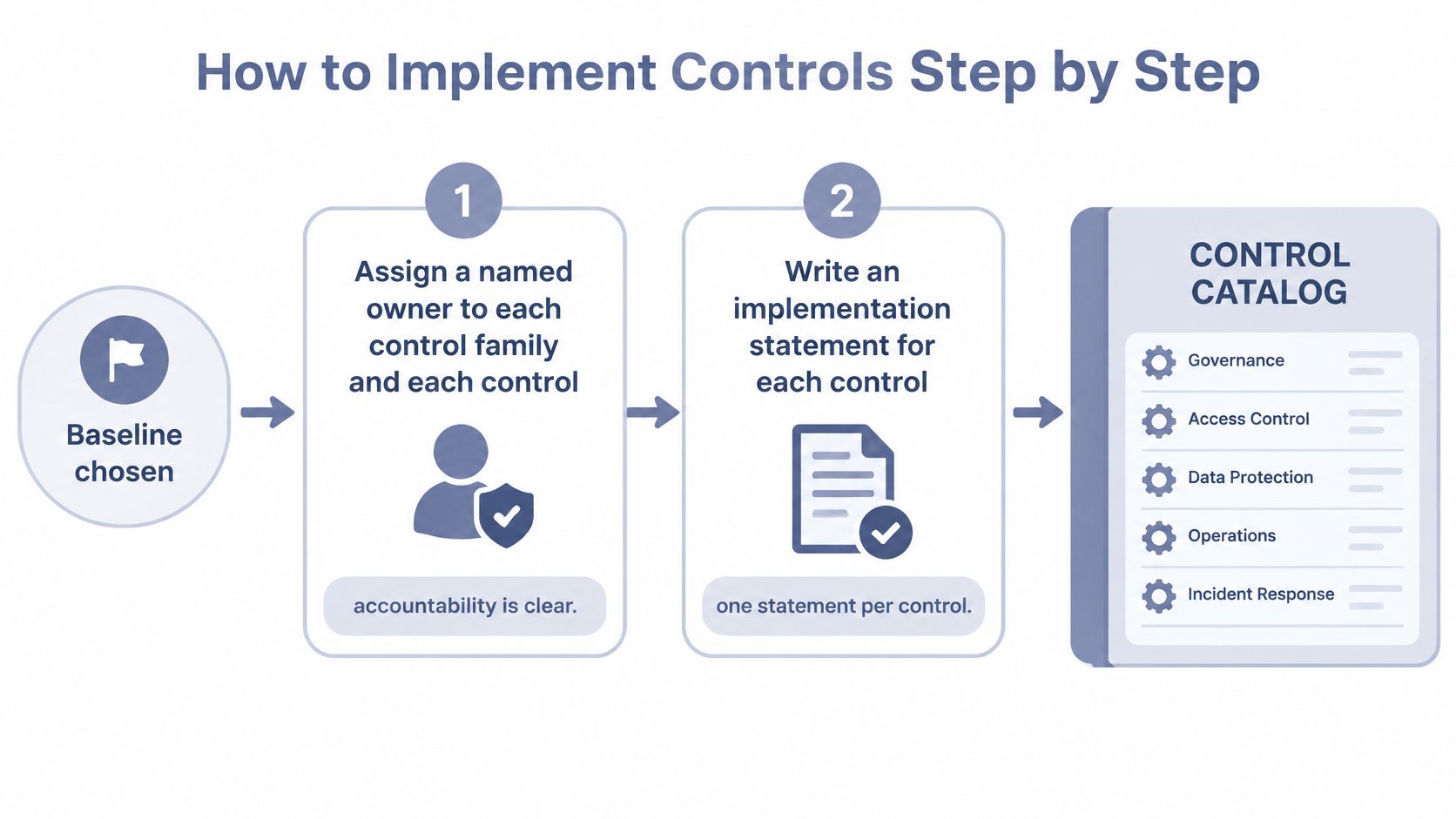
- Assign a named owner to each family and each control. A person, not a distribution list. When AU-6 evidence is stale at assessment time, you want one name on the file. The common slip is spreading ownership across a committee, which means nobody's name is on it.
- Write an implementation statement for this system. Name the product, the setting and the process. The common slip is pasting a statement from a sister system because the wording passed once already, which describes an architecture you don't run.
- Configure the control and record the setting. Password policy, log retention, TLS version, session timeout. The configuration is the substance and the statement is only the description. The common slip is changing a setting during remediation and never updating the record.
- Collect evidence at the moment of collection. Configuration exports, log samples, policy PDFs and screenshots with a visible timestamp. The common slip is a screenshot with no date, which can't be placed inside the assessment window.
- Run an independent assessment against the statement. Assess the sentence you wrote in step two, not the tool output. The common slip is letting the engineer who configured the control also decide whether it works.
- Record findings with owners and target dates. Each item gets a remediation owner, a date and a status. The common slip is a findings list that grows every quarter with nothing closing.
- Schedule continuous monitoring. Evidence expires, so the refresh belongs on a calendar before the old artifact lapses. The common slip is monitoring written into the plan and never scheduled in the system that would produce it.
A complete control file ends with six fields: owner, implementation statement, configuration record, dated evidence, assessment result and next review date. If a row is missing one, an assessor finds the gap before you do.
Assessment Methods That Turn Testing Into Evidence
A scan result is not proof that a control works. It proves a specific check returned a specific value at a specific moment, which is a much narrower claim than the one people write in reports.
SP 800-53A supplies the missing layer. NIST SP 800-53A Rev. 5 builds each assessment procedure from assessment objectives, determination statements, assessment methods and assessment objects, and the procedures exist to verify whether controls are implemented correctly, operating as intended and producing the desired security or privacy outcomes.
| Assessment method | What it establishes | Penetration-testing example |
|---|---|---|
| Examine | The control exists, is documented and is defined as required | Comparing the test scope and rules of engagement against the assessment objective |
| Interview | Personnel know and follow the process in practice | Asking the security operations lead how a critical finding is triaged and escalated |
| Test | The control operates as intended under test conditions | Authenticated scan or exploit attempt confirming whether an MFA bypass works |
Each method establishes something the others can't. An authenticated configuration test can support a test determination for a technical control. It can't support the objective that the policy exists, was approved and is understood by the administrators running it, and that's where document review and the interview earn their place.
Four states, one timestamp
Reports should preserve pass, fail, not applicable and assessor note for every objective, each carrying a timestamp and the provenance of the evidence behind it. Assessment plans should define scope, controls and enhancements, procedures, environment, roles, frequency and reporting outputs before execution, so a later run can be compared against the earlier one instead of standing alone.
For each finding, record five things: the objective, the method used, the artifact, the time it was captured and the limitation. Auditors weigh provenance more than volume. If you want a broader treatment of what makes a record survive scrutiny, ISO Security's guide to audit evidence covers collection, retention and the difference between an artifact and an assertion, and the compliance documentation practices that hold up across frameworks follow the same logic.
Where no technical test exists for a control, the honest output is a coverage gap rather than a pass. Saying so protects the customer at audit and points them at the exact objectives that need a human.
CA-8 Penetration Testing Requirements in Practice
CA-8 is the control most testers are hired to satisfy, and the one most often mapped too narrowly. The base requirement is simple enough: test defined systems at an organization-defined frequency. The NIST SP 800-53 Rev. 5 control catalog spreadsheet then adds three enhancements that change how an engagement gets staffed and scoped.
| Control | Requirement | Effect on the engagement |
|---|---|---|
| CA-8 | Penetration testing of defined systems at an organization-defined frequency | Defines the systems in scope and the test cadence the assessor will check |
| CA-8(1) | Use an independent penetration-testing agent or team | Tester must be impartial relative to the system being tested |
| CA-8(2) | Red-team exercises with defined rules of engagement | Adversary simulation must be scoped and governed, not run as an ad hoc attack |
| CA-8(3) | Attempts to bypass physical access controls at a defined frequency | Facility testing must be included, and announced or unannounced attempts must be selected |
CA-8(1) requires an independent agent or team, which means impartiality relative to the system under test. An internal group testing the platform it built and operates needs documented separation to satisfy that, and a different squad inside the same reporting line is not the same thing as independence.
CA-8(2) covers red-team exercises, with the exercises and rules of engagement defined before anything runs. Definition first is what keeps adversary emulation governed instead of turning into an unannounced attack on production, and the objective is compromise rather than a vulnerability list.
CA-8(3) extends testing to facilities, at an organization-defined frequency, with the organization choosing whether attempts are announced or unannounced. A cloud-only provider may scope this out, but the decision has to be written down with its reason.
NIST's published assessment procedures give an assessor three mechanics to check: that the organization defined which systems or components are subject to penetration testing, that it defined a frequency, and that testing happened on those targets at that cadence. The assessment objects include the security assessment plan, penetration test reports, security assessment reports and supporting evidence. Paperwork carries the same weight as the exploit chain.
Six artifacts make an engagement defensible: target scope, test dates, rules of engagement, tester independence where applicable, test outputs and per-finding evidence. Authorization sits underneath all of them. We require documents proving authorization to test a target, such as ownership records, a signed authorization or rules-of-engagement document, or domain and asset control validation, and the penetration testing requirements that set scope and approval are worth reading before you draft a statement of work.
A report that maps findings only to software vulnerabilities can miss CA-8 evidence entirely when the baseline includes independent testing, red-team activity or facility access attempts. Map the engagement, not just the bugs.
What Release 5.2.0 Changes for Your Evidence
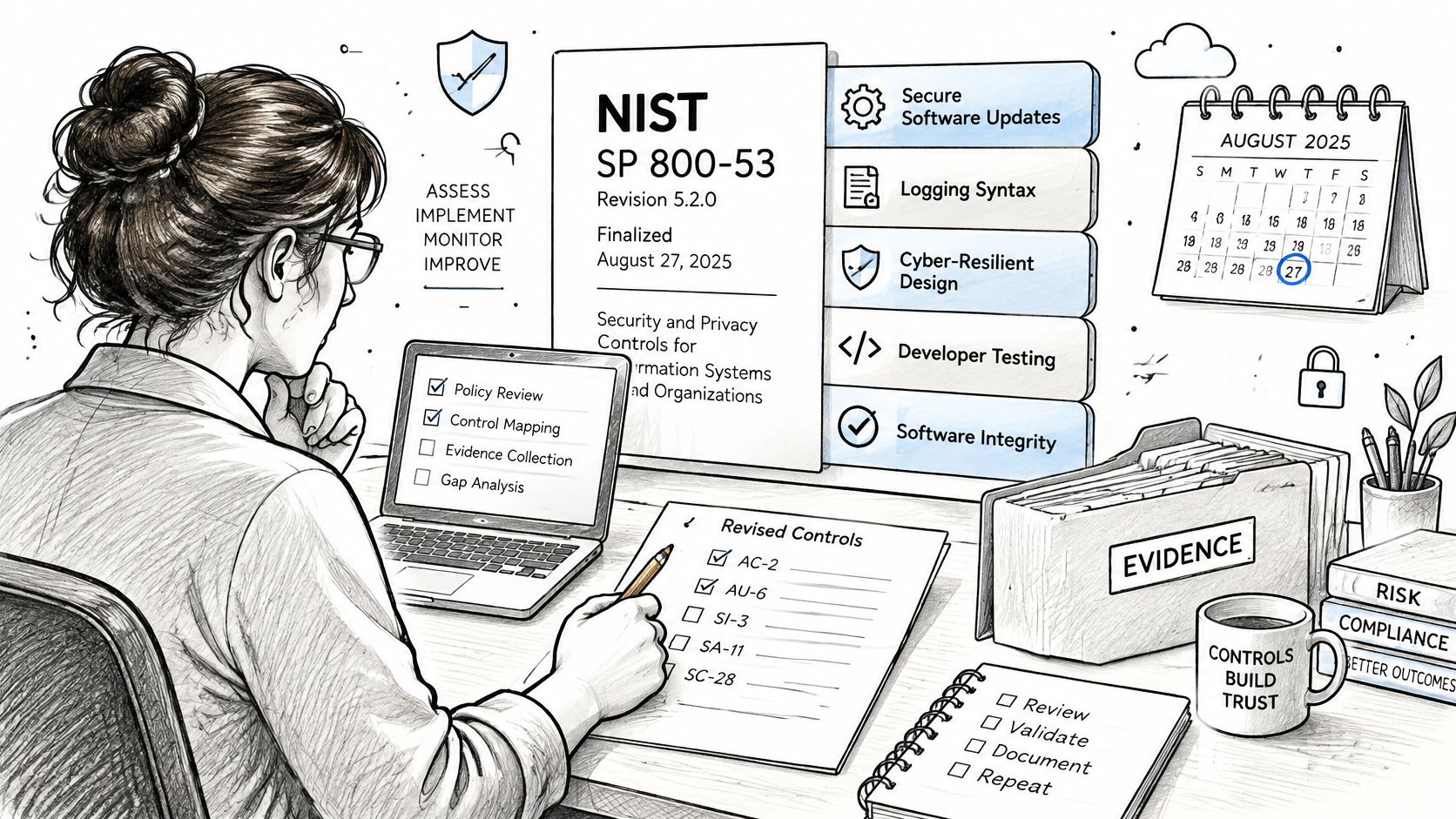
Release 5.2.0 was finalized on August 27, 2025, and the temptation is to file it as a minor update. NIST's SP 800-53 release page records it as adding or revising controls on secure software updates, logging syntax, cyber-resilient design, developer testing, software integrity and root-cause analysis.
The awkward part is what didn't change. The update left the SP 800-53B baselines alone, so every control file now carries a version question: which policies, system security plans, assessment procedures, evidence packages and customer mappings need revision, and which can stand as they are?
Two of the revised controls show how a catalog delta becomes an evidence problem.
Logging syntax. SA-15(13) addresses logging syntax in a way that supports automation and faster incident reconstruction. What satisfies it is machine-parseable logs that survive retention and correlation. A screenshot of a logging toggle turned to on proves neither.
Root-cause analysis. SI-2(7) requires root-cause analysis and an action plan after software-update issues. A patch record proves something got updated. It doesn't prove anyone worked out why the update caused trouble or what changes before the next one.
Release 5.2.0 also ships through NIST's Cybersecurity and Privacy Reference Tool in browser, OSCAL, JSON and spreadsheet formats, and the NIST release announcement sits beside corresponding SP 800-53A assessment updates that should be read alongside the catalog changes.
Four actions close the gap. Identify which controls and evidence packages are affected. Decide whether each finding reflects a new 5.2.0 expectation or an unchanged baseline requirement. Record the control version in every report you issue. Set an evidence freshness date, with the interval each artifact survives and the person who must produce the next one.
Confirm Your Control Mapping Before Your Next Assessment
Run this against one system, not the whole estate. Pick the report you'd hand a customer tomorrow and check it line by line.
- Baseline and parameter values. Confirm the system security plan states both, and that your tests were scoped against that version rather than last year's.
- Finding labels. Every finding names a control or enhancement, the affected asset and the test method. A finding missing any of the three is a vulnerability note, not control evidence.
- CA-8 mechanics. Defined scope, defined cadence, recorded execution. Lose one and the control isn't met, however good the test was.
- Authorization records. Check each target, including third-party cloud or hosting infrastructure, for a record of permission. A customer's ownership of its own subnet doesn't extend to a managed service it rents.
- Evidence dates. Flag anything expired or due for a 5.2.0 review, and put the refresh on a calendar with a name attached.
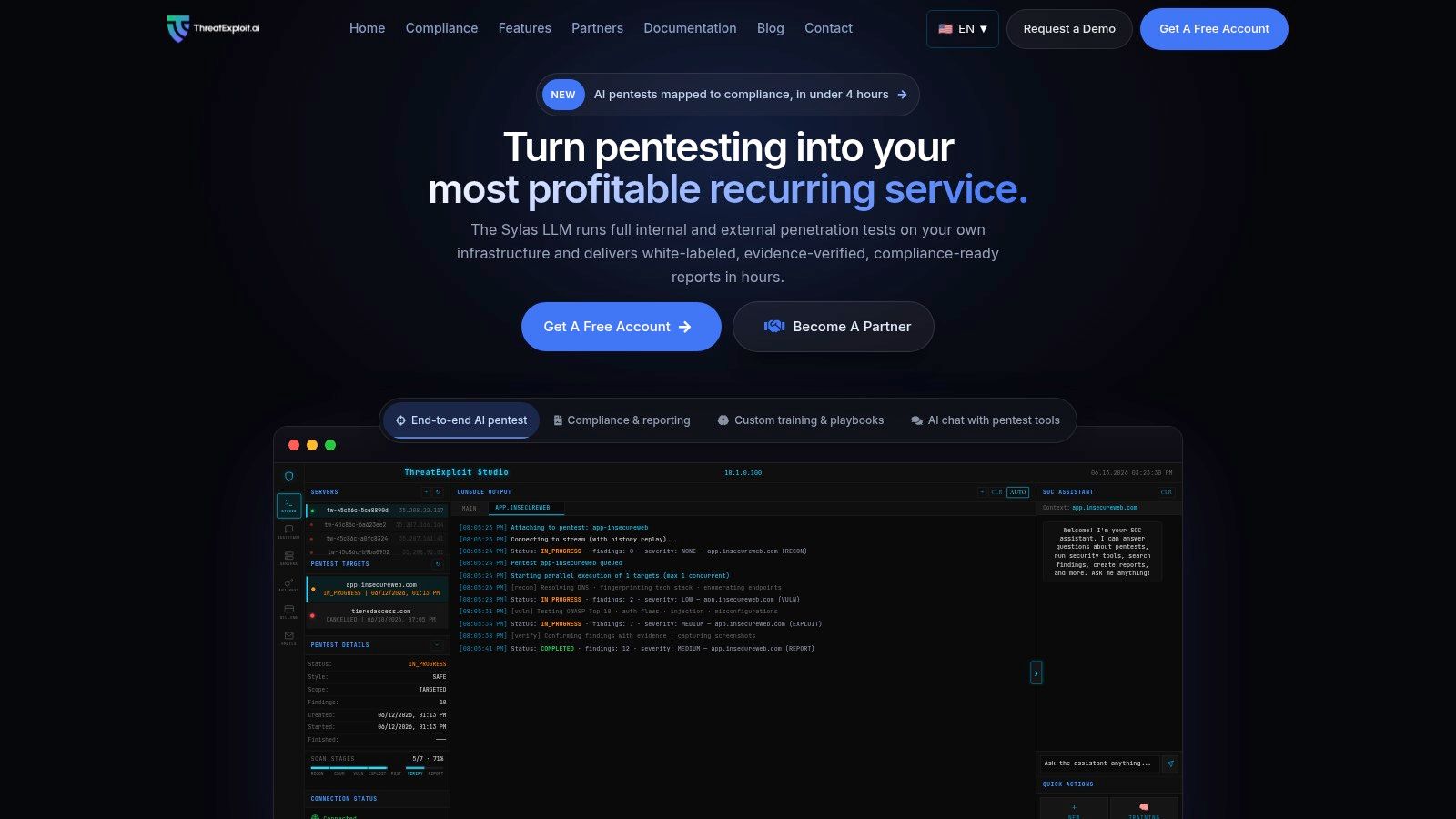
NIST treats automation as a legitimate part of this work. Its assessment guidance defines penetration testing as a controlled attempt to breach security and privacy controls using attacker techniques with appropriate hardware and software tools, and states that organizations should consider tools and attack techniques capable of conducting penetration-testing exercises in an automated manner whenever possible. The same guidance keeps automation inside the approved process, bounded by authorization, scope and rules of engagement.
Our engine runs only against targets the customer defines and authorizes, with scope, testing mode and schedule set before anything launches, and the reports auto-map findings to frameworks including HIPAA, SOC 2 Type 2, GLBA, PCI-DSS, CMMC and GDPR with specific control references.
Start with one finding. Find its control identifier, check that the six fields from the mapping rule are all present, and you'll know in ten minutes whether the rest of the report would survive an assessor's questions.
ThreatExploit AI runs automated penetration tests across web applications, networks and cloud infrastructure, and returns evidence-backed reports that map each finding to control references an assessor can follow, with screenshots, remediation steps and risk scoring attached. For teams delivering NIST 800-53 work across several customers, each engagement carries its scope and authorization record before a single test launches, and output arrives in both PDF and JSON for client delivery. Visit ThreatExploit AI to see how the engine handles a scoped test from reconnaissance through reporting.