
The most popular advice on DAST vs penetration testing is also the most misleading. You're told to run DAST often, book a penetration test once a year, and treat a clean scanner report as reassurance in between. That formula doesn't tell you what either test covered.
A clean DAST report only matters if it shows the tested surface, including the endpoints, roles, and workflows the scanner reached. A penetration test only matters if its scope covers the workflows an attacker would target. I would judge both methods by the gap between coverage and assurance, not by finding counts or scan dates.
Table of Contents
- DAST and Penetration Testing Side by Side
- Scope and Coverage Each Method Actually Reaches
- Detection Versus Exploitation in Practice
- False Positives and Missed Findings Compared
- Choosing the Method for Each Situation
- Where an Automated Pentest Platform Fits
- Build a Layered Testing Schedule
DAST and Penetration Testing Side by Side
DAST is automated testing of a running application that finds common, externally visible weaknesses at scale, while penetration testing is a risk driven assessment where a tester acts like an attacker and proves what's usable. OWASP's testing framework describes the two as complementary, with automated scanning identifying common known vulnerabilities at scale and penetration testing validating exploitability and impact. That distinction should shape how you buy, schedule, and read either result.
DAST vs penetration testing on core criteria
| Criterion | DAST | Penetration testing |
|---|---|---|
| Primary goal | Find known, externally visible weaknesses at scale | Prove which weaknesses are exploitable and what they expose |
| Typical trigger | Every build, release or scheduled run in CI/CD | Annual cycle, major architecture change or compliance requirement |
| Who operates it | Scanner configured by AppSec or DevOps | Human tester, often assisted by tools or an automated platform |
| Typical output | Lead list that needs triage | Validated findings with exploitation evidence and remediation guidance |
| Business logic and authorization | Weak; needs manual review | Strong; testers chain flows and swap roles |
| Repeatability | High; same scan configuration each run | Lower; depends on tester, scope and time box |
| Typical duration | Minutes to hours per scan | Days to weeks per manual engagement |
| Cost profile | Low marginal cost per run | Higher per engagement; scales with scope |
The table's sharpest line is the output row. A DAST result is usually a lead that needs triage, confirmation, and severity judgement. A penetration test finding should already carry exploitation evidence, affected roles, business impact, and remediation guidance.
If you're sorting the wider vocabulary first, this plain language guide to vulnerability scanning versus ethical hacking from Finchum Fixes IT is a useful companion. It reinforces the same practical boundary between automated identification and human led validation.
My working rule: DAST gives you repeatable breadth. Penetration testing gives you validated depth.
Neither replaces the other. The useful question for your application is where breadth stops being enough and where you need a tester to prove an attack path.
Scope and Coverage Each Method Actually Reaches
A report that says no findings can hide an uncomfortable fact. The scanner may never have reached the part of the application where the finding lives. That's the coverage gap buyers rarely ask about, and it's where DAST vs penetration testing becomes a measurement problem rather than a tool choice.
What a scanner can and cannot see
DAST reach is set by crawling, discovery, and authentication configuration. A scanner exercises routes linked from pages, forms it can submit, documented APIs you feed it, and roles for which it holds valid credentials. It misses unlinked endpoints, multi step workflows it can't complete, and role specific paths when it runs unauthenticated or with the wrong account.
OWASP's introduction to the Web Security Testing Guide makes the limit explicit. DAST can identify common vulnerabilities at scale, but automated tools can't reliably replace skilled analysis for business logic defects, authorization bypasses, and context specific risks, and DAST can't cover all source code paths because it only exercises functionality reachable through the deployed application.
Penetration test scope works differently. It's set in the statement of work through named hosts, user roles, APIs, workflows, and a time box. Within that scope, the tester chooses which paths to pursue, which is both the strength and the risk. A good tester follows risk, but anything outside the named scope stays untested no matter how skilled they are.
What large scale data does and doesn't prove
Scale alone doesn't settle the argument. Veracode's 2025 State of Software Security report analyzed 1.3 million unique applications and 126.4 million raw findings, of which 3.9 million came from DAST scans, roughly 3.1% of the total. That share reflects scan populations and coverage differences, not the share of vulnerabilities each method can find.
The same report found that adding DAST and SCA to SAST changed the proportion of applications with high severity flaws from 20% to 56.2%. I read that as evidence for layering methods, not for crowning one of them. Each mode sees a different slice of the problem.
Before you act on findings, it helps to connect them to fixes. This overview of practical mitigations for OWASP security risks from Foo Guard is a handy reference when you're turning scanner categories into engineering work.
Coverage metrics I would require on every report
- Crawled versus known endpoints: How much of the inventoried surface did the scan exercise?
- Authenticated versus unauthenticated paths: Which routes ran with a valid session, and which ran anonymously?
- Role and tenant combinations: Which user types and tenant boundaries were tested against each other?
- API schemas exercised: Which documented operations received requests, and which were skipped?
- Manually reviewed high impact workflows: Which payment, export, invite, and admin flows got human attention?
Building that inventory is the prerequisite, and a disciplined approach to attack surface mapping gives you the denominator those percentages need. Until those numbers sit on the report, a scan with no findings tells you almost nothing.
Detection Versus Exploitation in Practice
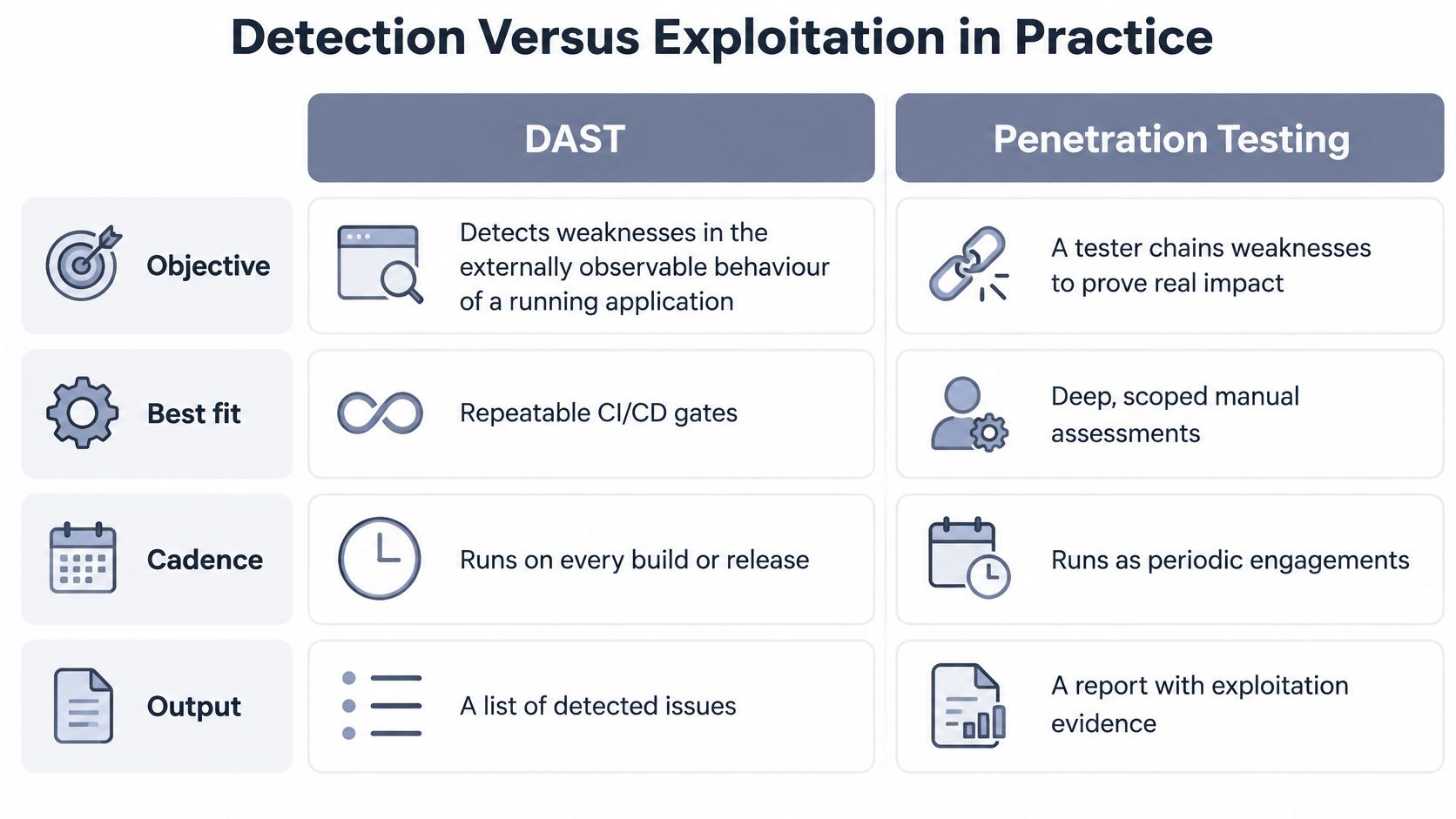
DAST and penetration testing answer different technical questions. DAST exercises a running application to detect weaknesses in its externally observable behaviour, which suits repeatable CI/CD gates and regression testing. Penetration testing uses human assessors, tools, and attack reasoning to get past controls, adding exploitability analysis and risk interpretation that scanner output doesn't carry.
The chart below sets the two objectives side by side before we walk through what they look like on real findings.
Example one where DAST flags and a tester proves
Say a DAST scan flags a reflected input on a search page as possible cross site scripting. The scanner saw its payload echoed in the response, so it raises a lead. It can't tell you whether the payload executes in a browser, whether content security policy blocks it, or whose session is at risk.
A tester takes that lead further. They craft a payload that survives the application's encoding, load it in a logged in admin page, and show script executing in the admin's session with the session token readable. Now you don't have a suspicion. You have evidence of account takeover risk, tied to a specific role.
Example two where DAST typically stays silent
Now consider an insecure direct object reference on an invoice endpoint. A scanner running with one test account requests its own invoice, gets a valid response, and moves on. Nothing looks broken, because the weakness only appears when you compare two tenants.
A tester logs in as two separate customers, captures both invoice identifiers, and swaps them. Customer A reads Customer B's invoice, including billing details. That finding needs two accounts, an understanding of tenant isolation, and deliberate role swapping, which is why scanners usually miss it. Building that kind of reproducible demonstration is exactly what a well constructed proof of concept exploit is for.
This division of labour isn't just practitioner preference. NIST IR 8397 distinguishes automated vulnerability identification from penetration testing as a validation technique, and business logic errors and race conditions generally require manual assessment. Detection proposes. Exploitation disposes.
The short walkthrough below shows how a tester moves from a scanner style signal to a confirmed, evidence backed result.
Read the outputs differently and your workflow improves. Send a DAST finding to a triage queue with a confirm or dismiss decision and a short deadline. Send a penetration test finding to remediation planning with severity, affected roles, an owner, and a retest requirement. Mixing those two queues is how real findings drown in scanner noise.
False Positives and Missed Findings Compared
A clean DAST report is not proof that an application is secure. It tells you something only when you know which authenticated paths and workflows the scanner exercised. A penetration test has the same limitation: its findings provide stronger assurance only when the scope includes the workflows that matter.
A false positive is a reported issue that is not exploitable. A false negative is a real weakness the method fails to report. These failures have different causes, so compare them separately.
Where each method gets it wrong
DAST can produce false positives when a response anomaly resembles an error but reflects harmless behaviour. False negatives arise when authentication or discovery is misconfigured. Pages the scanner cannot reach cannot produce findings, and an expired test account can make a deep scan shallow without making that gap obvious. Check the scan's authenticated coverage and confirm the intended roles and paths were exercised.
Penetration testers generally verify issues before reporting them, which keeps false positives low. Missed findings remain possible when the time box is short or attention follows one promising path while another workflow goes unexplored. Manual testing can validate the paths it reaches, but its coverage is bounded by the agreed scope and time.
The image below shows a routine but important step: reviewing scanner output before treating a potential issue as a confirmed finding.

What ground truth benchmarking shows
Vendor accuracy claims are hard to compare without a known test set. The OWASP developer guide to DAST tools points to the OWASP Benchmark project. OWASP Benchmark is a fully executable Java web application with 2,740 individually labeled test cases, each designated as vulnerable or non-vulnerable.
Precision varies widely by vulnerability category and should be measured for each tool. A single benchmark result does not establish how a scanner will perform against your application. Use the benchmark to ask for category-level evidence, then check it against the routes, roles, and workflows in your own scan scope.
Precision answers how many reported hits are real. Recall answers how many real weaknesses were reported at all. Both matter when judging a tool.
A scanner with high recall and mediocre precision may cover more ground but create more triage work. One with high precision and poor recall can produce a clean report while missing weaknesses. A single accuracy score obscures that trade-off, and neither score tells you whether the tested surface included the paths that matter.
Requirements I would put in procurement and delivery
- Tool-specific benchmark results: Request precision and recall by vulnerability category, rather than one blended score.
- Authenticated coverage measurements: Record which paths were exercised for each role on every production scan.
- Reproducible scan configurations: Version the scan profile so results from different runs can be compared.
- Human verification of exploitable findings: Confirm high-severity items before sharing them with a client or auditor.
Use DAST for repeatable breadth, and judge its output against measured coverage. Use penetration testing to examine scoped workflows through adversarial testing, while recognizing that untested paths remain outside its assurance. The practical comparison is not simply which method reports fewer issues. It is whether the scanner reached the intended surface and whether the test scope covered the business-critical flows.
Choosing the Method for Each Situation
A clean DAST report is useful only if you know what the scanner really tested. A penetration test gives meaningful assurance only when its scope includes the workflows and attack paths that matter. Choose the method by the question you need answered, then check coverage before treating the result as evidence.
Lead method by situation
| Situation | Lead method | Why it fits |
|---|---|---|
| Every pull request or nightly build | DAST, alongside SAST | Repeatable regression coverage at low marginal cost |
| New authentication, SSO or role model | Penetration testing | Human reasoning can test authorization across roles |
| PCI DSS annual test or after significant change | Penetration testing | The obligation calls for adversarial testing, with findings retested as applicable |
| Vendor security assessment due in two weeks | Automated pentest platform, if the requesting party accepts its results, with DAST evidence | A scoped platform can provide evidence quickly when manual scheduling is not possible |
| New internet-facing API release | DAST first, then targeted penetration testing of changed flows | DAST covers the release broadly; manual testing examines changed workflows in depth |
Why compliance draws a hard line
DAST can identify likely vulnerabilities, but a scan report does not by itself meet a formal penetration-testing obligation. PCI DSS requires penetration testing at least annually and after significant changes, with findings retested as applicable. Confirm the required scope and evidence with the party responsible for the assessment.
DAST still supports regulated programs. Repeated scans provide evidence of ongoing application testing between formal engagements. The penetration test remains a separate exercise, scoped to examine attack paths, segmentation where applicable, and whether remediation addressed the findings.
A scanner reports what it detects. A penetration test establishes what an attacker can do within the tested scope.
Budget against coverage, not application count
DAST costs are driven largely by configuration and per-run compute. Once authentication and crawling work properly, repeat scans have a low marginal cost. Penetration-testing costs depend on the tested surface, engagement duration, and tester skill. A vague scope risks producing a vague quote and a result that is hard to interpret.
Set the budget against the coverage you need, not a flat price per application. Name the roles, tenants, APIs, and high-impact workflows the tester must examine. Then compare the quote with that scope: a larger number of shallow tests can provide less assurance than fewer, deeper tests.
Some releases warrant both methods. A new payment flow, rebuilt identity system, or new internet-facing API can receive broad DAST coverage alongside human testing of changed logic. The value comes from seeing both the tested surface and the attack paths examined, not from counting reports.
Where an Automated Pentest Platform Fits
Start with what an automated pentest platform cannot replace. It won't make business logic judgements about whether a refund flow should allow partial amounts, it won't invent unusual attack chains that depend on your organisation's quirks, and it won't own risk decisions. If a vendor claims otherwise, walk away.
What sits between scanner and manual engagement
Automated pentest platforms occupy the middle ground in DAST vs penetration testing. They run reconnaissance, exploitation, and verification with evidence, which DAST doesn't do, but at a cadence and breadth manual testing can't match. That positioning makes them an evaluation exercise, not a leap of faith.
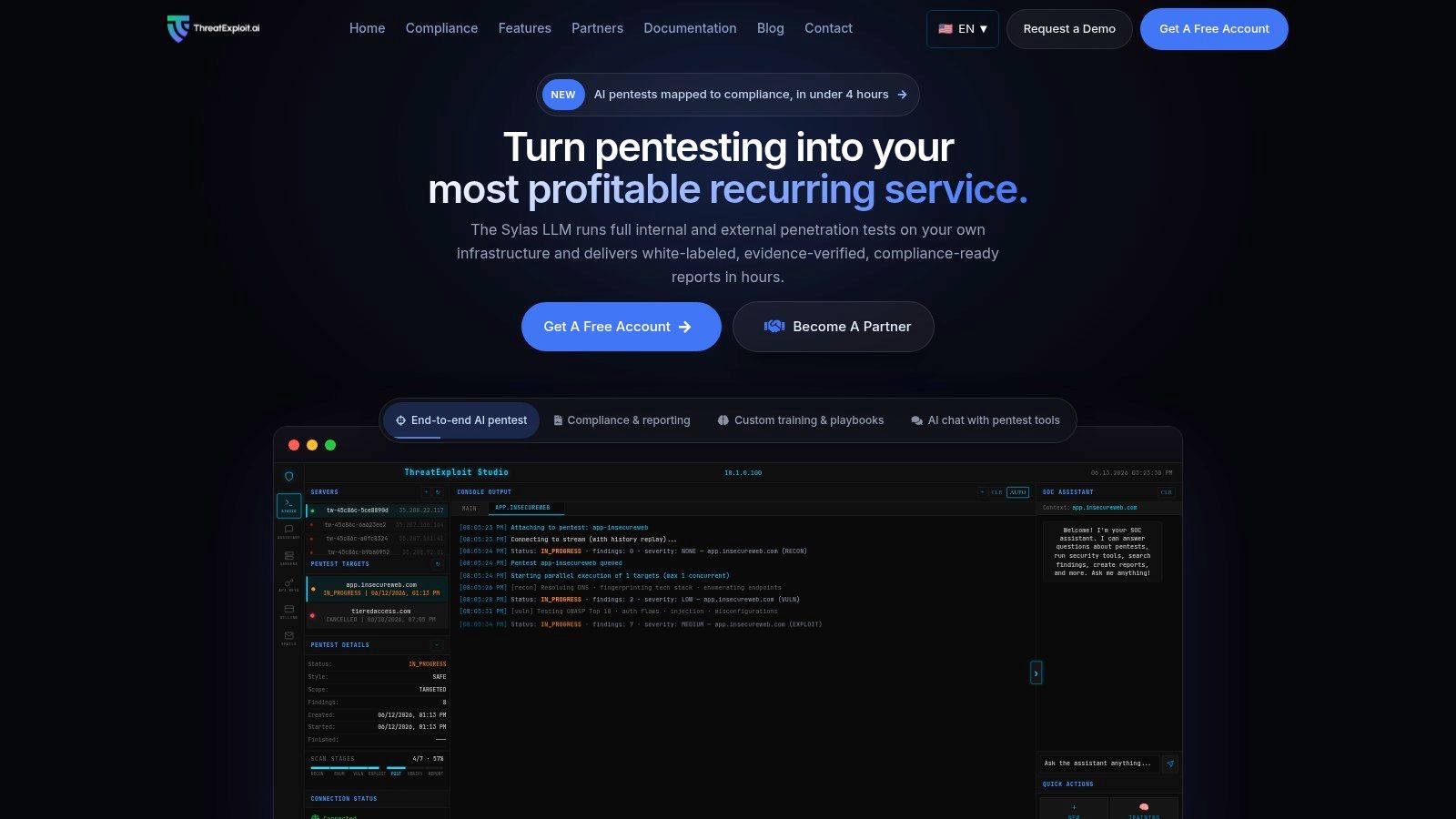
ThreatExploit AI documents an agentic controller orchestrating the seven PTES phases, with a toolchain of more than 60 tools including Nmap, SQLMap, and Nuclei. Its stated coverage spans web applications with REST and GraphQL APIs, networks, and AWS, Azure, and GCP environments. Reports come in PDF and JSON with screenshots and compliance mapping for PCI DSS, SOC 2, and ISO 27001.
The screenshot below shows the kind of dashboard view you should inspect during evaluation, paying attention to how findings, evidence, and coverage are presented rather than how polished the charts look.
Treat the headline numbers as vendor stated claims until documentation or independent results back them. The platform reports a 95% verification rate and 94% overall accuracy, with reports in under four hours in typical workflows. Those figures are plausible evaluation targets. They aren't proof, and you should test them against your own environment.
Where it augments, replaces, and stops
Augmentation is the strongest case. You get deeper runs more often than an annual manual test allows, fast retesting after fixes, and endpoint breadth across each release without booking tester weeks. For MSSPs and consultancies, that cadence also smooths delivery across many clients.
Replacement is narrower. For routine point in time assessments of lower risk assets, an automated platform can stand in for a manual test, but only once the client's auditor has confirmed acceptance in writing. Assuming acceptance and discovering otherwise at audit time is an expensive mistake.
I would run a proof of concept against a known vulnerable target before buying anything in this category. Seed it with findings you already know exist, including at least one authorization flaw, and see what the platform catches, misses, and mislabels. Then read the report for the two things that matter most, tested surface coverage and an explicit list of untested areas. A platform that hides its blind spots will hide yours too.
Build a Layered Testing Schedule
A layered schedule turns the DAST vs penetration testing debate into a calendar. Each step below exists because the one before it leaves a specific gap. Follow the order and the gaps close in sequence.
The flow below summarises the rhythm before you adapt the steps to your own portfolio.
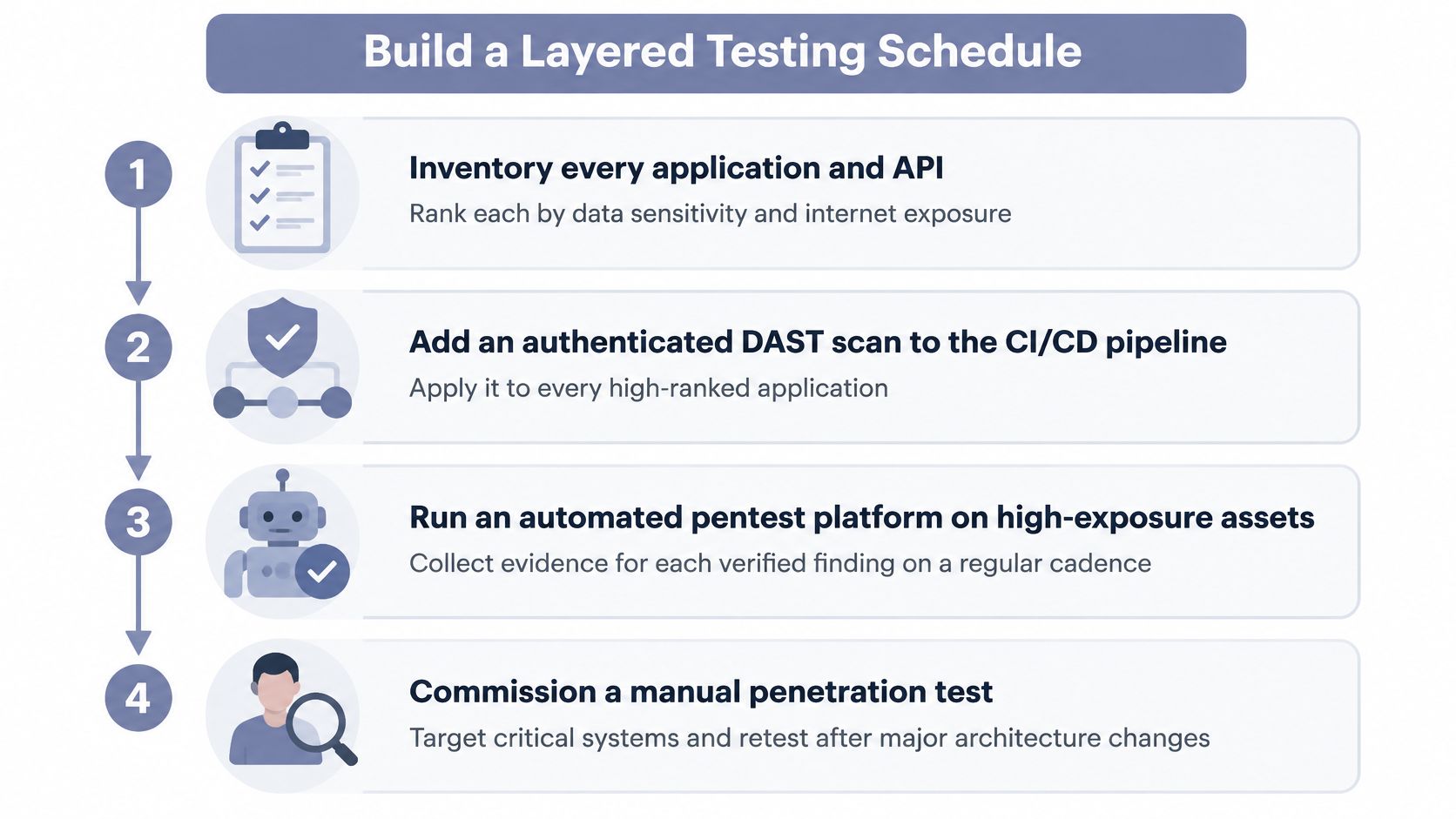
- Inventory every application and API. Rank each by data sensitivity and internet exposure, because you can't measure coverage against a surface you haven't listed.
- Add an authenticated DAST scan to CI/CD for each release. Run it against staging with test accounts for every role, and treat broken authentication in the scan config as a pipeline failure. A structured approach to CI/CD pipeline security testing keeps that gate consistent across teams.
- Schedule a nightly DAST run on production like environments. This catches configuration drift, expired certificates, and newly exposed routes that release based scanning misses.
- Commission a penetration test for each high risk application once a year. Bring it forward after any change to authentication, payments, or tenant isolation, and name the critical workflows in the statement of work.
- Require a retest of every high severity penetration test finding. Don't close the ticket on a developer's say so. Verified closure is what separates remediation from optimism.
- Record coverage metrics each cycle. Track crawled versus known endpoints, the authenticated share of paths, and manually reviewed workflows, then compare cycles so regressions in coverage become visible.
- Feed the misses back into the system. Confirmed DAST false positives should tune scan configuration, and paths a tester couldn't reach should land in the next statement of work.
Start with one application rather than the whole portfolio. Run a baseline authenticated scan, publish your first set of coverage numbers internally, and fix the discovery gaps they expose. Once that loop works on one system, expanding it is mostly repetition.
If your team needs penetration test depth at a cadence manual scheduling can't sustain, ThreatExploit AI runs autonomous reconnaissance, exploitation, and verification across web, network, and cloud targets and returns evidence backed, compliance mapped reports your clients can act on. Put it through a proof of concept against a target with known flaws, check the report for tested coverage and untested areas, and judge it the same way you'd judge any tester.