
Autonomous penetration testing is an agent-driven test that plans and runs reconnaissance, exploitation, verification and reporting inside a scope that people set and approve.
You've approved a release, your client wants assurance, and your senior tester is already committed elsewhere. An agent can help close that testing gap, but only if you can tell what it attempted, what it proved, and when it must stop for a person's decision.
Table of Contents
- What Autonomous Penetration Testing Means
- How It Differs From Manual Testing and Scanners
- How the Agentic Workflow Runs Phase by Phase
- Why Verified Evidence Matters More Than Finding Counts
- Where Autonomy Should Stop and Humans Take Over
- Data Governance and Report Defensibility
- Real Scenarios Where Autonomous Testing Fits and Fails
- Choose Your Testing Mix and Run a Proof of Concept
What Autonomous Penetration Testing Means
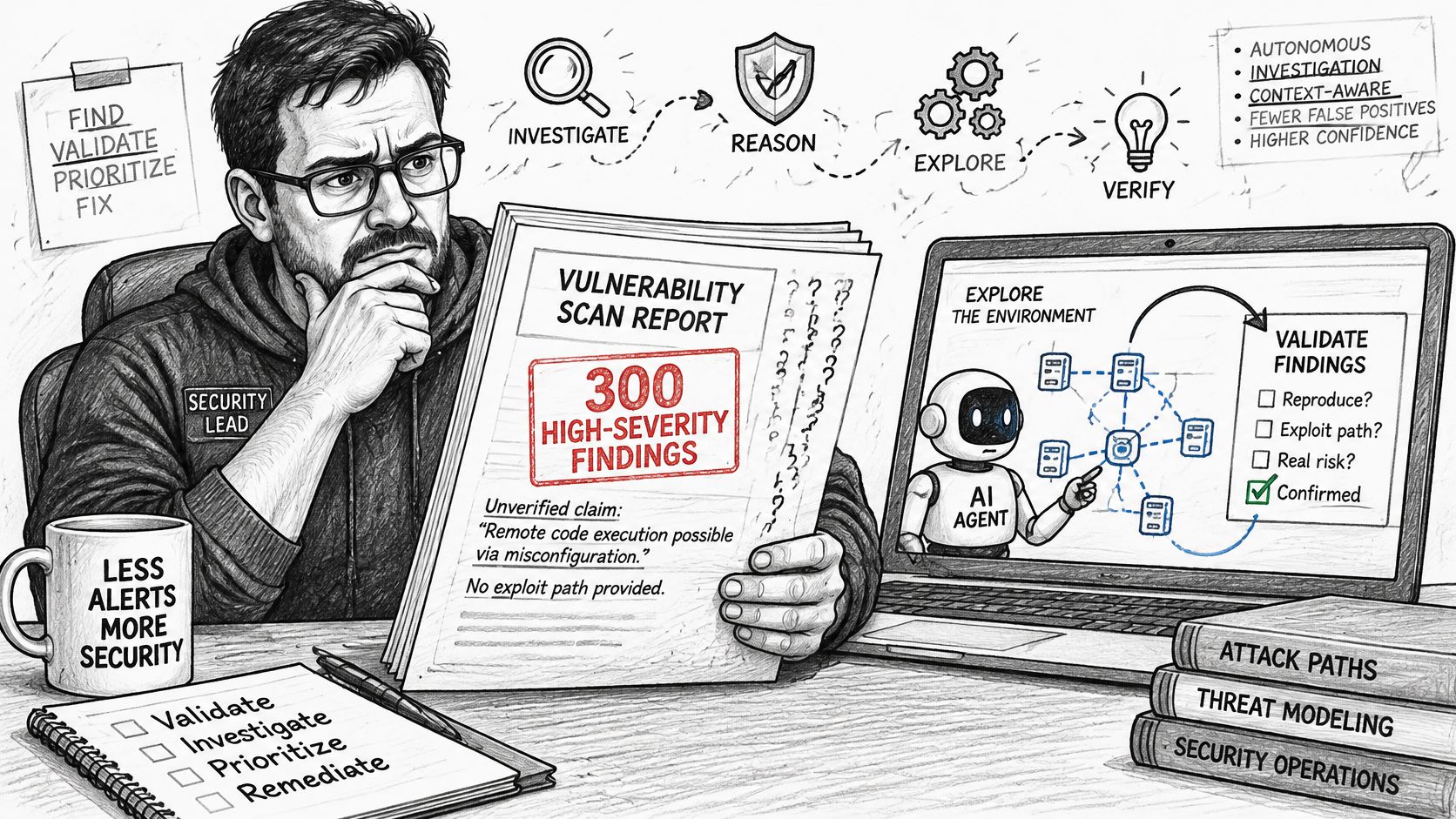
Say you're a security lead holding a scanner report with 300 high-severity findings. That's a hypothetical workload, not evidence of compromise. The immediate question isn't how many warnings the scanner produced. It's which weaknesses an attacker could use.
An autonomous agent should investigate that question inside your approved boundaries. It gathers context, chooses a test, observes the result, and uses that observation to decide what to do next.
The working relationship looks like this:
Autonomy means choosing, not just executing
Think of an aircraft's autopilot. The system follows the route and handles routine corrections. The pilot sets the flight plan, watches the instruments, and takes control when conditions exceed the system's operating limits.
Penetration testing means attempting an attacker-style action to establish whether a weakness is real. Autonomous means the agent selects its next action from observations rather than advancing through a fixed script. Neither word removes the need for authorization or accountable review.
For example, an agent might discover a login endpoint, recognize that it accepts a password-reset token, and select a permitted check of token handling. A script would run its predetermined checks whether or not that behavior appeared.
Why security leads are paying attention
Vulnerability exploitation accounted for 20% of breaches as an initial access vector, a 34% increase from the previous year, and 70% of exploitation-related breaches involved unpatched services, according to Verizon's 2025 DBIR findings. Those findings support more frequent validation, not a claim that autonomous testing alone prevents breaches.
Commercial interest is growing around that need: Dataintelo valued the global autonomous penetration-testing-platforms market at USD 450.0 million in 2025. Market size, however, doesn't establish technical capability.
The useful distinction is operational: a scanner identifies candidates, a manual tester investigates them using human judgment, and an autonomous tester delegates bounded investigative decisions to an agent.
How It Differs From Manual Testing and Scanners
A scanner flags a possible weakness; a penetration test attempts to prove exploitability. The PCI Security Standards Council's penetration-testing guidance distinguishes those purposes and describes penetration testing as a manual process that may incorporate automated tools. Don't assume an autonomous run automatically satisfies every formal testing obligation.
Autonomous testing occupies the operational space between repeatable scanning and human-led investigation. It aims to perform an investigative attack chain with recurring execution, but its effectiveness rests on scope enforcement, verification, and escalation.
Scanner, manual pentest and autonomous pentest compared
The timing entries below are planning expectations, not benchmark guarantees. Measure actual turnaround during your pilot.
| Criterion | Vulnerability scanner | Manual penetration test | Autonomous penetration test |
|---|---|---|---|
| What decides the next action | Known signatures and version checks | Tester judgment at every step | Agent selects the next action within scope rules |
| Proves exploitability | Rarely, flags a possible weakness | Yes, through tester-controlled validation | Yes, when verified exploit steps succeed |
| Typical cadence | Continuous or scheduled | Periodic and after significant changes | On demand or recurring |
| Speed to first results | After initial checks complete | After access, scheduling, and investigation | After discovery and initial validation |
| Consistency across targets | High but shallow | Shaped by tester expertise and methodology | High for repeatable checks |
| Business logic flaws | Usually misses workflow abuse | Strong with business context | Weak without human guidance |
| Chained multi-host attacks | Doesn't investigate attack chains | Strong with authorized access | Limited on complex end-to-end tasks |
| Evidence per finding | Scanner log entry | Written narrative and screenshots | Structured request, response, and timestamp artifacts |
| Accountability | Operator owns interpretation, vendor owns tool behavior | Named tester and firm | Provider and reviewing human |
Where human judgment still wins
A checkout process can return technically valid responses while allowing an unauthorized refund. Account recovery can work exactly as implemented while granting the wrong person control. Recognizing these problems requires understanding who should be allowed to do what, not just identifying vulnerable software.
Manual testers also evaluate business impact. Access to a demonstration record and access to a customer's financial history may share a technical mechanism but require different handling and remediation priorities.
For a closer selection framework, use our comparison of manual versus automated penetration testing. When evaluating the supporting toolchain, GoReplay's guide to practical AI security testing tools provides useful context for the tools an agent may coordinate.
Read the table against the asset, not against a preferred technology. Choose scanning for broad inventory, autonomous testing for repeatable investigation, and manual-led work where contextual reasoning determines whether a result is dangerous.
A tool's ability to launch an exploit isn't the same as its ability to deliver a defensible penetration test.
How the Agentic Workflow Runs Phase by Phase
The agentic loop is observe, decide, act, check, and repeat. A controller preserves state so the agent can distinguish a new observation from something it already tested. Without that memory, it may repeat ineffective actions or lose the relationship between a suspected weakness and its proof.
The loop describes decision-making, not separate engagement phases:
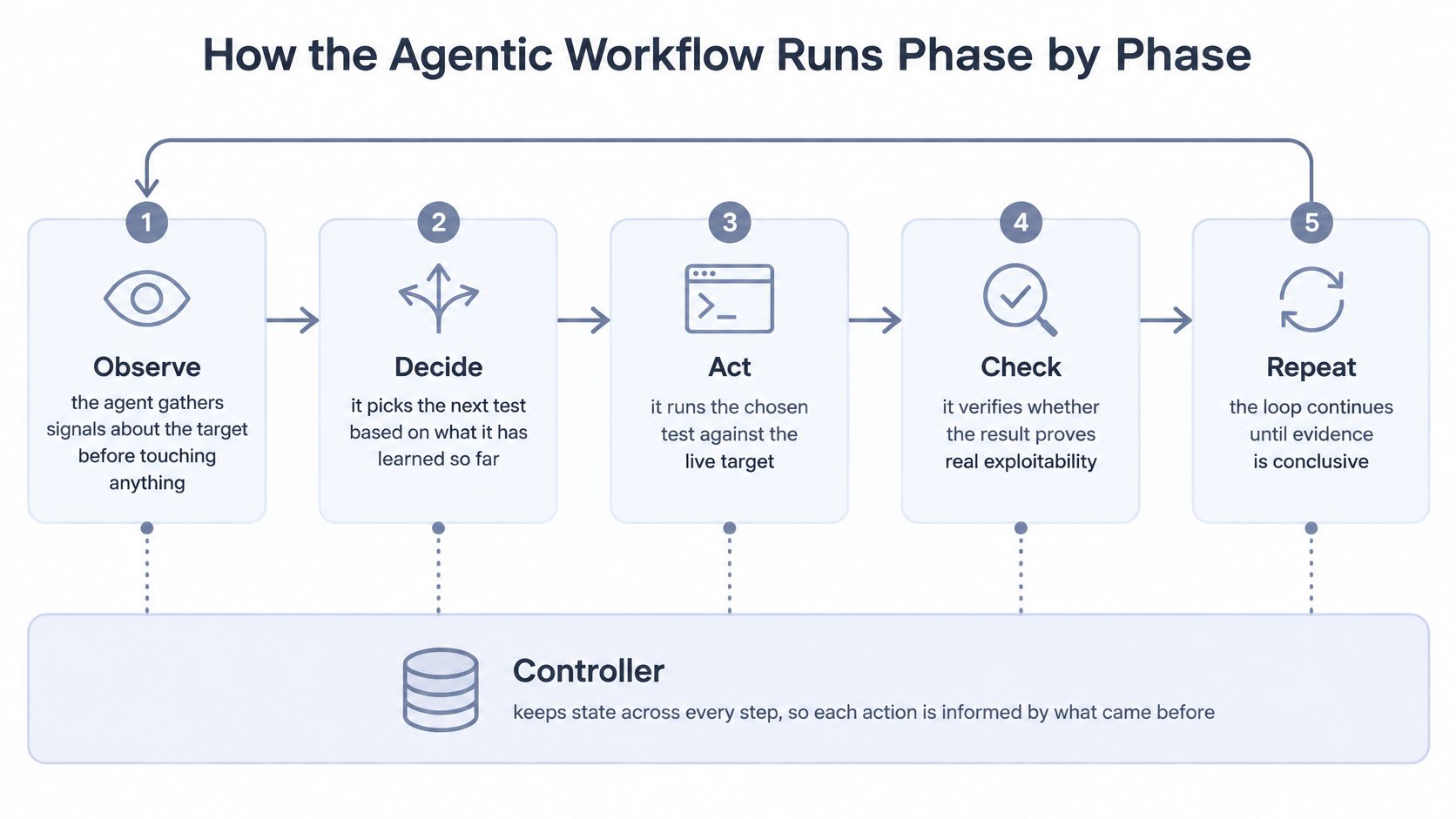
NIST SP 800-115 defines four penetration-testing phases: planning, discovery, attack, and reporting, with reporting occurring concurrently with other phases. An agentic controller should preserve that discipline rather than saving documentation until execution ends.
From authorization to an attack hypothesis
Scope lock comes before traffic. Load the allowlist, permitted identities, testing windows, prohibited actions, and escalation contacts. Enforce these restrictions at the execution boundary, not just in the agent's prompt.
Discovery then builds a model of the environment. For web applications, the OWASP Web Security Testing Guide recommends passive exploration and information gathering to understand application logic, access points, headers, parameters, cookies, and APIs before aggressive testing.
The agent might identify REST or GraphQL endpoints, associate them with authenticated roles, and record which operations appear to change state. Weakness filtering narrows those observations into plausible hypotheses. Attack-path selection then ranks permitted tests by likely impact, confidence, and operational risk.
Agent phases, outputs and human checkpoints
| Phase | What the agent does | Artifact produced | Human checkpoint |
|---|---|---|---|
| Scope lock | Loads allowlisted targets and rules of engagement | Signed scope record | Authorization confirmed before any traffic |
| Discovery | Enumerates hosts, services, APIs, and cookies | Asset inventory | Out-of-scope discoveries flagged |
| Weakness filtering | Matches signals to plausible weaknesses | Candidate list with confidence scores | Low-confidence items queued for review |
| Attack path selection | Ranks paths by likely impact | Ordered attack plan | Approval if a path touches production data |
| Exploitation | Runs tools such as SQLMap under per-tool policy | Request, payload class, and response | Gate for destructive proof-of-concept |
| Verification | Replays the exploit and confirms the relevant state change | Reproducible evidence bundle | Reviewer confirms severity |
| Reporting | Writes findings mapped to controls | PDF and JSON report | Reviewer edits before delivery |
Execution policies should reflect the tool's behavior. Nmap needs explicit discovery limits, Nuclei needs approved templates, and SQLMap needs restrictions on techniques and data extraction. Allowing a tool name isn't sufficient if its options can cross the engagement's boundaries.
Verification checks whether the observed response or authorized state change supports the hypothesis. The controller should preserve unsuccessful attempts too, because they explain coverage gaps and prevent a later agent from treating an untested assumption as fact. Reporting then connects the validated technical condition to remediation and relevant controls.
Why Verified Evidence Matters More Than Finding Counts
A scanner may report that a parameter appears injectable. A verified finding demonstrates that a controlled input changed the response in a way that establishes the suspected condition. A server error alone doesn't prove that the application executed an injected query.
Think of a finding as an accusation and its evidence as the exhibit that must survive cross-examination. Another tester should be able to distinguish a causal result from ordinary application behavior, caching, expired sessions, or a tool's mistaken interpretation.
What a finding must preserve
Keep an evidence bundle with:
- Target identifier: The affected asset, endpoint, and relevant role.
- Timestamp: When the test ran and which environment was tested.
- Tool invocation: The executable, relevant options, and version context.
- Payload class: The kind of input used, with sensitive values protected.
- Observed response: The behavior that supports the conclusion.
- Screenshot or log: Corroborating evidence tied to the actual test.
- Confidence score: The system's assessment, kept separate from severity.
- Safe reproduction procedure: Preconditions, permitted steps, and expected outcome.
A separate validator should replay the proof using fresh observations. Where possible, compare a control request with the test request and reject conclusions that don't establish causality. Preserve unconfirmed candidates outside the confirmed-findings list.
What large-scale demonstrations actually establish
In its final scored competition, systems in DARPA's AI Cyber Challenge analyzed synthetic vulnerabilities across 54 million lines of code, discovered 54 unique vulnerabilities in 63 challenges, and produced patches for 43. These results demonstrate cyber-reasoning capability in controlled open-source challenges, not an accuracy rate for enterprise penetration tests.
That distinction matters when a vendor presents a success metric. Ask what counted as a discovery, what qualified as verified, and whether an independent process reproduced the result. A system can correctly validate the issues it reports while missing important weaknesses entirely.
Evidence rule: Confidence is a reason to investigate. Reproducibility is a reason to accept the technical finding.
Even reproducibility isn't sufficient for audit-grade proof. Reviewers must also establish authorization, affected business processes, severity rationale, and remediation priority. Our guidance on evidence-based report writing helps turn technical artifacts into findings an engineering team can act on.
After remediation, use the original preconditions and proof to retest. A blocked request only establishes a fix if the relevant functionality still works and the exploit condition no longer does.
Where Autonomy Should Stop and Humans Take Over
In AutoPenBench, a fully autonomous agent achieved a 21% success rate, while human-assisted agents reached 64% across the evaluated vulnerability-testing tasks. That gap supports treating agents as expert-team force multipliers, not unsupervised substitutes for complex end-to-end work.
A plausible plan can still fail when the agent must maintain credentials, adapt an exploit, reason across hosts, and verify the final outcome. The right response isn't to prohibit automation. It's to allocate authority according to risk.
Autonomy tiers with approval and evidence requirements
Use the following as a proposed operating model, not a universal industry standard. Each tier remains subject to the engagement's original authorization.
| Tier | Typical actions | Approval required | Evidence kept |
|---|---|---|---|
| Tier 1, non-invasive | Asset discovery, version checks, passive review | No additional approval within allowlist and rate limits | Request logs and asset inventory |
| Tier 2, low-impact verification | Replay of a known-safe check | Automatic above an approved confidence threshold | Replay output and response comparison |
| Tier 3, gated exploitation | Proof-of-concept exploit, first on non-production targets | Human approval for each target | Payload class, screenshot, and rollback note |
| Tier 4, sensitive actions | Privilege escalation, data access, state changes, proposed out-of-scope pivots | Human only, with kill switch ready; expanded scope requires new authorization | Operator decision record |
Confidence alone must never authorize a sensitive action. An agent can be highly confident that a request will delete a record, which is exactly why the controller should block it.
Make the approval enforceable
For gated work, show the reviewer the target, intended effect, data touched, expected evidence, and rollback procedure. Bind approval to that specific action rather than granting a general permission to continue. Our guide to safe versus aggressive automated pentesting expands on that operational distinction.
At ThreatExploit AI, for each engagement on our autonomous platform or Studio, the customer must confirm and attest that they're authorized to test the specified targets and scope. Customers may not test third-party cloud, hosting, telecom, or SaaS infrastructure without following the provider's testing policies and obtaining any required authorization.
Record who approved or rejected each sensitive action, why they decided, and what happened afterward. Those records support client assurance, cyber-insurance questions, and audits. Assign someone who can stop execution, revoke credentials, and coordinate recovery if behavior exceeds the approved impact.
Approval gates, not maximum autonomy, are the differentiator. They make recurring testing a controlled service rather than an open-ended experiment.
Data Governance and Report Defensibility
An autonomous run can collect credentials, screenshots, source fragments, cloud configuration, and reconnaissance output. Treat those artifacts as customer-sensitive information, not disposable debugging material. A successful test can still be unacceptable if evidence travels through an unauthorized processing location.
Establish the handling rules before testing
Put the following into the engagement's data-handling checklist:
- Residency: Identify where processing, inference, backups, and evidence storage occur.
- Access: Name the roles permitted to view raw artifacts.
- Retention: Define the retention period, deletion procedure, and backup treatment.
- Model training: Obtain written confirmation that customer data is excluded.
- Encryption: Protect credentials and screenshots in transit and at rest.
- Redaction: Remove secrets and unnecessary personal information before report delivery.
Dedicated infrastructure, private-cloud inference, self-hosted models, and external APIs create different processing paths. Map the complete path, including support access and logging, rather than treating a deployment label as proof of isolation.
Keep enough evidence for another tester to reproduce the conclusion, not enough customer data to recreate the customer's database.
Preserve the chain of custody between raw output, redacted evidence, and delivered findings. A reviewer should know who transformed an artifact and why. For regulated engagements, resolve these handling decisions before the agent receives credentials.
Real Scenarios Where Autonomous Testing Fits and Fails
Example of a portal release
A managed security provider's client releases a customer portal on Friday. On Monday, an authorized recurring run discovers an exposed administrative endpoint. A scanner might classify its presence as informational; the agent investigates whether the endpoint enforces authentication.
This illustration shows the kind of bounded workflow involved:
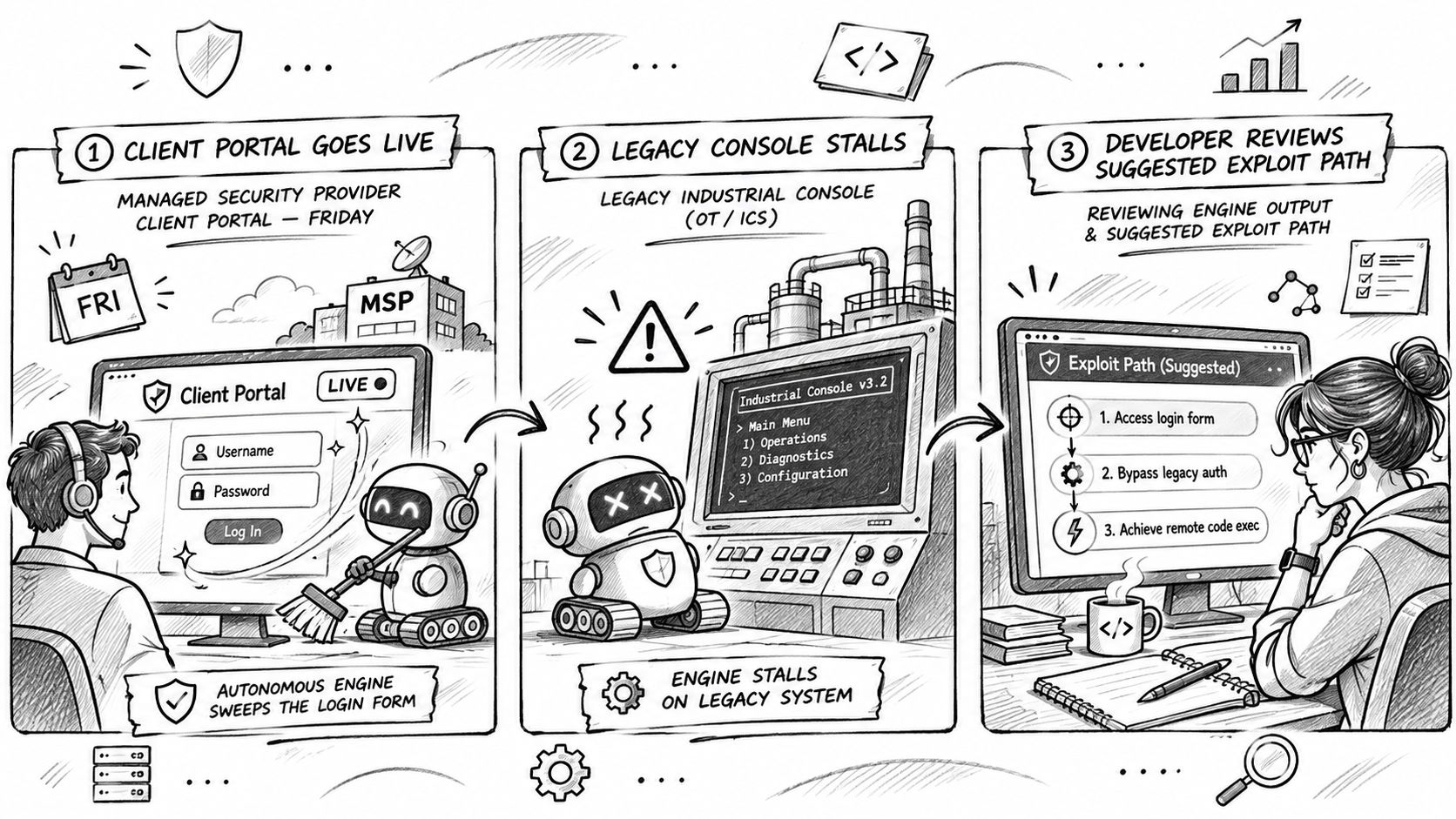
In this hypothetical example, safe replay establishes an authentication weakness without extracting customer data. A human tester evaluates the business impact and approves a Tier 3 test on staging. The provider then informs the client with validated evidence and a clear remediation path, subject to any engagement requirement for earlier notification.
Lesson: Repeated external testing fits bounded, observable conditions that can be checked without unnecessary production impact.
Example of an urgent compliance request
Another client needs testing evidence after a significant infrastructure change. The provider already has an asset inventory and recurring results, but the reviewer still checks whether the new engagement covers the changed environment and required test types.
PCI DSS 4.0.1 requires external and internal penetration testing at least once every 12 months and after significant infrastructure or application upgrades or changes; service-provider segmentation testing is required at least every six months and after changes to segmentation controls or methods. Scheduled automation can support that workload, but a recurring run isn't automatically evidence that all applicable requirements were met.
Lesson: Use automation to maintain readiness, then have a qualified reviewer establish coverage and acceptance.
For a visual companion to these workflow examples, consider the following video:
Example of a missed checkout flaw
A retailer's checkout flaw appears only when a discount, a refund, and a particular account role interact. Every individual request returns an ordinary response. The agent checks each endpoint but never constructs the prohibited business sequence.
A manual tester asks whether the final refund exceeds the amount the customer paid. That question reveals the missing invariant and guides a controlled reproduction using test accounts.
Lesson: Match the method to the weakness. Technically normal responses don't establish that a business process is safe.
Choose Your Testing Mix and Run a Proof of Concept
Choose autonomous-first testing for recurring external and web assessments with stable scope. Choose manual-led testing for business logic, novel architectures, and high-impact regulated segments. For most service providers, a hybrid approach gives agents the repetitive work while people retain investigative judgment and delivery accountability.
Test the operating model, not just the engine
A useful proof of concept includes known weaknesses, clean targets, and deliberate approval boundaries. You need to learn whether the system can reject an unsupported finding and stop an unauthorized action, not just whether it can discover a vulnerability.
- Confirm authorization and scope. Retain approval records for every target, including staging systems and externally hosted services.
- Assign approval owners. Define the autonomy tiers and name the person who can approve, reject, or stop sensitive execution.
- Set automatic-replay criteria. Establish a confidence threshold alongside impact restrictions. A confidence score must not override a prohibited-action policy.
- Use representative environments. Test a lab with known vulnerabilities and a production-like staging target. Include authenticated roles and realistic session behavior.
- Measure complete outcomes. Track stage-level completion, verified-finding rate, false positives, missed known weaknesses, and time to a complete report. Define the denominator for each metric.
- Inspect every evidence bundle. Have another tester reproduce the conclusion and check that redaction hasn't removed the information needed to validate it.
Expand only after the controls work
Include a stop condition in the pilot. For example, suspend expansion if the engine attempts an out-of-scope request or reports a confirmed finding without reproducible evidence. Resolve the failure before increasing coverage.
To get started with us, create a free account through the registration portal, explore the platform, and run an authorized test pentest to inspect results firsthand.
Start with a single external asset class. Measure evidence quality and approval behavior, then expand only when the operating boundaries hold up in practice.
ThreatExploit AI offers an AI-powered penetration testing engine for security service providers, with automated reconnaissance, exploitation, verification, and evidence-backed reporting. Visit ThreatExploit AI to evaluate it against an authorized pilot scope and assess the results using your own evidence and approval criteria.