
Fully automated testing reliance fell from 29% to 9%, while 47% of organizations preferred a hybrid model, and 78% of organizations using fully automated scanning experienced missed critical vulnerabilities or false negatives. The practical answer is clear: use automation for breadth, frequency, and evidence collection, then assign human testers to validation, exploit chaining, and business logic.
That conclusion changes the question MSSP owners should ask. Manual vs automated penetration testing isn't a contest between a skilled consultant and a faster scanner. It's an operating-model decision about where scarce expertise creates the most risk reduction, where repeatable automation improves delivery economics, and where neither method should be trusted without verification.
A manual engagement can produce the contextual judgment a scanner lacks, but it consumes senior analyst time and usually delivers a point-in-time view. Automated testing can inspect large estates repeatedly, but its output may include noise, miss exploit paths, or create confidence that hasn't been earned. The right model therefore depends on the target, the client promise, the reporting requirement, and the consequences of an overlooked flaw.
| Decision area | Manual testing | Automated testing | Hybrid operating model |
|---|---|---|---|
| Primary strength | Context, creativity, and exploit validation | Breadth, speed, and repeatability | Scalable coverage with human verification |
| Best fit | Complex applications and high-risk systems | Large, changing estates and routine checks | Most recurring MSSP delivery programs |
| Main limitation | High effort and narrow scale | False positives and limited business context | Requires clear workflow ownership |
| Typical output | Nuanced attack narrative | Repeatable findings and evidence | Prioritized, validated client report |
Table of Contents
- The Market Reality Behind Manual and Automated Penetration Testing
- Economics and Timeline - The Hidden Costs of Each Approach
- Accuracy, False Positives, and Finding Quality
- Coverage Breadth Versus Depth in Real Engagements
- Compliance Mapping and Reporting Requirements
- When to Choose Manual, Automated, or Hybrid Models
- Building a Hybrid Operating Model for Scale
The Market Reality Behind Manual and Automated Penetration Testing
The shift away from fully automated testing is more revealing than a simple preference survey. A 2026 survey cited by Cybersecurity Insiders found that reliance on fully automated testing fell from 29% to 9%, while 47% of organizations preferred a hybrid model. The same report said 78% of organizations that used fully automated scanning experienced missed critical vulnerabilities or false negatives.
For an MSSP, that translates into a familiar operational scene. A client wants broader coverage across web applications, networks, and cloud assets, but the delivery team can't put a senior tester in every environment every week. The provider introduces automation, receives a larger stream of findings, and then discovers that the true constraint has moved from scanning capacity to review capacity.
A fully manual model creates the opposite problem. It can examine authentication flows, abuse workflows, privilege boundaries, and attack chains in ways a predefined test sequence may not. Yet a service provider that relies on manual work for every asset faces slower turnaround, uneven delivery capacity, and a difficult hiring market. The issue isn't whether manual skill matters. It does. The issue is whether every task requires the same level of human attention.
The buyer is no longer choosing between two products
Many comparison pages still force a binary decision. That framing is useful for explaining the basics, but it doesn't help an MSSP design a profitable service. A provider needs to allocate work across a continuum:
- Automation handles repetition, including reconnaissance, broad checks, evidence capture, and retesting.
- Analysts handle uncertainty, including exploitability, business impact, chained paths, and unusual application behavior.
- Engagement leads handle accountability, including scope decisions, risk acceptance, client communication, and final quality control.
A provider can also use an automated penetration testing workflow to standardize the first pass while preserving a human review stage. For prospects or low-risk environments, an inline screening layer for trials can help establish whether an asset warrants a deeper engagement, provided the output is positioned as screening rather than a substitute for validated testing.
Practical rule: Automate the parts of a pentest that produce consistent evidence. Keep human ownership where a wrong interpretation could change a client's remediation decision.
The commercial implication is significant. Buyers are not paying merely for a list of vulnerabilities. They are paying for confidence that the list is relevant, defensible, and connected to an action. Hybrid delivery aligns the production line with that expectation.
Economics and Timeline - The Hidden Costs of Each Approach
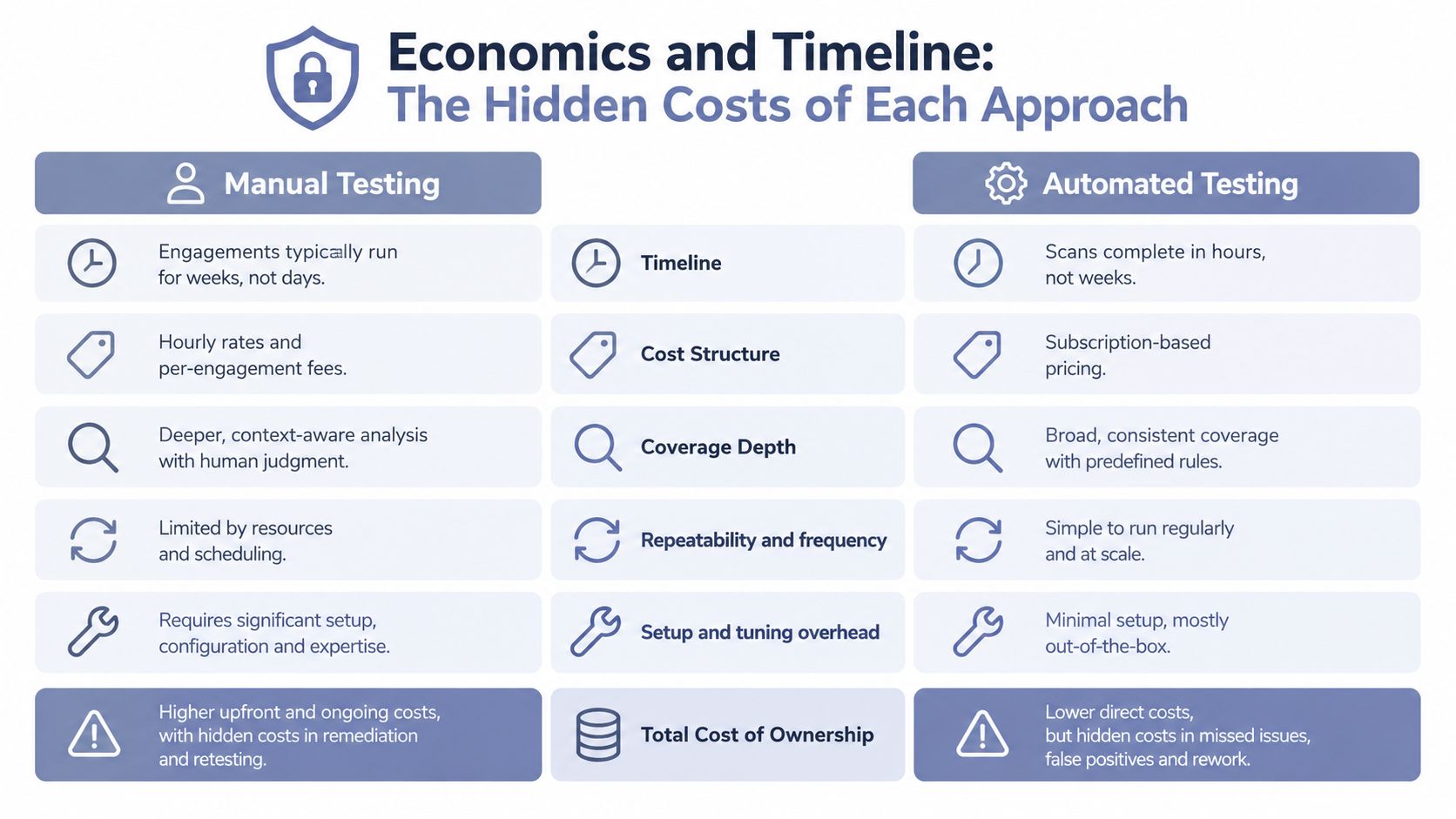
Manual penetration testing has a clear cost structure, yet scaling it requires more than adding testers. One industry guide places typical manual engagements at two to four weeks and approximately $15,000 to $30,000 per engagement according to an industry guide summarized by AppSecure. The fee covers scoping, access coordination, reconnaissance, exploitation, evidence review, reporting, retesting, and the senior expertise needed to support defensible risk judgments.
Automation changes the time profile. Autonomous platforms can compress first-finding work to hours, and one industry report claims they can be 80 times faster than traditional manual approaches for that initial activity as reported by Astra. The result is a lower cost for repeated first-pass coverage. It does not make the output equivalent to a complete manual engagement. For MSSPs, the commercial value comes from assigning fast discovery to automation while reserving expert time for interpretation and decisions that affect remediation.
The cost isn't just the invoice
A manual-only service absorbs hidden costs when senior testers spend hours on repetitive discovery, evidence formatting, and regression checks. Those hours could support complex applications, escalation analysis, or client advisory work. Automation reduces the marginal effort for repeatable tasks, while adding its own operating requirements: tool configuration, credential management, safe execution controls, result triage, and integration with the provider's reporting process.
Point-in-time testing creates a separate economic risk. A manual report describes the environment within an agreed scope and testing window. Changes to code, infrastructure, access controls, or cloud permissions can make that assessment less representative without changing the document itself. Recurring automated assessment can shorten this visibility gap when the provider retests meaningful assets and sends significant findings for human validation.
A better margin calculation
MSSP owners should compare delivery models with four questions:
- How much senior analyst time does each engagement consume?
- How much output requires verification or rewriting?
- How quickly can the provider deliver evidence a client can act on?
- How often can the service revisit changed assets without reopening the entire commercial process?
A penetration testing cost and ROI guide can support this calculation. A lower-priced scan that creates extensive analyst rework may weaken margins. A premium manual engagement can make commercial sense when the target contains high-value workflows or the client requires an adversary-style assessment.
A repeatable hybrid model treats automation as production infrastructure. It lowers the cost of recurring coverage, then directs expert time toward findings that can materially affect trust, remediation, and exposure. That allocation is the economic case for combining both methods rather than treating them as competing services.
Accuracy, False Positives, and Finding Quality
Automated tools commonly generate false positives in the 10% to 30% range, while manual testing produces minimal false positives when a human verifies each finding. Survey data also points to the 2026 shift toward hybrid delivery: 78% of fully automated scanners miss critical vulnerabilities, and 47% of organizations prefer a combined approach as summarized by Astra. The implication for MSSPs is practical: automation should create a broad candidate set, while analysts decide which findings represent genuine exposure.
| Metric | Automated testing | Manual testing |
|---|---|---|
| Initial precision | 80% to 90% automated in evaluated scenarios published evaluation | 92% to 100% manual in the same evaluation |
| False positives | Regular triage required before client delivery | Usually limited when findings are human-verified |
| Verification burden | Analysts reproduce findings and add context | Verification is part of the testing activity |
| Reporting risk | Alert volume can obscure material issues | Lower output volume, with quality tied to tester skill |
| Operational advantage | High throughput across repeatable checks | Stronger judgment about exploitability and impact |
The cost of a false positive extends beyond an inaccurate report row. Analysts spend time reproducing a non-issue, developers investigate a defect that cannot be exploited, and client stakeholders begin to discount the provider's severity judgments. Once confidence in those judgments declines, valid high-severity findings face more resistance.
A false-positive reduction workflow should therefore be part of service design, rather than an informal analyst habit. It should define which findings automation can close with evidence, which require manual reproduction, and which need senior review because business context changes their significance.
Volume can rise while assurance falls
A published industry dataset reported that automated finding volume grew 3.1 times from 2024 to 2025, while human-vetted findings declined 36% over the same period. Vetted findings also fell from 0.89% of automated volume in 2024 to 0.18% in 2025. The figures describe a capacity problem: detection output can expand faster than the team's ability to validate it.
More alerts do not automatically create more security value. If verification capacity remains fixed, a provider may deliver a longer report containing a smaller proportion of confirmed, actionable findings. That outcome can increase delivery effort while weakening the client's confidence in the service.
A scanner evaluation recorded a 61.44% detection rate alongside 85 false positives, showing why detection and usefulness require separate measures industry summary. MSSPs should ask whether precision is measured before or after human review, how authentication affects results, whether exploit evidence is required, and how the system accounts for business context.
What buyers should test
A single accuracy number says little without operational definitions. Buyers should ask for:
- Pre-review precision: What percentage of raw findings survive validation?
- Evidence quality: Can the provider show reproduction steps and business impact?
- Severity calibration: Does the report separate technical presence from exploitable risk?
- Escalation rules: Which findings must a senior tester inspect?
- Retest behavior: Can the provider confirm that remediation closed the attack path?
The meaningful comparison is between unverified automation and a workflow that uses automation for breadth, then assigns human judgment to context, evidence, and consequence.
Coverage Breadth Versus Depth in Real Engagements
Breadth and depth answer different security questions. Breadth asks where weaknesses may exist across the estate. Depth asks whether an attacker can exploit one, combine it with another condition, and reach something important. A reliable engagement needs both, because routine coverage and high-consequence investigation create different forms of assurance.
Automation compounds breadth across large environments. It can enumerate assets, identify known vulnerability patterns, review configurations, and repeat checks as the estate changes. That scale is why scanners remain practical for recurring assessment across hosts, applications, cloud resources, and network devices industry summary. The output is a broad map of exposure, not a complete account of exploitability.
Manual effort becomes more valuable when risk depends on sequence, intent, or business logic. A web application may enforce each permission check individually while still allowing a user to manipulate a multi-step transaction. A cloud environment may contain no single misconfiguration with obvious impact, yet expose a dangerous route when identity permissions, storage access, and workload roles are examined together.
Where manual depth changes the answer
Exploratory testing has shown an advantage for weaknesses that require investigation rather than repetition. Research summarized by Bugcrowd reports that manual penetration testing found more severe vulnerabilities and matched automated techniques for vulnerabilities found per hour research summary. For an MSSP, the commercial implication is clear: automated volume does not remove the need to assign skilled testers to the parts of an engagement where context determines impact.
That distinction matters across several target categories:
- Complex web applications: Testers can examine authorization boundaries, state transitions, pricing logic, invitation flows, and separation between tenants.
- Internal networks: Humans can interpret relationships between credentials, trust zones, privilege escalation opportunities, and administrative paths.
- Cloud estates: Analysts can assess how identities, roles, exposed services, and data permissions interact within the client's architecture.
Academic work on web application testing found that automation can reduce human error, accelerate data collection, and improve early activities such as reconnaissance, scanning, and enumeration academic study. The strongest operating model therefore assigns repetitive discovery to machines and reserves human attention for interpretation, attack-path selection, and business consequence.
The service design implication
The practical question is not whether an engagement is manual or automated. It is how the provider divides the work. Automated discovery can establish the reachable surface and identify candidate weaknesses. A human tester can then select attack paths likely to expose material impact, validate them safely, and explain how technical evidence relates to operational risk.
This hybrid structure also supports the market's shift toward combined delivery models. It gives clients repeatable coverage without treating scanner output as the final judgment. The MSSP can show the surface assessed, the paths investigated, the findings confirmed, and the areas that still require specialist attention. That makes the report a record of tested risk and confidence, rather than a catalogue of alerts.
Compliance Mapping and Reporting Requirements
For an MSSP, reporting is where testing methodology becomes a commercial deliverable. A technically accurate finding still creates work if the provider can't connect it to evidence, ownership, remediation guidance, and the client's audit process.
Automated platforms are well suited to repeatable evidence collection and structured control mapping. ThreatExploit AI's stated platform capabilities include reports for HIPAA, SOC 2, PCI-DSS, CMMC, ISO 27001, GLBA, and GDPR, with specific control references, alongside PDF and JSON outputs. Those capabilities matter when a service provider operates across multiple clients and needs consistent report production rather than rebuilding the same mapping manually.
Manual testing contributes a different reporting asset. A skilled tester can explain why a workflow is exploitable, how separate weaknesses combine, and what business consequence follows. That narrative is often more useful to an application owner than a control reference alone, particularly when the remediation requires changing process design or authorization logic.
Match the report to the assurance question
A practical reporting framework starts with the client's purpose:
- Recurring assurance: Use automated collection for repeatable checks, change detection, and evidence refresh. Add analyst review for material findings.
- Audit preparation: Map findings to the requested controls, preserve reproduction evidence, and identify which conclusions require human validation.
- New application assessment: Combine automated coverage with manual workflow and authorization analysis.
- Executive risk review: Translate validated technical findings into affected assets, plausible impact, remediation ownership, and residual risk.
The mistake is treating a compliance-mapped report as proof that automation was sufficient. A control reference demonstrates alignment of evidence to a framework. It doesn't, by itself, prove that the test explored complex authorization logic or chained attack paths.
Reporting quality is a throughput issue
Manual reporting can become a delivery bottleneck when every engagement requires extensive narrative preparation. Automation can standardize recurring sections, collect screenshots, organize evidence, and produce consistent exports. Analysts then spend their time correcting interpretation, adding context, and reviewing high-impact cases rather than formatting every page.
That model also helps with client trust. A low-noise report with reproducible evidence gives technical teams something they can verify and remediate. A concise executive view gives decision-makers a basis for prioritization. The provider's advantage comes from making those two views consistent, not from choosing one testing method and applying it to every audit scenario.
When to Choose Manual, Automated, or Hybrid Models
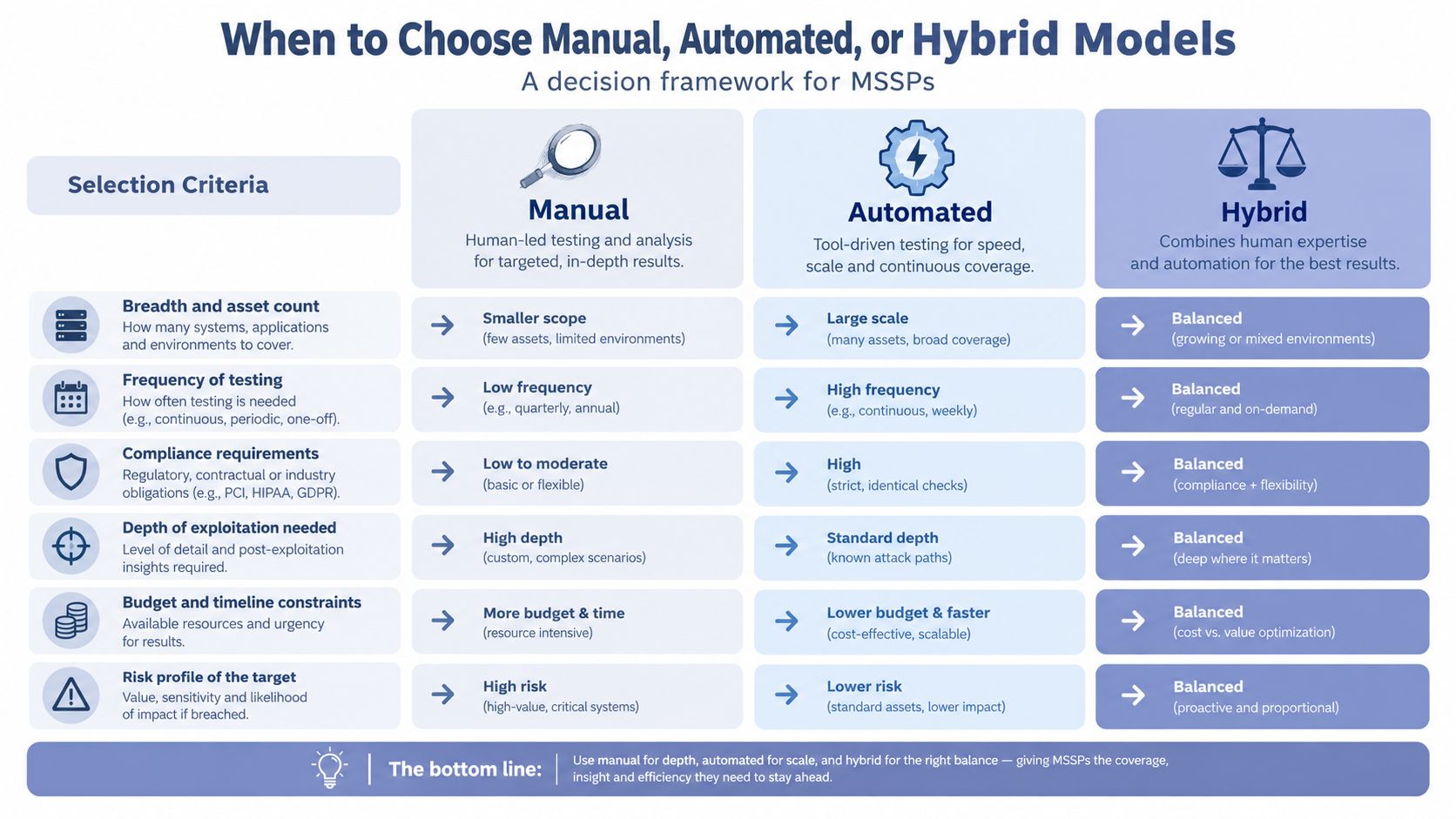
A hybrid model should be the default for most MSSP programs because it separates scale from judgment. Manual testing remains essential when the engagement depends on creativity, exploitability decisions, or human sign-off. Automation is the better instrument for broad coverage, frequent checks, evidence collection, and repeatable validation.
Use this allocation logic:
- Choose automated testing when the estate is broad, the components are repetitive, the client needs frequent reassessment, and the primary question is whether known weaknesses or regressions are present.
- Choose manual testing when the target contains complex business logic, a high-value workflow, unusual trust relationships, or a requirement for human exploit validation.
- Choose hybrid testing when the client needs both current coverage and defensible depth, which is the common case for recurring service delivery.
An emergency assessment before an audit may start with automation to collect evidence quickly, then route material findings to a tester. A continuous testing program can run automation on changed or exposed assets while scheduling manual deep dives for critical applications. A prospective client assessment can use a lightweight automated screen to identify obvious exposure, but the provider shouldn't present that screen as a complete pentest.
The research supports this division. Manual testing is stronger for accuracy, while combining automated scanning with manual penetration testing produces better overall results academic research. For an MSSP building broader detection and response services, related SOC workflows with Horus Intelligence can provide useful context for connecting offensive findings with defensive operations.
Decision test: If a missed finding could result from misunderstanding how the client's business works, put a human in the path. If the task is repetitive and evidence can be evaluated consistently, automate it.
The hybrid approach isn't a compromise in the weak sense. It is a deliberate allocation of expensive expertise.
Building a Hybrid Operating Model for Scale
A provider moving to hybrid delivery should design a pipeline, not just buy a scanner. The first stage establishes scope, credentials, safe-testing boundaries, and the assets that matter most to the client. Automation then performs reconnaissance, enumeration, repeatable checks, exploitation attempts where appropriate, and evidence capture. Analysts review the output, reproduce material findings, investigate relationships between issues, and decide what belongs in the client report.
Give every finding a defined path to confidence
A repeatable workflow needs explicit gates:
- Candidate creation: Automation records the endpoint, condition, test performed, and supporting evidence.
- Initial triage: An analyst removes duplicates, checks scope, and assigns a provisional severity.
- Human verification: The reviewer confirms exploitability, impact, and whether another finding changes the risk.
- Escalation: Complex authorization, chained attack, or business logic cases move to a senior tester.
- Client reporting: The final report separates confirmed findings from observations and explains remediation.
- Retesting: The provider checks whether the fix closed the validated path and preserves the result.
The provider should also define false-positive thresholds before delivery pressure arrives. A finding that lacks reproducible evidence shouldn't automatically receive the same treatment as a confirmed exploit. Escalation criteria should be written into the service design, so analysts don't make inconsistent decisions under deadline pressure.
Measure outcomes beyond finding counts
Raw volume is a poor performance metric. A provider should track whether analysts can verify findings efficiently, whether clients accept remediation priorities, whether retests close the original path, and whether report revisions decline. Those measures connect technical production to client trust and delivery margin.
Consider three common MSSP scenarios. A network-heavy recurring program can automate broad discovery and route unusual privilege paths for review. A SaaS client with complex tenant authorization needs automated coverage for surface changes and manual testing for cross-tenant abuse. A high-risk industrial environment may require carefully scoped automation for efficiency, with experienced testers validating the paths that could affect operations. A published study on industrial systems reported improved task efficiency from automation in finding and executing a suitable exploit compared with manual testing published study.
The strategic outcome is not fewer humans. It's better use of humans. Providers can expand coverage without assigning senior analysts to every repetitive task, while preserving expert attention for the cases where context changes the risk decision.
Before expanding a manual-only service or accepting unverified scanner output, map your current workflow against these allocation rules. If you need a platform for automated reconnaissance, exploitation, verification, evidence collection, and compliance-mapped reporting across web, network, and cloud environments, review ThreatExploit AI and assess where it can fit alongside your existing human validation process.