
38% of respondents reported a sensitive-data exposure or privacy incident involving a production API during the preceding year, according to Salt Security's 2024 survey reporting. That reframes API security risks as a problem of access to business data, not just malicious payloads.
A penetration tester can expose a serious weakness with a valid token, a normal request, and an identifier belonging to someone else. For security consultancies and MSSPs, the job is to discover which interfaces exist, prove where permissions fail, and translate those failures into remediation a client can verify. A clean vulnerability scan isn't enough.
Table of Contents
- The API Security Risks That Matter Most
- Why APIs Create Risks Web Apps Often Miss
- Authorization Flaws That Expose Other Users Data
- Valid Requests Used the Wrong Way
- How One Changed Identifier Becomes a Data Breach
- Test and Fix Each OWASP API Risk
- How to Find and Fix API Risks Step by Step
- Confirm Your API Test Coverage Before the Next Release
The API Security Risks That Matter Most
37% of respondents experienced an API security incident during the preceding year, compared with 17% in 2023, according to Salt Security's 2024 State of API Security reporting. The same reporting found that 80% of attack attempts used at least one technique associated with the OWASP API Security Top 10.
These figures describe the survey and associated attack reporting, not a worldwide breach rate. Their practical value is that they connect API incidents to testable failures, including missing ownership checks, weak recovery flows, uncontrolled workloads, and misplaced trust in integrations.
OWASP API Security Top 10 Risks at a Glance
The categories below are grouped by dependency: authorization first, then identity and abuse controls, followed by exposure and integration risks.
| Risk | What It Looks Like | Typical Impact |
|---|---|---|
| Broken Object Level Authorization | Changing an object ID in a request returns another user's record | Data disclosure across accounts |
| Broken Object Property Level Authorization | Responses expose hidden fields or accept writes to protected fields | Data exposure and privilege escalation |
| Broken Function Level Authorization | Standard users call admin or other-role endpoints | Unauthorized administrative actions |
| Broken Authentication | Weak tokens, unprotected login or password reset flows | Account takeover |
| Unrestricted Resource Consumption | Unlimited requests, oversized payloads, or repeated calls to paid services | Denial of service and inflated cloud or SMS costs |
| Unrestricted Access to Sensitive Business Flows | Automated misuse of checkout, signup, or redemption flows | Fraud, scalping, and abuse of limited resources |
| Server-Side Request Forgery | The server fetches attacker-chosen URLs | Access to internal services and cloud metadata |
| Security Misconfiguration | Verbose errors, permissive CORS, or default settings remain enabled | Information leakage and easier exploitation |
| Improper Inventory Management | Old, shadow, or undocumented API versions remain live | Exposure through forgotten endpoints |
| Unsafe Consumption of APIs | Third-party API data is trusted without validation | Injection and data tampering through partners |
Use Categories to Define Coverage
For a penetration-testing engagement, each category should become an explicit coverage question. Which roles were exercised? Which operations were attempted without authentication? Which downstream actions could create charges? An endpoint scan doesn't answer those questions by itself.
The order also matters operationally. If an assessment cannot distinguish callers or associate objects with their owners, it cannot meaningfully validate authorization. If the inventory omits a legacy deployment, testing the current release won't establish that the underlying data is protected.
OWASP's list is a risk taxonomy, not a measured frequency ranking. Its data-collection effort didn't provide enough information for a statistically valid ranking of issue frequency. Use the categories to define test coverage, not to assume that a category's position predicts how often it occurs.
Why APIs Create Risks Web Apps Often Miss
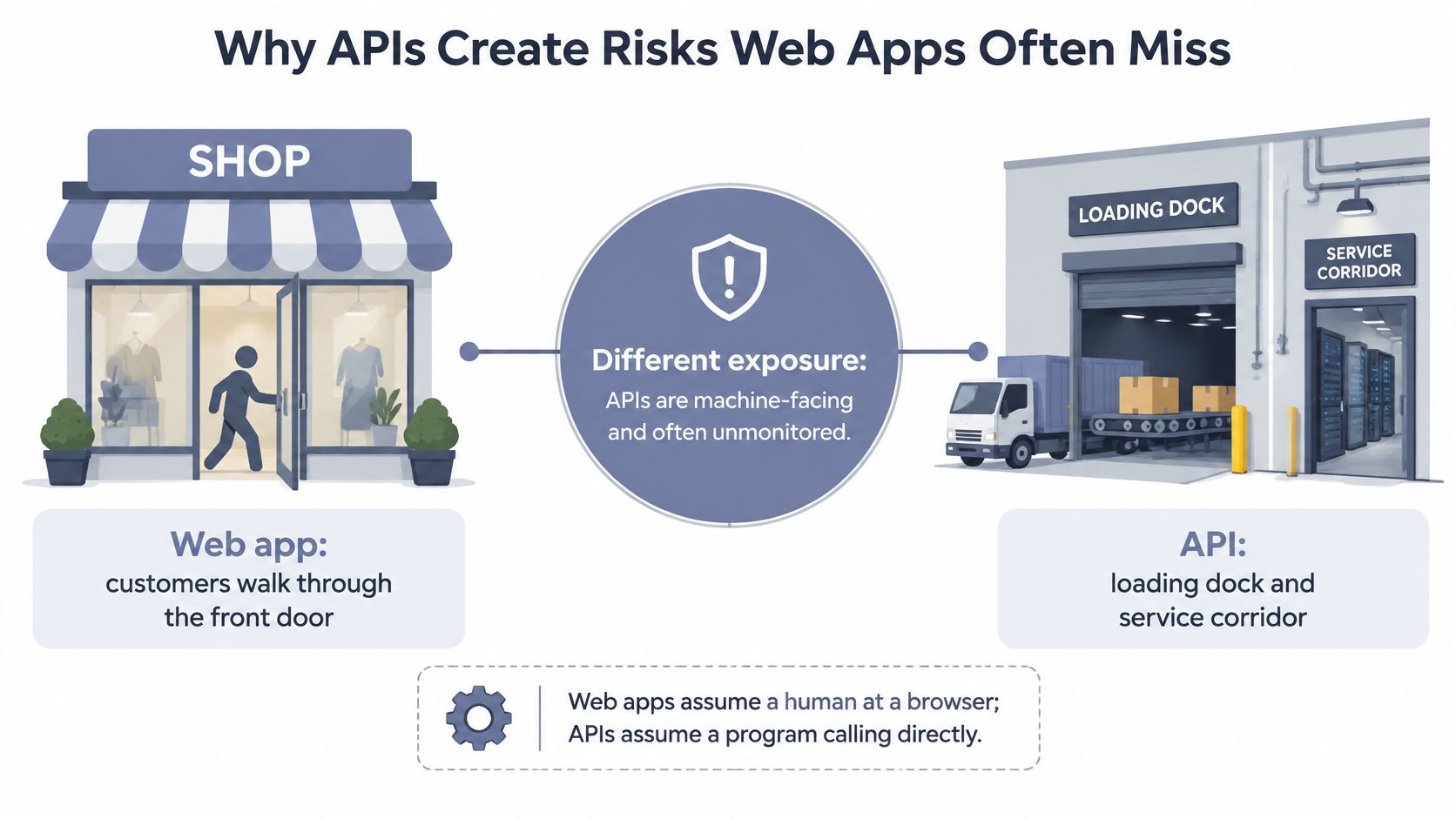
A web application is like a shop with a front door customers walk through. An API is the loading dock and service corridor behind it, where machines exchange goods constantly and fewer people inspect individual movements. That's an analogy for exposure, not a reason to assume every API is unmonitored.
The distinction is visible in the way requests reach business systems.
Direct Access Changes the Security Boundary
Objects are directly addressable. In a hypothetical order service, changing order 48213 to 48214 must trigger a fresh authorization decision. Successful login establishes identity, not permission to access whichever identifier the caller supplies.
Clients aren't limited to a browser interface. Mobile apps, partner systems, and backend services can call operations directly. Hiding an administrative button doesn't prevent a caller from constructing its underlying request.
Endpoints outlive their intended lifecycle. Teams deploy replacements while partners continue using earlier routes. The OWASP API Security Top 10 framework explicitly recognizes inventory management and unsafe consumption alongside authorization failures, extending coverage beyond conventional injection testing.
Practical rule: Treat the interface as a convenience for legitimate users, never as the enforcement point for permissions.
Machine-facing workflows also introduce asynchronous states. An accepted request may still fail downstream, so testers need to distinguish acknowledgement from completed business action. Akinda's explanation of why accepted orders still get rejected provides useful brokerage context for that distinction.
For penetration testers, the implications are concrete: identify the actual caller, follow the object through service boundaries, and verify the final state. Authorization, inventory, and integration trust deserve attention because the visible application doesn't fully describe any of them.
Authorization Flaws That Expose Other Users Data
Broken Object Level Authorization, or BOLA, is a foundational API breach mechanism. A caller has permission to use an invoice endpoint, but the server doesn't establish whether that caller may access the particular invoice requested.
Consider a hypothetical request to GET /invoices/48213. Changing it to GET /invoices/48214 should not reveal another customer's invoice merely because the session is valid. Unpredictable identifiers can make discovery harder, but they don't replace an ownership check.
Separate Objects, Functions, and Properties
Broken Function Level Authorization concerns the operation itself. A standard user might legitimately call GET /users/me, then attempt DELETE /admin/users/target. The test asks whether the server enforces the required privilege, not whether the interface displays that action.
Changing an HTTP method can expose the same gap. A route that protects reads isn't necessarily protected against updates or deletion. Check permitted methods independently, and distinguish forbidden operations from operations that aren't implemented.
Broken Object Property Level Authorization concerns individual fields. OWASP's property-level authorization guidance combines the former Excessive Data Exposure and Mass Assignment categories because both involve inadequate authorization at the property level.
A legitimate profile response might include a display name but also disclose an internal account status, role, or personal information. Conversely, an ordinary update containing {"displayName":"Alex"} might accept an added "role":"admin" property. A schema-valid field can still be unauthorized.
Test What the Caller Can Read and Change
Inspect normal REST responses rather than relying on what the interface renders. Compare fields across roles, probe undocumented properties, and submit controlled updates to protected attributes such as role or verified status. For GraphQL, explicitly request additional fields instead of assuming the client's usual selection represents everything available.
OAuth scopes deserve scrutiny, too. Mallary.ai's guide to securing social publishing API access provides context for delegated access, but a valid grant still doesn't establish permission over every account, publication, or property.
The possible impact includes data disclosure, data loss, corruption, privilege escalation, and partial or full account takeover. Report the demonstrated consequence, not every theoretically possible outcome.
Use this negative-test checklist:
- Prepare separate identities: Create same-role accounts and equivalent accounts in another tenant, using approved test data.
- Record ownership: Capture each account's object identifiers and legitimate baseline responses.
- Replay across boundaries: Submit each request under another identity, including reads, writes, and alternate methods.
- Verify rejection: Confirm both the response and persisted state show no unauthorized disclosure or change.
A forbidden response isn't sufficient evidence if the server performed the action before returning it.
Valid Requests Used the Wrong Way
A scanner can finish without findings while a caller successfully redeems the same benefit repeatedly. The requests contain valid JSON, legitimate credentials, and permitted operations. The weakness is in the business rules governing their sequence and effect.
Approximately 61% of API attacks in 2025 involved unauthorized workflows or abnormal activity, compared with 30% in 2024, according to Akamai's 2026 application, API, and DDoS security report. That makes behavioral testing a necessary part of API penetration testing, not an optional supplement to payload scanning.
Abuse the Workflow, Not the Parser
Consider these controlled test scenarios:
- Change account details: Verify an address, replace it, then attempt a sensitive operation. If verification remains valid for the replacement, an attacker may bypass the intended identity check.
- Replay redemption: Repeat a successful discount or gift-card redemption request. If the service applies the value again, the failure is transaction handling, not input validation.
- Reorder checkout or approval: Submit the completion operation before payment or approval. A server that trusts the client's sequence may release goods or execute an unapproved action.
- Automate valuable actions: Script ticket purchases or account creation within the agreed test scope. Individually legitimate actions can still exhaust inventory or enable fraud.
Classic checks can pass because there's no injection payload and no malformed token. Even a functioning rate limit may allow abuse if the attacker needs only a small number of requests or distributes activity across accounts.
A request can be valid at the protocol level and unauthorized at the business level.
Measure Cost as Well as Request Volume
Resource-consumption testing asks a different question: what does the server spend fulfilling each request? Requests consume bandwidth, CPU, memory, and storage, while some workflows invoke paid SMS, email, telephony, or biometric-verification services.
Exercise oversized payloads, expensive GraphQL nesting, and repeated downstream calls in a controlled environment. Agree on spending caps, concurrency ceilings, and stop conditions before testing. Production denial-of-service testing isn't a reasonable default.
A global request limit is blunt. Per-identity and per-tenant quotas, payload caps, query-complexity controls, and limits on expensive operations provide more useful boundaries, but they need tuning against legitimate customer workloads.
State-aware penetration testing should track prerequisites, replay behavior, race conditions, and final records. Capture which transaction changed, whether the effect persisted, and what loss the business could incur. Where financial impact isn't demonstrated, describe the mechanism and assumptions rather than presenting a speculative loss as fact.
How One Changed Identifier Becomes a Data Breach
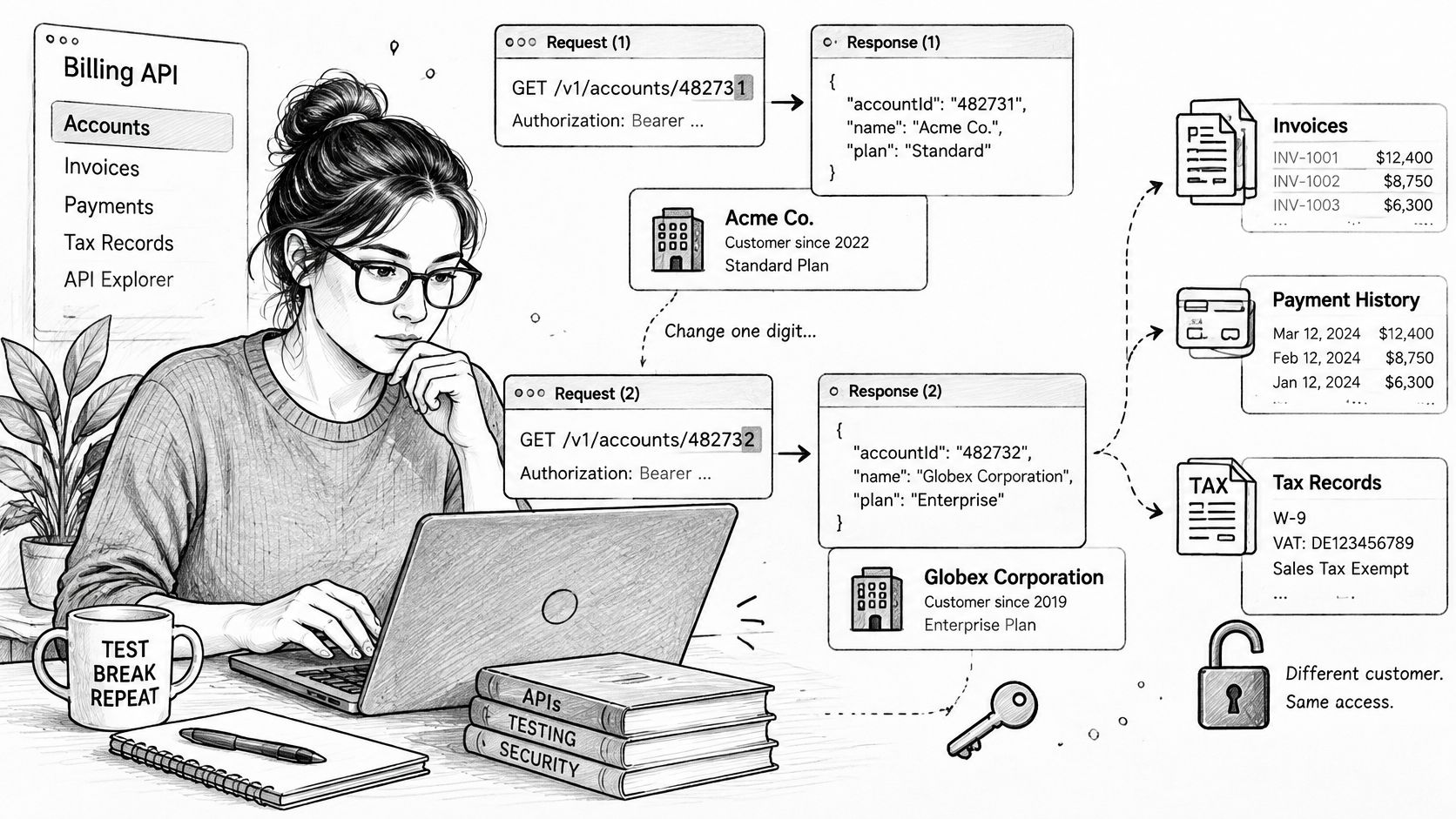
Consider a hypothetical billing API at a mid-sized software company. The following scenario illustrates how related findings could form an attack path, rather than describing a named client engagement.
The tester began with an authorized standard customer account and captured a legitimate invoice request. The identifier appeared sequential, so the tester substituted an identifier associated with another approved test customer.
The illustration shows the boundary being tested.
Establishing Read and Write Access
The response returned the other customer's name, billing address, and the last four digits of a payment card. The tester saved the original request, substituted request, authentication context, and redacted responses. That comparison established cross-account disclosure without requiring broad enumeration.
Next, the tester submitted an update containing a status property documented as internal. The server accepted it, and a subsequent read confirmed the altered state. This produced separate evidence of unauthorized writing, not merely a permissive success message.
A retired release then supplied another route. Its version-one invoice endpoint still returned the same data without checking ownership, even when the current handler was corrected.
For additional context on API testing, the following video can accompany the worked example.
Turning the Attack Path Into a Remediation Plan
The report distinguished what had been proven from what remained uncertain:
- Read access: The substituted identifier disclosed another approved test customer's billing information.
- Write access: The protected status change persisted and could affect invoice processing.
- Alternative access: The retired route exposed the same object through an independently vulnerable handler.
- Reachable scope: The tester recorded confirmed accessible test records, then used an owner-assisted review to establish broader exposure without downloading customer invoices.
For the finance lead, the issue wasn't an authorization label. Unauthorized reads could expose billing relationships, while status manipulation could undermine reconciliation or collection processes. The report separated those plausible consequences from transactions changed during testing.
The recommended fix sequence addressed the shared data path: enforce ownership in every object handler, allowlist writable fields, and retire the legacy route after identifying its remaining legitimate traffic.
Retesting included both releases and the affected update operation. Correcting the current read endpoint alone would have left the demonstrated write path and older deployment unresolved.
Test and Fix Each OWASP API Risk
Use this reference to pair each test with an implementation change and a retest condition. Run disruptive checks only within an authorized scope, using controlled accounts, safe callback infrastructure, and agreed limits.
| Risk | Test That Reveals It | Fix to Verify |
|---|---|---|
| Broken Object Level Authorization | Replay another account's object identifiers across read and write operations | Enforce object ownership and tenant policy in every handler |
| Broken Authentication | Check token validation, expiry, login throttling, and recovery flows | Validate tokens rigorously, constrain recovery, and throttle authentication attempts |
| Broken Object Property Level Authorization | Compare responses with permitted fields; attempt protected-property updates | Use response allowlists and separate writable-field allowlists |
| Unrestricted Resource Consumption | Submit bounded oversized payloads and repeat costly SMS or email operations | Apply identity and tenant quotas, payload limits, and query-depth or complexity caps |
| Broken Function Level Authorization | Call administrative routes and alternate methods as a standard user | Deny by default and enforce operation-level privileges |
| Unrestricted Access to Sensitive Business Flows | Automate controlled checkout, signup, and redemption sequences | Enforce step ordering, single-use transaction tokens, atomic state changes, and appropriate bot controls |
| Server-Side Request Forgery | Test URL parameters against approved internal destinations and simulated cloud metadata services | Allowlist destinations, constrain redirects, and restrict outbound access |
| Security Misconfiguration | Inspect error verbosity, CORS behavior, debug features, and defaults | Harden deployment settings and validate permitted origins and credentials |
| Improper Inventory Management | Reconcile gateway logs and DNS records with documented endpoints | Assign owners and retire obsolete versions after confirming traffic dependencies |
| Unsafe Consumption of APIs | Supply tampered partner responses through a stubbed integration | Schema-check external data, bound response handling, and validate before use |
Match Runtime Evidence to the Source
A gateway can reject oversized requests, but it usually can't determine whether an invoice belongs to the caller. Conversely, a code review can identify a suspicious handler without proving that a deployed route reaches it. Pair implementation review with observed behavior.
For AI-assisted implementations, an AI code security audit from AY Automate is relevant to reviewing generated code, but it shouldn't replace runtime authorization tests. Use documented API security standards to define acceptance criteria consistently across client engagements.
The useful deliverable is a tested control statement: which boundary held, under which identity, against which deployment.
How to Find and Fix API Risks Step by Step
Start with incomplete visibility rather than assuming documentation describes production. Unknown endpoints deserve early attention when they expose sensitive data or privileged actions, not because they're undocumented.
Establish Scope and Priorities
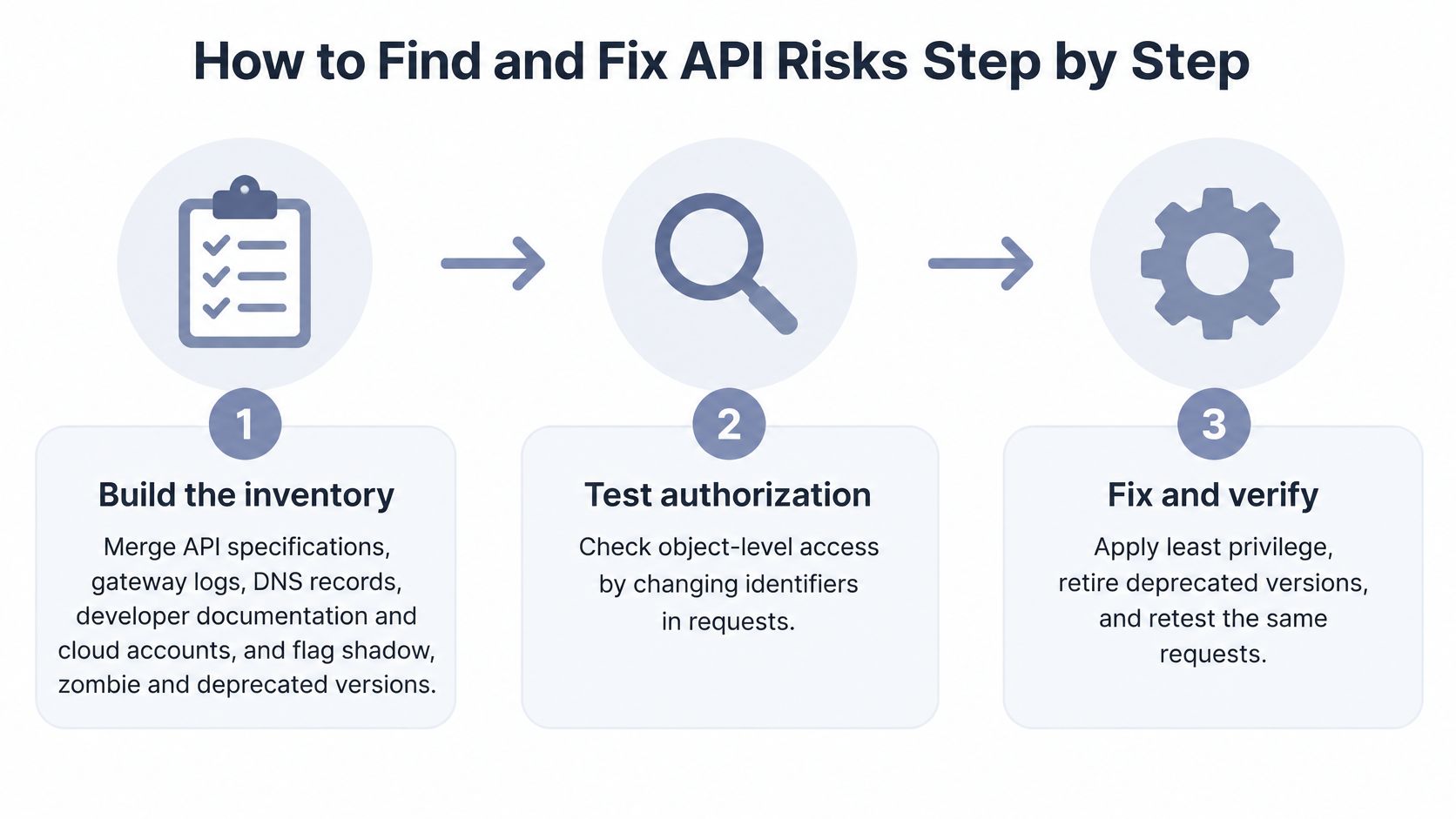
Build the inventory. Merge API specifications, gateway logs, DNS records, developer documentation, and cloud-account inventories into an owner-assigned register. Flag shadow routes, zombie deployments, and deprecated versions; the common slip is importing an OpenAPI file and calling discovery complete.
Rank likely business impact. Score exposure, authentication model, data sensitivity, privilege, workflow criticality, internet reachability, change frequency, and AI-agent autonomy. Research summarized in Traceable's State of API Security reported that 19% of organizations were very confident in their API inventory and 54% relied on developer documentation to identify sensitive-data exposure, which is why documentation alone shouldn't determine priorities.
Test the unauthenticated surface first. Examine discovery, health, version, metadata, and error-handling endpoints, then assess approved service-to-service and administrative paths reachable after an initial foothold. Analysis cited by Salt Security found that 61% of API attack attempts were unauthenticated and 13% explicitly targeted internal APIs; don't equate internal placement with enforced trust.
The process needs a feedback loop, not just an initial inventory export.
Execute, Verify, and Retest
Run authenticated, role-aware tests. Provision at least two accounts per role and two tenants as the test design, then replay objects across those boundaries. Don't reuse an administrator session for convenience, because it invalidates conclusions about ordinary-user restrictions.
Inspect properties and functions. Compare responses against the intended permission model, probe undocumented fields, and attempt protected writes such as role changes. Documentation helps generate cases, but the common mistake is treating the documented schema as proof of what the server accepts.
Exercise complete workflows. Change step order, replay operations, race controlled requests against limited stock, and validate quotas by identity and tenant. Include GraphQL API testing where applicable, especially field selection, batching, and query complexity; endpoint-level success alone doesn't establish safe behavior.
Verify each finding. Preserve a minimal reproducible request, relevant response, caller context, resulting state, and business impact, then map the issue to its OWASP category. Avoid unbounded enumeration and distinguish confirmed accessible records from a larger population inferred through owner-assisted analysis.
Fix at the source and repeat the attack. Enforce ownership, deny privileged functions by default, validate schemas, constrain costly actions, and retire obsolete versions. Don't close a finding because a patch merged; replay the proof against the deployed fix and check sibling routes.
For AI-agent integrations, add tests that follow untrusted tool output into privileged actions. Prompt or tool injection matters when external content can influence which API operation an agent invokes or which data it exports.
Evidence standard: A useful finding lets another authorized tester reproduce the issue without guessing which identity, object, or workflow state was required.
Confirm Your API Test Coverage Before the Next Release
Release readiness should depend on demonstrated boundaries, not a scanner's completion status. Use these questions to identify concrete gaps:
- Inventory completeness: Does the register include shadow routes and deprecated versions?
- Object isolation: Does every object endpoint have a two-account negative test?
- Property protection: Are protected fields blocked from unauthorized writes?
- Cost controls: Do quotas cover paid integrations?
- Reproducibility: Does every finding include sufficient evidence to repeat the test?
A no identifies work to assign before release, with an owner and a retest condition. Make those checks repeatable through CI/CD pipeline security testing, while keeping human review for workflows whose intended behavior can't be inferred from a schema.
Our capabilities at ThreatExploit AI include Web App Testing, Network Pentesting, Cloud Security, API Security, Vulnerability Scanning, and CI/CD Integration. Tests cover OWASP Top 10 vulnerabilities, SQL injection, XSS, authentication flaws, misconfigurations, and more.
That coverage isn't a guarantee of completeness. Our service is provided "as is" and "as available," and security testing cannot identify every vulnerability. Business-logic abuse still requires state-aware and role-aware review alongside automated checks.
Make authorization evidence a release requirement. This week, run the two-account authorization test against your three most sensitive endpoints and log the results against the OWASP categories so unresolved gaps remain visible in the next release decision.
ThreatExploit AI offers automated penetration testing for security service providers, with evidence-backed reports that support technical remediation and management review. Visit ThreatExploit AI to explore how API security testing can fit into your client assessment and release-verification workflows.