
If you're waiting on a SOC 2 report, a vendor questionnaire, or a deal that won't move until security signs off, you already know the problem. A scanner report with a few red flags doesn't answer the question buyers ask, which is whether anyone can use your application to reach data, accounts, or admin functions.
What is web application penetration testing? It's an authorized, controlled attempt to behave like a real attacker against a live application, then prove what's exploitable, not just what looks suspicious. NIST SP 800-115 describes penetration testing as security testing in which evaluators mimic real-world attacks to find ways around an application, system, or network's security features, and it treats planning, evidence handling, analysis, and mitigation as part of the security outcome, not paperwork around it. NIST Special Publication 800-115
Table of Contents
- Defining Web Application Penetration Testing
- The Standard Pentesting Lifecycle and Phases
- Core Testing Domains and API Security Techniques
- Penetration Testing Versus Vulnerability Scanning
- Modern Attack Paths and Identity Risks
- Deliverables and Compliance Mapping
- Moving Toward Continuous Security Validation
Defining Web Application Penetration Testing
The cleanest way to think about it is simple. A scanner says, “this input looks risky” or “this component may be outdated.” A pentest asks, “can an attacker use this weakness to cross a trust boundary, read another customer's data, or trigger a protected action?”
That difference matters when a security review is blocking revenue. If an enterprise buyer wants proof that your SaaS handles access control correctly, a list of warnings is not enough. A penetration tester needs to validate whether the issue is reproducible, what it exposes, and whether the impact survives safe retesting.
From suspicious finding to proven impact
A real engagement focuses on cause and effect. If a request parameter can be changed, the question is not whether the parameter exists, it's whether the server trusts it too much. If a user can log in, the question is not whether authentication works in the narrow sense, it's whether authorization still blocks the wrong object, role, or tenant.
Practical rule: if you can't describe the attacker's path in one or two concrete request/response steps, you probably don't have a pentest finding yet.
That's why pentesting sits above scanning in the assurance stack. It's not a replacement for automated checks, but it goes deeper into business logic, session behavior, APIs, and control bypasses. For a basic overview that stays close to the industry's standard definition, see this primer on penetration testing.
The Standard Pentesting Lifecycle and Phases
A professional web application pentest is structured because production systems deserve guardrails. PTES defines seven phases, pre-engagement interactions, intelligence gathering, threat modeling, vulnerability analysis, exploitation, post-exploitation, and reporting, and that sequence keeps scope separate from attack activity. PTES
Why the order matters
Pre-engagement is where the tester and client agree on scope, test accounts, timing, and safety limits. That protects live systems, but it also protects the value of the work, because a test without rules of engagement usually wastes time chasing dead ends or touching systems that weren't meant to be in scope.
Intelligence gathering and threat modeling come next. Testers map entry points, identify trust boundaries, and prioritize the parts of the application that move risk, such as admin workflows, customer data paths, and APIs that expose high-value functions. Only after that does active exploitation make sense.
Then comes the part many buyers misunderstand. Post-exploitation isn't a victory lap, it's where the work becomes useful. Evidence collection, impact analysis, and mitigation guidance show whether a flaw is a low-value nuisance or a serious control failure that justifies engineering time.
A short video walkthrough can help non-technical stakeholders understand the rhythm of the process.
Core Testing Domains and API Security Techniques
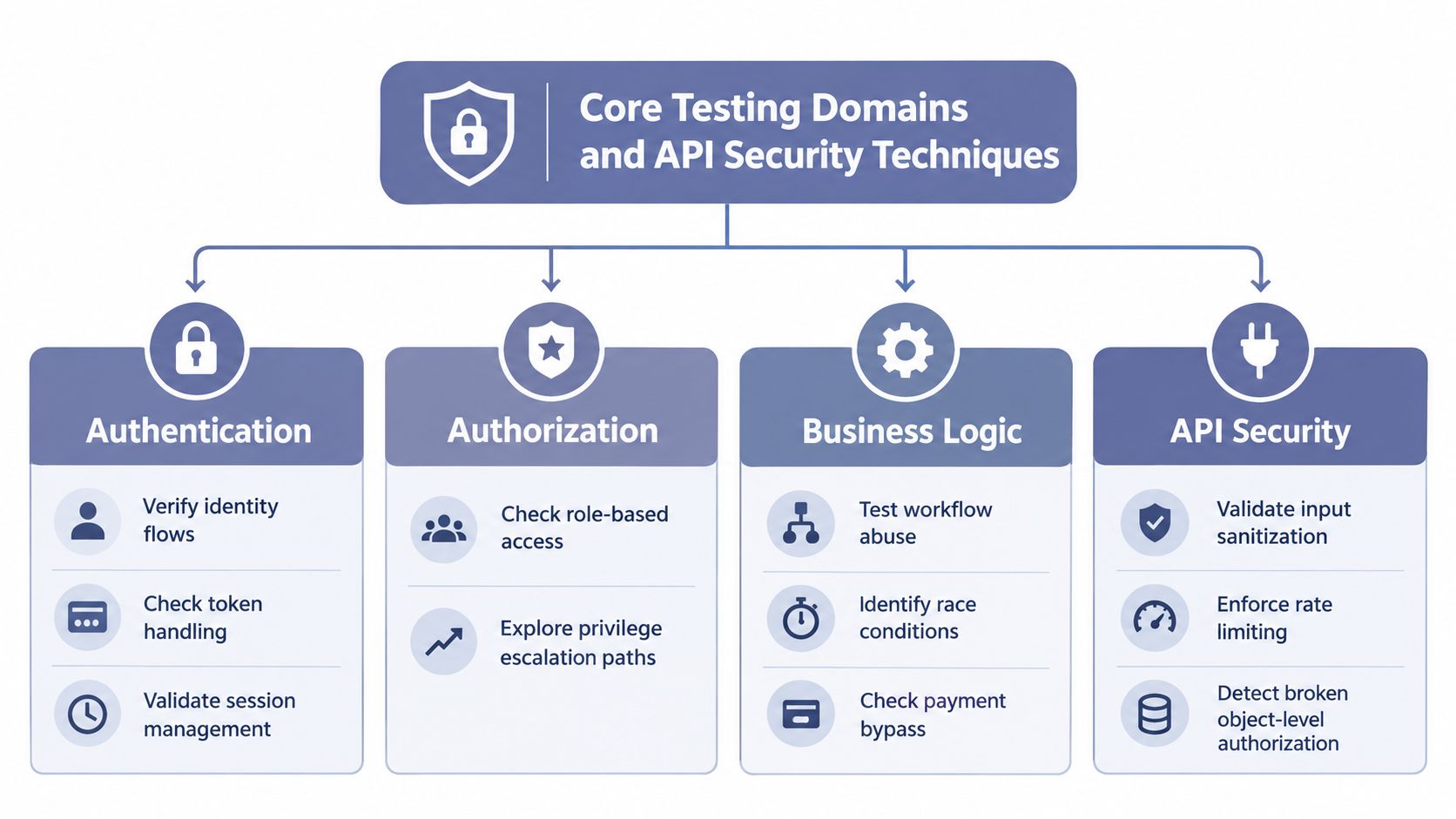
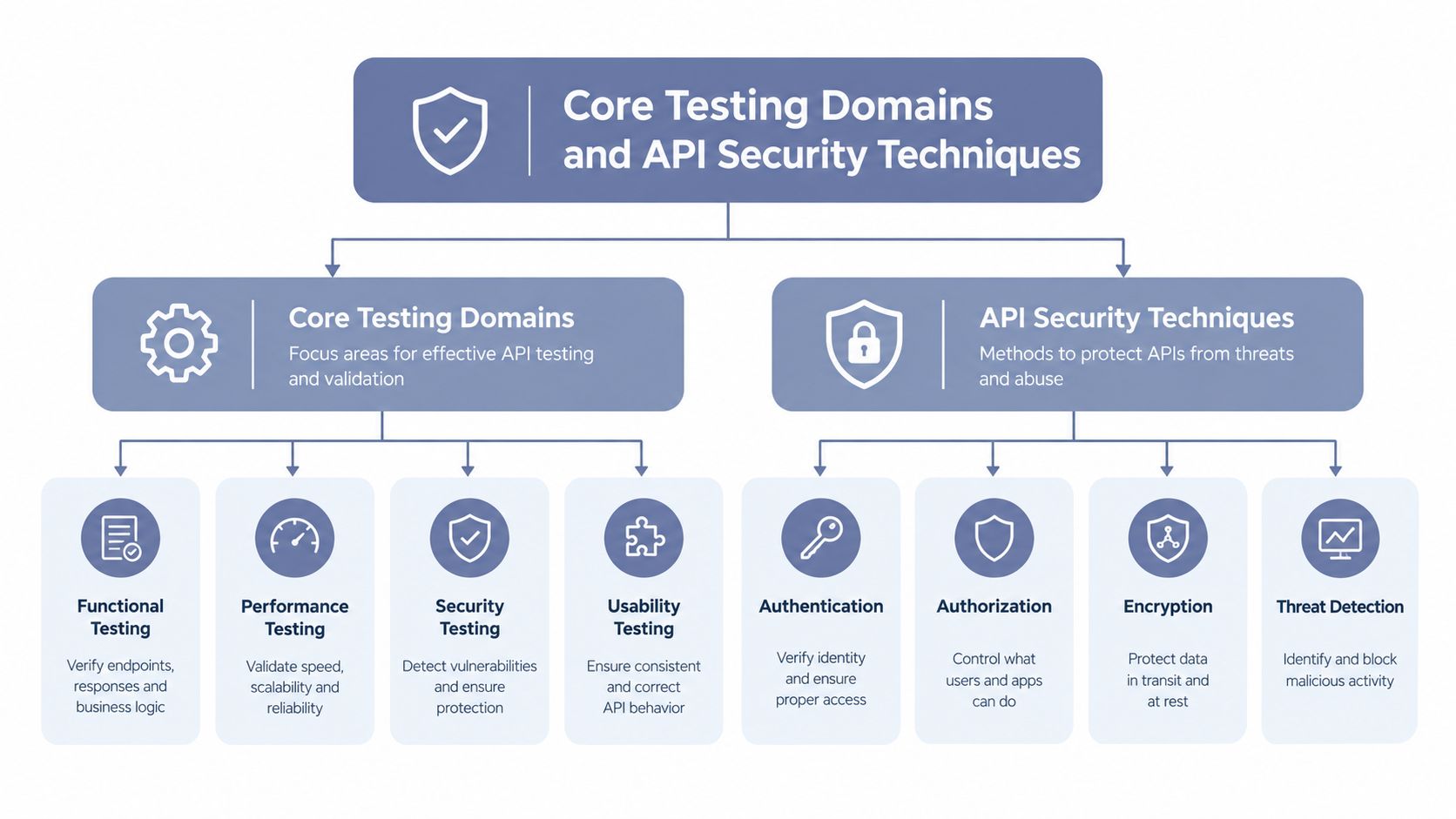
Modern applications rarely fail only in the browser. They fail where identity, APIs, and workflow logic intersect, which is why OWASP's testing guidance organizes work around domains like configuration, identity management, authentication, authorization, session management, input validation, error handling, weak cryptography, business logic, client-side testing, and APIs. OWASP WSTG
Authentication is only the starting point
Authentication proves who someone is. It does not prove what they're allowed to do after login. That distinction sounds obvious until a pentest finds that a valid user can reach another tenant's record, a read-only role can alter state, or a mobile-backed API exposes functions the UI never shows.
Authorization is where modern SaaS breaks
This is why authorization testing is so valuable for REST and GraphQL APIs. Testers create controlled accounts for different roles, then vary object identifiers, HTTP methods, fields, and workflow order to see whether the server enforces ownership and privilege boundaries. Microsoft's API guidance notes that insufficient object-level authorization can lead to data leakage or unauthorized manipulation, and that decisions need to happen at both the request and object level. OWASP API Testing
A login page that works perfectly can still sit on top of a broken permission model.
Business logic and API abuse need human judgment
Scanners don't understand workflow abuse very well. They can miss race conditions, payment bypasses, repeated use of a discount path, or a role mix-up that only appears when requests are replayed out of order. That's where a tester's job becomes analytical rather than mechanical.
For a practical overview of API-focused testing as a service line, this API penetration testing resource is a useful adjacent read. One tool option in this space is ThreatExploit AI, which automates pentesting workflows for web applications and APIs and produces evidence-backed reports, but it still needs clear scope and strong review to be useful in delivery.
Penetration Testing Versus Vulnerability Scanning
Teams confuse these two all the time, usually because both produce lists of issues. The difference is that a scanner is optimized for breadth, while a pentest is optimized for proof.
| Feature | Vulnerability Scanning | Penetration Testing |
|---|---|---|
| Primary question | What might be wrong? | What can an attacker actually do? |
| Method | Automated checks | Human-led or agent-led validation |
| Output | Suspected issues and known signatures | Verified exploitability and impact |
| Business logic | Limited coverage | Core focus |
| API authorization | Often shallow | Deep, role-aware testing |
| Reporting value | Good for hygiene | Better for audit evidence and remediation prioritization |
A scanner is excellent for coverage. It catches known CVEs, exposed files, misconfigurations, and common patterns quickly. That's useful, and a mature program should keep scanning on a regular cadence. But the output often stops short of saying whether the issue can be chained, whether a control fails, or whether the finding matters in the context of a real workflow.
A pentest is slower and more contextual. It may ignore a noisy issue if that issue doesn't change risk, then spend time on a permission flaw that lets one user read another user's invoice through an API. That's why compliance teams ask for penetration testing rather than just scans. They need evidence, not just alerts.
For an example of how a commercial scanner frames its work, how scans vulnerabilities is a helpful reference point because it makes the scanner-versus-validation gap easy to explain to non-specialists.
Modern Attack Paths and Identity Risks
The biggest mistake MSSPs still make is treating web application testing like it's only about public forms. In practice, the first foothold often comes through identity abuse, session theft, an exposed API, or a third-party integration that extends trust too far.
The breach path is broader than the app UI
Verizon's 2025 DBIR analyzed 22,052 incidents and 12,195 confirmed breaches, and it found that exploitation of vulnerabilities was involved in 20% of breaches while third-party involvement doubled from 15% to 30%. It also reports that system intrusion, social engineering, and basic web-application attacks together represented 93% of breaches. Verizon 2025 DBIR Executive Summary
Those numbers reinforce a practical point. If you only test the obvious browser surface, you miss the paths attackers use, stolen credentials, weak session controls, API abuse, CI/CD exposure, and partner trust chains. Credential abuse stays central because valid access often looks like normal traffic until a tester checks whether that access can reach the wrong object or function.
Risk-driven testing beats checklist-only work
A good assessment starts with the assets that matter most, administrative interfaces, sensitive workflows, externally reachable APIs, and tenant-scoped data paths. It then asks how one weakness could enable another. A session flaw may not be dramatic on its own, but combined with permissive authorization or a brittle reset flow, it becomes a real incident path.
Operational insight: the more your platform relies on identity, the less useful a “website only” pentest becomes.
That's why modern pentesting is closer to attack-path analysis than to legacy page-by-page review. If the app can trigger downstream actions, consume third-party data, or call internal services, those flows belong in scope.
Deliverables and Compliance Mapping
The report is the product. Everything else is just the method used to create it.
A strong web application pentest report has two audiences. Leadership needs a concise summary that explains business risk, control gaps, and what needs attention first. Engineers need enough detail to reproduce the issue, confirm the failure mode, and fix it without guessing. NIST explicitly treats planning, analysis, and mitigation strategy as part of technical security testing, which is why the report can't be an afterthought. NIST SP 800-115
What useful evidence looks like
Good findings include the exact request and response, affected identities, the trust boundary that failed, and a clear explanation of impact. They also separate confirmed exploitation from suspicion, because a single noisy alert doesn't help anyone prioritize remediation.
That discipline pays off in audit work. When a report maps evidence to controls, security teams can use it for SOC 2, PCI DSS, ISO 27001, and customer due diligence without rewriting the story each time. The same report can help a sales team answer a security questionnaire and give engineering a fix list that's reproducible.
What weak reporting gets wrong
Generic output says a parameter is “high risk” without proving the business effect. That's not enough for a board, and it's not enough for a developer trying to patch the issue safely. A better report explains how the flaw was tested, how it behaved under a controlled account, and what server-side control was missing.
If the remediation advice doesn't tell a team what to change in the application, the report is too vague to drive a fix.
Moving Toward Continuous Security Validation
Annual testing still exists because compliance programs need a calendar, but application risk doesn't follow a calendar. Releases, dependency changes, new integrations, and permission model tweaks all create fresh attack paths between assessments.
That's why the better model is continuous validation tied to material change. Retest after major releases, after auth or authorization work, after API changes, and after dependency or integration shifts that affect trust boundaries. OWASP's framework already supports this risk-based stance by letting teams select tests according to application behavior and organizational requirements, rather than forcing the same checklist onto every target. OWASP Testing Framework
Why continuous doesn't mean reckless
Continuous testing still needs authorization, throttling, rollback planning, and evidence handling. The point is not to run uncontrolled attacks all day, it's to validate high-risk changes fast enough that they don't ship blind. That's especially important for MSSPs and consultancies that need to scale delivery without turning every engagement into a months-long manual effort.
What a service provider can operationalize
The scalable model is simple. Keep broad scanning on for hygiene, then run deeper pentesting where the business changed, where the identity path matters, or where a customer needs proof before a deal closes. For teams exploring that shift, what continuous testing looks like in practice is worth reading alongside your internal delivery model.
If you're building a pentest service line, ThreatExploit AI can automate web application and API testing workflows, produce evidence-backed reports, and map findings into compliance-friendly formats. Visit ThreatExploit AI to see how it fits into a continuous, evidence-driven delivery model for modern web application penetration testing.