
Your client's environment changed after the last penetration test. A new API went live, cloud permissions shifted, and a development team deployed several releases before the report reached the people responsible for remediation. The assessment may have been accurate when performed, but it no longer describes the risk your client faces today.
That gap is where continuous testing becomes operationally important for penetration-testing providers. It connects recurring security validation to the pace of software delivery, helping MSSPs replace isolated snapshots with a repeatable process for discovery, testing, evidence collection, remediation, and retesting.
Table of Contents
- What Is Continuous Testing for Security Providers
- How Continuous Testing Works in Practice
- Implementing Continuous Testing for MSSPs
- Continuous Testing versus Point-in-Time Penetration Testing
- Real-World Impact and Verification Standards
- Business Case for Continuous Security Testing
- Common Challenges and How to Overcome Them
What Is Continuous Testing for Security Providers
An MSSP can deliver a careful annual penetration test and still leave its client exposed to changes made shortly afterward. The problem isn't necessarily the quality of the engagement. It's the interval between assessments. Assets appear, configurations change, APIs evolve, and new releases alter the attack surface while the previous report remains the latest available evidence.
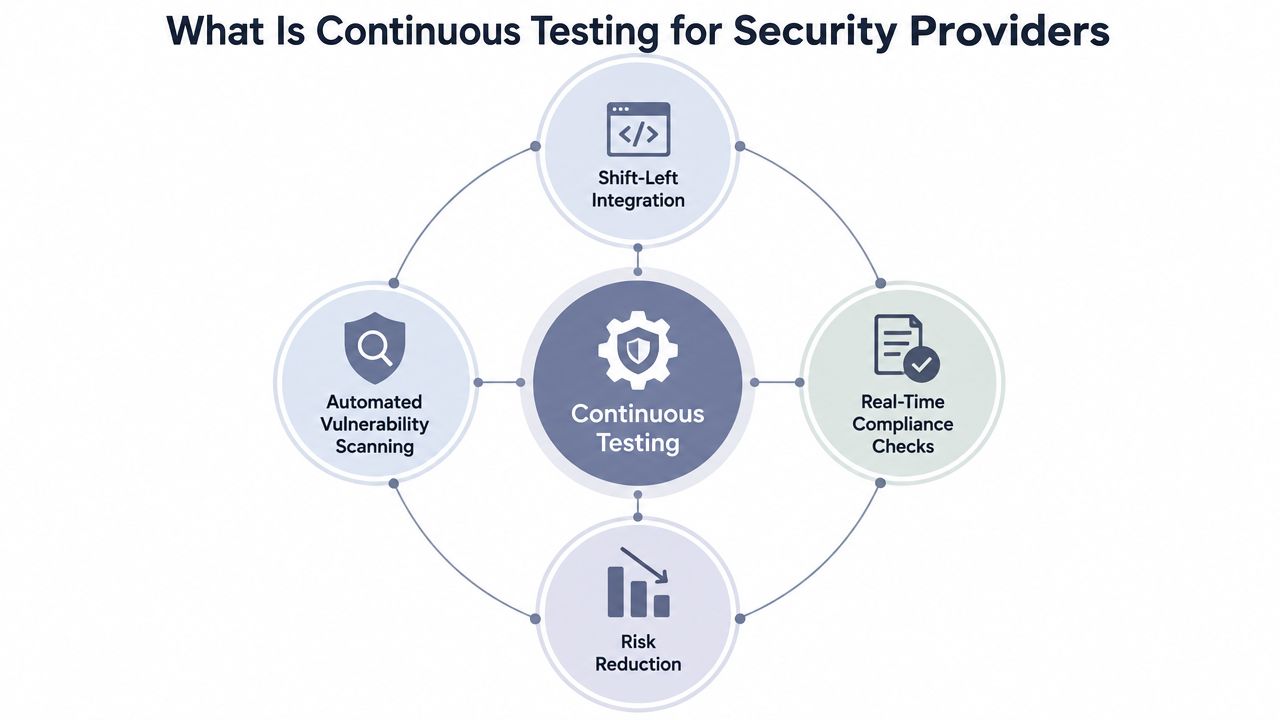
Continuous testing for security providers means evaluating systems repeatedly throughout the delivery lifecycle and after meaningful changes, rather than treating penetration testing as a fixed annual event. In software delivery, this approach embeds automated tests into CI/CD so defects receive early feedback. In security operations, the equivalent is an ongoing validation cycle that checks applications, infrastructure, APIs, and cloud workloads as they change. AWS describes continuous testing as automated validation across the software delivery lifecycle.
The MSSP operating problem
Point-in-time work creates a familiar sequence. The provider defines scope, schedules specialists, performs reconnaissance and exploitation, produces a report, and waits for the client to remediate. That workflow still has value, particularly for complex business logic, chained attack paths, and situations that require expert judgment. It becomes insufficient when the client expects security visibility that matches an environment changing every day.
Continuous testing changes the service from a completed project into a managed control. The provider can set authorized targets, define triggers, run recurring assessments, validate important findings, and retest remediation. The report becomes a current operational record rather than a document that gradually loses relevance.
Practical rule: If the client's attack surface changes more often than the provider tests it, the service needs a change-driven validation layer.
This model also clarifies what automation should and shouldn't do. Automated agents can handle repeatable reconnaissance, tool orchestration, baseline comparison, and routine validation. Security specialists should remain responsible for scope decisions, high-risk findings, complex exploitation paths, and interpretation of business impact.
Why this is more than a DevOps term
Continuous testing emerged alongside DevOps and CI/CD, where tests run when code is integrated instead of waiting for a discrete release gate. Market research now treats it as an established category. One estimate places the market at USD 2.05 billion in 2024, with a projection of USD 2.43 billion by 2029, representing a 3.49% CAGR from 2024 to 2029. Another estimate places the market at USD 1.48 billion in 2020 and projects USD 3.45 billion by 2026, at a 15.24% CAGR. These estimates differ, but both describe sustained investment in the practice. Mordor Intelligence provides both market estimates and their projections.
For an MSSP, the strategic implication is direct. Continuous testing helps turn security validation into a service that can scale across customers without asking manual consultants to repeat the same low-value checks after every material change.
How Continuous Testing Works in Practice
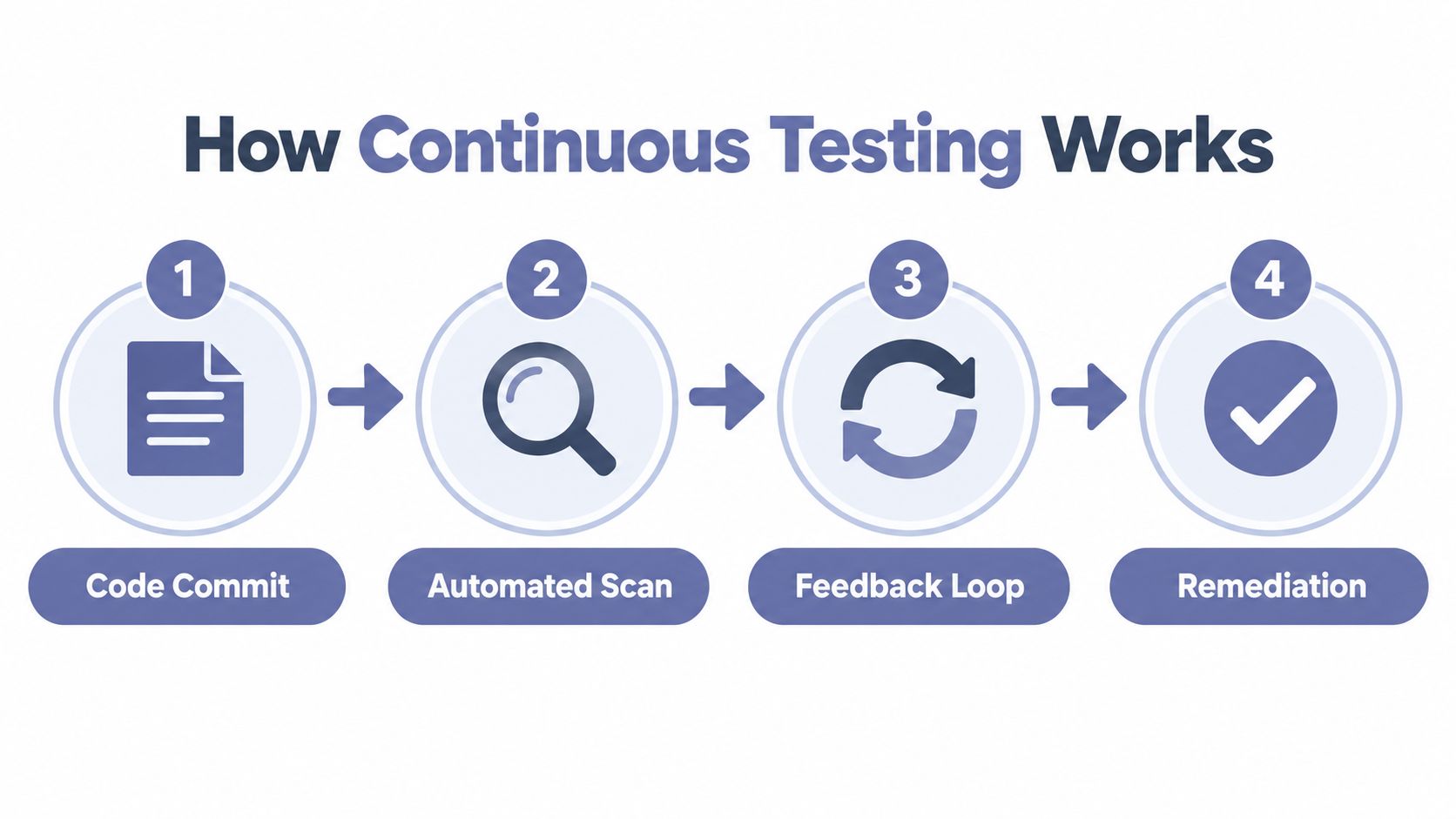
Continuous testing works when security checks become part of an operational feedback loop, not when a provider just schedules the same scan more frequently. The system needs a defined scope, an execution trigger, a method for validating findings, a remediation workflow, and evidence that supports the final conclusion.
Before testing starts, the provider and client should document the authorized assets, goals, exclusions, credentials, rate limits, and stop conditions. This protects the client environment and gives the testing engine boundaries it can enforce. Synack's guidance on continuous security testing identifies these authorization controls as part of the operating model.
The execution loop
A practical pentesting pipeline usually follows this sequence:
- A change or schedule triggers testing. The trigger may be a code deployment, a new cloud resource, a configuration change, or a recurring validation window. The important distinction is that testing responds to risk and change, rather than relying only on a calendar.
- The engine discovers and assesses the authorized surface. Reconnaissance identifies reachable assets and services, while automated checks examine common weaknesses across the agreed scope.
- The system validates potential findings. A scanner output is not automatically a confirmed vulnerability. Verification should attempt to reproduce the issue, collect evidence, and distinguish an exploitable condition from an informational signal.
- The provider prioritizes remediation. Findings need context, affected assets, technical impact, evidence, and a practical remediation path. Severity alone rarely gives a client enough information to decide what to fix first.
- The provider retests the change. Closure requires evidence that remediation addressed the original condition without introducing a related weakness.
This is why continuous testing differs from basic vulnerability scanning. Scanning generates signals. Continuous pentesting adds validation, structured evidence, risk interpretation, and independent retesting. IBM explains continuous testing as an automation layer that converts software risk into pipeline signals.
Where integration matters
The pipeline can place lightweight checks early, then reserve deeper testing for environments where meaningful attack paths can be evaluated. CI/CD integration is useful when it gives developers actionable feedback without blocking every build for a slow, broad assessment. A security provider should also connect findings to ticketing, dashboards, customer reports, and remediation tracking so results don't disappear inside a scanner console.
The continuous integration workflow for agile teams illustrates the broader principle. Security validation gains value when it joins the same workflow that already manages changes, ownership, and release decisions.
The following video provides a visual introduction to the process:
A reliable implementation also needs failure handling. The provider should distinguish a failed test, a blocked test, an unavailable dependency, and a confirmed vulnerability. Treating every abnormal result as a finding creates noise, while treating every inconclusive result as harmless creates blind spots.
Implementing Continuous Testing for MSSPs
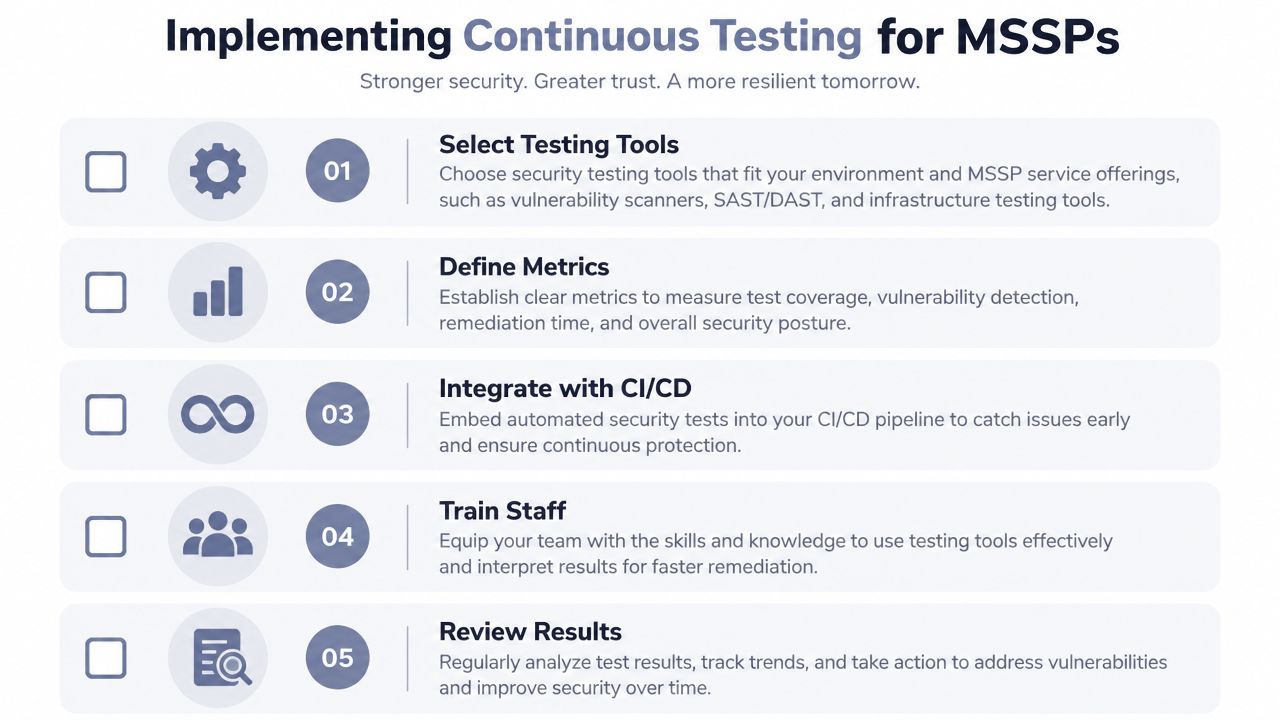
An MSSP shouldn't begin by promising to test everything continuously. Start with the assets and changes that carry the greatest business or security risk, then build the operating model around reliable execution and clear ownership.
Establish the control boundary
Write the authorization model before connecting automation to a client environment. Record the assets in scope, testing objectives, exclusions, credentials, permitted techniques, rate limits, notification contacts, and stop conditions. This documentation gives the provider a defensible basis for operating repeatable tests and gives the client a clear understanding of what the service will do.
Next, classify assets by risk and change sensitivity. A public application with frequent deployments may need a different cadence from a stable internal service. Cloud infrastructure and exposed APIs may require reassessment after material changes even when a recurring schedule hasn't arrived.
Build a risk-led cadence
Use risk tiers and change events instead of one universal timetable. A practical model can combine:
- High-impact assets: Trigger reassessment after significant releases, authentication changes, exposure changes, or cloud permission modifications.
- Moderate-risk services: Run recurring validation and add testing after material configuration or application changes.
- Lower-risk assets: Maintain a scheduled baseline and reassess when ownership, exposure, or architecture changes.
The cadence should be explicit in the customer agreement. It should also define what happens when a test is blocked, a new asset appears, or a critical finding requires immediate escalation.
Make verification part of delivery
Don't measure the service by scan volume. Track whether the provider can identify meaningful exposure, support remediation, and verify closure. Centralized reporting should show open findings, repeated findings, remediation status, affected assets, and trends over time.
Independent retesting matters because a ticket marked “fixed” isn't proof that the vulnerability is gone. Synack's model for moving from point-in-time testing to continuous security testing emphasizes risk-tiered cadence, trigger-based reassessment, independent retest verification, and centralized trend tracking.
For tool selection, evaluate the depth of reconnaissance, exploitation support, evidence capture, API access, CI/CD integration, permissions, reporting, and infrastructure isolation. Automated penetration testing for security providers is one reference point for assessing how automation can fit into an MSSP delivery workflow.
Continuous Testing versus Point-in-Time Penetration Testing
Point-in-time penetration testing and continuous testing answer different operational questions.
A traditional engagement asks, “What could an attacker exploit during this assessment?” Continuous testing asks, “What has changed, and does the current environment still meet the agreed security expectations?” The first produces a detailed snapshot. The second maintains an evolving view.
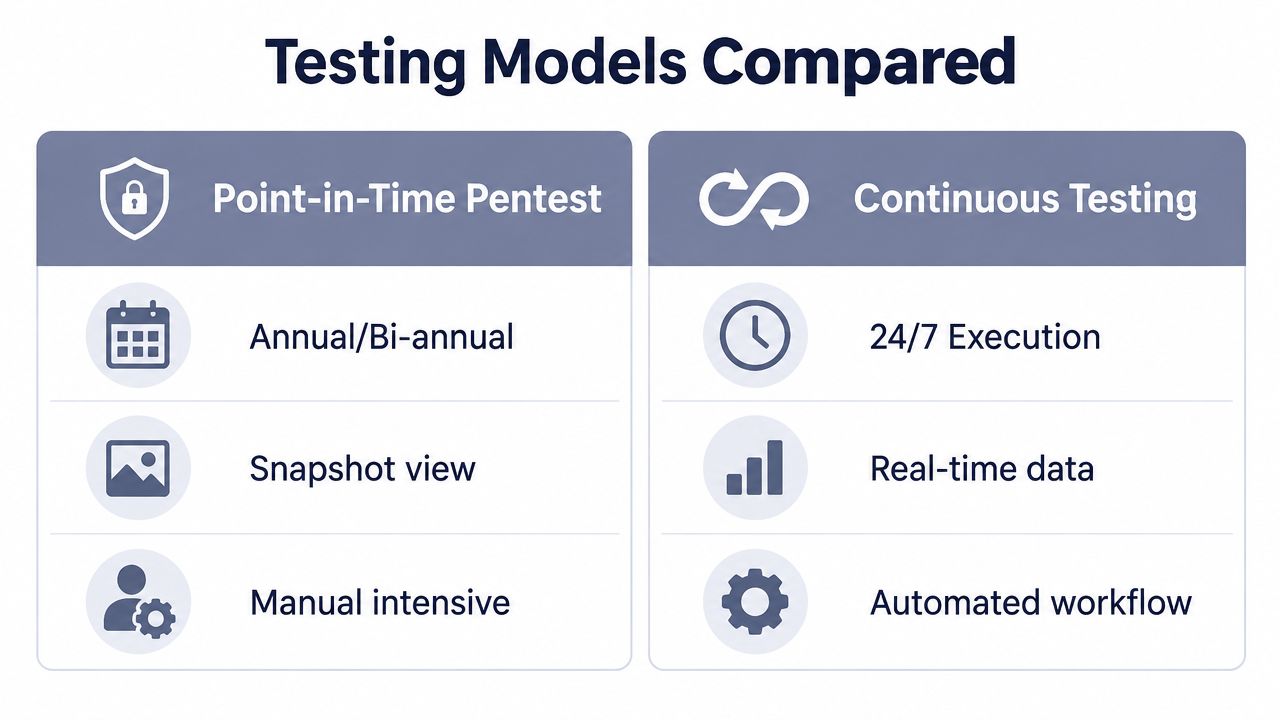
| Point-in-time penetration testing | Continuous testing |
|---|---|
| Scheduled around an engagement window | Triggered by risk, change, or an agreed recurring cadence |
| Produces a snapshot of the tested environment | Maintains ongoing visibility into changing assets |
| Often depends heavily on specialist availability | Uses automation for repeatable validation and specialist review for complex risk |
| Remediation is commonly followed by a separate retest | Retesting is built into the operating cycle |
| Reporting centers on an assessment period | Reporting can show status, recurrence, and trends |
Point-in-time testing remains necessary for deep manual assessment. Skilled testers can reason through business logic, chain weaknesses, test unusual authorization paths, and explore scenarios that automation may not understand. The limitation is coverage between engagements, not the value of expert work inside one engagement.
Continuous testing also carries trade-offs. Automation needs maintenance, clean scope definitions, dependable credentials, and careful result triage. A poorly tuned recurring scan can produce repetitive findings and consume analyst attention without improving the client's risk position.
The strongest model is hybrid. Automation handles frequent baseline validation, discovery, evidence gathering, and regression checks. Human testers investigate ambiguous results, test complex paths, and periodically challenge the assumptions built into the automated coverage.
Real-World Impact and Verification Standards
Continuous testing only improves an MSSP's service if clients trust the output. A large stream of unverified findings creates operational debt. Analysts spend time dismissing false positives, customers question the report, and remediation teams lose confidence in the priority order.
Evidence changes that relationship. A useful finding should connect the affected asset to the observed behavior and include enough supporting material for a customer's technical team to reproduce and understand the issue. Screenshots, request and response context, structured technical details, and remediation verification make the report useful beyond the initial notification.
Evidence standard: A recurring finding should tell the client what changed, what was tested, what was confirmed, and what evidence supports the conclusion.
Verification is especially important when automation performs exploitation attempts. The engine should distinguish discovery from confirmation and preserve a clear record of the steps that led to the finding. This approach supports more accurate reporting and gives a human reviewer a practical basis for escalation.
Designing for provider operations
Infrastructure affects quality. Shared execution environments can create concerns around tenant isolation, resource contention, data handling, and unpredictable test performance. Dedicated infrastructure can give a provider clearer separation between customer engagements and more consistent control over where testing runs.
Reporting must work for multiple audiences. Executives need concise business impact and remediation status. Engineers need affected assets, reproduction detail, evidence, and technical guidance. Compliance teams need control references and an auditable record of validation activity.
The adversarial exposure validation approach reflects the core requirement: security validation should test whether an exposure is practically meaningful, not merely whether a tool recognizes a potential weakness.
Compressing the delivery loop
A provider gains operational efficiency when reconnaissance, testing, verification, and reporting run as one controlled workflow. In typical workflows, ThreatExploit AI states that its automated penetration testing can produce complete reports in under four hours, with a reported 95% verification rate and 94% overall accuracy. Those figures are platform claims and should be evaluated against the provider's own targets, scope, and quality review process.
The broader lesson doesn't depend on a particular platform. Faster delivery matters only when evidence quality remains high and critical findings receive appropriate human scrutiny. Speed without verification is noise delivered sooner.
Business Case for Continuous Security Testing
MSSPs face a capacity problem. Senior penetration testers are difficult to scale, while customers increasingly expect faster validation, more frequent reassessment, and reports that support both remediation and compliance. Adding manual effort to every recurring test can raise delivery costs faster than revenue.
Continuous testing addresses that mismatch by assigning repeatable work to automation and reserving specialist time for decisions that require expertise. Reconnaissance, baseline comparisons, routine checks, evidence formatting, and retest workflows can follow a controlled process. Consultants can then focus on attack-path analysis, business logic, cloud privilege relationships, and customer guidance.
That model supports several commercial outcomes:
- More consistent delivery: A defined workflow reduces dependence on one consultant remembering every step across every customer.
- Better service packaging: Recurring validation can become part of a managed retainer rather than an isolated project.
- Lower marginal effort: Reusable automation can expand testing capacity without requiring proportional hiring.
- Stronger retention logic: Customers receive an ongoing security record, not just an assessment document that becomes stale between renewals.
- Faster sales conversations: A lightweight prospecting pentest can give a prospective customer a concrete view of exposure before a broader managed program is proposed.
Compliance reporting strengthens the business case when it maps findings and remediation evidence to frameworks such as SOC 2, PCI DSS, ISO 27001, and HIPAA. Mapping doesn't replace the underlying assessment or the customer's compliance obligations, but it can reduce the manual work needed to organize evidence for review.
Market estimates show sustained investment in continuous testing, although published figures vary by methodology. One source estimates USD 2.94 billion in 2024, projecting USD 3.35 billion in 2025 and USD 8.25 billion by 2032 at a 13.7% CAGR. Another projects USD 4.4 billion by 2034 at a 15.0% CAGR. Research and Markets presents these estimates and projections.
For an MSSP, the commercial question is practical: can the provider deliver more current validation while keeping evidence quality, customer communication, and specialist oversight intact? If yes, continuous testing becomes a service design decision, not merely a tooling purchase.
Common Challenges and How to Overcome Them
Continuous testing doesn't remove operational complexity. It moves that complexity into scope management, integration, triage, maintenance, and customer communication. Providers that underestimate those areas often create a noisy service that customers stop trusting.
Integration failure
A test that can't reliably connect to the right environment isn't continuous validation. Start with a narrow integration path, document credentials and dependencies, and classify outcomes clearly. “Not run,” “blocked,” “inconclusive,” and “passed” shouldn't appear as the same status.
False positives and flaky results
Automation must earn trust through verification. Require evidence for material findings, review recurring alerts, and tune checks that repeatedly fail because of unstable environments rather than exploitable conditions. A human reviewer should be able to see why a finding was confirmed and whether its severity reflects the customer's actual exposure.
Scope creep
New assets can appear without a corresponding authorization update. Establish an asset ownership process and stop testing when a target falls outside the approved boundary. Change detection should create a review request, not expand the test scope without approval.
Manual-only assumptions
Manual expertise remains essential, but using specialists for every repeatable check creates a bottleneck and makes recurring coverage expensive. The practical alternative isn't unattended automation. It's a controlled division of labor, where machines repeat validated checks and testers investigate uncertainty, business impact, and complex attack chains.
Operational discipline: Continuous testing succeeds when the provider improves the system after every cycle, including its scope, rules, evidence requirements, escalation paths, and retest criteria.
Compliance requirements also change as assets and services evolve. Review the control mapping, report language, and evidence retention process periodically so the automated workflow continues to support the customer's current obligations. Start small, measure result quality, and expand only when the team can maintain reliable coverage.
ThreatExploit AI provides automated penetration testing for web applications, networks, APIs, and cloud environments, with reconnaissance, exploitation, verification, evidence collection, and compliance-mapped reporting in a managed workflow. If you're evaluating how to add recurring validation to an MSSP offering, visit ThreatExploit AI to review the platform and discuss a practical implementation path.