

You've just received a vulnerability scan report with no critical findings. The dashboard is green, the ticket queue is quiet, and the quarterly security review looks easy to close. Then an engineer discovers that an attacker entered through a misconfigured API gateway, chained weaknesses the scanner had listed separately, and remained inside the environment without triggering a critical alert.
That situation explains why what is VAPT testing is a more important question than it first appears. Vulnerability Assessment and Penetration Testing combines broad weakness discovery with controlled attempts to exploit those weaknesses. The assessment shows what may be wrong across an environment. The penetration test shows what an attacker can reach, combine, and affect.
For service providers, this distinction shapes the entire engagement, from scoping and staffing to report quality and recurring revenue. VAPT isn't just a larger scan. It's a delivery discipline that turns technical findings into evidence-backed risk decisions.
Table of Contents
- The Moment a Clean Scan Report Stops Feeling Safe
- What VAPT Actually Means and Why It Is Two Activities
- Inside the VAPT Workflow From Scoping to Reporting
- How VAPT Differs From Scanning Red Teaming and Bug Bounty
- What a Good VAPT Deliverable Looks Like
- Where Automated Pentest Platforms Fit in the VAPT Lifecycle
- A Practical Adoption Path for Service Providers
- Where VAPT Is Headed and What to Do Next
The Moment a Clean Scan Report Stops Feeling Safe
A mid-size e-commerce company had completed its quarterly vulnerability scan. The report contained no critical findings, and the security team used it to support an internal assurance review. Six months later, incident responders found that attackers had entered through an API gateway whose configuration allowed an unintended path into backend services.
The scanner hadn't been useless. It had identified individual weaknesses, outdated components, and configuration concerns. What it hadn't done was safely demonstrate how those weaknesses could be chained, whether the gateway exposed a valuable route, or whether application behavior allowed an authenticated user to cross an authorization boundary.
That difference matters because automated scanners generally work by matching observed conditions against known signatures, vulnerable versions, configuration patterns, and common weakness indicators. They provide breadth and repeatability, but a green dashboard doesn't prove that business logic is sound or that no practical attack path exists.
The gap between detection and proof
An automated result might flag a permissive gateway rule. Another result might identify an API endpoint with weak authorization. A third might show an exposed service. A human penetration tester asks whether those conditions combine into a route to sensitive functionality, then validates the route within the agreed rules of engagement.
Business logic flaws are especially difficult for scanners to judge. A tool can inspect requests and responses, but it may not understand that a customer can alter another customer's order, reuse a payment workflow, or access an administrative function through an unexpected sequence of valid actions.
Practical rule: A scan tells you where to investigate. A penetration test tells you what the weakness enables.
VAPT exists to close this gap. The vulnerability assessment inventories and prioritizes weaknesses across the attack surface. The penetration test selects relevant findings, tests them safely, and documents actual impact. When attackers bypass a clean-looking report, the missing evidence often sits between those two activities.
The right question isn't whether your environment was scanned. Ask whether anyone validated the important findings, tested chained attack paths, and examined the application behavior behind the dashboard. If the answer is no, the scan may have measured exposure without proving exploitability.
What VAPT Actually Means and Why It Is Two Activities
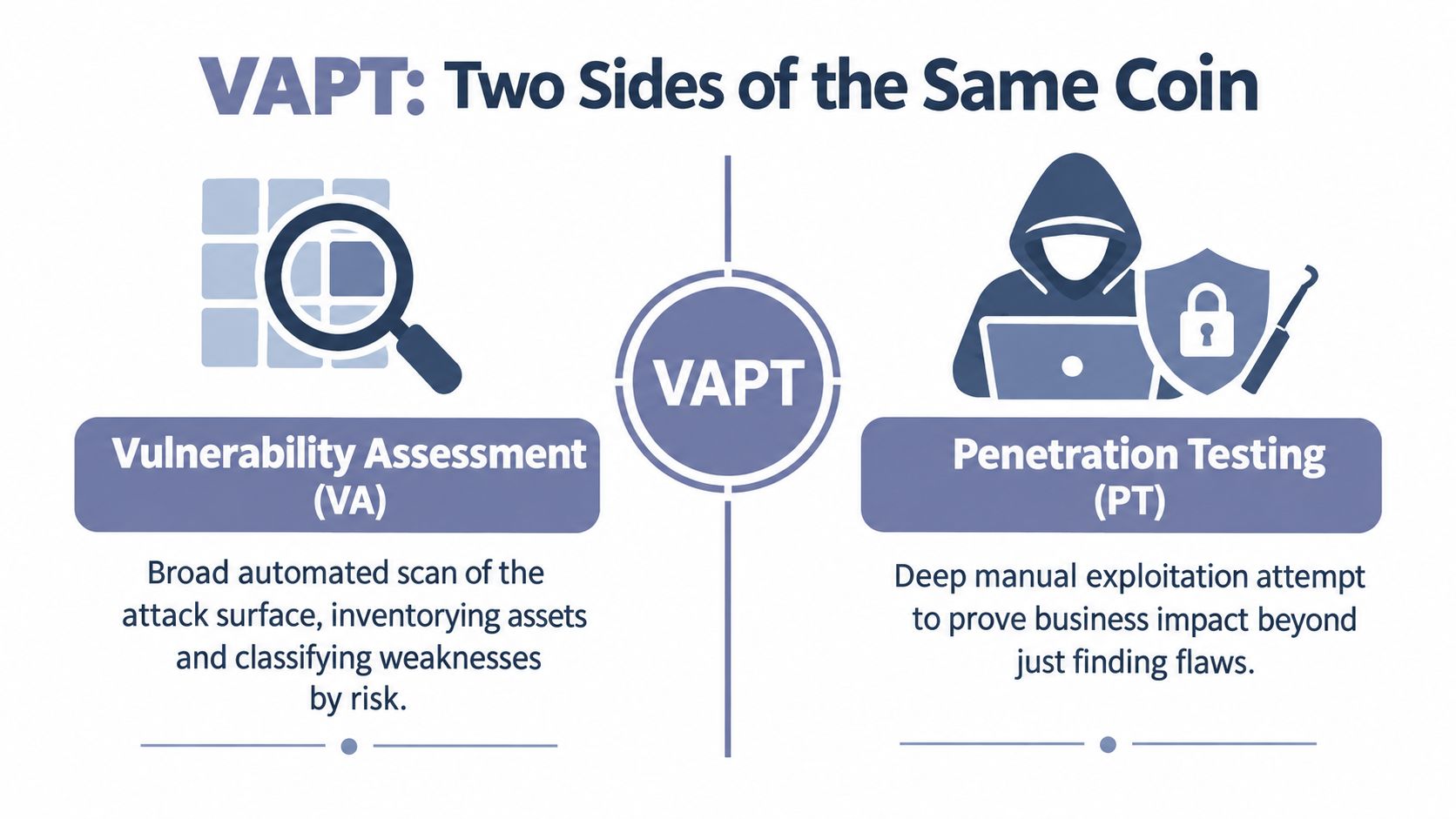
VAPT stands for Vulnerability Assessment and Penetration Testing. It combines two related but distinct activities under one delivery model. A vulnerability assessment is broad and systematic. Penetration testing is targeted and adversarial.
Think about home security. A vulnerability assessment resembles a detailed inspection that records every weak lock, open window, damaged hinge, and poorly lit entrance. It creates an inventory and helps rank which problems deserve attention first. A penetration test is different. You hire a specialist to try the doors, test the windows, and determine whether the weaknesses provide a realistic way inside.
Vulnerability assessment provides coverage
The VA portion usually combines asset discovery, automated scanning, configuration review, and risk classification. The team identifies systems, applications, APIs, cloud resources, and network services, then organizes potential weaknesses according to severity and context.
Its value is scale. A service provider can repeat scans across a large environment, compare results over time, and identify newly introduced issues without asking a senior tester to manually inspect every asset. Tools such as Nmap, Nuclei, and web proxies can support this work, but their output still requires validation and interpretation.
Penetration testing provides depth
The PT portion focuses on exploitation. Testers examine selected weaknesses, manipulate requests, attempt privilege escalation, follow attack paths, and establish what an attacker could access or change. NIST's description of penetration testing centers on controlled attempts to circumvent security features in an application, system, or network, which distinguishes it from simple detection work. The NIST-aligned explanation of penetration testing phases provides useful context for this distinction.
A penetration tester may discover that a medium-severity authorization issue becomes serious when combined with a predictable workflow or an exposed API function. The tester's job isn't to cause damage. It's to prove the weakness within agreed boundaries and preserve enough evidence for the client to fix it.
Why the combination matters
Assessment without exploitation can leave severity ratings unverified. Exploitation without assessment can waste skilled hours because the tester starts with an incomplete asset map and misses important targets.
The terms also appear differently in RFPs. VA may mean a scan-led inventory and prioritization exercise. PT may mean a focused manual attack simulation. VAPT should signal coordinated breadth and depth, but buyers should still ask what assets, methods, validation steps, and retesting activities the provider includes. For a plain-language foundation, this penetration testing overview helps separate the attack simulation from the broader assessment activity.
Inside the VAPT Workflow From Scoping to Reporting
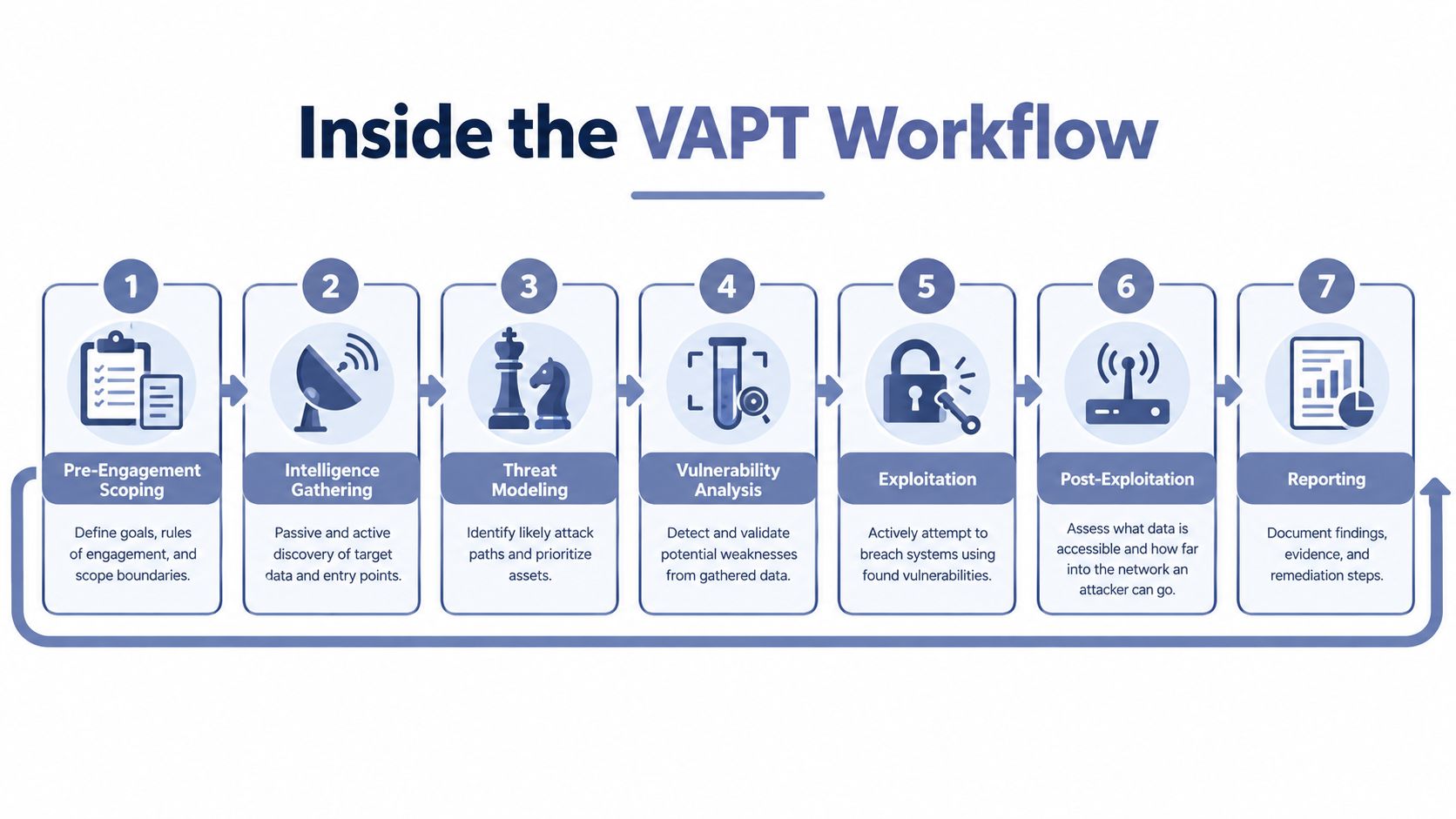
A professional VAPT engagement follows a controlled sequence, but the work behaves more like an iterative funnel than a rigid checklist. PTES describes seven phases, covering pre-engagement interactions, intelligence gathering, threat modeling, vulnerability analysis, exploitation, post-exploitation, and reporting. The PTES phase guide outlines this structure and its relevance to repeatable delivery.
The first four phases create the attack map
Pre-engagement interactions: The provider agrees on objectives, targets, test windows, contacts, prohibited actions, credentials, and escalation procedures. The buyer receives a defined scope and rules of engagement, which protect production systems and prevent misunderstandings.
Intelligence gathering: Testers collect authorized information about domains, applications, APIs, services, cloud assets, and supporting infrastructure. The buyer receives an attack-surface view that can expose forgotten or shadow IT assets. New discoveries may change the scope or feed directly into threat modeling.
Threat modeling: The team identifies valuable assets, likely adversary paths, trust boundaries, and realistic objectives. Instead of treating every finding equally, testers focus effort on routes that could affect customer data, financial workflows, privileged access, or business operations.
Vulnerability analysis: Automated tools and manual review identify potential weaknesses and connect related observations. The output isn't just a list of scanner alerts. It is a set of testable hypotheses that guide exploitation.
The final three phases turn hypotheses into evidence
Exploitation: Testers safely attempt selected attacks. A successful exploit can confirm that a suspected weakness is reachable and can show its practical consequence. A failed attempt can also improve accuracy by reducing false positives.
Post-exploitation: Once access is obtained, testers assess reach, privilege, data exposure, and possible movement toward other systems, without exceeding the agreed boundaries. This phase gives the buyer context about blast radius rather than only the initial entry point.
Reporting: The provider documents findings, evidence, affected assets, risk context, remediation actions, limitations, and retesting needs. A useful report lets technical teams reproduce the issue and lets leadership understand why it matters.
The phases inform one another. Intelligence changes the threat model, threat modeling prioritizes analysis, analysis shapes exploitation, and exploitation determines what evidence belongs in the report. That feedback loop is what separates a managed VAPT engagement from a scan followed by a PDF export.
How VAPT Differs From Scanning Red Teaming and Bug Bounty
Buyers often compare services by asking which one is more thorough. That question is less useful than asking what decision the engagement must support. A scanner is appropriate when a team needs broad, repeatable identification. VAPT fits when the team needs both coverage and proof. A red team tests whether defenders can withstand a realistic campaign aimed at a defined objective, while a bug bounty uses external researchers to discover issues under a program's rules.
| Criterion | Vulnerability Scanning | VAPT | Red Teaming | Bug Bounty |
|---|---|---|---|---|
| Primary goal | Identify known weaknesses at scale | Discover weaknesses and validate exploitability | Test defense against an adversary pursuing a business objective | Invite external researchers to report vulnerabilities |
| Depth | Mostly automated and surface-oriented | Automated coverage plus targeted manual exploitation | Deep, objective-driven attack simulation | Variable, depending on researcher interest and skill |
| Frequency | Suitable for recurring checks | Scheduled or recurring assurance | Conducted when an organization needs adversary simulation | Potentially ongoing while the program remains open |
| Budget model | Tool or service subscription | Scoped engagement or managed program | Specialist project with substantial planning | Program rewards and administration |
| Confidentiality | Controlled within the provider or team | Contracted and tightly scoped | Highly controlled and need-to-know | Depends on disclosure policy and researcher participation |
| Best fit | Large inventories and routine detection | Evidence-backed remediation and assurance | Testing detection, response, and resilience | Expanding external discovery coverage |
VAPT sits between detection and full adversary simulation. It gives an MSSP a repeatable product that can include web applications, APIs, internal networks, external infrastructure, and cloud environments, while preserving room for tester judgment.
Red teaming shouldn't be sold as a premium version of every VAPT. It answers a different question: can a capable adversary reach a defined objective while the organization's people, processes, and controls respond? Bug bounty programs also serve a different purpose. They can extend external coverage, but providers and buyers can't assume guaranteed scope, depth, timing, or confidentiality from an open researcher community.
For a sharper buyer-side distinction, this comparison of vulnerability scanning and penetration testing can help teams choose the engagement that matches their actual risk question.
What a Good VAPT Deliverable Looks Like
A VAPT report earns its value after the test ends. If developers can't reproduce a finding, managers can't prioritize it, and auditors can't connect it to relevant evidence, the document becomes an archive rather than a remediation tool.
Start with decisions, not tool output
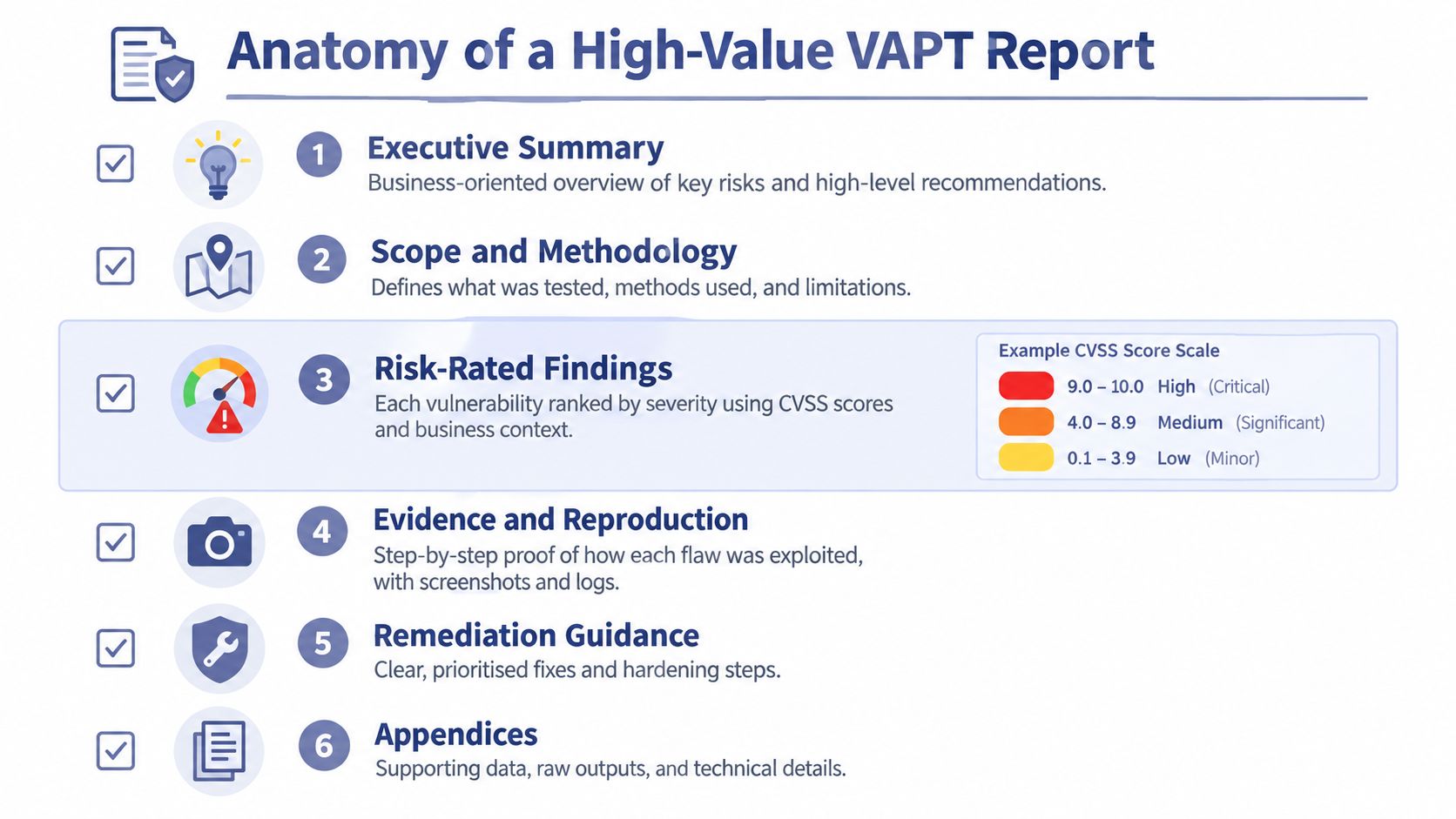
The executive summary should explain the most important risks in business language. It should identify the tested environment, major themes, material limitations, and recommended priorities without forcing leadership to interpret raw scanner terminology.
The scope and methodology section should state what was tested, how access was provided, which testing methods were used, and what the provider couldn't assess. This protects both sides. A client shouldn't mistake an out-of-scope API or cloud account for a tested control.
A strong finding then combines severity with context. CVSS scoring can provide a consistent technical reference, but the report should also explain the affected business function, reachable data, prerequisites, and realistic consequences. A moderate technical score may deserve urgent treatment if it affects a critical payment or identity workflow.
Evidence should shorten the remediation cycle
Each validated finding should contain reproducible steps, screenshots, request and response captures, relevant logs, and a proof-of-concept that demonstrates the issue without creating unnecessary risk. Developers need enough detail to locate the defect. Security managers need enough context to rank it. Auditors need traceable evidence.
Remediation guidance should be specific. Depending on the issue, that may include a code change, access-control adjustment, secure configuration, logging improvement, or architectural recommendation. A retest section should explain how the provider will verify the fix and what residual risk remains.
A compliance appendix can map findings to relevant controls in frameworks such as ISO 27001, PCI DSS, SOC 2, and HIPAA. That mapping doesn't replace control testing, but it can make evidence collection more orderly. Teams building a wider evidence process may also find this audit readiness blueprint useful for organizing preparation beyond the penetration test itself.
A report should answer three questions quickly: what happened, why it matters, and what someone must do next.
Where Automated Pentest Platforms Fit in the VAPT Lifecycle
Automation works best when delivery teams use it to remove repetition, not to remove judgment. An AI-driven pentest platform can support reconnaissance, recurring discovery, repetitive exploitation paths, initial triage, evidence collection, and report drafting. Senior testers can then spend more time on business logic, chained vulnerabilities, creative pivoting, and risk interpretation.
Before the test
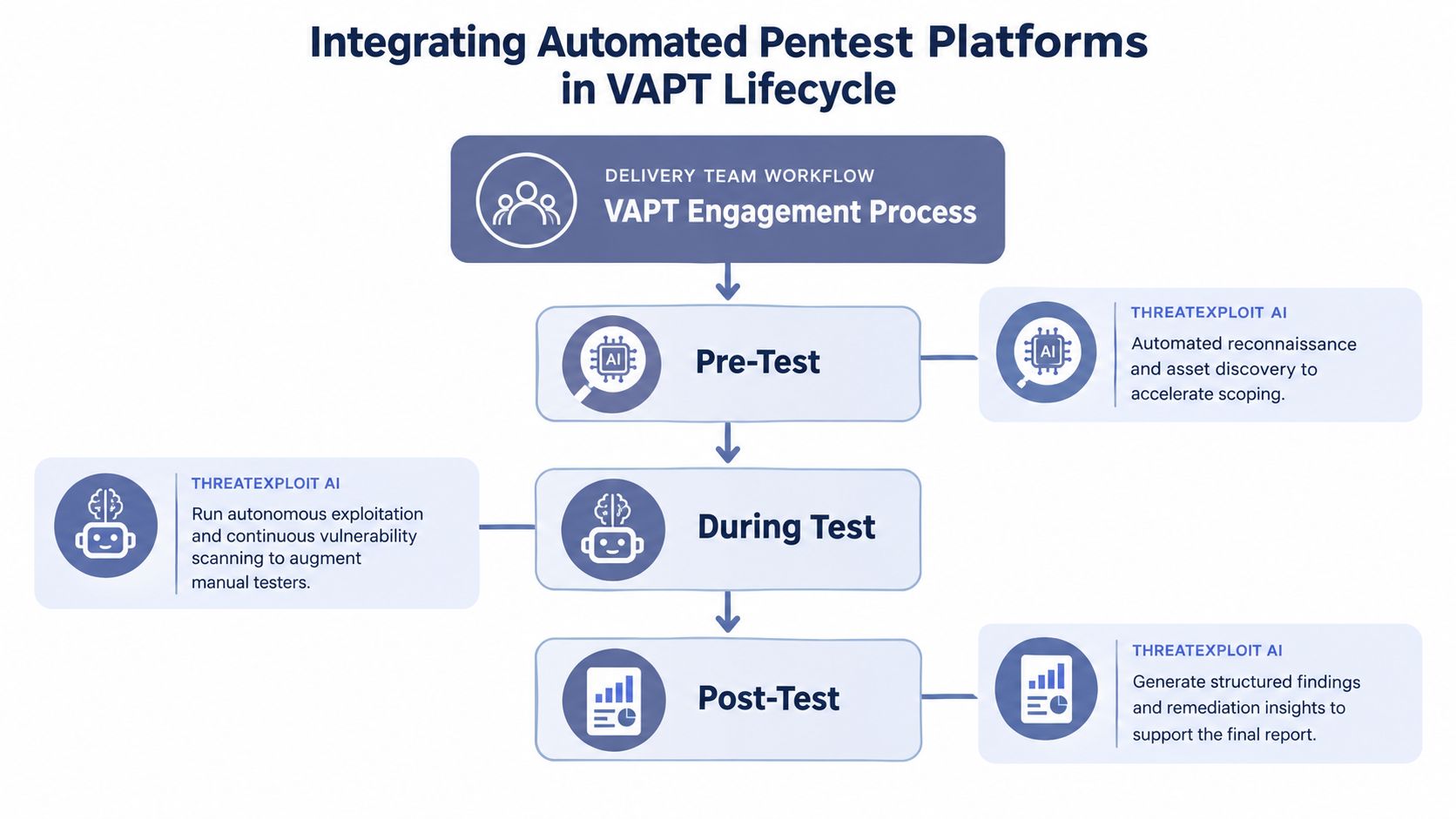
A platform can help collect and organize asset information before a tester begins manual work. That makes scoping more current, especially in environments where cloud resources, APIs, and application endpoints change between formal assessments.
The delivery team still needs to confirm ownership, authorization, testing windows, credentials, prohibited actions, and escalation contacts. Automation can accelerate discovery, but it can't decide whether a newly found asset belongs in the engagement or whether a production action is acceptable.
During the test
Automated agents are useful for breadth and regression coverage. They can repeat known attack paths, test common input-handling issues, inspect authentication flows, and look for changes introduced after a deployment. That consistency helps providers deliver recurring assurance without assigning every repetitive task to a senior consultant.
Human expertise remains essential for workflows that depend on business meaning. A tester may need to understand how roles interact, how a payment state changes, or how several low-confidence signals form a credible attack path. Social engineering, high-risk production testing, and regulated engagements also require explicit human control and sign-off.
After the test
Structured outputs can reduce the time spent converting raw observations into client-ready findings. The reviewer still needs to remove duplicates, challenge weak evidence, confirm severity, and tailor remediation to the client's architecture.
ThreatExploit AI is one example of a platform designed for authorized testing across web applications, APIs, networks, and cloud infrastructure, with automated reconnaissance, exploitation, verification, and reporting. Service providers evaluating such platforms should compare workflow controls, evidence quality, scope management, integrations, and reviewer oversight, not only the number of tools orchestrated. This automated penetration testing resource provides further context on how automation can sit inside a broader engagement.
A Practical Adoption Path for Service Providers
MSSPs and consultancies rarely fail because they lack a scanner. They struggle when every engagement depends on custom analyst effort, inconsistent scoping, manually rebuilt reports, and senior staff who become the delivery bottleneck.
Foundation
Start by selecting a methodology and turning it into operational templates. Define asset categories, rules-of-engagement language, intake questions, evidence standards, severity conventions, and escalation procedures. Pricing should reflect scope, testing depth, reporting effort, retesting, and the amount of human review required.
The first milestone is repeatability. A new consultant should be able to understand what information to collect, which approvals are required, and how a finding moves from discovery to client delivery.
Pilot
Choose one engagement type that appears often in your pipeline, such as an external web application or API assessment. Run the work through the full lifecycle, then examine where analysts spent time, which findings required rework, and which client questions the report failed to answer.
A useful pilot isn't judged only by execution speed. It should produce a stable scope template, a review checklist, a report structure, and a clear handoff between testing, account management, remediation support, and retesting.
Scale
Once the workflow is reliable, standardize report modules and compliance mappings for the sectors you serve. Build reusable content for common technologies, but keep space for asset-specific analysis. Partner enablement also matters. Sales teams need to understand what a scan, VAPT, and red team engagement can and can't promise.
Track concrete operational milestones, including shipping the first 10 reports and signing the first multi-year contract. Those milestones show that the service has moved beyond experimentation into a deliverable clients can understand and renew.
Recurring revenue
The mature model treats VAPT as recurring assurance rather than a one-off PDF. Providers can package periodic testing, managed VAPT, retesting, and targeted assessments around material application or infrastructure changes.
Automation can remove the largest capacity constraint, analyst hours per engagement, but it doesn't eliminate governance. Keep a human approval gate for scope, exploit safety, finding verification, final severity, and customer communication. That balance protects margin while preserving professional accountability.
Where VAPT Is Headed and What to Do Next
VAPT is moving from an annual audit ritual toward a continuous validation loop. Faster software changes, expanding cloud estates, changing exposure, and demand for evidence all make point-in-time testing less sufficient on its own. Market commentary identifies automation, cloud-based testing, and AI-assisted detection as emerging directions, but the practical question is how those capabilities fit into a provider's delivery and assurance model. The market perspective on VAPT development offers background on that broader shift.
The core discipline remains stable. Vulnerability assessment finds what is theoretically weak. Penetration testing proves what is exploitable. VAPT combines both into evidence-backed risk information.
Service providers can begin by reviewing their current scan coverage, selecting a tightly scoped pilot, documenting their manual validation process, and evaluating how an automated platform would affect evidence collection and report review. Buyers should ask whether a proposed engagement covers their real attack surface, tests business logic, explains limitations, and supports remediation verification.
Market projections point toward continued expansion. One estimate valued the global VAPT market at approximately USD 3.8 billion in 2022 and projected nearly USD 8.9 billion by 2030, with an implied CAGR of around 12.4%, while another projected USD 8.7 billion by 2033 at a 10.5% CAGR from 2026 to 2033, as summarized by Pentera's VAPT overview. These projections suggest that VAPT has become a mainstream security budget category, but operational quality will determine which providers can turn demand into durable assurance.
ThreatExploit AI helps security service providers automate authorized reconnaissance, exploitation, verification, evidence collection, and compliance-mapped reporting across web, API, network, and cloud environments. Visit ThreatExploit AI to evaluate how an automated pentesting workflow could support your next VAPT pilot and recurring delivery model.