
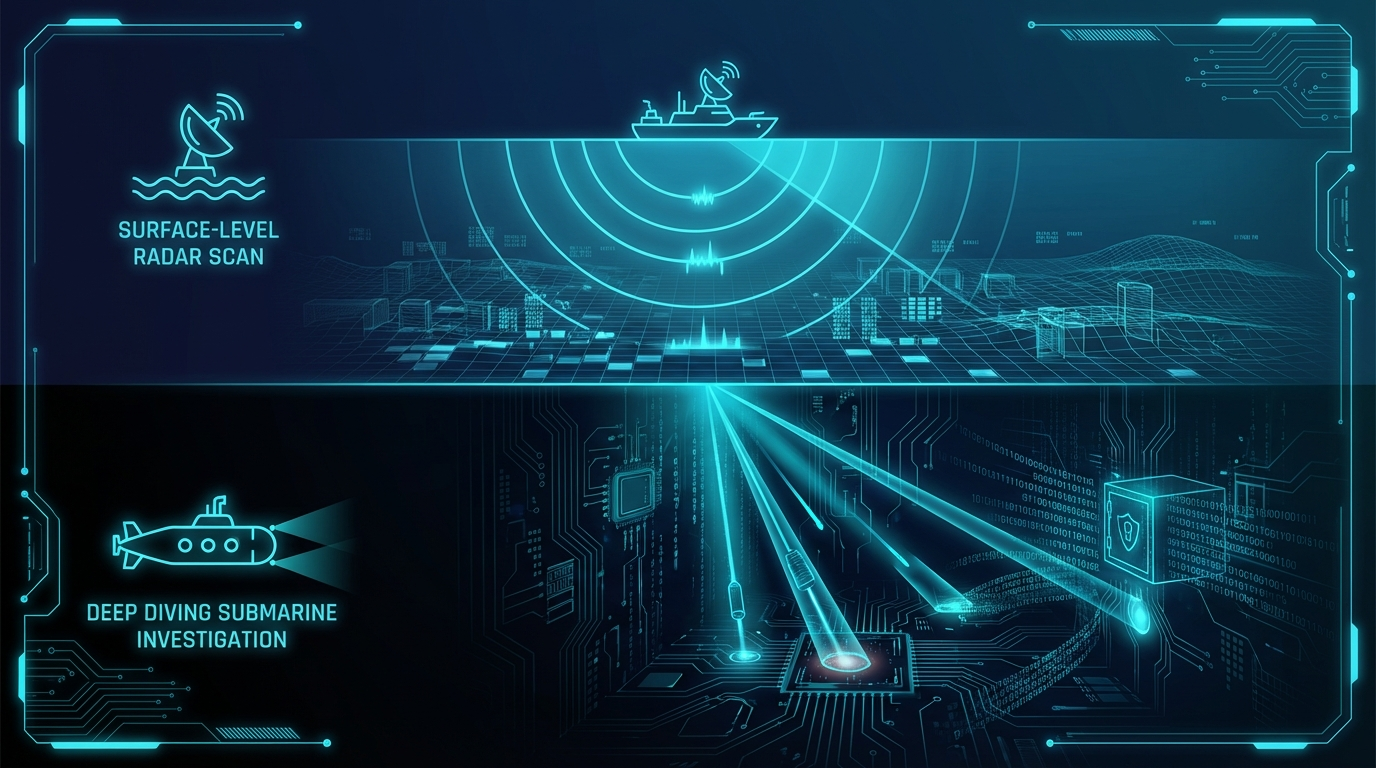
TL;DR: Vulnerability scans and penetration tests are not interchangeable. Scans identify potential weaknesses across broad environments using automated pattern matching. Penetration tests actively exploit those weaknesses to prove which ones represent real risk. Security service providers who conflate the two end up underdelivering, mispricing, and creating compliance gaps for their customers. Understanding the distinction is foundational to building a credible, scalable security practice.
The terms "vulnerability scan" and "penetration test" are routinely used interchangeably in sales calls, customer conversations, and even compliance documentation. This confusion is not harmless. When a customer asks for a penetration test and receives a vulnerability scan, they walk away with a false sense of security -- a list of theoretical findings rather than proof of what an attacker can actually do. When a service provider quotes penetration testing rates for what is essentially an automated scan, the pricing mismatch creates friction and erodes trust.
For MSSPs, telecoms, compliance firms, and any organization that delivers security services, getting this distinction right is not a technical nicety. It is a business-critical capability.
What Is a Vulnerability Scan?
A vulnerability scan is an automated process that identifies known weaknesses in systems, networks, and applications. Scanners like Nessus, Qualys, and Rapid7 crawl the target environment, compare what they find against databases of known vulnerabilities (CVEs), and generate a report listing every potential issue.
The key characteristics of a vulnerability scan:
- Automated and repeatable. Scans run on a schedule with minimal human involvement. They are designed for breadth, not depth.
- Pattern-matching based. Scanners identify vulnerabilities primarily through version detection and signature matching. If a server runs Apache 2.4.49, the scanner flags every CVE associated with that version.
- No exploitation. Scanners do not attempt to exploit the vulnerabilities they find. They report that a weakness exists based on indicators, but they do not prove it is exploitable.
- High volume output. A single scan of a moderately complex environment can produce hundreds or thousands of findings, including a significant percentage of false positives.
Vulnerability scans are essential. They provide the continuous, broad-coverage visibility that every security program needs. But they answer only one question: what might be vulnerable? They do not answer the question that actually matters to the customer: what can an attacker actually do?
What Is a Penetration Test?
A penetration test is an active assessment in which a tester -- human, AI-driven, or both -- attempts to exploit vulnerabilities to demonstrate real-world impact. The objective is not to list what might be wrong but to prove what is wrong by doing what an attacker would do: chaining weaknesses, escalating privileges, moving laterally, and accessing sensitive data.
The key characteristics of a penetration test:
- Active exploitation. The tester does not just identify a potential SQL injection. They craft payloads, bypass controls, extract data, and document the full attack path.
- Contextual reasoning. A penetration tester evaluates vulnerabilities in context. A medium-severity finding on an internet-facing system with access to customer data is a higher priority than a critical finding on an isolated development server. Scanners cannot make this judgment.
- Proof-based findings. Every confirmed vulnerability comes with evidence: the exact exploit used, the data accessed, the level of access achieved. This proof is what makes pentest findings actionable and credible.
- Attack chain discovery. Penetration tests uncover risks that scanners structurally cannot see. Two low-severity vulnerabilities that individually seem harmless may, when chained together, provide administrative access to the database tier. Only active testing reveals these compound risks.
Key Differences at a Glance
| Dimension | Vulnerability Scan | Penetration Test |
|---|---|---|
| Approach | Automated pattern matching | Active exploitation and reasoning |
| Depth | Surface-level identification | Deep, proof-based validation |
| Exploitation | None | Yes -- confirms exploitability |
| False positive rate | 30-60% | Near zero (findings are proven) |
| Output | List of potential vulnerabilities | Exploited attack paths with evidence |
| Compliance value | Meets scanning requirements only | Satisfies penetration testing mandates (PCI DSS, SOC 2, HIPAA, etc.) |
| Typical frequency | Weekly or continuous | Quarterly to annually (or continuous with automation) |
| Human expertise required | Minimal | Significant (or AI-equivalent reasoning) |
Why the Distinction Matters for Service Providers
If you deliver security services, the difference between these two assessments directly affects your credibility, your pricing, and your compliance posture.
Customer Education and Expectation Setting
Many customers do not understand the difference. They request a "pentest" expecting a scan, or they request a "scan" expecting proof of exploitation. Misalignment here leads to disappointed customers, scope disputes, and damaged relationships. Service providers who can clearly articulate the distinction -- and recommend the right combination -- position themselves as trusted advisors rather than commodity vendors.
Pricing and Service Packaging
Vulnerability scans and penetration tests have fundamentally different cost structures. Scans are high-volume, low-touch, and easily automated. Penetration tests require deeper engagement, specialized expertise, and more time per target. Conflating the two leads to one of two problems: undercharging for pentests (destroying margins) or overcharging for scans (destroying trust). Accurate service definitions protect both.
Compliance Requirements
Most compliance frameworks explicitly distinguish between scanning and penetration testing. PCI DSS 4.0 requires both quarterly vulnerability scans (Requirement 11.3) and annual penetration tests (Requirement 11.4). SOC 2 Type II auditors expect evidence of penetration testing, not just scan reports. HIPAA's technical safeguard requirements are best satisfied with demonstrated exploitation testing. Delivering a scan when the compliance framework requires a pentest creates audit risk for your customer -- and liability for you.
"The service provider who delivers a vulnerability scan report when the compliance framework requires a penetration test has not saved the customer money. They have created an audit finding waiting to happen."
A vulnerability scan tells you what might be vulnerable. A penetration test proves what is vulnerable. Most compliance frameworks require both — delivering a scan when the framework mandates a pentest creates audit risk for your customer and liability for you.
How AI-Powered Automated Pentesting Bridges the Gap
Historically, the trade-off was stark. Vulnerability scans were fast and cheap but shallow. Penetration tests were deep and credible but slow, expensive, and dependent on scarce human expertise. Organizations had to choose between broad coverage and deep validation.
AI-powered automated pentesting eliminates this trade-off. Platforms that use AI reasoning to actively exploit vulnerabilities deliver the speed and scalability of scanning with the depth and proof quality of manual penetration testing. Findings are validated through actual exploitation, false positives are eliminated before they reach the report, and attack chains are discovered automatically.
For service providers, this changes the economics entirely:
- Scale without headcount. Deliver penetration test quality across your entire customer base without hiring proportionally more pentesters. The AI handles the exploitation, validation, and evidence collection that previously required senior consultants.
- Continuous validation. Move from annual pentests to continuous automated testing. Customers get real-time visibility into their exploitable attack surface, not a point-in-time snapshot that is outdated within weeks.
- Higher confidence findings. Every finding in the report has been proven through exploitation. Engineering teams trust the results because they come with evidence, not just a version number match. Remediation happens faster, and re-testing confirms the fix.
- Clean compliance posture. Automated pentesting satisfies the penetration testing requirements in PCI DSS, SOC 2, HIPAA, and other frameworks. Customers get the documentation they need for audits without the scheduling delays and cost of traditional manual engagements.
What This Means for Partners Delivering Security Services
The market is shifting. Customers increasingly understand that scan reports alone do not represent their actual risk posture. Compliance frameworks are tightening the distinction between scanning and testing. And the availability of AI-powered pentesting platforms means that the "pentesting is too expensive to do frequently" argument no longer holds.
Service providers who adapt to this shift have a clear advantage:
- Differentiate on depth. Competitors who still deliver scans labeled as pentests will lose credibility as customers become more sophisticated. Partners who deliver validated, proof-based findings stand out.
- Expand revenue per customer. Offering both scanning and automated pentesting as complementary services -- rather than substitutes -- creates a larger engagement per account. The scan provides breadth. The pentest provides depth. Together, they deliver a complete picture that justifies premium pricing.
- Reduce delivery risk. When every finding in the report has been validated through exploitation, there are no awkward conversations about false positives. Customer trust increases, renewals improve, and referrals follow.
The distinction between a vulnerability scan and a penetration test is not a technicality. It is the foundation of a credible security service practice. Partners who understand it, communicate it clearly to their customers, and deliver both capabilities at scale are the ones who will own the market.
Frequently Asked Questions
Can a vulnerability scan replace a penetration test?
No. A vulnerability scan identifies potential weaknesses but does not verify exploitability. A penetration test actively attempts exploitation to prove which vulnerabilities represent real risk. Most compliance frameworks require both.
How often should each be performed?
Vulnerability scans should run weekly or after every infrastructure change. Penetration tests are typically required quarterly or annually by compliance frameworks, though continuous automated pentesting is becoming the industry standard for organizations that want real-time validation.
Which do my customers actually need?
Both. Vulnerability scans provide broad coverage and early detection. Penetration tests validate which findings are actually exploitable. The combination eliminates false positives and gives customers a clear, prioritized remediation roadmap.