
A client's dashboard shows a critical vulnerability on an internet-facing service. The ticket is urgent, the severity score is high, and the remediation deadline is already under discussion. Then your pentest team tests the actual route and discovers that the vulnerable component isn't reachable from the relevant entry point, while an existing control blocks the next step.
That finding wasn't useless. It was incomplete.
MSSPs face this distinction every day. Discovery produces more findings than most customers can remediate at once, while executives, auditors, and engineering teams increasingly want evidence that a reported exposure can become a real attack path. Adversarial exposure validation, or AEV, changes the conversation from “this might be dangerous” to “this behavior succeeded here, these controls responded this way, and this remediation stopped or failed to stop the path.”
Proof beats possibility when a client has to decide what gets fixed first.
For a service provider, that shift has commercial weight. A validated path supports a defensible remediation recommendation, a clearer retest scope, and a report that connects technical activity to privilege gain, lateral movement, sensitive-data access, or control failure. This article builds the model from the ground up, then applies it to threat modeling, chained attack scenarios, operating cadence, metrics, and MSSP adoption.
Table of Contents
- Introduction Why Proof Beats Possibility in Modern Pentesting
- What Adversarial Exposure Validation Really Means
- Why Threat Modeling Needs Validation to Be Trustworthy
- Attack Scenarios That Prove Real Exploitability
- How Adversarial Exposure Validation Works in Practice
- Measuring Success With Metrics That Matter to Clients
- Your Adoption Roadmap for Adversarial Exposure Validation
Introduction Why Proof Beats Possibility in Modern Pentesting
A senior analyst opens the morning queue to dozens of high-severity findings across several tenants. One affects a public application, another involves a cloud role, and a third concerns an identity relationship that appears too broad. The dashboard ranks each item, yet none shows whether an attacker can move from exposure to meaningful impact.
That gap creates a practical dispute. The MSSP needs to give responsible guidance, the customer needs a priority list engineering can act on, and the auditor needs evidence that controls were tested rather than documented. A severity label starts the conversation. It does not determine which path works, what stopped it, or what deserves remediation first.
Traditional penetration testing remains valuable. Skilled testers find novel weaknesses, examine business logic, and adapt to the environment. A typical engagement still has a defined scope and testing window, though. After the report is delivered, deployments, identity changes, cloud-policy revisions, or incomplete fixes can alter the result.
AEV adds a proof-oriented validation layer. It uses controlled attacker-like behavior to test whether an exposure is exploitable in the customer's environment, whether controls prevent or detect the activity, and whether remediation closes the same path. AEV does not replace a human pentester. It keeps important attack paths tied to evidence as the environment changes.
For an MSSP, the service becomes easier to prioritize and explain:
- Discovery identifies possibilities.
- Validation demonstrates reachability and exploitability.
- Control testing shows what stopped the path, if anything.
- Retesting verifies whether the fix changed the result.
That sequence also supports a clearer commercial deliverable. A chained action that reaches a sensitive resource can justify urgent work. A path blocked by an effective control may shift the recommendation toward monitoring or a narrower fix. A retest can create a concrete trigger for closing the ticket, reopening it, or billing for follow-up validation.
AEV has developed into a formalized market category in Gartner's 2025 and 2026 guidance. The category brings earlier Breach and Attack Simulation, automated penetration testing, and red teaming closer to a shared purpose: proving whether exposures are exploitable. Gartner's guidance projected adoption of structured exposure validation initiatives at 40% by 2027 and 60% by 2029, as summarized in AttackIQ's coverage of the 2026 Gartner guide.
The practical MSSP question is direct: can your team turn a finding into an evidence-backed decision, then prove what changed after the customer acted?
What Adversarial Exposure Validation Really Means
Start with a locked door.
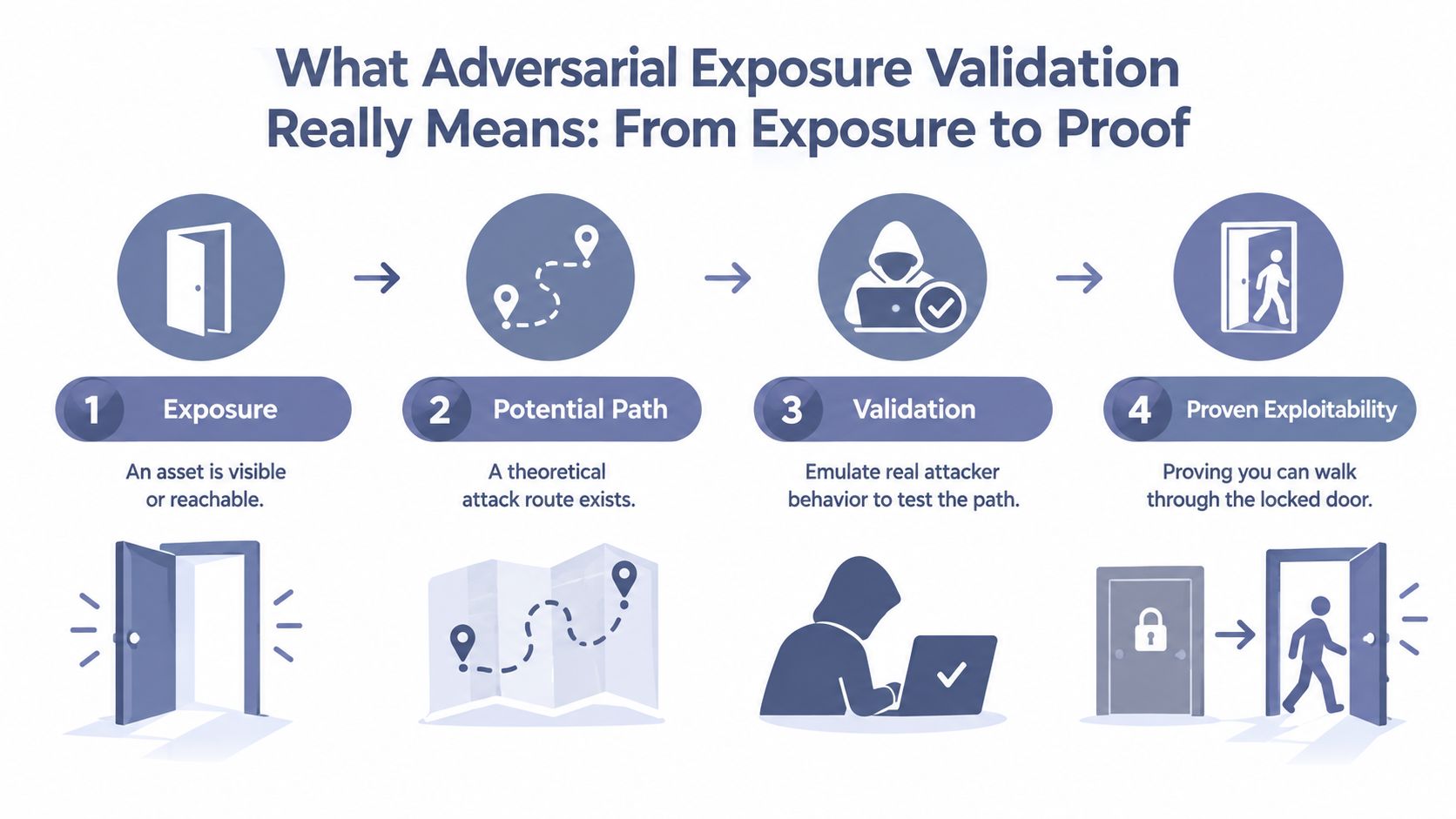
A scanner can tell you that the door exists, that it faces a public hallway, and that the lock appears weak. A threat model can draw a route from the hallway to the room beyond it. Validation asks whether a controlled actor can open the door, enter safely, continue through the building, and reach something that matters.
That analogy separates four ideas that teams often blend together.
From exposure to proven path
Exposure means an asset, service, identity, permission, misconfiguration, or control gap is visible or reachable. It doesn't automatically mean compromise is possible.
Potential path means the available conditions appear to connect. An exposed API may lead to an application privilege, which may connect to a cloud role, which may provide access to another service. At this stage, the route is a hypothesis.
Validation means the tester or platform emulates relevant attacker behavior against that route under controlled conditions. The test observes whether the application, identity layer, cloud control plane, endpoint, network control, and monitoring stack respond as expected.
Proven exploitability means execution evidence shows that the path works, fails, or stops at a specific control. A useful result might show that the initial action succeeds but lateral movement is blocked, or that a permission appears broad but can't reach the intended resource in the current environment.
Vulnerability scanning answers, “What exists?” A point-in-time pentest answers, “What could we exploit during this engagement?” AEV adds the environmental and operational questions: Can the path be chained now? Did prevention stop it? Did detection fire? Did a compensating control limit the blast radius? Does the same path fail after remediation?
For a client briefing, avoid saying that AEV is a better scanner. Explain it as a controlled proof process that connects exposure discovery to attacker behavior and remediation verification. The pentesting validation layer for MSSP services provides useful context for positioning that capability within a broader service model.
“Continuous” also needs careful wording. It doesn't mean every asset is attacked constantly. It means the provider has a repeatable policy for selecting paths, executing safely, observing controls, and retesting after meaningful environmental change.
Why Threat Modeling Needs Validation to Be Trustworthy
A threat model can show a credible route from exposure to impact, yet still misrepresent its urgency. An analyst may identify a trust relationship, excessive permission, or vulnerable service without confirming whether the next action works under current conditions. The reverse also occurs. A modest finding can become high priority when identity and cloud relationships connect it to privilege gain or a sensitive workload.
Picus Security's Blue Report 2026 provides a control-effectiveness reality check. Its analysis covered more than 338 million attack simulations run in production environments between January and June 2026. The report recorded 69% prevention effectiveness, 58% logging, and alerts for only 14% of simulated attacks. It also found that, after initial access, only 37% of post-compromise actions were blocked. These figures are documented in the Picus Blue Report 2026.
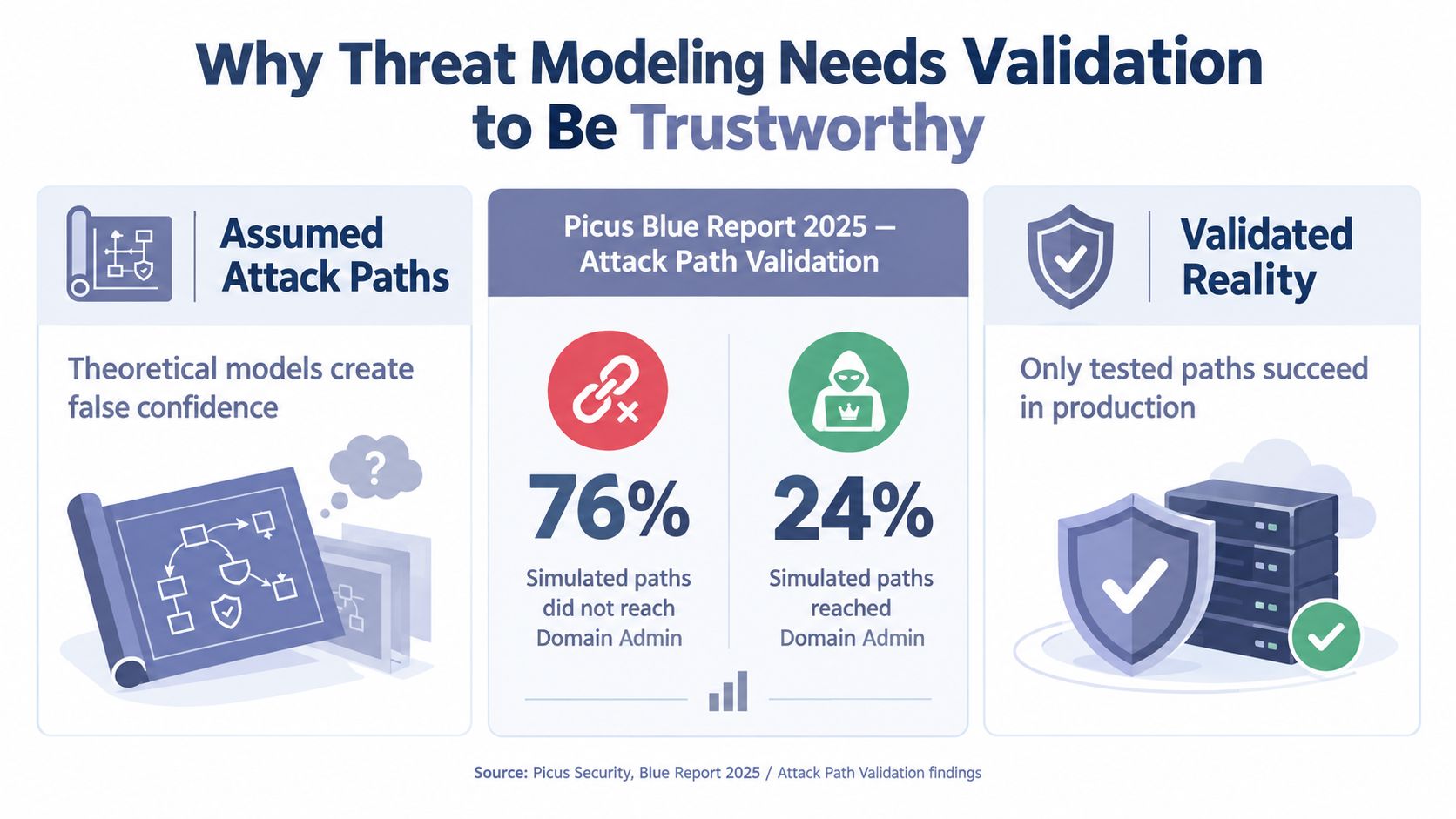
The practical lesson is that control presence doesn't equal control efficacy across an attack chain. A firewall may stop the first route while an identity control fails after an attacker obtains a valid session. A logging pipeline may collect events without generating an alert. A detection may fire, but the response process may leave the affected identity active.
The cost of trusting assumptions
Unvalidated threat models create three operating problems for MSSPs.
First, they create noise. Giving every modeled path the same urgency can direct engineering time toward exposures that existing controls already contain. Second, they conceal sequencing risk. A finding that appears modest alone may become urgent when it connects to a reachable identity or sensitive workload. Third, they weaken client reporting. An executive cannot make a confident investment decision from a diagram showing theoretical movement without evidence of what succeeded.
AEV converts the model into testable hypotheses. The provider selects a path, defines safe execution boundaries, observes each transition, and records where the chain stopped. That record supports a precise remediation decision, such as reducing role permissions, changing a trust condition, strengthening segmentation, tuning detection, or adding a compensating control while a permanent fix is prepared. For MSSPs, the result is more than a technical finding. It is evidence that supports prioritization, client discussions, remediation work, and a retest trigger after a material change.
A threat model tells you where to look. Validation tells you which route deserves action first.
The distinction also protects compliance reporting from overstatement. A successful simulation does not prove that every attacker can achieve the same outcome, and a blocked path does not prove that the environment is secure. It proves that the tested behavior and conditions produced a specific result. That bounded confidence gives clients a defensible basis for deciding what to fix, what to monitor, and what to test again.
Attack Scenarios That Prove Real Exploitability
Consider an internet-exposed API gateway. A scanner identifies an authentication weakness and a cloud configuration that appears permissive. Reporting both findings separately may produce two tickets and two severity debates. An adversarial exposure validation exercise asks a more consequential question: can a controlled request reach an identity context that then obtains a privilege capable of accessing a sensitive service?
The chain might stop at the gateway. It might reach the application but fail at authorization. It might obtain a limited cloud identity that cannot move further. Or it might cross the boundary because a role trust relationship accepts an unintended principal. Each result changes the customer's priority and the evidence the MSSP delivers.
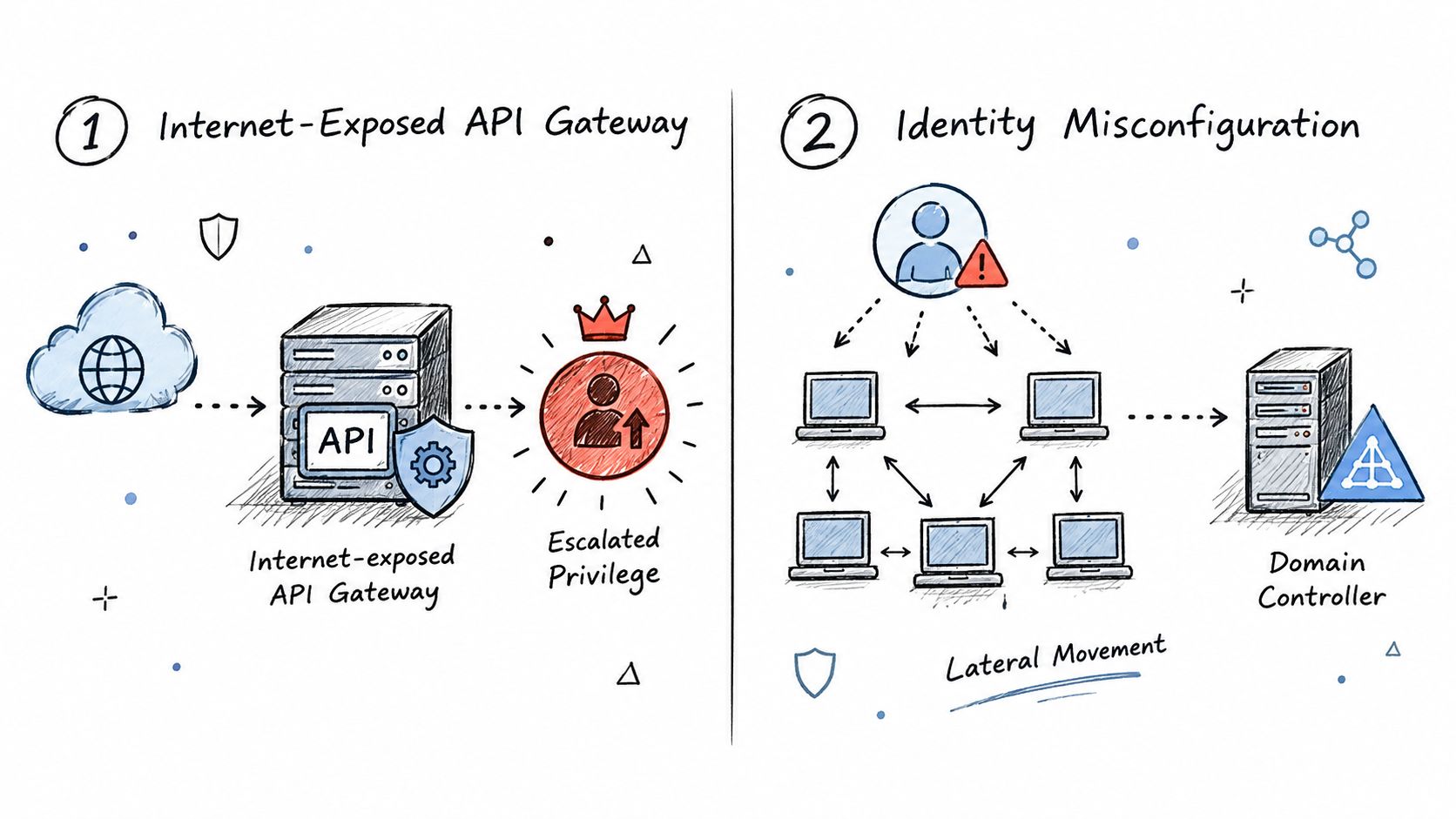
A second scenario starts with identity rather than an application flaw. An over-permissive role may look harmless because it has no obvious direct route to sensitive data. Validation can test whether that role can assume another identity, access a management function, or move laterally to a workload with broader privileges. The meaningful result isn't “role has too many permissions.” It's “this identity can progress through these relationships and reach this defined impact marker,” or “the path fails because this control prevents the transition.”
For MSSP operators, every scenario should preserve the chain's evidence:
- Entry condition: What asset, identity, or service did the controlled action begin with?
- Transition: Which permission, trust relationship, weakness, or configuration enabled the next step?
- Control response: Did prevention block the action, did detection observe it, or did neither occur?
- Impact boundary: What meaningful access was demonstrated without destructive activity?
- Closure test: After remediation, did the same route fail at the expected point?
The attack surface mapping resource can help teams establish the asset and relationship context before selecting paths for validation.
An MSSP shouldn't treat a successful path as permission to overreach. Safe execution matters, particularly in production cloud and identity environments. Use synthetic markers, constrained actions, explicit scope, approval gates, and a defined stop condition. The goal is to prove attacker progress, not to create an incident.
The video below offers another visual way to frame attacker paths and defensive responses.
The contrast with isolated testing is sharp. A scanner may find ten exposed conditions. A chained validation exercise may show that only one route reaches a meaningful outcome, while another apparently serious route is stopped by segmentation. That difference gives the customer something operationally useful: a sequence of fixes tied to observed behavior.
How Adversarial Exposure Validation Works in Practice
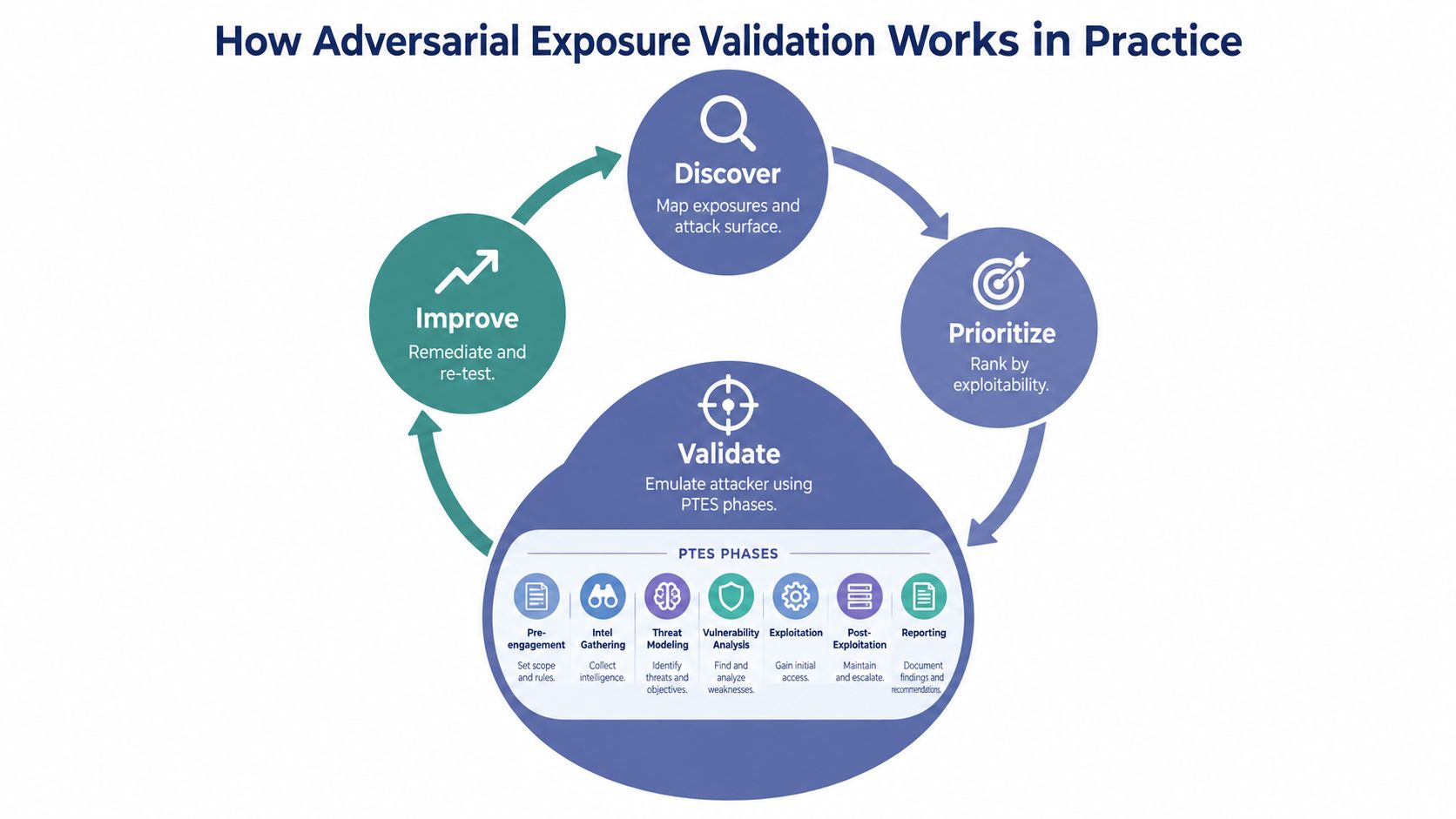
A practical AEV program needs structure before it needs automation. The penetration-testing standard PTES defines seven phases, pre-engagement interactions, intelligence gathering, threat modeling, vulnerability analysis, exploitation, post-exploitation, and reporting, as described in this PTES methodology explainer. AEV uses that discipline, then connects the result to a recurring discover, prioritize, validate, improve loop.
Build the loop around decisions
Discover means mapping the current attack surface and ingesting relevant findings from scanners, cloud posture systems, identity reviews, application tests, and prior pentests. Discovery should include relationships, not just asset names.
Prioritize means selecting paths based on reachability, asset importance, identity context, control uncertainty, recent change, and potential business impact. Don't let a severity field make the decision alone.
Validate means executing a safe scenario through the selected path. Vulnerability analysis should distinguish real weaknesses from false positives. PTES guidance ties this phase to discovering and validating weaknesses so that only true vulnerabilities are reported, a point discussed in this explanation of PTES vulnerability analysis.
Improve means remediating the enabling condition, tuning controls, updating ownership, and rerunning the relevant path. Closure is an observed result, not a ticket status.
Toolchain orchestration becomes important when the path crosses web, network, identity, and cloud layers. An MSSP may coordinate reconnaissance, API testing, cloud permission analysis, controlled exploitation, telemetry observation, and report generation. Agentic automation can expand coverage, but human operators still need to define authorization, safety limits, tenant separation, and escalation rules.
Continuous validation should be policy-driven rather than blindly always-on. Stable, low-impact assets may use risk-based sampling. A production identity change, a cloud trust update, a remediation, or a CI/CD release may justify immediate retesting because the environment state has materially changed.
Retest Trigger Decision Matrix for Continuous Validation
| Change Event | Validation Action | Priority |
|---|---|---|
| Remediation of a validated exposure | Re-execute the original path and confirm the enabling transition fails | Highest |
| Cloud permission or trust relationship change | Recalculate affected paths, then validate routes toward sensitive services | High |
| Identity role, credential, or access-policy change | Test privilege escalation and lateral movement paths connected to the identity | High |
| CI/CD release affecting authentication or authorization | Validate the changed application route and its connected services | High |
| New internet-facing asset or API | Discover reachable paths, then test safe entry and control responses | High |
| Detection or prevention policy change | Re-run the relevant adversary behavior and compare telemetry and blocking | Medium |
| Stable asset with no material change | Apply risk-based sampling and retain a defined retest schedule | Planned |
MSSPs also need governance around AI-enabled execution. Teams evaluating grounded AI safety tools for enterprise should apply the same scrutiny to AEV automation: verify that actions stay grounded in authorized scope, that the system records evidence, and that an operator can stop or review risky behavior.
Measuring Success With Metrics That Matter to Clients
A client sees value when a reported weakness becomes a verified decision. The MSSP should show whether an attacker can still move through the tested route, which controls interrupt that movement, and whether remediation changed the result. Scan counts belong in activity logs, not at the center of the service report.
A practical scorecard separates path feasibility, control efficacy, and operational closure:
| Metric | What it tells the client | Reporting caution |
|---|---|---|
| Validated exploitable paths | Which tested routes currently support attacker progress | Define the tested scope and impact boundary |
| Prevention effectiveness | Which actions controls blocked during execution | A blocked technique does not prove every path is blocked |
| Detection coverage | Which executed behaviors generated usable alerts | An event may be logged without reaching an analyst |
| Post-compromise control performance | Whether controls remain effective after initial access | Do not infer perimeter strength from internal containment |
| False-positive reduction | Which reported weaknesses failed validation | A failed test reflects the tested conditions, not permanent safety |
| Retest closure rate | How often remediated paths fail on rerun | Record the exact change and stopping point |
| Time to remediate validated exposure | How quickly the client closes proven paths | Separate ticket completion from technical verification |
The Picus data cited earlier shows why prevention and detection require separate measures. Its production analysis found stronger prevention than alert generation, while post-compromise blocking remained a separate concern. An MSSP can use that distinction to explain why a deployed control does not automatically mean an attack path is stopped, observed, or contained.
Each metric also needs a measurement boundary. One tool may treat a scenario as a single technique, while another records a multi-step chain. Before comparing tenants or toolchains, align the reporting unit, execution conditions, asset scope, impact marker, and success criteria. Otherwise, a polished dashboard can create false precision.
A validation result is only as useful as its evidence. For every disposition, retain the original finding, the path attempted, the transition that succeeded or failed, the observed stopping point, and the supporting artifact. This makes the result reviewable and helps MSSPs explain why a theoretical weakness was downgraded. Guidance on reducing false positives in pentest reporting can support that workflow.
Retest closure should measure a technical outcome, not a ticket status. Record the change that was made, rerun the relevant path under comparable conditions, and identify any remaining route or dependency. A closed ticket with no failed transition is administrative closure, not proof that exposure was removed.
For SOC 2, PCI-DSS, or another framework, map the evidence to the relevant control objective without treating one successful simulation as proof of full compliance. The report should state what was tested, when it ran, how controls responded, what remediation changed, and what remains outside scope. That gives the client an evidence-backed basis for prioritization, billing, and the next review.
Your Adoption Roadmap for Adversarial Exposure Validation
MSSPs can begin with a focused service instead of testing every tenant and asset. Choose a client segment with frequent cloud, identity, application, or API changes. Define a few high-value attack paths and safe impact markers. Before execution, assign approval, alert, and residual-risk ownership.
Productize the workflow around evidence-backed decisions:
- Baseline selected paths and record control responses.
- Validate routes tied to the customer's business.
- Remediate with technical fixes or compensating controls.
- Retest after a defined trigger, attaching evidence to the report.
- Review path trends, detection gaps, and unresolved dependencies with the customer.
The loop turns theoretical exposure into prioritization the client can defend and the MSSP can bill. A failed transition may show that a control stopped the chain. A successful chain can justify remediation urgency. Neither result proves more than the tested scope and conditions, so preserve those boundaries.
Automation helps scale this work safely. Dedicated infrastructure, tenant separation, tool orchestration, structured evidence collection, and compliance-mapped reporting make repeatable validation possible across customers without turning every engagement into a manual red-team exercise.
As noted earlier, Gartner projects 40% adoption by 2027 and 60% by 2029 for structured exposure validation within Continuous Threat Exposure Management. The projection signals market demand, while execution evidence determines service value.
ThreatExploit AI provides automated penetration testing across web applications, APIs, networks, and cloud environments, with agentic orchestration for reconnaissance, exploitation, verification, and evidence-backed reporting. Visit ThreatExploit AI to evaluate how a validation-oriented workflow could help your MSSP turn attack paths into defensible remediation decisions.