
35% of respondents experienced a significant web-application security event at least weekly, according to a 2024 CyCognito survey of 349 cybersecurity professionals in the United States and United Kingdom. For a security consultancy, that makes the report's practical value more important than its page count. Clients need to know what was demonstrated, who must act, and what evidence will prove the fix worked.
A useful web application penetration testing report connects those decisions. It preserves the tester's evidence, gives engineers a reproducible problem, and tracks each confirmed finding through remediation and retesting. It also states what the assessment couldn't establish, rather than implying that an untested feature is secure.
Table of Contents
- Report Structure at a Glance
- Executive Summary and Technical Sections Compared
- Required Fields for Every Finding
- Evidence That Proves Exploitation
- Showing Coverage of Identity and Authorization Tests
- Mapping Findings to PCI DSS, SOC 2 and ISO 27001
- Remediation Queue and Retest Proof
- Sample Report Template to Copy
- Choose PDF or JSON and Issue the Report
Report Structure at a Glance
A web application penetration testing report is the formal evidence record that turns testing activity into remediation and governance decisions, not a list of scanner hits. NIST SP 800-115 says the concluding report should identify vulnerabilities, assign risk ratings, and recommend mitigation actions.
NIST identifies four uses for results: guiding corrective action, defining mitigation activities, benchmarking progress toward security requirements, and assessing whether those requirements have been implemented. It also recommends including methodology, results, analysis, and a Plan of Action and Milestones, or POA&M, in internal reports.
Required report sections, contents and reference standards
| Section | Primary reader | Required contents | Reference standard |
|---|---|---|---|
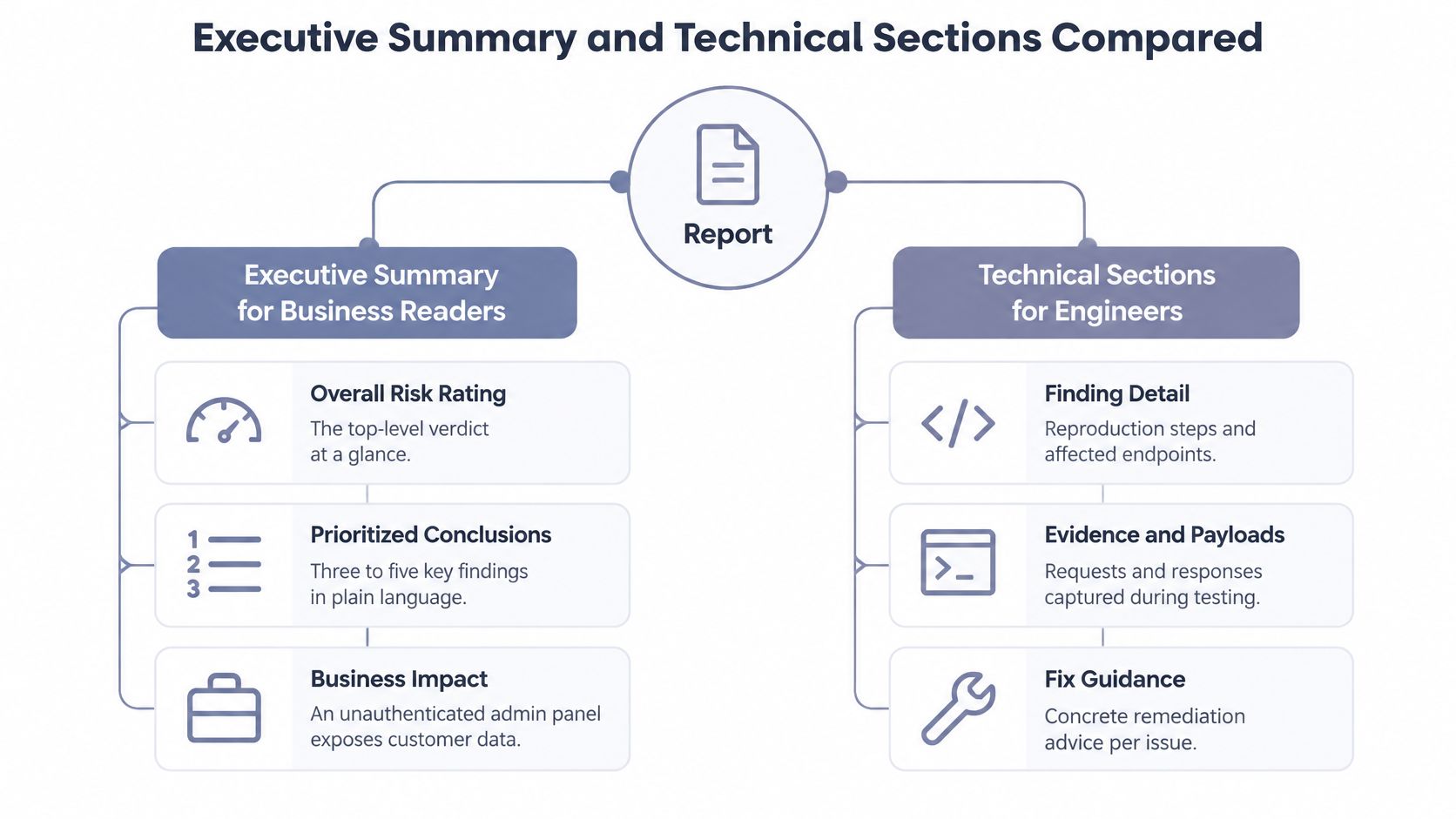
| Executive summary | Management and executives | Overall risk rating, prioritized conclusions, business impact | NIST SP 800-115; PTES executive reporting |
| Scope and methodology | Auditors and security leads | Targets, rules of engagement, test dates, tools, exclusions | OWASP WSTG reporting structure |
| Findings register | Developers and remediation teams | Reference ID, title, classification, impact, reproduction steps, fix | OWASP WSTG |
| Evidence appendix | Developers and retesters | Redacted requests and responses, screenshots, HAR files | CREST penetration testing guide |
| Remediation plan | Owners and governance | Owner, deadline, priority, POA&M, retest criteria | NIST SP 800-115 |
| Limitations | Auditors and compliance teams | Blind spots, failed verification, rate limits, environment constraints | OWASP WSTG |
Treat this table as a lookup, not a requirement to read every page sequentially. The executive summary answers what matters most. The findings register answers what to fix and how. The evidence appendix lets a reviewer inspect the basis for those conclusions.
Agree on the deliverable before testing
Specify minimum report content and delivery frequency in the rules of engagement. Agree whether urgent findings require immediate notification and whether the client needs interim status reports rather than waiting for the final document.
Keep the cover page and findings summary separate from the substantive assessment content. In a copyable report skeleton, separating scope from methodology produces the nine-part structure used below.
Delivery test: A reader with only the first two pages should understand the top risk and first action. An engineer should be able to locate any finding by its reference ID.
Field-level detail, exploit evidence, coverage disclosures, compliance mappings, and export records should all support that navigation. Consistent organization also gives service providers a stable baseline for comparing remediation progress across engagements.
Executive Summary and Technical Sections Compared
Executives and engineers need different views of the same assessment. Leadership needs objectives, overall risk, prioritized conclusions, and business consequences. Engineers need the affected components, attack sequence, observed behavior, and corrective action.
The OWASP Web Security Testing Guide introduction emphasizes documenting who tested, when testing occurred, what actions were performed, and what was found. That record supports a business-facing conclusion without requiring management to interpret HTTP traffic.
Express the same issue at different depths
For a hypothetical tenant-isolation failure, the executive summary might say:
Customer billing documents are accessible to users from other customer organizations. Prioritize the billing service's authorization fix before releasing additional document-sharing features.
The technical entry would identify the invoice-download endpoint, invoice identifier parameter, authenticated account role, test timestamp, and request sequence. It would link the successful cross-tenant response to an evidence artifact and explain which server-side authorization decision failed.
Neither version should exaggerate the demonstrated access. If the tester verified invoice exposure, the summary shouldn't claim that all customer records were exposed.
| Reader's question | Executive answer | Technical answer |
|---|---|---|
| What happened? | Customer billing information crossed tenant boundaries | A request returned an invoice belonging to another test tenant |
| How serious is it? | Explain affected business processes and customers | Explain prerequisites, reach, and demonstrated impact |
| What happens next? | Name the responsible function and order of work | Specify the authorization correction and verification procedure |
Keep conclusions and counts aligned
Separate confirmed exploitable vulnerabilities, informational observations, and unverified leads. Put confirmed issues in the vulnerability register, observations in a clearly labeled register category, and unresolved leads in a validation subsection with the reason verification stopped.
The summary must use the same categories. A scanner alert awaiting validation mustn't inflate the confirmed vulnerability count.
Give leadership a short ranked set of conclusions, typically three to five, rather than a miniature technical catalog. Explain why the first remediation action deserves priority, including its business dependency and accountable team.
Finally, remove endpoint names, payloads, and implementation details from the summary as a review exercise. If the remaining text doesn't explain what is at risk, how serious it is, and what to do first, rewrite it before delivery.
Required Fields for Every Finding
Finding entry fields and what each one must contain
| Field | What to record | Example |
|---|---|---|
| Reference ID | Unique ID used in all cross-references and retests | WA-014 |
| Title | The vulnerability named in plain terms | IDOR on invoice download |
| Classification | OWASP Top 10 or CWE category | A01:2025 Broken Access Control |
| Likelihood and access level | Exploitability and privilege required | Low-privilege authenticated user, one request |
| Impact | Business and technical effects | Invoices of other tenants readable |
| Reproduction steps | Numbered request sequence with test account | Change invoice ID in the download request |
| Remediation | Specific fix and the team that owns it | Billing API team: enforce tenant ID check on the server |
| Risk rating | Severity with rationale, not the scanner label | High: internet-facing, no extra approval step |
These are the core fields of a hypothetical finding, WA-014. The OWASP reporting guidance calls for reference identifiers, vulnerability titles, exploitability, required access, impact, exploitation steps, and resolution guidance, with sensitive information masked.
Walk through the entry in order
The reference ID stays unchanged when the finding moves into a ticket, remediation queue, or retest result. The title names the actual failure, insecure direct object reference, rather than a vague phrase such as weak security.
The classification groups the issue under Broken Access Control, but the category isn't the explanation. The likelihood and access level establish that an ordinary authenticated customer can attempt the unauthorized request without an administrative role or additional approval.
The impact states what the tester demonstrated: another tenant's invoice was readable. Avoid extending that conclusion to invoice modification or deletion unless those actions were separately validated.
For reproduction steps, use authorized test tenants:
- Sign in as a customer in the requesting tenant.
- Download that customer's own test invoice and capture the request.
- Replace the invoice identifier with an agreed test invoice from another tenant.
- Submit the request and compare the returned document with its expected owner.
The remediation belongs to the Billing API team: load invoices through a server-side authorization check that binds the requested object to the authenticated tenant and permitted action. Don't rely on hiding identifiers in the interface.
The risk rating then explains the decision. In this scenario, High reflects internet exposure, low privileges, low exploit complexity, and cross-tenant financial-document disclosure. An attacker has a clear reason to seek confidential billing information, while the business must investigate customer exposure and correct the authorization defect.
Add the traceability record
Attach the in-scope asset, endpoint or parameter, authenticated role, test timestamp, methodology step, and evidence artifact reference. Use stable artifact identifiers so a developer can retrieve the exact exchange without searching an archive.
Steps explain what to do; evidence proves what happened. A developer receiving only this entry should be able to reproduce the issue with test accounts and verify the corrected behavior without asking the tester to reconstruct the assessment.
Evidence That Proves Exploitation
Screenshots alone are weak exploit evidence. They can show a document or success message while omitting the request headers, tokens, parameters, timing, and authorization context that explain how the tester reached it.
The OWASP reporting structure recommends reproducible artifacts such as sanitized curl requests, proof-of-concept forms, HAR files, and small automation scripts. Build an evidence chain containing the target and request context, required privileges, relevant response or state change, security impact, and cleanup or rollback action.
Evidence types compared by what they prove
| Evidence type | What it proves | Limitation | Use when |
|---|---|---|---|
| Screenshot | Visible state of a success page or error | Omits headers, tokens, timing and authorization context | Supporting detail only |
| Redacted curl command | Exact request that reproduces the issue | Tokens must be masked before sharing | Every confirmed exploit |
| HAR file | Full request and response flow across steps | Contains session data; mask before delivery | Multi-step or workflow flaws |
| Proof-of-concept form | Cross-site request forgery succeeds | Changes state; run only on test accounts | State-changing actions |
| Automation script | Issue can be re-checked after the fix | Needs maintenance as the app changes | Retesting and regression checks |
| Raw scanner output | Detection of a possible issue | False positives are common | Lead only, not proof of exploitation |
For findings that aren't HTTP-based, attach the equivalent reproducible request or action record rather than forcing the evidence into curl.
A stored XSS evidence package
Consider a controlled stored cross-site scripting test. A low-privilege test account submits a POST to the comments endpoint, placing an img tag with an onerror handler in the text field. The hypothetical response returns 201, and a later GET returns the saved payload unescaped.
Record the sanitized curl command and relevant response snippet with tokens masked. Put expected: payload sanitized or safely encoded beside observed: payload returned unescaped.
That exchange demonstrates storage and unsafe output, but browser execution still needs verification before claiming demonstrated XSS exploitation. Attach a controlled browser result showing the harmless test handler executed in the affected rendering context.
Include the before-and-after retest outcome and record that the test account's comment data was reset afterward. The cleanup note prevents a later reviewer from mistaking leftover test content for a new incident.
Protect the record without weakening it
Mask credentials, personal data, session tokens, and payment information before delivery. Protect originals with access controls and encrypted storage, and restrict distribution to authorized reviewers.
Record test boundaries, rate limits, destructive-test restrictions, failed verification attempts, and retest status alongside the artifacts. A practical evidence-based report-writing reference can help teams standardize this review.
Attach the complete request, response, privilege context, and impact proof to critical findings first. Those are the issues where a missing artifact can delay an urgent engineering decision.
Showing Coverage of Identity and Authorization Tests
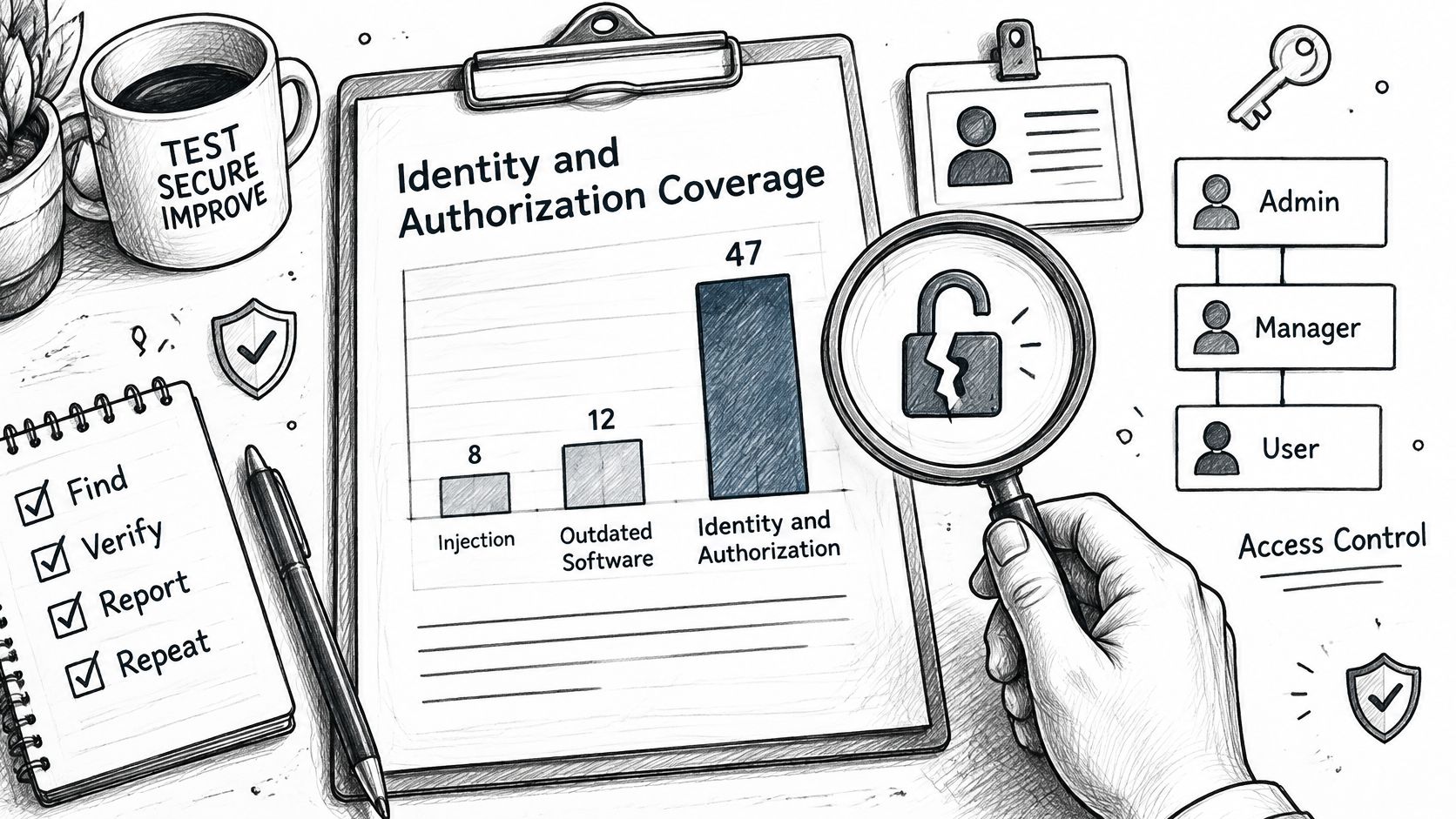
A report organized around injection, outdated software, and configuration errors can still leave the client's most important trust boundaries unexplained. Broken Access Control remains number one in the OWASP 2025 Top 10. Identity and authorization therefore deserve an explicit coverage record, not an assumption that a broad scan exercised them.
Use a coverage view to distinguish the application's available functionality from the functionality testers exercised.
Document the boundaries tested
Describe tests of privilege boundaries, session lifecycle, tenant isolation, role changes, password recovery, and token reuse. Include GraphQL resolvers and multi-step transactions where they exist, because an interface-level permission check doesn't establish that the underlying API enforces the same restriction.
Make coverage inspectable through concrete records:
- Role matrix: Identify test accounts, assigned roles, tenant membership, and permitted operations.
- Route inventory: Separate authenticated routes from routes reachable without a session.
- API inventory: Record tested REST operations and GraphQL queries or mutations.
- Object authorization checks: Identify the resources and ownership boundaries exercised.
- State transitions: Describe attempted workflow bypasses, role changes, and session invalidation behavior.
For password recovery, say whether the tester exercised token expiry, reuse, account binding, and the effect of a password change on existing sessions. For role changes, record whether permissions changed immediately or remained available through an existing token.
The accompanying video provides another format for reviewing web application testing concepts.
State what remains unknown
Missing test accounts, rate limits, unavailable staging data, and unreachable routes must appear as specific limitations. Explain their consequence: an unavailable administrator account prevented testing administrator-only export authorization, rather than merely saying access was limited.
A hypothetical coverage statement could read:
Authorization on invoice routes was tested with three roles. The administrator export route wasn't reachable with the accounts provided, so its authorization controls remain unverified.
For each finding, identify whether the demonstrated effect reaches a user, a tenant, or the application as a whole. Distinguish a discovered exposure from a validated exploit, and don't extrapolate across untested roles.
A clean finding count isn't proof of complete coverage. The client needs both the confirmed failures and a clear account of the paths the tester couldn't evaluate.
Mapping Findings to PCI DSS, SOC 2 and ISO 27001
Framework control references and what the report must show
| Framework | What the report must show |
|---|---|
| PCI DSS v4.0 | For requirement 11.4, penetration test method, results and corrective actions |
| SOC 2 | For CC7.1, vulnerabilities detected and evaluated, with associated remediation tracked to closure |
| ISO/IEC 27001:2022 | For controls 8.8 and 8.29, technical vulnerability management and security testing records |
| HIPAA Security Rule | For 45 CFR 164.308(a)(8), evidence supporting periodic evaluation of security safeguards |
| GDPR | For Article 32(1)(d), evidence supporting regular testing and evaluation of security effectiveness |
Use these references as mapping starting points, not a declaration that a penetration test alone satisfies the framework. Confirm the applicable edition, assessment scope, and auditor's interpretation before issuing a control-mapped report.
A control mapping explains why a finding and its disposition matter to a requirement. It doesn't turn an assessment into a certification, and it doesn't establish that every relevant organizational safeguard was evaluated.
Map the individual finding
Add a control mapping field to each finding rather than placing framework logos on the cover page. Record the framework, version, control reference, mapping basis, and relevant evidence references.
For the hypothetical invoice authorization issue, the mapping basis might say: the finding demonstrates that the application failed to enforce the client's requirement restricting customer access to authorized tenant records. Select the actual access-restriction control from the client's applicable framework, rather than assigning a generic testing control to every defect.
Keep the testing requirement and the failed application control distinct. One explains why the assessment was performed; the other explains which safeguard the demonstrated vulnerability undermines.
Build an audit-ready evidence trail
Tailor the supporting record to the assessment:
- PCI DSS: Preserve the testing method, scoped environment, results, corrective actions, and applicable retest outcomes.
- SOC 2: Connect detection and evaluation to the client's vulnerability-handling process and disposition records.
- ISO/IEC 27001: Relate technical testing and vulnerability treatment to the organization's selected controls and security processes.
- HIPAA: Explain the assessed system boundaries and how the technical evaluation supports review of relevant safeguards.
- GDPR: Describe the tested security measures and observed effectiveness without claiming a complete legal compliance assessment.
For teams connecting application testing to a broader management system, Matil's guide to how to satisfy ISO 27001 provides useful implementation context. Keep that organizational work separate from the narrower evidence a penetration tester can establish.
Maintain testing dates, scope boundaries, remediation status, and retest results in the client's compliance documentation. Before delivery, have the compliance owner validate the mapping language and framework version, especially when older reports are being reused as templates.
Remediation Queue and Retest Proof
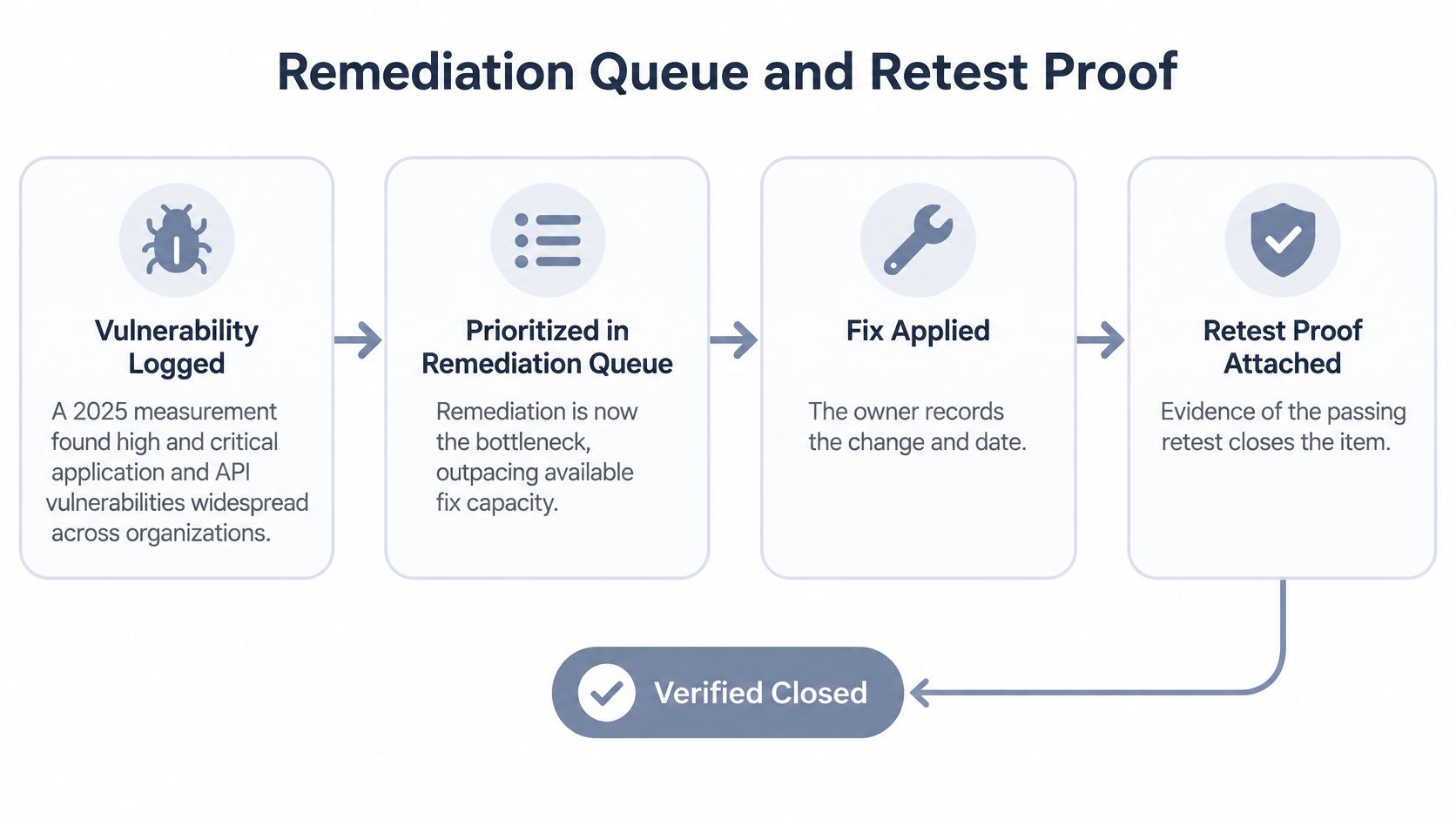
A 2025 measurement found an average remediation time of 54.8 days for high- and critical-severity application/API vulnerabilities, while only 26% of critical vulnerabilities were fully remediated, according to Stingrai's application security statistics coverage. Its separate 2026 penetration-testing dataset reported a median resolution time of 26 days, with the slowest 10% taking more than 121 days. Critical findings closed in 10.5 days, compared with 38 days for High findings.
Those measurements describe different datasets, not interchangeable benchmarks. They nevertheless reinforce a practical point: severity labels alone don't explain how quickly clients complete remediation.
Give each issue an operational record
The queue should identify the owner, affected business asset, internet-facing status, and whether exploitation was demonstrated or remains theoretical. Add the agreed deadline, compensating control, residual risk if the deadline is missed, and exact evidence required for retesting.
Keep risk accepted, temporarily mitigated, and verified fixed separate. Disabling an endpoint may reduce exposure without correcting its authorization logic.
Close through verification
- Assign an owner. Name an accountable team and a person responsible for coordination.
- Agree a deadline by priority. Consider demonstrated impact, exposure, dependencies, and available interim safeguards.
- Fix or apply a compensating control. Record the change, deployment environment, and remaining exposure.
- Retest with the same steps. Verify that the original exploit fails and legitimate behavior still works.
- Attach retest evidence and close. Preserve the expected result, observed result, tester, date, and release reference.
A completed engineering ticket is a claim of remediation. A passing retest is evidence of remediation.
If a retest can't run, keep the finding awaiting verification and state why. For disclosures that extend beyond the contracted engagement, review the affected organization's authorized channel and boundaries; the Purple responsible disclosure policy is an example of a published policy to consult before reporting to that organization.
At kickoff, ask who owns each application component, who can authorize urgent changes, who accepts residual risk, and which environment supports retesting. Agree how the client will request verification and which evidence permits closure before the first finding reaches the queue.
Sample Report Template to Copy
Use this skeleton as the report's working document. Keep the section names stable, then replace the descriptions with engagement-specific content.
- Cover page: Client, tester, testing dates, report version, classification, and authorized recipients.
- Executive summary: Assessment objectives, overall risk, business impact, and prioritized conclusions.
- Scope and rules of engagement: Targets, exclusions, test windows, restrictions, and agreed minimum report content.
- Methodology: Test phases, tools, manual validation approach, and relevant methodology references.
- Findings summary: Counts separated into confirmed vulnerabilities, informational observations, and unverified leads.
- Detailed findings: Complete finding fields, attack narrative, root cause, evidence references, and remediation.
- Evidence appendix: Redacted artifacts, artifact identifiers, hashes, and controlled storage references.
- Limitations and blind spots: Untested functionality, unavailable access, environmental constraints, and their consequences.
- Remediation plan: Owners, priorities, deadlines, compensating controls, and retest status.
For a hypothetical findings summary, write: High: 3 confirmed vulnerabilities; separately, 2 informational observations and 1 unverified lead. This wording avoids incorrectly assigning a confirmed severity to every observation.
Make the template part of the engagement
The CREST penetration-testing guide recommends defining report format and content in the engagement scope and formal contract. Attach the agreed template to the statement of work so the client can approve the deliverable before testing begins.
CREST also identifies the test narrative, supporting evidence, technical risks, and remediation as substantive report content. Record root causes and remediation activities rather than stopping at a vulnerability label.
The visual checklist below groups these reporting tasks into a compact review aid; the written skeleton keeps them separated for delivery.
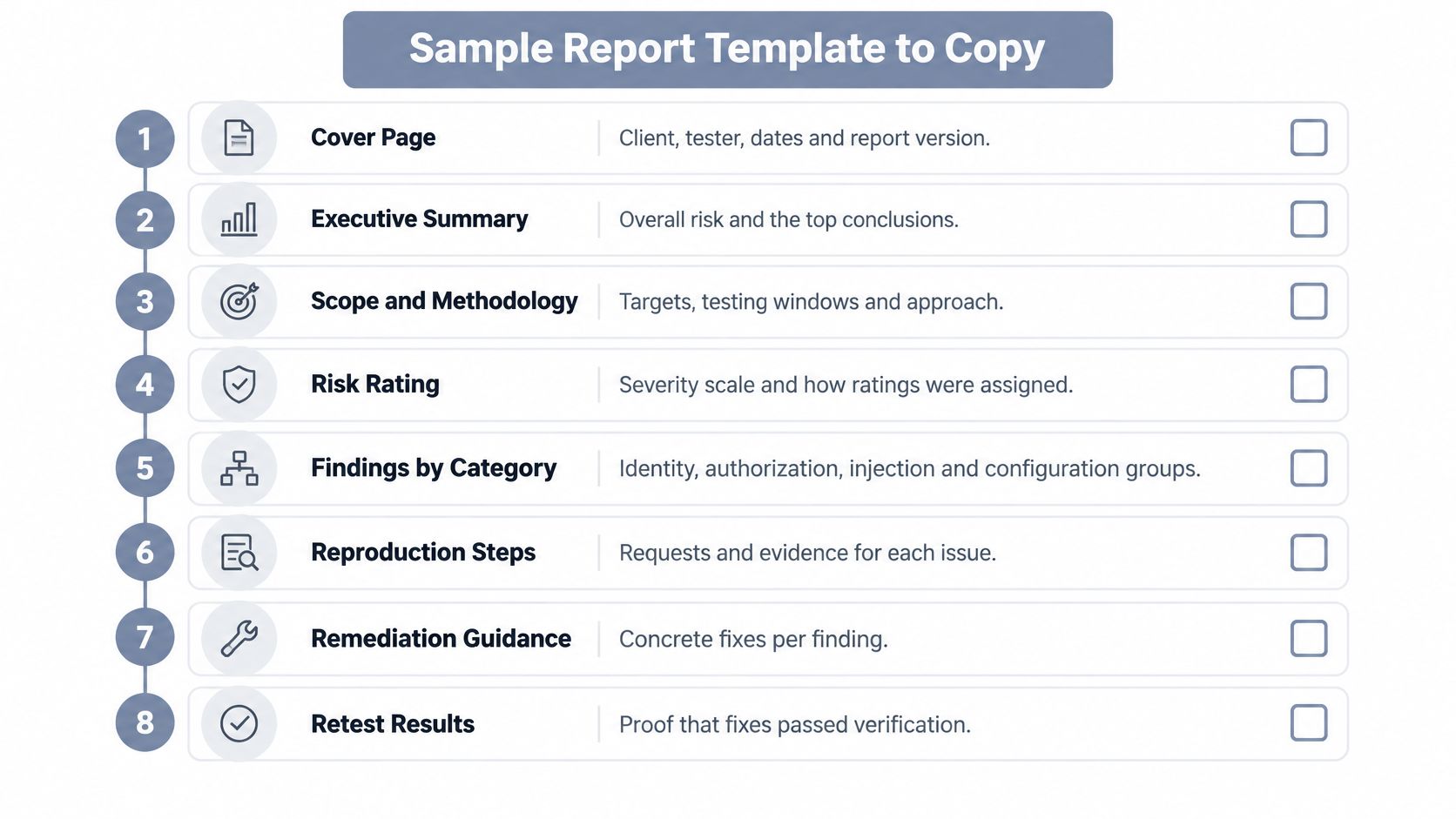
Use pentest report templates to standardize layout, but don't preserve irrelevant boilerplate. Remove claims about tests that weren't performed and replace generic recommendations with corrections appropriate to the affected implementation.
Before copying the document for another client, change the scope, compliance frameworks, retest schedule, and delivery format. Review inherited artifact references and owner names too, so another engagement's confidential details don't enter the new report.
Choose PDF or JSON and Issue the Report
Use PDF for the executive summary, signed deliverable, and archive copy. Use JSON when findings must enter a ticketing system, dashboard, or CI/CD pipeline. PDF supports human reading; JSON preserves fields that software can validate and reconcile.
Generate both from the same controlled finding records. Don't maintain a manually edited executive document alongside an independently updated export, because corrections can leave the deliverables inconsistent.
Define the machine-readable record
A minimal JSON finding record should preserve these keys in order:
id: The stable finding reference, such asWA-014.status:confirmed,informational, orunverified.asset,endpoint,parameter,role,tested_at: The target and testing context.severity: The rating together with its rationale.evidence_refs: References to redacted artifacts and their SHA-256 hashes.remediation: Owner, deadline, and remediation state.retest:original_id, result, and date.
Treat finding classification and remediation state as different dimensions. A confirmed vulnerability can be awaiting remediation, temporarily mitigated, or verified fixed without losing its original validation history.
Artifact hashes support integrity checking, not confidentiality. Deliver the referenced evidence through the same controlled process as the report, and avoid embedding live secrets in export fields.
Run the release checks
Reconcile the PDF's counts with the JSON totals and findings register. Confirm that filters haven't excluded informational observations, unresolved leads, or findings awaiting retest.
Before issuing, check the following:
- Identifiers: Every finding has a stable reference ID.
- Evidence protection: Delivered artifacts are redacted and originals are encrypted.
- Limitations: Coverage gaps and environmental restrictions are explicit.
- Compliance versions: Each mapping identifies the applicable framework edition.
- Retest dates: The verification plan contains scheduled dates and responsible parties.
At ThreatExploit AI, we generate reports in PDF, JSON, and structured data formats, and deliver a complete, compliance-mapped penetration test report in under 4 hours from target submission. Apply the same acceptance checks to automated outputs that you'd apply to a manually assembled deliverable.
Issue the report through the agreed secure channel, record its version and recipients, and include a dated retest request for every critical finding. The delivery is ready when the client can move directly from the documented exposure to accountable action.
ThreatExploit AI offers automated penetration testing with evidence-backed, compliance-mapped reports for security service providers. Create a free account through the registration portal, explore the platform, and run a test pentest to inspect the findings and reporting outputs firsthand.