
A client can own a WAF, pass a vulnerability scan, and still hand one customer another customer's invoice through a perfectly valid login. That's the uncomfortable center of web application and API protection for MSSPs. Edge blocking matters, but it doesn't answer the question that decides whether data leaks. Does this identity, on this route, with this method, have permission to touch this object and these fields? If your service can't prove that answer repeatedly, you don't have protection. You have perimeter theater.
Table of Contents
- Why Web Application and API Protection Still Breaks Clients
- How Layered Controls Protect Apps and APIs
- Authorization Failures That Gateways Do Not Catch
- Proving Broken Object Access in a Pentest
- Choosing How MSSPs Test and Enforce Protection
- Running Continuous Tests Across Customer Environments
- Start a Client Protection Test This Week
Why Web Application and API Protection Still Breaks Clients
Verizon's 2025 Data Breach Investigations Report analyzed more than 22,000 security incidents and over 12,000 confirmed breaches, and it still places basic web attacks near the top of the pile. In the Verizon 2025 DBIR executive summary, Basic Web Application Attacks accounted for 12% of breaches, one of the five leading patterns alongside System Intrusion, Social Engineering, Miscellaneous Errors, and Privilege Misuse. That's not a niche developer problem. That's a standing delivery risk for any provider selling security around internet-facing software.
The exploitation trend is worse. The same report found exploitation of vulnerabilities in 20% of breaches, up 34% from the previous year, and 42% of those exploited vulnerabilities affected web applications.
A short chain beats a slow test cycle
Verizon describes many basic web attacks as short chains. An intruder gets access, retrieves information, and exits. There's no long dwell time for your SOC to admire, and no requirement that the attacker defeat every control you sold. One exposed flaw, one weak authorization check, or one post-authentication path to data can finish the job.
Annual point-in-time testing doesn't match that pace. Code ships, dependencies update, authentication libraries change, and new API routes appear between audits. A test performed last quarter says little about an endpoint added last Tuesday or a role change made for a partner integration. MSSPs need repeatable reconnaissance, validated exploitation, evidence collection, and reporting that clients can act on before the next release buries the finding.
Delivery test: If your report only proves a WAF blocked an obvious payload, you haven't proved the application protects customer data.
Separate four jobs when you scope an engagement. First, decide what the edge should block. Second, define what authorization must decide on every request. Third, show how a tester proves both positive and negative cases. Fourth, repeat that proof across customers without lowering the evidence standard. Teams aligning those jobs with practical controls for securing business APIs get a useful baseline, but a control list isn't the same as verified behavior.
The contrarian point deserves blunt wording. A logged-in user who receives another customer's object isn't a minor scanner miss. That's a protection failure in the application itself, even when authentication worked and the gateway allowed a well-formed request.
How Layered Controls Protect Apps and APIs
Think about a building. The WAF is the street gate, useful for stopping obvious injection attempts and floods before they reach the door. The API gateway is the lobby desk, checking identity and route. Object and field checks are the locks on each room and drawer. A client with only the gate hasn't secured the rooms.
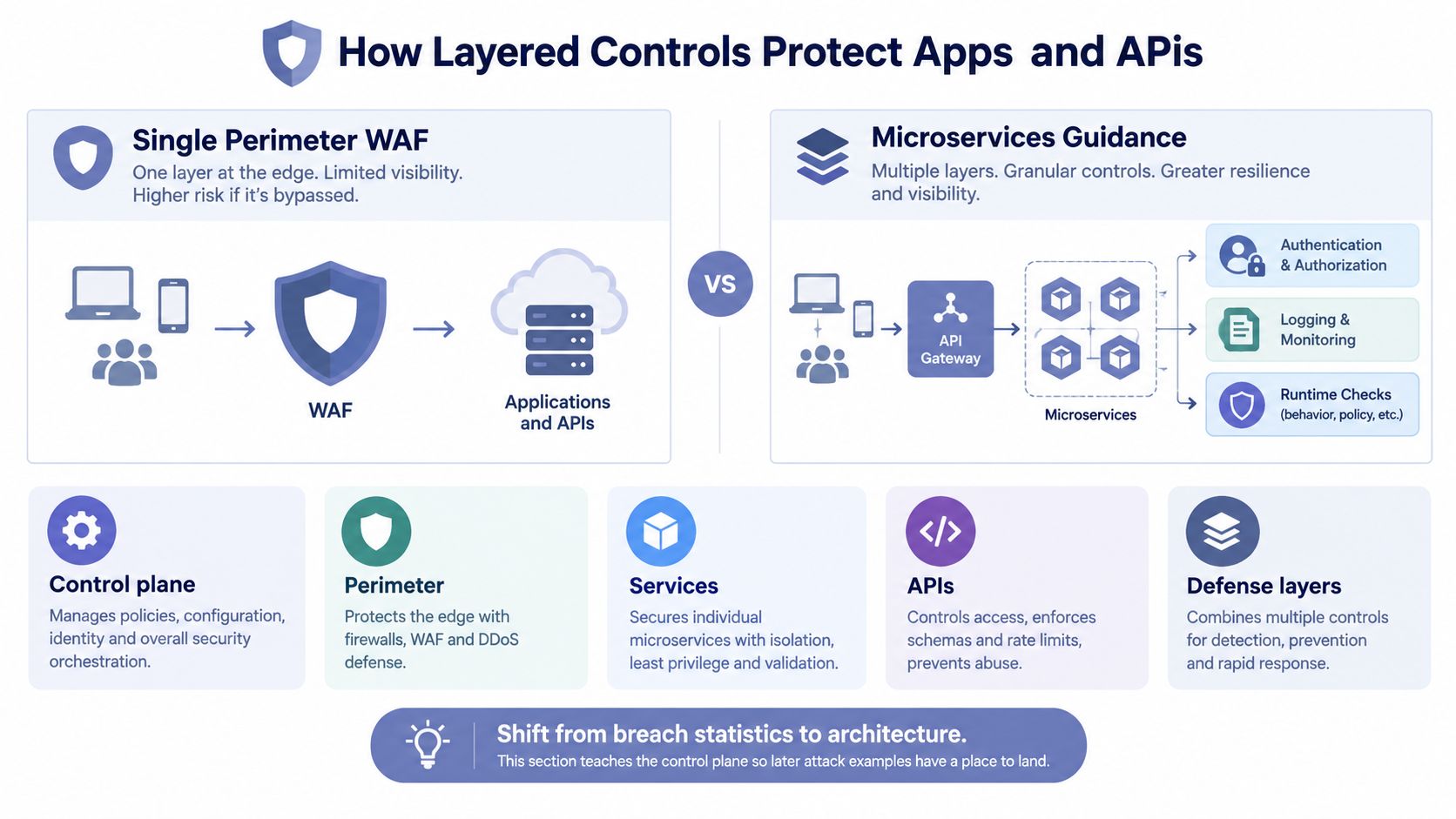
NIST makes the same point for microservices in NIST SP 800-204 on microservices security strategies. The guidance calls for coordinated authentication and access management, secure service-to-service communication, monitoring, and resiliency controls such as circuit breakers, load balancing, and throttling. It also covers integrity when services are introduced and secure session persistence. None of that collapses into a single perimeter box.
What fails when only the gate exists
A compromised token walks through the gate because it looks legitimate. Weak east-west trust then lets one service call another with more privilege than the original user held. Excessive request rates can exhaust a costly operation, while a vulnerable internal API gives the attacker a second door nobody monitored. Availability fails with confidentiality when a struggling dependency retries itself into a wider outage.
Build the control plane in layers.
- Workload identity: Use mTLS or an equivalent for service calls so internal traffic isn't trusted by network location.
- Scoped tokens: Prefer short-lived tokens tied to an identity and operation, not broad keys that survive for months.
- Fail-closed policy: Set policy centrally, but keep local checks that deny traffic when policy can't be evaluated.
- Schema validation: Validate REST payloads and GraphQL operations against an expected shape before business logic runs.
- Replay protection: Protect sensitive actions so a captured request can't be resent.
Rate limits should follow business cost, not one global number. Password reset, data export, payment, and mutation endpoints deserve stricter per-identity and per-operation quotas than a public read. Circuit breakers belong beside those quotas because they stop a failing dependency from turning one service problem into a platform denial of service.
Telemetry must connect the pieces your testers will later dispute. Log user, token, route, object, and downstream service together so an analyst can reconstruct who asked for what and which service answered. That discipline supports testing as much as runtime defense, which is why it pairs well with structured best practices for API security during service design. On a scoping call, draw the gate, lobby, room, and drawer. If a layer is missing, price the test around that gap instead of pretending the WAF covers it.
Authorization Failures That Gateways Do Not Catch
A gateway can confirm a caller has a valid token and still allow a severe compromise. That's why the right question isn't whether an API is discovered and authenticated. It's whether every request produces the correct authorization decision for the object, property, role, tenant, and HTTP method involved.
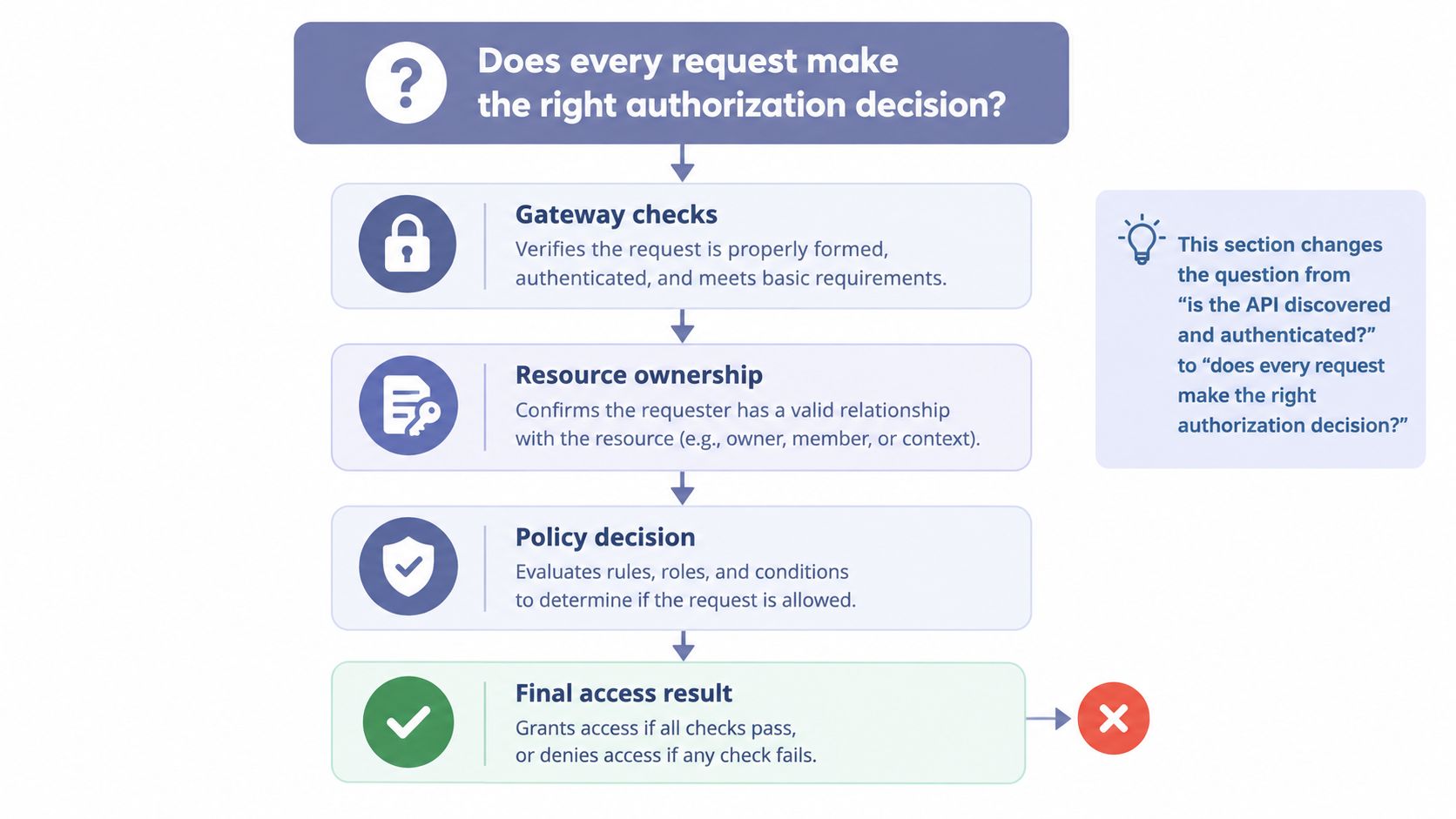
The OWASP announcement of the API Security Top 10 2023, published July 3, 2023, treats API protection as its own discipline. Authorization dominates the list, with three of the five highest-ranked risks tied to access control. That ranking should change what an MSSP puts in a statement of work.
Object access is not field access
Broken Object Level Authorization occurs when an endpoint accepts an account, invoice, or customer identifier without verifying that this caller may access that specific object. Authentication proves who the caller is. It doesn't prove the caller owns the record requested.
Broken Object Property Level Authorization is narrower and often more damaging. As described in the OWASP guidance on broken object property level authorization, an endpoint may expose fields it shouldn't return or accept fields it shouldn't let the caller change. Role, account status, pricing, and ownership are classic examples. This combines excessive data exposure with mass assignment, and the results can include disclosure, corruption, privilege escalation, or account takeover.
Two additions in the 2023 list expand the scope conversation. Unrestricted Access to Sensitive Business Flows covers automated abuse such as scalping and fraudulent account creation. Server-Side Request Forgery covers server-side fetches that attackers steer toward unintended destinations. Both matter, but they don't replace the authorization work at the center of the list.
A validly authenticated user receiving an unauthorized response is not a bypass of the control. It is the control failing.
The engineering principle is deny by default. Perform the check server-side after object lookup. Derive tenant, role, and permitted fields from trusted identity claims, then allowlist both response properties and writable properties. Test reads and writes with cross-tenant and lower-privilege identities. Mutate object IDs and JSON fields, then judge status codes, response schemas, and actual side effects. An HTTP 200 alone proves almost nothing.
Identity design and authorization design are linked, so AAA implementation insights from AletheionAGI can help teams separate authentication, authorization, and accounting before testing begins. That separation also supports deeper business logic vulnerability testing when the question shifts from object ownership to whether a permitted action should be allowed at all. Put that language in the scope now, or you'll argue about coverage after delivery.
Proving Broken Object Access in a Pentest
A multi-tenant SaaS client gives your team two ordinary user accounts from different tenants. Both users can view their own invoices through the mobile backend. The tester signs in as the low-privilege user from Tenant A, captures a request containing an invoice ID, and replaces that ID with an invoice belonging to Tenant B. Nothing about the token changes. The only question is whether the API checks ownership before returning the record.
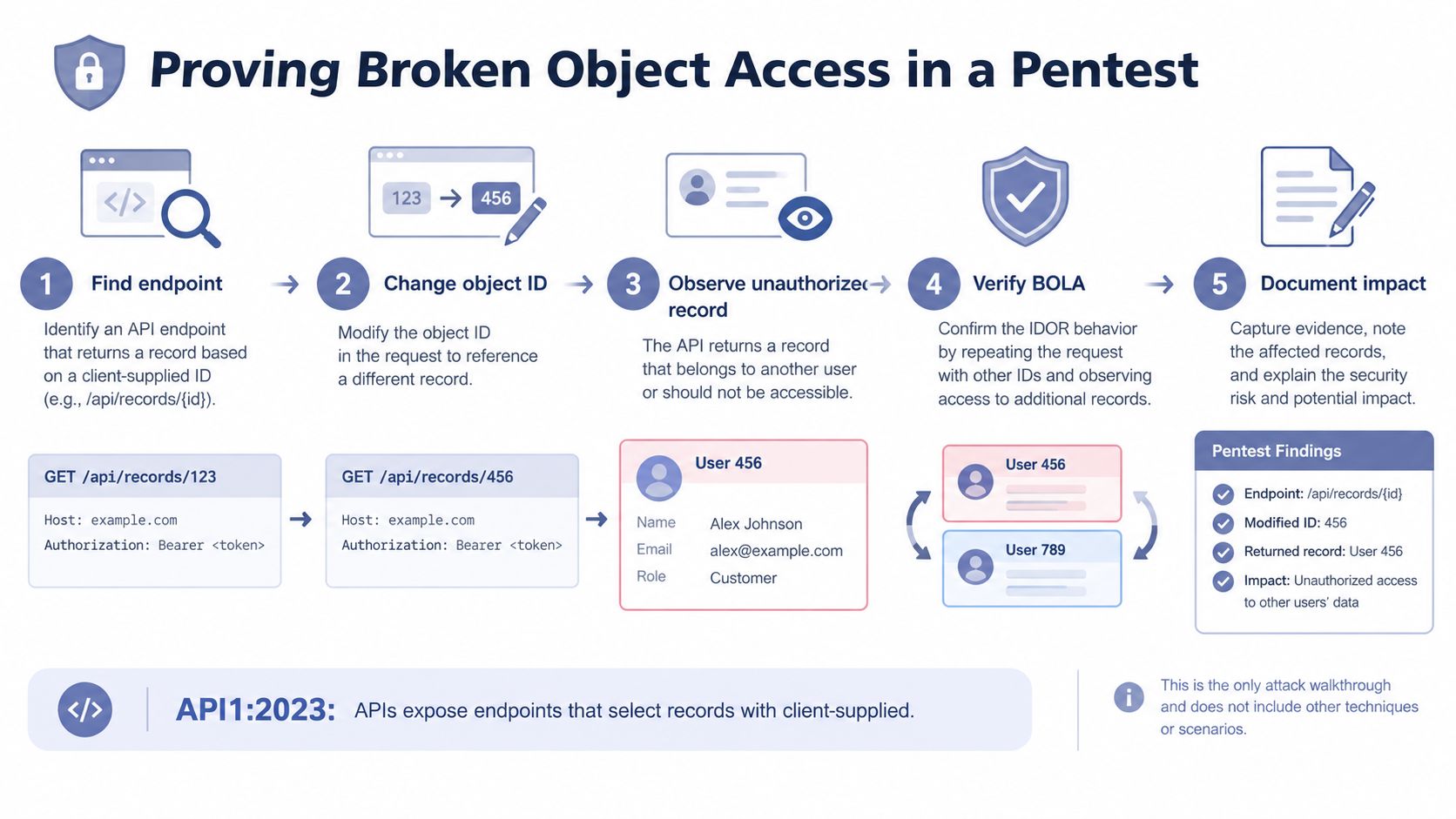
That's Broken Object Level Authorization, classified as API1:2023 in the OWASP API Security Top 10 2023 list. APIs commonly expose endpoints that process client-supplied object identifiers. Every function that uses such an identifier against a data source needs its own authorization check, whether the interface is REST or a GraphQL resolver taking an ID as an argument.
What counts as proof
A failed exploit is a clean control result. The API returns a 403, an empty authorized set, or an equivalent denial, and no server-side state changes. A successful exploit shows the foreign record in the response body, modifies the other tenant's object, deletes it, or changes a value such as a balance. The response and the side effect must agree before you call it verified.
Package the evidence so a client engineer can reproduce the result without calling you.
- Original identity: Record the account, tenant, role, and authentication context used.
- Substituted identifier: Show exactly which object ID changed and what stayed the same.
- Request and response: Preserve the full HTTP exchange, including method, route, status, and relevant body fields.
- Affected operation: State whether the flaw allowed read, update, delete, or another action.
- Boundary bypassed: Name the tenant, ownership, or role boundary that should have blocked the request.
Don't mislabel the finding. An unauthenticated request returning 401 is an authentication observation, not BOLA. BOLA requires an authenticated caller reaching an object that caller shouldn't access. That distinction matters because the fix sits in object-level authorization, not in login hardening.
The mechanic scales well in automated web and API assessments. Endpoint discovery finds routes containing identifiers, controlled substitution changes them, response comparison flags foreign data, and evidence capture preserves the exchange. Automation still needs judgement. A shared record may be intentionally visible across accounts, so a tester must confirm the business boundary before reporting. Done properly, the finding maps cleanly to a named OWASP category and gives an auditor a reproducible failure, not a scanner's suspicion.
Choosing How MSSPs Test and Enforce Protection
MSSPs often buy enforcement tools and testing tools as if they answer the same question. They don't. A WAF blocks patterns at runtime. A gateway authenticates callers and applies quotas. A pentest proves whether a real identity can cross a boundary. Confusing those jobs leaves clients with strong dashboards and weak evidence.
What Each Protection Approach Proves
| Approach | Stops or finds | Authorization proof | MSSP constraint |
|---|---|---|---|
| Signature WAF | Blocks known injection and protocol abuse patterns | Doesn't know whether this user owns this object | Tuning and false positives across many client apps |
| API gateway with auth and quotas | Enforces identity, routing, and request volume | Proves a caller is authenticated, not that object and field rules hold | Policy drift as routes and roles change |
| Manual senior-led pentest | Finds chained business logic and subtle access flaws | Strong when identities, tenants, reads, and writes are in scope | Scarce senior time and slow repeat testing |
| Automated penetration testing | Repeats discovery, exploitation, and verification across targets | Strong for repeatable object and property test cases with evidence | Needs human review for ambiguous business rules |
The missing piece in most guidance is a living authorization test matrix. Roles change, tenants onboard, feature flags alter routes, and data relationships evolve. The OWASP API Security Project provides the risk taxonomy, but your service still has to maintain identities, objects, methods, expected results, and evidence as the application changes. Strong identity doesn't close that gap, even when a client uses a lightweight identity platform for apps to simplify authentication. Login quality and authorization correctness remain separate claims.
Where automation belongs
ThreatExploit AI is one automated option built for security service providers. It uses a pentest-trained model and agentic framework for reconnaissance, exploitation, verification, and reporting across web applications, including REST and GraphQL APIs, plus network and cloud targets. Its ROOT Controller covers the seven PTES phases and orchestrates 60+ tools such as Nmap, SQLMap, and Nuclei. Partner-scoped servers are available in America, Europe, and Asia, with PDF and JSON reports, executive and technical views, screenshots, API and CI/CD integration, a VS Code extension, Starter through Enterprise plans, and optional on-prem deployment. Findings map to HIPAA, SOC 2, PCI-DSS, CMMC, ISO 27001, GLBA, and GDPR. The platform reports 95% verification, 94% overall accuracy, dedicated non-multi-tenant infrastructure, and reports often inside four hours.
Weigh those claims like an operator, not a fan. Ask whether evidence survives client scrutiny, whether authorization cases are properly verified, and whether rerunning a regression costs days or hours. Then use a hybrid model. Keep the WAF and gateway for runtime enforcement, automation for breadth and regression, and senior testers for business-logic chains that require context.
Running Continuous Tests Across Customer Environments
A recurring service starts with an uncomfortable admission. The application you tested last month isn't the application running today. Routes change, tokens gain scopes, dependencies update, and partner APIs expose new paths into the same data. Your authorization matrix has to replay when those pieces move, not when the annual audit calendar says so.
Continuous penetration testing gives an MSSP a structure for that replay. Onboard the customer as a separate tenant. Scope web, REST, and GraphQL targets. Run from reconnaissance through verified exploitation, attach screenshots and request evidence, and deliver executive and technical views mapped to the framework the customer's auditor named, whether that's PCI-DSS, SOC 2, ISO 27001, or another standard.
Tie runtime signals back to test cases
Your test plan should consume what production already observes. If telemetry links user, token, route, and object, use it to identify high-value routes and unusual cross-tenant access attempts. If per-identity quotas protect costly operations, test the operations where abuse carries financial or regulatory impact first. A finding discovered in testing should become a detection case, and a suspicious production pattern should become a regression test.
- Onboard narrowly: Start with authenticated roles and tenant boundaries that represent real customer data.
- Run a full baseline: Cover discovery, verified exploitation, evidence, and compliance-mapped reporting.
- Regression test changes: Replay authorization cases when routes, scopes, roles, or data relationships change.
- Review the exceptions: Send ambiguous business-logic results to a senior tester before client delivery.
Capacity is the commercial reason this model matters. Autonomous agents and dedicated regional infrastructure let a consultancy add customers without hiring a new senior tester for every engagement. Humans still own client messaging, judgement calls, and chained logic abuse. Automation owns the repeatable work that burns out scarce staff.
Operating rule: Every fixed authorization flaw becomes a permanent regression case, or you'll sell the same finding again next quarter.
Protect the service itself. Partner-scoped infrastructure, role-based access, and controlled API keys keep one customer's evidence out of another customer's portal. That hygiene is part of web application and API protection, not back-office detail. A monthly retainer can then carry one full run plus targeted regression on changed endpoints, with a report the client can hand to engineering and audit without translation.
Start a Client Protection Test This Week
Pick one live customer application that already has a WAF or API gateway and still lacks a current authorization test. Don't boil the estate. One application, one tenant boundary, and evidence a buyer can understand are enough to expose the gap.
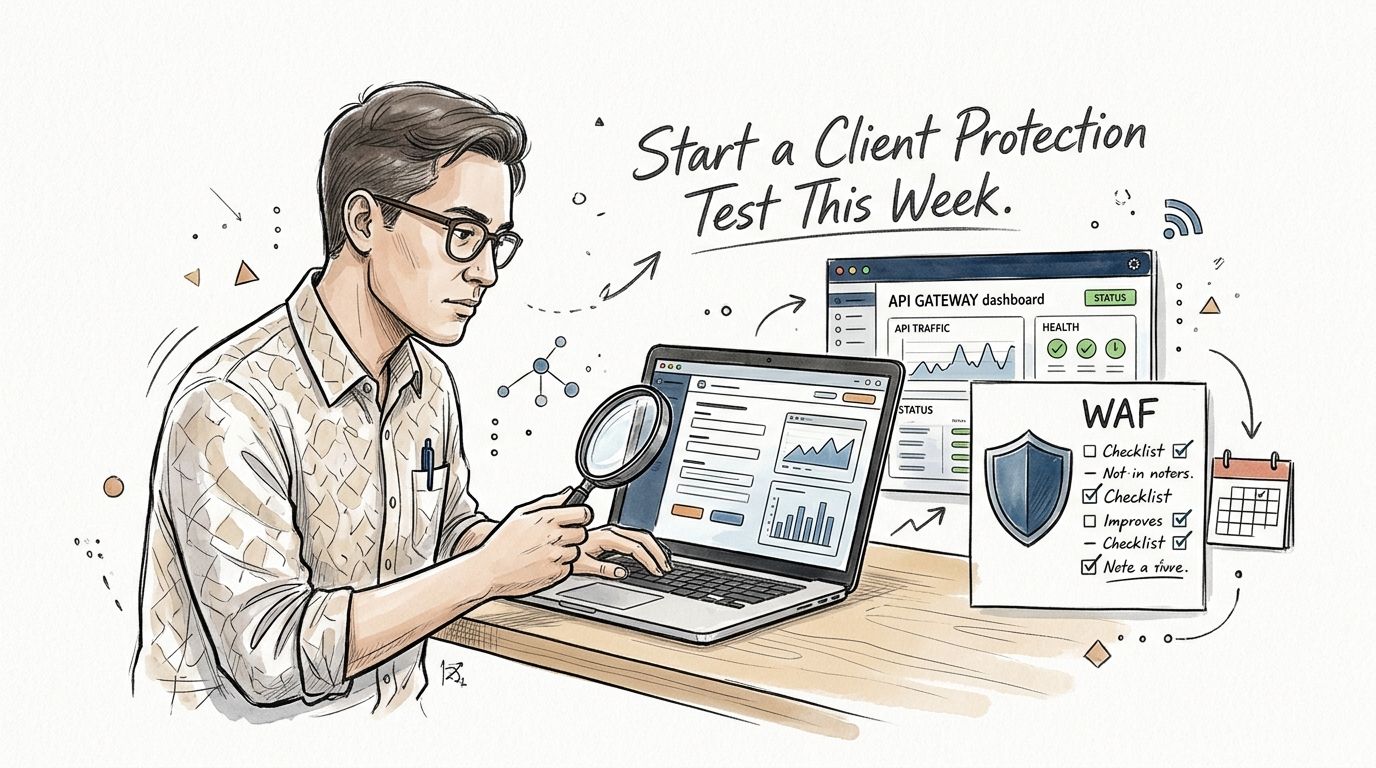
Scope the proof tightly. Use two roles, a small set of object IDs, and both a read and a write operation. Require the output to show the original identity, the swapped identifier, the request and response, any side effect, and whether a PCI-DSS or SOC 2 control conversation is affected. If the API denies every unauthorized case, you've produced useful assurance. If it returns foreign data, you've produced a remediation briefing that doesn't need exaggeration.
Turn the proof into a service motion
Run the narrow test with an automated pentest platform that verifies findings and exports a client-ready report. Have a senior tester review anything that looks like business-logic abuse rather than simple object access. That division keeps speed without outsourcing judgement to a tool.
The walkthrough below shows how a guided testing workflow can support that first scoped engagement.
Start the trial, onboard that single customer in the partner dashboard, and run the authorization cases before you pitch a broader program. Use the result in one of two honest ways. Either brief the client on remediation with evidence engineering can reproduce, or use a clean, scoped result to show a prospect what verified testing looks like.
The success test is simple. Within days, you should be able to stand in front of a buyer and separate two statements. "We have a gateway" describes inventory. "This identity couldn't touch that object, and here's the evidence" describes web application and API protection that has been proved.
ThreatExploit AI helps MSSPs and consultancies run automated, evidence-backed penetration tests across web applications and REST and GraphQL APIs, with compliance-mapped reports clients can use for remediation and audit conversations. Start with one customer application, prove whether authenticated identities can cross object or tenant boundaries, and turn the verified result into a recurring protection service. Visit ThreatExploit AI to start your first client-ready test today.