
Your automated scan has passed, the report is clean, and the checkout flow appears to enforce every visible rule. Then a tester changes one request parameter, sends a value the browser would never permit, and watches the account balance move in the wrong direction. The application isn't failing because of SQL injection or a known vulnerable library. It's following a workflow that was never made secure.
That's the practical challenge of business logic vulnerability testing. The tester has to understand what the application is meant to do, identify where that intent is enforced, and then deliberately violate the assumptions between steps. For MSSPs, that work requires more than adding another scanner to the toolchain. It requires a repeatable method for testing state, authorization, sequencing, limits, and transaction integrity across web applications, APIs, queues, and cloud services.
Table of Contents
- Why Business Logic Flaws Evade Automated Scanners
- The Scale and Impact of Business Logic Vulnerabilities
- Mapping Business Rules Before Writing Test Cases
- Attack Scenarios and Testing Techniques for Common Flaws
- Integrating Business Logic Testing into Automated Pipelines
- Evidence Collection and Compliance-Ready Reporting
- Building a Sustainable Business Logic Testing Practice
Why Business Logic Flaws Evade Automated Scanners
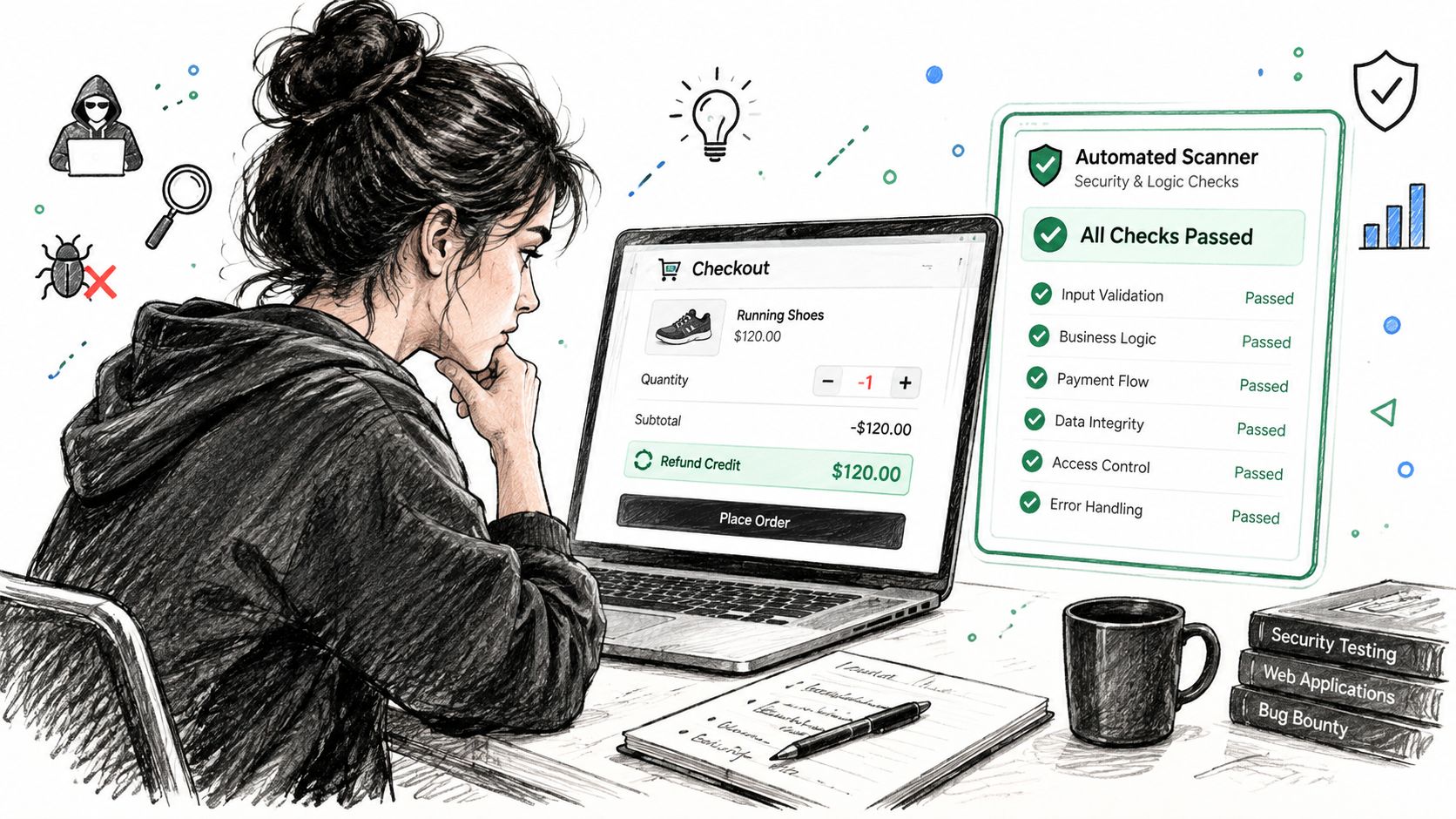
Consider a normal e-commerce checkout. A customer adds an item, sets a quantity, confirms shipping, applies a discount, and submits payment. A DAST scanner may inspect each endpoint, fuzz parameters, check authentication, and report no obvious technical vulnerability. A manual tester, however, might intercept the cart request and replace the positive quantity with a negative value. If the server calculates the total without enforcing the rule that quantities must be positive, the application could treat the purchase as a credit instead of a charge.
The important detail is that every individual request may look technically valid. The endpoint exists, the session is authenticated, the parameter has the expected data type, and the response is well formed. The defect appears only when the tester understands the business rule and compares intended behavior with actual state changes.
The scanner sees requests, not intent
Traditional scanners are strong at pattern recognition. They can send injection payloads, identify exposed services, inspect response behavior, and compare results with known vulnerability signatures. They generally can't determine whether a refund should require an approved return, whether a coupon is single-use, or whether a user is allowed to perform the same action again after a state transition.
Business logic weaknesses live in workflow sequencing, state management, authorization assumptions, and limits. A scanner doesn't automatically know that a delivery request should follow payment, that a refund should follow a completed purchase, or that one approval must come from a separate role. Those constraints exist in the application's domain, not in a universal payload database.
That's why a clean automated result shouldn't be treated as proof that a workflow is secure. A useful discussion of false positives and the difference between scanners and penetration testing helps frame the broader issue, but business logic testing adds the opposite problem too, false negatives caused by missing context.
This is a recognized vulnerability class
Business logic vulnerabilities were formally recognized in OWASP's taxonomy by 2003. By 2025–2026, OWASP had expanded the area into a dedicated business-logic-abuse category, while MITRE's CWE-840 describes weaknesses that allow attackers to manipulate an application's intended behavior. The historical progression reflects a practical reality. These flaws aren't a rare curiosity confined to unusual applications, they recur anywhere software encodes valuable business processes. The academic summary of business logic vulnerabilities%20Business%20Logic%20Vulnerabilities%20in%20the%20Digital%20Era.pdf) provides useful context for that evolution.
The same distinction matters during vulnerability triage. A scanner alert still needs validation, and a clean scan still needs human review of critical workflows. Teams that provide vulnerability triage for agencies already understand this separation between tool output and practical risk. The MSSP that treats business logic assessment as a dedicated activity will find issues that a broad scan leaves untouched.
The Scale and Impact of Business Logic Vulnerabilities
Business logic flaws deserve dedicated time because they appear in the parts of an application where the consequences are highest. Payment, account recovery, identity management, inventory, refunds, discounts, approvals, and tenant separation all rely on rules that span multiple requests. When those rules fail, the result can be unauthorized access, transaction manipulation, resource exhaustion, or a material change to a user's privileges.
The available testing data supports that concern. A 2024 penetration-testing intelligence summary reported that broken access control appeared in 32% of high-severity findings across more than 4,000 engagements, as described by BreachLock findings summarized by Edgescan. Broken access control isn't identical to every business logic flaw, but it frequently reflects the same underlying failure, the application doesn't enforce who may perform an action on a particular object or at a particular stage.
API workflows are becoming a larger target
Imperva's 2024 API Security research found that 27% of API attacks in 2023 were business logic attacks, compared with 17% the year before, a 59% year-on-year increase. Those figures are reported in Edgescan's analysis of certified expert testing and business logic risk. The change matters because APIs often expose the state transitions that a graphical interface hides. A tester can call an endpoint directly, alter a status value, repeat a transaction, or submit a request from a different identity context.
Other 2025 market data cited in the same industry discussion placed business logic vulnerabilities at 11% of critical findings in expert PTaaS testing, with 20% associated with unauthenticated access to sensitive resources. These categories overlap in practical assessments. A workflow may contain a direct authorization failure, then expose a second flaw because the attacker can repeat or reorder the action.
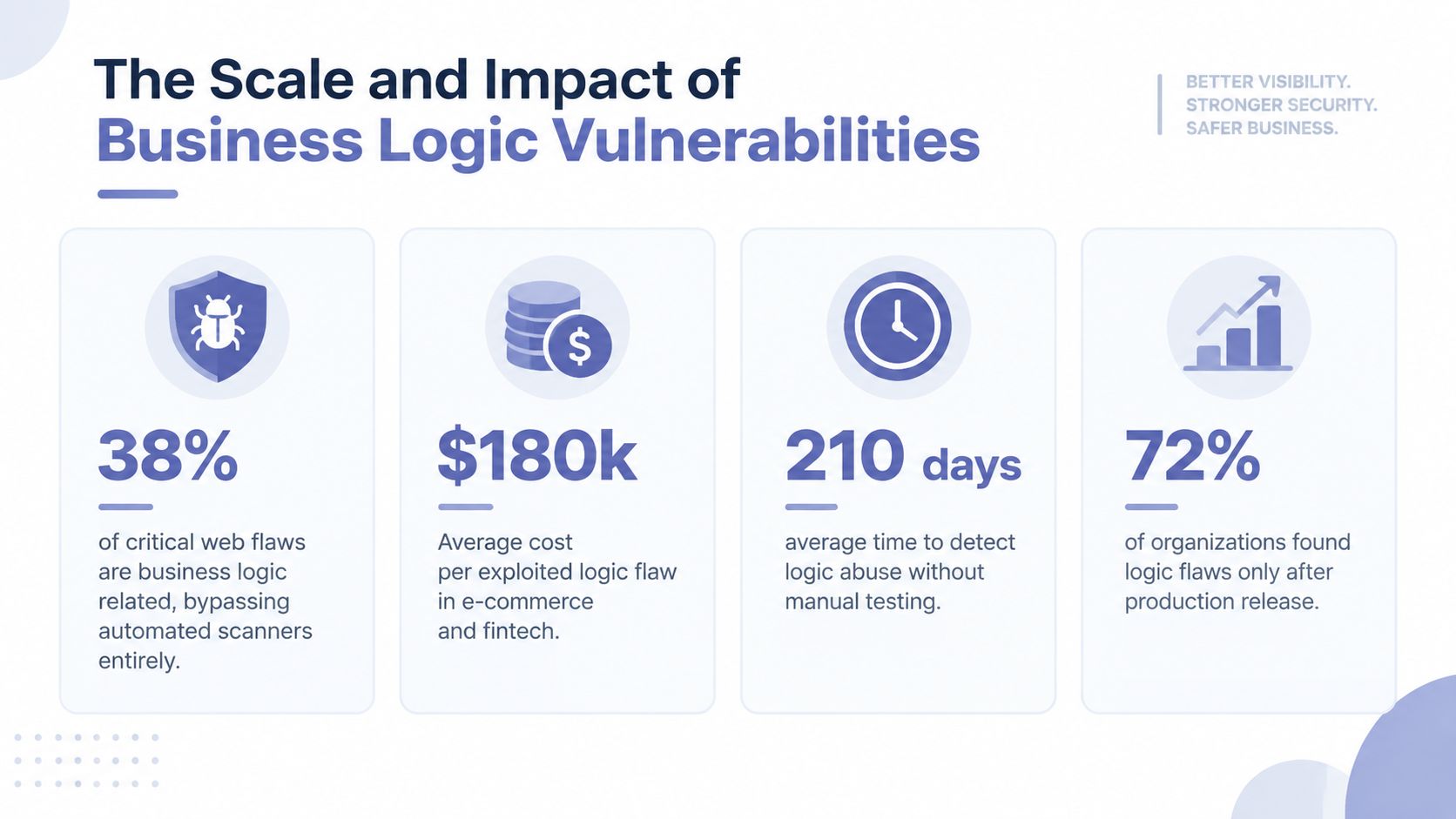
The infographic should not be used as a substitute for the verified figures above. Its additional values are not supported by the available evidence, so they shouldn't be presented as established facts.
Why prevalence changes scoping decisions
For an MSSP, the conclusion is operational. Business logic testing shouldn't be an optional paragraph added after automated scanning. It belongs in the scope whenever the target has stateful workflows, sensitive objects, role-dependent actions, or an economic function.
A broad scan can establish a technical baseline. Manual testing then concentrates on:
- High-value transactions: Payments, credits, refunds, transfers, and pricing changes need tests for invalid states and repeated actions.
- Authorization boundaries: Testers should compare user roles, tenants, ownership, and object-level permissions.
- Stateful APIs: Every transition deserves review when one endpoint creates the conditions for another.
- Abuse limits: Rate limits, quantity restrictions, approval requirements, and concurrency controls should be tested as business rules.
The flaws aren't necessarily difficult because the code is obscure. They're difficult because the tester must know which outcome is unacceptable.
Mapping Business Rules Before Writing Test Cases
Random workflow poking produces inconsistent coverage. Before sending altered requests, document the normal process and the assumptions that make each step valid. OWASP's guidance recommends modeling the application as a state machine and testing every transition for authorization, sequencing, and data-integrity violations, rather than limiting the assessment to obvious input validation. That recommendation appears in the OWASP Business Logic Testing guidance.
Start with the intended workflow
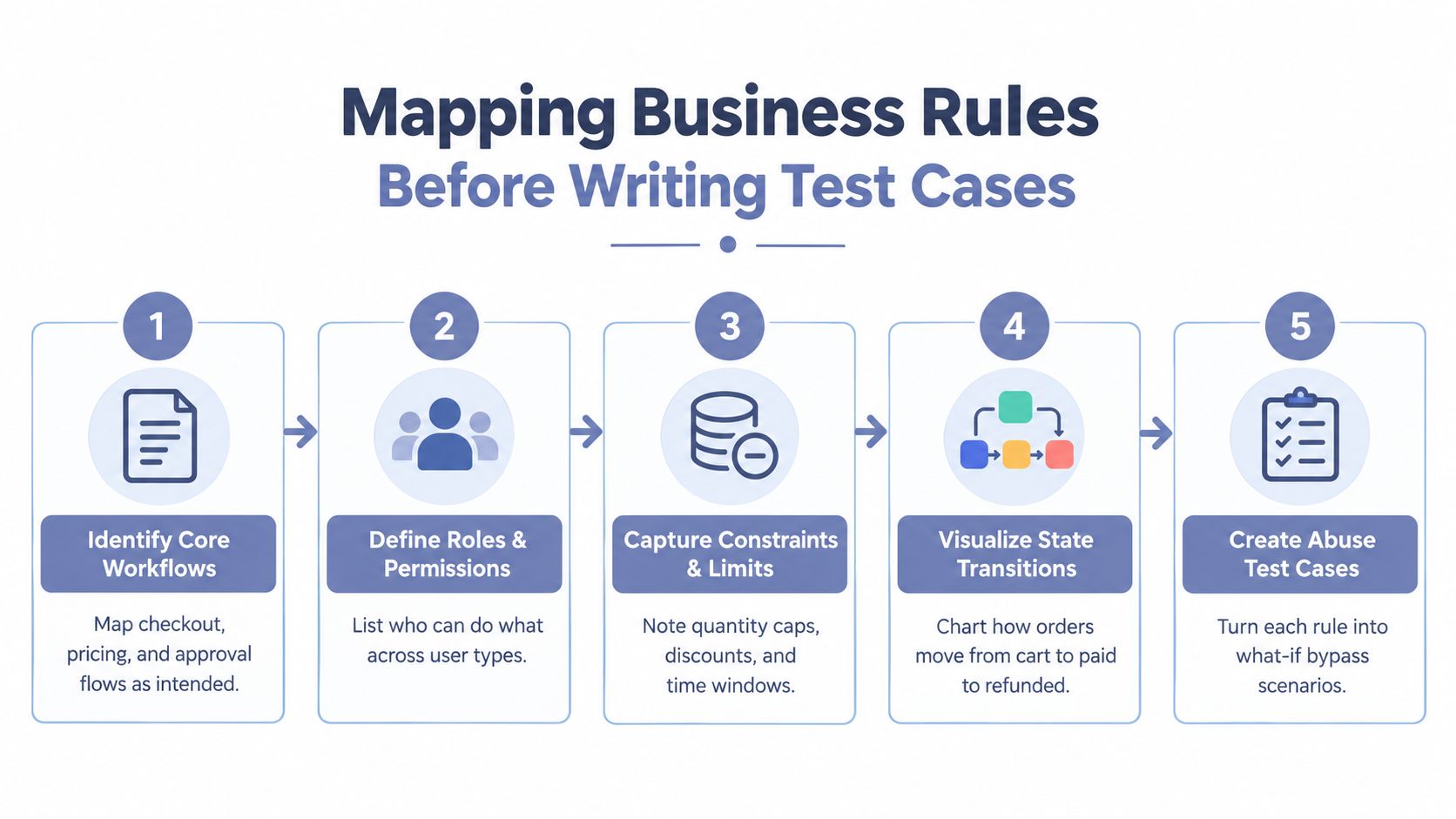
Begin with application documentation, user stories, API specifications, and conversations with product owners. Documentation will be incomplete, so validate it by using the application as each relevant user type. Record the actions, parameters, responses, and state changes, not just the page sequence.
For a checkout, the states might include cart created, item reserved, shipping selected, payment authorized, order confirmed, fulfilled, and refunded. The exact labels don't matter as much as the transitions. For each transition, write down:
- Who may trigger it
- Which prior state is required
- Which values must remain consistent
- What data the server creates or changes
- Whether the transition can be repeated
- Whether another system must approve or confirm it
This work exposes hidden assumptions. A developer may assume that only the front end can reach a refund endpoint. An API consumer may assume that a status value is trustworthy because it came from an earlier service. A queue consumer may assume that a message appears only once. Each assumption becomes a test target.
Record invariants across systems
An invariant is a rule that must remain true regardless of how a user reaches the state. Examples include an order total matching its line items, a refund never exceeding the captured payment, or a user belonging to the tenant associated with the requested object. OWASP's Business Logic Security Cheat Sheet emphasizes writing down and testing these invariants.
Map the hand-offs between the browser, API gateway, application service, database, queue, payment provider, and cloud function. A rule enforced in one service may be absent in the next. A concise security model explanation can help teams distinguish intended trust boundaries from assumptions that were never enforced.
Use the map to create abuse questions rather than generic payload lists:
- Can a user call a later endpoint before completing the prerequisite?
- Can one role create a state that only another role should approve?
- Can an object identifier cross a tenant boundary?
- Can a request be replayed after the state has changed?
- Can two requests produce a result that neither request should produce alone?
- Can a downstream system accept stale, duplicated, or reordered data?
The resulting model makes testing faster. It also gives developers a language for fixing the issue because the finding points to a broken rule, not merely an unusual response.
Attack Scenarios and Testing Techniques for Common Flaws
The most productive manual assessments begin with a valid transaction. Capture it in an intercepting proxy such as Burp Suite, save the request and response, and then change one assumption at a time. The aim isn't to generate noise. It's to determine whether the server validates the rule that the user interface appears to enforce.
OWASP's workflow guidance recommends capturing requests for every step, attempting later actions without prerequisites, replaying or reordering requests, and modifying state or status parameters to invalid, future, or unauthorized values. The following table turns those ideas into an assessment pattern.
| Attack Pattern | Testing Technique | Server-Side Verification |
|---|---|---|
| Workflow circumvention | Capture each request in a multi-step flow, then call the final action before completing earlier steps. Replay requests in a different order and remove prerequisite tokens where possible. | Confirm that the server checks the current workflow state, not merely the presence of a client-supplied parameter. |
| Logically invalid data | Intercept values such as quantity, cost, discount, transfer amount, or date. Submit negative, zero, excessive, stale, or contradictory values that the UI blocks. | Verify that the backend rejects the value and that no balance, order, entitlement, or inventory state changes. |
| Hidden field manipulation | Inspect hidden inputs and JSON properties for roles, prices, ownership, approval states, tenant identifiers, and feature flags. Modify them before submission. | Ensure sensitive decisions come from trusted server-side data and authorization checks, not from hidden client values. |
| Replay and duplicate action | Repeat a successful request after completion, refresh the operation, or resend the same message through the API. | Check idempotency, transaction uniqueness, and whether the second request creates an additional benefit or state change. |
| Concurrency abuse | Send requests concurrently against a limited action, such as a redemption, reservation, transfer, or quota-controlled operation. | Confirm that the limit is enforced atomically and that competing requests cannot each observe the same available state. |
| Cross-role or cross-tenant access | Repeat a request with another authorized test account, changing object identifiers or role-dependent parameters. | Confirm object ownership, tenant isolation, and function-level authorization at the server. |
What to inspect in HTTP traffic
Pay attention to more than status codes. Compare the response body, authorization claims, object identifiers, calculated totals, balance fields, workflow status, and audit identifiers before and after each mutation. A successful HTTP response doesn't prove a vulnerability, and an error response doesn't prove the control works if the underlying state still changed.
For data validation, OWASP specifically recommends using a proxy to inspect POST and GET parameters such as cost and quantity, then submitting logically invalid values to confirm backend enforcement. The relevant OWASP data validation testing guidance makes the key point: front-end acceptance tests don't establish security because an attacker can alter requests directly.
Concurrency needs a different mindset
Race testing isn't just rapid fuzzing. Identify the invariant, such as “one redemption per account” or “a reservation consumes inventory once,” then determine whether two requests can read the same pre-action state. OWASP's guidance says that if two requests can race, testers should assume exploitability until the application proves that the operation is synchronized.
Keep the test controlled. Use test accounts, non-production values, and explicit authorization from the client. For MSSPs, a reproducible two-request race with before-and-after evidence is far more useful than a vague statement that an endpoint “may be vulnerable.” Teams building broader coverage can use API penetration testing resources to standardize discovery and endpoint analysis, while retaining manual judgment for the rule itself.
Integrating Business Logic Testing into Automated Pipelines
Automation should handle repetition, not pretend to understand intent. Use scanners for routine discovery, known technical weaknesses, endpoint inventory, authentication checks, and evidence capture. Reserve human analysis for questions such as whether an approval is mandatory, whether a state transition is legitimate, and whether a repeated action creates an unauthorized benefit.
The distinction is becoming more important. An independent 2026 report found insecure design and business-logic flaws in web applications rose to 16% from 8% a year earlier, suggesting that this class is becoming more prominent even as scanners improve. That finding is reported in the analysis of human context in business logic testing.
Automate the repeatable layer
Build a reusable library around workflow patterns rather than individual URLs. A useful library can include tests for:
- State prerequisites: Call later actions without earlier transitions.
- Replay behavior: Resend completed operations and compare state changes.
- Role boundaries: Run the same request under different authorized identities.
- Object ownership: Replace identifiers with objects from another test tenant.
- Value constraints: Submit invalid quantities, totals, dates, and status values.
- Concurrency: Exercise limited actions with controlled parallel requests.
Store the expected invariant with each test. “The request returns an error” is a weak assertion. “The refund total remains unchanged and the order state remains fulfilled” is a security assertion.
Keep the pipeline evidence-oriented
A CI/CD job should preserve the request, response, identity context, precondition, mutation, and final state. When a workflow changes, the failing test should tell the developer which rule no longer holds. This makes business logic testing part of engineering feedback instead of a separate report that arrives after release.
For broader delivery automation, pentesting in a DevSecOps pipeline offers useful implementation context. ThreatExploit AI can automate reconnaissance, exploitation, verification, and reporting across designated web, REST, GraphQL, network, and cloud targets, with evidence-backed outputs. It can accelerate the surrounding assessment work, but a tester still needs to define the business invariant and validate whether a surprising result represents abuse or an intended feature.
The trade-off is straightforward. Full manual testing offers deeper context but doesn't scale across every change. Pure automation scales but misses rules that were never encoded in the test. A hybrid pipeline gives the MSSP repeatable coverage while keeping a human responsible for the decisions that require business understanding.
Evidence Collection and Compliance-Ready Reporting
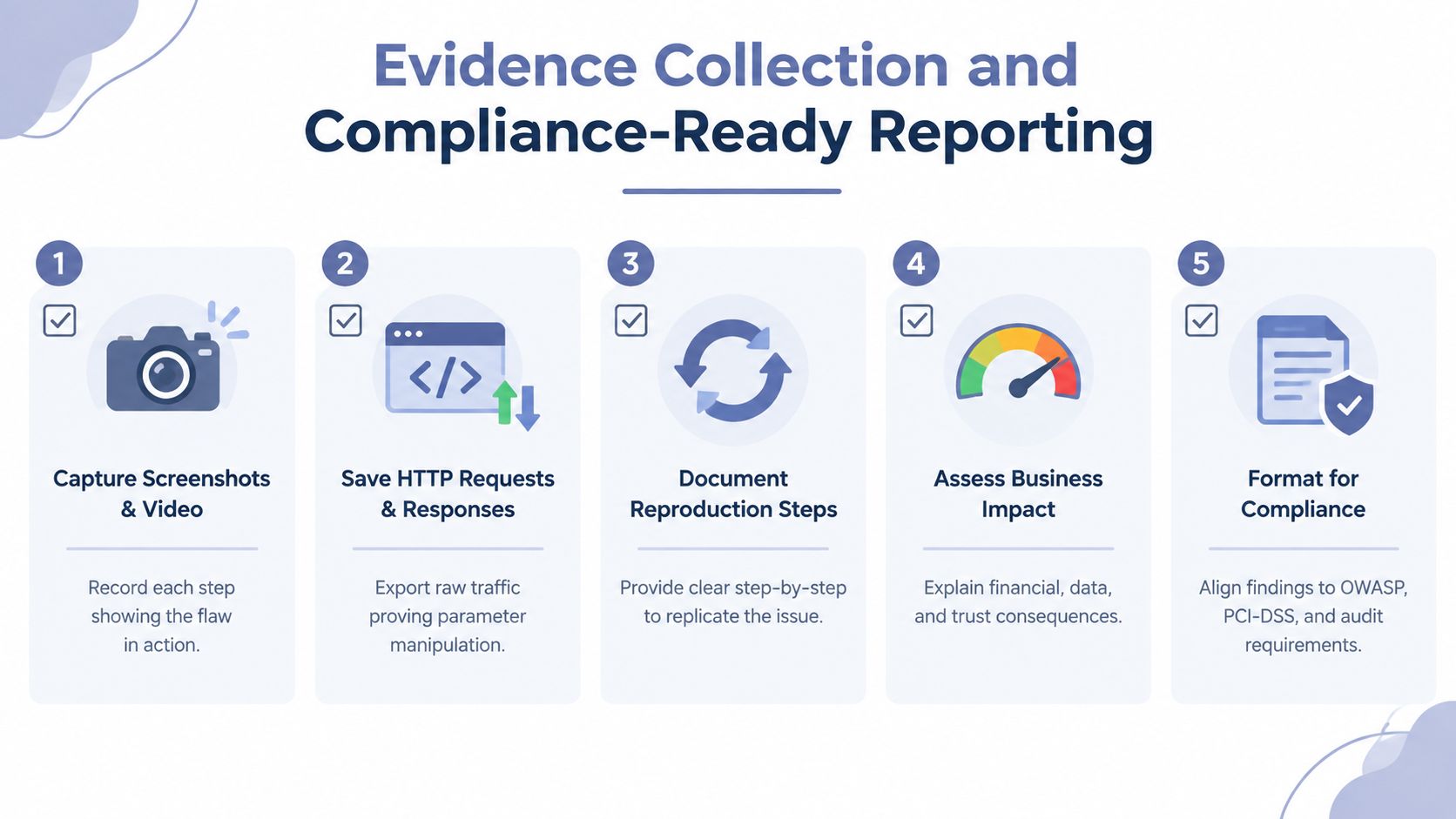
A business logic finding often lacks a CVE, a standard exploit string, or a single vulnerable line of code. The report must supply the missing context. A reviewer should be able to see the intended workflow, the altered action, the server response, and the resulting unauthorized state without reconstructing the entire assessment from scattered notes.
Capture proof at each stage
Start with a clean baseline using a dedicated test account. Save the normal request and response, then preserve the modified transaction separately. Include screenshots only when they clarify the state change. Raw HTTP evidence usually carries more technical weight because it shows the exact parameter, identity, endpoint, and server output.
A strong evidence package includes:
- Precondition: Account role, tenant, object state, balance, inventory, or approval status.
- Normal sequence: The requests required for legitimate behavior.
- Mutation: The specific parameter, order change, replay, or concurrent action.
- Server response: Status code, body, state identifier, and any error handling.
- Postcondition: The unauthorized balance, privilege, object access, entitlement, or workflow state.
- Cleanup record: Actions taken to reverse test data or prevent downstream effects.
Avoid collecting sensitive production data unnecessarily. Redact secrets and personal information while retaining enough identifiers to connect the request to the resulting state.
Write for engineers and assessors
The title should describe the violated rule, not just the mechanism. “Refund endpoint accepts a request after order cancellation” is more useful than “business logic flaw.” Explain the intended control, show how the tester bypassed it, state the security consequence, and provide a remediation direction such as server-side state validation, authorization enforcement, atomic transaction handling, or idempotency protection.
Compliance mapping should support the finding rather than replace technical detail. Depending on the application and engagement scope, map the issue to relevant OWASP categories and applicable controls in PCI-DSS, SOC 2, HIPAA, or ISO 27001. The exact control reference must match the client's assessment framework and the actual failure. Don't claim that a generic business logic issue automatically violates every framework.
Reporting rule: If the reader can't reproduce the state change from the evidence, the finding isn't finished.
Include a concise executive summary that explains the business consequence in plain language. Then give engineering teams the precise request sequence, affected roles, affected objects, verification steps, and remediation guidance. This structure reduces arguments over severity because it connects the flaw to an observable violation of an intended business rule.
Building a Sustainable Business Logic Testing Practice
MSSPs should scope business logic vulnerability testing as a distinct workstream, especially for applications with payments, approvals, sensitive records, tenant boundaries, or complex API workflows. Treating it as an afterthought guarantees uneven coverage because the tester reaches it only after automated findings consume the engagement schedule.
A sustainable practice has four parts:
- Scope the workflows: Name the critical transactions and states in the proposal.
- Create reusable patterns: Maintain test cases for replay, sequencing, authorization, limits, and concurrency.
- Train the team: Teach junior testers to ask what must be true before and after every action.
- Review the rules: Involve developers or product owners when the intended behavior isn't documented.
Senior testers should design the methodology and review high-risk findings. Junior testers can execute mapped scenarios, collect traffic, validate invariants, and expand the library under supervision. That division builds capacity without reducing the assessment to automated output.
Business logic testing isn't a luxury reserved for unusual applications. It is the discipline that checks whether security controls survive real user journeys, altered requests, repeated actions, and cross-system state changes. Scanners remain valuable, but they answer a narrower question. They identify technical weaknesses that match their detection models. Manual and scripted business logic testing asks whether the product still protects its rules when a user behaves in a way the product team never intended.
ThreatExploit AI helps MSSPs automate reconnaissance, exploitation, verification, and evidence-backed reporting across web applications, APIs, networks, and cloud environments. Use it to accelerate repeatable assessment work while your testers focus on stateful business rules, then visit ThreatExploit AI to evaluate how it can fit into your penetration testing delivery process.