
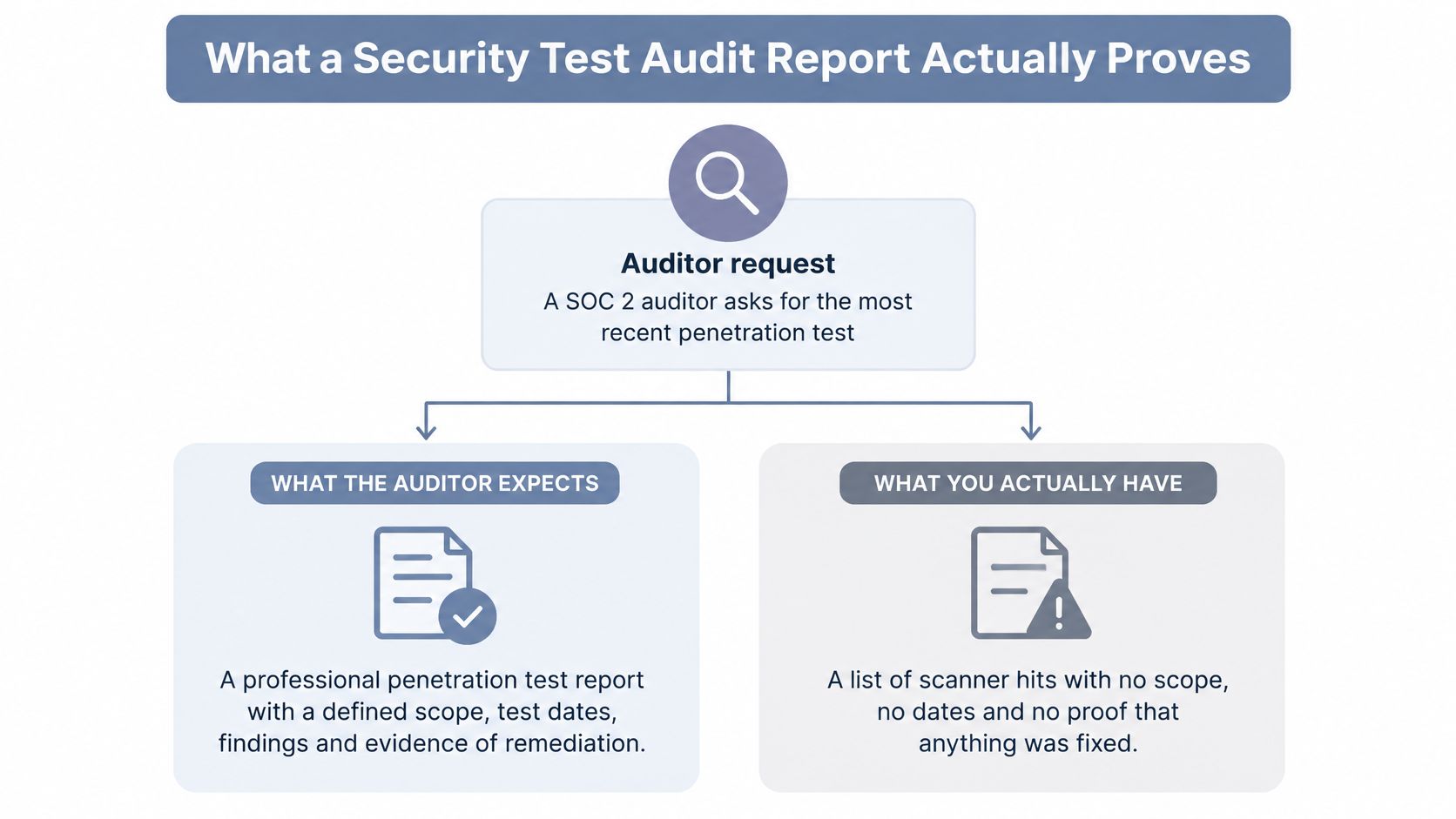
A SOC 2 auditor asks for your customer's most recent penetration test. You open the file and find scanner hits, severity labels, and suggested patches, but no scope, no testing dates, and no proof that anything was fixed. The customer expected audit evidence. Your team delivered a work queue.
That gap is fixable, but not by adding a compliance logo to the cover. An audit-ready report needs a traceable record of the test, the demonstrated risk, and the evidence supporting each closure decision.
Table of Contents
- What a Security Test Audit Report Actually Proves
- Required Components and Who Reads Each One
- Writing Each Finding So It Can Be Verified
- Mapping Findings to SOC 2, PCI DSS and ISO 27001
- Remediation Verification and Closure Status
- A Sample Findings Register and Delivery Package
- Confirm the Report Passes This Checklist Before Delivery
What a Security Test Audit Report Actually Proves
Think of a building inspection. A useful inspector's report identifies the areas checked, attaches photographs of defects, describes the repairs, and records whether a return visit confirmed the work. A list of possible structural problems wouldn't establish which rooms the inspector entered or whether the owner repaired anything.
A security test audit report serves the same purpose for systems. It's the formal record of the assessment: scope and dates, methods and tools, reproducible findings, business consequences, remediation owners, and retest results. An assessor should be able to follow those records without needing the original tester to explain missing context.
This comparison captures the difference between the auditor's request and an inadequate delivery.
Scan output, test narrative, and audit evidence
These deliverables have different jobs:
- Raw vulnerability scan export: Lists suspected weaknesses and detection results. A scanner alert alone doesn't establish exploitability or business impact.
- Penetration-test narrative: Explains the tester's route through the environment. It provides useful context, but a story without asset references and evidence isn't independently checkable.
- Audit-grade report: Connects each conclusion to authorized scope, observed behavior, corrective action, and verification.
The financial stakes justify that discipline. IBM's 2025 Cost of a Data Breach study reported a global average breach cost of USD 4.44 million and an average breach lifecycle of 241 days; breaches lasting more than 200 days averaged USD 5.01 million, compared with USD 3.87 million for those resolved in fewer than 200 days.
Those figures concern breach identification and containment, not penetration-test reporting speed. They don't prove that a polished report prevents a breach. They do explain why a provider should remove avoidable delays between identifying a weakness and confirming that the customer has addressed it.
Practical rule: A report must prove what was tested, what was actually exploitable, and whether the fix holds.
A clean result also needs boundaries. If the tester couldn't access an administrative interface, the report must distinguish an untested surface from a tested surface where no exploitable weakness was found.
Required Components and Who Reads Each One
Report components and what each audience needs
| Component | Executive view | Technical view |
|---|---|---|
| Scope and testing parameters | One paragraph on targets, dates and authorization | Target list, exclusions, test windows and tester identities |
| Methodology and tools | Summary of approach and standard followed | Method, tools, custom scripts and the test checklist used |
| Risk summary | Severity counts and the top three risks | Severity and CVSS vector per finding, with exposure and asset criticality |
| Findings register | Top five findings with owners | Full records with reproduction steps, evidence and root cause |
| Remediation plan | Deadlines and owners grouped by risk | Fix instructions, configuration changes and affected code paths |
| Retest and closure | Status per finding and open risk | Retest date, method, result and before-and-after evidence |
| Limitations | One sentence on what the test cannot show | Test window, excluded systems and assumptions behind each conclusion |
These are views of the same assessment, not separate versions of reality. Executives use the opening pages to decide what needs attention and funding. Engineers need enough detail to locate the defect, change the right component, and demonstrate that the change worked.
NIST SP 800-115 recommends reporting system, network, and organizational vulnerabilities alongside mitigation actions, allowing the report to support corrective action, progress tracking, risk assessment, and security improvement. That makes the remediation record part of the report's purpose, not an optional appendix.
Keep one underlying record
Generate the executive summary and technical register from the same finding records. Otherwise, an engineer can change a finding's status while the management summary continues to show it as open, or an executive chart can omit a risk that remains in the appendix.
Preserve an evidence chain from the tested asset and test condition to the observed result, risk interpretation, affected requirement, and remediation owner. Record who performed the test, whether a person or an automated agent, and retain the request or command context needed to interpret the result.
Authorization belongs alongside scope. A hostname appearing in a customer's inventory doesn't by itself establish permission to test infrastructure operated by a supplier.
OWASP's penetration-testing reporting guidance also calls for testing parameters, schedule, limitations, methodology, tools, custom scripts, findings, and remediation material suitable for technical teams and system managers. Record deviations too, such as an agreed restriction against destructive testing.
If an executive can't identify the top risk and its owner from the opening page, the summary hasn't done its job.
Don't fill missing ownership with a department name alone. Assign an accountable role or named individual who can coordinate the fix, arrange deployment, and return evidence for verification.
Writing Each Finding So It Can Be Verified
Consider a hypothetical SQL injection finding in a customer login API. Writing “SQL injection, high severity, sanitize input” leaves the engineer to rediscover the issue. A useful record explains what happened and supports every consequential claim.
The OWASP Web Security Testing Guide identifies vulnerability classification, root cause, testing technique, consequences, remediation, and severity as reporting content, with reproducible artifacts supporting fix verification.
Walk the engineer through the evidence
Use a stable finding identifier and asset reference, then document the finding in the order someone would investigate it:
- Location and prerequisites: Identify the login handler, affected application build, request field, and whether the tester needed an account. For this scenario, the affected route accepts unauthenticated requests.
- Reproduction: Capture a normal login attempt, repeat it with the approved test input, and compare the responses. Keep the sequence concise enough to repeat within the authorized environment.
- Observed behavior: Attach sanitized request and response artifacts. Explain what changed rather than dropping unexplained SQLMap output into the report.
- Expected behavior: State that the application should treat submitted credentials as data and reject invalid authentication attempts.
- Boundary and impact: Identify whether the test demonstrated authentication bypass, database inference, or another consequence. Don't claim customer-record extraction if the test only demonstrated a response difference.
A proof-of-concept exploit should establish the weakness with the least necessary impact. It isn't permission to retrieve production data unnecessarily.
Separate root cause from severity
Name the implementation defect precisely. If code review confirms that the handler concatenates user-controlled input into a database query, document that behavior and recommend parameterized queries. If the tester lacked source access, describe the root cause as an inference and identify what the developer must confirm.
Include the CVSS vector when the engagement uses CVSS, together with the reasoning behind its metrics. Don't select a score first and invent a vector to match it.
Context can change the remediation order. A medium-scored flaw on an internet-facing login boundary may warrant earlier attention than a higher-scored issue on an isolated lab host. Record exposure, asset criticality, prerequisites, data sensitivity, compensating controls, and the agreed remediation deadline separately from technical severity.
Finally, protect the artifacts. Redact credentials, session tokens, and personal data without removing the fields needed to understand the test. Timestamp evidence and retain hashes so reviewers can check file integrity; a hash helps detect alteration, but doesn't independently prove that the original test was valid.
Mapping Findings to SOC 2, PCI DSS and ISO 27001
Framework testing requirements and report evidence
| Framework | Testing requirement | Evidence auditors usually ask for | Report element to map |
|---|---|---|---|
| PCI DSS v4.0 | Requirement 11.4 covers internal and external penetration testing at least every 12 months and after significant change, qualified testers, correction and retesting | Authorized scope, tester qualifications, test results and successful remediation retests | Scope, methodology, qualifications and closure artifacts |
| SOC 2 (Trust Services Criteria) | No universal fixed penetration-test rule; testing can support criteria such as CC7.1 for detecting and monitoring vulnerabilities | Dated report tied to in-scope systems and tracked remediation | Scope and dates, remediation plan and closure status |
| ISO/IEC 27001:2022 | Annex A controls 8.8 and 8.29 address technical vulnerabilities and security testing, subject to the organization's control applicability | Test results and records of vulnerability treatment | Findings register, risk owners and treatment records |
| HIPAA Security Rule | No explicit penetration-test mandate; testing can inform risk analysis and evaluation under 45 CFR 164.308 | Risk analysis inputs and evaluation records | Risk summary and business impact per finding |
| GDPR | Article 32 requires regular testing and evaluation of security measures | Dated test records and evidence of follow-up | Test dates, retest schedule and closure status |
Treat these mappings as an evidence-planning guide, not an assurance that a report guarantees compliance. The organization's scope, applicable obligations, control design, and assessor's procedures determine what evidence is sufficient.
The closure question also changes with the framework. A PCI DSS penetration-test record needs to connect correction of exploitable findings to retesting. For SOC 2, the assessor evaluates evidence against the relevant controls and examination period. For ISO 27001, treatment decisions and the organization's applicable controls matter alongside the technical result.
Map controls without rewriting the test
Use a short mapping process:
- Identify the relevant control. Tag the finding with the specific requirement it supports, not merely the framework's name.
- Preserve a shared scope statement. Reference the same systems, exclusions, dates, and asset identifiers across mappings.
- Attach the appropriate follow-up. Link retest artifacts, treatment decisions, or evaluation records according to the control being evidenced.
- Confirm acceptance before delivery. Agree the reporting period, acceptable evidence age, and sampling expectations with the customer's assessor.
Freeform Company's discussion of aligning enterprise security requirements with risk provides useful context for connecting control obligations to business priorities. Keep that strategic discussion separate from the technical proof that a particular attack path has been addressed.
Good compliance documentation lets an assessor locate supporting evidence without guessing why a finding was tagged. Include a short explanation of the mapping and the artifact that supports it.
A report can support several frameworks when scope and dates align. It can't turn a tested application into evidence for an untested environment, and a control reference doesn't convert an accepted exception into a verified fix.
Remediation Verification and Closure Status
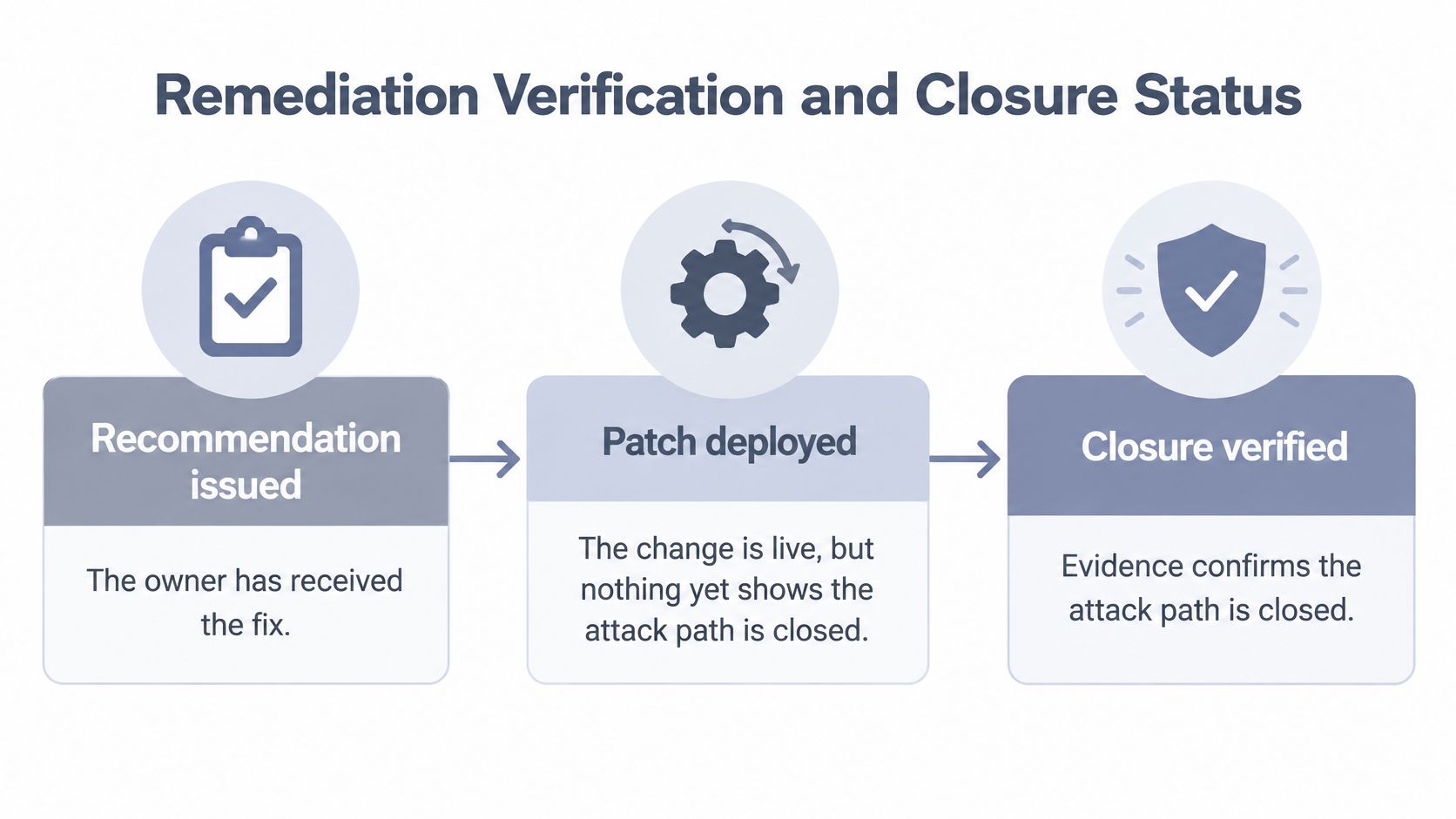
Use distinct statuses so customers don't mistake activity for assurance:
- Recommendation issued: The owner has received the proposed fix.
- Patch deployed: The change is live, but the tester hasn't established that it closes the attack path.
- Independently verified: The tester retried the original path from the same trust boundary and confirmed that the previously demonstrated exploit no longer succeeds.
The difference between deployment and verification should be visible at a glance.
Verizon's 2025 DBIR found that only about 54% of perimeter-device vulnerabilities were fully remediated, with a median remediation time of 32 days. That's a practical reason to keep target dates and retest dates inside the report record rather than scattered across email threads.
Apply a repeatable closure procedure
- Assign ownership when issuing the finding. Record the accountable owner and target date before handing the issue to the customer.
- Record the change ticket, affected deployment, and supporting implementation evidence. A ticket marked complete establishes workflow progress, not technical closure.
- Repeat the original attack path. Use the original steps and tool version where feasible. Document any necessary changes to the test setup, credentials, network position, or tooling.
- Investigate partial fixes, regression risk, and new exposure. If the original payload fails but an equivalent variation succeeds, keep the finding open and attach the new evidence.
- Document residual risk. Record compensating controls and approved exceptions separately. Risk acceptance is a governance decision, not proof of remediation.
- Obtain the customer's closure approval against the identified retest artifact. Preserve the finding ID, asset identity, test timestamp, and evidence hash with that decision.
A finding remains technically open until the retest passes. If the customer accepts the risk instead, use an explicit accepted-risk disposition rather than verified closed.
Show days open from the agreed discovery or validation date, and label which date you use. Don't reset that history when the customer deploys an unsuccessful patch.
A failed retest is useful evidence. Hiding it makes the closure decision harder to defend.
The operational remediation gap in penetration-testing findings is where providers can add value beyond discovery. Define the retest scope carefully: disproving the original exploit doesn't establish that the entire application is free of related defects.
Use the following video as supporting context for the remediation discussion.
A Sample Findings Register and Delivery Package
Illustrative findings register extract
| Finding ID | Asset | Severity | Business context | Status |
|---|---|---|---|---|
| WEB-014 | Customer portal invoice API | High (8.1) | Exposes billing records across tenants | Retest pending |
| NET-VPN | VPN gateway | Medium, illustrative | Still accepts TLS 1.0; legacy protocol exposure requires validation | Patched, not independently verified |
| CLOUD-EXPORT | Public storage bucket | High, illustrative | Holds customer exports accessible without intended authorization | Verified closed, retest log attached |
These entries are hypothetical, not results from a real engagement. The example score is illustrative; an actual report must include the scoring method, vector where applicable, and supporting rationale.
The invoice API finding remains unresolved from the verifier's perspective. The VPN entry records a deployed change without overstating assurance. The storage finding has a closure artifact that a reviewer can inspect, rather than just a green status label.
Deliver files that serve different jobs
A customer-ready package should include:
- Executive PDF: Scope, limitations, top business risks, accountable owners, and deadlines. Keep the management decisions easy to locate.
- Technical PDF: Full findings, annotated screenshots, request and response evidence, commands, remediation guidance, and retest results.
- JSON register export: Stable identifiers and structured fields the customer can import into its ticketing workflow. Preserve status meanings during import.
- Evidence folder: Redacted artifacts with timestamps, integrity hashes, and references back to the relevant findings.
Add a test narrative that follows the path from reconnaissance to demonstrated exploitation. Explain how the tester moved between weaknesses and which permissions or access conditions enabled each transition.
CREST's penetration-testing guidance calls for agreed reporting that combines technical and business perspectives, describes discovery and impact, and includes test narratives, evidence, root causes, and corrective actions. The narrative should explain the attack path, while individual finding records provide the precise evidence needed to repair it.
Make report changes reviewable
Date each release and retain previous versions. Include a change log distinguishing a corrected description, a severity adjustment, new evidence, and a genuine closure decision.
Don't overwrite the initial evidence after a successful retest. Store the before-and-after artifacts together so the customer can establish what changed and why the tester approved closure.
Deliver the package through a customer-approved secure channel with appropriate access restrictions. A penetration-test report contains information that could help an attacker, even after credentials and personal information have been removed.
Confirm the Report Passes This Checklist Before Delivery
Run these checks before releasing the package:
- Scope matches the audit request. Systems, testing dates, tester identities, and authorization align with the customer's requested assessment.
- Findings are actionable. Each has reproducible evidence, a supported root cause, and an accountable remediation owner.
- Views agree. Executive and technical outputs show identical counts, severities, and statuses.
- Mappings are specific. References identify the supported control, such as PCI DSS 11.4, SOC 2 CC7.1, or ISO 27001 control 8.8.
- Statuses reflect evidence. Deployment notices and recommendations aren't presented as successful retests.
- Artifacts are protected. Evidence is redacted, timestamped, hashed, and linked to the appropriate finding.
- Limitations are visible. The opening pages identify the test window, exclusions, and boundaries of the conclusions.
Make packaging a release gate
Automate completeness and consistency checks where possible. Hold a release when required fields are missing, evidence references break, or summary totals disagree, then have a qualified reviewer assess the reasoning that automation can't establish.
Confirm framework mappings and evidence acceptance with the customer's auditor. Version every release so changes remain visible.
At ThreatExploit AI, our reports include evidence, screenshots, and compliance-ready documentation for standards such as PCI-DSS, SOC2, and ISO 27001. We generate PDF, JSON, and structured data formats, and deliver a complete, compliance-mapped penetration test report in under 4 hours from target submission. Evaluate turnaround claims against a sample report's evidence quality, scope, and closure records, not speed alone.
ThreatExploit AI offers automated penetration testing for security service providers, with evidence-backed findings, remediation details, and compliance-mapped reporting for customer delivery. Visit ThreatExploit AI to evaluate how its reporting outputs fit your assessment workflow, and use this checklist to review the evidence your customers will receive.