

A security team can have a full assessment calendar, a serious budget, and a long list of security tools, yet still lack a clear answer to a basic question: which parts of the attack surface have been tested, and what happened after the findings arrived?
That question defines modern security pen testing. A useful engagement doesn't end when a scanner exports a PDF. It establishes what was tested, validates what can be exploited, documents the evidence, assigns practical remediation, and confirms whether the fix worked. The strongest programs treat penetration testing as an operational security control, not an annual ceremony.
Table of Contents
- The Reality of Modern Security Pen Testing
- Understanding the PTES Methodology Framework
- Target Types and Testing Environments
- Automated Versus Manual Penetration Testing
- Compliance Mapping and Report Requirements
- The Coverage Gap in Security Pen Testing
- Operational Guidance for MSSPs Adopting Automation
- Conclusion - The Future of Penetration Testing Operations
The Reality of Modern Security Pen Testing
An MSSP security lead starts the week with several customer environments waiting for assessment. One customer has launched a new API, another has moved workloads into the cloud, and a third needs evidence for an audit. Senior testers are already committed to complex engagements. The team can increase coverage, preserve quality, or meet every deadline, but doing all three with the same manual process is difficult.
That tension is common because security pen testing is a controlled simulation of real-world attack behavior. Testers gather intelligence, examine exposed services, challenge authentication and authorization, exploit weaknesses within agreed rules, and determine what an attacker can reach. The objective isn't to produce the largest vulnerability list. It's to validate defensive assumptions before an adversary validates them first.
The market reflects how far the practice has developed. The global penetration testing market was valued at USD 2.74 billion in 2025 and is projected to reach USD 7.41 billion by 2034, representing a projected compound annual growth rate of 11.60%. North America held 35.10% of the market in the 2025 estimate, according to Astra's penetration testing market report. Those figures mark a shift from occasional specialist consulting toward a recurring security assurance function.

Why methodology matters at scale
A small, highly experienced team can sometimes compensate for an informal process through judgment and memory. An MSSP serving many customers can't rely on that model. Scope decisions, evidence collection, severity ratings, retesting, and customer reporting need repeatable controls so quality doesn't depend entirely on which tester happens to be available.
The practice is both an art and an engineering discipline. Creativity helps a tester recognize an unusual attack chain or business logic flaw. Engineering discipline ensures the tester can reproduce it, explain its impact, preserve evidence, and return later to verify remediation. Automation helps with breadth and consistency, but it doesn't remove the need for judgment.
A mature program therefore moves away from isolated assessments and toward structured, recurring validation. That model fits the operational reality of expanding APIs, internal services, cloud identities, and third-party integrations. It also gives security leaders a more useful conversation with executives: not just how many findings exist, but which assets were tested, which risks were validated, who owns the fixes, and whether exposure is shrinking.
Understanding the PTES Methodology Framework
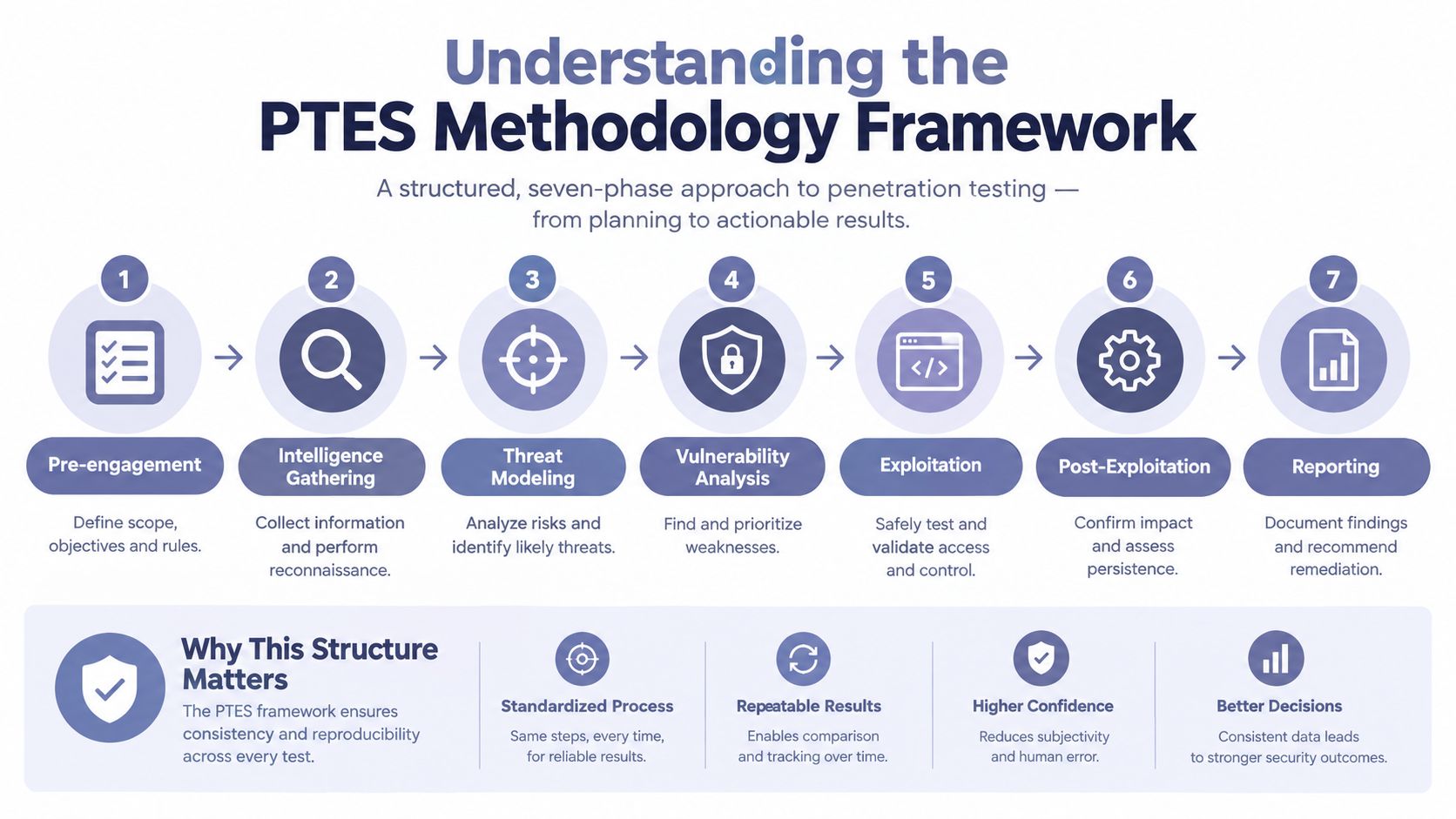
A professional test needs a shared sequence of decisions. The Penetration Testing Execution Standard, or PTES, provides that structure, while the OWASP testing framework describes seven phases: Pre-engagement Interactions, Intelligence Gathering, Threat Modeling, Vulnerability Analysis, Exploitation, Post Exploitation, and Reporting.
Establish the engagement before touching the target
Pre-engagement Interactions define scope, authorization, objectives, contacts, test windows, prohibited actions, and emergency procedures. The deliverable is a written set of rules that protects both the customer and the testing team. Without it, even a technically valid test can create ambiguity over what was permitted.
Intelligence Gathering builds the target picture. Testers review supplied documentation, discover public-facing assets, inspect application behavior, identify technologies, and map trust relationships. Tools such as Nmap, web proxies, directory discovery utilities, and cloud inventory functions may support this phase, but the important output is an organized understanding of the environment rather than a raw tool dump.
Turn observations into attack hypotheses
Threat Modeling connects assets to likely business impact. A public API handling account changes deserves a different testing path from a low-impact marketing page. The tester considers identities, sensitive functions, entry points, trust boundaries, and realistic attacker goals.
Vulnerability Analysis then examines weaknesses through automated checks, configuration review, manual inspection, and targeted experimentation. NIST SP 800-115 identifies analysis goals that include finding false positives, categorizing vulnerabilities, and determining root causes. It also explains that tools can produce many findings that require validation through manual examination or comparison with another automated method, as described in the NIST technical guide.
Exploitation tests whether a suspected weakness is usable under the engagement rules. A tester might demonstrate unauthorized access to another object, bypass a control, or chain a configuration issue with an application flaw. Exploitation should be controlled and proportionate. The point is to establish risk, not to cause unnecessary disruption.
Validate impact and preserve proof
Post Exploitation determines what access means. The tester may examine reachable permissions, confirm whether a compromised account can access another system, or document the boundary of exposure without collecting unnecessary sensitive data. This phase often changes severity because exploitability and impact become clearer.
Reporting turns technical work into decisions. The report should identify what happened, who performed the action, when it occurred, how the issue can be reproduced, why it matters, and how to remediate it. OWASP recommends recording the testing activity and including the vulnerability category, exposure, root cause, technique, remediation, and severity in the OWASP reporting guidance.
PTES isn't a rigid one-way checklist. A discovery in exploitation may require additional intelligence gathering. Post-exploitation evidence may reveal that the original threat model underestimated impact. That feedback loop is what makes a methodology useful in practice.
Target Types and Testing Environments
The target determines the tester's questions, evidence, and toolchain. A web application test, an internal network assessment, and a cloud review may share principles, but they don't share the same attack paths.
| Environment | Practical focus | Common supporting tools |
|---|---|---|
| Web applications and APIs | Authentication, authorization, session handling, input validation, injection, REST and GraphQL behavior, and business logic | Burp Suite, SQLMap, Nuclei, custom scripts |
| Internal and external networks | Discovery, exposed services, weak configurations, credential exposure, segmentation, and lateral movement | Nmap, service enumeration tools, credential auditing utilities |
| Cloud infrastructure | Storage exposure, identity and access management, security groups, secrets, containers, and control-plane permissions | Cloud-native assessment tools, Nuclei, configuration analyzers, custom queries |
Web applications and APIs
A web test that focuses only on visible pages can miss the APIs powering mobile clients, single-page applications, and integrations. Testers should inspect REST and GraphQL requests, compare authorization decisions across users, challenge authentication flows, and test whether input reaches database or command interpreters safely.
GraphQL requires attention to schema exposure, resolver authorization, nested object access, and query complexity. REST testing often centers on object-level authorization, hidden parameters, inconsistent endpoint controls, and excessive data returned by otherwise valid requests. A normal user being able to retrieve another user's record is more consequential than a generic scanner label suggests because it demonstrates a broken trust decision.
Networks and cloud environments
Network assessments begin with discovery and service enumeration, then move toward configuration weaknesses, exposed management interfaces, credential use, and controlled lateral movement. The test is less about finding every listening service than about showing how an attacker could move from an initial foothold toward a valuable system.
Cloud testing shifts the center of gravity toward identity. A storage bucket, container, or virtual machine may be configured securely in isolation but exposed through an overprivileged role or an unexpected trust relationship. Attack surface mapping helps teams maintain an inventory across these changing assets, as described in attack surface mapping for security teams.
No single toolchain fits all three environments. Nmap can establish network visibility, SQLMap can support controlled database injection testing, and Nuclei can apply reusable templates across web and infrastructure targets. None of them understands the full business context alone. Experienced testers combine tool output with authenticated testing, manual state changes, identity analysis, and evidence review.
Automated Versus Manual Penetration Testing
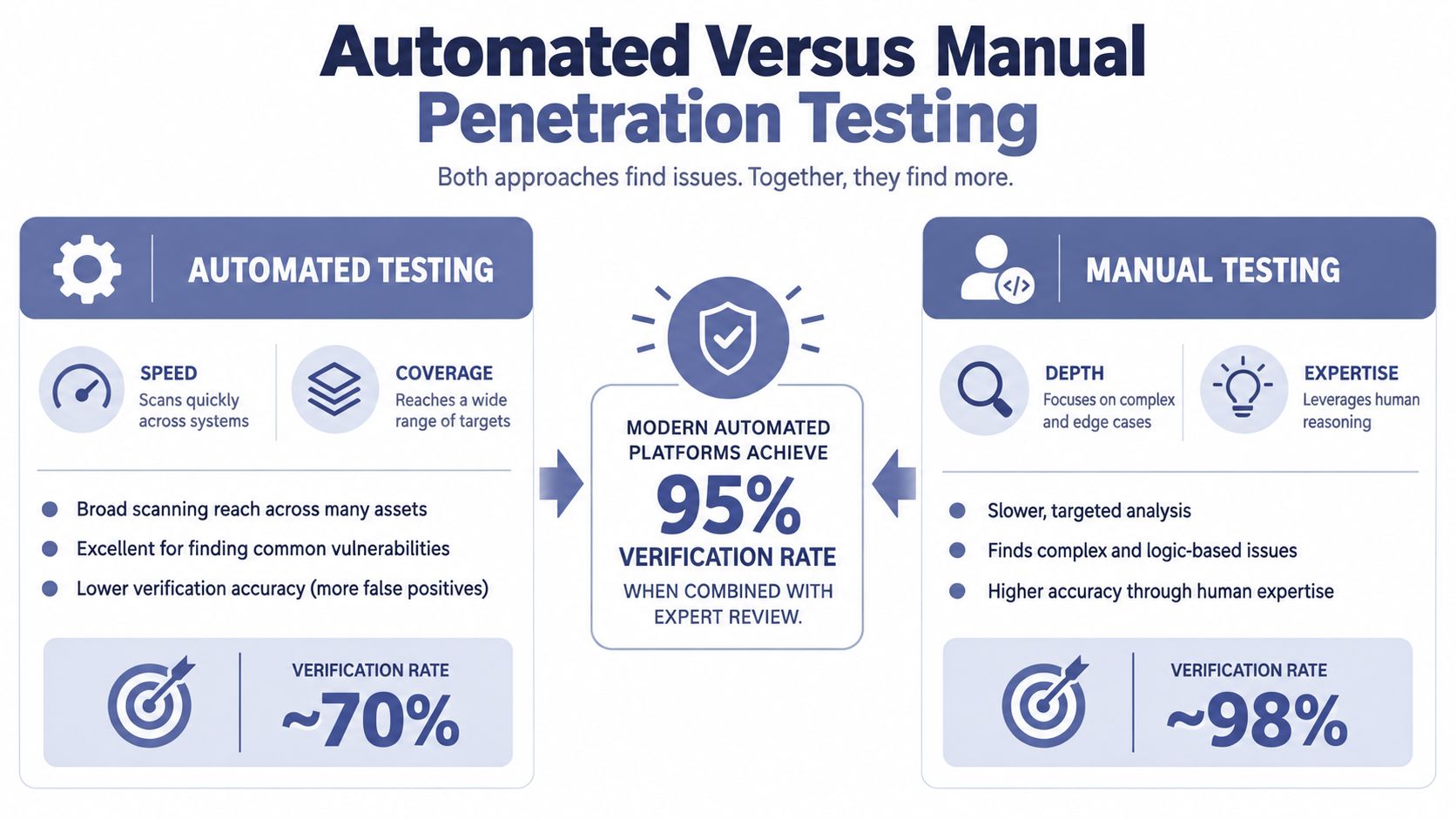
Automation and manual testing solve different problems. Automated testing is good at repeating known checks across broad scope, running consistently, and returning quickly when an environment changes. Manual testing is good at interpreting behavior, following a plausible attack path, and testing rules that aren't visible in a response signature.
ThreatExploit AI's documented platform capabilities report a 95% verification rate and 94% overall accuracy when automated testing is combined with expert review, as described in its automated and manual penetration testing comparison. Those figures should be treated as platform performance claims rather than universal benchmarks for every automated tool. The practical lesson is that verification, not scanning volume, determines whether automation produces trusted output.
Where automation earns its place
Automated workflows are effective for:
- Breadth: Rechecking many URLs, endpoints, services, and configurations without asking a tester to repeat the same actions.
- Consistency: Applying the same checks across customers or environments and preserving comparable evidence.
- Speed: Identifying likely weaknesses early, especially after a deployment or configuration change.
- Repeatability: Running a validation cycle after remediation and comparing the result with the original finding.
Agentic platforms can coordinate dozens of specialized tools, pass results between reconnaissance and exploitation stages, and collect screenshots or request data as the workflow progresses. That orchestration is more useful than merely placing many scanners behind one button because the system can use one observation to select the next test.
Where people remain essential
Automation struggles with business logic. It may recognize that an endpoint accepts a parameter, but not that changing the parameter transfers ownership, skips an approval step, or applies a discount incorrectly. It also needs context to distinguish a safe test response from a meaningful privilege boundary failure.
Manual testers contribute hypotheses, restraint, and interpretation. They decide whether an exploit is safe to demonstrate, determine which evidence proves impact, and identify attack chains that require multiple authenticated states. The effective operating model is hybrid: machines handle repetition and coverage, while people handle intent, context, and final judgment.
A scanner-generated finding isn't a finished vulnerability. It becomes useful only after someone or something verifies exploitability, explains the root cause, and gives the customer a clear retest path.
Compliance Mapping and Report Requirements
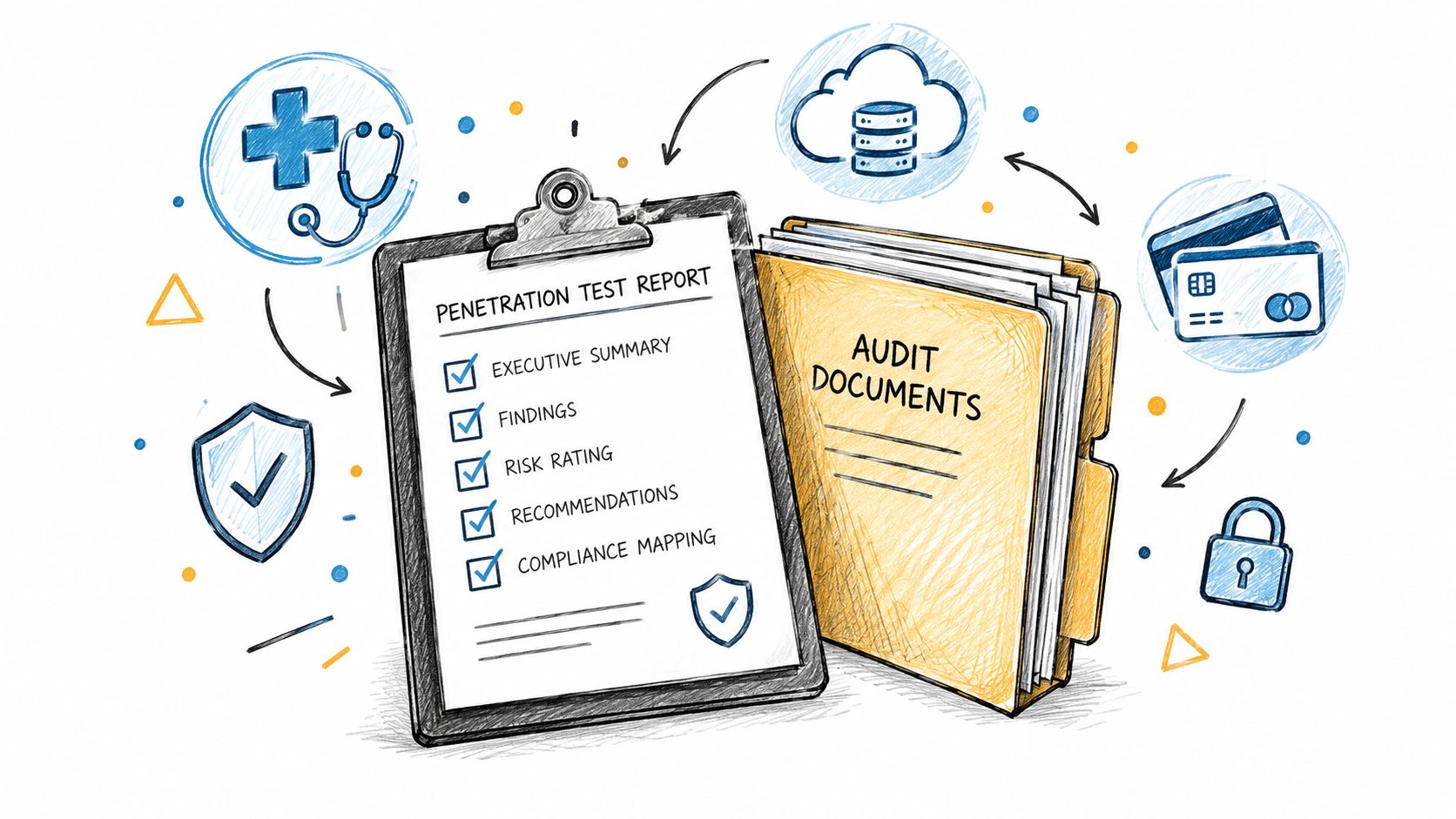
A penetration test report must serve engineers, auditors, and decision-makers without becoming three disconnected documents. Engineers need reproducible technical detail. Auditors need evidence that connects the assessment to control expectations. Executives need a clear view of business impact, ownership, and remediation status.
Frameworks such as HIPAA, SOC 2, PCI-DSS, CMMC, ISO 27001, GLBA, and GDPR may require security evidence, but framework names alone do not make a test sufficient. The report should define the scope, describe the methods used, identify validated weaknesses, and record the organization's response. See this guide to compliance documentation for security teams for a breakdown of how to map findings to each framework.
Evidence makes findings defensible
A finding needs proof that another tester can inspect and reproduce. Useful evidence includes:
- Screenshots: Show the relevant application state or access result while limiting exposure of customer data.
- Request and response captures: Preserve the interaction that demonstrated the control failure.
- Logs and command output: Record what the tester ran and what the target returned.
- Reproduction steps: Give engineers enough detail to confirm the issue and retest the fix.
- Root cause and remediation: Explain the failed control, its underlying cause, and the corrective action.
The OWASP reporting structure recommends business context, possible compliance and reputation implications, and artifacts such as curl commands, proof-of-concept examples, HAR files, or simple automation scripts. These artifacts let an auditor, developer, or customer security lead trace the conclusion back to observable evidence.
Map controls without losing technical detail
Control mapping should sit beside the technical report, not replace it. A PCI-DSS reference can help an assessor locate relevant evidence, while a developer still needs the affected endpoint, authorization condition, root cause, and repair guidance. The same weakness may carry different consequences based on the data involved, the system's role, and the business process it affects.
Remediation deserves equal attention. A report that identifies a high-priority issue but gives unclear ownership or no retest method leaves the most important work unfinished. Scanner output often stops at detection, with duplicate alerts, uncertain severity, and no proof that exploitation succeeded. Evidence-backed findings support triage, assign practical corrective work, and preserve the before-and-after record needed to verify closure. That turns compliance documentation into an operational record instead of a file assembled only before an audit.
The Coverage Gap in Security Pen Testing
Security leaders generally understand that pentesting matters. The harder problem is reaching enough of the environment often enough to catch meaningful change.
A recent survey found that 95% of organizations rank penetration testing as a top or high priority, yet they test only 32% of their attack surface on average, leaving 68% untested, according to Synack and Omdia research reported by PR Newswire. The gap isn't evidence that leaders don't care. It reflects expanding environments, limited senior tester capacity, and the practical constraints of point-in-time engagements.
Why annual testing misses changing exposure
A yearly assessment may be thorough for the assets selected, but the selection itself can become stale. New APIs appear, cloud permissions change, contractors receive access, and internal services move behind different trust boundaries. A report can be accurate when delivered and incomplete as the environment evolves.
A complementary research summary reports that organizations with larger security stacks face roughly 2,000 alerts per week, which helps explain why teams struggle to turn every signal into a testable hypothesis. The useful response isn't to run more unverified scans and add noise. It is to establish a repeatable validation process that revisits important exposure and preserves evidence across cycles.
Continuous validation doesn't mean launching uncontrolled exploitation against production. It means defining safe recurring checks, prioritizing exposed and high-value assets, and routing verified findings into ownership and retesting workflows. That approach broadens coverage without requiring every cycle to begin from zero.
Operational Guidance for MSSPs Adopting Automation
An MSSP should choose automation based on delivery control, not a tool count printed on a product page. The platform has to fit the provider's isolation model, reporting obligations, customer onboarding process, and tester review habits.
Start with the operating questions:
- How are environments isolated? Dedicated partner-scoped infrastructure can provide clearer separation and more predictable execution than shared multi-tenant resources. Confirm where data, credentials, evidence, and reports are stored.
- What does the toolchain cover? Look for support across web applications, REST and GraphQL APIs, internal and external networks, and cloud infrastructure. Confirm that the system can handle authenticated testing rather than only unauthenticated discovery.
- How are findings verified? Ask for the evidence workflow. The system should distinguish suspected issues from validated vulnerabilities and preserve artifacts for customer review.
- Can reports match the customer? An executive summary, technical detail, PDF delivery, JSON export, and control mapping serve different users. Flexible outputs reduce manual report rebuilding.
- Can partners manage multiple customers safely? Onboarding, scope configuration, role-based access, retesting, and multi-tenant reporting should be visible from a partner dashboard.
A sensible rollout starts with a controlled internal assessment, followed by one or two customer environments with clearly documented rules. Define what automation handles, where a human approves exploitation, how evidence is reviewed, and who communicates urgent findings. Use lightweight prospecting assessments only with explicit authorization, then position recurring testing as a service that validates changes rather than as a once-a-year checkbox.
ThreatExploit AI is one example of an automated penetration testing platform that coordinates reconnaissance, exploitation, verification, and reporting across web, network, and cloud environments, with partner dashboards and compliance-oriented outputs. The selection decision should still rest on evidence quality, isolation, workflow fit, and the provider's ability to review results.
Conclusion - The Future of Penetration Testing Operations
Security pen testing is becoming an operating function, not an occasional consulting exercise. As applications, APIs, identities, networks, and cloud services change, teams need validation that keeps pace. The hard question is not which finding ranks highest. It is whether testing reaches enough of the attack surface and whether someone fixes what it exposes.
PTES, OWASP, and NIST provide useful direction on scope, evidence, verification, and reporting, but future programs will be judged by what happens after the report.
Continuous validation will make coverage a standing measure rather than an annual snapshot. Agentic platforms can repeat reconnaissance, test approved paths, verify results, and gather evidence as environments change. Human testers still set boundaries, investigate business logic, assess attack chains, approve risky actions, and interpret impact. Automation expands reach without removing accountability.
Remediation-first workflows will matter just as much. A finding should create an owner, a fix plan, a retest of the original path, and a record of the outcome. Teams that connect testing to engineering queues and change management can show whether exposure falls, instead of merely counting reports. That discipline helps programs work within constrained budgets and limited specialist capacity.
ThreatExploit AI offers automated penetration testing across web, network, and cloud environments, combining reconnaissance, exploitation, verification, evidence collection, and compliance-mapped reporting. Visit ThreatExploit AI to evaluate whether recurring, evidence-backed testing fits your coverage and remediation process.