
Only 26% of breaches in the prior 12 months were detected by the SOC, according to Google's 2025 security validation material (Google security validation material). That number should unsettle anyone who's ever watched an organization spend heavily on EDR, SIEM, firewalls, and policy frameworks, then assume the stack works because it exists.
In penetration testing, that assumption is where trouble starts. A deployed control isn't proof. A policy isn't proof. Even a clean audit snapshot isn't proof. Security control validation is the work of producing operational evidence that a control blocks, detects, or alerts when a real technique hits the live environment. Done properly, it feels less like red-team theater and more like forensic reconstruction of the defender stack. What fired, what didn't, what got logged, what got dropped, and what vanished between integrations.
Table of Contents
- Why Breaches Keep Slipping Past the Controls You Already Bought
- What Security Control Validation Actually Means
- How We Got From Annual Audits to Continuous Assurance
- Comparing Manual, Automated, and Continuous Validation
- A Practical Validation Methodology and Evidence Framework
- Metrics and Reports That Survive an Auditor's Scrutiny
- The Pitfalls That Quietly Undermine Every Validation Program
- Building a Recurring Validation Practice for MSSPs and Consultancies
Why Breaches Keep Slipping Past the Controls You Already Bought
Only 26% of breaches in the prior year were detected by the SOC, as noted earlier from Google's 2025 security validation material. That is the number to keep in mind when a team says the stack is covered because the licenses are paid, the agents are deployed, and the dashboards are green.
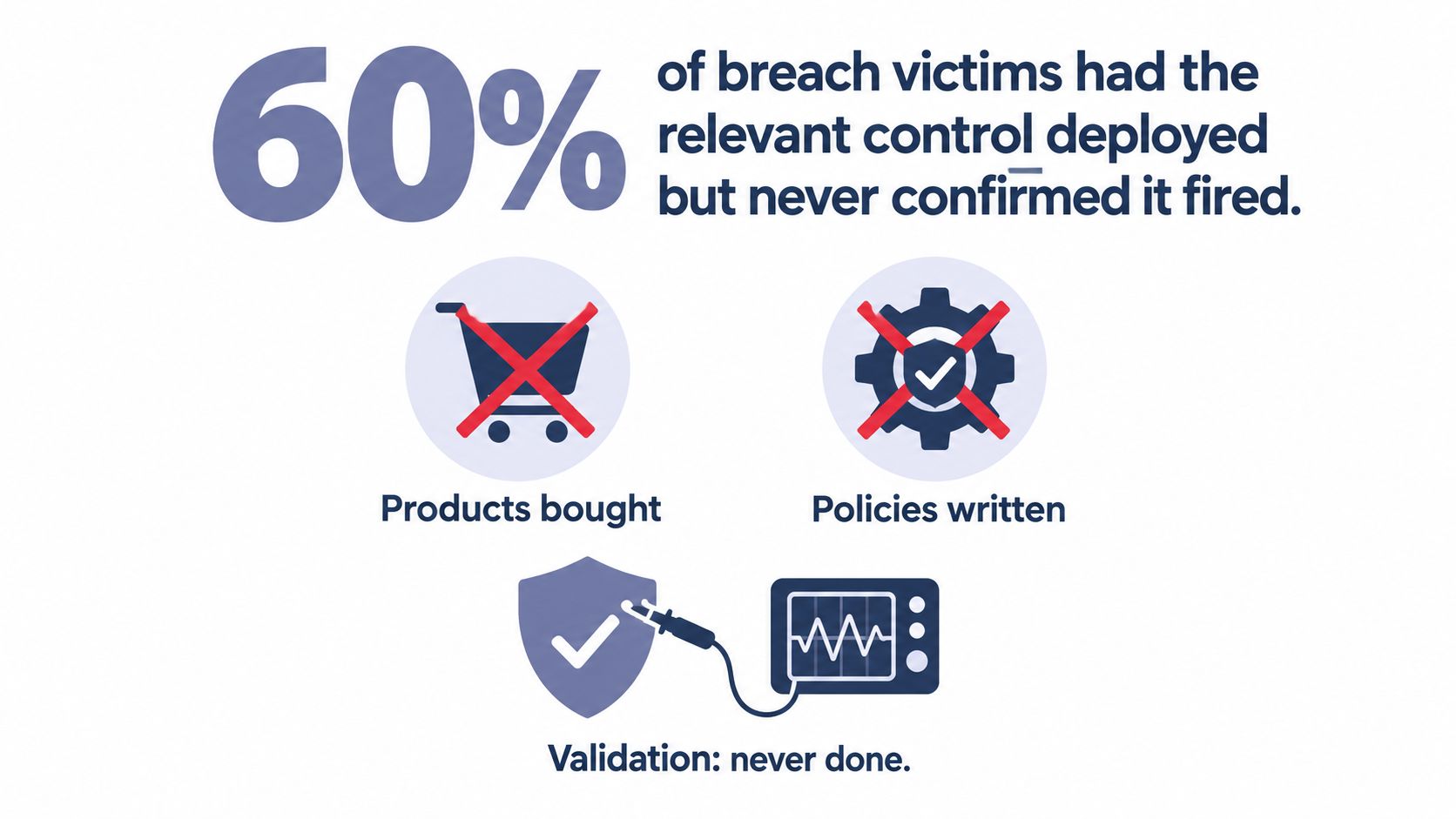
Breaches keep slipping through because procurement creates inventory, not proof. Security leaders often have evidence that a control exists, evidence that it was configured, and evidence that somebody signed off on it. What they usually do not have is a clean chain of forensic proof showing what happened across the defender stack when a relevant technique hit production. Did telemetry fire at the endpoint? Did the event survive normalization? Did correlation produce an alert? Did the alert reach the queue the SOC watches? That is a defender forensics problem more than a red-team problem.
The break usually happens in the handoffs.
A control can work at the host and still fail at the program level because the parser changed, a connector stalled, a suppression rule got too aggressive, or ownership split across teams that never retested after tuning. Audits miss this all the time because screenshots and policy statements do not capture failure between systems. Manual review misses it too. An analyst can confirm that a detection exists and still miss that the raw event never arrives with the fields the rule needs.
The evidence standard is simple and unforgiving. Show the triggering activity, the raw event, the transformed log, the alert, and the case or response record tied to the same test. If one link is missing, the control may still be useful, but it has not been validated in a way that survives scrutiny from an auditor, a client, or an incident review.
That is also why validation matters commercially for MSSPs and consultancies. If delivery depends on senior analysts manually proving control effectiveness every quarter, margins erode fast and reporting quality drifts by operator. If the workflow captures evidence consistently, maps it to techniques, and packages it inside the same pentest platform clients already use, recurring validation becomes easier to sell and cheaper to deliver. The service stops looking like red-team theatre and starts looking like operational assurance with defensible evidence.
Pentesters are still well suited to do this work. NIST SP 800-115 places validation inside the tradition of structured security testing, including discovery, scanning, and controlled attack activity to verify weaknesses and defensive behavior (NIST SP 800-115). The difference is what counts as a successful outcome. In classic offensive work, the prize is access. In control validation, the prize is proof of defender behavior, including where the stack goes blind.
What Security Control Validation Actually Means
Security control validation is a deliberate, repeatable exercise that tests whether a deployed control performs as intended against relevant attacker behavior. It is not the same thing as vulnerability discovery, and it isn't the same thing as a broad red-team campaign built around business objectives and stealth.
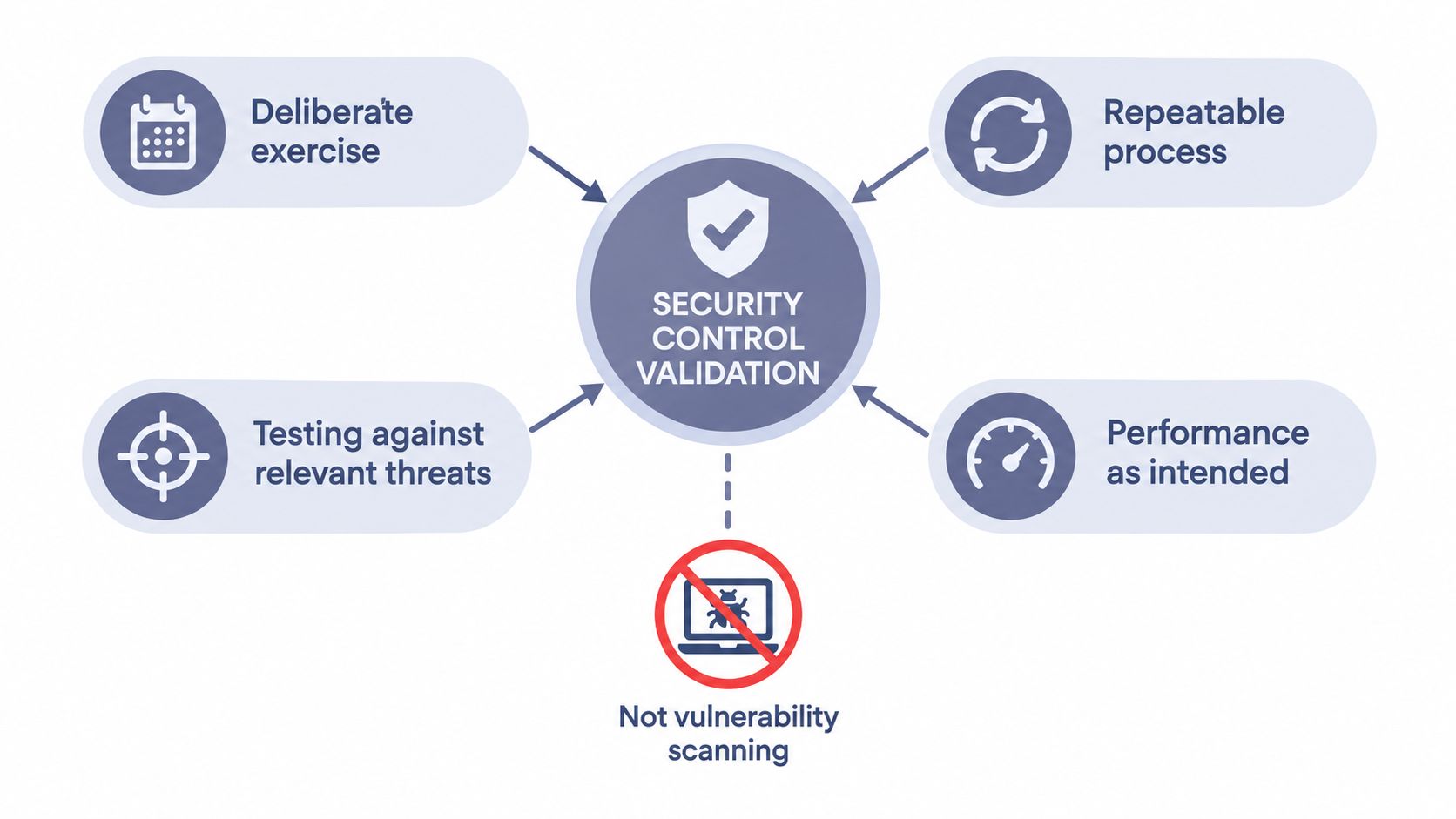
A simple analogy works. A fire alarm that passed installation checks but never beeps during an actual fire is worthless. Security controls behave the same way. Certification, configuration, and procurement don't matter much if the thing stays silent under conditions it was supposed to handle.
What it includes and what it does not
Vulnerability scanning tells you where a weakness may exist. A red team tells you whether a capable operator can achieve a broader objective under realistic constraints. Security control validation sits in the middle. It tests whether the stack responds correctly to selected techniques that matter to your environment.
That distinction matters for delivery. If you need background reading to standardize how your team documents those tests, it helps to browse PDF security guides that collect practical security documentation patterns without forcing everything into a scanner-first mindset.
The three outcomes that matter
For any test case, I care about three possible outcomes:
Block
The control prevented the technique from succeeding. That can show up as a denied connection, process prevention, policy enforcement, or application-layer rejection.Detect
The technique executed far enough to generate telemetry, and the stack recognized it. EDR timelines, SIEM rules, IDS signatures, and enriched events matter.Alert
Detection reached an actionable state. Someone or something got notified in a way that supports triage, escalation, or automated response.
There's a fourth real-world outcome too. Silent miss. That's the one nobody likes discussing because it exposes broken assumptions, brittle logging paths, and controls that exist only in architecture diagrams.
Validation should produce evidence for one of those outcomes every time. “Tool installed” is not an outcome.
Scope boundaries that keep the work honest
Good validation has narrow hypotheses. “Test whether PowerShell abuse is detected on these endpoints” is useful. “Assess our overall readiness against advanced threats” usually collapses into a vague pentest with messy reporting.
That's why the work benefits from penetration testing discipline. Hypothesis, execution, observation, evidence, verdict. When the scope is crisp, the findings become reusable across engineering, compliance, and managed service delivery.
How We Got From Annual Audits to Continuous Assurance
A yearly control check made sense when server fleets changed slowly and logging pipelines stayed put for months. That model breaks fast in environments where identity policy, cloud routing, agent health, and detection content can all drift between two change windows.
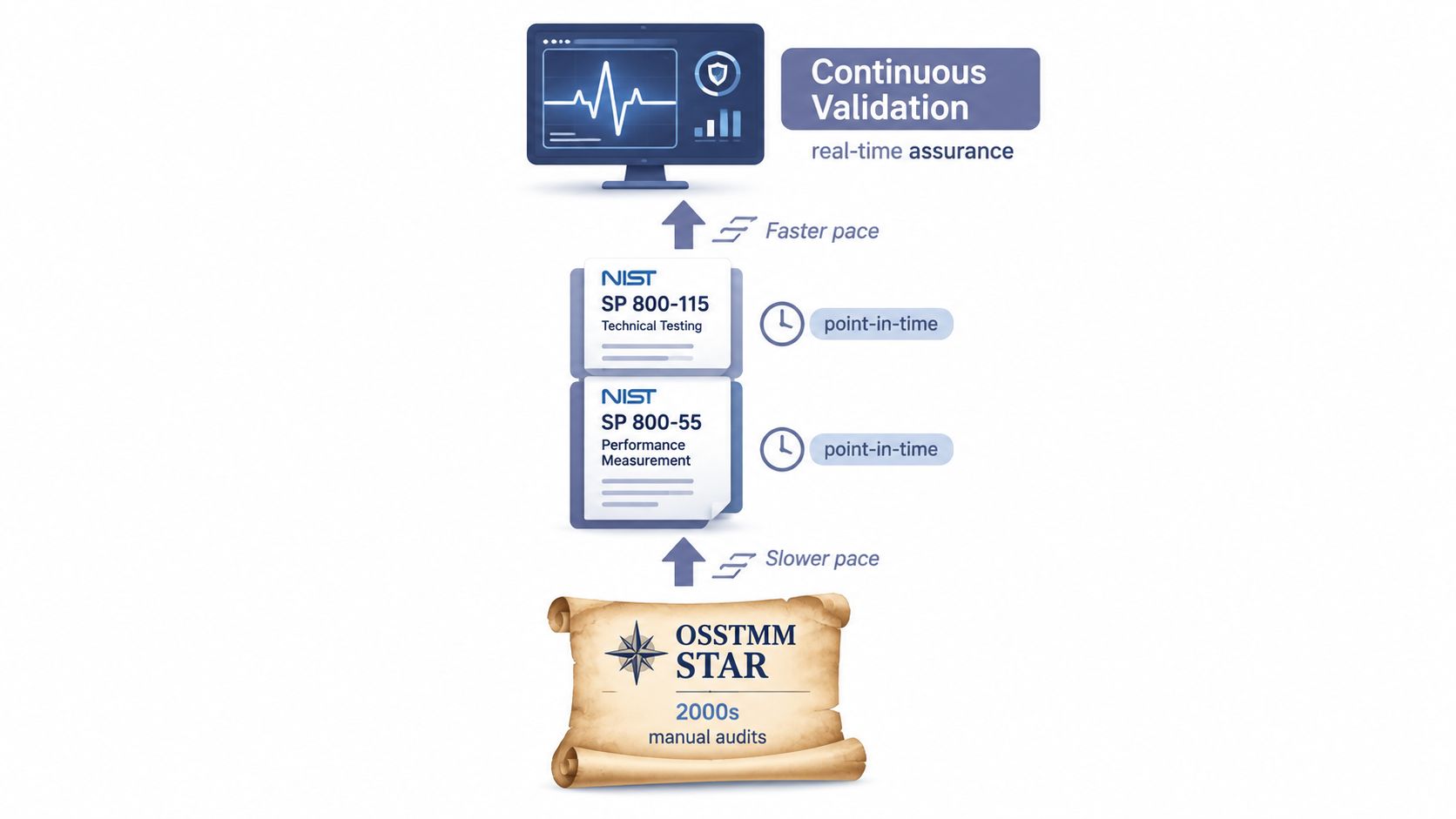
Older assurance models still got one thing right. Independent testing and repeatable measurement matter. The ISECOM STAR material and related measurement work cited in earlier research tied assurance to regular validation, consistent scoring, and third-party review, rather than a one-time control inventory (ISECOM and NIST metrics discussion). NIST SP 800-55 pushed the same idea from another angle. Measure whether controls were tested across the estate, not whether a policy said they should be.
The weakness was cadence, not intent.
Point-in-time assurance stopped being credible once defender stacks became fluid systems. A control can be present in the architecture diagram, partially deployed in production, logging to the wrong index, and suppressed by an exception that nobody revisited after an incident. Annual audits rarely catch that chain because they sample state. Validation has to examine what the stack recorded during a real test and what never made it into the record at all.
That shift matters operationally. Security control validation started to look less like a red-team event and more like a forensics problem on the defender stack. Did the endpoint produce telemetry. Did the SIEM ingest it. Did enrichment fire. Did the rule match. Did the alert reach a queue a human or workflow would see. The answer is only as good as the evidence trail.
Managed service economics pushed the field the rest of the way. MSSPs cannot keep assigning senior operators to rebuild the same proof set every time a client changes a parser, rotates an agent, or adds a new cloud account. They need repeatable tests, normalized artifacts, and evidence packages that can be reviewed across many tenants without redoing the reasoning from scratch. That is why recurring validation and platform-driven workflows gained ground, including continuous penetration testing workflows built around scheduled execution and evidence collection instead of annual project cycles.
Formal guidance moved in the same direction. FedRAMP's penetration testing guidance points back to NIST SP 800-115 and keeps the familiar testing lifecycle of planning, discovery, attack, and reporting, including validation of target vulnerabilities during execution (FedRAMP penetration testing guidance). The difference in practice is that mature teams now run that cycle often enough to catch drift before an auditor or an attacker does.
What changed in practice is simple. Evidence now has to behave like operational data. It needs timestamps, artifacts, environment context, expected outcome, observed outcome, and enough chain-of-custody to survive review by an auditor, a client, or an internal detection engineer. Once teams adopt that evidence model, continuous assurance stops being a reporting preference. It becomes the only workable way to prove that controls still function after the next round of change.
Comparing Manual, Automated, and Continuous Validation
Understanding where each approach fails is more important than locking in a single model forever.
Validation Model Comparison
| Dimension | Manual | Automated | Continuous |
|---|---|---|---|
| Evidence quality | Strongest for nuanced control review, raw artifact interpretation, and detection tuning | Often limited to configuration state, script output, or scanner snapshots | Strong when it records live outcomes across prevention, detection, and alerting |
| Coverage breadth | Narrow by design | Broad across many assets and control checks | Broad across selected attack techniques and control families |
| Cadence | Periodic | Scheduled | Recurring or near-continuous |
| Cost per control | High | Low | Moderate once the workflow is built |
| Skills required | Senior pentesters, detection engineers, platform owners | Security engineers and operators | Hybrid team with offensive, detection, and reporting discipline |
Where manual work still wins
Manual validation is still the gold standard when a control needs human judgment. I want a senior tester reviewing custom WAF behavior, odd IAM trust assumptions, brittle EDR suppressions, or weird application flows. That work catches design flaws and edge cases that canned replay jobs miss.
What it doesn't do well is scale. A team can manually validate a handful of critical controls per quarter and do it well. Try to stretch that model across a portfolio of clients and it either becomes shallow or painfully expensive.
Where automation helps and where it disappoints
Scheduled scripts, scanner outputs, and platform health checks are useful. They tell you whether a parser is alive, whether an integration endpoint is reachable, whether a policy object exists, and whether a known condition persists. For baseline hygiene, that's fine.
Auditors, however, often discount automation that only proves configuration state. A screenshot of “rule enabled” is weaker than evidence showing the tested behavior, resulting telemetry, generated alert, and handling trail. Configuration is context. It's rarely proof.
The quickest way to lose credibility in front of a client is to confuse a control snapshot with a control outcome.
Why continuous validation fits MSSP delivery
Continuous validation closes the loop. It replays real techniques against the live stack and records what happened. That gives MSSPs a service they can repeat, price, and compare across tenants without pretending each client needs a bespoke red team every month.
A typical mix looks like this:
- Manual for edge cases: control design review, high-risk attack paths, and tuning workshops.
- Automated for hygiene: parser checks, policy presence, scheduled sanity checks.
- Continuous for operational assurance: recurring technique replay with evidence capture.
In tooling terms, that can include BAS platforms, replay frameworks, custom harnesses, and automated pentesting systems. One option in the platform category is ThreatExploit AI, which supports recurring assessments and produces evidence-backed, compliance-mapped reporting for service providers. The point isn't the brand. The point is the workflow: repeated execution, normalized evidence, and client-ready outputs.
A Practical Validation Methodology and Evidence Framework
The cleanest validation programs use a four-part method: scope, simulate, capture, map. It sounds simple because it should be. The difficulty is in evidence discipline, not in naming the phases.
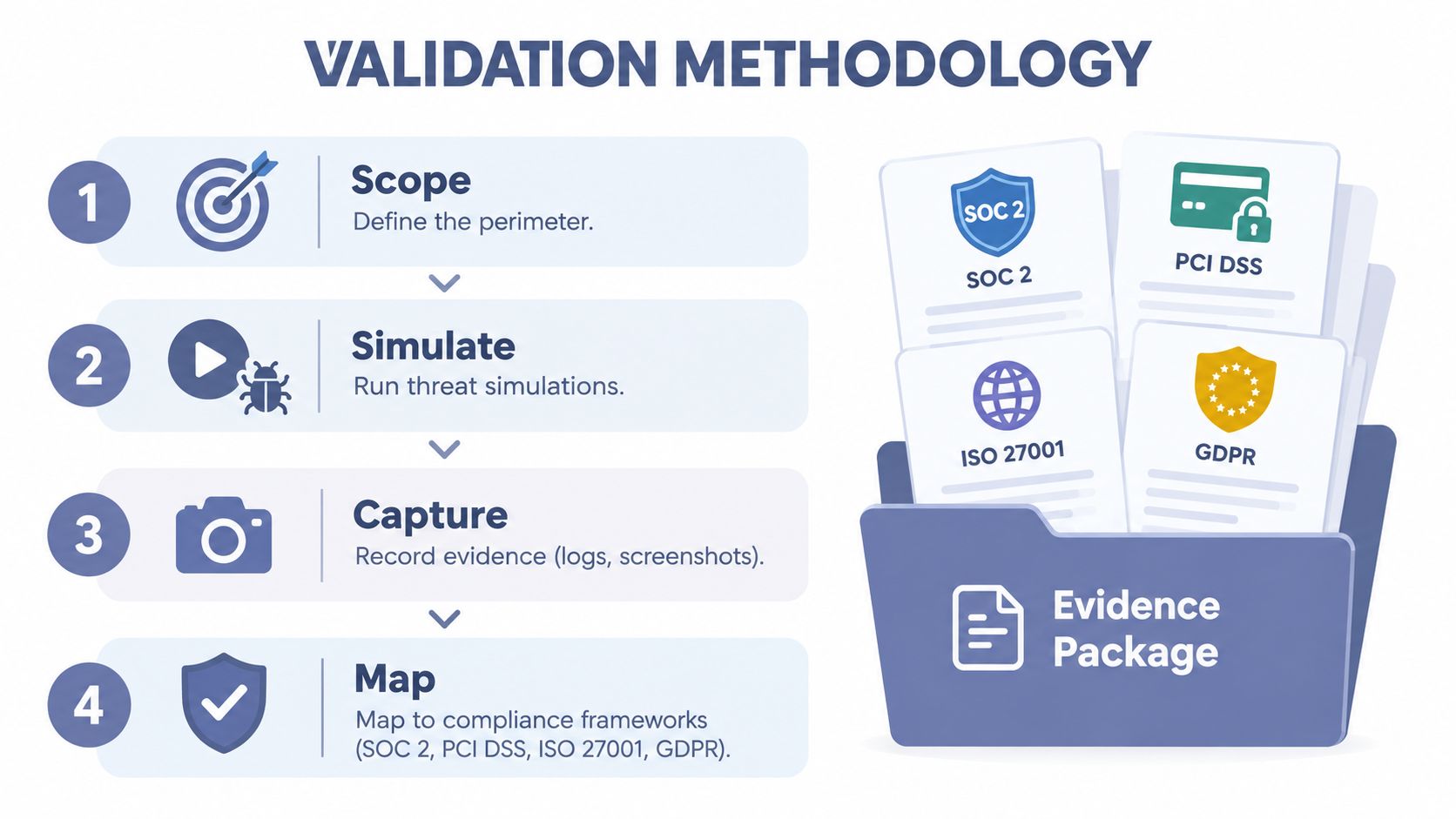
Scope with a written control hypothesis
Before anyone runs a test, write down four things:
- Control owner: who owns the firewall rule, EDR policy, SIEM content, or identity control
- Expected trigger: which technique or behavior should exercise the control
- Expected telemetry: what raw event, alert, or deny action should appear
- Verdict rule: what counts as pass, fail, or inconclusive
Many teams get sloppy. They say “validate phishing detection” when what they really need is “validate that this email security path produces a logged event, a correlated alert, and a triaged ticket under these conditions.”
If you need a governance lens for deciding which controls deserve that level of rigor, an information security risk management guide is useful as a companion to the offensive workflow because it helps tie test selection back to actual business risk.
Simulate in the live environment
Run the technique against production controls whenever it's safe to do so. Cloned environments lie. They lack the exact latency, logging path, parser behavior, suppression content, and operational weirdness that create most validation failures.
For recurring control checks, that live-environment discipline aligns well with adversarial exposure validation practices where the test is designed to answer whether the current stack behaves correctly today, not whether a lab behaved correctly last quarter.
Capture raw artifacts, not polished summaries
Defensible evidence packages include the messy parts.
- SIEM evidence: raw event records, parsed fields, rule hit details, and alert timestamps
- Endpoint evidence: EDR process tree, command lineage, block or detect action, host context
- Network evidence: firewall denies, IDS signatures, proxy logs, or application gateway records
- Workflow evidence: ticket creation, assignment, enrichment, and closure metadata
Audit test: If the only artifact is a screenshot in a slide deck, expect pushback.
Map each artifact to a framework control
Evidence becomes reusable. The strongest pattern I've seen is direct mapping based on observed outcomes, not inferred compliance. An OWASP ASVS mapping example from Edgescan shows which requirements currently fail and which have been remediated, while explicitly limiting output to controls for which positive or negative evidence exists (OWASP ASVS evidence mapping example).
That same discipline works for SOC 2, PCI DSS, ISO 27001, and GDPR. You're not claiming broad compliance from a tool run. You're attaching timestamped artifacts to specific control identifiers with one of three verdicts:
| Verdict | Meaning | What belongs in the package |
|---|---|---|
| Pass | The expected control action occurred | Raw artifacts plus mapped control ID |
| Fail | The technique bypassed or the expected signal never appeared | Attack trace, missing telemetry note, affected control ID |
| Inconclusive | The test ran but evidence quality was insufficient | Explanation of evidence gap and retest requirement |
That structure is repeatable across clients, and it keeps MSSP reporting from turning into handcrafted storytelling.
Metrics and Reports That Survive an Auditor's Scrutiny
Bad reporting wastes good validation work. I see it all the time. A team proves a control fired, the logs exist, the case record is there, and then the final report strips out the chain of evidence and replaces it with a green status box that no auditor can test.
That is the mistake. Security control validation is a forensics problem on the defender stack. The report has to show what happened, where it happened, what should have happened, and what evidence proves the difference. If that chain breaks at any point, the control result is hard to defend and expensive to rework later.
Different audiences still need different report cuts, but they should come from the same evidence model.
What belongs in each reporting layer
Leadership needs a short operational readout tied to risk and budget:
- Validated control coverage over time: how much of the agreed control set was tested within the reporting window
- High-impact failures: the small set of misses that expose important assets, business processes, or detection paths
- Retest closure rate: whether failed controls were revalidated after engineering changes
Auditors and assessors need enough detail to reproduce the conclusion:
- Test identifier and execution timestamp
- Technique or scenario tested
- Expected control action
- Observed outcome
- Control owner and framework mapping
- Raw artifact references
- Pass, fail, or inconclusive rationale
- Retest history and final disposition
Engineers need the messy details because that is where programs fail.
- parser failures
- enrichment errors
- field mapping drift
- timing mismatches between sensor and SIEM
- suppression logic collisions
- case-management failures after alert generation
That last layer matters more than many teams admit. A control can detect correctly and still fail the business if the alert never becomes a ticket, lands with the wrong queue, or arrives too late to matter.
Which metrics hold up under scrutiny
A few metrics survive both audit review and operational use.
Detection coverage is still the headline number, but define it narrowly. Measure the share of tested techniques or scenarios that produced the expected control outcome within a stated time window. Without the stated expectation and timing threshold, the percentage is just decoration.
Time-to-validate after change is one of the most useful program metrics. Parser updates, rule edits, IAM changes, agent upgrades, and policy tuning all create fresh uncertainty. The shorter the gap between change and successful revalidation, the lower the chance that silent breakage sits in production for weeks.
Weighted control pass rate is more honest than a flat average. A missed control on a crown-jewel detection path should count more than a low-value housekeeping control. Otherwise the dashboard stays green while the expensive failures hide in the denominator.
Evidence completeness rate is worth tracking if you run validation as a service or across multiple client environments. Count how many tests finished with enough artifacts to support a third-party review on first pass. This metric exposes where manual review, poor data retention, or weak workflow discipline are driving delivery cost.
That economics piece matters for MSSPs and consultancies. If every report needs senior analysts to reconstruct telemetry by hand, margins disappear fast. Stable report packs, consistent evidence references, and structured compliance documentation workflows reduce that drag and make recurring validation easier to deliver at scale.
Teams that package evidence for formal trust reviews run into the same constraint. The issue is rarely producing more screenshots. The issue is producing a report set with clear lineage from test activity to control claim. If you are refining that workflow, guidance on selecting SOC 2 compliance software can help frame what matters once validation output leaves the security team and enters an auditor's review queue.
A metric baseline auditors already understand
Older assurance programs often tracked whether controls were tested within a defined period, as noted earlier in the article. That baseline is still useful because auditors understand it quickly.
It is not enough on its own.
“Tested this year” says nothing about whether the control generated the right signal, whether the telemetry survived the pipeline, or whether the response workflow executed cleanly. A modern report should show all three. Control exercised. Evidence captured. Outcome verified.
If the report cannot answer those points without a side conversation, expect the auditor to keep digging.
The Pitfalls That Quietly Undermine Every Validation Program
A green dashboard can hide a broken program. I've seen teams celebrate passing controls while the underlying evidence trail was too weak to survive five minutes of skeptical review.
Stale assurance
Independent coverage shows only 25% of security leaders test control performance at least weekly, while 5% do so only once a year (Panaseer coverage on stale assurance). That's the classic stale-assurance problem. A control worked once, then everyone assumed it kept working.
The fix is operational, not philosophical. Schedule recurring replay jobs for the controls that matter, and trigger ad hoc retests after meaningful changes.
Silent SIEM breakage
This one is common and embarrassing. Log sources still “exist,” but fields changed, connectors broke, or the rule logic drifted. Hyperproof's 2025 benchmark notes that log collection issues caused 50% of detection rule failures, with misconfigurations and performance bottlenecks adding more failures (Hyperproof benchmark findings).
A mature validation program checks the telemetry path itself, not just the end alert. If the event never entered the pipeline correctly, the control didn't work, even if the rule looked perfect on paper.
Broken collection turns good detections into imaginary detections.
Scope creep
A validation contract dies when a scoped exercise to validate a control family slowly mutates into a free-form pentest with new attack paths, expanding asset lists, and no stable reporting baseline.
MSSPs need fixed-scope validation units. Define the control set, the techniques, the expected evidence, and the reporting format upfront. If a client wants exploratory work, carve it out as a separate penetration testing engagement.
Evidence theater
The quiet killer is evidence that looks professional and proves almost nothing. A screenshot of a Jira ticket closed by the same engineer who wrote the rule is weak evidence. So is a screenshot of a dashboard tile with no test context, no artifacts, and no mapped control ID.
The stronger alternative is an evidence manifest. Bind each test execution to a timestamp, artifact list, verdict, and control reference. That gives auditors, clients, and your own operators a shared chain of custody.
Building a Recurring Validation Practice for MSSPs and Consultancies
The MSSP version of this problem is straightforward. You have many clients, different stacks, limited senior operator time, and recurring contractual expectations. You need a service that is repeatable enough to scale and technical enough to stay credible.
A workable delivery model
Start with a mid-market SOC serving many tenants. Each client gets a defined control map and a recurring cadence. High-risk controls get regular micro-bursts. Broader coverage runs on a slower cycle. Manual review is reserved for failures, tuning, and edge cases.
The platform layer matters here because the service lives or dies on workflow.
- Tenant onboarding: map each client's assets, control owners, and logging destinations
- Execution scheduling: assign recurring validation jobs to the right environment and technique set
- Result normalization: present outcomes in a common schema so operators aren't re-learning every client
- Remediation sync: push failed validations into the client's ticketing process with enough context to act
Integration points that actually matter
Plenty of integrations look nice in demos and add little in production. Three are worth caring about.
First, SCIM or equivalent user and tenant lifecycle support. If onboarding is manual, multi-client delivery gets messy fast.
Second, webhook delivery of validation events. Failed tests should move immediately into the places analysts already work, not sit in a separate portal waiting to be discovered.
Third, bidirectional ticket sync. When a control fails, open a remediation ticket. When the client claims the fix is done, rerun the validation and update the status with evidence.
A checklist you can adapt
- Scoping template: client systems, control owners, allowed techniques, execution windows
- Evidence manifest schema: timestamps, artifacts, control IDs, verdicts, retest references
- Client-facing report format: executive summary, failed controls, artifact appendix, remediation queue
- Retention policy: how long raw evidence, summaries, and ticket links remain available
- Upstream MSSP metrics: validated controls completed, failed controls awaiting remediation, retest backlog, recurring execution health
CIS Control 18 gives this cadence a practical anchor by requiring periodic external penetration tests at a minimum of no less than annually, then requiring organizations to validate security measures after each test and modify rulesets or capabilities if needed (CIS Control 18 guidance). That loop is still the right one for managed services. Test, validate, tune, repeat.
The firms that do this well stop selling single reports and start delivering a measurable assurance service.
ThreatExploit AI gives service providers a way to run automated penetration testing as a recurring validation workflow, with evidence-backed reporting and control mapping that fits client delivery. If you're building a program that needs repeatable testing across web, network, and cloud environments without turning every validation cycle into a custom engagement, visit ThreatExploit AI.