

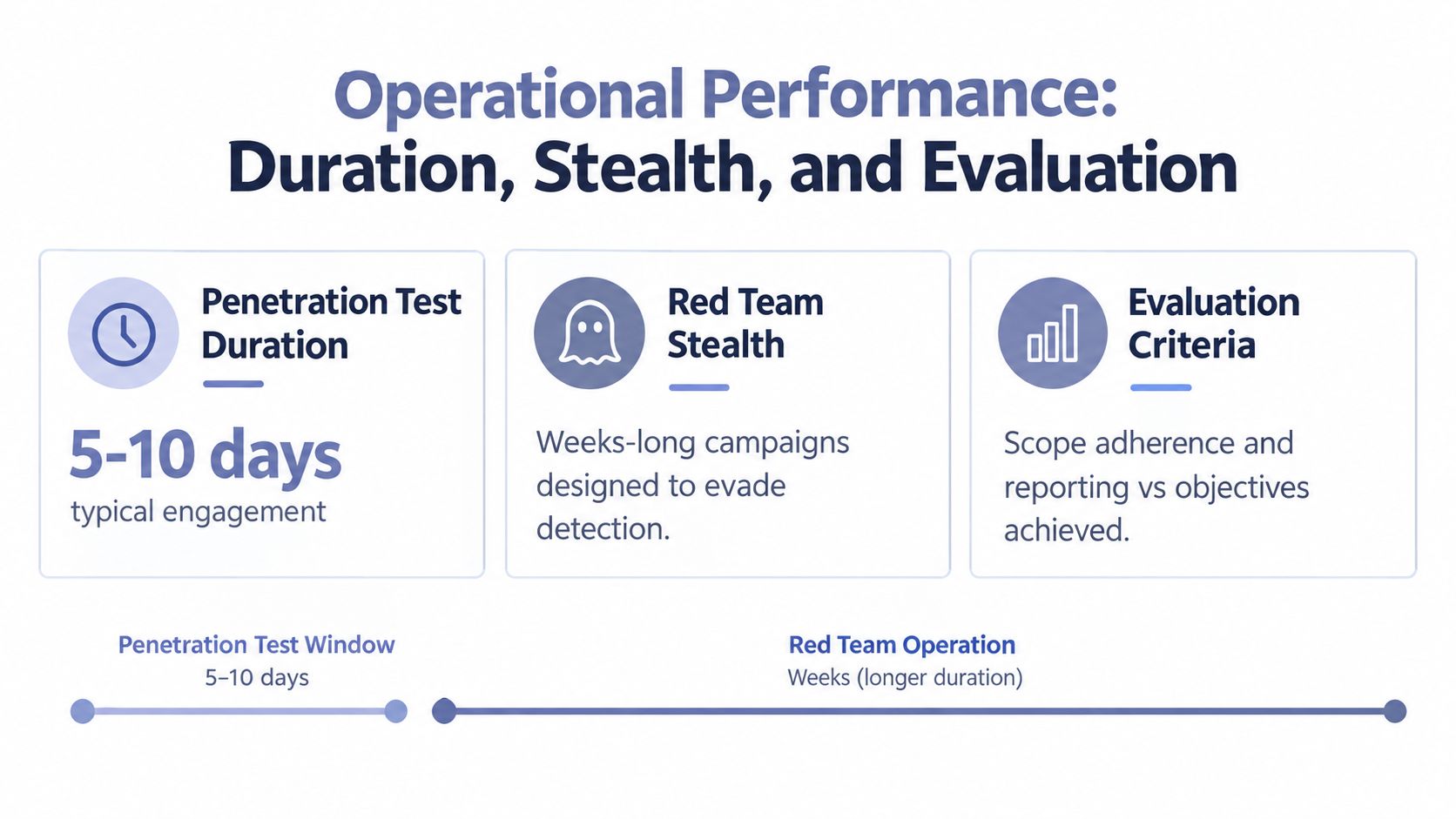
A penetration test typically runs for 5–10 days, while a red-team engagement commonly spans 4–12 weeks. Red teaming tests whether defenders can detect and respond to a realistic adversary, while penetration testing validates whether specific systems can be exploited within a defined scope, and neither replaces the other.
That difference creates a counterintuitive buying problem. A longer, stealthier red-team operation isn't automatically a better security assessment, and a broad penetration test may produce more actionable technical coverage for an organization that hasn't yet validated its exposed systems. The right choice depends on the question the engagement must answer, the controls the organization can safely test, and the evidence its stakeholders need.
Most comparisons stop at “pentesting finds vulnerabilities” and “red teaming tests detection.” Enterprise buyers need a more operational distinction. They need to know how each exercise is authorized, where its boundaries sit, how failure is contained, and which metrics demonstrate value. The strongest programs use both methods in a deliberate sequence rather than treating them as competing products.
Table of Contents
- Understanding the Core Distinction Between Red Teaming and Penetration Testing
- How Measurement Models Differ Between the Two Approaches
- Operational Performance, Duration, Stealth, and Evaluation Criteria
- Why Rules of Engagement Determine Whether an Exercise Succeeds or Backfires
- Building a Complementary Security Assessment Model
- Choosing the Right Assessment for Your Organization or Client
Understanding the Core Distinction Between Red Teaming and Penetration Testing
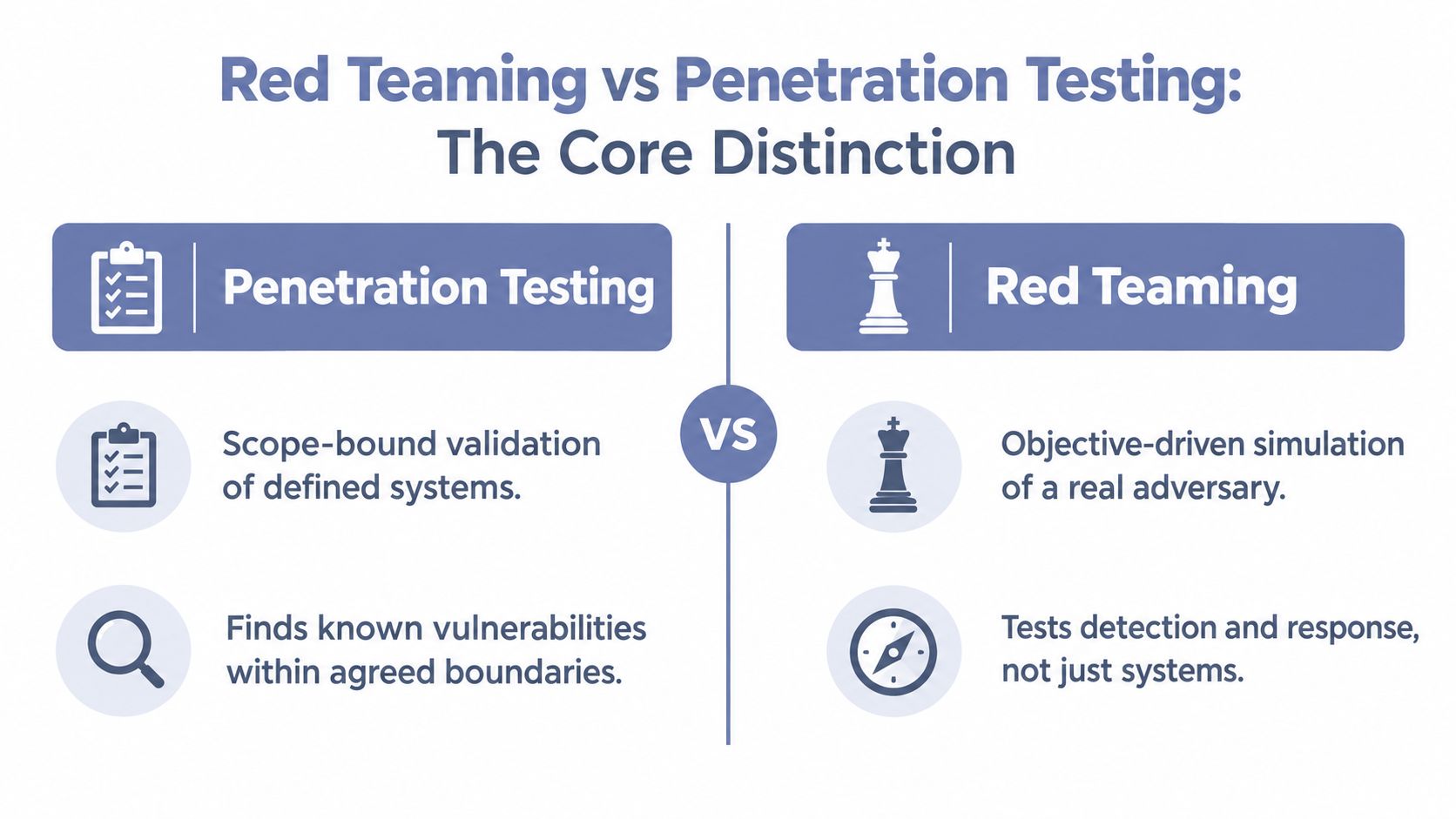
NIST draws the foundational boundary clearly. A penetration test is a controlled, scope-bound validation exercise, while a red team conducts an objective-driven simulation of an adversary against an organization's broader mission and defensive capability. That distinction changes everything from the authorization document to the final report. NIST Special Publication 800-115 organizes penetration testing into planning, discovery, attack, and reporting, with rules of engagement defining authorized targets, permitted techniques, prohibited actions, communications, and evidence handling.
A buyer should therefore begin with an operational question, not a vendor label: what is the organization willing to test, and what must the exercise prove? If the requirement is to validate a web application, API, network segment, host, or cloud environment, a penetration test offers a controlled way to identify and verify exploitable weaknesses. If the requirement is to determine whether a realistic attacker can reach sensitive data while the SOC detects, investigates, contains, and responds, a red-team exercise addresses a different problem.
Scope defines the evidence
Penetration testing works best when the organization can name the assets under assessment and define the actions testers may take. The engagement can then produce evidence tied to particular systems, including exploit confirmation, impact analysis, screenshots, severity, and remediation guidance. The penetration testing fundamentals resource provides useful context for why defined scope makes findings easier to validate and remediate.
NIST describes red teaming differently. The team pursues a mission or business objective under conditions designed to resemble real-world attack activity. That mission might involve reaching sensitive data, obtaining privileged access, or compromising a critical business process. The team may combine exploitation with social engineering, physical access, persistence, lateral movement, or other techniques, provided those actions are authorized and safely controlled.
The distinction is not merely “automated versus manual.” A technically complex penetration test can use extensive human judgment, while a red team can use automation during reconnaissance or execution. The deciding factor is the measurement objective. Penetration testing asks whether defined systems can be exploited. Red teaming asks whether an adversary can achieve a defined outcome and whether defenders can interrupt that path.
| Decision factor | Penetration testing | Red teaming |
|---|---|---|
| Primary question | Can defined systems be exploited? | Can an adversary reach a mission objective? |
| Scope | Explicitly bounded assets and techniques | Organization-wide or mission-relevant scope within agreed rules |
| Operating style | Coverage-oriented and comparatively visible | Stealth-oriented and adversary-like |
| Main evidence | Confirmed vulnerabilities, exploit proof, impact, remediation status | Attack path, objective result, defensive telemetry, detection and response performance |
| Typical techniques | Automated discovery, manual validation, controlled exploitation | Technical exploitation plus potential social, physical, stealth, and persistence activities |
| Best fit | Recurring assurance and technical weakness validation | Integrated resilience and defensive operations testing |
Neither method provides a complete security verdict on its own. A clean penetration test doesn't prove that the SOC would detect a patient attacker. A failed red-team mission doesn't prove that the environment contains no exploitable weaknesses. Each result is meaningful only when interpreted against the question, scope, and rules established before testing begins.
How Measurement Models Differ Between the Two Approaches
The most important difference in red teaming vs penetration testing is often hidden in the report template. Penetration testing measures exploitable exposure and remediation evidence. Red teaming measures mission success and defensive performance. If a provider reports both through a single accuracy score or a single vulnerability count, it has removed the distinction that makes the engagements useful.
A penetration test should make it possible to answer practical questions about the assessed attack surface. Which assets were tested? Which vulnerabilities were confirmed? Could the tester exploit them under the agreed conditions? What impact did the exploit demonstrate? Has the customer remediated and retested the issue? The adversarial exposure validation resource frames this kind of evidence as a validation problem rather than a simple inventory exercise.
What a penetration test can prove
A scoped test can provide broad technical coverage across an application, API, network segment, or cloud environment. Its outputs typically include:
- Asset coverage: Which in-scope systems, endpoints, interfaces, and services were assessed.
- Verified findings: Which suspected weaknesses were confirmed through controlled exploitation.
- Severity and impact: What an attacker could access, modify, execute, or escalate after exploitation.
- Evidence quality: Screenshots, request and response evidence, reproduction details, and attack-path context.
- Remediation status: Whether the customer has corrected the issue and whether a retest supports closure.
These measures support vulnerability management because they connect a technical weakness to a specific action. They also support compliance reporting when the customer needs evidence that defined systems were tested and material findings were addressed.
Red-team reporting uses a different chain of proof. The central question is whether the operators achieved the objective, not whether they enumerated every weakness along the way. A report may therefore emphasize the attack path, the ATT&CK techniques attempted, the telemetry generated, how long activity remained undetected, and how the SOC investigated and contained the operation.
MITRE illustrates the defensive model
MITRE's ATT&CK Evaluations demonstrate how adversary-oriented testing differs from a vulnerability checklist. Published evaluation cycles extend back to 2018, and MITRE reports eight years of evaluations involving 14 adversaries in its program overview MITRE ATT&CK Evaluations. The exercises use real adversary tradecraft from the ATT&CK knowledge base and involve cyber-threat intelligence, red development, detection engineering, and execution teams.
The resulting evidence is recorded by technique. That allows defenders to ask whether a control generated useful telemetry at a relevant point in the attack lifecycle, whether analysts recognized the activity, and whether response actions interrupted the operation. A red-team result can therefore be expressed through objective achievement, dwell time, detection quality, and containment performance rather than through the number of vulnerabilities discovered.
Measurement rule: Never collapse confirmed vulnerabilities, achieved objectives, ATT&CK techniques, time to detection, and time to containment into one blended score.
For MSSPs and consultancies, the distinction supports a tiered service model. Automated or recurring penetration testing can deliver broad, repeatable technical validation. Targeted red-team engagements can then test adversary emulation and operational defense where the customer needs evidence about people, processes, telemetry, and response. The provider should sell the outcomes separately because the customer is buying different kinds of assurance.
Operational Performance, Duration, Stealth, and Evaluation Criteria
The two engagement types also consume operational capacity differently. A representative comparison places a conventional penetration test at roughly 5–10 days and a red-team engagement at approximately 4–12 weeks Precursor Security's comparison of red-team operations. These are planning benchmarks, not universal service-level standards. Scope, access, objectives, approval delays, customer complexity, and safety controls can change the schedule.
The practical difference is not just calendar time. Penetration testing is comparatively noisy because the testers prioritize discovery, validation, and coverage across defined assets. Red teaming is generally stealthier, may be concealed from the SOC, and focuses effort on a specific operational goal. A provider that compares them by tests completed per hour is using the wrong denominator.
Capacity planning should follow the engagement purpose
For penetration testing, a useful dashboard emphasizes repeatability and evidence production:
- In-scope asset coverage shows how much of the agreed attack surface the provider assessed.
- Unique exploitable findings separates confirmed weaknesses from duplicate observations.
- Verified-finding rate indicates how many reported issues were supported by exploitation evidence.
- Time to evidence measures how quickly the tester can produce defensible proof.
- Retest closure rate tracks whether remediation changes address previously confirmed weaknesses.
- Report turnaround shows how quickly technical and executive stakeholders receive usable findings.
These measures help an MSSP schedule recurring assessments and identify delivery bottlenecks. They also expose a common weakness in automated testing programs: a large volume of scanner output doesn't equal useful coverage unless the provider verifies exploitability and supplies evidence that customers can act on.
Red-team dashboards need a different design. Useful indicators include objective-achievement rate, dwell time, ATT&CK technique coverage, the percentage of actions detected, mean time to detect, mean time to respond, and containment success. CREST distinguishes red teaming from typical penetration testing on precisely this basis. Red-team success concerns the organization's ability to prevent, detect, and respond, not its ability to identify every vulnerability CREST's cyber buyer's guide.
Tooling must match the control being tested
Automation adds clear value where the workflow is repeatable. Reconnaissance, scanning, exploitation checks, evidence collection, retesting, and report assembly can be orchestrated consistently across defined targets. It doesn't remove the need for human judgment when the exercise depends on mission design, deconfliction, stealth, safety decisions, or interpretation of defensive behavior.
That is why an MSSP should avoid promising that one platform can turn every customer assessment into a red team. A short-cycle penetration test and a weeks-long adversary campaign have different staffing, communications, escalation, and reporting requirements. The provider's operating model should make that boundary visible to the customer before a statement of work is signed.
Why Rules of Engagement Determine Whether an Exercise Succeeds or Backfires
“More realistic” isn't automatically better. A red-team exercise can create less useful assurance than a controlled assessment if the team disrupts production, mishandles sensitive information, or performs an unauthorized action that the client can't interpret safely. The quality of the engagement depends on the decisions made before the first payload, email, physical visit, or persistence action.
PTES places pre-engagement interactions before intelligence gathering and exploitation. The framework requires the parties to define scope, objectives, time and budget constraints, third-party authorization, communications, escalation paths, meeting cadence, and rules of engagement the Penetration Testing Execution Standard. Those requirements apply with even greater force when an exercise can affect employees, facilities, cloud accounts, or production systems.

Authorization must describe actions, not just assets
A list of domains and network ranges isn't enough for a red-team operation. The authorization should address:
- Technical boundaries: Authorized networks, cloud accounts, applications, domains, identity systems, and data stores.
- Human boundaries: Employee groups that may receive phishing or social-engineering attempts, along with prohibited targets.
- Physical boundaries: Sites, facilities, wireless environments, badges, reception areas, and security personnel interactions.
- Action constraints: Prohibited exploitation, destructive testing, denial-of-service activity, persistence mechanisms, credential use, or data access.
- Escalation paths: Named contacts and procedures for suspected production impact, accidental access, legal concerns, or safety issues.
- Evidence handling: Storage, encryption, access, retention, and deletion procedures for credentials, personal data, customer records, and sensitive business information.
- Stop conditions: Events that require immediate suspension, such as service degradation, safety risk, uncontrolled propagation, or exposure of protected information.
Red teams may use phishing, social engineering, physical intrusion, wireless attacks, persistence, and multi-stage attack chains. Those activities can create legal, privacy, safety, and business-continuity risks if the client treats them like ordinary vulnerability testing. Executive authorization and third-party approvals matter because a provider may otherwise lack the legal right to test a hosted service, a shared facility, or an employee population.
The notification model must also be explicit. The SOC might be fully informed, partially informed, or intentionally kept unaware. Each choice changes the evidence. A notified SOC exercise can support collaborative detection engineering. A concealed operation can test operational detection and escalation, but it requires stronger deconfliction and stop procedures so the customer's incident response team doesn't mistake the exercise for a live breach.
Practical rule: The less the defenders know, the more precisely the sponsor must define safety controls, emergency contacts, evidence handling, and stop conditions.
The video below provides additional context for evaluating how engagement boundaries shape offensive security operations.
For MSSPs, this governance boundary creates a sensible service distinction. Automated or recurring penetration tests can validate exposed weaknesses under repeatable controls. Human-led red-team exercises should be offered to organizations that can govern adversarial operations, protect affected people and systems, and interpret detection and response evidence without confusing operational drama for security value.
Building a Complementary Security Assessment Model
The strongest program doesn't ask whether red teaming is better than penetration testing. It asks which control loop is currently missing.
A penetration test can show that an API permits unauthorized access, that a network service exposes a verified weakness, or that a cloud configuration enables an attack path. A red team can show whether an operator can chain available access toward a high-value objective while avoiding detection. The first produces technical remediation evidence. The second tests whether the organization can recognize and interrupt a realistic operation.
Start with breadth before adversarial depth
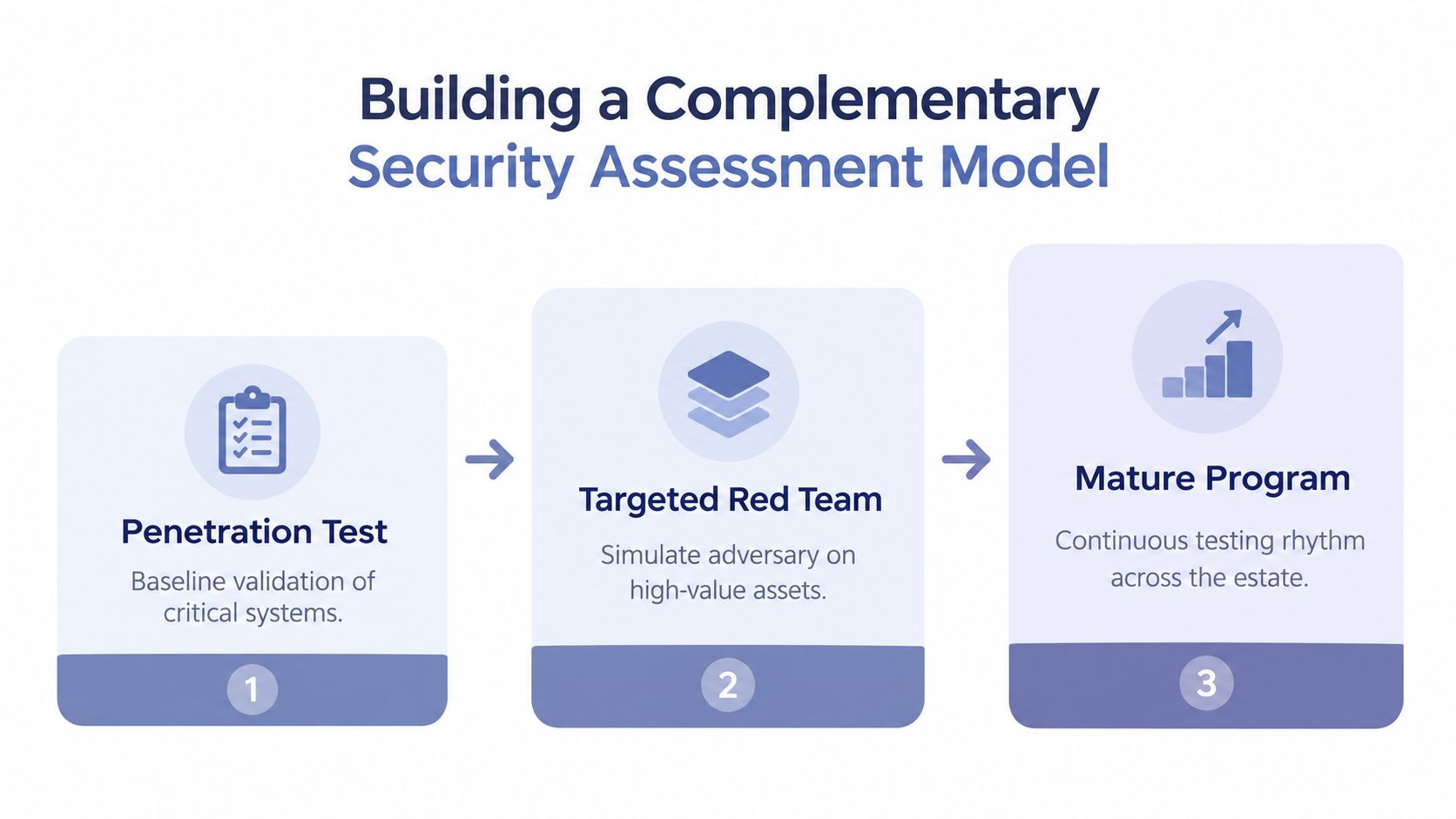
A customer with unvalidated web applications, APIs, networks, or cloud environments usually needs coverage-oriented penetration testing first. The provider can define the attack surface, verify exploitable weaknesses, collect evidence, and support remediation. That work establishes whether the organization has addressed basic exposure before it asks a red team to test the performance of its defenses.
A red team may intentionally bypass many vulnerabilities because they don't contribute to its mission. If the objective is to reach a particular identity or data store, the operators may choose one viable route and ignore other weaknesses. A successful mission therefore doesn't demonstrate that the organization found or remediated most exploitable flaws.
The reverse limitation matters just as much. A conventional pentest can generate a strong vulnerability inventory without showing whether the SOC detects lateral movement, privilege escalation, or data access. The customer can fix every reported issue and still lack evidence that analysts can identify and contain a patient attacker using a different path.
Use separate scorecards
A combined program should maintain two scorecards rather than one blended maturity number.
| Assessment stream | Primary measures | Management question |
|---|---|---|
| Penetration testing | Asset coverage, verified exploitability, evidence quality, remediation and retest status | Which technical weaknesses remain exploitable? |
| Red teaming | Mission completion, ATT&CK techniques, telemetry, time to detection, containment, response actions | Can defenders prevent, detect, investigate, and contain an adversary? |
This separation also improves prioritization. A confirmed vulnerability belongs in a remediation workflow. A missed detection belongs in a detection-engineering or incident-response workflow. The organization can connect both to the same business asset without pretending they represent the same type of failure.
MITRE's terminology adds another useful distinction. Adversary emulation uses cyber-threat intelligence about a specific adversary and its known operating methods to test whether controls detect or mitigate relevant behavior. Red teaming applies an adversarial mindset to achieve an operational objective without relying on a known threat profile MITRE's design and philosophy paper. MITRE's adversary-emulation plans make the threat-informed option repeatable by mapping public threat reports and observed behavior to ATT&CK techniques.
For a service provider, the resulting model is practical. Use autonomous testing to scale repeatable discovery, exploitation validation, evidence collection, and retesting. Reserve objective-based red-team judgment for carefully designed missions that require deconfliction, stealth decisions, and interpretation of blue-team performance. Organizations that also handle regulated personal data can pair this operational model with a resource such as the GDPR compliance testing playbook when defining evidence, privacy, and governance requirements.
Choosing the Right Assessment for Your Organization or Client
The decision should follow the risk question, not the prestige of the engagement type.
Choose penetration testing when the customer needs broad validation across web applications, REST or GraphQL APIs, internal or external networks, or cloud infrastructure. It is also the more practical starting point when the organization needs recurring evidence for frameworks such as PCI-DSS, SOC 2, ISO 27001, HIPAA, CMMC, GLBA, or GDPR. The engagement should produce a defined scope, confirmed vulnerabilities, exploitation evidence, impact analysis, remediation guidance, and retest status.
Choose red teaming when the organization has a specific operational objective and wants to test integrated defensive resilience. That can include validating SOC detection and response, examining whether defenders can follow an attack path to a crown-jewel asset, or simulating a named threat profile through ATT&CK-based adversary emulation. The sponsor must be prepared to authorize the operation, define safety constraints, protect sensitive evidence, and interpret defensive timing rather than expecting a complete vulnerability inventory.
Use these decision filters
If asset coverage is the immediate concern, start with penetration testing. A defined technical scope makes it possible to measure what was tested and which weaknesses were verified.
If the organization needs remediation evidence, use penetration testing. Its reporting model aligns confirmed findings with risk, corrective action, and retesting.
If detection and response are the concern, design a red-team or adversary-emulation exercise. Define the mission, notification model, ATT&CK behaviors, telemetry expectations, and containment criteria before execution.
If the customer has limited governance maturity, don't begin with an unconstrained operation. Establish authorization, escalation, evidence handling, and safety procedures through controlled testing first.
If both exposure and resilience matter, combine the methods. Run recurring coverage-oriented penetration tests, then use targeted red-team missions to test whether the remaining attack paths are visible and containable.
For ThreatExploit AI users, the actionable distinction is to expose the test mode and success criteria in the service design. Coverage-oriented workflows should report confirmed vulnerabilities, exploitability, evidence, remediation, and retesting. Objective-based workflows should report achieved objectives, ATT&CK techniques attempted, telemetry generated, time to detection, time to containment, and response actions as separate outcomes.
CREST's distinction is useful for the final governance check: red-team success measures the organization's ability to prevent, detect, and respond, not its ability to identify every vulnerability CREST's buyer guidance. That is why neither result should be used as a substitute for the other.
ThreatExploit AI supports security providers with automated penetration testing across web applications, APIs, networks, and cloud environments, including reconnaissance, exploitation, verification, evidence collection, and compliance-ready reporting. Use ThreatExploit AI to scale recurring technical validation, then reserve carefully governed red-team engagements for the detection and response questions that automation alone can't answer.