
In 2024, the CVE program published 40,009 vulnerabilities, yet only 768 were publicly reported as exploited for the first time in the wild that year, roughly 2% of newly published CVEs (Edgescan's 2025 Vulnerability Statistics Report). That gap is the operational problem behind vulnerability vs exploit.
A vulnerability tells a pentest team that a weakness exists. An exploit shows that someone can turn it into unauthorized access, code execution, data theft, privilege escalation, or another concrete outcome. Those aren't interchangeable findings, and treating them as if they were can cause an MSSP to spend remediation hours on low-urgency scanner output while missing a narrow window to contain an actively weaponized weakness.
For service providers, the practical question isn't, “How many CVEs affect this customer?” It's, “Which weakness has a working attack path, which asset is reachable, and what evidence proves the customer is exposed right now?”
Table of Contents
- Why the Vulnerability vs Exploit Distinction Matters in Pentesting
- The Scale Gap Between Disclosed CVEs and Real-World Exploitation
- How NIST Defines Vulnerability and Exploit Differently
- Why Exploit Availability Changes Prioritization
- Exploitation Phase in Pentesting Methodology
- Incident Response Implications When an Exploit Appears
- A Decision Framework for Pentest Providers and MSSPs
Why the Vulnerability vs Exploit Distinction Matters in Pentesting
A pentest report becomes more useful when it separates three decisions: whether a weakness exists, whether an attack path works, and what access or business consequence follows. CVE volume alone cannot answer those questions. For an MSSP, the distinction determines whether a finding enters routine remediation, receives immediate containment, or triggers investigation for evidence of compromise.
A vulnerability is a weakness in software, hardware, controls, or implementation. Examples include an unpatched Apache Struts deployment, a misconfigured cloud storage bucket, or an API key embedded in source code. The weakness may affect many systems without having been successfully abused.
An exploit is the mechanism that uses that weakness. It can be public proof-of-concept code, crafted requests, a credential-stuffing script, or token replay. Once a pentester verifies the path, the finding moves from theoretical exposure to demonstrated unauthorized access, code execution, data access, privilege escalation, or another tested outcome. NIST's vulnerability resources separate weakness, exploitability, and impact, supporting clearer customer decisions.
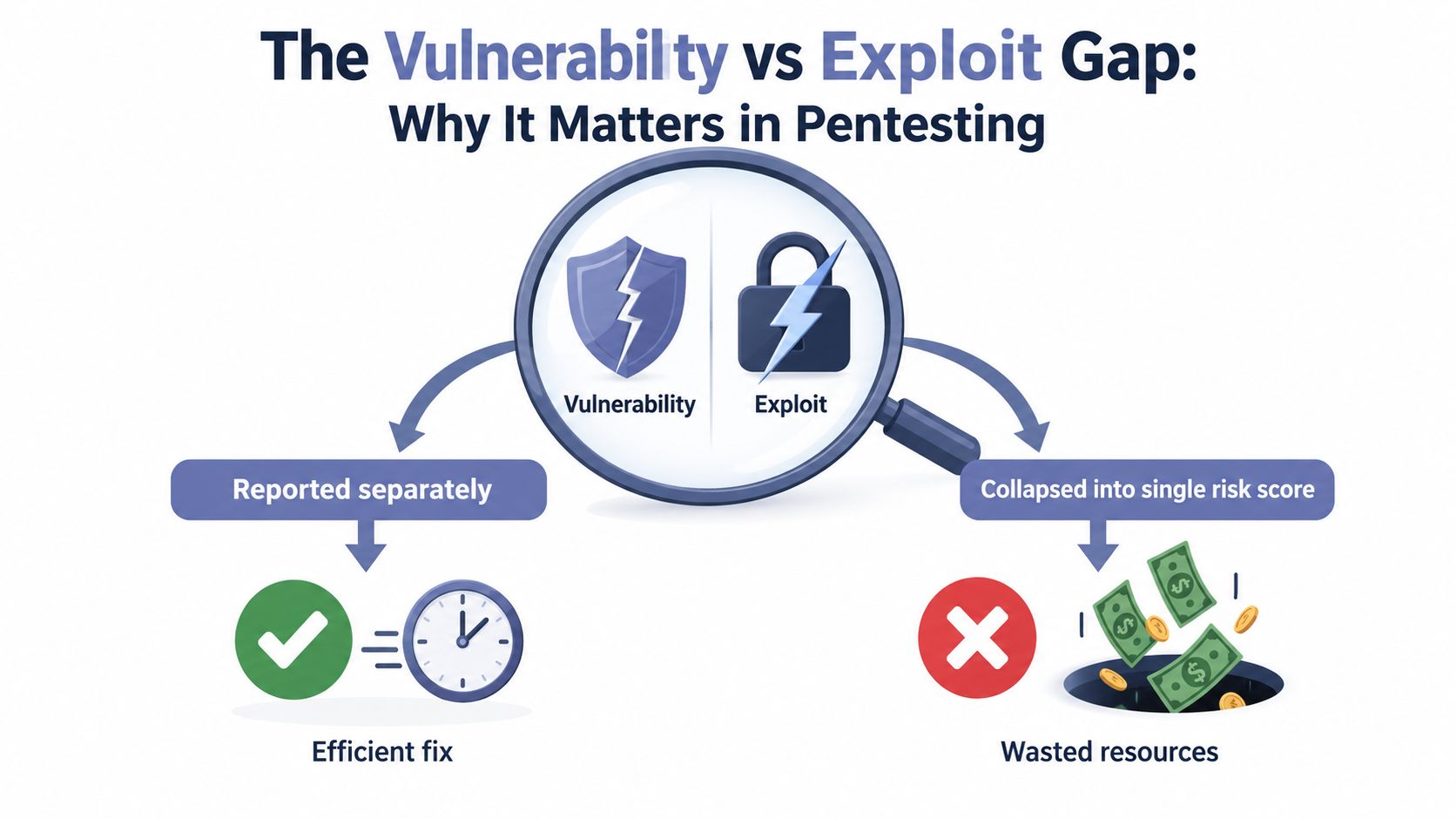
A working distinction for engagement teams
| Question | Vulnerability | Exploit |
|---|---|---|
| What is it? | A weakness that may be abused | A code path, technique, or payload that abuses it |
| What does a scanner usually provide? | Detection, version, configuration, or signature evidence | Usually no proof of successful compromise |
| What does a pentester add? | Reachability and context | Controlled execution and impact validation |
| What changes for the client? | Remediation is required | Containment and investigation may require immediate action |
A scanner may identify an exposed service running a vulnerable version. The pentester tests reachability from the assumed threat position, authentication controls, and whether controlled exploitation reaches a meaningful asset. That evidence changes prioritization because it connects a weakness to a reachable attack path. Cisco's explanation of penetration testing distinguishes identification and evaluation from simulated attack activity and attempted exploitation.
Practical rule: Record the weakness, exploit evidence, reachability, and business impact as separate fields. This gives clients a defensible basis for remediation, containment, and escalation decisions.
The Scale Gap Between Disclosed CVEs and Real-World Exploitation
In 2024, the global CVE program published 40,009 CVEs, while 768 vulnerabilities were first reported as exploited in the wild, according to Edgescan's 2025 report. The same report found that roughly 6% of all published CVEs had been exploited in the wild by 31 May 2024. That broader figure includes vulnerabilities exploited before or during the period, rather than only first-time exploitation in that calendar year.
| Metric | 2024 Figure |
|---|---|
| Newly published CVEs | 40,009 |
| Vulnerabilities first reported as exploited in the wild | 768 |
| First-time exploited share of newly published CVEs | About 2% |
| Broader published-CVE exploitation share by 31 May 2024 | Roughly 6% |
The scale gap changes how a pentest provider should build its queue. CVE volume measures disclosure activity and remediation workload. Exploitation evidence identifies a smaller set with a demonstrated attacker path. The groups overlap, but treating every disclosed weakness as an emergency obscures the vulnerabilities that require immediate verification.
The timing data adds another operational risk. A six-year study of 75,807 CVE IDs found public exploits for only 3,164 vulnerabilities, about 4.1% of the sample. For vulnerabilities with public exploits, the median time to publication was 2 days, compared with a mean of 91 days. The distribution matters more than the average. A provider that waits for a stable disclosure pattern can miss fast-moving cases, especially when an exposed service is reachable from an attacker-controlled position.
Why severity alone misleads
A high severity score describes potential consequences and technical conditions. It does not establish that attackers have a reliable method, that the affected asset is reachable, or that the customer's configuration matches the vulnerable state.
MSSPs should therefore combine scanner findings with exploit intelligence, asset exposure, customer telemetry, and controlled validation. Verification can move a finding from theoretical exposure to an evidenced attack path, or show that compensating controls prevent exploitation. CVE counts remain useful for inventory and governance, but they should not determine the emergency queue alone. The operational question is whether a known weakness is reachable, usable, and connected to an asset whose compromise changes the response decision.
How NIST Defines Vulnerability and Exploit Differently
NIST separates the existence of a weakness from the conditions that make an attack practical. A vulnerability is a flaw that could violate a security policy. Exploitability concerns whether an attacker can reach and use that flaw, while impact describes the result after successful exploitation. The NIST vulnerability and exploit metrics resource keeps these dimensions distinct, which matters when an MSSP converts scanner output into a testing queue.
For pentesters, the distinction should shape both test design and evidence collection. AV, AC, and Au describe attack conditions: network position, complexity, and authentication requirements. C, I, and A describe consequences involving confidentiality, integrity, and availability. A finding can pair difficult exploitation with severe impact, or easy exploitation with narrower consequences. CVE volume alone cannot resolve that difference.
Read the vector as two questions
Can the tester reach and trigger the weakness?
Examine network position, complexity, required privileges, user interaction, and authentication conditions. Confirm that the customer's asset and configuration match the vulnerable state.What can the tester do after triggering it?
Validate data exposure, account control, code execution, service disruption, or movement into higher-value systems. Record evidence that separates a theoretical condition from a reproducible attack path.
That separation should appear in client reporting. A critical impact rating does not prove that exploitation is currently practical. Conversely, a moderate-looking weakness can warrant rapid verification when an available exploit makes the path straightforward. For a service provider, the report should state which condition was observed, which was inferred, and what control prevented further access, if any.
| Concept | NIST definition | Remediation action | Detection signal | Reporting artifact |
|---|---|---|---|---|
| Vulnerability | An underlying weakness that can be exploited to violate security policy | Remove, patch, reconfigure, or compensate for the weakness | Vulnerable version, configuration state, or code pattern | Asset, weakness, affected component, and remediation evidence |
| Exploitability | Conditions that determine whether the weakness can be used | Reduce reachability, privileges, complexity, or exposure while fixing the flaw | Crafted request, unusual process behavior, authentication anomalies | Attack preconditions and reproducibility notes |
| Exploit | Code, technique, or weaponized path that uses the weakness | Block the path, apply virtual controls, and remove the weakness | Exploit signatures, suspicious requests, payload behavior | Payload or reproduction steps, logs, and tester evidence |
| Impact | The consequence of successful exploitation | Limit blast radius and recover affected assets | Data access, integrity changes, service interruption, or lateral movement | Business effect, affected records or systems, and risk rating |
A provider can map these separate findings to control evidence with ThreatExploit AI's NIST control family resource. Remediation, detection, and reporting should remain separate fields, because each supports a different operational decision. Verification then shows whether the weakness is reachable, usable, and consequential in the customer's environment.
Why Exploit Availability Changes Prioritization
Exploit availability determines whether a disclosed weakness remains a backlog item or becomes an immediate testing decision. A CVE may have high theoretical severity but no reliable attack path. Another weakness with lower severity can require faster action when working code is circulating or exploitation has been observed.
The timing can be short. Earlier research found a 2-day median between vulnerability disclosure and public exploit publication among vulnerabilities with public exploits. More recent tracking from VulnCheck found that 28.96% of Known Exploited Vulnerabilities were exploited on or before CVE publication in 2025, so disclosure, exploitation, and patching do not always occur in that order (VulnCheck's exploit intelligence report).
Use exposure and exploit evidence together
Consider two client findings. An internet-facing Confluence server affected by CVE-2023-22515 combines external reachability with a known exploitation history. An internal application with a critical CVE but no public exploit may still require remediation, yet it does not automatically warrant the same emergency response.
The first finding should prompt immediate validation, compensating controls, and investigation for compromise indicators. The second can usually enter a risk-based patch cycle, unless telemetry, asset criticality, or a newly released exploit changes the assessment. The internal weakness is not safe. Its current attack feasibility is lower, and the provider should document that distinction rather than rank both findings by CVE severity alone.
| Exploit evidence | Example source | Recommended SLA |
|---|---|---|
| Confirmed exploitation in the customer environment | EDR, web logs, authentication telemetry, or pentest evidence | Immediate containment and incident investigation |
| Exploitation observed in the wild | KEV entry or trusted exploit-intelligence feed | Urgent validation, compensating controls, and accelerated patching |
| Reliable public exploit or functional PoC | Public code, controlled reproduction, or vendor advisory | Prioritized testing and fast remediation |
| Weakness detected without exploit evidence | Scanner or code analysis finding | Risk-based patching and scheduled verification |
For MSSPs, the decision record should state why a finding entered its tier, which evidence supported that choice, and what event would trigger reassessment. A vulnerability-management program can organize those decisions around exposure, exploitability, and remediation rather than CVE volume alone, as described in ThreatExploit AI's vulnerability management resource. Verification changes the risk posture because it replaces assumed exploitability with evidence from the customer's actual environment.
Exploitation Phase in Pentesting Methodology
A typical engagement begins with uncertainty. Reconnaissance and scanner output produce a list of candidate weaknesses, but that list doesn't yet establish which paths are reachable from the agreed threat model. The exploitation phase tests that uncertainty under controlled rules, without turning the engagement into uncontrolled damage.
The tester first selects a finding that is technically plausible and operationally relevant. For a web application, that might mean validating SQL injection, cross-site scripting, broken access control, or an exposed administrative path. For an internal network, the tester may examine whether a vulnerable service permits remote execution, whether credentials enable an authenticated pivot, and whether the resulting access reaches a sensitive segment.
What verification should prove
A credible finding needs more than a scanner label. The evidence should show:
- Successful access: A screenshot of a shell, authenticated session, or controlled administrative result establishes that the path reached its intended target.
- Reproducible execution: A proof-of-concept payload with timestamped logs shows what the tester sent, what the target returned, and how another authorized team can validate the result.
- Observed business effect: A recorded HTTP transaction showing controlled data extraction connects the technical weakness to confidentiality or application impact.
The tester must also label the access level accurately. Unauthenticated exploitation demonstrates that no valid account was needed. An authenticated pivot demonstrates that a user session or credential was required. Post-exploitation actions, such as credential harvesting or lateral movement through PsExec, should be separated from the initial exploit so the report doesn't imply that every step was automatic.
Evidence is part of the risk rating
PTES provides a useful lifecycle for organizing the engagement, while MITRE ATT&CK execution techniques help describe what happened after initial access. The report should preserve the chain from discovery to exploitation to impact, with timestamps, authorization boundaries, and cleanup status.
Pentesters who need background on device-based attack surfaces can also consult Digital Footprint Check on iPhone exploits, particularly when mobile devices form part of the client's assumed threat model. The resource is most useful as context for understanding how an exploit path depends on the target, access conditions, and available tooling.
ThreatExploit AI's penetration testing methodology resource provides another reference point for structuring reconnaissance, exploitation, verification, and reporting. For a provider, that structure matters commercially as well as technically. A high-impact claim without proof invites dispute from remediation teams, while a verified exploit with a clear reproduction path supports faster patch approval and a defensible scope of work.
Incident Response Implications When an Exploit Appears
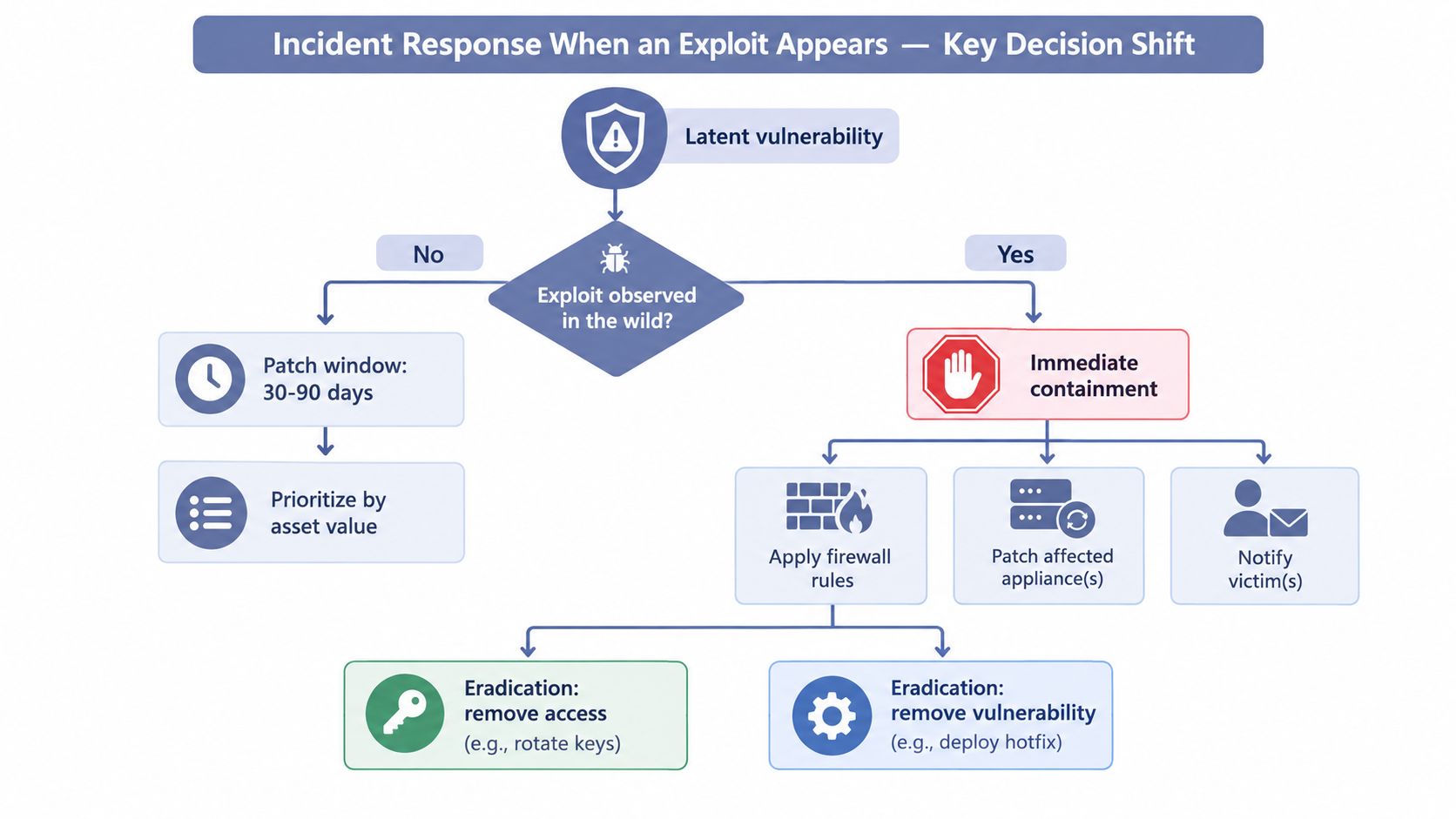
An observed exploit changes the response category. A latent vulnerability belongs in vulnerability management unless other evidence raises its priority. An exploit attempt against a live customer asset requires the incident response team to ask whether the attacker succeeded, whether the same path was used elsewhere, and whether credentials or data have already moved.
The first decision is containment. Depending on the system, that may involve isolating the host, restricting external access, applying a WAF rule, deploying an IPS signature, or disabling the affected function. Virtual patching can reduce immediate exposure, but it doesn't remove the underlying weakness, so the permanent fix still requires a patched release or a secure configuration change.
Treat the signal as a scope question
Use the MOVE framework to challenge the initial assumption that only one host is affected. The team should determine whether the activity is limited to one machine, moved across the subnet, reached related applications, or reflects a broader campaign against the customer.
Investigation priorities should follow the exploit chain:
- Collect indicators: Preserve suspicious requests, process names, authentication events, file changes, and outbound connections.
- Acquire volatile evidence: Capture memory where the suspected access involved a live process, injected code, credentials, or command execution.
- Reconstruct movement: Correlate identity logs, endpoint events, network telemetry, and administrative actions to identify lateral access.
- Rotate exposed secrets: Change keys, tokens, passwords, and service credentials after determining which accounts or processes the exploit could reach.
The MOVEit Transfer case involving CVE-2023-34362 illustrates why external-facing exploitation can demand shutdown and investigation rather than scheduled patching. The scenario described in the engagement plan involves Cl0p affiliates exfiltrating data within hours of file upload, so a response team would need to treat the service as a potential active incident, preserve evidence, and assess affected files before restoring normal access.
Match the response to evidence
A theoretical critical remote-code-execution weakness with no exploit code may require accelerated patching and exposure reduction, but it doesn't automatically justify emergency forensics. By contrast, a blocked exploit attempt still warrants log review, while a successful exploit requires containment, eradication, recovery, and customer notification decisions. NIST's incident response guidance supports organizing those activities around preparation, detection, response, and recovery.
A Decision Framework for Pentest Providers and MSSPs
A usable prioritization model needs an audit trail. The provider should be able to show which signal triggered the ticket, which action followed, and what evidence closed the decision. That approach keeps the process consistent when one customer has a large scanner backlog and another has fewer findings but an exposed exploit path.
Three rules for operational triage
Prioritize by vulnerability count when the environment is small, asset ownership is clear, and the findings provide useful direction. At larger scale, raw counts can overwhelm the queue without telling the team which weakness is practically reachable.
Prioritize by exploit availability when a KEV listing, exploit-intelligence feed, or vendor PoC indicates weaponization. The existence of working attack code should move the finding ahead of equivalent weaknesses without exploit evidence, regardless of how a single severity score ranks them.
Prioritize by verified exploitation when customer telemetry or a pentest confirms that an exploit chain reached business logic, sensitive data, privileged execution, or lateral movement. That evidence collapses the distance between theoretical exposure and observed risk.
| Input signal | Triggers when | Containment SLA | Patch SLA | Reporting output |
|---|---|---|---|---|
| CVE and asset inventory | A weakness is identified on a known asset | Exposure review based on reachability | Risk-based remediation window | Asset list, affected component, and ownership |
| CVSS or impact assessment | Potential consequence and attack conditions are scored | Escalate when reachability or impact is material | Prioritize against business criticality | Vector, assumptions, and impact explanation |
| KEV listing | Exploitation is recognized by a trusted catalog | Immediate exposure validation | Accelerated remediation | Catalog status, affected assets, and decision owner |
| Exploit-intelligence feed | Working code or observed exploitation is reported | Apply compensating controls while validating | Urgent patching and retesting | Feed evidence, timestamp, and triage rationale |
| Customer telemetry | Attempts or suspicious behavior appear in the environment | Isolate, investigate, and scope | Fix after containment and evidence capture | IOC set, timeline, affected identities, and actions |
| Pentest evidence | Authorized testing reproduces the attack path | Contain according to demonstrated access | Remediate and require retest | Payload, logs, screenshots, impact, and reproduction steps |
The provider can turn those outputs into remediation tickets, retainer-hour records, escalation notes, and audit evidence. ThreatExploit AI can fit into this workflow as an automated penetration testing platform that coordinates reconnaissance, exploitation, verification, and reporting across web, network, and cloud targets, with evidence-backed outputs for service providers.
The central decision is simple but easy to lose in a CVE-heavy workflow. A vulnerability tells you what to investigate. An exploit tells you how urgently to investigate it. Verified exploitation tells you the customer's risk is no longer hypothetical.
ThreatExploit AI helps security service providers automate reconnaissance, controlled exploitation, finding verification, and evidence-backed reporting across web, network, and cloud environments. Visit ThreatExploit AI to see how exploit validation can become a repeatable part of your MSSP or pentest delivery workflow.