
A client calls your MSSP with a compliance deadline approaching. The request sounds simple: test the web application and network, deliver a report, and provide evidence for the assessor. Then the questions begin. Which hosts are authorized? Can the team test production? Are authenticated workflows included? What proves that a finding was exploitable, and who will verify the fix?
A strong pen test plan answers those questions before anyone launches Nmap, Burp Suite, Nuclei, or another testing tool. It turns a potentially disruptive technical exercise into a controlled lifecycle with defined objectives, documented authorization, reproducible evidence, risk analysis, remediation ownership, and retesting. That distinction matters to both engineers who must fix weaknesses and auditors who must evaluate whether controls operate as intended.
Table of Contents
- Why Most Pen Test Plans Fail Before Testing Begins
- Four Essential Components Every Pen Test Plan Requires
- Mapping the PTES Lifecycle to Your Engagement Plan
- Automated Testing Versus Manual Assessment Methods
- Compliance Mapping Requirements Across Major Frameworks
- Closing the Remediation Gap Most Plans Ignore
- Practical Templates and Checklists for Immediate Use
Why Most Pen Test Plans Fail Before Testing Begins
The failure usually starts in a hurried intake call. A customer says, “Test our application and network,” while the consultancy records a domain name, a date range, and a list of preferred tools. Nobody documents excluded assets, test accounts, emergency contacts, acceptable techniques, or the evidence the customer's compliance team will need later.
Two weeks into the engagement, the scanner has produced a long list of candidate vulnerabilities. The testers can't reproduce several of them, the application team disputes others, and the report doesn't show which business functions were tested. The client has a document, but not defensible proof of risk reduction.

NIST's Technical Guide to Information Security Testing and Assessment established a foundational government reference for penetration testing with Special Publication 800-115, published in September 2008. The 80-page guide replaced NIST SP 800-42 and frames testing as a lifecycle covering planning, technical execution, analysis, and mitigation, rather than as an isolated scan.
The operational symptoms
A weak plan creates predictable problems:
- Unclear authorization: Testers don't know whether a cloud account, third-party service, or production endpoint is approved.
- Uncontrolled risk: The team has no agreed rate limits, stop conditions, or escalation route if testing affects availability.
- Unverifiable findings: A vulnerable version or scanner alert gets reported without a reproducible request, command, or proof of impact.
- Late compliance surprises: The final report lacks control references, timestamps, screenshots, or remediation records required by the customer's audit process.
A practical starting point is to map the external and internal target inventory before scoping the work. An attack surface mapping resource can help teams identify assets that the customer's official inventory may not fully represent, but discovery still needs human review and written authorization.
Practical rule: A finding isn't ready for a customer report until another qualified tester can understand what was tested, reproduce the relevant action, and see the resulting security impact.
The plan should identify business-critical assets, authorized targets, exclusions, objectives, test windows, roles, constraints, data-handling requirements, communication contacts, and success criteria. It should also state how findings will be classified, who owns remediation, and what evidence closes a finding. That preparation makes execution more predictable and gives the final report a traceable chain from authorization to retest.
Four Essential Components Every Pen Test Plan Requires
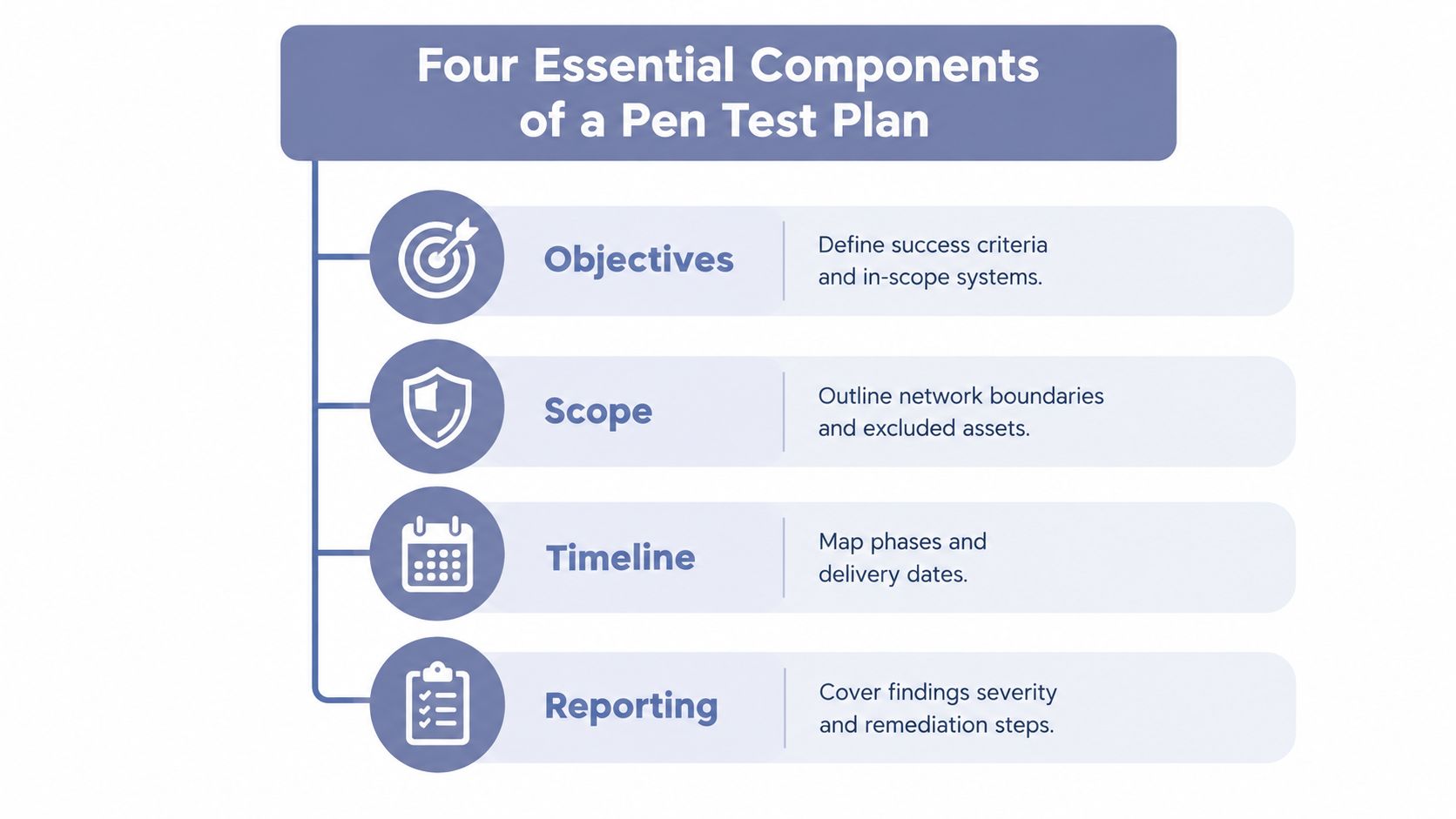
A defensible pen test plan needs four connected components. Objectives define the question, scope defines the boundary, operating rules define safe execution, and evidence requirements define what the engagement must prove.
1. Objectives that describe success
“Find vulnerabilities” is too broad to guide testing. A useful objective states the decision the customer needs to make. Examples include validating external exposure, assessing authentication and authorization, testing cloud permissions, confirming compliance controls, or demonstrating whether a sensitive workflow can be abused.
Objectives affect methodology. A black-box external assessment asks a different question from a white-box application review with source code and test credentials. Document the intended depth, threat assumptions, critical assets, and success criteria before selecting tools or assigning testers.
2. Scope that names assets and exclusions
Scope should enumerate websites, REST and GraphQL APIs, authentication roles, administrative functions, network segments, cloud environments, integrations, and relevant workflows. For web testing, OWASP's information-gathering guidance emphasizes identifying application entry points and mapping execution paths. A single hostname rarely represents the full application attack surface.
Record explicit exclusions as carefully as included targets. State whether production systems, third-party platforms, mobile back ends, social engineering, denial-of-service techniques, destructive payloads, or cloud control-plane actions are excluded. Each target should have an owner and an authorization status.
3. Rules that control execution
Rules of engagement should specify test windows, permitted techniques, rate limits, credentials, notification channels, emergency contacts, escalation procedures, stop conditions, and cleanup expectations. FedRAMP guidance says these rules should identify systems, scope, constraints, notifications, disclosures, responsible personnel, and communication procedures if testing triggers incident response.
NIST's penetration testing guide recommends documenting goals, scope, roles, constraints, assumptions, resources, schedule, and deliverables. Obtain written authorization before reconnaissance begins, especially where cloud providers, vendors, or shared infrastructure are involved.
4. Evidence requirements that survive review
Define the minimum evidence package for each confirmed finding:
- Execution record: Timestamp, tester, affected asset, command, request, or relevant tool setting.
- Proof of impact: Safe response data, screenshot, access demonstration, or other minimally invasive artifact.
- Technical context: Affected component, prerequisite, attack path, and root cause.
- Closure record: Remediation change, retest result, remaining limitation, and reviewer.
OWASP's reporting guidance calls for screenshots and command lines, affected items, technical descriptions, remediation guidance, and severity ratings. Evidence collection isn't clerical work. It determines whether engineering teams can reproduce the issue and whether auditors can trust the conclusion.
Mapping the PTES Lifecycle to Your Engagement Plan
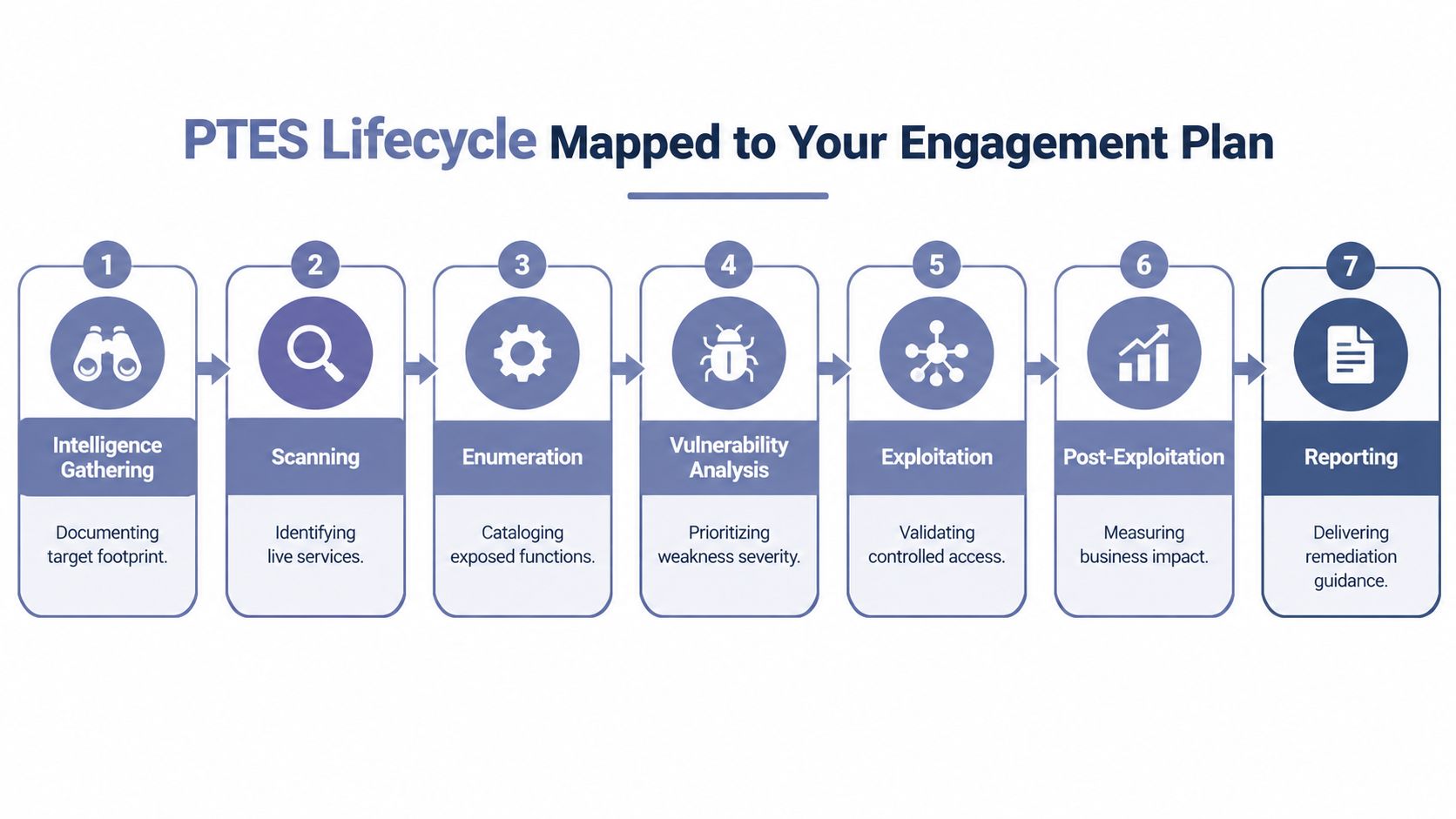
The Penetration Testing Execution Standard gives consultancies a useful structure for converting methodology into deliverables. A seven-phase plan should make every stage produce an artifact that the next stage can use.
Start with intelligence gathering
Record discovered hosts, services, application entry points, authentication paths, technology indicators, trust relationships, and ownership questions. The output should be an evidence-backed target inventory, not an unfiltered export. Reconcile discoveries against the authorized scope before active testing proceeds.
Scanning identifies live services and candidate weaknesses. Enumeration adds context by cataloging API operations, administrative interfaces, roles, parameters, uploads, integrations, and execution paths. For every discovery phase, preserve timestamps and source evidence so the final report can explain how coverage was established.
Apply threat modeling before exploitation
Threat modeling connects technical exposure to business consequence. Identify crown-jewel assets, sensitive-data flows, privilege boundaries, external access paths, and likely attack chains. The plan should tell testers which paths deserve deeper manual attention when time or production safeguards limit exhaustive testing.
Vulnerability analysis combines automated discovery with manual review. Classify candidates as confirmed, plausible but unverified, or disproven. A vulnerable software banner alone shouldn't become a confirmed customer finding.
Control exploitation and post-exploitation
Exploitation should validate approved attack paths with minimally invasive techniques. Define acceptable proof, prohibited actions, data access limits, and rollback requirements before execution. If a tester obtains access, post-exploitation should measure privilege boundaries, lateral movement potential, and business impact without collecting unnecessary sensitive information.
Each phase needs a checkpoint:
| Phase | Planning checkpoint | Evidence output |
|---|---|---|
| Intelligence gathering | Authorized footprint confirmed | Asset and entry-point inventory |
| Scanning and enumeration | Services and functions categorized | Requests, responses, and discovery logs |
| Threat modeling | Critical paths prioritized | Attack hypotheses and asset relationships |
| Vulnerability analysis | Candidates triaged | Reproducible validation records |
| Exploitation | Techniques approved | Safe proof of exploitability |
| Post-exploitation | Boundaries observed | Impact and cleanup records |
| Reporting | Findings independently reviewed | Technical and executive deliverables |
Reporting begins during execution, not after the last command. NIST describes written logs, updates to administrators or management, and a final report that explains vulnerabilities, risk ratings, and mitigation. That discipline prevents the common problem of reconstructing evidence from memory at the end of an engagement.
Automated Testing Versus Manual Assessment Methods
Automation and manual assessment solve different problems. A scanner gives breadth across ports, service versions, and known vulnerability signatures. A skilled tester supplies context, explores state changes, tests business logic, and chains weaknesses into an attack path.
| Assessment need | Automated testing | Manual assessment |
|---|---|---|
| External discovery | Fast identification of reachable services and candidate technologies | Verification of ownership, forgotten assets, and meaningful exposure |
| Known vulnerabilities | Efficient signature and configuration checks | Confirmation that the weakness applies to the running service and context |
| Authentication | Repeated checks at scale | Analysis of workflow behavior, session state, MFA assumptions, and role boundaries |
| Business logic | Limited unless explicitly modeled | Stronger analysis of intended versus actual process behavior |
| Attack chaining | Can surface related candidates | Better suited to proving how separate weaknesses create material impact |
| Verification | Consistent first-pass evidence | Deeper proof, root-cause analysis, and safe impact demonstration |
The principal mistake is treating coverage as assurance. Automated tools can miss business-logic flaws, race conditions, authorization defects, and weaknesses that require authenticated workflows or knowledge of how the application is meant to operate. OWASP recommends combining automated techniques with manual inspection, design review, threat modeling, source-code review where available, and penetration testing, while warning that excessive false positives can cause teams to overlook genuine findings. See this comparison of manual and automated penetration testing when deciding how to divide effort.
Use parallel tracks, then converge on risk
Run discovery tracks for:
- External exposure: Internet-facing services, perimeter devices, VPNs, and remote access paths.
- Identity and sessions: Authentication, authorization, account recovery, session handling, and privilege transitions.
- Sensitive data: Repositories, APIs, exports, and access-control boundaries.
- Cloud control planes: Roles, policies, exposed storage, secrets, and trust relationships.
- Lateral movement: Segmentation, reachable services, credential reuse, and escalation paths.
Every candidate should pass an evidence gate before reporting. Require a reproducible request or command, the observed security impact, the affected component, and a cleanup or rollback record. This approach also creates a useful boundary for AI-assisted tools. ThreatExploit AI, for example, orchestrates reconnaissance, exploitation, verification, and reporting across web, network, and cloud environments, but the consultancy still needs human approval for scope, safety, interpretation, and customer communication.
Teams evaluating automation maturity can also review success stories in test automation for examples of how automation programs handle repeatability and operational integration. The lesson for penetration testing is practical: automate repeatable discovery and evidence capture, then reserve expert time for attack-path reasoning and business impact.
Compliance Mapping Requirements Across Major Frameworks
Compliance mapping shouldn't be added while formatting the final report. Put it into the engagement intake, because each framework creates different expectations about scope, evidence, frequency, and remediation.
A consultancy should collect the customer's applicable frameworks, assessment date, control owners, required deliverables, accepted severity model, and auditor preferences. The report can then connect each finding to a control, affected asset, evidence record, owner, remediation status, and retest outcome. A compliance matrix resource can help structure that relationship without turning the penetration test into a checklist exercise.
Map evidence to the customer's actual obligation
The mapping should be specific rather than decorative:
- SOC 2: Document the penetration test within the prior twelve months and retain evidence of remediation tracking.
- PCI DSS: Plan for annual external and internal penetration testing, with quarterly retesting of remediated vulnerabilities.
- HIPAA: Preserve risk analysis documentation and evidence of vulnerability management processes.
- ISO 27001: Address penetration testing within control A.12.6, including documented results and management review.
- CMMC: For Level 3 assessments, include penetration testing evidence that meets the assessment requirements.
- GLBA: Plan for independent testing every two years and preserve the supporting record.
These requirements affect scheduling and report design. A PCI engagement needs clear separation of external and internal coverage, while a SOC 2 package needs a traceable remediation history. An ISO 27001 review may require management-facing evidence that the organization considered results and acted on them.
Treat control mapping as an accountability system
A finding record should contain the control reference, risk rationale, business owner, technical owner, target date, exception decision, compensating control, and retest evidence. If a control doesn't apply, document why. If the customer accepts risk, record an expiry date and approval authority rather than allowing an exception to remain indefinite.
Compliance leaders often need to explain testing scope and evidence to customers or procurement teams. Resources focused on helping compliance leads win contracts can be useful context, but the penetration-test plan must still stand on its own as an auditable record. A framework label without control-level evidence won't help an assessor decide whether the weakness was addressed.
Closing the Remediation Gap Most Plans Ignore
A report delivery date isn't a security outcome. It's the point at which ownership, prioritization, and verification must become operational.
An independent analysis of more than 16,000 penetration tests across over 2,700 organizations found that fewer than half of findings were ultimately resolved. The same analysis found a 69% resolution rate for the riskiest findings, while three-quarters of organizations set a two-week remediation SLA for serious findings and the median resolution time was 37 days. Those figures show why a plan that ends at report delivery leaves a material control gap. The CISA-published analysis provides the source for these findings.
Build the closure workflow before testing
Assign owners while findings are being reviewed, not after the report reaches a shared inbox. A useful workflow looks like this:
- Triage: Confirm severity, exploitability, business impact, affected assets, and attack-path relationships.
- Assign: Name both a technical owner and a business owner. Security can coordinate, but it shouldn't take on ownership of every fix alone.
- Set the SLA: Use risk and business exposure to establish a target date. Record the rationale for exceptions.
- Remediate: Require the owner to attach the change record, configuration evidence, code reference, or other proof of action.
- Retest: Reproduce the original technique and test adjacent paths that the fix could affect.
- Close or escalate: Close only when evidence supports the conclusion. Escalate overdue or ineffective fixes through a defined management route.
A retest shouldn't merely check whether the original scanner signature disappeared. It should confirm that the vulnerable behavior is no longer exploitable and that the remediation hasn't introduced a new authorization, workflow, or availability problem.
Track exceptions as temporary decisions
Risk acceptance needs an approver, business rationale, compensating control, review date, and expiry date. “Won't fix” is not a remediation status. It's an ungoverned decision unless someone accepts responsibility for the remaining exposure.
A finding is closed when the evidence shows reduced risk, not when a ticket changes color.
The engagement record should preserve original evidence, remediation evidence, retest steps, residual limitations, and the person who approved closure. This makes the process useful to engineering teams and defensible during an audit.
Practical Templates and Checklists for Immediate Use
Standardized templates make quality repeatable across testers, customers, and engagement types. They also reduce the risk that a busy consultant remembers the technical scope but forgets the authorization record or closure criteria.
Scope and authorization template
Capture these fields before testing:
- Business context: Critical applications, sensitive data, owners, and the reason for testing.
- Target inventory: Systems, domains, APIs, network segments, cloud accounts, roles, and environments.
- Boundaries: Explicit exclusions, third-party dependencies, production restrictions, and prohibited techniques.
- Authorization: Approvers, dates, provider contacts, testing windows, and escalation channels.
- Success criteria: Required attack scenarios, coverage expectations, deliverables, and compliance controls.
Rules of engagement checklist
Use a separate checklist for execution safety:
- Timing: Approved start and end windows, maintenance conflicts, and communication cadence.
- Technique limits: Rate limits, credential handling, payload restrictions, and data-access boundaries.
- Stop conditions: Availability impact, unexpected sensitive-data exposure, incident-response activation, or loss of scope certainty.
- Recovery: Cleanup actions, rollback contacts, evidence retention, and incident notification procedures.
Evidence and reporting template
For every finding, require:
- Reproduction: Requests, commands, timestamps, affected asset, and relevant tool configuration.
- Impact: Demonstrated access, data exposure, privilege change, or business consequence.
- Diagnosis: Root cause, prerequisites, attack path, and limitations.
- Remediation: Specific fix, owner, target date, compensating control, and control mapping.
- Verification: Retest method, result, residual risk, and closure approval.
For the final report, separate the executive summary from technical detail. Include business impact, severity, attack paths, screenshots, remediation priorities, CVSS scoring where appropriate, and compliance references. Add a retest trigger so a remediation update automatically creates a validation task instead of waiting for the next scheduled assessment.
A mature consultancy can also add an AI-specific intake for model endpoints, retrieval pipelines, training or fine-tuning data, system prompts, agent tools, plugins, vector stores, and sensitive-data flows. NIST finalized its Adversarial Machine Learning taxonomy in March 2025, and CISA's AI roadmap calls for dedicated techniques, guidance, and red-team testing. The plan should state whether it covers prompt injection, data poisoning, model extraction, insecure tool use, authorization boundaries, privacy leakage, and unsafe downstream actions, with human approval and safe test-data rules.
ThreatExploit AI helps security service providers structure repeatable penetration tests across web applications, networks, and cloud environments, with automated reconnaissance, exploitation, verification, evidence capture, and compliance-mapped reporting. Review ThreatExploit AI to see how its engagement controls and reporting workflow can support the pen test plan you'll use for your next customer assessment.