
Your best client needs a signed report by Friday. Your senior tester isn't free until next month, the scope covers a web app, two APIs, and an external network range, and procurement wants evidence mapped to SOC 2 controls. That's the moment most providers stop shopping for features and start asking whether a platform can deliver work.
I rank these penetration testing platforms by three buying questions. What do you need to test, how will you run it across multiple clients, and when does a human need to step in. A strong network engine doesn't help if web testing is an add-on, and fast automation doesn't help if you can't separate tenants, brand reports, or prove a fix worked.
The pressure is real. The Verizon 2025 Data Breach Investigations Report executive summary analyzed more than 22,000 security incidents, including 12,195 confirmed data breaches, and found exploitation of vulnerabilities was the initial access vector in 20% of breaches. You're not buying a scanner. You're buying repeatable validation that an exposed weakness is, or isn't, a credible way in.
Vendor speed, accuracy, and pricing claims below are reported as stated, not independently verified by me. Where a claim needs your own pilot, I say so. If you're scoping an external test today, you can scan ports on your server to sanity check exposure before you commit scope.
Table of Contents
- 1. ThreatExploit AI
- 2. Horizon3.ai NodeZero
- 3. Pentera
- 4. Cobalt
- 5. Vonahi Security vPenTest
- 6. Pentest-Tools.com
- 7. Escape
- 8. BreachLock
- 9. Synack
- 10. XBOW
- How the 10 penetration testing platforms compare on pricing, coverage, and fit
- Choosing Your Platform Verify Claims Before You Commit
1. ThreatExploit AI
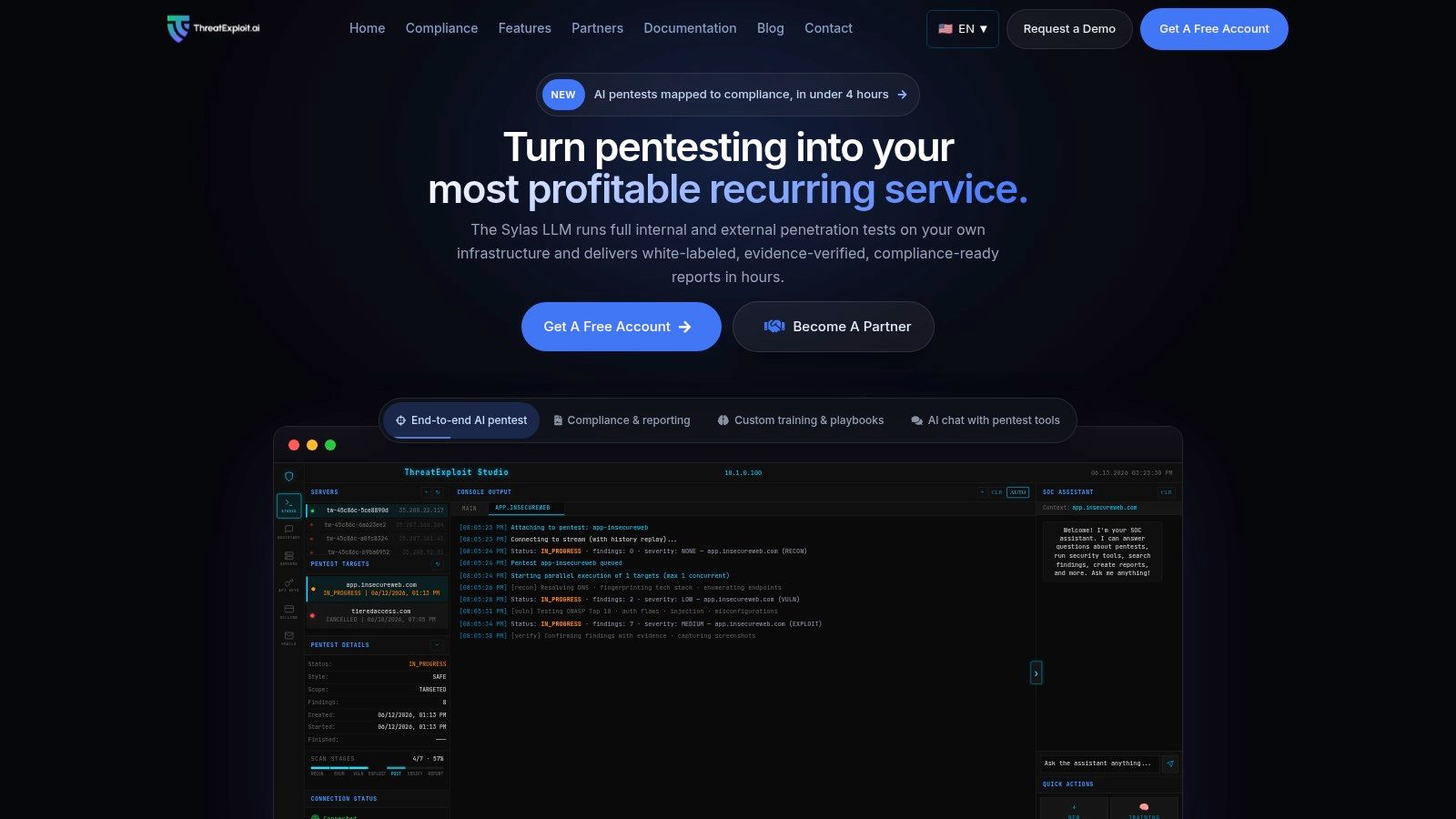
ThreatExploit AI sells throughput. It's an AI-powered penetration testing engine built for security service providers, and the partner base it describes is MSSPs, consultancies, MSPs, and telecom providers. Those partners run client tests without pentesters on staff because the engine handles reconnaissance, scanning, exploitation, and evidence collection itself. That reframes the buying question. It isn't whether automation can find a vulnerability, it's whether it can hand you a deliverable a client will pay for.
Its Sylas LLM and ROOT Controller coordinate autonomous agents through all seven PTES phases, from reconnaissance to exploitation, verification, and reporting. The lifecycle matters because the NIST Special Publication 800-115 guide to security testing formalized penetration testing in September 2008 as planning, discovery, attack, and reporting, with exploitation used to verify whether a suspected vulnerability is real. A platform that stops at discovery leaves you to do that verification by hand.
Coverage and Delivery Model
The platform tests web applications including REST and GraphQL APIs, internal and external networks, and AWS, Azure, and GCP environments from a single portal. It orchestrates 60+ tools, including Nmap, SQLMap, and Nuclei, and tests run on dedicated, non-multi-tenant infrastructure. Partners create and manage multiple pentest servers deployable in America, Europe, and Asia. Isolation matters when two clients' findings sit in one system, and this gives you separate servers without giving up dashboard-level control over onboarding and reporting.
- Speed claim: the vendor states a complete, compliance-mapped report lands in under four hours from target submission, with executive and technical views and screenshots rather than raw tool output.
- Compliance mapping: findings map to HIPAA, SOC 2, PCI-DSS, CMMC, ISO 27001, GLBA, and GDPR, which cuts the manual cross-referencing before an audit.
- Operations: API access, CI/CD integration, and role-based permissions support recurring delivery rather than one-off engagements.
Practical rule: judge the sample report, not the dashboard. If evidence, reproduction steps, and control references aren't clear enough to send to a client unchanged, the automation hasn't saved you senior time.
Pricing is per pentest run, not per seat, which suits partners billing per engagement and frustrates anyone expecting unlimited testing on a flat license. Plans run from Starter through Enterprise, with a free account for a test pentest and optional on-premise deployment. The vendor reports an 86% lower cost per pentest than a manual engagement, a figure to test against your own cost base rather than adopt. Privaxi, Halotree, UTMStack, InsecureWeb, and CyberSentry appear as ecosystem partners, which tells you something about integration surface, not about delivery quality.
I recommend it first for providers selling recurring, compliance-mapped testing across mixed web, network, and cloud scope. It does not suit engagements dominated by complex business logic or chained attack paths that need human judgment mid-test, and no amount of agent orchestration changes that. Pilot it against a known-vulnerable authorized target and compare the verified findings with what your senior tester reports.
2. Horizon3.ai NodeZero
Horizon3.ai NodeZero is the network-first option I'd shortlist when a client keeps fixing the same internal exposure. It autonomously tests internal and external networks, AWS and Azure cloud, and Kubernetes, then gives fix guidance and one-click retesting to confirm the path is closed.
That retest loop is the differentiator for service delivery. You can run recurring assessments, show the client what changed, and avoid reopening a full engagement to verify one remediation. If you're comparing approaches for this layer, this overview of network penetration testing tools and delivery models helps frame where autonomous network testing ends and application testing begins.
Fit for Multi-Client Operations
- Multi-tenant management: Built for MSP and MSSP accounts managing clients and licenses centrally.
- Published pricing: Flex at $15 per asset per test and Core at $50 per asset annually, according to the vendor, which makes early margin modeling possible.
- Buying options: Episodic testing or annual subscription, so you can match cadence to contract terms.
The trade-offs are clear. Web application testing is a separate product or add-on, so don't sell NodeZero alone as full-stack coverage. Asset definitions may not map cleanly to every client's inventory, which can move your per-asset cost. Partner pricing and the exact multi-tenancy terms still require vendor engagement, so get the definition of an asset in writing before you quote a client.
3. Pentera
Pentera suits large, spread-out estates where the hard question is which exposures chain into a real attack path. It covers internal and external environments, cloud, web applications, and APIs, then ranks findings by demonstrated exploitability rather than scanner severity alone. That ordering matters to an enterprise client sitting on thousands of open findings with no capacity to fix them all this quarter.
Buyer behavior supports the approach. Pentera's 2025 State of Pentesting summary reports that 50% of surveyed CISOs named software-based penetration testing as their primary method for uncovering exploitable security gaps. Buyers want validation they can rerun on a schedule, which is why remediation tracking and fix revalidation carry so much of the pitch.
For how this category automates validation, see this guide to penetration testing automation tools, because not every platform proves exploitability the same way.
Where It Fits and Where It Doesn't
Pentera provides compliance evidence mapping for PCI DSS, SOC 2, ISO 27001, and HIPAA, but check its Gartner Peer Insights reviews directly and weigh them against references in your own segment.
Pricing isn't publicly listed and evaluation is sales-led, which is a delivery-model problem. You cannot model per-test margin before a sales cycle closes, so go in asking whether the commercial structure keys off assets, users, or seats, and get that definition in writing. For a small consultancy, the breadth can be more platform than you can operationalize, and licensing, deployment, and customer separation need direct testing if you plan multi-client delivery.
I wouldn't pick it to win on price. I'd pick it when an enterprise client will pay for attack-path prioritization across a complex surface and you have people who can interpret what the platform proves.
4. Cobalt
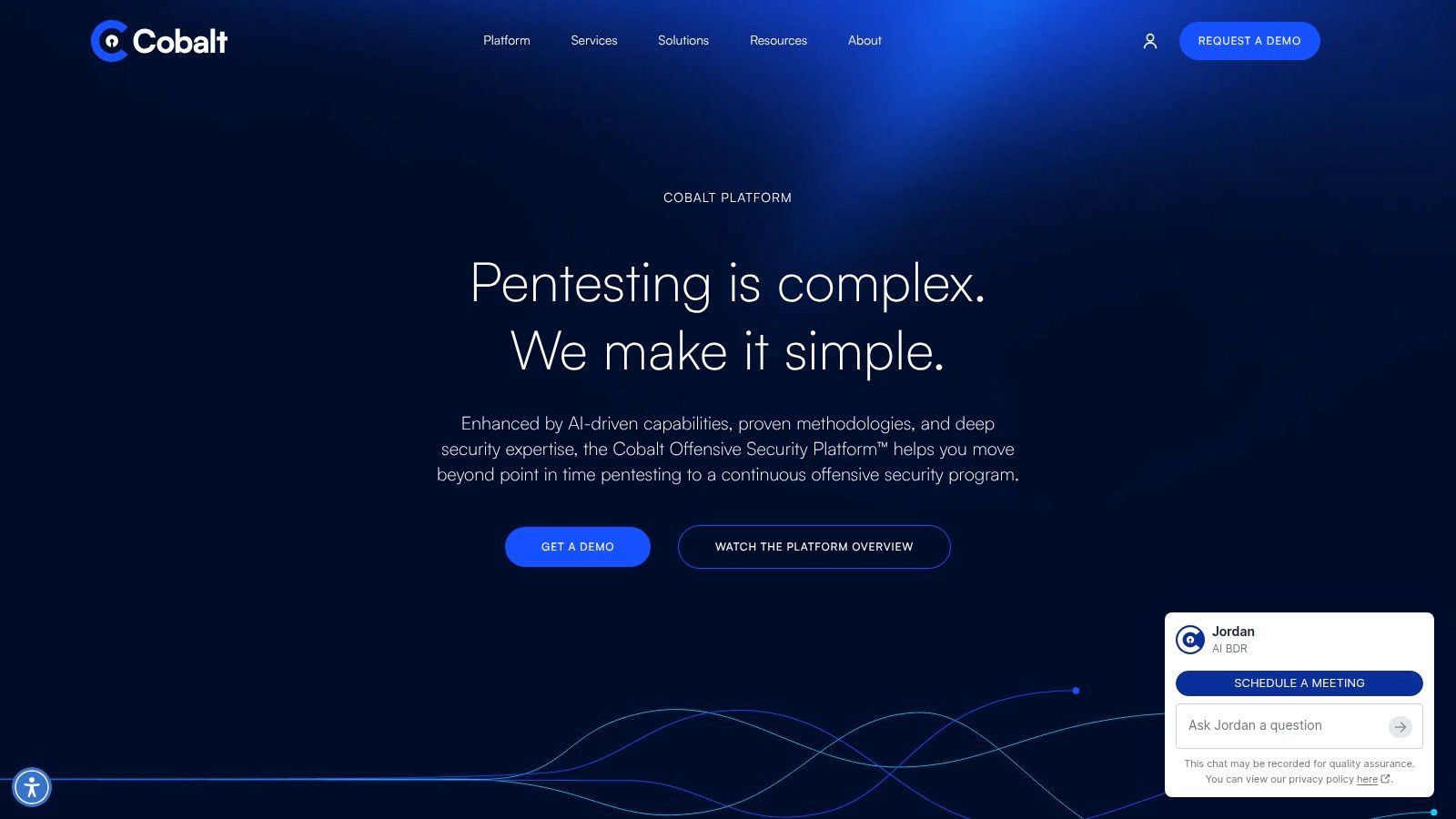
Cobalt answers a different question: what if you don't want to run the test yourself at all? It combines a workflow platform with a network of human pentesters, plus AI-assisted and autonomous testing focused on web applications.
You scope engagements, track progress, collaborate on findings in real time, and retest fixes inside one system. Integrations with Jira, GitHub, and Slack keep engineers working where they already work instead of waiting for a final PDF. That model is the pentest as a service approach, and it fits buyers who value a managed roster over owning an engine.
Market context supports the service packaging. An industry annual report on penetration testing in 2025 estimates the global market at approximately $2.74 billion in 2025 and reports PTaaS adoption above 70%. Treat those as directional figures, but the direction is consistent with clients buying recurring validation rather than an annual event.
Limits to Price In
Confirm Cobalt's current autonomous web-app pricing directly with the vendor before quoting it to a client. Limited offers rotate, and a stale number can erase your margin on a fixed-fee deal. That scope is web apps, not broad network and cloud testing. Human-led work still depends on scoping, tester availability, and engagement terms.
If you're a provider, confirm resale, white-labeling, and end-customer reporting rights before you build an offer on top of it. Cobalt works when human escalation is the product and your clients want a managed roster. It is a weaker fit when you need a self-serve engine you control across dozens of tenants, or when per-seat economics would punish a high-volume book of small tests.
5. Vonahi Security vPenTest
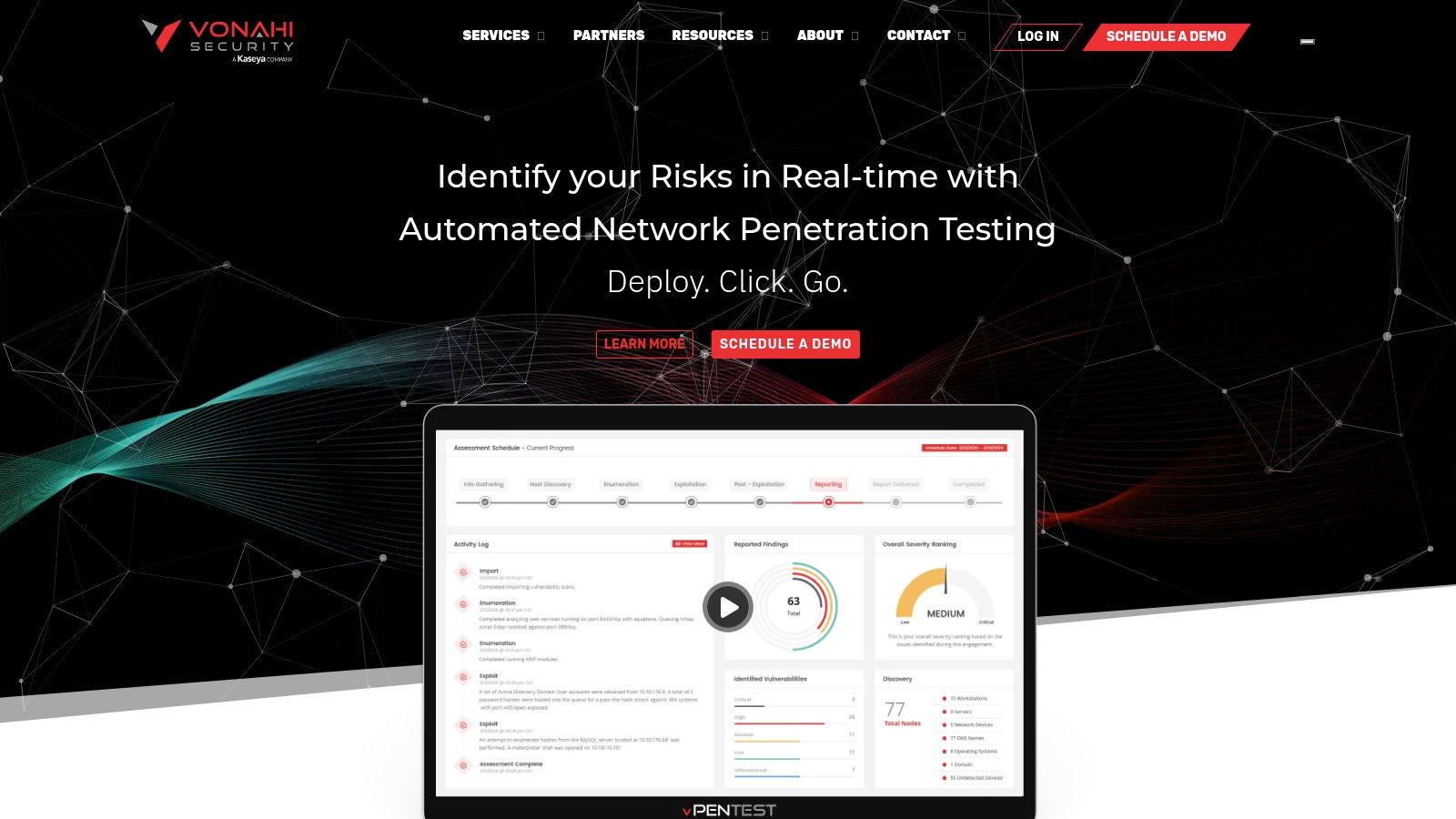
Vonahi Security vPenTest is unapologetically built for MSPs. If your team sells network security to small and midsize clients and needs reports a non-technical owner can read, start here.
It automates host discovery, service enumeration, exploitation, privilege escalation, and lateral movement across internal and external networks. Reports come as executive presentations and technical documents, and partners can brand both the portal and the deliverables. Users have cited ease of setup, usability, and report clarity, which matters when your account manager, not a pentester, presents the findings.
The Prospecting Angle
- Partner portal: Branding is central, not an afterthought bolted onto an enterprise console.
- Prospecting tests: The vendor says eligible MSP partners receive 20 per month, useful for opening a sales conversation without burning a full assessment.
- Clear boundary: A prospecting test isn't a substitute for compliance-required testing, and you shouldn't sell it as one.
A branded report that a client understands will outsell a deeper report they ignore. That doesn't make it deeper.
Pricing isn't published and partner licensing is sales-led. The bigger limit is scope. This is primarily a network pentesting product, not your single answer for deep web application, API, and cloud testing. Pair it with an application-focused tool or be explicit with clients about what's out of scope.
6. Pentest-Tools.com
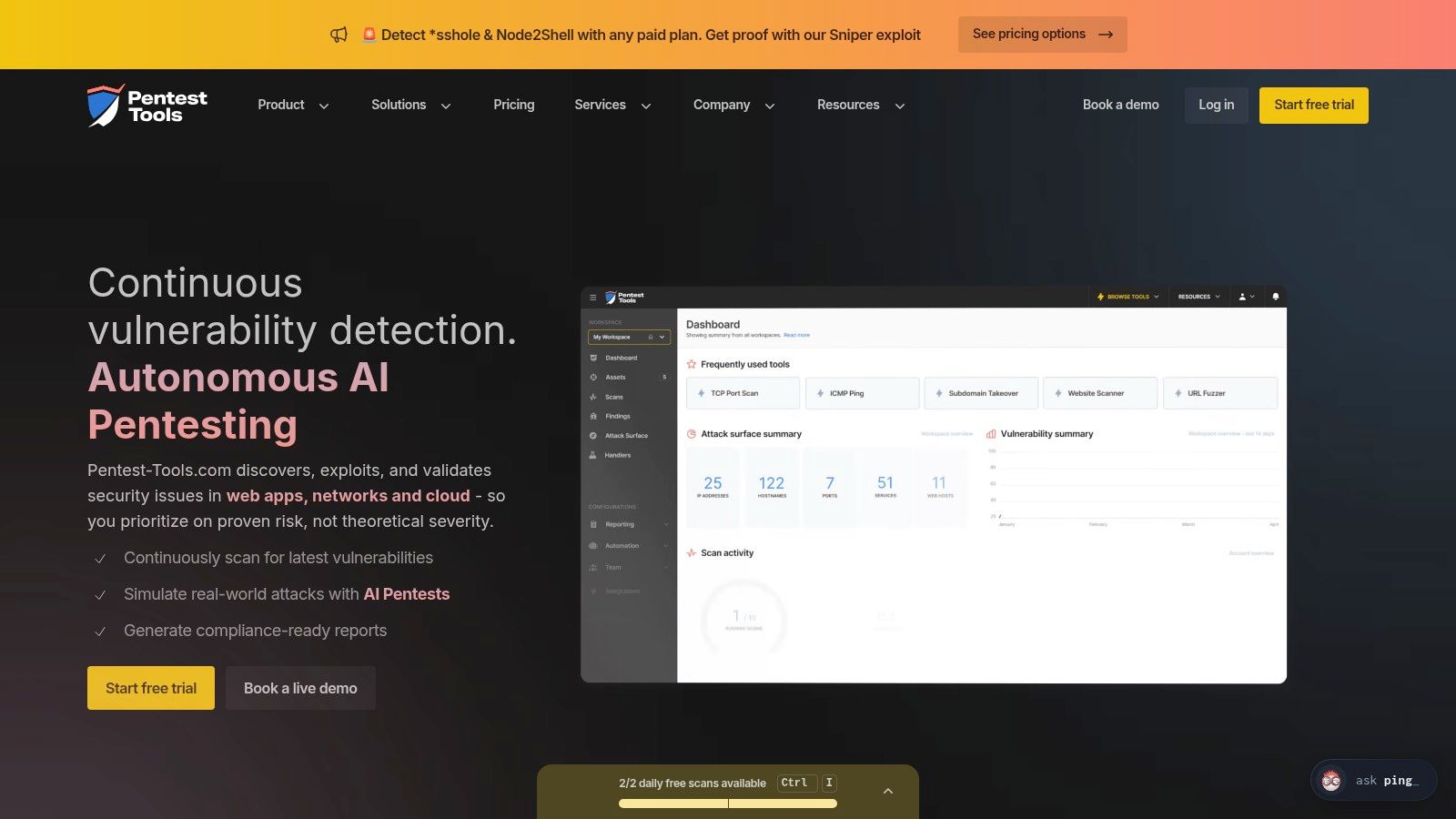
Pentest-Tools.com is the toolbox option. It's a cloud-based offensive security toolkit for consultants and teams who already know how to scope a test and want repeatable building blocks, not a fully autonomous operator.
It combines reconnaissance, web and API scanning, network and cloud checks, and selected proof-of-exploitation workflows. You can schedule scans, build automated flows, use the API, and export results for your own reporting process. Paid plans include unlimited team members, which helps small consultancies avoid per-seat friction.
Cost and Control
The vendor offers a free edition and a 7-day free trial, with paid subscriptions starting at $95 per month. That low entry point is very useful. You can evaluate it on authorized assets this week without a sales cycle, which you can't do with most platforms on this list.
You still need security expertise to interpret results and decide what to exploit further. Branded reports and internal scanning may require add-ons or a custom plan, and internal network testing uses a VPN Agent rather than full on-premises deployment. I recommend it for skilled operators who want an edge. I don't recommend it for an MSP with no tester who needs a client-ready, verified report by Friday.
7. Escape
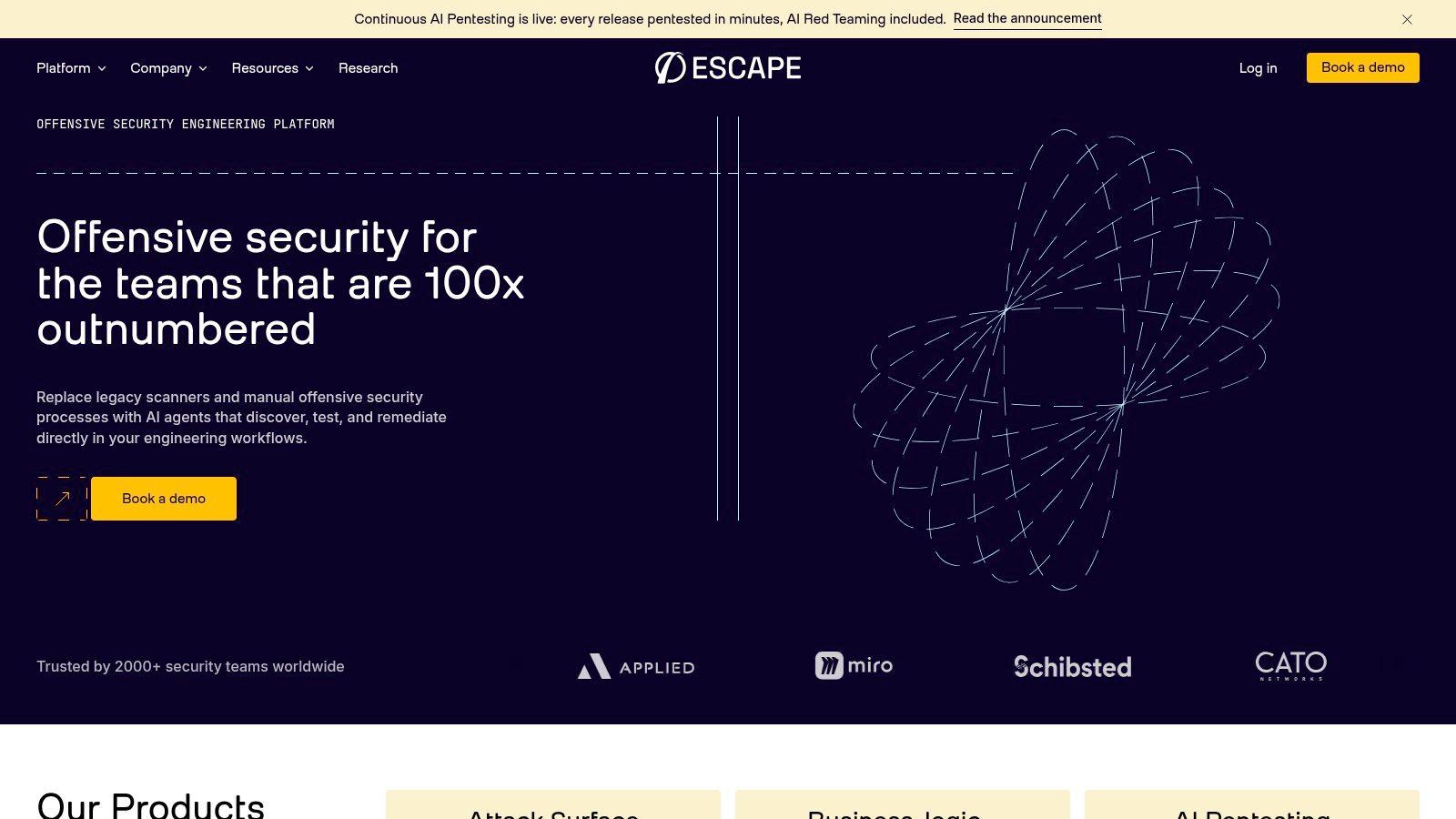
Escape goes deep where network-first tools go shallow: web applications, APIs, and application-layer attack surfaces. It combines DAST, attack surface management, and agentic AI pentesting, with agents that explore apps and APIs while a separate reporter process reproduces candidate findings before filing them.
That reproduction step is worth attention. It tests REST and GraphQL use cases, business logic, authorization flaws, and multi-step attack paths, then gives evidence and reproduction steps developers can act on. API, CLI, and MCP support, plus an AWS Marketplace option, make recurring, programmatic testing practical for product teams.
This focus matters as AI features enter client applications. Cobalt's 2025 State of Pentesting key takeaways state that 98% of surveyed organizations are incorporating generative AI into products, but only 66% conduct regular security assessments such as pentesting on those products. Ask any application platform how it handles prompt injection, excessive agent permissions, and plug-in abuse, and whether it can prove unauthorized business impact rather than flag odd model behavior.
Boundaries
Pricing isn't publicly listed. AI Network Pentesting is in beta, doesn't test Active Directory, and doesn't perform asset discovery, so don't rely on it for internal network scope yet.
Documentation describes scope enforcement, guardrails, and finding reproduction, which I see as a strength for production testing. Providers with broad network and cloud obligations will still need a second platform.
8. BreachLock
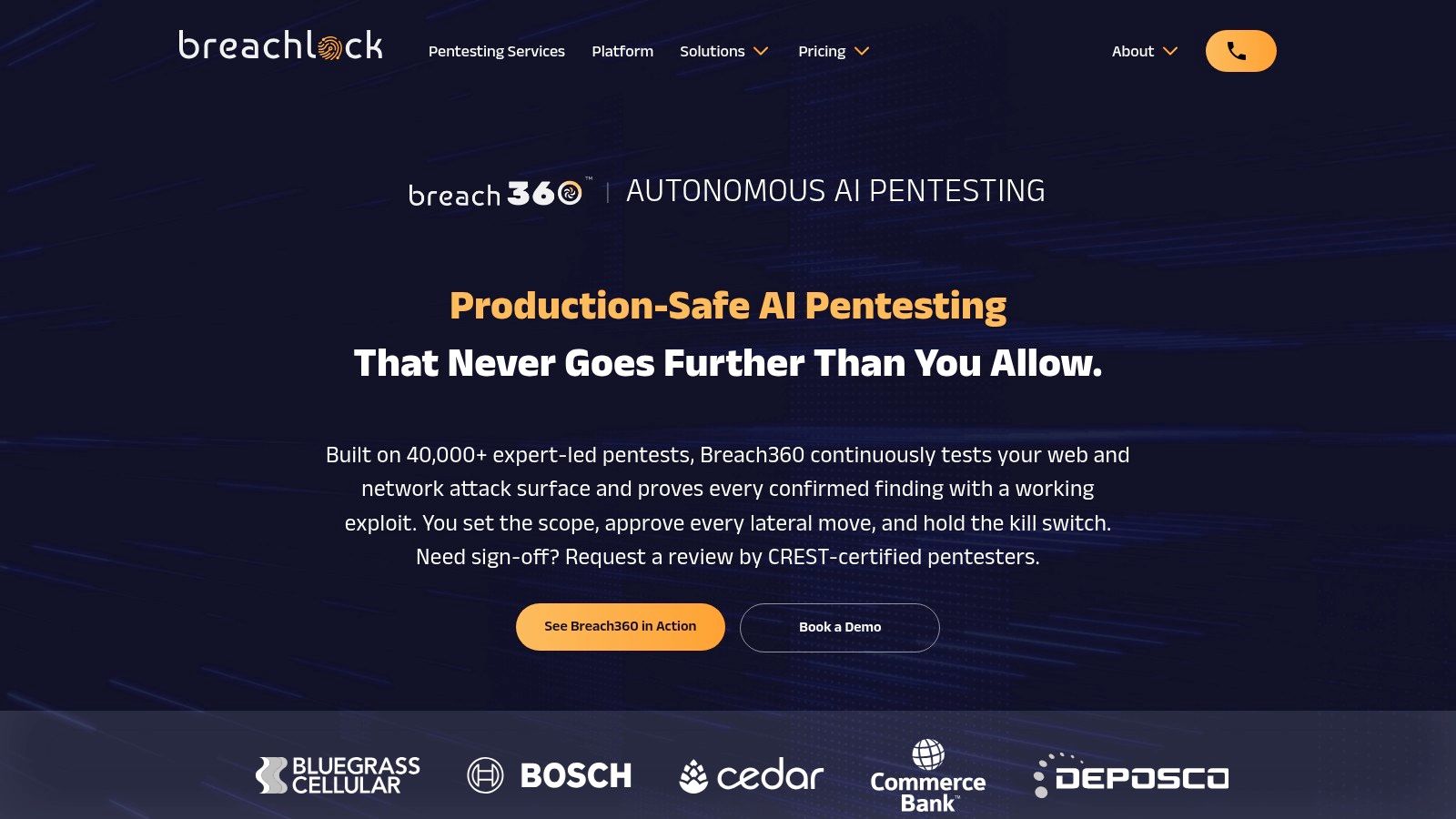
BreachLock tries to cover both buying motions: autonomous testing when you want speed, human-led PTaaS when you need certified testers. Its Breach360 capability is presented as agentic testing for web and network environments, connected to attack surface management.
Discovery feeding validation is the right architecture. You get live attack-path visibility, evidence, and prioritized remediation advice, with optional human review before findings drive client work. Controls include approval gates for lateral movement and an emergency stop, which are exactly the guardrails you want before running autonomous exploitation in production.
Remediation Is the Real Test
Faster discovery doesn't automatically reduce risk. Cobalt's State of Pentesting 2025 report is cited for the finding that 75% of organizations set a 14-day SLA for serious pentest findings, yet the median resolution time is 37 days. Evaluate BreachLock on deduplication, retest proof, SLA tracking, and evidence retention, not only on how quickly it finds the first issue.
- Strength: Automated validation and human assessment under one vendor relationship.
- Control: Scope approvals and an emergency stop for production safety.
- Gap to check: Which functions are included in which product and contract, since packaging can shift.
Pricing isn't published and requires a demo. The autonomous product is relatively new, so validate it against your own targets and reporting requirements before you standardize client delivery on it.
9. Synack
Synack is a testing service platform, not inexpensive self-serve software. It combines a vetted researcher community with Sara Pentest, its AI-led option, alongside human-led packages for deeper or compliance-focused engagements.
The platform handles findings management, vulnerability tracking, patch verification, and retesting. That gives you an escalation path inside one relationship: start AI-led for coverage, bring researchers in when a target needs creative manual investigation, and keep remediation history in the same system.
Economics and Fit
Purchases are credit-based, with a platform subscription listed separately. Published starting prices help initial comparison, but you need to model the subscription plus credits together, or your first quote to a client will be wrong.
- Best for: Buyers who want researcher access without hiring or vetting testers themselves.
- Watch out: Package scope and duration may not suit multi-customer service delivery at MSP price points.
- Not ideal for: Providers who want a white-labeled engine they operate under their own brand.
I wouldn't force Synack into a high-volume, low-margin managed offer. Where a regulated client values vetted human testing and structured patch verification, and will pay for it, the model makes sense. Confirm how credits are consumed per asset type before you commit.
10. XBOW
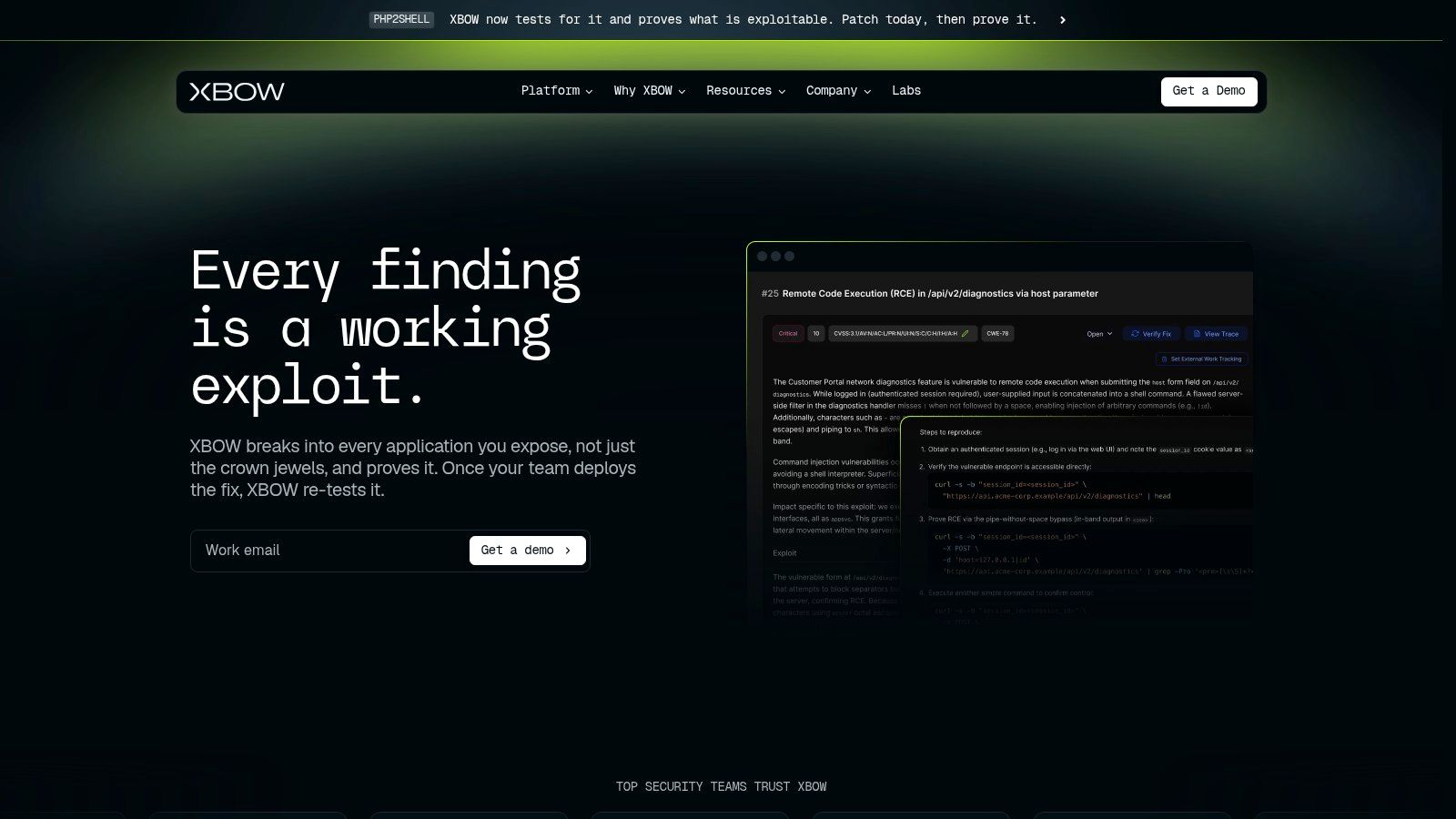
An auditor wants a current web application pentest report, and your testers are already booked. XBOW is built for that narrower job. Its Pentest On-Demand offering runs AI-driven web application assessments and produces compliance-oriented documentation, so the immediate deliverable is a report an auditor can read rather than a raw scanner export.
Lead time is the trade you are buying. Autonomous testing is meant to start sooner than a traditional engagement you still have to schedule. Public customer stories, which are vendor-reported, illustrate that compliance-readiness use case. Trust-center materials are worth reviewing for the audit documentation the vendor publishes. Treat that packet as input to your own vendor review, not as proof the product fits every control set.
Narrow by Design
Previously announced pricing started at $4,000 (XBOW). Packaging on newer autonomous platforms changes often, so confirm the live price before it lands in a client quote. I would not reuse a stale list price in a proposal.
Scope is the constraint that matters for a service provider. XBOW is primarily application-focused, so it does not stand in for broad internal network and cloud pentesting. Check integrations, reseller features, and multi-tenant operations before you assume one clean customer workflow becomes a managed offer. A per-test price only works if the test matches the scope you sell across clients.
Use it for focused web app automation. Pick another platform when one contract must cover web, network, and cloud for many tenants, or when the client expects a human tester to take over findings the automation cannot explain.
How the 10 penetration testing platforms compare on pricing, coverage, and fit
The table sorts these platforms by what a services lead weighs: price per test, target coverage, and whether a human tester is available when scope gets awkward. Prices are vendor-published or previously announced starting points, not contract figures.
| Item | Published pricing | Primary target types | Best for | Human-led option |
|---|---|---|---|---|
| ThreatExploit AI | Per pentest run, not per seat; free account available | Web apps and REST/GraphQL APIs, internal and external networks, AWS, Azure, and GCP | Service providers scaling automated pentesting and client reporting | Automated only; no pentesters needed on staff |
| Horizon3.ai, NodeZero | Flex: $15 per asset per test; Core: $50 per asset annually | Internal and external networks, cloud, and Kubernetes | MSPs and MSSPs running recurring, multi-client assessments | Automated only; self-serve autonomous testing |
| Pentera | Not publicly listed; sales-led evaluation | Internal and external environments, cloud, web apps, and APIs | Enterprises validating attack paths and remediation | Automated only; platform-run validation |
| Cobalt | Autonomous web-app test listed at $3,500 per test as a limited-time offer | Web apps; human engagements can be scoped separately | Teams combining managed pentest workflows with expert testing | Yes; human pentesters available |
| Vonahi Security, vPenTest | Not publicly listed; partner licensing is sales-led | Internal and external networks | MSPs needing branded network testing and reports | Automated only; no tester required |
| Pentest-Tools.com | Free edition and 7-day trial; paid plans start at $95 per month | Web apps, APIs, networks, and cloud | Consultants seeking an accessible offensive-security toolkit | Human-driven; your tester runs the tools |
| Escape | Not publicly listed; quote through sales | Web apps, APIs, and application-layer attack surfaces | Teams prioritizing application and API security testing | Automated only |
| BreachLock | Not publicly listed; contact sales | Internal and external networks, and web apps | Buyers combining autonomous testing with human-led assessments | Yes; certified PTaaS engagements |
| Synack | Published starting prices; credit-based testing and separate platform subscription may apply | Targets covered by AI-led and researcher-led testing engagements | Buyers wanting AI-led or researcher-led testing with remediation tracking | Yes; vetted researchers |
| XBOW | Previously announced pricing started at $4,000 | Web applications | Teams seeking autonomous application pentesting and compliance documentation | Automated only; AI-driven web app testing |
Match the pricing model to your delivery model. Per-asset pricing rewards broad internal scopes with many hosts; per-test pricing keeps a fixed-scope quote predictable. Only three rows put a human on the test, and those engagements price like an expert's time.
Choosing Your Platform Verify Claims Before You Commit
Don't buy penetration testing platforms from a feature grid. Buy them from a pilot that mirrors how you'll deliver work for paying clients.
Start with target coverage against real client environments. Write down your last ten scopes and mark what each platform covers natively, covers through an add-on, or doesn't cover at all. Pay attention to the seams: web testing sold separately from network testing, beta network features without Active Directory, cloud checks that aren't full cloud exploitation, and API testing that handles REST but not GraphQL. Those seams become your manual work.
Next, get economics in writing. Ask whether pricing is per test, per asset, per seat, credit-based, or subscription plus credits, and get the vendor's definition of an asset, a test, and a retest. A low per-asset rate can become expensive if every IP, subdomain, and cloud resource counts separately. Our partner pricing is charged per pentest run, not per seat, which makes the cost of a client engagement predictable before you quote it. Whatever model you choose, model your margin at your actual test volume, including retests after remediation.
Then test multi-client operations, not just the engine. Create two client tenants, run overlapping scopes, and check tenant isolation, role-based permissions, white-labeling, evidence ownership, and report export. Confirm who can see screenshots and credentials, how long evidence is retained, and whether findings deduplicate across recurring runs. Ask how the platform proves a fix closed the attack path, tracks SLAs, and exports compliance mappings your auditors accept.
Run a pilot against an authorized target with known vulnerabilities. Seed a few findings your tester already knows exist, include one false lead a scanner would flag, and compare what the platform verifies, misses, and overstates. Read the report as your client would. If a competent engineer can't reproduce and fix the issue from the evidence provided, the finding isn't finished, no matter how fast it arrived.
Check human escalation before you need it. Decide which scopes stay automated, which trigger human review, and who provides that human, you or the vendor. Complex business logic, chained attack paths, AI application behavior, and anything with production safety concerns need a named owner and approval gates. Confirm scope enforcement, emergency stop controls, and testing windows for production systems.
Respect authorization boundaries without exception. You may not test third-party cloud, hosting, telecom, or SaaS infrastructure without complying with that provider's testing policy and obtaining any required authorization. Get client authorization in writing, confirm the upstream provider's rules, and keep both with the engagement record. Access on our platform is limited to verified users and organizations for exactly this reason.
Finally, use the lowest-risk evaluation available. A free trial account lets you run a test pentest, inspect evidence quality, time the report, and show the output to a friendly client before money changes hands. That's worth more than any vendor claim on this page, including ours. Create the account, run your pilot this week, and let verified results on your own authorized target decide.
If you need to deliver verified web, network, API, and cloud tests for multiple clients without waiting on scarce senior testers, ThreatExploit AI gives you per-test partner pricing, dedicated test infrastructure, and compliance-mapped reports in hours. Create a free account, run a pilot against an authorized target, and judge the evidence and report quality firsthand before you put it in front of a client.