
A client's network scan just finished. The export says 400 findings, the account manager is asking which ones are real, and you've got three days to turn that spreadsheet into a report someone can defend. That's the moment tool choice stops being a preference and starts deciding your evidence.
A scanner can tell you a service looks vulnerable. It can't, on its own, show that an attacker can reach it, exploit it, and get to something that matters. The gap matters because exploitation of vulnerabilities accounted for 20% of breaches in Verizon's analysis of more than 22,000 security incidents, including 12,195 confirmed data breaches, according to the 2025 Data Breach Investigations Report executive summary. Perimeter devices and VPNs also jumped as targets in that dataset, so internet-facing exposure can't sit in a queue waiting for manual triage.
If you're sorting that risk from general company security, it helps to compare cybersecurity and network security before you pick tools. Then judge network penetration testing tools by the evidence they produce, not by logo recognition.
The five evidence types in this comparison
- Discovery: what's alive, what's listening, and what version is it running
- Vulnerability assessment: which known weaknesses and misconfigurations match that inventory
- Validated exploitation: which findings yield access under controlled conditions
- Adversary simulation: whether defenders detect and contain realistic post-exploitation behavior
- Continuous management: whether you can repeat, retest, and report without rebuilding the workflow each time
The ten tools below sit in different places on that scale. Some are excellent at one layer and silent on the next. That's not a flaw if you know it going in.
Table of Contents
- The five evidence types in this comparison
- 1. ThreatExploit AI
- 2. Nmap
- 3. Metasploit Framework and Metasploit Pro
- 4. Tenable Nessus
- 5. OPENVAS Community Edition
- 6. Rapid7 InsightVM
- 7. Cobalt Strike
- 8. Core Impact
- 9. Horizon3.ai NodeZero
- 10. OPENVAS SCAN
- How the 10 network penetration testing tools differ on pricing, fit, and exploit validation
- Matching Tools to Proof, Not Just to Budget
1. ThreatExploit AI
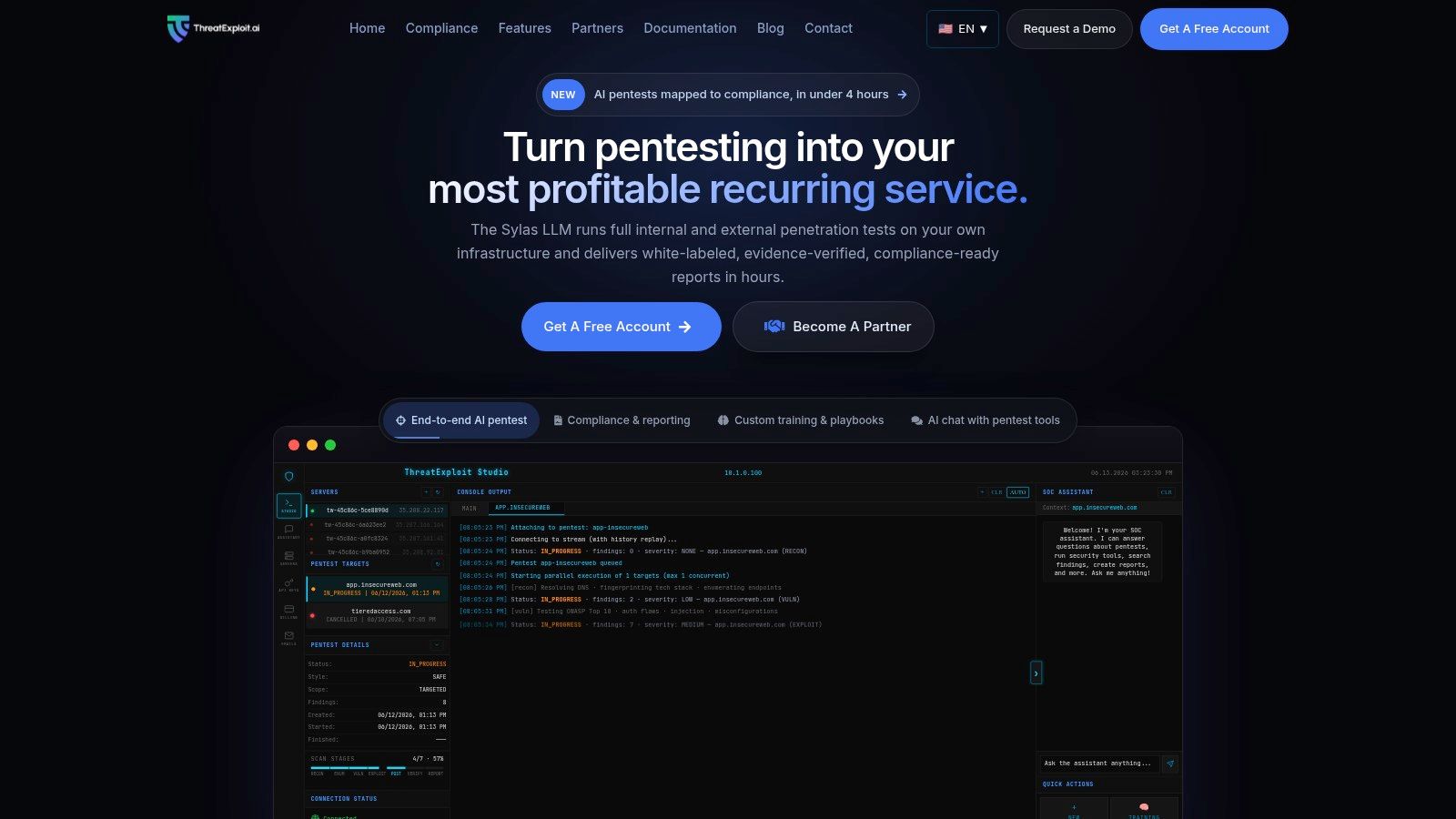
ThreatExploit AI is built for MSSPs, consultancies, MSPs, telecom and hosting providers, and compliance firms that need more assessments without hiring a pentester for each new client. I place it in the orchestration category, not the scanner category. Its Sylas LLM and ROOT Controller coordinate autonomous agents through all seven PTES phases, from reconnaissance and vulnerability testing to exploitation, verification, and reporting.
That scope is broad by design. It covers web applications and REST and GraphQL APIs, internal and external networks, and AWS, Azure, and GCP, orchestrating 60+ open-source and proprietary tools such as Nmap, SQLMap, and Nuclei. For a provider drowning in handoffs between those utilities, the value isn't owning another scanner. It's keeping scope, evidence, and reporting in one repeatable run.
What the output actually looks like
Reports include executive and technical views, evidence and screenshots, remediation guidance, and risk scoring, with PDF, JSON, and structured exports. Findings map to HIPAA, SOC 2, PCI-DSS, CMMC, ISO 27001, GLBA, and GDPR. Tests run on dedicated, partner-scoped infrastructure in America, Europe, and Asia rather than shared multi-tenant servers, and the partner dashboard handles customer onboarding, multi-tenant reporting, API and CI/CD integration, and role-based access.
That emphasis on delivery lines up with buyer behavior. In a 2024 global survey, 73% considered functionality a key reason to evaluate commercial tools, and reporting, templates and automation, and extensive threat libraries were each selected by 65%, as shown in the Fortra 2024 penetration testing report. Forrester's earlier survey put reporting at 71% as the leading paid-tool requirement, while 72% used free and/or open-source tools, per the Core Security 2023 penetration testing report. Orchestration only earns its cost if it preserves tester control while making those tools produce consistent, customer-ready evidence.
ThreatExploit advertises complete reports in under four hours, and pricing is per test with volume tiers, adjusted to partner volume with no public rate card and a free account available. Treat the speed and accuracy figures as vendor-reported claims. The supplied materials differ slightly, citing 95% verification and 94% accuracy in product details and 94% on the website. There are downloadable sample reports and ecosystem partner logos, but no named customer testimonials or awards.
Practical rule: Judge an orchestration platform on report production time, analyst review hours, evidence completeness, and findings accepted without rework, not on tool count alone.
If you want the network-specific positioning, start with the guide to network penetration testing and then pilot it against a lab range you already know. That's where you'll see whether verification holds up.
2. Nmap
Start every network engagement with a map you trust. Nmap gives you live hosts, open ports, services and versions, operating systems, and some firewall characteristics, with the Nmap Scripting Engine for extra checks. It's free for end users, runs on Windows, macOS, and Linux, and the Windows download includes Zenmap.
That foundation role is well documented. In NIST Special Publication 800-115, network discovery and vulnerability scanning are core activities, and its tool lists explicitly include Nmap, Netdiscover, P0f, UnicornScan, Firewalk, Hydra, Metasploit, and Snort. The point in that list is combination, not substitution. No single utility covers the whole test.
Defenders should read Nmap output the same way attackers do. MITRE classifies Network Service Discovery as technique T1046, and MITRE ATT&CK T1046 documents examples including APT39 using CrackMapExec, Agrius using WinEggDrop, and BackdoorDiplomacy using SMBTouch to identify systems vulnerable to EternalBlue. Your scan is rehearsing a real adversary behavior, which is why timing and scope matter.
Where Nmap stops
- Strength: flexible command-line control over scope and technique for manual analysis
- Limit: discovery doesn't prove a vulnerability is exploitable, and there's no client-ready engagement report
- Skill cost: you need an operator who can configure scans and interpret ambiguous service fingerprints
- Licensing note: commercial embedding or redistribution needs a separate OEM license
For perimeter work specifically, pair it with the discipline in this overview of external network penetration testing. I recommend Nmap in every toolkit, but never as the whole toolkit. It's the instrument that tells you where to point the next one.
3. Metasploit Framework and Metasploit Pro
Discovery tells you a door exists. Metasploit is where you check, carefully, whether it's open to entry. The open-source Framework is a hands-on, command-line platform for researching and validating weaknesses with modular exploits, payloads, enumeration, and post-exploitation workflows. Pro adds a web interface, task chains, vulnerability validation, evidence collection, and reporting, plus integration with Rapid7 vulnerability-management products.
That validation step is the underserved part of most tool comparisons. CISA recommends defenses be regularly validated through exercises testing both external intrusion and an "assume breach" attacker's ability to move laterally toward critical systems, including OT and ICS, in the CISA Cross-Sector Cybersecurity Performance Goals checklist. An open port isn't business impact. Metasploit helps you connect a foothold to privilege and reach, or show that the chain breaks.
What you're trading
The Framework costs nothing and gives you a deep module ecosystem, but you're the safety system. You choose targets, payloads, and stopping conditions, and you document what happened. Pro structures that work for teams, although Pro pricing isn't published on the product pages cited here, and the Framework doesn't include all Pro capabilities.
A successful module run proves exploitability under those exact conditions. It doesn't prove the same path works after patching, segmentation changes, or credential rotation, so retest the chain, not just the CVE.
I recommend Metasploit when the client question is "can they really get in this way." Don't use it to generate volume. Use it to settle the findings that drive remediation priority, with experienced operators and written authorization.
4. Tenable Nessus
Tenable Nessus is the baseline scanner many teams reach for first, and for good reason. It checks networked systems for known vulnerabilities and configuration issues, offers prebuilt configuration and compliance audits, vulnerability scoring, and configurable reports, with flexible deployment and recurring scanning. Tenable lists Nessus Professional at $4,790 for a one-year license on the Nessus product page.
Use it to establish what might be wrong across a large estate, quickly and repeatably. Credentialed scans, where the client permits them, usually give you better configuration visibility than unauthenticated probes alone. Uncredentialed scans still have value because they show what an outsider can infer from exposed services.
What Nessus proves, and what it doesn't
- Proves: a host matches a known vulnerability check or audit policy at scan time
- Supports: prioritization, recurring assessment, and audit-oriented reporting
- Doesn't prove: that the weakness is reachable and exploitable into meaningful access
- Watch out: broader asset management or continuous exposure needs may push you into a larger Tenable product
That last limit is why Nessus output so often creates the 400-finding problem. Every medium looks urgent until someone tests reachability, compensating controls, and exploitability. Nessus is strong at breadth. Pair it with a validation layer for the handful of findings that could become an attack path, and keep the rest in a remediation queue ranked by exposure and asset value.
I recommend Nessus for teams that need a defensible, repeatable vulnerability baseline. I don't recommend presenting its report as a penetration test. Clients notice the difference when you can't show impact.
5. OPENVAS Community Edition
If budget is tight and your team can run its own infrastructure, OPENVAS Community Edition is Greenbone's self-managed route into vulnerability scanning. You can set it up with containers, packages for some Linux distributions, or source builds, and you control the environment it runs in. There's no commercial appliance purchase required to start.
The trade is administrator time. Installation looks simple on day one. Feed synchronization, maintenance, troubleshooting, and tuning are where the hours go in month three. Community and enterprise feeds differ, so check coverage and support expectations before you promise a client a scan depth you can't deliver.
A realistic fit
This edition works well for labs, small internal programs, and learning how vulnerability scanning behaves before you buy support. It's also a useful second opinion against a commercial scanner, since different feeds and checks catch different things. For client-facing internal work, read the guide to internal network penetration testing alongside it, because internal reachability changes which findings matter.
- Strength: self-managed deployment with an upgrade path to Greenbone commercial products, feeds, appliances, and support
- Cost: your team owns updates, feed health, and broken scans
- Evidence limit: results identify potential vulnerabilities, not verified exploit paths
Don't judge it against Nessus on polish. Judge it on whether your team will keep it maintained. An unpatched scanner with stale feeds gives you false confidence, which is worse than a smaller scan you trust.
6. Rapid7 InsightVM
Rapid7 InsightVM isn't trying to be an exploit tool. It's vulnerability management, combining network scanning, asset organization, risk prioritization, and reporting so findings are tracked over time instead of delivered once and forgotten. Rapid7 lists a starting price of $1.62 per asset per month for 500 assets and offers a trial on the InsightVM product page.
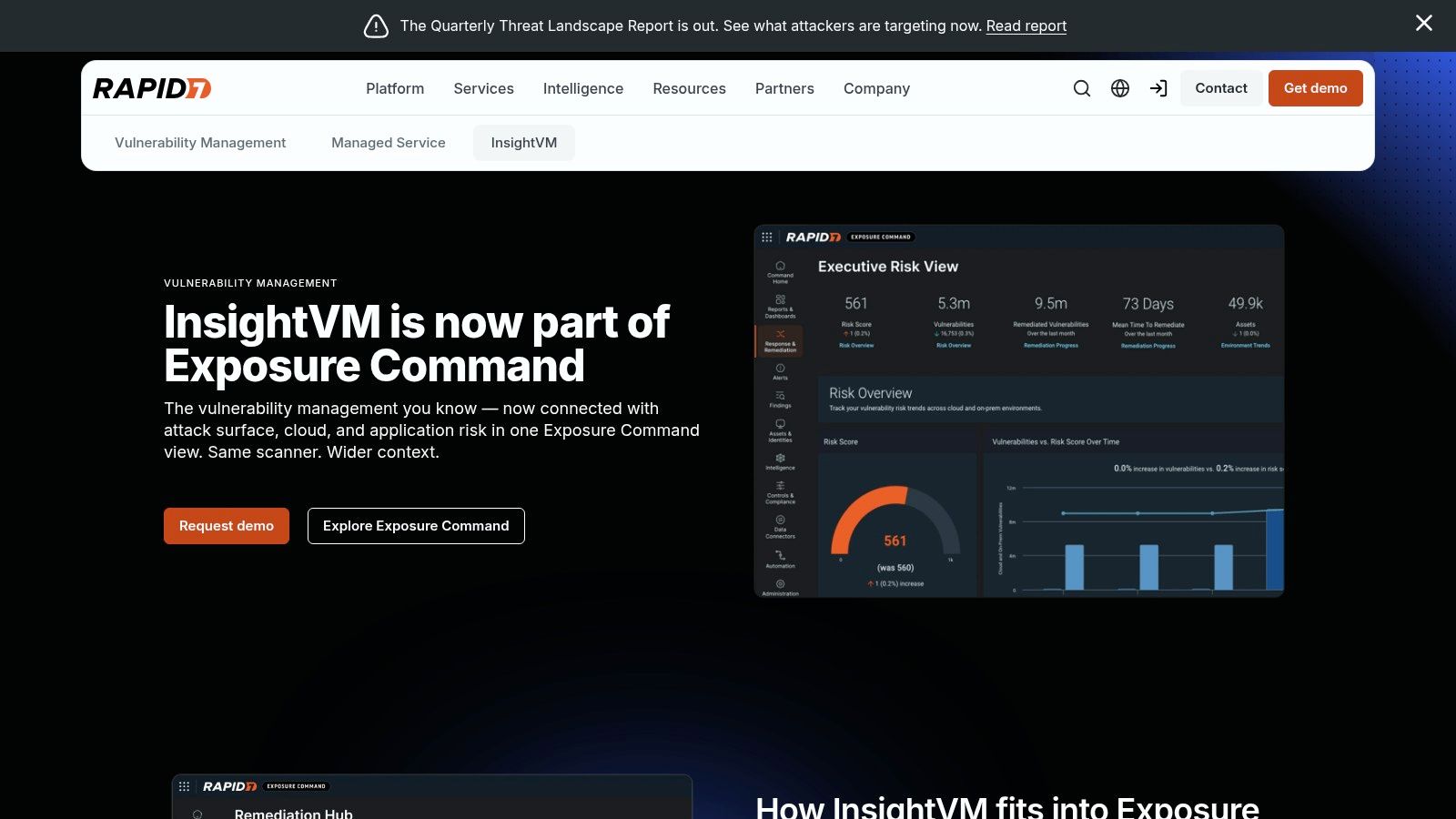
That tracking layer matters more than most pentest buyers admit. A point-in-time report tells a client what's broken today. InsightVM's scan engines for network and cloud-hosted infrastructure, asset grouping, scan scheduling, remediation guidance, and integrations help them show whether it's still broken next quarter and who owns the fix.
When it earns its place
Choose InsightVM when the engagement is really a program, with recurring scans, asset owners, and remediation deadlines. It's also useful upstream of exploitation work, because grouped, prioritized assets make validation targets easier to pick. Large or complex environments still need scan-engine planning and administration, and actual costs depend on licensing beyond that starting price.
- Strength: scheduled scans and trend reporting across grouped assets
- Transparency: published starting price and a trial for hands-on evaluation
- Limit: primarily vulnerability management, not a replacement for exploitation-led testing
I recommend it for organizations that already know their problem is follow-through. If findings die in inboxes, the management layer helps. If nobody has yet proven which findings are exploitable, you still need a tester or a validation platform beside it.
7. Cobalt Strike
Cobalt Strike answers a different question entirely. Don't ask it what's vulnerable. Ask whether the security team notices when someone is already inside, communicating out, and moving. It's an adversary-simulation and red-team platform built around Beacon and configurable command-and-control, with community extensions, interoperability with other offensive tools, and reporting for engagement timelines and indicators.
That makes it powerful and narrow at the same time. A mature client with a SOC, EDR coverage, and incident response runbooks can learn a lot from a well-governed simulation. A client still struggling to patch internet-facing VPNs will learn mostly that they're not ready, which cheaper tools could've told them.
Governance isn't optional
Fortra vets prospective buyers, pricing is quote-based, and the platform expects experienced operators. You'll need tight rules on infrastructure, payload handling, data access, cleanup, and deconfliction with defenders. Timeline reporting is valuable only if someone reconstructs detections accurately afterward.
- Strength: tests detection and response beyond known vulnerabilities
- Flexibility: designed to work alongside other offensive-security tools
- Barrier: restricted purchase, quote-based pricing, and a steep operator requirement
- Not suited to: beginner vulnerability scanning or routine compliance checks
I recommend Cobalt Strike only when detection is the thing being tested. Used as a flashy extras package on a standard network pentest, it adds risk without adding proportionate evidence.
8. Core Impact
Core Impact sits between the scanner report and the hand-built exploit session. It's commercial penetration-testing software focused on guided automation and validated exploits, testing network infrastructure, endpoints, and applications. Its Rapid Penetration Tests structure the workflow, and it can import findings from Nessus, Nmap, and OpenVAS so validation starts from scanner output instead of a blank screen.
That import step is the practical appeal. Say Nessus flags a critical service on a server segment. Instead of debating severity in a meeting, a tester can attempt controlled validation and record whether access followed. The vendor describes its exploit library as validated and updated, and the product includes reporting plus options for cleaning up deployed agents, which matters when you leave a client network.
Pricing and constraints
Budgeting is unusually visible for this category. Core Impact Basic is listed at $9,450 per year and Pro at $12,600 per year, with Enterprise pricing customized, according to the Core Impact product page. Those figures may not cover every configuration, so confirm scope before quoting a client.
- Strength: bridges vulnerability scanning and controlled exploitation in one workflow
- Efficiency: scanner integrations focus validation on existing findings
- Limit: skilled users still have to select scope and interpret outcomes safely
- Deployment caveat: Windows-based deployment may not suit every team
I recommend Core Impact for consultancies that want repeatable validation without building everything around command-line frameworks. It's not push-button assurance. Guided automation speeds the mechanics, but judgment about target selection and business impact stays with the tester.
9. Horizon3.ai NodeZero
Horizon3.ai NodeZero takes the autonomous route to attack-path evidence. It tests internal and external environments, cloud, and Kubernetes, chaining weaknesses together and providing evidence of impact, remediation guidance, and retesting. External tests run from Horizon3's cloud, while internal testing uses a NodeZero host deployed in your environment. Pricing isn't published on the product page.
The operating model is the key decision here. Industry survey material reports software-based pentesting and red teaming had reached 50% adoption, while traditional vulnerability scanning remained at 46% and scanning continues to have limitations in validating real-world risk, per the Pentera State of Pentesting 2025 report. Automation helps with frequency and breadth. It doesn't remove questions of authorization, safety, or interpretation.
What to check before you buy
- Visibility: real-time test views and a centralized portal for multiple operations
- Proof style: findings connect to demonstrated impact, not just matched CVEs
- Retesting: you can check whether fixes closed the path
- Overhead: internal tests need a deployed host, careful scoping, and human review of ambiguous results
On autonomy: let software handle reconnaissance, repeatability, evidence collection, and regression checks. Keep scope approval, novel attack chains, and risk acceptance with senior testers.
I recommend NodeZero for providers and internal teams that want recurring attack-path testing between human-led engagements. Don't frame it as a tester replacement. Frame it as more frequent evidence, with experts handling the edge cases it surfaces.
10. OPENVAS SCAN
OPENVAS SCAN is Greenbone's commercial answer to the maintenance burden in the community edition. It's a hardware or virtual appliance using the enterprise vulnerability feed, with commercial support and product lifecycle information. You're paying for a packaged, vendor-supported scanning system instead of assembling and nursing your own.
For organizations that run recurring scans across a defined estate and want support accountability, that trade makes sense. The appliance model gives operations teams a known deployment shape, and the enterprise feed addresses one of the community edition's main caveats. Greenbone's portfolio also includes entry-level and community products, so you can compare tiers before committing.
The honest limits
Pricing isn't published, so you'll need to contact Greenbone for a quote. For a small team with a handful of subnets, an appliance and enterprise feed may be more program than you need. Above all, the evidence category doesn't change because the support contract improved.
- Strength: vendor-supported alternative to operating the community edition yourself
- Deployment: packaged hardware or virtual appliance for recurring organizational scanning
- Limit: scan results don't by themselves prove findings can be exploited
I recommend OPENVAS SCAN when reliability of the scanning program is the bottleneck, not validation. If your community instance sits broken between engagements, supported infrastructure fixes a real problem. If your problem is unproven findings, spend that money on the validation layer instead.
How the 10 network penetration testing tools differ on pricing, fit, and exploit validation
| Item | Pricing Model | Best For | Validates Exploitability | Deployment |
|---|---|---|---|---|
| ThreatExploit AI | Per-test, volume tiers; quote-based; free account available | Providers scaling client pentesting services | Yes; automated exploitation and verification | Dedicated, partner-scoped infrastructure; regional options |
| Nmap | Free for end users; OEM license for commercial embedding or redistribution | Network discovery and mapping | No; discovery findings need further testing | Windows, macOS, and Linux |
| Metasploit Framework and Metasploit Pro | Framework is open source; Pro pricing is quote-based | Hands-on exploitation and weakness validation | Yes; controlled exploitation | Framework is command-line; Pro adds a web interface |
| Tenable Nessus | Nessus Professional listed at $4,790 per year | Network vulnerability assessment and prioritization | No; findings may not be exploitable | Flexible deployment; recurring scans |
| OPENVAS Community Edition | Community edition available without a commercial purchase | Self-managed vulnerability scanning | No; identifies potential vulnerabilities | Self-managed; containers, select Linux packages, or source builds |
| Rapid7 InsightVM | Starts at $1.62 per asset per month for 500 assets; trial available | Ongoing vulnerability management | No; primarily scans and prioritizes vulnerabilities | Scan engines for network and cloud-hosted infrastructure |
| Cobalt Strike | Quote-based; purchase restricted to vetted buyers | Authorized red-team and adversary simulations | Supports red-team simulation, not general vulnerability validation | Operator-managed platform |
| Core Impact | Basic $9,450/year; Pro $12,600/year; Enterprise customized | Guided penetration testing and exploit validation | Yes; validates scanner findings through controlled exploitation | Windows-based |
| Horizon3.ai NodeZero | Quote-based | Autonomous testing across networks, cloud, and Kubernetes | Yes; tests attack paths and provides impact evidence | Internal host in customer environment; external tests from vendor cloud |
| OPENVAS SCAN | Quote-based | Vendor-supported recurring vulnerability scanning | No; scan results do not prove exploitability | Hardware or virtual appliance |
Matching Tools to Proof, Not Just to Budget
Go back to that client with 400 findings and three days. The wrong response is buying a bigger scanner. The right response is deciding what proof the report needs, then assigning each tool to the layer where its evidence is strongest.
Start by mapping the engagement question. If the client asks "what do we expose," Nmap plus Nessus, OPENVAS Community Edition, or OPENVAS SCAN answers it. If they ask "what should we fix first," add prioritization and tracking with InsightVM. If they ask "can an attacker get in," you need validation through Metasploit, Core Impact, NodeZero, or an orchestrated platform such as ThreatExploit AI. If they ask "would we notice," that's Cobalt Strike territory, and only for mature detection programs.
Pair breadth with proof
Discovery and scanning tools are cheap per host and excellent at coverage. They're also where false confidence starts. Every scanner finding you plan to call critical should either be validated, shown reachable from a realistic attacker position, or explicitly labeled unverified. That labeling isn't weakness. It's what makes the verified findings believable.
Compliance deadlines make this pairing concrete. PCI guidance summarized for Requirement 11.4 calls for internal and external penetration testing at least every 12 months and after significant segmentation changes, with quarterly scans described across the cardholder data environment, per the Scrut PCI DSS penetration testing requirements guide. Segmentation claims need live probes against the actual controls, not firewall diagrams. Scanning keeps the quarterly rhythm. Testing proves the boundary.
Put safety in writing before tooling
None of this works without authorization mechanics. CISA states a penetration test must operate under a signed Rules of Engagement document defining scope, with tests coordinated by possible damage level, constant communication with the customer's technical contact, and testing only during agreed times against predetermined systems, as set out on CISA's penetration testing service page. Unrestricted scanning can affect production availability, trigger defenses, or reach systems outside the boundary. Your tooling should make scope easy to enforce and easy to audit afterward.
That's where orchestration earns consideration. A platform that coordinates discovery, scanning, exploitation, verification, and reporting can keep evidence attached to each finding and make retesting a rerun instead of a rebuild. It doesn't eliminate human review. It moves reviewer time to the ambiguous, high-impact results where judgment matters most, instead of burning it on formatting and handoffs.
A concrete way to decide
- Pick one known environment: a lab range or a small client segment with findings you already understand
- Run your current stack and one challenger: same scope, same window, same rules of engagement
- Count confirmed findings: how many scanner results become verified, reachable, or clearly disproven
- Time the reporting: hours from last probe to a report you'd send without embarrassment
- Log human interventions: every manual rescue, false-positive dispute, and evidence gap
Those five measures tell you more than any feature matrix. A tool that finds less but proves more will usually serve a consultancy better than one that inflates the finding count. A management platform that proves nothing new but gets fixes closed may be the right buy for an internal team. Budget follows the evidence you need, not the other way around.
Run that pilot before your next annual buying cycle. You'll stop arguing about network penetration testing tools in the abstract and start choosing them by what they help you stand behind in front of a client.
If you deliver network assessments for clients and your bottleneck is turning scanner output into verified, compliance-mapped reports, ThreatExploit AI orchestrates reconnaissance, exploitation, verification, and reporting across internal and external networks on dedicated partner infrastructure. Start a free account, run it against a test environment you know well, and compare confirmed findings and report time against your current workflow.