
Your annual PCI review looked clean on paper, the QSA signed off, and everyone moved on. Six months later, the report gets challenged because the testing record doesn't prove the cardholder data environment was still protected after changes, and the gap is obvious: a scan is not the same thing as a penetration test. That's the trap with penetration testing PCI, the work has to show that security systems and processes keep operating, not just that someone ran a tool once and exported a PDF.

A strong program makes the difference between a technical artifact and something a QSA can actually use. Managed service teams often discover that the hard part is not finding weaknesses, it's proving the findings were tested, remediated, and retested with evidence the assessor can trust. If you want the operational side of that work framed in a broader compliance context, how managed IT supports PCI is a useful outside perspective.
Table of Contents
- Understanding PCI DSS Requirement 11
- Applying the PTES Methodology to PCI Scopes
- Manual Versus Automated Testing Approaches
- Evidence Collection and Compliance Mapping
- Building a Continuous Testing Program
- Conclusion and Key Takeaways
Understanding PCI DSS Requirement 11
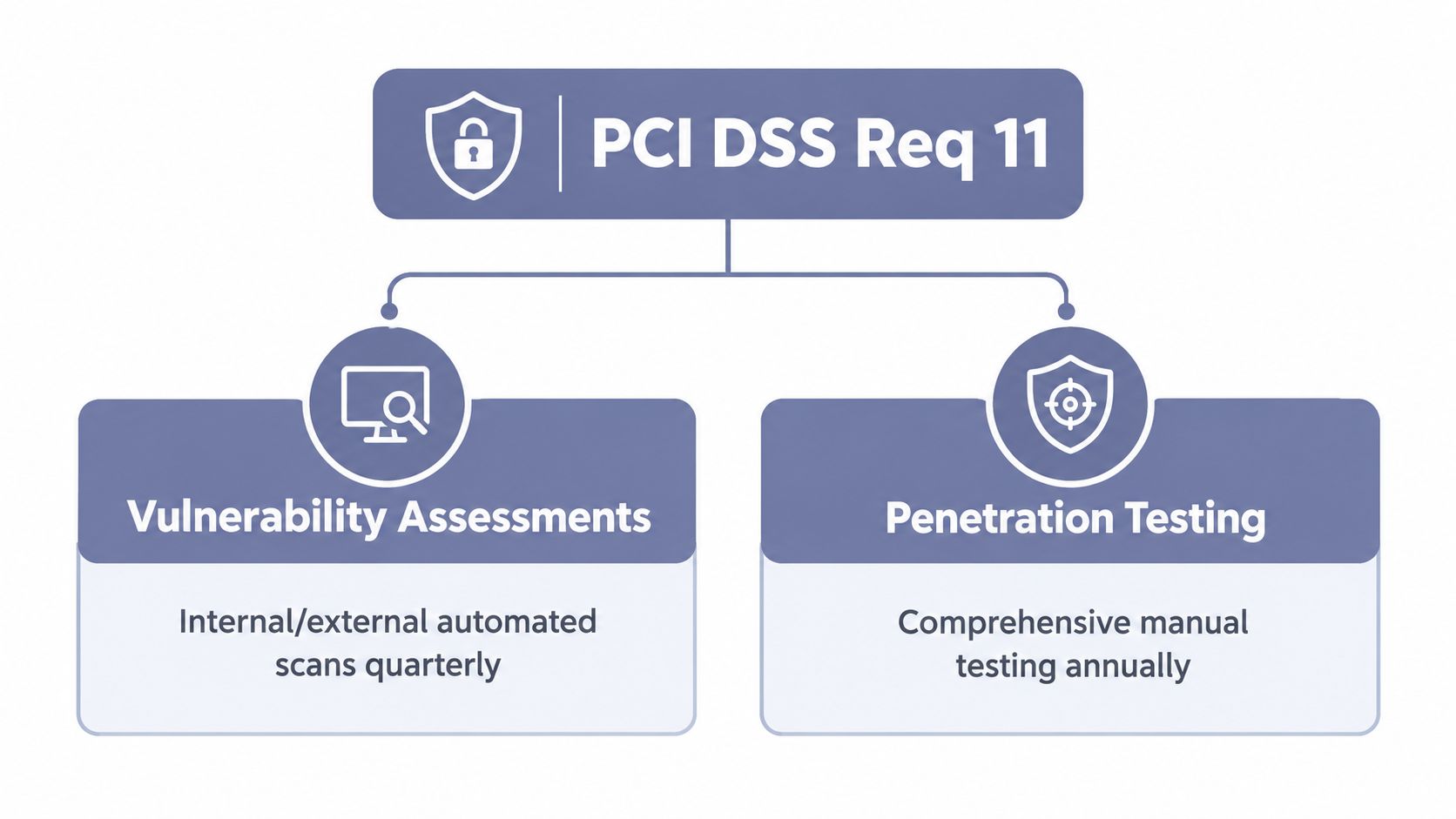
PCI DSS treats penetration testing as part of a broader obligation to test security systems and processes, and the distinction matters. A vulnerability assessment tells you what might be wrong, but a penetration test shows whether the weakness can be used to reach cardholder data or break segmentation. That's why Requirement 11 is built around validation, not just discovery.
What the assessor is really looking for
The standard's scope is not limited to one subnet or one application. It covers the Cardholder Data Environment, connected systems, the perimeter, and the places where control failure would expose cardholder data. PCI guidance also expects testing from both inside and outside the network, with network-layer and application-layer coverage, because a defensive posture that looks solid from one angle can still fail from another.
Practical rule: if the report only lists vulnerabilities, it reads like a scan. If it shows exploitation path, impact, remediation, and retest evidence, it starts to look like PCI-grade penetration testing.
That same discipline is why automation needs to be anchored to scope, not just speed. A tool can enumerate issues, but it won't decide whether a weakness belongs in the CDE, whether a segmentation control was truly tested, or whether the evidence chain is good enough for an assessor. For a concise mapping of control intent to tester responsibilities, the Microsoft summary of PCI Requirement 11 is useful reading, especially around the documented methodology requirement and the need to cover the entire perimeter and critical systems. PCI Requirement 11 summary
Why a scan never carries the whole burden
A scanner can support the work, but it cannot substitute for it. PCI guidance expects testers to assess exploitable weaknesses in a way that reflects the organization's size, complexity, and control design, which means the result has to show how the attack path was proven and what was done after discovery. That's also why evidence from related compliance workflows matters, such as the way SAQ types are chosen and documented. A practical overview of those choices is available in PCI DSS SAQ types compared, which helps frame why the right evidence package matters as much as the test itself.
The internal control library matters too. A PCI-facing team should keep methodology, retest, and remediation records in one place so the evidence can survive turnover, tool changes, and assessor review. A focused resource on that workflow is available at https://threatexploit.ai/en/resources/pci-dss-compliance-testing.
Applying the PTES Methodology to PCI Scopes
A PCI-ready engagement works better when it follows a named method instead of an improvised checklist. PTES gives you a clean way to structure the work, and that structure is what makes the final report easier to defend. In PCI environments, the method has to be repeatable, evidence-backed, and broad enough to cover both perimeter exposure and lateral movement into the CDE.
Pre-engagement and intelligence gathering
Start with authorization, scope, and rules of engagement. Then collect the architecture details that determine where the tester can safely operate, what systems are in scope, and which validation points will matter later. In a PCI job, the scoping work has to be tight because the wrong target set can invalidate the whole engagement.
Threat modeling and vulnerability analysis
Threat modeling in PCI is less about abstract attacker personas and more about practical paths into cardholder data. That means identifying externally reachable services, internal trust boundaries, application trust chains, and the controls that are supposed to stop movement into the CDE. Vulnerability analysis then maps those routes to concrete weaknesses, but only after the target inventory and attack paths are clear.
Exploitation, post-exploitation, and reporting
Exploitation should validate whether the issue can lead to unauthorized access or control loss. Post-exploitation is where the evidence becomes audit-useful, because the tester confirms impact, documents what was reached, and captures the proof needed for a QSA review. Reporting closes the loop only if it links findings to remediation and retest results, not just severity labels.
Every test should leave a traceable chain, from first authorization to final retest. If that chain breaks, the report becomes harder to defend than the vulnerability itself.
A disciplined PTES workflow also helps with chain of custody. Screenshots, logs, timestamps, and retest notes should line up with the change history in the environment, because PCI evidence gets weak fast when the tester can't show how a finding was closed. That's the main reason repeatable methodology matters more than an ad hoc “red team style” engagement in this context.
Manual Versus Automated Testing Approaches
Manual testing still matters, especially when a reviewer needs to reason about business logic, chained access, or segmentation assumptions. The trade-off is scale. Human-led work is slower to schedule, harder to standardize across many environments, and more likely to vary from one tester to the next. Automated systems solve the scheduling and consistency problem, but only if they verify findings and keep the evidence attached to each result.
| Metric | Manual Testing | Automated AI Testing |
|---|---|---|
| Coverage style | Deep, targeted, tester-dependent | Broad, repeatable, orchestrated |
| Speed | Slower execution and reporting | Faster execution and reporting |
| Consistency | Varies by tester | More consistent across runs |
| Evidence collection | Usually assembled manually | Can attach screenshots and structured proof |
| Scaling across many clients | Limited by senior tester time | Easier to scale with orchestration |
| False positives | Reduced by expert review | Reduced when verification is built in |
The strongest operational model is usually hybrid. Use automation to handle discovery, verification, and recurring checks, then reserve expert time for the cases where judgment matters most. That approach is especially useful for service providers that need to keep reporting aligned to PCI expectations without turning every engagement into a manual bottleneck.
If you need a concrete example of how cloud-oriented testing tools are positioned in broader security workflows, guide to securing cloud workloads is a relevant adjacent reference. It's not PCI-specific, but it reflects the same operational concern, which is how to make frequent validation practical without losing control of the evidence.
The most useful automation does more than run tools. It coordinates recon, exploitation, verification, and reporting in one chain, so the output is already closer to a compliance packet than a raw findings dump. ThreatExploit AI is one option in that category, with automated penetration testing across web, network, and cloud targets and reporting designed to map findings to compliance controls.
For teams comparing approaches in more depth, https://threatexploit.ai/en/resources/manual-vs-automated-penetration-testing is the right place to look at the trade-offs in a structured way.
Evidence Collection and Compliance Mapping
The report lives or dies on evidence quality. A QSA doesn't just need to know that a weakness existed, they need to see that it was exploitable, that the remediation was recorded, and that the retest proved the path is closed. That means the final package should tie each finding to the relevant PCI control and preserve the proof in a way that survives audit review.
What belongs in the evidence chain
At minimum, the record should connect the original finding, the exploit validation, the remediation ticket, the configuration or code change, and the retest result. That chain is what turns a security event into compliance evidence. PCI materials also require retention of testing and remediation evidence for at least 12 months PCI DSS v4 SAQ B IP, so the storage model matters as much as the test itself.
Audit-friendly evidence is boring on purpose. It should be timestamped, reproducible, and easy to cross-reference across tickets, screenshots, and the written methodology.
Executive summaries should stay separate from technical detail. The summary belongs with business owners and compliance leads, while the technical sections should show command output, attack path reasoning, and retest proof. That split saves time during assessor review because each audience can find what it needs without digging through the wrong layer of detail.
Why mapping beats generic findings lists
A generic vulnerability list forces the assessor to do translation work. A mapped report does that translation up front by showing which PCI requirement a finding touches and how the fix changed the result. Structured tooling can help here, because automated mapping shortens the path from exploit proof to auditor-ready language.
The operational win is not just faster delivery, it's less ambiguity after major change. PCI guidance expects recurring internal and external penetration testing, correction of exploitable weaknesses, and evidence retention, so the report has to read like a living record rather than a one-time event. That's the difference between a useful artifact and a document that ages badly after the next infrastructure change.
Building a Continuous Testing Program
An annual penetration test goes stale fast in environments that change every week. Cloud workloads shift, identities expand, segmentation rules drift, and new services get attached to the CDE long after the last assessment closed. Continuous validation catches those changes sooner, which is why many service providers now run penetration testing as an ongoing program rather than a calendar event.
Where Continuous Testing Delivers the Most Value
Continuous testing pays off where change is constant. Cloud infrastructure, APIs, identity layers, and segmentation rules can all shift without a full project cycle. If a new route into the CDE appears, frequent checks can catch it before it turns into a compliance problem. For a deeper look at structuring this cadence, see this continuous penetration testing guide.
For MSSPs, the value is operational as much as technical. A recurring automated program reduces scheduling pressure on senior testers and keeps the evidence trail active between formal audits. It also makes it easier to fold findings into CI/CD or SOC workflows, where the same issue can be validated, retested, and documented without waiting for the next annual assessment window.
What works and what doesn't
Automation fails when it tries to replace judgment. An over-automated program that skips verification produces noisy reports and wastes time on false leads. What works is a system that runs often, verifies what it finds, and keeps the proof attached to each result so a human reviewer can decide quickly whether the issue affects PCI scope.
Continuous testing is most valuable when it is tied to change control. If nothing changed, the check stays simple. If something changed, the test gets deeper.
That approach fits providers that need to scale without adding headcount. It creates a steady stream of defensible proof instead of a last-minute scramble before an audit, and it keeps the organization closer to its actual risk state throughout the year.
Conclusion and Key Takeaways
Effective PCI penetration testing is not a formality, it's a controlled proof exercise. Requirement 11 expects a documented methodology, coverage of the full CDE perimeter and critical systems, internal and external testing, segmentation validation where relevant, and evidence that the organization corrected exploitable weaknesses. If any one of those pieces is missing, the report becomes weaker than the control it was meant to prove.
A practical program usually comes down to four things. First, define scope tightly and keep it current. Second, use a repeatable method such as PTES so the work can be reviewed and repeated. Third, preserve evidence in a way that survives audit timelines. Fourth, make remediation and retesting part of the same operational workflow, not a separate cleanup effort.
For service providers, automation changes the economics of that process without changing the need for rigor. The right platform can coordinate testing, attach evidence, and format results for compliance review, which shortens delivery time and reduces rework. The wrong platform only creates more noise, so the standard should always be proof quality, not tool count.
Before handing a PCI report to a QSA, check the following:
- Scope is current, including the systems and segments that affect cardholder data.
- Methodology is documented, implemented, and aligned to an accepted approach.
- Exploitation evidence exists, not just scan output.
- Remediation and retest records are attached and easy to follow.
- Retention is covered so the evidence can be produced again if needed.
ThreatExploit AI automates penetration testing across web, network, and cloud environments, then packages the results into evidence-backed reports that map to compliance controls. If you're trying to turn PCI testing into a repeatable operational process instead of a yearly scramble, visit ThreatExploit AI and see how it supports continuous validation, verification, and reporting.