
More than 90% of organizations use at least some infrastructure as code, and 49% encounter 50 or more cloud misconfigurations every day. IaC security is therefore a pipeline-coverage and verification problem, not just a question of choosing the right scanner.
A pull request arrives with clean Terraform formatting, a successful plan, and a green deployment job. Minutes later, a security group exposes an administrative service, a role trusts an unintended principal, or a storage resource is created without the protection the team assumed was present. The provider receives a scanner report, but the customer wants a harder answer: can an attacker reach and use this weakness in the deployed environment?
That question sits at the intersection of automated pentesting and infrastructure as code security. Static analysis is valuable because it finds risky declarations before provisioning. Penetration testing adds the missing context by validating reachability, identity, exploitability, and chained impact in a live environment. For security service providers, the strongest operating model combines both.
Table of Contents
- Why IaC Security Matters for Security Providers
- Understanding the IaC Risk Surface
- Core Best Practices for IaC Security
- Common Misconfigurations and Detection Gaps
- Integrating IaC Security into Pentest Workflows
- Mapping IaC Security to Compliance Controls
- Building an Evidence-Based Assurance Program
- From Assessment to Continuous Security
Why IaC Security Matters for Security Providers
A customer's cloud assessment may begin with a Terraform repository and end with an exploitable route through a live account. Between those points, a provider must understand modules, rendered plans, identity relationships, network exposure, and deployment state. The same discipline applies when the customer uses CloudFormation or provisions Kubernetes resources through Helm.
More than 90% of respondents in Sonatype's 2021 State of Cloud Security survey said their organizations used at least some IaC, while 49% reported encountering 50 or more cloud misconfigurations every day (Sonatype's State of Cloud Security survey). IaC is now part of the delivery mechanism that creates and reproduces cloud exposure.
The scaling problem behind the finding
An MSSP reviewing a new landing zone can inspect the repository, run Terraform-aware checks, review the rendered plan, compare it with cloud inventory, and test high-risk findings under controlled conditions. That sequence produces stronger evidence than a policy-violation list, because it tests whether a declared weakness is reachable and usable in the deployed environment. It also consumes senior assessor time.
Providers can make the work repeatable by defining a common intake format, normalizing findings by resource address and control, and running static checks during pull requests. Automated pentesting can then target findings with credible attack paths, testing exposure, identity permissions, and chained impact against the live environment. This division keeps scanners focused on breadth while giving penetration testers time to prove risk.
Sonatype reported that 36% of respondents had suffered a serious cloud-security leak or breach during the preceding year, and that about half of cloud teams devoted at least 50 hours per week to IaC security, using the same survey report linked above. For security providers, those figures reinforce the need for deliverables that identify the tested configuration, show what was reachable, and record what remains unresolved. A repeatable method also lets teams compare remediation across accounts and deployments without treating every scanner alert as a confirmed vulnerability.
Practical rule: A scanner result is an assessment input. A verified attack path is a penetration-testing finding.
Understanding the IaC Risk Surface
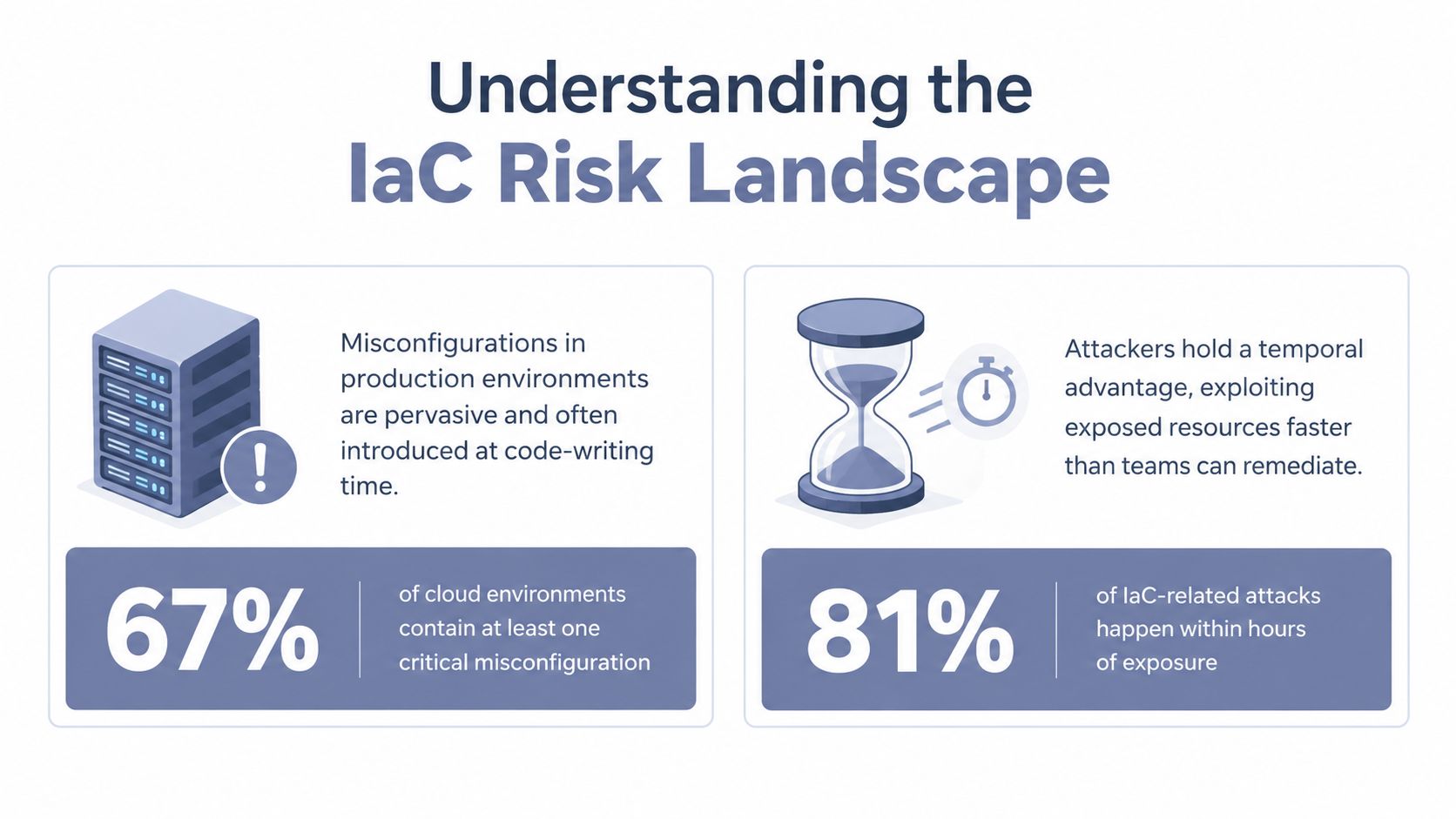
Risk begins before a resource exists. Independent analysis of more than 15,000 Terraform files representing over 10 million downloads found that nearly 50% contained at least one misconfiguration capable of exposing data or compromising workloads (CSO's analysis of Bridgecrew research). The same report cited research showing nearly 22% of examined Terraform configuration files contained at least one insecure configuration, while almost 50% of reviewed AWS CloudFormation templates had potentially vulnerable settings. These samples differ, so they should not be treated as a universal defect rate. They show that assessors can identify meaningful risk in source code before cloud exposure becomes visible.
Replication increases the potential impact. A flawed module or public template can spread across accounts, environments, and customer deployments. A local coding mistake becomes a repeatability problem, while a widely downloaded template can shape deployments far beyond its original author.
Attackers have the faster feedback loop
Sonatype's survey identified a significant timing gap. Attackers could typically identify a cloud misconfiguration within about 10 minutes of deployment, while defenders were often slower to detect their own errors (Sonatype's cloud security findings). Providers relying on periodic reviews may test after the most useful response window has passed.
Scanner alerts still require validation. The pipeline should block predictable exposure, while live testing determines whether a flagged resource is reachable and useful to an attacker. Automated pentesting can verify exposure, permissions, and attack paths against the deployed environment, turning static findings into evidence that supports remediation decisions. Useful controls include policy checks, secret scanning, least-privilege validation, and deployment gates.
The boundary between cloud posture management and application-aware validation also matters. Teams comparing approaches can use CNAPP and CSPM guidance to clarify how preventive code checks, cloud inventory, runtime monitoring, and penetration testing fit together.
Core Best Practices for IaC Security
A dependable program uses layers. No single control understands source syntax, expanded modules, provider behavior, runtime state, identity relationships, and attacker reachability equally well.
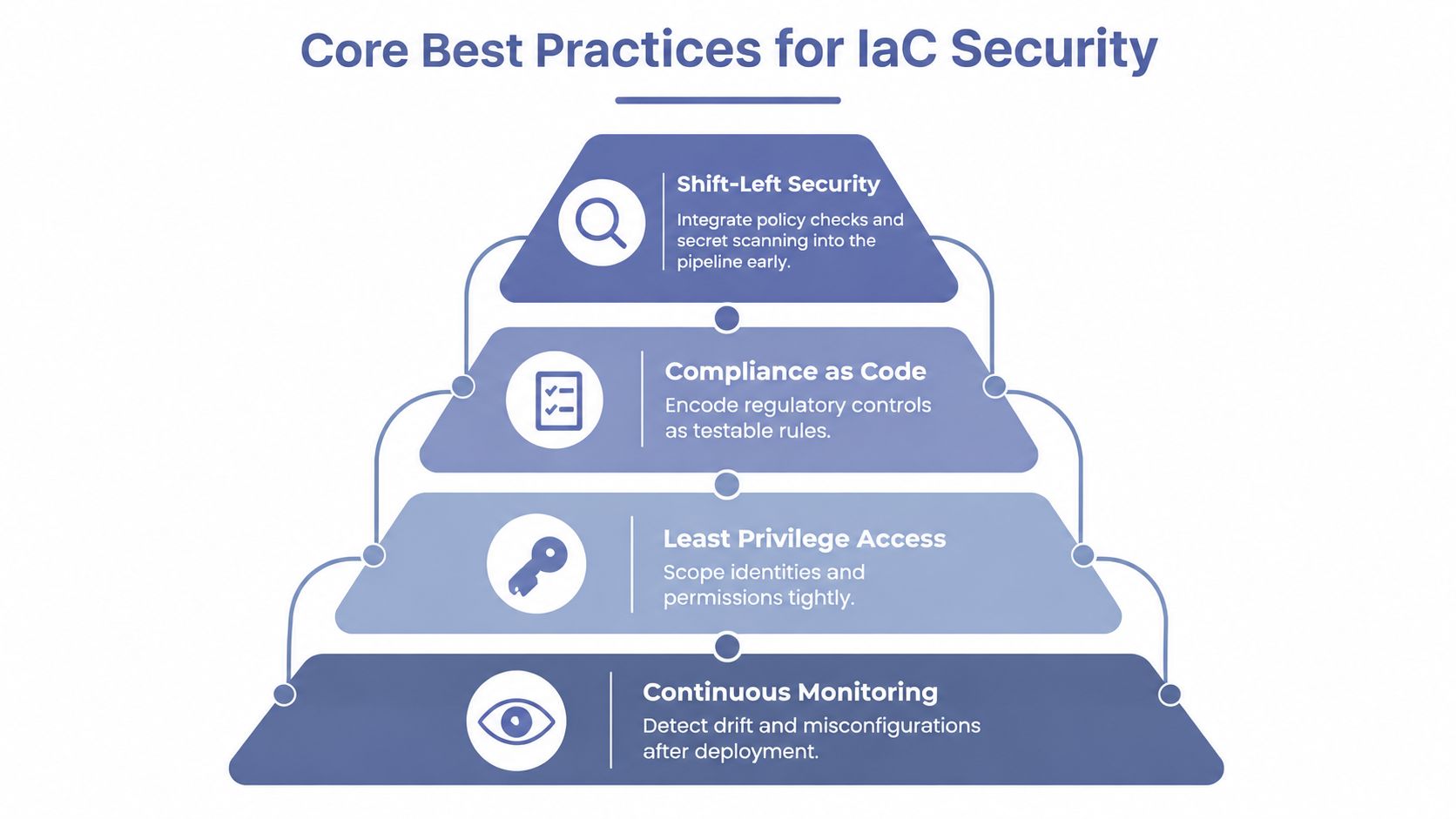
Shift checks to the earliest useful point
Run formatting and syntax validation first, then scan changed files and dependencies in the pull request. Scan the rendered plan after variable interpolation and module expansion, because the source module alone may not reveal the final resource attributes. Protect the merge path with risk-based gates, rather than allowing parser success to stand in for security approval.
A useful implementation pattern is to retain the result as an artifact. Record the commit, plan scope, policy version, resource address, severity, and remediation state. Reviewers can then see whether a finding was fixed, accepted, or bypassed.
Turn control intent into policy
Policy as code makes requirements testable. Rules can prohibit public ingress, require encryption, restrict regions, detect missing logging, and constrain identity trust relationships. Organize them by control intent, such as exposure restriction, protection enforcement, and privilege constraint, so the library remains understandable as coverage expands.
Teams building or reviewing an IaC program may find TekRecruiter on IaC for DevOps useful for broader operational practices. Security rules still need independent testing, ownership, exception handling, and evidence retention.
Keep secrets out of the delivery path
Secret scanning should cover repositories, generated plans, variable files, pipeline output, and artifacts. A secret that isn't committed to Git can still leak through a debug log or a stored plan. When a scanner identifies a credential, the provider should verify whether it is active, determine its permissions, rotate it, and test whether the identity enabled access beyond the declared resource.
Least privilege also needs identity-level review. Examine role policies, trust policies, service accounts, workload identity bindings, and cross-account assumptions. A narrowly scoped resource with a broadly trusted role can still create a high-impact path.
Watch for drift after deployment
Approved IaC describes intended state, not necessarily actual state. Console changes, emergency fixes, provider behavior, and manual remediation can leave deployed resources different from the repository. Continuous comparison should create a ticket with the owner, affected resource, policy finding, and remediation deadline.
Design principle: Pre-deployment policy prevents known mistakes. Drift detection and live pentesting test whether the deployed system still matches the approved design.
Common Misconfigurations and Detection Gaps
Scanner coverage varies by tool and provider. A benchmark evaluating Checkov, tfsec, and Terrascan across AWS, Azure, and Google Cloud found substantial differences in detection coverage, with false positives and missed detections remaining common (the cross-provider IaC benchmark). That makes “the scan passed” an incomplete statement. The meaningful question is which controls ran, against which representation of the infrastructure, with what provider-specific coverage.
| Pattern | Static signal | Pentest validation |
|---|---|---|
| Public storage | Public access or permissive bucket policy | Confirm exposure and test whether sensitive objects are readable |
| Broad network ingress | 0.0.0.0/0 or equivalent unrestricted access |
Verify external reachability and identify the exposed service |
| Missing encryption | Encryption attribute absent or disabled | Confirm the live resource and assess data sensitivity |
| Excessive IAM | Wildcard actions, resources, or principals | Test whether the identity can access or modify unintended assets |
| Privileged Kubernetes workload | Privileged container or missing network policy | Validate pod privileges, service reachability, and lateral movement |
Why a finding needs context
A public storage declaration may be overridden by an account-level control. A security group may allow broad ingress but attach to an unused resource. An IAM policy may look excessive while a condition, permission boundary, or session context limits its practical effect. Static analysis can't reliably answer all of those questions.
The opposite error is equally dangerous. A finding can look minor in isolation but become severe when chained with another weakness. NIST SP 800-115 defines penetration testing as testing that mimics real-world attacks and notes that combinations of vulnerabilities can provide more access than any single issue (NIST SP 800-115).
A tool-agnostic review method
Use at least two complementary detection methods for important cloud paths. Compare rule IDs and resource addresses, merge duplicates, and preserve disagreements for review. Then ask four questions:
- Deployment: Does the declared resource exist in the target environment?
- Reachability: Can the relevant network, identity, or service path reach it?
- Permission: Does the available principal have the required capability?
- Impact: Can the path expose, alter, delete, or pivot to sensitive assets?
This approach turns scanner output into a testing queue instead of an automatically accepted severity label.
Integrating IaC Security into Pentest Workflows
OWASP describes IaC scanning as a DevSecOps control that can identify public cloud storage, unrestricted security groups, unencrypted databases, excessive IAM permissions, privileged Kubernetes pods, missing network policies, disabled audit logging, and hardcoded credentials in Terraform, Helm, or Ansible variables (OWASP's IaC scanning guidance). A pentest provider should use those findings to focus live validation, not to replace it.
Apply the PTES phases to declared infrastructure
During pre-engagement interactions, define repository access, cloud accounts, test windows, allowed exploitation, data-handling rules, and rollback authority. During intelligence gathering, collect Terraform and CloudFormation repositories, module sources, plan files, state references, cloud inventory, identities, regions, and exposed endpoints.
In threat modeling, connect declared assets to likely attacker goals. A public management interface, a weak trust relationship, and a sensitive storage resource should be modeled as a possible chain, not as three unrelated tickets. During vulnerability analysis, run multiple scanners against source and rendered plans, normalize results, and prioritize issues that affect externally reachable or privileged resources.
The exploitation phase validates the finding safely. Confirm that a network path is reachable, use an authorized identity to test access boundaries, and avoid unnecessary data retrieval. In post-exploitation, determine whether the foothold permits lateral movement, privilege escalation, persistence, or access to additional cloud services. Reporting then ties each result to the source declaration, deployed resource, reproduction evidence, business impact, remediation, and retest status.
The CI/CD pipeline security testing resource provides useful context for placing these controls around build and deployment workflows. For providers testing AI-assisted systems and generated changes, guidance on how to test AI systems can complement the IaC workflow.
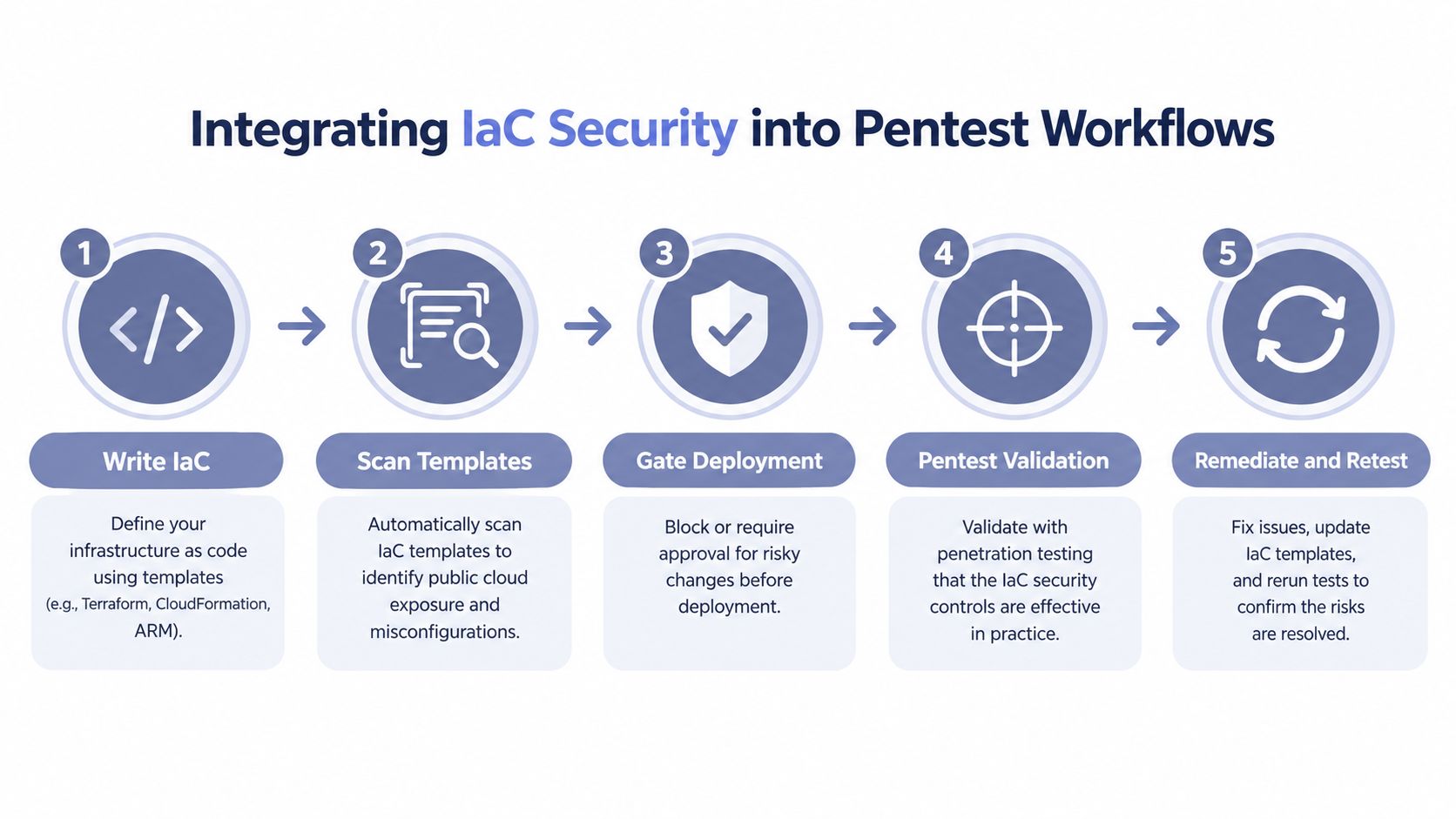
A practical pipeline looks like this:
- Write IaC: Identify the author, repository, commit, module provenance, and intended environment.
- Scan templates: Check source, dependencies, secrets, rendered plans, and policy requirements.
- Gate deployment: Block high-confidence critical risks and document approved exceptions.
- Pentest validation: Test live reachability, permissions, exploitability, and chained impact.
- Remediate and retest: Confirm both the code correction and the deployed state.
Use the video below as a visual introduction to integrating security testing into delivery workflows.
Mapping IaC Security to Compliance Controls
A provider's report becomes more useful when it answers both technical and audit questions. “Public ingress detected” describes a condition. A compliance-ready finding explains the affected asset, the violated control objective, the evidence collected, the owner, the exception status, and the retest result.
Connect findings to control intent
Configuration management controls can reference repository ownership, peer review, plan evaluation, and deployment approval. Access-control controls can reference IAM policies, trust relationships, service accounts, and privilege validation. Encryption controls can reference declared settings, provider defaults, key selection, and confirmation of the live resource. Monitoring controls can reference logging, alerting, drift detection, and retained scan artifacts.
This mapping supports frameworks including SOC 2, PCI-DSS, ISO 27001, HIPAA, CMMC, GLBA, and GDPR, but the exact interpretation depends on the customer's scope and assessor. A single IaC finding may support more than one control family, while one framework requirement may require evidence beyond code review.
Build evidence an auditor can follow
A strong record includes:
- Origin: Repository, branch, commit, module, and resource address.
- Evaluation: Scanner names, policy versions, plan scope, and timestamps.
- Verification: Live resource identifier, reachability result, identity used, and safe reproduction evidence.
- Disposition: Severity, owner, remediation, exception approval, and due date.
- Closure: Retest result showing that the code and deployed state now satisfy the control.
The security controls for cloud computing resource can help teams structure this control-oriented view. The key is to avoid claiming compliance merely because a template passed a linter. Auditors and customers need traceability from requirement to implementation, test, exception, and retained evidence.
Building an Evidence-Based Assurance Program
AI-generated infrastructure changes the assurance problem. The question isn't only whether Terraform or CloudFormation is secure. Providers also need to know who or what produced a change, which policies evaluated it, whether reviewers understood it, and whether the deployed result matched the approved intent.
Survey evidence shows that only 15% of organizations measure the amount of AI-generated IaC in their pipelines, and only 20% monitor error rates for AI-generated modifications. At the same time, 40% report that security vulnerabilities are emerging faster, 40% say governance is becoming more difficult, and 35% observe increasing infrastructure drift as AI adoption expands (the Spacelift survey coverage).
Record provenance, not just approval
A useful assurance record follows the change from prompt or commit through deployment. Capture the authoring context, generated files, model or automation identity where applicable, reviewer, policy package, scanner output, plan digest, deployment identity, runtime verification, and rollback action.
Syntactically valid IaC isn't necessarily secure. A benchmark across 17 scenarios found that valid Terraform did not imply secure Terraform. WizardCoder-33B achieved a 77.8% validation rate but zero Checkov compliance, while Claude Opus 4 reached 23.1% Checkov compliance and a 92.5% Trivy pass rate under detailed security prompting (the benchmark study). The operational lesson is straightforward: parser success and security-policy success are different gates.
Give customers measurable assurance
Expose coverage and latency per customer. Useful measures include scan coverage across repositories and plans, median time to detect, median time to remediate, escaped misconfigurations, aged exceptions, drift findings, and the percentage of high-risk findings with live verification. These metrics support service reviews without pretending that a single score captures security.
For audit-heavy customers, digna compliance reporting automation offers relevant context on turning test evidence into structured reporting. Automation should reduce preparation effort, but the provider still owns the testing logic, evidence quality, and interpretation of exploitability.
From Assessment to Continuous Security
The practical bottleneck is coverage and response time. An industry survey found that 60% of respondents reported IaC or configuration code passing through continuous-integration testing, while only 32% included security checks in those pipelines (Snyk's Infrastructure as Code Security Insights report). Syntax tests can produce a reliable build while leaving deployment risks unexamined.
In the same report, high-performing teams found and fixed IaC issues within a day. Lower-performing teams took more than a week to discover a problem and up to two additional days to remediate it. Providers can turn that gap into measurable service objectives:
- Coverage: Repositories, pull requests, rendered plans, and deployed environments scanned.
- Detection: Median time from change to finding.
- Remediation: Median time from finding to verified closure.
- Escape rate: Misconfigurations discovered after deployment.
- Exception age: Open exceptions by risk, owner, and approval date.
- Verification depth: Findings confirmed through live reachability or exploitation testing.
Automated pentesting gives these measures operational value. Static analysis can flag a risky public policy, while a structured test confirms reachability, exposed permissions, and exploitable impact in the live environment. Scan early, gate high-confidence risks, test rendered plans, compare deployed state with approved IaC, and retain evidence mapped to customer controls. Followed consistently, this operating model turns infrastructure as code security into continuous assurance rather than an annual checklist.
ThreatExploit AI helps security providers automate reconnaissance, exploitation, verification, and reporting across cloud infrastructure. Visit ThreatExploit AI to see how repeatable pentesting can extend IaC assessments into verified attack paths.