
The advice you'll hear most often about GDPR technical controls is a short list. Encrypt personal data, pseudonymise what you can, keep systems available, and book a penetration test once a year. Buy the test, file the PDF, and the security question is closed until the next budget cycle.
That advice fails because Article 32 doesn't ask whether a control exists. It asks whether the control still works against the risks your processing creates, and it puts the burden of proof on you. A report from March proves an assessor found nothing on a Tuesday. It doesn't prove that a database snapshot wasn't publicly readable last week, or that an API returned another customer's address to a logged-in user in June.
Every control in this guide is treated as a claim that needs retesting, with artifacts you can hand to a regulator, a customer's security team or an auditor. Plain language, worked examples, and the specific evidence that makes each claim hold.
Table of Contents
- The GDPR Technical Controls at a Glance
- Why GDPR Ties Security to Risk, Not Checklists
- How Pseudonymisation, Encryption and Access Controls Fail
- Logging, Monitoring and Breach Detection Controls
- How to Assess and Evidence Control Effectiveness
- Confirm Your Controls Before Your Next Audit
The GDPR Technical Controls at a Glance
The GDPR contains no single official list of technical controls. Articles 25 and 32 set the duties, and every control matrix you'll encounter is an interpretation of how those duties land on real systems. Article 32 does name three measures outright, pseudonymisation, encryption, and regular testing, as the text of Article 32 on legislation.gov.uk sets out. Every other row below follows from the goals it lists: confidentiality, integrity, availability and resilience.
Those obligations have applied for years. The Regulation has applied since 25 May 2018, after a two-year transition period from adoption, as the EDPS legislative history of the GDPR records.
| Control family | GDPR reference | What it protects | Evidence an assessor expects |
|---|---|---|---|
| Pseudonymisation and encryption | Art. 25(1), Art. 32(1)(a) | Personal data at rest, in transit and in backups | Encryption configuration, key management records, pseudonymisation key separation |
| Access control and least privilege | Art. 25(2), Art. 32(1)(b) | Confidentiality of personal data in systems and APIs | Role matrix, access review records, authenticated test results |
| Data minimisation and default settings | Art. 25(2) | Amount, extent and duration of collection and processing | Field-level data inventory, retention settings, default configuration baselines |
| Integrity and resilience | Art. 32(1)(b) | Protection against unauthorised change and service outages | Hardening baselines, patch records, change logs |
| Backup and restoration | Art. 32(1)(c) | Timely recovery of personal data after an incident | Restore test records, recovery timings, backup access permissions |
| Logging and monitoring | Art. 32(1)(b), supports Art. 33 | Ability to detect a breach and reconstruct what happened | Log retention settings, alert test results, triage records |
| Regular testing and evaluation | Art. 32(1)(d) | Ongoing proof that measures still work | Penetration test reports, remediation tickets, retest results |
Read that as a planning map, not a scorecard. Two families get all the attention, encryption and access control, because they're the easiest to configure and the easiest to claim in a sales questionnaire. The three that decide whether you survive a real incident, restoration, logging and retesting, are the ones most often backed by a policy document and nothing else.
The practical exercise takes an afternoon. Take each row and ask what exists for it today: a document, a configuration record, or a test result. A row backed only by a document is a claim. A row backed by a dated test result and a retest after remediation is evidence. Start where there's no test result at all, because those are the rows where you're asking a regulator to take your word for it.
Why GDPR Ties Security to Risk, Not Checklists
A bank branch and a corner shop both lock up cash overnight. The bank builds a vault with time delays, dual control and an alarm. The shop bolts a steel drawer under the counter. Nobody calls the shop negligent for skipping the vault, and nobody accepts the drawer as good enough for the bank. GDPR applies the same reasoning to personal data: the lock has to match what is inside and what happens if it fails.
Article 25 requires data protection by design and by default. That means limiting what you collect, how far it spreads and how long it stays, and not exposing records to an indefinite audience without the individual's intervention. Article 32 then asks for measures appropriate to the risk, weighing the state of the art, implementation cost, the nature, scope, context and purposes of processing, and the risk to individuals. The full text of Regulation (EU) 2016/679 sets out both duties. Neither duty names a tool, a scan frequency or a security architecture, so a finished questionnaire can still say nothing about whether the chosen measure fits this processing.
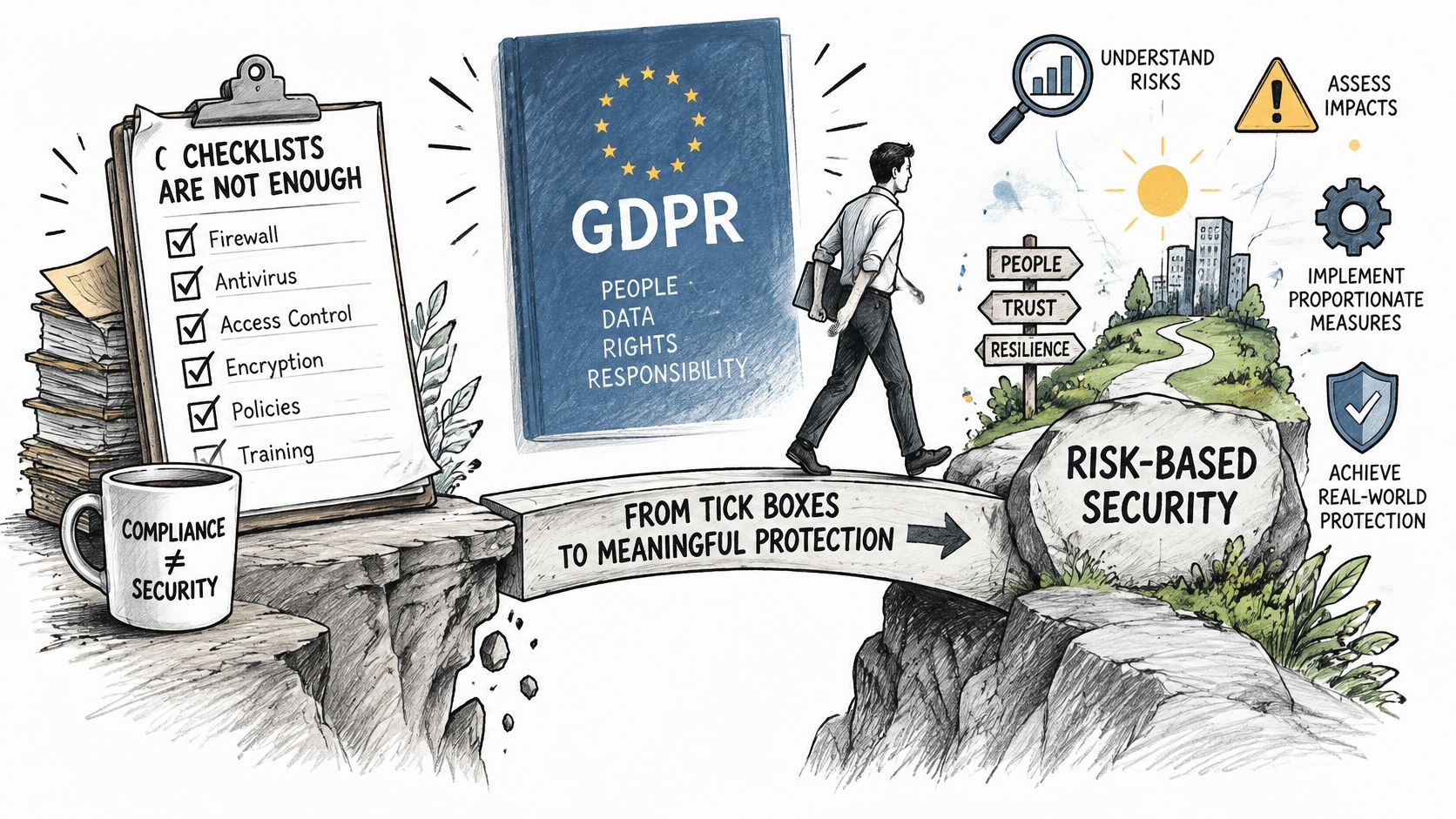
Two processing operations show how differently this plays out. A clinic holding patient histories needs encryption with keys held away from the data, audited access to the record system, and restore tests it can prove, because a leak exposes diagnoses and the harm is immediate and irreversible. A newsletter list needs proportionate protection and a deletion routine that runs, because the risk to a subscriber is nuisance rather than harm. Same article, very different locks.
That sizing only holds if you can show the reasoning. A structured security risk assessment records why the clinic's keys sit apart from the records and why the newsletter does not get the same vault. Without that record, both setups become the same unchecked claim: we have security.
Rule of thumb: cost is a factor in choosing the measure, never a justification for leaving high-risk processing weakly protected. If the data can ruin someone's year, the argument about licence fees is over before it starts.
Regulators treat these duties as enforceable rather than aspirational. The 2025 GDPR Enforcement Tracker report from CMS recorded 418 fines for insufficient technical and organisational measures, with an average fine of approximately EUR 2.0 million.
How Pseudonymisation, Encryption and Access Controls Fail
Pseudonymised data is still personal data. The EDPB Guidelines 01/2025 on pseudonymisation make that explicit: where information can be linked back to an individual using additional information such as a lookup table or secret key, the protection is a risk reduction, not an exemption from the Regulation.
A coat-check ticket means nothing on its own. Staple it to the cloakroom register that maps ticket numbers to names and you've reunited coat and owner in seconds. Pseudonymisation works the same way, which is why the control that matters isn't the token, it's the register.
The EDPB guidance points at concrete controls that ordinary compliance checklists skip:
- Separate the secrets: keep the lookup table or key in a different system and a different trust boundary from the pseudonymised records, so one compromised host doesn't hand over both halves.
- Use a real cryptographic design: a hash of a predictable identifier such as an email address is reversible with a wordlist. Keyed constructions and well-scoped tokenisation aren't.
- Segment the network: the analytics cluster that only needs tokens shouldn't be able to reach the key service.
- Hold keys in an HSM: key material that lives in an application config file is one directory traversal away from becoming plaintext.
- Secure the API: detokenisation endpoints need authentication, tight scopes and object-level authorisation, not just a valid session.
- Rate-limit and log reversal: every detokenisation call should be attributable to a person or service, and bursts should trip an alert.
- Restrict who can reverse: a short named list, reviewed quarterly, beats an IAM group nobody has audited since onboarding.
Access control fails in the same quiet way. Role-based permissions get designed once, then accrue exceptions until every support engineer has an admin role "temporarily". Multi-factor authentication gets deployed on the admin console but not on the internal API that holds the same records.
Where Apparently Compliant Systems Leak
The failure modes that survive an audit trail are consistent. Encryption keys stored in the same backup as the encrypted data. Tokenised records exposed through an API whose permissions are broader than the application needs. A detokenisation path that writes nothing to the log, so nobody can prove who reversed what or when. Access control on the web tier while the mobile backend trusts any request from the internal network.
Access control problems often start below the application, in the network that carries the traffic. Retail groups running guest and staff networks across dozens of sites wrestle with the same question of who gets on which segment, which is why secure Wi-Fi onboarding for multi-site retailers is a useful reference for the identity side of that problem.
A control you can't reverse and audit isn't a control. It's a setting.
The test question that cuts through all of this is short. Can identifiers be recombined across production, backups, analytics and support tooling? If a tester with a support account can join a pseudonymised table to a lookup table reached through an over-permissioned API, then Article 25 and Article 32 evidence is missing regardless of what the architecture diagram says.
Logging, Monitoring and Breach Detection Controls
A support account exports tens of thousands of customer records at 2 a.m. If the alert fires within minutes, triage starts the same morning, containment is decided before lunch, and the reportability assessment has a timeline behind it. If nobody reviews the logs and retention is seven days, the team may not reconstruct that access by the time a customer complains three weeks later. Same copy of the same table. Two very different conversations with a supervisory authority.
Logs work like shop CCTV that overwrites itself. A camera that keeps seven days cannot show who left with the stock three weeks on. The lock on the door never answers that question. Firewalls, WAF rules and encryption are the lock. Detection is the camera plus someone who watches it.
Each logging and monitoring control is a claim you retest: we would know, within a day, that someone copied a customer table. EDPB guidance on personal data breach notification recommends processes to detect and promptly contain incidents, assess the risk to individuals, and decide whether supervisory-authority or individual notification is needed. Where notification is required, it should happen without undue delay and, where feasible, no later than 72 hours after the controller becomes aware of the breach.
The same guidance identifies log and network-traffic analysis as ways to detect breaches. It also lists access-control review, MFA for sensitive-data access, monitoring of unusual data flows, disk encryption, current security updates and regularly tested backups. Turn those into acceptance criteria you can fail a test against: centralised and time-synchronised logs, retention long enough to reconstruct who touched which personal-data store, alerts for anomalous authentication, privilege escalation, bulk export and unusual egress, a named incident owner, and containment and restore playbooks that have been run.
| Claim | What you retest | Proof you keep |
|---|---|---|
| We would notice a bulk copy | Simulated export from a real account type | Alert name and SIEM timestamp |
| Someone owns the first response | Ticket opened by a named person | Minutes from first request to pickup |
| We can stop the account | Disable, revoke, or block, then confirm | Screenshot or ticket showing the change held |
| We can still tell the story later | Full sequence filed before logs age out | Incident-register entry, no rebuild required |
Volume makes the missed alert routine rather than exotic. Approximately 132,000 personal-data breach notifications were reported under the GDPR between January 2024 and January 2025, an average of 363 per day, according to Vanta's compliance statistics. Ireland's Data Protection Commission alone received 7,346 breach notifications in 2024, as KPMG Law's summary of the DPC annual report records.
What a detection test must prove
Detection tooling is the other half of the camera. Blowfish Technology's guide to intrusion detection systems is a solid primer on how signature and anomaly-based detection differ, and why the second is what catches an authenticated bulk export that looks like normal traffic. A signature looks for a known bad pattern. Anomaly detection looks for a normal account doing an abnormal amount of work. The 2 a.m. export often matches no signature at all.
A useful control test produces four things, in this order:
- Detection fired. The alert exists, it triggered on the simulated activity, and the timestamp is recorded in the same time zone as the SIEM.
- Time to triage. How many minutes between the first suspicious request and a human picking up the ticket.
- Containment verified. The account was disabled, the token revoked, the rule deployed, with a screenshot or ticket reference.
- Evidence retained. The whole sequence filed against the incident register so it can be produced later without a rebuild.
Security testing should include a run of the monitoring and logging procedures, and vulnerability-scan evidence should be kept after significant incidents, operational changes or material risk changes. The report maps each test to detection coverage, response owner, timestamp, residual risk and retest status. Anything less is a story about what would probably happen.
How to Assess and Evidence Control Effectiveness
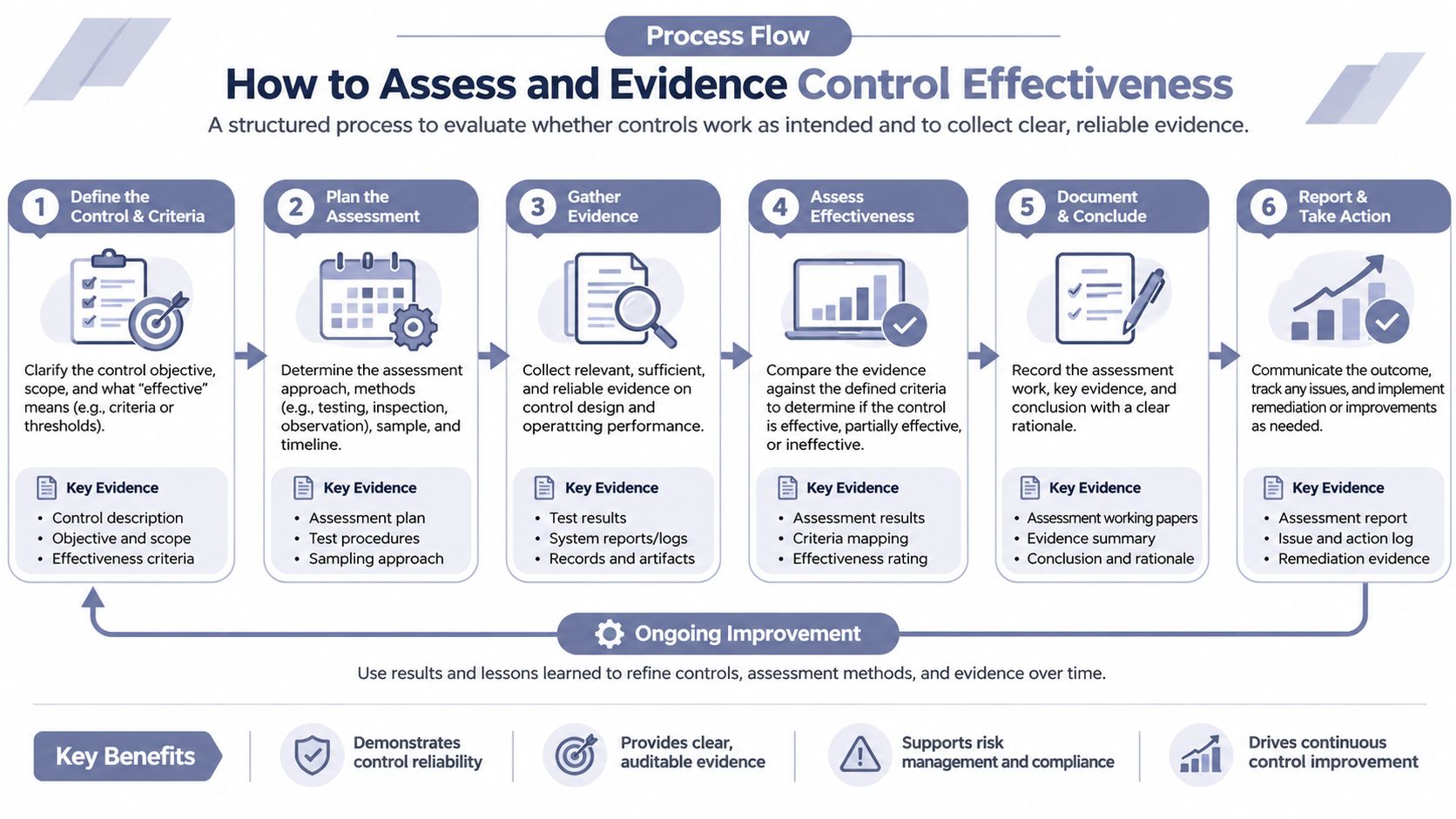
A technical control works like a lock you say is set. The proof is whether the door still opens when someone tries it. Under Article 32 the controller has to show that the measures fit the risks of that particular processing, including how they are implemented in practice. A certificate with a vendor logo is the weakest artifact you can bring to a supervisory authority. A test record that names the system, the data, the method and the result is among the strongest.
Article 32 requires regular testing, assessment and evaluation of whether measures remain effective, as the consolidated text of the Regulation states. Deploying a control and never returning to it does not meet that duty. Penetration testing earns its place as a way to produce evidence, not only as a search for bugs. What you ask for, and what you file, changes with that purpose.
The nine-step evidence cycle
- Inventory the systems and the personal-data flows. Include cloud accounts, APIs, backups, analytics copies and processors. A system nobody listed is a system nobody tested.
- Rank each asset by data sensitivity, internet exposure, record volume and potential impact on individuals. That order decides what is tested first and what is tested properly.
- Confirm scope and written authorisation. Fix a target list, testing windows and prohibited techniques before anything launches. On ThreatExploit.ai, tests run only against targets the customer defines and authorizes, and scope, testing mode and schedule are set before anything launches. For each engagement the customer must confirm and attest that they are authorized to test the specified targets and scope, and the customer alone defines that scope and confirms the authorizations before a test starts. ThreatExploit.ai may require identity verification and documents such as ownership records, a signed authorization or rules-of-engagement document, or domain or asset control validation. Testing without that authority creates the incident the programme is meant to prevent.
- Run authenticated and unauthenticated tests across web applications, REST and GraphQL APIs, networks and cloud permissions. Authenticated testing is where object-level authorisation failures surface.
- Check whether logging and alerting caught the activity. A finding with no detection is two findings.
- Record timestamps, request and response pairs, screenshots and the exact scope tested. Reproducibility is what separates evidence from opinion.
- Assign remediation owners and set severity from business impact, not from a generic CVSS number that ignores which records sit behind the endpoint.
- Retest every fix and record the result. A closed ticket with no retest is a hope.
- Set the next assessment from changes in risk, new exposure, architecture shifts or incidents, rather than from the calendar alone. A programme that can show each of these steps is what makes the file credible.
What to test, what to keep, where it breaks
| Control | Test method | Evidence to retain | Common gap |
|---|---|---|---|
| Encryption and pseudonymisation | Attempt re-identification through key or lookup access and check key storage | Key custody records, successful and failed attempts | Keys stored beside the data they protect |
| Access control | Authenticated tests across roles, including object-level authorisation checks on REST and GraphQL APIs | Role matrix, request and response pairs | Users can read records that belong to other accounts |
| Backups and snapshots | Check for publicly readable storage and snapshot sharing permissions | Dated permission exports, screenshots of settings | Forgotten copies in development or support environments |
| Logging and alerts | Generate controlled attack activity and time how long detection takes | Alert timestamps, triage tickets | Logs exist but no alert fires |
| Remediation | Retest every fixed finding | Retest result with timestamp and tester identity | Fix closed in a ticket without verification |
Failed validation steps belong in the report too. They show where an assumed control did not hold, and they stop the next assessor from repeating the same dead end. State the limits plainly: accounts not provided, environments left out, residual risk accepted, and the reason for that acceptance.
For teams building this into a repeatable programme rather than a one-off project, the mechanics of security control validation cover how to tie each test back to the obligation it evidences.
Confirm Your Controls Before Your Next Audit
One action beats a twelve-month roadmap. Pick the control family with the weakest evidence in the first table, choose a single application or data store inside it, and run one authorised test that produces the artifacts the testing table lists.

Start with a written scope and a named owner who signs off the target list. Then work the finding through to closure: retest the fix before the ticket closes, and file the result against the Article 32 control it supports, so the evidence exists before an auditor or a customer's security team asks for it. That filing habit is worth more than any tool, which is why compliance documentation deserves the same rigour as the test itself.
Where producing that evidence by hand is the bottleneck, a platform such as ThreatExploit AI automates reconnaissance, exploitation and verification across web, network and cloud targets, and auto-maps its reports to frameworks including GDPR with specific control references, carrying evidence, screenshots, remediation steps and risk scoring into the file you hand over. Automation doesn't replace judgement about business logic and processing context, so pair every automated result with a human review before it enters the audit pack.
If you'd rather prove your GDPR controls than describe them, ThreatExploit AI runs authorised, scoped penetration tests across web applications, APIs, internal and external networks, and cloud infrastructure, then returns evidence-backed reports mapped to GDPR control references with remediation steps, risk scoring and retest results you can file against Article 32. Visit ThreatExploit AI to scope your first assessment and see what the evidence looks like before your next audit.