

A client asks for a “pentest” before a product launch. The deadline is close, the environment spans cloud services and APIs, and the compliance team wants evidence that controls work. Your delivery team has to decide whether to run a vulnerability scan, commission a manual penetration test, or simulate an adversary campaign. Choosing poorly creates predictable problems: wasted analyst time, an unusable report, missed attack paths, or a compliance result that doesn't satisfy the requirement.
For an MSSP, cyber security testing is therefore a service-design decision, not just a tooling decision. The right approach depends on what the client needs to prove, how much of the environment must be covered, how safely the test can run, and whether the final evidence will help someone fix the risk.
Table of Contents
- Why Not All Security Testing Is Created Equal
- The Cyber Security Testing Spectrum Explained
- Comparing Security Testing Methodologies
- When to Use Each Type of Security Testing
- The Rise of Continuous and Automated Pentesting
- Integrating Testing into a Scalable MSSP Offering
Why Not All Security Testing Is Created Equal
Three activities sit under the label “testing,” and each answers a different operational question. A scanner looks for known weaknesses across a wide estate. A penetration test confirms whether a weakness is real, exploitable, and capable of leading to meaningful access or impact. An adversary simulation measures whether an objective-driven campaign can succeed against people, processes, technology, and detection controls.
For an MSSP, that distinction affects margin, delivery quality, and client trust. Sell the wrong test, and the team either over-delivers at the wrong cost or under-delivers against an expectation the report cannot support. A client asking for exposed asset visibility needs speed and coverage. A client asking whether segmentation protects a cardholder-data environment needs evidence that the boundary holds under attack. Standard scanning does not answer that question, and PCI DSS treats penetration testing and segmentation validation as separate proof points.
Start with the outcome
Choose the method by the decision the client needs to make after the test.
Use four questions to frame the engagement:
- What must be proved? Discovery, exploitability, control effectiveness, or resilience against an objective-driven attack?
- Which assets matter? Public applications, APIs, internal networks, cloud identities, segmentation boundaries, or business workflows?
- What level of disruption is acceptable? The rules of engagement should define permitted techniques, test windows, contacts, and stop conditions.
- Who will act on the result? Developers need reproducible evidence, infrastructure teams need affected assets and configurations, and executives need business impact and ownership.
Service design becomes practical here. If the output must feed patching and remediation queues, breadth and consistency matter. If the output must satisfy an assessor or prove a control works in the client's environment, manual validation matters more. If the output must show whether defenders can detect and respond to a realistic objective, the exercise has to include operational behavior, not just technical findings.
NIST SP 800-115 draws this line clearly. Discovery and vulnerability scanning identify potential weaknesses, while penetration testing verifies whether a vulnerability exists and can be exploited in the NIST technical guide. Keeping those stages distinct cuts false positives, improves prioritization, and gives delivery teams cleaner evidence to work from.
Practical rule: Never sell a test by tool count or scan volume. Sell the decision the client will be able to make after the evidence is collected.
Clear framing also protects the MSSP. It limits scope drift, keeps reporting aligned with the engagement goal, and gives account teams a defensible explanation of what the service establishes, what it does not, and where a different testing method is required.
The Cyber Security Testing Spectrum Explained
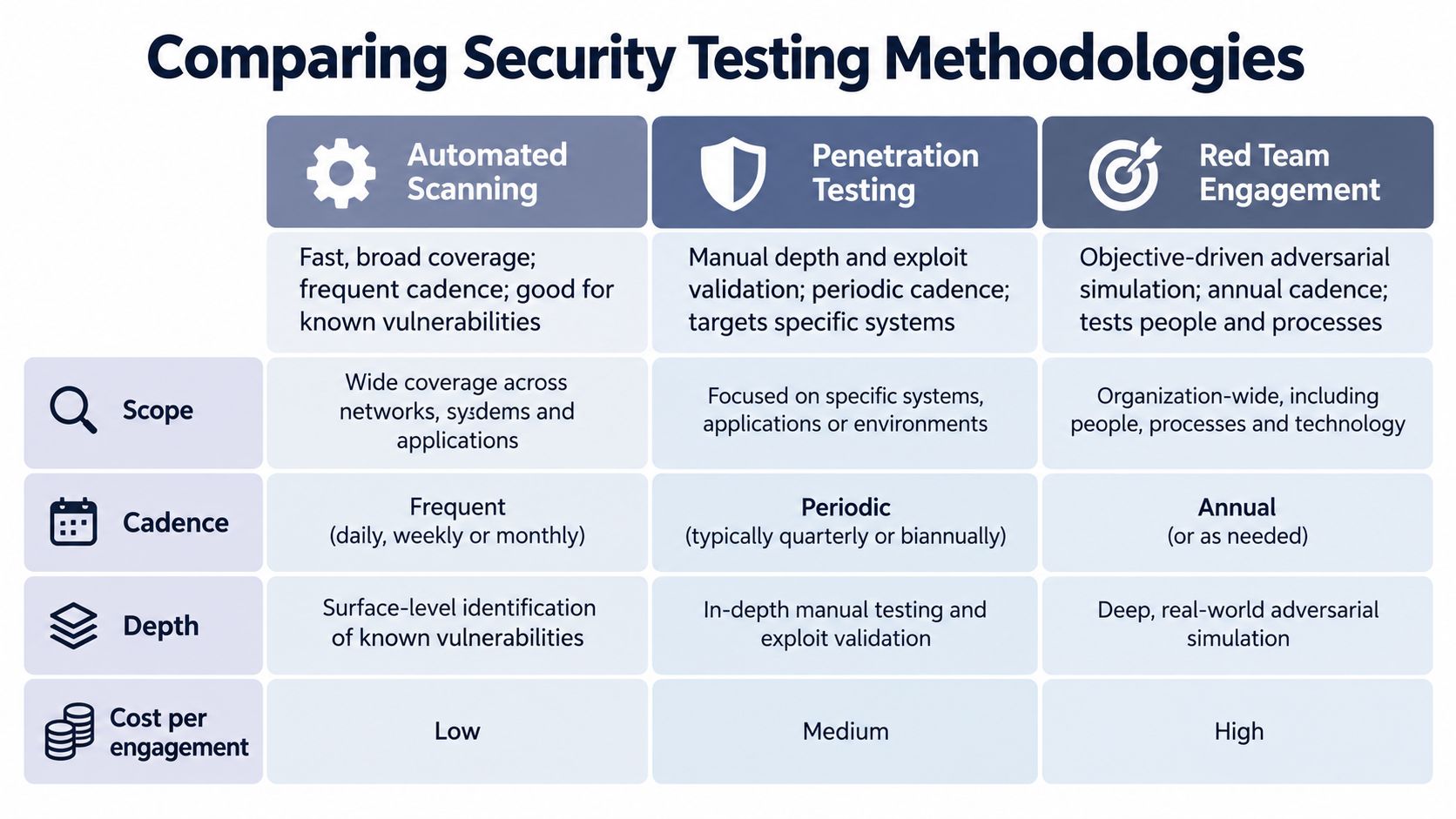
A physical bank provides a useful mental model. Automated scanning is like checking doors, windows, cameras, and locks for obvious weaknesses. Penetration testing is hiring a skilled tester to attack a specific safe or entrance under agreed rules. Red teaming is a controlled attempt to carry out a defined heist, including social engineering, physical access, technology, detection, and response.
The analogy matters because each activity answers a different question. A scan asks, “What might be weak?” A penetration test asks, “Can this weakness be exploited, and what does it enable?” An adversary simulation asks, “Can an attacker achieve a meaningful objective while the organization detects and responds?”
Vulnerability scanning
Scanning provides breadth. Tools enumerate hosts, ports, services, versions, configurations, and known vulnerability signatures. That makes scanning useful for asset discovery, routine hygiene, triage, and identifying changes between formal assessments.
It also has clear limits. A scanner may identify a potential weakness without proving that the condition exists in the client's specific deployment or that exploitation creates meaningful impact. It can miss authenticated functionality, business-logic flaws, chained attack paths, cloud identity abuse, and trust relationships that require context.
Penetration testing
A penetration test narrows the question and increases depth. Testers use reconnaissance, version and configuration analysis, controlled exploitation, privilege escalation, and proof-of-impact checks against defined targets. The strongest engagements produce reproducible evidence, such as the affected asset, request or command sequence, response, authorization context, timestamp, and remediation-relevant configuration.
The VAPT testing overview is useful when a client uses “assessment” and “penetration test” interchangeably. An MSSP should still translate the client's wording into a written objective, scope, authorization boundary, and acceptance criteria.
Adversary emulation
Red, blue, and purple team work evaluates the organization as an operating system, not merely an application or host. A red team pursues an objective. A blue team detects and responds. A purple team brings both sides together to improve visibility and defensive controls.
This approach requires more coordination, judgment, and operational safety. It can reveal weaknesses in identity controls, alerting, escalation, incident response, and decision-making that a conventional pentest won't target. It also costs more to deliver and is harder to standardize across many customers.
The practical progression is simple:
- Scan to establish visibility.
- Pentest to validate priority weaknesses.
- Emulate an adversary to test resilience and response.
MSSPs don't need to force every client through the entire spectrum. They need to match the method to the risk question, then explain what the result proves.
Comparing Security Testing Methodologies
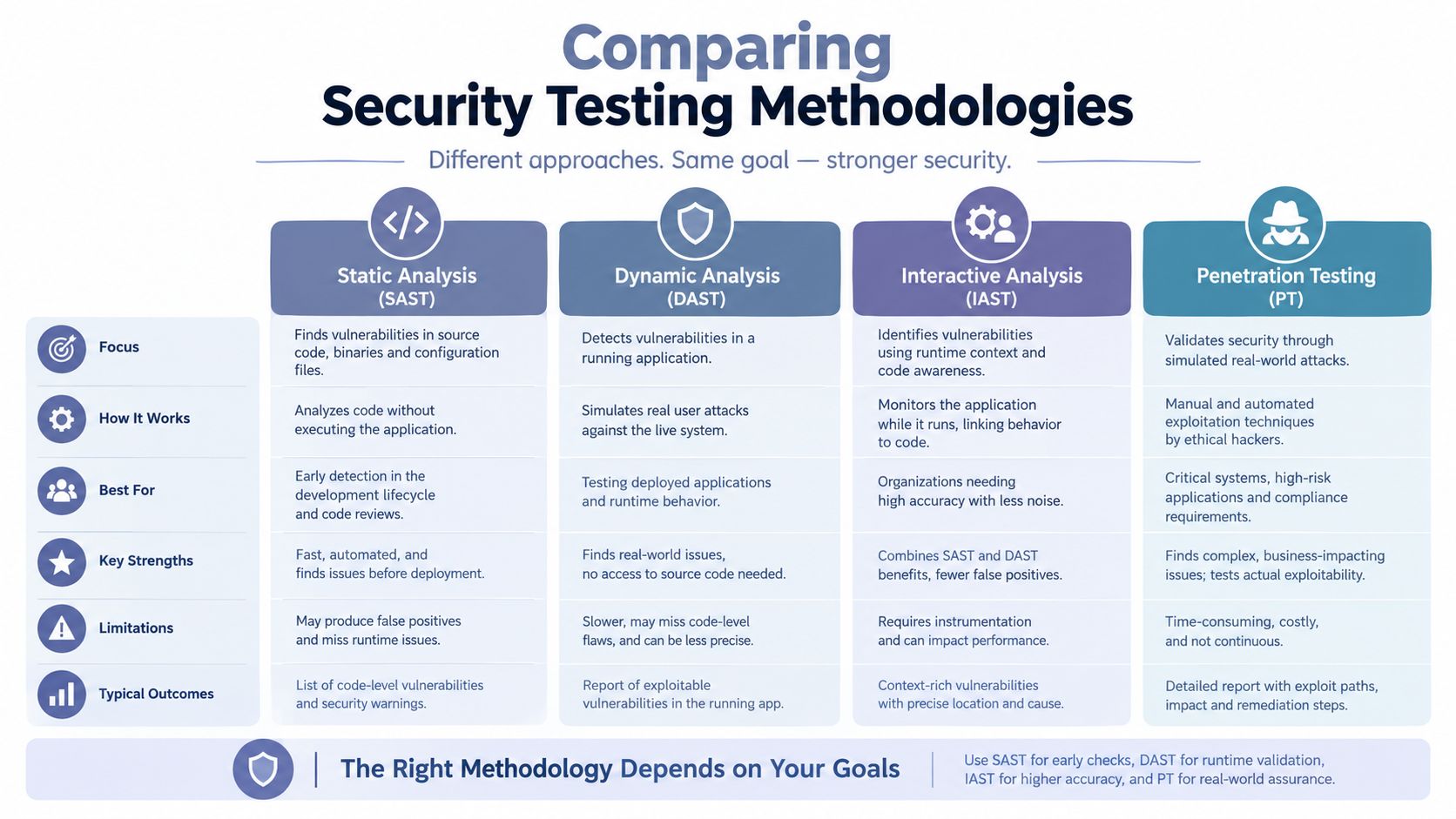
The fastest way to scope an engagement is to compare the methods against the client's decision, not against a product feature list.
| Methodology | Primary Goal | Scope | Human Effort | Ideal Frequency |
|---|---|---|---|---|
| Vulnerability scanning | Find potential weaknesses and exposed assets | Broad infrastructure, applications, services, and configurations | Low to moderate, focused on triage and validation | Recurring or triggered by material change |
| Penetration testing | Confirm exploitability and demonstrate impact | Defined applications, APIs, networks, cloud resources, or segmentation boundaries | Moderate to high, depending on depth and authentication | Periodic and after significant changes |
| Red team engagement | Test whether an adversary can achieve a defined objective | Selected people, processes, facilities, identities, applications, and infrastructure | High, with planning, coordination, and specialist judgment | Planned exercises based on risk and maturity |
Scanning optimizes coverage
Scanning is the operational baseline for an MSSP with many customers. It helps create a repeatable service, catches exposed services and known weaknesses, and gives analysts a queue for remediation discussions. It works especially well when paired with asset inventory and change monitoring.
The trade-off is confidence. A finding may be technically plausible but operationally irrelevant, inaccessible, already mitigated, or exploitable only under conditions that don't exist in the target environment. If the provider delivers raw scanner output as a penetration-test report, the client inherits the verification workload.
Penetration testing optimizes confidence
Penetration testing applies human or agentic judgment to a narrower scope. The tester can authenticate with multiple roles, follow application workflows, test authorization boundaries, combine weaknesses, and document actual impact. NIST's separation between detection and validation is important here, because confirmed exploitability gives remediation teams a stronger basis for prioritization in its testing guidance.
The cost is delivery capacity. Skilled testers must understand the environment, select safe techniques, interpret results, and communicate with the client during execution. For providers evaluating delivery models, a practical overview of UK penetration testing services can help frame how scope, methodology, and reporting expectations vary across engagements.
Red teaming optimizes realism
Red team exercises are valuable when leadership needs to know whether the organization can prevent, detect, contain, and investigate an attack campaign. They expose coordination problems that isolated technical tests often miss.
They aren't a substitute for broad vulnerability management. A red team may intentionally avoid large portions of the estate because it is pursuing a specific objective. It also needs mature authorization, communications, and response procedures. An MSSP that sells red teaming to an organization without those foundations may produce drama rather than useful learning.
The best service portfolios combine the approaches. Scanning maintains visibility, penetration testing validates material exposure, and adversary emulation tests organizational resilience. Automation can reduce repetitive work, but it doesn't eliminate the need for scope decisions, safety controls, interpretation, and client-facing judgment.
When to Use Each Type of Security Testing
A client heading into a PCI DSS assessment is usually not asking for more findings. They need evidence that testing covered the relevant internal and external environments and that segmentation actually limits unauthorized access. For an MSSP, that means scoping a penetration test with clear segmentation objectives and evidence requirements. As noted earlier, PCI DSS also creates recurring and change-based triggers, so the service should be tied to architecture, cardholder-data-flow, and segmentation changes rather than treated as a yearly reporting exercise.
A product team preparing to launch a new web application needs a different path. Start with automated discovery and application testing to get broad coverage across reachable assets and common failure points. Then move to authenticated penetration testing on the workflows that matter to the business, including roles, APIs, authorization boundaries, and sensitive transactions. The report should help two audiences at once: security leaders need a defensible view of exposure, and developers need reproducible detail on what was tested, what was exploitable, and what to change before release.
Four common client triggers
- Compliance preparation: Define scope from the standard or contractual requirement, then test the control that must be evidenced. Scanning supports vulnerability management, but it does not show that every required control works in practice.
- New application or major release: Combine automated checks with focused, authenticated penetration testing. Put payment flows, administrative functions, access control, data exposure, and business logic first, because these areas usually drive both release risk and client trust.
- M&A due diligence: Start with external discovery and exposure validation across the acquired environment. Follow with targeted testing of internet-facing systems, identity paths, remote access, and high-value applications, so the buyer gets a clearer picture of inherited risk and post-deal remediation effort.
- Security-program baseline: Build an inventory and an initial vulnerability view, then validate the weaknesses that could materially affect operations. Use that evidence to assign remediation ownership, define retest criteria, and set expectations for ongoing service delivery.
Baseline work only pays off if it can be repeated usefully. Document which assets were reachable, which identities and roles were available, which techniques were allowed, and where visibility was incomplete. That record turns the next engagement into a measured comparison instead of a fresh argument about scope.
The right test is the smallest engagement that answers the client's actual risk question with defensible evidence.
This also makes sales and account management easier. Instead of promising complete security, the provider can explain the job of each service clearly: one identifies likely weaknesses, one confirms exploitability, and one evaluates whether defenses can stop a defined attack objective. Clients trust the program more when the boundaries are explicit and the outcome maps to a business decision.
The Rise of Continuous and Automated Pentesting
A client passes its annual penetration test in March. By June, a new VPN configuration, an exposed management interface, and a rushed cloud change have altered the attack surface. For an MSSP, that gap is more than a technical problem. It affects SLA credibility, compliance evidence, and whether the client believes the service is reducing risk or just documenting it once a year.
Verizon's 2025 Data Breach Investigations Report analyzed more than 22,000 security incidents, including 12,195 confirmed data breaches, and found that vulnerability exploitation accounted for 20% of breaches as an initial access vector, a 34% increase from the previous year. The same analysis found perimeter devices represented 22% of vulnerability-exploitation activity, up from 3%, while only about 54% of affected perimeter-device vulnerabilities were fully remediated, with a median remediation time of 32 days in the report's findings. For providers managing many customer environments, that is the business case for recurring validation.
Automation must do more than enumerate
Automated pentesting has value when it produces controlled, repeatable validation, not just more findings. A mature service should preserve authorization and scope, collect intelligence, model threats, analyze vulnerabilities, perform bounded exploitation, assess post-exploitation impact where permitted, and generate evidence a client can act on. That operating sequence aligns with the seven phases in PTES: pre-engagement interactions, intelligence gathering, threat modeling, vulnerability analysis, exploitation, post-exploitation, and reporting in the PTES methodology.
This matters operationally. MSSPs need consistency across web apps, APIs, networks, and cloud estates, while keeping senior testers focused on edge cases, complex attack paths, customer approvals, and review. Automation improves coverage between major engagements and reduces delivery variance from one analyst or customer to the next. It does not replace expert-led adversary simulation.
Control boundaries need equal attention. Rules of engagement should document management approval, objectives, scope, test windows, contacts, and stop conditions in SP 800-115. Pre-engagement also needs to define what is authorized, what is prohibited, and how exceptions are handled in the PTES methodology. In an automated program, those controls must be machine-enforceable.
A safe model should record authorization, action limits, stop conditions, evidence handling, and human approval before any destructive action, uncertain lateral movement, or activity with unclear reversibility.
Measure the service by outcomes. Track verified exploitable findings, attack-path coverage, remediation retest rates, time to retest, control effectiveness, and exposure change over time. Scan counts and raw finding volume help with capacity planning, but they do not show whether the client's risk position improved or whether your team can defend the service in front of auditors and buyers.
For teams building this into a recurring service line, this guide to continuous penetration testing gives a practical operating view.
Integrating Testing into a Scalable MSSP Offering
A scalable MSSP testing offer is built at the service-design level. If packaging is vague, delivery becomes inconsistent, margins erode, and clients lose confidence when one engagement looks nothing like the last. Define a baseline discovery service, a validated penetration-test service, and a higher-touch adversary simulation. For each tier, set target types, credentials, test windows, prohibited techniques, evidence standards, remediation support, and retest conditions. For a fuller treatment of packaging and delivery, see this guide to pentest-as-a-service.
Clients buy outcomes, but they experience the service through the report. That means the report has to work for both the risk owner signing off on renewal and the engineer fixing the issue. Include an executive view and a technical view, with affected assets, attack paths, reproduction steps, evidence, impact, remediation guidance, ownership, and retest status. Compliance mapping can connect findings to controls in SOC 2, ISO 27001, HIPAA, PCI DSS, or GDPR, but the mapping must reflect what the test evaluated.
Teams reviewing how evidence moves into audit and assurance workflows may also find a practical overview of SOC 2 compliance software features useful. Testing platforms and compliance systems solve different problems, but they should reconcile cleanly enough that your team is not rebuilding evidence packages by hand every quarter.
Build the operating model around repeatability
Repeatability is where MSSPs protect margin. Use automation where consistency matters most and where manual variation adds little value:
- Provisioning: Create customer scopes, credentials, test windows, and authorization records from controlled templates.
- Execution: Orchestrate reconnaissance, analysis, validation, screenshots, and structured evidence collection.
- Review: Route uncertain or high-impact findings to a senior tester before client delivery.
- Remediation: Assign owners, record deadlines, and trigger retesting against the original proof.
- Reporting: Produce technical, executive, and compliance-oriented outputs from one evidence set.
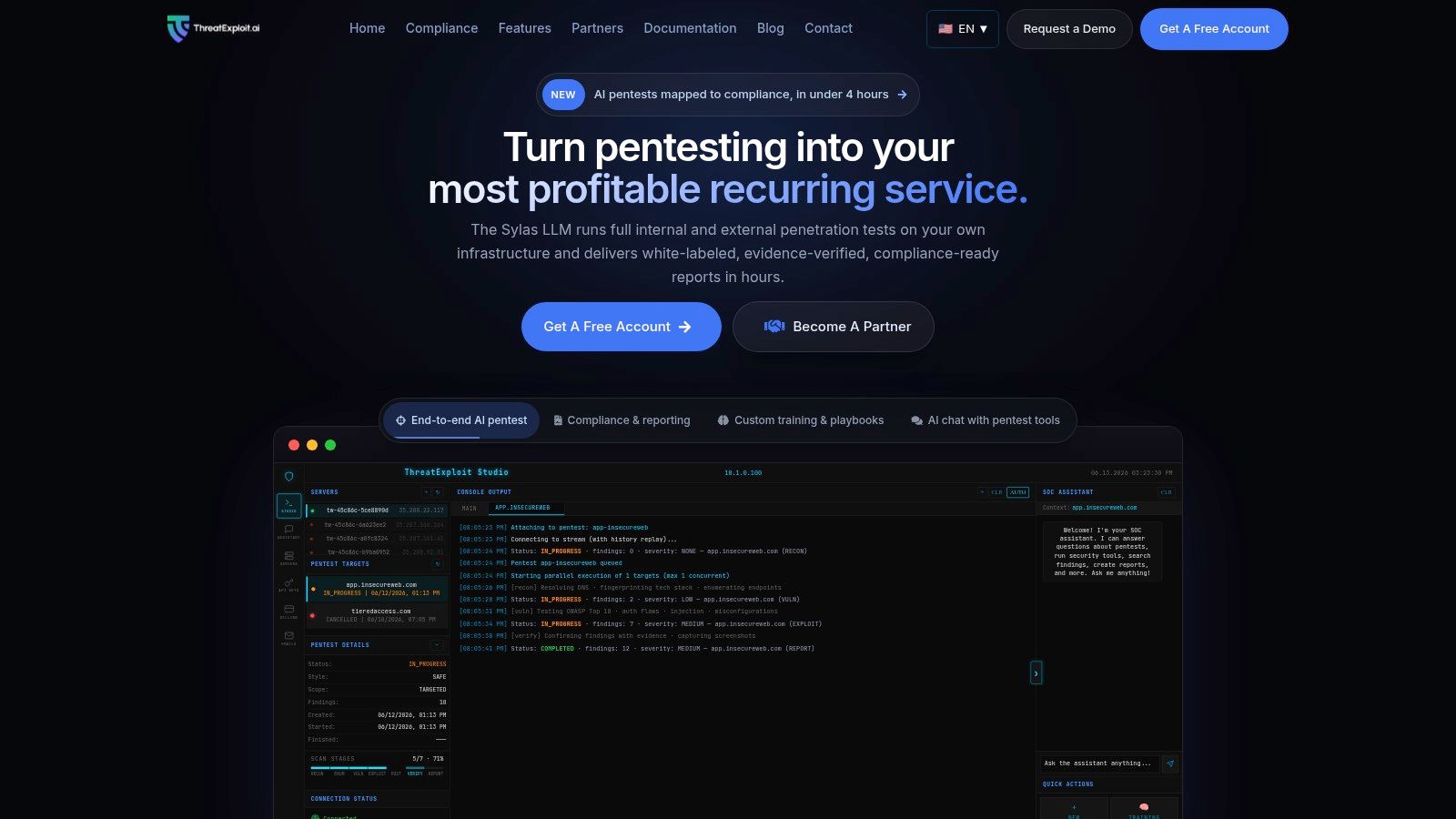
ThreatExploit AI is one example of that model. Its platform coordinates reconnaissance, exploitation, verification, and reporting across authorized web, network, and cloud targets, with PDF and JSON outputs and compliance mappings. For an MSSP, the question is not whether a platform automates testing. The question is whether it enforces authorization, preserves evidence quality, supports the target types you sell, isolates customer data correctly, fits your review workflow, and integrates with the systems your delivery team already uses.
The business case is straightforward. Slower validation creates longer remediation cycles, more analyst touchpoints, and more room for disputes over severity and proof. Faster, evidence-backed testing helps an MSSP deliver retests sooner, close findings with less back-and-forth, and show measurable progress to clients who need proof for renewals, board updates, or audits.
IBM's 2025 Cost of a Data Breach research examined 600 organizations and reported a global average breach cost of $4.44 million, with the United States average at $10.22 million. Organizations using security AI and automation extensively averaged $3.62 million, compared with $5.52 million for organizations that did not use those capabilities. The same research reported that breaches with a lifecycle longer than 200 days averaged $5.01 million, and internal security teams identified breaches in an average of 172 days in IBM's 2025 research. Those figures do not prove that automated penetration testing alone prevents breaches, but they support investment in earlier discovery, validation, evidence collection, and remediation workflows.
Measure the program like a service line, not a lab function. Track delivery time, analyst review effort, verified-finding quality, retest completion, customer remediation progress, renewal rates, and margin by service tier. Scan counts and raw finding volume help with capacity planning, but they do not show whether the client is reducing exposure or whether your team can defend the service in front of procurement, auditors, and security leadership.
For teams evaluating delivery platforms, ThreatExploit AI provides automated reconnaissance, exploitation, verification, and reporting for authorized web, network, and cloud environments, with evidence-backed outputs designed for service-provider workflows.