
You're three days from a customer's audit meeting, and the cloud report on your desk is last year's point-in-time test with a fresh cover page. The accounts have changed, a new SaaS integration went live, and nobody can say which service principal can reach the production data store today. That's the normal state of cloud pentest delivery, and it's why cloud security vulnerabilities can't be treated as scanner rows to be closed before the next annual engagement.
Table of Contents
- Why Cloud Security Vulnerabilities Break Pentest Delivery
- What Counts as a Cloud Security Vulnerability
- Identity Privilege and Exposure Paths That Matter
- Business Impact of Real Cloud Breach Paths
- How to Collect Evidence During Cloud Tests
- Choosing Cloud Testing Methods by Provider
- Continuous Cloud Testing and the Next Engagement
Why Cloud Security Vulnerabilities Break Pentest Delivery
An MSSP delivery manager I brief often describes the same week. Sales promised the customer a cloud assessment for an audit, the tester inherited a scope written around a handful of accounts, and the customer then added a hosted file transfer service, two SaaS connectors, and a partner-managed backup platform. None of those additions appeared in last year's test. The tester isn't short of findings. The tester is short of proof about what an attacker can reach right now.
The Exploitation Window Has Moved
That gap matters because attackers aren't waiting for your next scheduled scan. Verizon analyzed 30,458 security incidents, including 10,626 confirmed data breaches, and found exploitation of vulnerabilities as an initial access method rose 180% year over year and accounted for 13% of all confirmed breaches in Verizon's 2024 Data Breach Investigations Report findings. A near tripling in one year changes the delivery question. You're no longer asking whether a flaw exists. You're asking whether you can discover, verify, and retest it before a mass exploitation campaign does.
Verizon tied much of that rise to MOVEit and similar zero-day campaigns against widely used file transfer infrastructure. The lesson for pentest teams is uncomfortable. The breached organizations didn't all build the vulnerable software themselves. Many inherited exposure through hosted platforms and suppliers.
Delivery rule: If your cloud scope stops at applications the customer built, you've scoped out the path attackers are currently scaling.
Third Parties Belong in Scope
The same dataset shows 15% of breaches involved third parties such as data custodians or hosting partner infrastructures, as reported in the Verizon analysis cited above. For a service provider, that figure should reshape scoping conversations. Internet-facing appliances, managed services, software dependencies, and partner environments aren't context around the test. They're part of the test surface.
Periodic compliance checks leave a long window between disclosure and exploitation. A customer can pass an assessment in January and still be exposed when a supplier flaw is weaponized before the next quarterly review. Your report therefore has to do more than record a configuration state. It has to show rapid discovery, verification, remediation, and continuous retesting, with evidence that the exposure closed.
That's the delivery problem. Cloud findings age faster than annual pentest cycles, and the entry point often sits outside the customer's own code.
What Counts as a Cloud Security Vulnerability
A cloud environment passes its patch scan, but a compromised service account can still reach a production data store through a trusted integration. The software is current. The attack path remains open because authorization crosses environments without a tested boundary.
Valid Access Is the Exploit
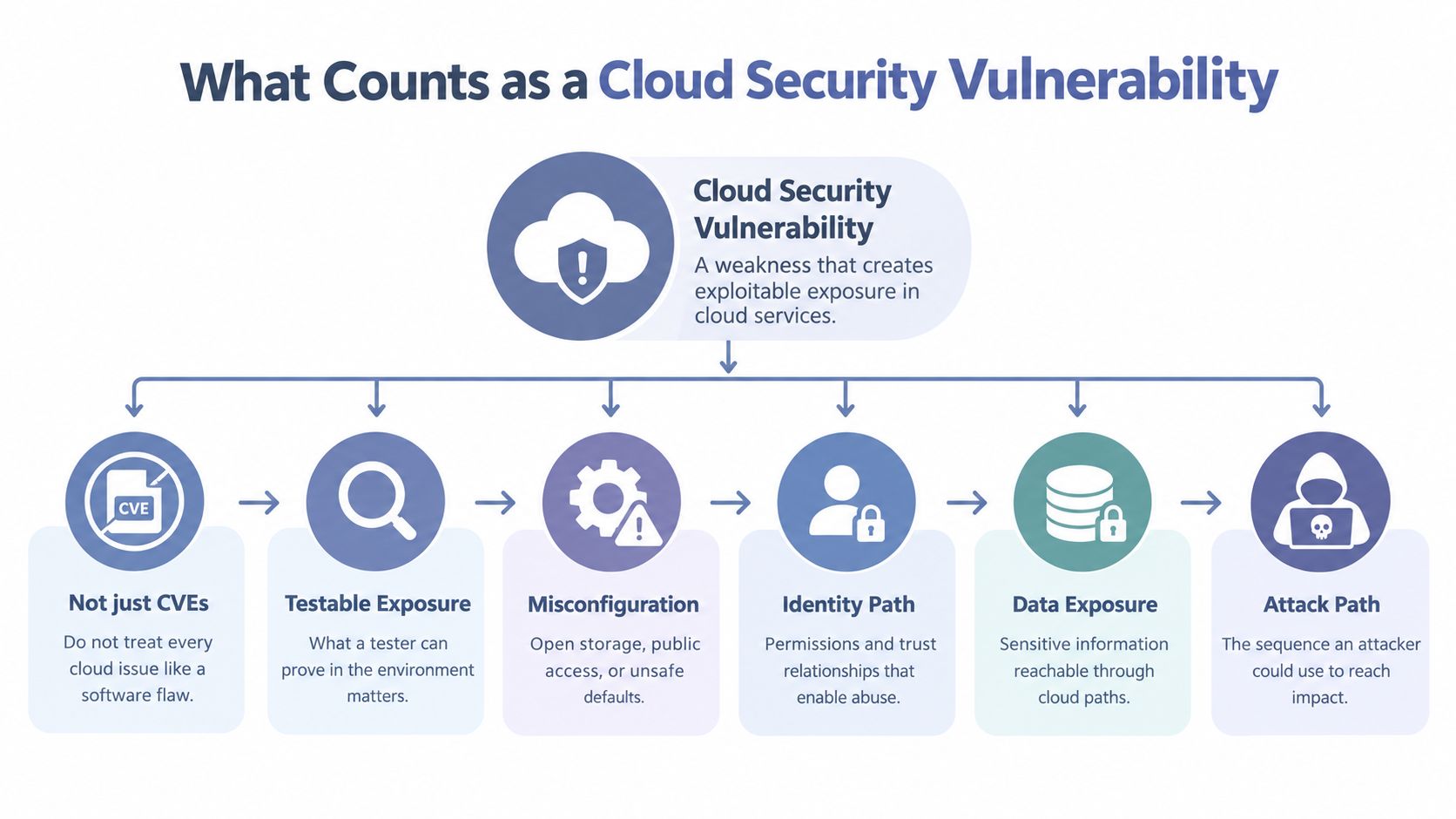
A cloud security vulnerability is any weakness an attacker can use to gain or expand access, including excessive permissions, exposed credentials, unsafe trust relationships, or a configuration that exposes data. A CVE may create that opening, but valid credentials and approved integrations can create an exploitable path without a software flaw.
The test must establish what happens after access is obtained. Can a compromised identity cross an account, tenant, pipeline, or data-store boundary? Which permissions enable that movement, and what evidence shows the path works? A fully patched cloud can remain exploitable when authenticated trust extends farther than the customer expects.
A finding is a demonstrated attack path, not simply a vulnerable version or a configuration value outside a baseline.
The Question Your Scope Must Answer
Frame the engagement around whether a compromised service principal, refresh token, workload identity, or OAuth connection can reach systems beyond its intended boundary. Provider-specific services differ, so the test must trace the actual trust relationships in scope rather than apply one cloud-wide checklist.
For each path exercised, the report should prove:
- Effective permissions: Record the permissions the identity or token can use, with supporting evidence from the test.
- Reachable resources: Show which accounts, tenants, pipelines, or data stores became accessible and how.
- Revocation results: Document whether revoking the credential ended active sessions and refresh access.
- Detection evidence: Include relevant logs and alerts, or state what telemetry was absent when the path was exercised.
For smaller customers, the essential cloud security controls for SMBs guide can help establish a baseline before scoping. The penetration test must then show whether trusted identities can cross that baseline and what the customer can detect.
Identity Privilege and Exposure Paths That Matter
Start with a simple ordering principle. Test what a compromised identity can reach before you test what a scanner can enumerate. Cloud accounts are globally reachable, so a stolen password, a reused credential, or an abused MFA push works from outside the customer's network perimeter. There's no internal foothold required.
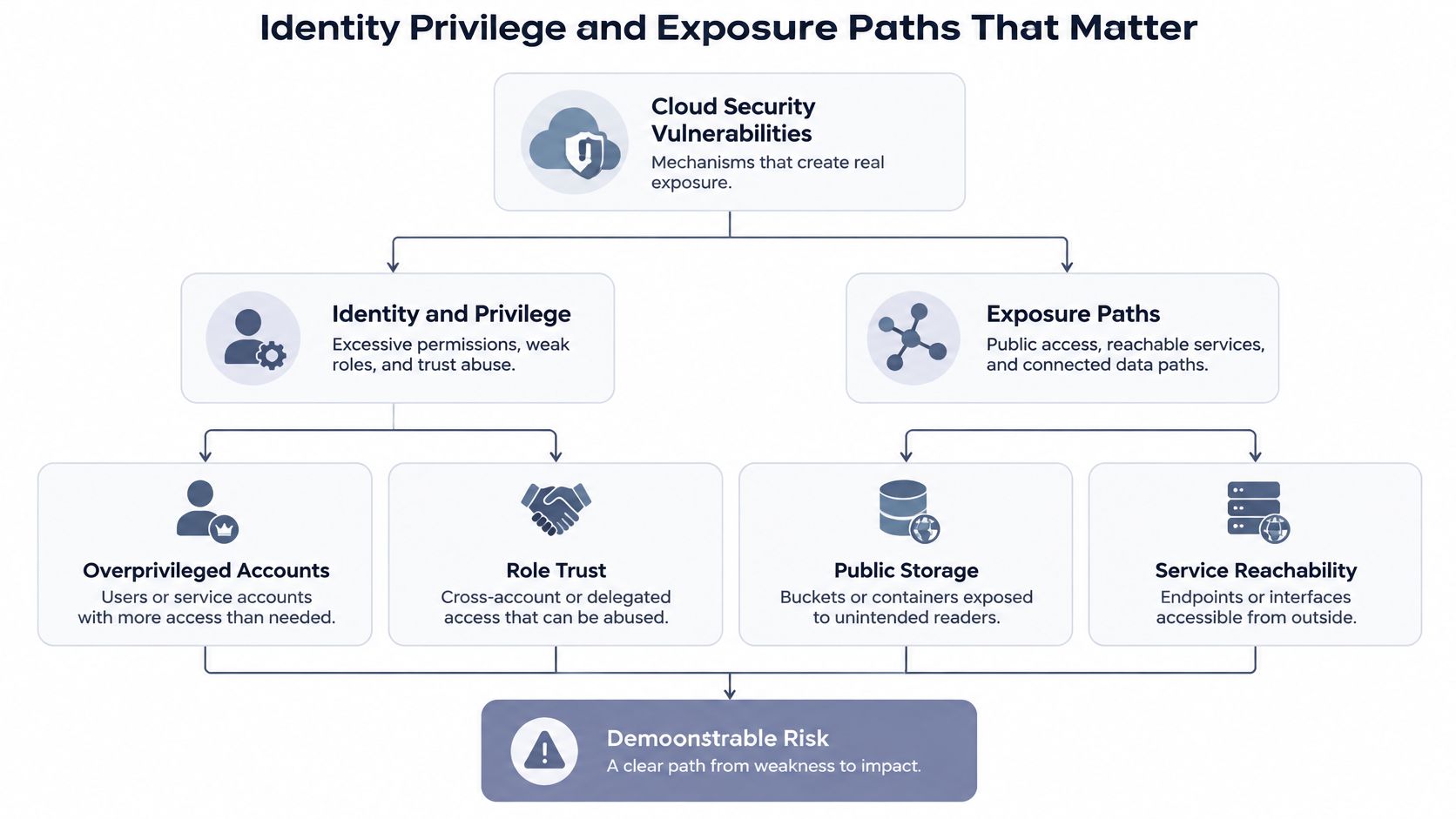
The hierarchy below shows how identity and exposure paths combine into demonstrable risk.
Build the Authorization Graph
NSA and CISA identify phishing, external accounts with excessive access, insecure federation trust, exposed certificates, long-lived secret keys, and overly broad authorization policies as recurring attack paths in NSA and CISA guidance on cloud identity and access management. The chain is direct. Credential theft or token abuse creates an authenticated session, and excessive privilege then permits resource discovery, secret access, lateral movement, or administrative change without exploiting any software flaw.
Don't test identity as a checkbox for MFA presence. Test it as an authorization graph:
- Phishing-resistant MFA: Attempt the push fatigue and session reuse paths, don't just confirm enrollment.
- Just-in-time access: Verify standing admin privilege is gone and elevation requires approval that leaves an audit trail.
- Short-lived credentials: Check whether long-lived keys still exist beside the temporary credential program.
- Federation trust: Audit which external identity providers can assert identities into the account and under what conditions.
- Metadata access: Test whether workloads can query the instance metadata service and whether server-side request forgery converts that into temporary credentials.
For multi-tenant providers, raise the stakes in your report language. One overprivileged automation identity or federation trust can create cross-customer blast radius, which turns a single finding into a platform risk. A structured review of cloud application security testing scope helps you frame which identities and integrations belong in that graph before testing starts.
The short briefing below walks through how these privilege paths present during a live cloud assessment.
Storage and Network Paths at Proof Level
For storage, your job at this stage is to establish reachability, not to catalogue every bucket setting. Determine whether access is anonymous or inherited through a broad role, because the remediation differs completely. For network paths, test segmentation from cloud workloads back into internal systems, since a cloud foothold that reaches on-premises resources changes the severity conversation. Prioritize by reachable privilege and reachable data. Benchmark labels come last.
Business Impact of Real Cloud Breach Paths
Executives don't fund remediation because a finding scored high on a generic scale. They fund it when you connect a reachable principal to a sensitive store and then to time and money. Multi-environment breaches give you the strongest language for that conversation, because the cost driver isn't the cloud itself. It's lost visibility across environments.
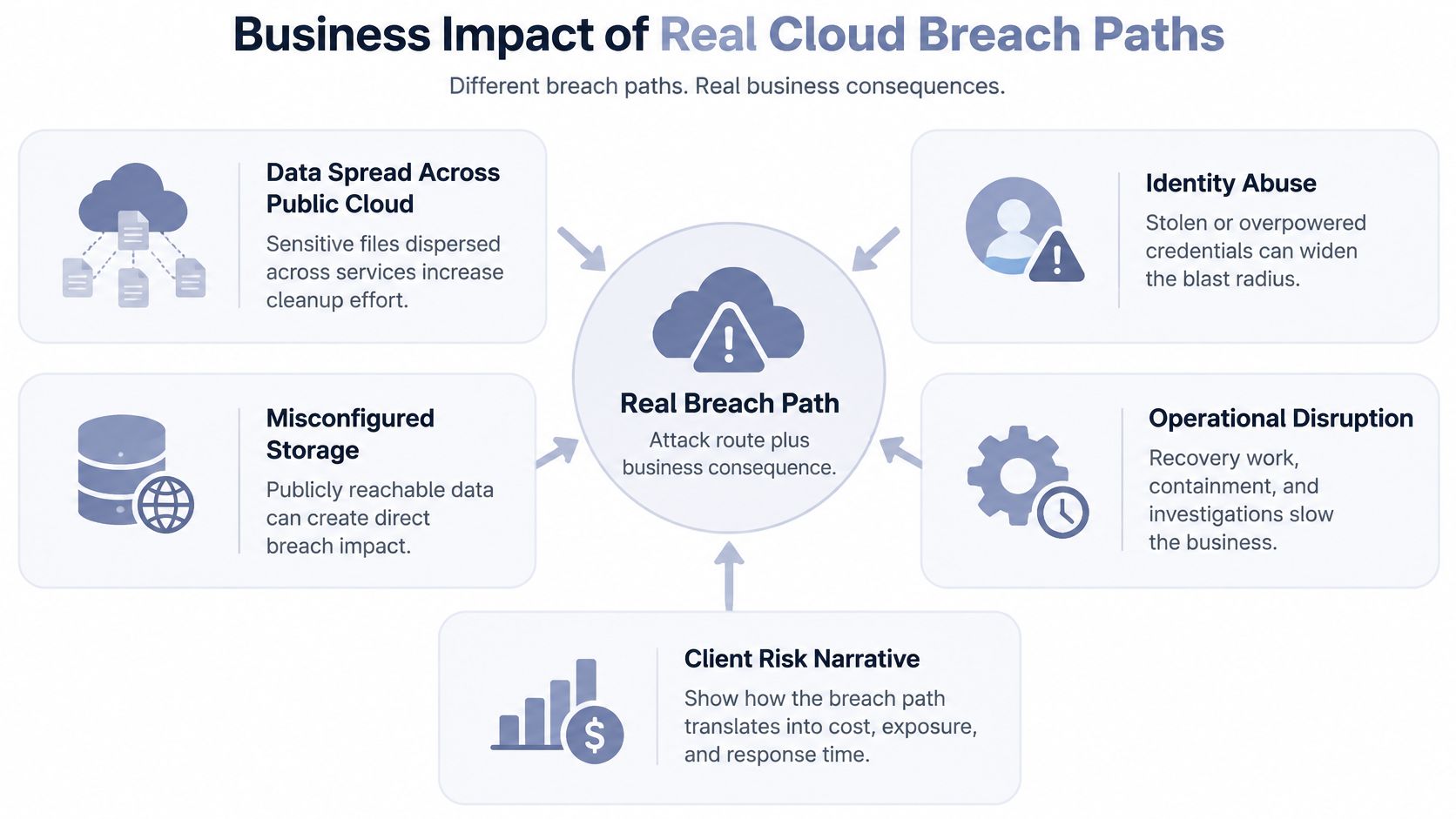
The scenario cards below translate technical breach paths into business consequences.
What Distributed Data Costs
IBM found 40% of breaches involved data stored across multiple environments, including public cloud, private cloud, and on-premises systems, and those breaches cost more than USD 5 million on average and took 283 days to identify and contain, according to IBM's 2024 Cost of a Data Breach announcement. That was the longest lifecycle among the categories IBM analyzed. The global average breach cost reached USD 4.88 million in 2024, while public cloud data carried the highest single-environment average at USD 5.17 million, as detailed in IBM's Cost of a Data Breach report.
Use those figures carefully in a debrief. Don't claim your customer's breach would cost that amount. Show instead that their architecture matches the pattern behind the numbers: data in several places, inconsistent configuration, unmanaged assets, and unclear ownership when something goes wrong.
Shadow Data and Supplier Reach
IBM also reported that more than one-third of breaches involved shadow data, information sitting in unmanaged or poorly governed locations, per the IBM announcement cited above. That's a finding your testers can make tangible. When you discover an unowned store during testing, name the missing owner in the report. Unclear ownership is what stretches discovery time, because nobody recognizes the alert as theirs.
Client language that works: This identity reaches data in two environments, neither team owns the store, and that ownership gap is what turns a contained incident into a long investigation.
Frame supplier scenarios the same way. A hosting partner or data custodian inside the trust boundary widens the blast radius beyond the customer's own accounts, so containment depends on a third party's logging and response speed. Your executive summary should state which environments the path crossed, how long detection would plausibly take given current telemetry, and who owns each hop. That's an impact story a board can act on. A severity label alone isn't.
How to Collect Evidence During Cloud Tests
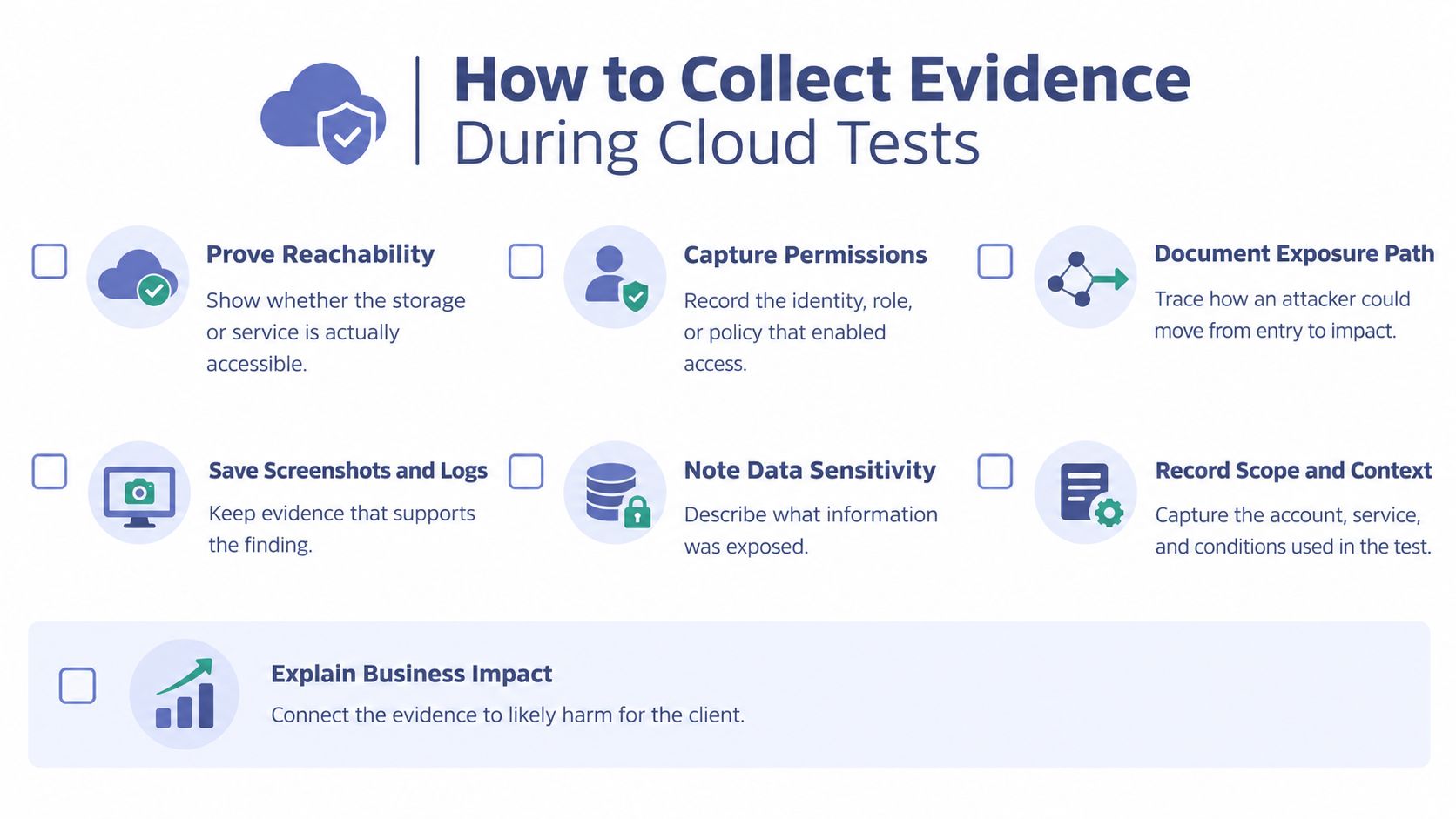
A finding survives customer pushback when another engineer can replay it from your evidence pack. Screenshots of scanner rows don't meet that bar. You need the principal, the policy path, the resource, the data reached, and the log record, captured while the test is running.
The checklist below sets out the evidence items to collect for every cloud finding.
Storage Evidence That Holds Up
Unit 42 found sensitive data, including personally identifiable information, financial records, and intellectual property, in 66% of assessed cloud storage buckets, and 63% of publicly exposed buckets contained sensitive data, according to Unit 42's Cloud Threat Report executive summary. Reachability alone therefore understates the finding. Record these items for every exposed bucket:
- Effective access condition: Capture the exact policy or ACL state that permitted your read or write.
- Bucket and object: Name the specific objects retrieved, with timestamps.
- Data classification: State what you found, sampled responsibly, rather than speculating about contents.
- Exposure route: Distinguish direct anonymous access from access inherited through an overly broad identity or role.
Unit 42 also reported that 61% of cloud accounts had storage buckets without access logging, as documented in the same Unit 42 summary. When logging is absent, say so explicitly in the finding. An unauthorized download that leaves no record is a separate risk from the exposure itself, and auditors treat it that way.
Proving Temporary Privilege Abuse
Identity persistence rarely looks like a new permanent administrator. MITRE ATT&CK documents Temporary Privileged Cloud Access, technique T1548.005, covering short-lived credentials and temporary manipulation of roles or policies, in MITRE ATT&CK documentation for Temporary Elevated Cloud Access. The companion technique, Additional Cloud Roles, covers actions such as CreatePolicyVersion and AttachUserPolicy that broaden an existing account's permissions.
Use a fixed verification sequence so every tester produces comparable proof:
- Identify the initial principal and its documented permissions before you touch anything.
- Cross one least-privilege boundary and record the exact policy or role change you made.
- Confirm the resulting access by performing the newly permitted action once.
- Remove every test permission and token, then verify removal in the audit log.
Close each finding by attaching tamper-resistant control-plane and data-plane logs covering your actions. If the customer's logging can't reconstruct your test, that gap belongs in the report as its own finding.
Choosing Cloud Testing Methods by Provider
A tester starts with a low-privilege workload identity in one cloud account and finds a federated role that reaches a production subscription. The cloud may be fully patched, yet the authenticated trust path still exposes data or control-plane actions across environments. Provider-neutral checklists miss these paths because AWS, Azure, and Google Cloud implement identity, federation, and telemetry differently.
What to Test Differently by Cloud
| Provider focus | Paths to attempt | What changes priority |
|---|---|---|
| AWS identity and network | Role assumption chains, metadata service access, security group reachability into internal ranges | Whether a low-privilege role can assume its way toward administrative actions |
| Azure storage and Entra ID | Storage account public access, Entra ID application consent, managed identity scope | Whether an app registration or consent grant reaches tenant-wide data |
| Google Cloud OS Login and IAM | OS Login bypass paths, service account impersonation, project-level IAM bindings | Whether impersonation crosses project boundaries into production workloads |
Prioritize findings by the path an attacker can traverse: the starting identity, trust relationships, reachable services, and the resulting access to sensitive workloads. A benchmark failure alone does not establish exploitable impact. A useful AWS penetration testing methodology shows why test order must follow the provider's privilege model, then verify whether trust extends into other accounts or environments.
Where Automation Fits Beside Manual Testing
Automated penetration testing can widen coverage across accounts, while human testers assess business logic and chains that require context. ThreatExploit AI is a platform for security service providers that runs reconnaissance, exploitation, verification, and reporting across web, network, and cloud targets, including AWS, Azure, and GCP. It orchestrates more than 60 tools through a pentest-trained model and an agentic controller aligned to PTES phases, and produces evidence-backed PDF and JSON reports.
The platform reports a 95% verification rate and 94% overall accuracy, runs on dedicated rather than shared test infrastructure, and maps findings to HIPAA, SOC 2, PCI-DSS, CMMC, ISO 27001, GLBA, and GDPR. Treat automated results as coverage evidence, not proof that a cross-environment attack path is exploitable. The customer report should show the starting principal, each trust boundary crossed, the actions authorized at the destination, and the supporting evidence. Senior testers can then validate the chains that automation identifies but cannot fully judge.
Continuous Cloud Testing and the Next Engagement
Everything in the earlier sections points to one commercial conclusion. An annual cloud test can't stay accurate in an environment where exploitation windows shrink, multi-environment discovery takes months, and every new pipeline, SaaS application, or federation changes the trust graph. MSSPs and consultancies should sell a recurring testing rhythm, not a yearly event.
A Cadence You Can Put in a Proposal
Structure the offer around change rather than the calendar:
- Inventory continuously: Reconcile accounts, subscriptions, projects, SaaS integrations, and on-premises connectors so new assets enter scope automatically.
- Retest after material change: Re-examine effective permissions and public storage whenever a pipeline, integration, or federation relationship is added.
- Verify logging coverage: Confirm control-plane and data-plane actions still reach centralized, tamper-resistant storage after each change.
- Reissue the evidence pack: Map updated findings to the customer's framework so compliance teams always hold current proof.
Platforms that support recurring assessments, multi-tenant customer onboarding, and client-ready executive and technical reports make this model deliverable without adding headcount for every new customer. Tiered options, from a free trial through enterprise plans with optional on-premise deployment, let you match the delivery model to regulated customers who can't send test traffic to shared infrastructure. A structured approach to continuous penetration testing programs helps you package that cadence as a retained service instead of ad hoc retests.
Don't pitch continuous security as a slogan. Pitch one scoped engagement with a report the customer can use this month.
Scope One Engagement This Week
Pick a single multicloud or high-privilege customer from your current book. Scope an authenticated cloud test that includes one SaaS trust relationship, such as an OAuth-connected CRM integration, and one storage exposure check against the customer's most sensitive bucket. Set the success criteria before you start. You'll prove or disprove token reach, document revocation behavior, and confirm whether logging captured the activity.
Deliver a short, evidence-backed report that the customer's compliance team can hand to an auditor and your sales team can use in the renewal conversation. That's how a recurring cloud testing practice starts. Not with a platform migration, but with one engagement that proves what last year's checklist never could.
ThreatExploit AI gives MSSPs and consultancies an automated penetration testing platform that runs reconnaissance, exploitation, verification, and reporting across AWS, Azure, and GCP, so you can prove authenticated cloud attack paths with evidence your customers can audit. Start with one high-privilege customer, scope the SaaS trust and storage checks described above, and deliver a compliance-mapped report this month by visiting ThreatExploit AI.