
The most popular cloud security advice is incomplete: scan the application code, fix the OWASP findings, and assume the cloud platform will handle the rest. SQL injection and cross-site scripting still deserve attention, but they're no longer a sufficient model for testing a cloud application. A modern breach often begins with an exposed service, a permissive identity, an abused API, or several individually modest weaknesses chained into one practical attack path.
For MSSPs, that changes the engagement. A cloud application penetration test must examine the application, its API gateway, serverless functions, storage, network routes, workload identities, control-plane permissions, logging, and the ways those components interact. The job isn't to produce a longer vulnerability list. It's to prove how an attacker can move from public reachability to privilege escalation, sensitive data access, or operational impact, then give the client evidence that engineering and SOC teams can act on.
Table of Contents
- Redefining Cloud Application Security
- The Reality of Cloud Asset Sprawl and Exposure
- Mapping Identity and API Attack Vectors
- Evaluating Provider-Specific Misconfiguration Risks
- Bridging Technical Findings and Compliance Readiness
- Scaling Delivery with Automated Penetration Testing
- Operationalizing Continuous Cloud Security Testing
Redefining Cloud Application Security
Treating cloud application security as a code-only discipline creates a dangerous blind spot. The application runs inside a context controlled by identity providers, cloud APIs, managed databases, queues, storage services, deployment roles, and network policies. A secure function can still become an entry point if its execution role can access far more than the business process requires.
The practical boundary has moved from “the web application” to the application's entire runtime graph. That graph includes user identities, service accounts, API tokens, secrets, gateways, containers, serverless handlers, CI/CD roles, and the provider services those workloads call. A tester who stops after confirming that an endpoint rejects a malformed parameter may miss the more consequential question: what can the endpoint's authenticated principal do after access is granted?
Code flaws still matter, but context determines impact
Traditional application testing remains valuable. SQL injection, cross-site scripting, insecure deserialization, broken authentication, and authorization defects can expose data or provide direct control. The difference in cloud environments is that impact depends heavily on the permissions and connectivity available behind the vulnerable component.
A server-side request forgery issue, for example, becomes materially more serious when the workload can reach metadata services or internal control-plane interfaces. An API authorization weakness becomes more dangerous when the compromised identity can assume another role, read deployment secrets, or modify a production resource. The tester should therefore validate not only whether a defect exists, but also what access it grants.
Practical rule: Report the exploitable chain, not just the first technically valid finding.
The new testing boundary
A useful cloud application security scope includes four connected layers:
- Application behavior: Validate input handling, authentication, authorization, session management, business logic, and error handling.
- API exposure: Test endpoint discovery, object-level authorization, token scope, rate controls, schema enforcement, and excessive data exposure.
- Cloud configuration: Review public reachability, storage permissions, security groups, route paths, workload settings, and managed-service controls.
- Identity relationships: Trace human and non-human principals, role assumptions, privilege escalation paths, credential lifetime, and audit coverage.
This broader model doesn't replace application penetration testing. It makes the testing representative of how cloud applications operate. The strongest MSSP methodologies connect a web finding to the identity and infrastructure conditions that determine whether an attacker can turn it into lateral movement.
The Reality of Cloud Asset Sprawl and Exposure
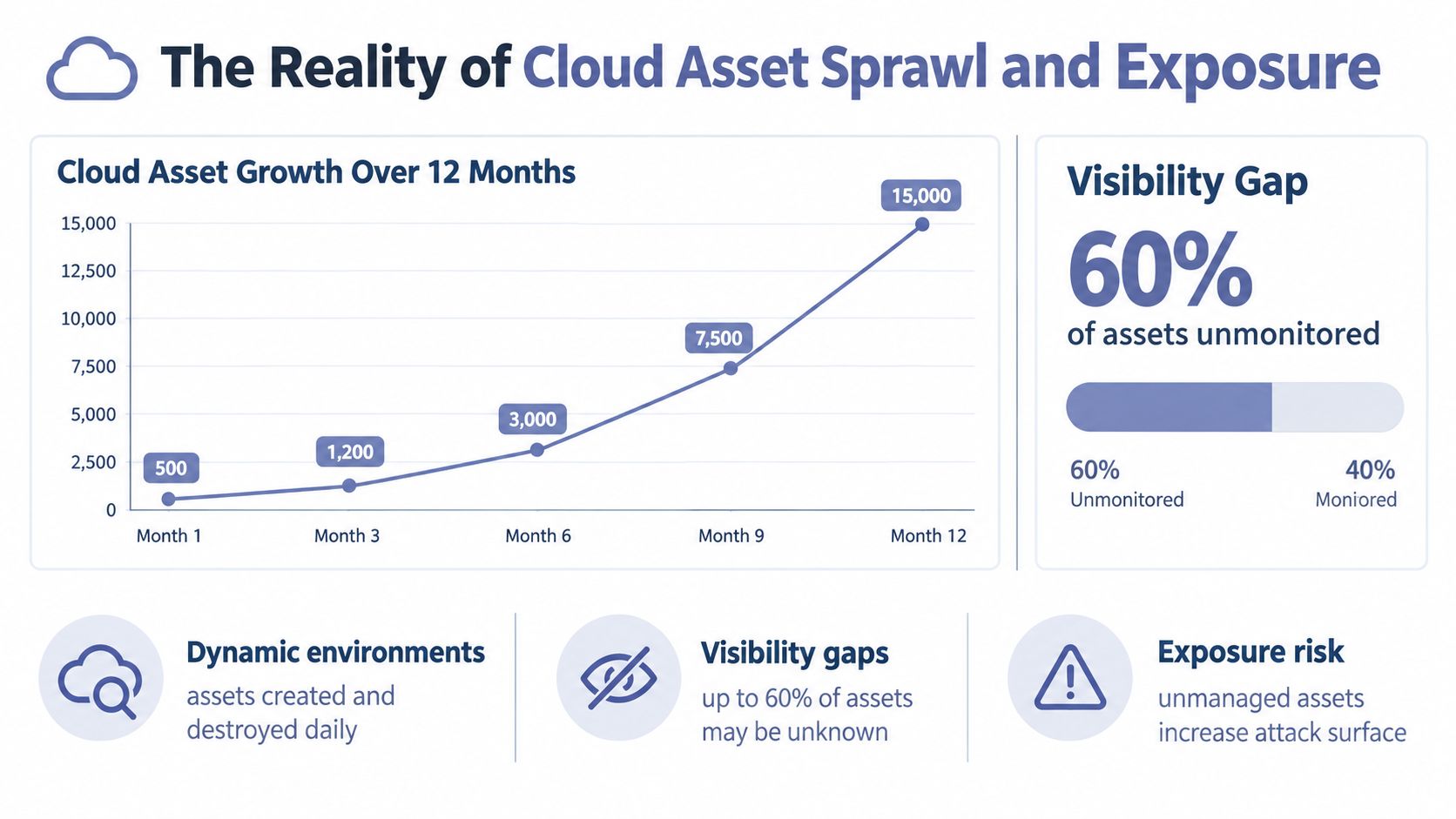
Cloud environments invalidate point-in-time perimeter assumptions. The boundary changes whenever a team deploys a service, creates a temporary account, exposes a development endpoint, or alters a route. The 2025 State of Cloud Security Report described 32% of cloud assets as neglected, with each asset containing an average of 115 vulnerabilities in its published findings. Missed inventory and concentrated technical risk therefore reinforce each other.
The report also found that 76% of organizations had at least one public-facing asset that enabled lateral movement. 36% had at least one cloud asset supporting more than 100 attack paths, and 13% had assets supporting more than 1,000 attack paths. A public endpoint is rarely only an isolated perimeter issue. It may provide the first route toward identities, services, data stores, and administrative functions.
Why perimeter scanning misses the critical exposure
An external scan can identify domains, ports, certificates, and exposed application services. It cannot reliably show whether a minor endpoint is attached to a powerful workload role, whether an assumed identity can reach a storage bucket, or whether a route-table change has made a private subnet accessible from the internet. Those relationships often determine whether an application flaw becomes an identity-based breach.
MSSPs need continuous discovery and attack-surface mapping, rather than an annual inventory exported to a spreadsheet. A practical workflow reconciles cloud APIs, infrastructure-as-code, DNS, application documentation, CI/CD records, and observed internet exposure. The resulting asset graph should record ownership, environment, identity relationships, data sensitivity, and reachable attack paths. A cloud attack-surface mapping workflow converts that inventory into a boundary that testers can validate.
What automation should validate
Automation should monitor change and reachability continuously. It can flag newly public services, abandoned workloads, permissive security groups, storage without enforced transport protections, unexpected identity relationships, and routes connecting private resources to the internet. It should preserve evidence as well, since a finding that cannot be reproduced or tied to a specific resource is difficult for a client to remediate.
Manual review still determines business context and exploit chaining. Senior testers should not spend every engagement rediscovering the same assets and configuration facts. Let automated testing maintain coverage, then apply human judgment to authorization logic, business impact, chained exploitation, and safe validation.
Mapping Identity and API Attack Vectors
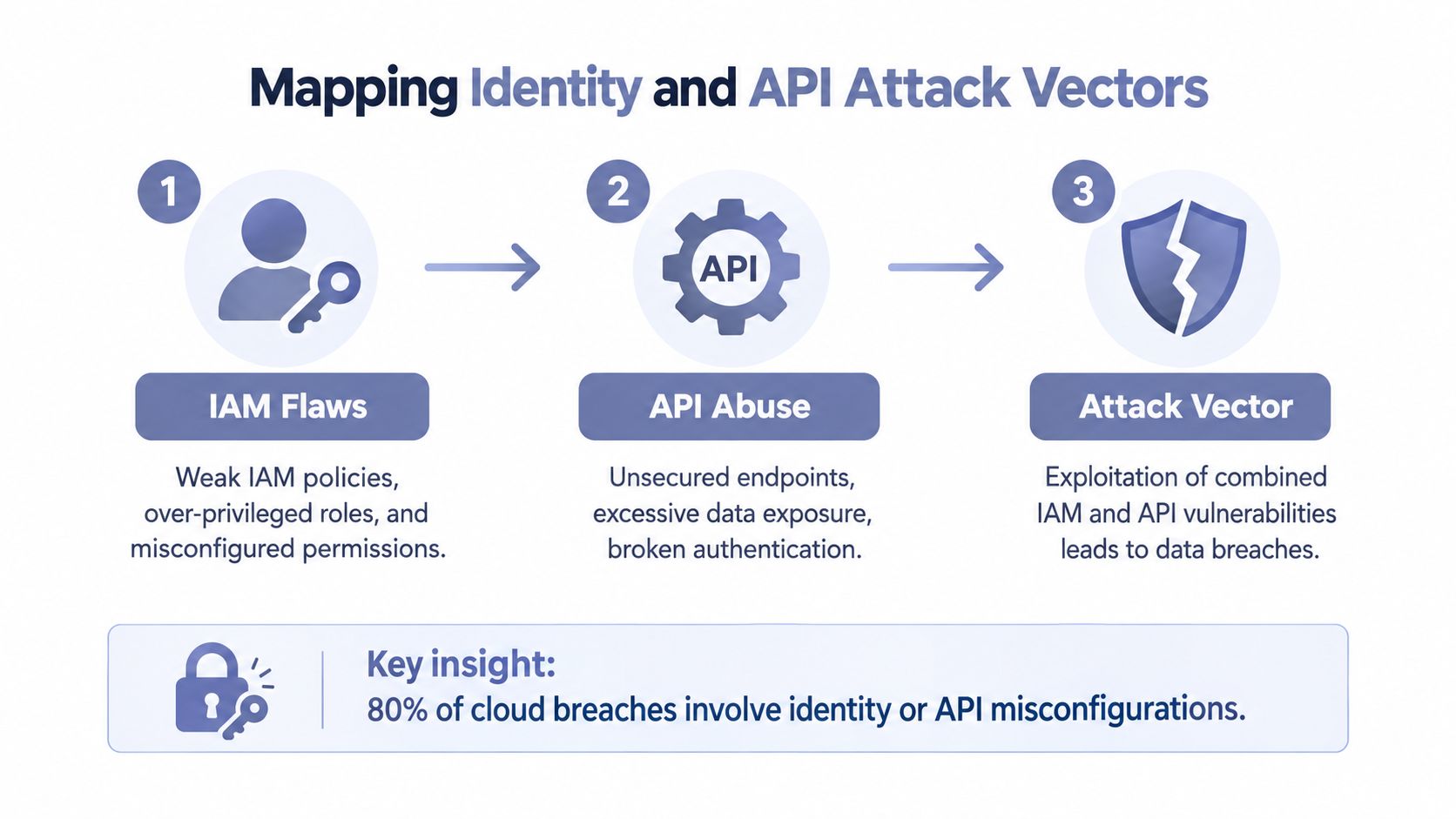
The central cloud testing question is no longer, “Can I break this endpoint?” It's, “Which identity does this endpoint use, what can that identity reach, and can API behavior let me cross a trust boundary?” Weak IAM controls, missing logging, and over-permissive roles frequently combine with API flaws to create escalation paths.
A 2026 industry analysis reported that weak IAM controls or missing logging affected 80% to 98% of cloud accounts across providers. It also found 76% of AWS accounts with at least one publicly exposed service, while S3 buckets without enforced HTTPS appeared in 87% of AWS accounts and IAM policy paths enabling privilege escalation appeared in 83% in the analysis. These conditions matter because exposure is usually chained. Public reachability provides the approach, weak permissions provide the means, and missing logs reduce the chance of rapid detection.
A practical IAM testing sequence
Start with identity enumeration. Identify human roles, service accounts, workload identities, deployment principals, federation paths, and emergency access mechanisms. Then build an authorization graph that shows which principal can assume, impersonate, modify, or delegate to another principal.
Test the graph in controlled stages:
- Confirm effective permissions: Compare declared policy with effective access, including inherited permissions and resource policies.
- Test escalation paths: Check whether a low-privilege identity can alter policies, attach roles, pass roles to workloads, modify functions, or change deployment artifacts.
- Validate credential controls: Determine whether sensitive workflows enforce short-lived credentials, appropriate token scope, and revocation procedures.
- Assess metadata exposure: Where authorized, test whether a workload can reach metadata services and whether retrieved credentials provide access beyond the workload's intended function.
- Review logging coverage: Verify that role assumptions, policy changes, token use, administrative actions, and data access generate usable events for the SOC.
The test should demonstrate the minimum chain required to reach a meaningful impact. Don't collect excessive data or alter production permissions merely to prove a theoretical route.
APIs are identity paths
API abuse often bypasses the assumptions behind network-centric defenses. A gateway may enforce TLS and rate limits while the application still accepts a valid token with excessive scope, exposes another user's object, or permits a service role to perform administrative actions. Testers should combine endpoint discovery with token analysis, object-level authorization checks, method tampering, schema abuse, replay resistance, and workflow testing.
API-heavy systems also need tests for non-human actors. AI agents can call tools, retrieve data, and invoke cloud services through delegated credentials, so the security boundary includes the agent's instructions, tool permissions, secrets, and approval workflow. A technically useful companion resource is Agntz on AI agent vulnerabilities, particularly when cloud applications delegate actions to autonomous components.
For MSSPs building repeatable delivery, API penetration testing guidance can support a dedicated workflow that combines discovery, authorization testing, and evidence collection instead of treating APIs as secondary web targets.
Evaluating Provider-Specific Misconfiguration Risks
A generic cloud checklist produces generic findings. AWS, Azure, and Google Cloud expose different services, permission models, network constructs, and default behaviors, so a tester must map each assessment to the provider and the exact technology being reviewed.
A 2026 analysis of 3,000 organizations reported public exposure in 76% of AWS accounts, compared with 64% on Azure and 8% on Google Cloud in its provider comparison. The figures don't prove that one provider is insecure. They show why an MSSP should validate provider-specific exposure rather than assume that one control set transfers cleanly across platforms.
| Cloud Provider | Public Exposure Rate | Primary Pentest Focus |
|---|---|---|
| AWS | 76% | IAM policy paths, role assumption, S3 exposure, security groups, route tables, metadata access |
| Azure | 64% | Entra identity relationships, managed identities, storage access, network security groups, role assignments |
| Google Cloud | 8% | IAM bindings, service accounts, bucket permissions, firewall rules, workload identity, project boundaries |
CIS publishes separate hardening guides for major cloud providers, and its benchmark selector presents distinct provider categories rather than one universal cloud standard. Use those benchmarks as a baseline, not as a substitute for exploitation. A compliant-looking control can still participate in an attack chain when an API, identity, or route creates an unintended path.
Tailoring the engagement
On AWS, test identity policy combinations, resource-based policies, role chaining, S3 transport enforcement, security-group reachability, and changes to route tables. On Azure, examine tenant and subscription boundaries, Entra role assignments, managed identity permissions, storage authorization, and network security group rules. On Google Cloud, focus on project and organization boundaries, IAM bindings, service-account impersonation, firewall policy, bucket access, and workload identity behavior.
The provider also changes the automation strategy. The discovery engine should use provider-native APIs and normalize results into a common model, while the exploitation layer preserves provider-specific evidence. A finding should identify the exact principal, resource, action, trust relationship, and remediation owner. That precision matters in multi-cloud environments, where “remove excessive access” isn't an actionable instruction.
Bridging Technical Findings and Compliance Readiness
A penetration test becomes valuable to an audit program when it produces more than severity labels. Compliance teams need evidence, scope, ownership, remediation status, and a defensible explanation of how technical observations relate to controls. Security teams need the same information to prioritize work, so compliance mapping shouldn't be a separate reporting exercise performed after the technical assessment.
The operational gap is visible in cloud response workflows. CSA's 2025 trend analysis says critical cloud events were often never logged, logs were stored in inaccessible locations, and teams didn't know what to retain until after an incident. 30% of organizations reported taking more than a full day to resolve an incident because of disjointed cloud and SOC workflows, while 89% said cloud and application security must be fully integrated with the SOC in the analysis.
Convert a finding into usable evidence
A cloud application pentest report should connect each verified issue to:
- Affected scope: Account, subscription, project, application, API, workload, identity, and data path.
- Attack evidence: Requests, permissions, timestamps, screenshots, logs, or controlled proof of access.
- Business consequence: What an attacker could read, change, impersonate, disrupt, or persist within.
- Control mapping: Relevant SOC 2, PCI-DSS, ISO 27001, or client-specific requirements.
- Remediation ownership: The engineering, platform, IAM, DevOps, or SOC team responsible for closure.
- Verification state: Whether the fix has been retested and whether the attack path has closed.
This structure prevents a common audit failure. A team may close an individual scanner alert while leaving the identity relationship or public route that made the issue exploitable. Retesting should validate the full chain, not just whether a configuration value changed.
For firms that need broader context on audit preparation, Agentable's security audit overview offers a useful reference point for connecting website security reviews with evidence and governance expectations.
Put the report inside the SOC workflow
Export findings in formats the SOC and ticketing systems can consume. Include resource identifiers, detection opportunities, relevant cloud events, recommended containment actions, and the assumptions used during testing. A report that sits in a client portal without workflow integration won't improve response readiness.
The strongest deliverable serves three audiences at once. Executives receive business exposure and priority. Engineers receive precise remediation steps. Auditors receive traceable evidence and control references. That is how a pentest supports both risk reduction and audit readiness without diluting its technical purpose.
Scaling Delivery with Automated Penetration Testing
MSSPs rarely struggle to invent another cloud test case. They struggle to deliver thorough assessments consistently when senior testers are already committed to complex engagements. Manual testing remains essential for judgment-heavy work, but using specialists for every discovery, baseline check, evidence capture, and report formatting creates a capacity ceiling.
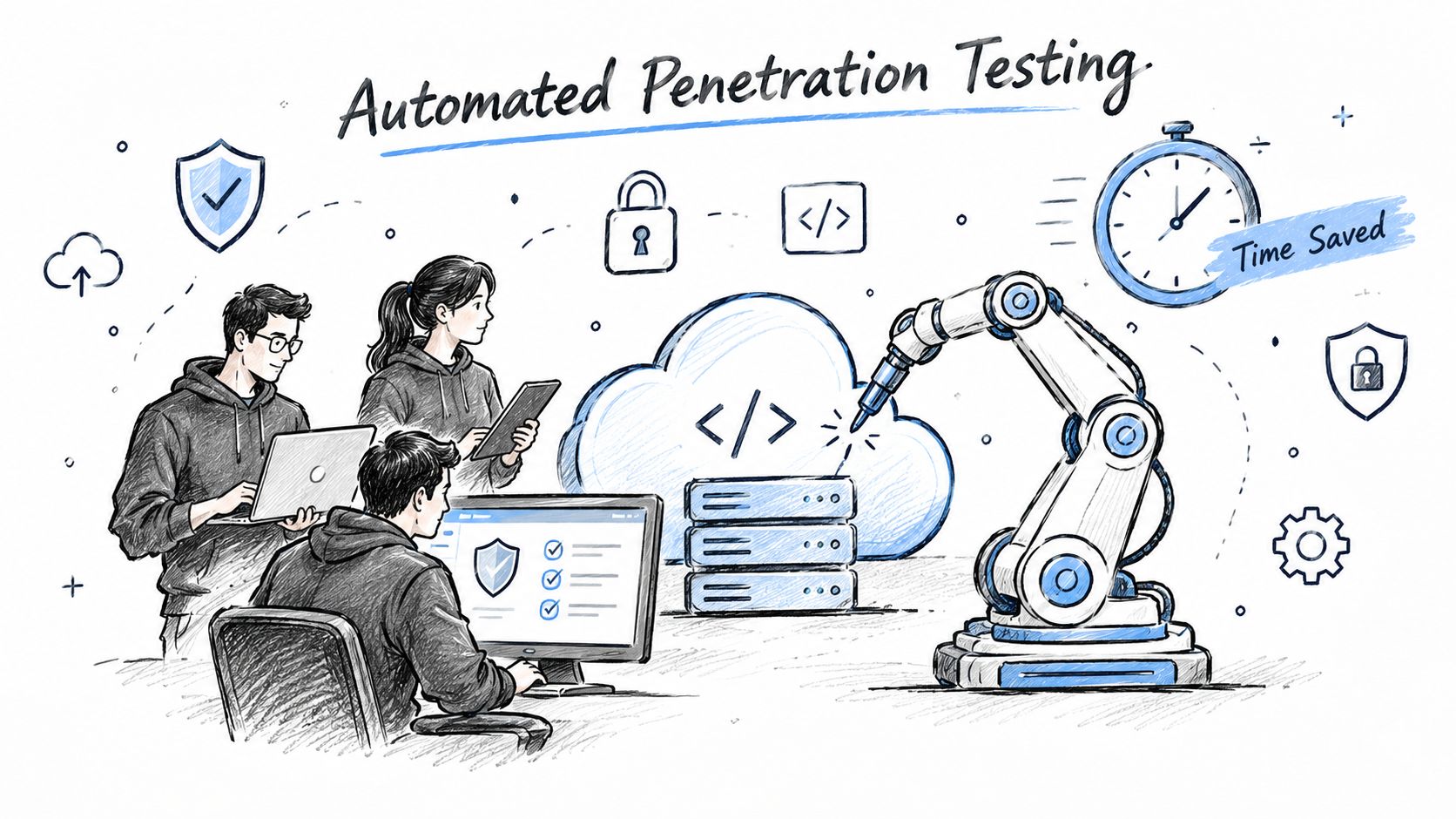
Automation should handle repeatable work across reconnaissance, cloud asset discovery, API enumeration, IAM analysis, controlled validation, evidence collection, and report assembly. The tester then spends time on the parts machines handle poorly, including business-logic interpretation, authorization nuance, exploit safety, client communication, and remediation design.
What automation does well
A useful automated penetration testing engine orchestrates tools and decisions rather than launching an unconnected collection of scanners. It should maintain scope, track credentials and permissions, verify findings, preserve screenshots or request evidence, and distinguish an exploitable path from a theoretical configuration concern.
For an MSSP, the operational gains come from repeatability:
- Consistent coverage: Every client assessment follows an approved methodology across cloud, web, API, and network targets.
- Faster evidence capture: Findings retain the technical context required for remediation and audit review.
- Lower reporting overhead: Executive and technical outputs can be generated from the same verified result.
- Recurring assessments: Clients can test after deployments, infrastructure changes, and remediation rather than waiting for an annual review.
- Better specialist allocation: Senior testers review high-value chains instead of repeating mechanical checks.
ThreatExploit AI is one example of this model. Its platform uses an agentic controller to coordinate penetration testing across web applications, REST and GraphQL APIs, internal and external networks, and AWS, Azure, and GCP environments. It produces PDF and JSON reports with evidence and compliance mapping, and supports partner workflows for customer onboarding and multi-tenant reporting.
Automation doesn't remove the need for rules of engagement. It increases the importance of them because a repeatable engine can repeat an unsafe action just as efficiently as a safe one. Define production boundaries, data-handling rules, credential scopes, rate limits, stop conditions, and human approval points before enabling exploitation.
A short demonstration of automated penetration testing can help MSSP leaders evaluate how orchestration fits their delivery model:
The right buying decision isn't “manual or automated.” It's deciding which activities require human judgment and which activities should never consume scarce senior capacity.
Operationalizing Continuous Cloud Security Testing
Continuous cloud application security testing needs an operating model, not another dashboard. MSSP leaders should define how a client enters the service, how scope changes are detected, how tests run safely, who receives findings, and how remediation is verified. Without those decisions, automation produces more output without improving closure.
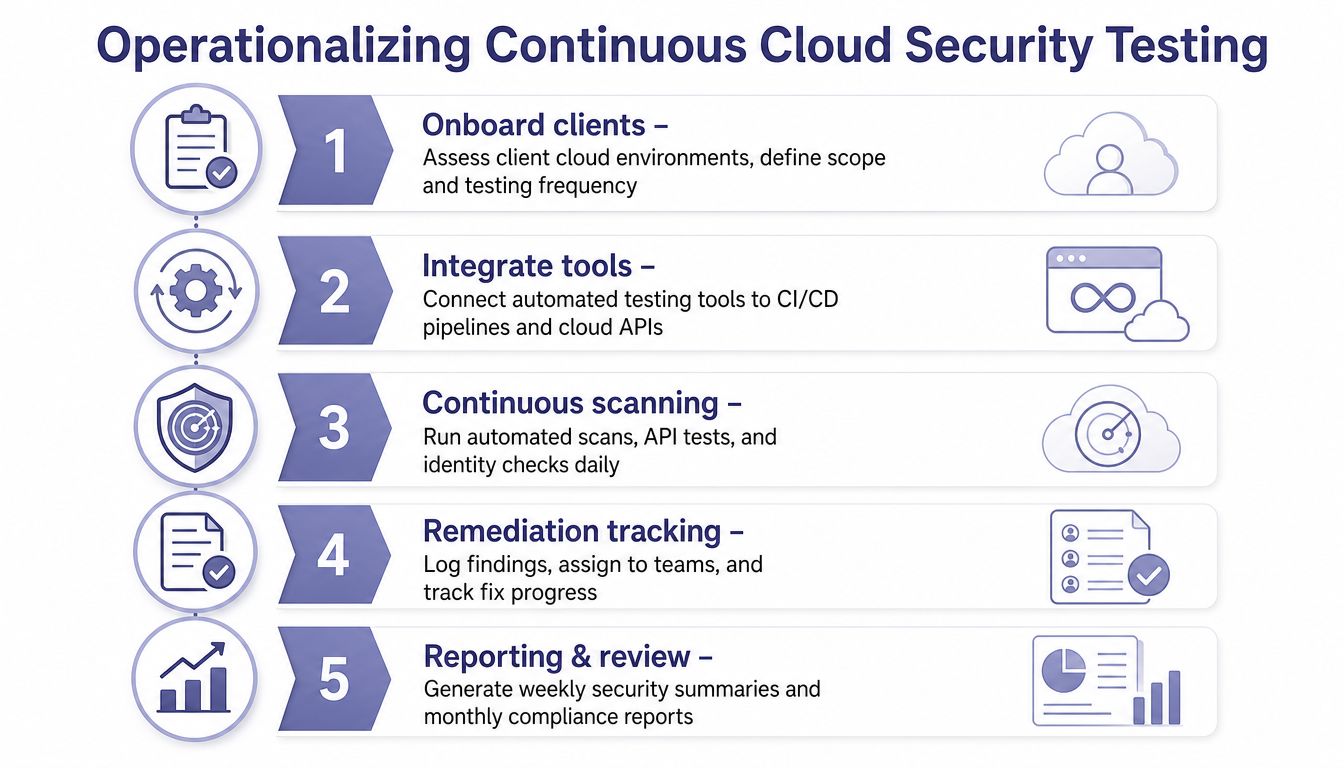
Build the service around five operating decisions
Onboard with explicit scope: Record accounts, subscriptions, projects, applications, APIs, environments, identities, exclusions, testing windows, and escalation contacts. Treat scope as a versioned artifact so a new cloud account doesn't remain outside coverage.
Connect the delivery layer: Use cloud APIs, CI/CD integrations, ticketing systems, and role-based access controls. Keep client environments logically separated, and issue credentials with the minimum permissions required for discovery and approved validation.
Trigger testing at meaningful points: Run lightweight checks after infrastructure or API changes, deeper assessments on an agreed schedule, and targeted retests after remediation. Continuous penetration testing guidance is useful when designing the transition from point-in-time engagements to recurring validation.
Route findings to owners: Send IAM issues to the identity team, API authorization findings to application owners, route and storage problems to platform engineering, and detection gaps to the SOC. Each finding should include evidence, attack-path context, severity rationale, and a due date determined by the client's risk policy.
Review service quality: Produce weekly security summaries for operational teams and monthly compliance-oriented reports for governance stakeholders. Track unresolved attack paths, retest outcomes, scope changes, recurring misconfigurations, and findings that repeatedly escape CI/CD controls.
Use prospecting assessments carefully
A lightweight prospecting pentest can show a prospective client how exposed assets, APIs, and identity relationships appear from an attacker's perspective. Keep it explicitly authorized, minimally invasive, and focused on evidence that supports a conversation about scope. It should open a path to a properly governed assessment, not become an uncontrolled free-form scan.
MSSPs should also define escalation rules for suspected active compromise, sensitive data exposure, destructive actions, and credential discovery. Automation works best when the service provider knows exactly when the engine pauses and a human takes ownership.
Cloud application security is now an identity and operations problem as much as a code problem. Providers that combine continuous discovery, cloud-aware exploitation, API testing, verified evidence, and compliance-ready reporting can deliver a more useful service without forcing every client assessment through a manual bottleneck.
ThreatExploit AI helps security service providers automate reconnaissance, exploitation, verification, and reporting across cloud, web, API, and network environments, with evidence-backed and compliance-mapped deliverables. Visit ThreatExploit AI to evaluate how continuous cloud penetration testing can fit into your MSSP delivery workflow.