
In 2024, 91% of organizations used containers in production, while production Kubernetes use reached 80%, according to the CNCF annual survey. That scale changes the penetration-testing problem. A cloud-native security service that only counts misconfigurations is incomplete. The service must prove which identity paths, exposed interfaces, workload permissions, and supply-chain weaknesses an attacker can use.
An MSSP may need to investigate an AWS workload, trace an Azure identity path, and test a GCP container cluster during the same customer engagement. The provider can't rely on a static annual report or another dashboard full of unverified findings. It needs repeatable reconnaissance, controlled exploitation, evidence collection, remediation guidance, and retesting across environments that change continuously.
Table of Contents
- Why Cloud Native Security Services Now Demand an Offensive Lens
- What Cloud Native Security Services Actually Are
- The Five Core Cloud Native Security Service Categories
- How to Integrate and Automate the Stack Across Multi-Cloud
- From Findings to Proof Why Attack-Path Validation Is the Underserved Angle
- Common Misconceptions MSSPs Should Retire
- A Practical Rollout Playbook for Multi-Cloud Delivery
Why Cloud Native Security Services Now Demand an Offensive Lens
The offensive lens starts with a different question: What can an attacker reach from this entry point, and can we prove it safely? Cloud-native services change constantly, so a posture score or scanner finding cannot establish exploitability. An exposed storage policy deserves investigation, but the provider must determine whether a reachable workload can access sensitive data. A permissive Kubernetes role requires the same test: can a realistic service identity use it to move laterally?
That distinction separates attack-path validation from alert collection. A useful service links the entry point, identity, workload, permission, and target, then records evidence that a customer can review and an engineer can reproduce.
The provider's operating problem
MSSPs face a coordination bottleneck across AWS, Azure, and GCP. One team may understand AWS IAM, another Azure Entra ID, and a third Kubernetes. Customers do not keep those systems in separate compartments. A single engagement can cross cloud control planes, CI/CD systems, APIs, container registries, and runtime workloads.
An AWS application may trust an Azure-hosted identity service through federation. A GCP cluster may expose a service account whose permissions reach a shared data platform. Reporting those observations as unrelated alerts hides the route an attacker could use. The provider should connect the relationships, validate access within an approved boundary, and preserve evidence without disrupting production.
Offensive rule: A finding becomes commercially useful when an engineer can reproduce it, an owner can fix it, and the provider can retest it.
What the playbook changes
Build the service around five questions:
- Discovery: What assets, identities, workloads, APIs, registries, and trust relationships exist?
- Exposure: Which paths are reachable from the internet, a compromised workload, or a stolen identity?
- Validation: Can the suspected weakness be exercised within an approved testing boundary?
- Evidence: Which screenshots, request traces, permissions, and affected resources prove the result?
- Remediation proof: Did the fix remove the path, and did a later deployment recreate it?
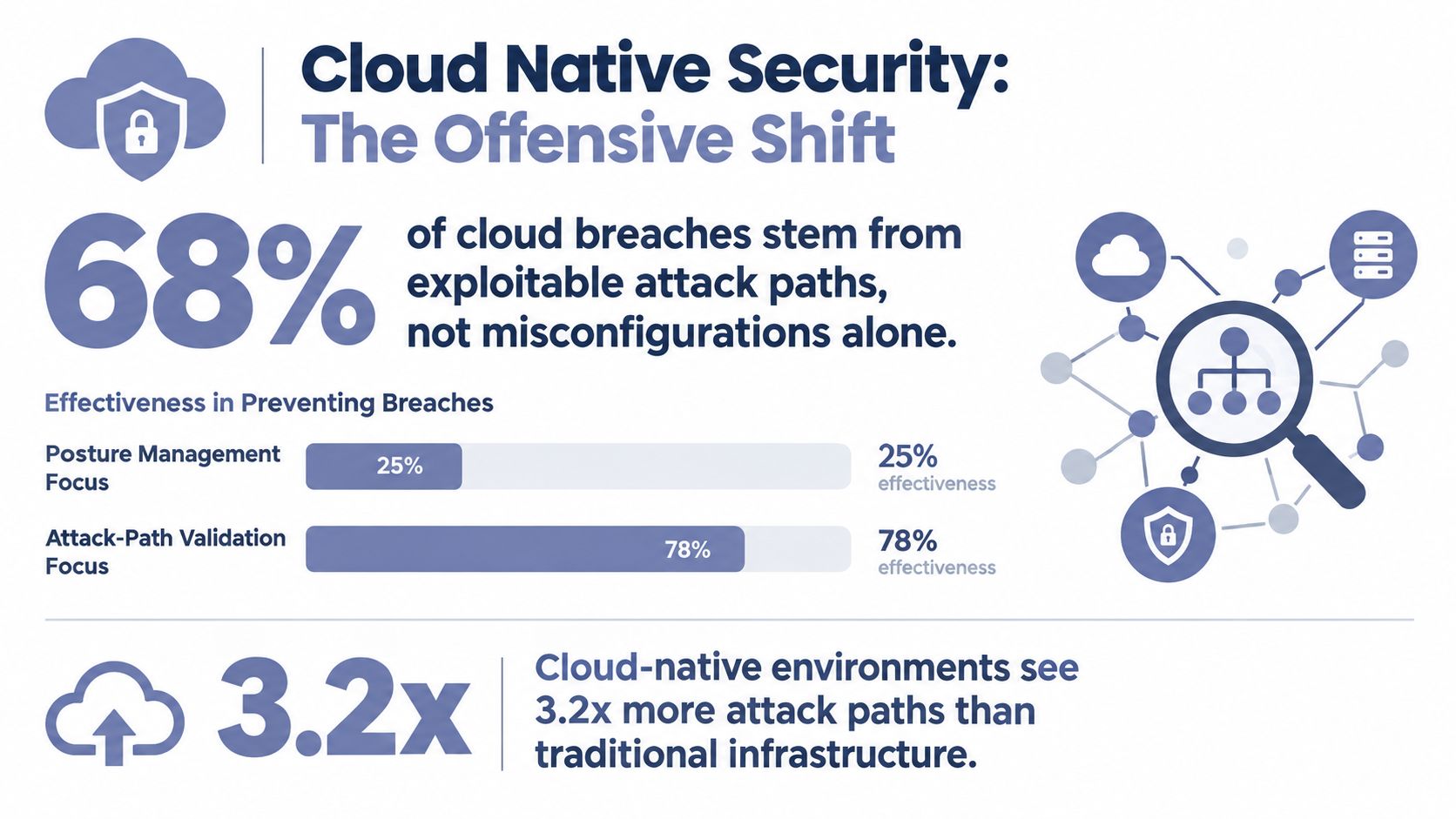
This operating model aligns with NIST SP 800-190, which identifies security concerns across image creation, registries, orchestration, runtime operations, hosts, and network communication. Use that coverage as a foundation, then add controlled exploitation and retesting. The service should turn changing telemetry into defensible decisions, not maximize alert volume.
What Cloud Native Security Services Actually Are
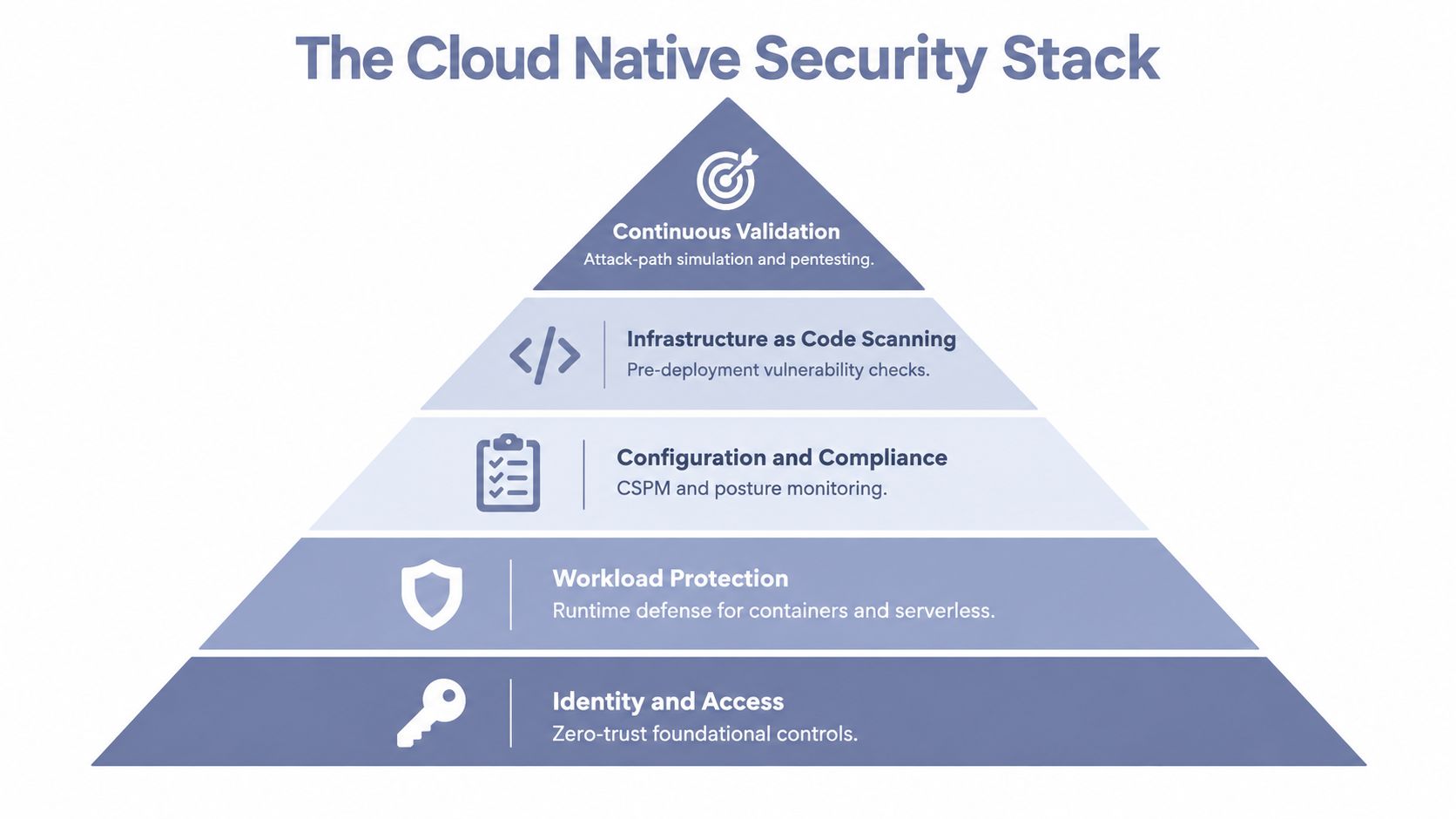
Cloud-native security services are not a single scanner or a branded product category. They are a layered operating model that continuously checks the same surfaces a penetration tester would examine during reconnaissance, privilege analysis, exploitation, and verification.
Start with identity and access. Map human users, workload identities, service accounts, roles, federation, tokens, and cross-account trust. Then examine workloads, configuration, infrastructure-as-code, supply-chain controls, and runtime behavior. Each layer answers a different offensive question, and no layer can replace the others.
Five layers, one offensive model
Identity controls reveal who or what can invoke a resource. NIST SP 800-207A requires authentication and authorization based on user, service, and application identities, rather than relying only on IP addresses, subnets, or perimeter location. For an MSSP, this means testing the actual authorization decision at request time, including credential rotation, policy conditions, and service-to-service calls.
Workload protection examines containers, serverless functions, hosts, and runtime drift. A workload sensor may identify unusual process activity or privilege use. Offensive validation determines whether an attacker can turn that behavior into access to secrets, metadata, another service, or a control-plane function.
Configuration and compliance catches weak storage policies, unsafe network exposure, permissive security groups, and Kubernetes settings. Compliance mapping helps organize evidence, but a passing control doesn't prove that an attacker lacks a viable route.
Infrastructure-as-code scanning moves detection left. Terraform, CloudFormation, Helm, and pipeline definitions can be checked before deployment. The limitation is obvious: a static template can't show the blast radius created by its interaction with live identities, routing, APIs, and inherited permissions.
Continuous validation connects the stack. A recurring test exercises selected attack paths, confirms exposure, captures proof, and retests after remediation or material change.
The useful mental model is simple: scanners identify conditions, pentesters validate consequences, and retesting proves whether the consequence still exists.
Browser automation introduces another layer of risk when agents can move through authenticated applications or trigger actions. Teams designing cloud-native security services should review browser automation security risks alongside identity, session, and authorization controls. The same principle applies everywhere: an automated action should be constrained by explicit identity, scope, and evidence requirements.
The Five Core Cloud Native Security Service Categories
The market divides cloud-native security services into product categories, but an MSSP should judge each category by the attack question it answers and the proof it cannot provide alone.
Cloud Security Posture Management, or CSPM, identifies configuration weaknesses across AWS, Azure, and GCP. It can flag an exposed storage resource, an unrestricted security group, or a risky cloud control-plane setting. It usually can't confirm whether the resource is reachable through a real attack path, whether the data is sensitive, or whether a chained identity can exploit the condition.
Cloud Workload Protection, or CWPP, watches hosts, containers, functions, and runtime processes. It helps detect drift, suspicious execution, and privilege abuse after deployment. It can miss the relationship between a workload's runtime identity and the downstream resource it can access, especially when the attack involves several services rather than one anomalous process.
Cloud Infrastructure Entitlement Management, or CIEM, inventories permissions and highlights excessive privilege. That's valuable reconnaissance, but permission existence isn't the same as exploitable reach. A pentester must test whether a real identity can assume a role, invoke an API, retrieve a secret, or move from one tenant or workload to another.
Infrastructure-as-code scanning catches insecure Terraform, CloudFormation, Helm, and related deployment definitions before they reach production. It prevents repeatable mistakes, but static analysis can't fully calculate the live blast radius created by inherited policies, runtime routing, external integrations, or organizational exceptions.
Cloud-native penetration testing and continuous testing connect those signals. A controlled test can begin at an internet-facing gateway, follow an authentication path, assess API authorization, inspect Kubernetes exposure, and document the exact point where access stops. Continuous testing matters because the path can return after a deployment, identity change, or infrastructure update.
For a broader comparison of platform categories, use this CNAPP versus CSPM analysis as a reference point, but don't let product taxonomy replace testing design.
| Category | Primary Goal | Catches | Misses Without Pentesting | Best Hook |
|---|---|---|---|---|
| CSPM | Improve cloud posture | Misconfigurations and exposed services | Exploitability and business impact | Configuration review plus attack-path validation |
| CWPP | Protect running workloads | Runtime drift and suspicious behavior | Identity abuse and lateral reach | Workload telemetry tied to controlled tests |
| CIEM | Reduce excessive privilege | Risky roles and entitlements | Whether an identity can use the path | Permission analysis plus authorization testing |
| IaC scanning | Prevent repeatable deployment errors | Unsafe templates and policy violations | Live interactions and production blast radius | Merge gates with post-deployment retesting |
| Cloud-native pentesting | Prove real exposure | Chained attack paths | Nothing, if scope and evidence are sound | Recurring validation with remediation proof |
The buyer shouldn't choose one row. The buyer should decide how the rows exchange data, ownership, and evidence.
How to Integrate and Automate the Stack Across Multi-Cloud
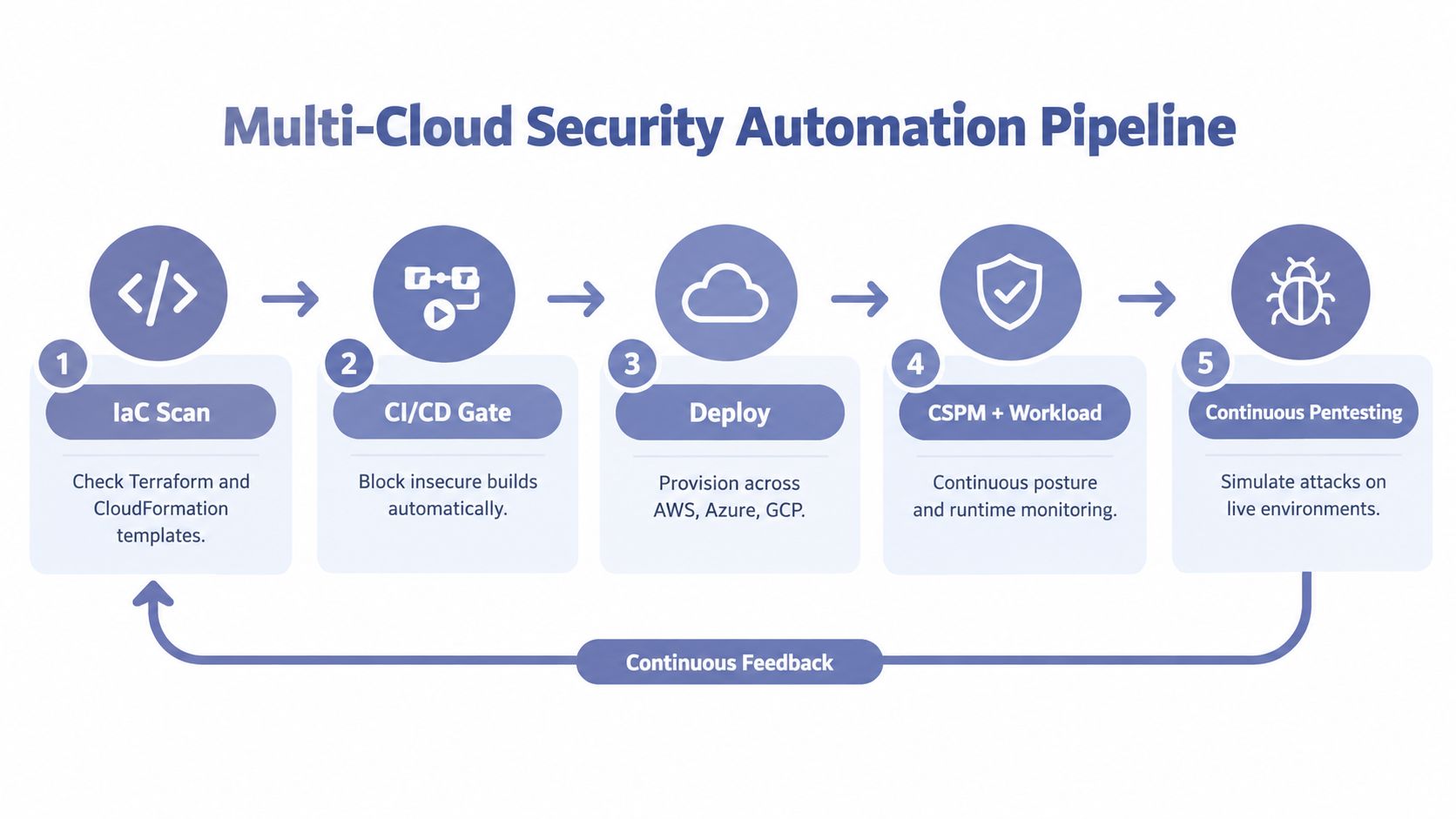
The practical architecture is a loop, not a line. A Terraform change enters CI, scanners evaluate the code, policy gates decide whether it can merge, and the deployed workload becomes the runtime surface for CSPM, workload protection, and controlled penetration testing.
Begin with the deployment artifact. Scan Terraform and CloudFormation for unsafe permissions, exposed services, weak encryption settings, registry risks, and policy violations. Add policy-as-code gates for issues that must block a merge, but keep advisory findings visible so developers can understand risk without turning every warning into friction.
Wire the controls to the delivery lifecycle
When the workload reaches AWS, Azure, or GCP, collect normalized asset, identity, network, and runtime telemetry. Correlate it with the commit, deployment, owner, and environment. A finding without ownership becomes queue noise. A finding tied to a change becomes a remediation task.
Continuous pentesting then exercises approved paths against live or representative environments. The test should feed discovered conditions back into backlog priorities and regression cases. A changed IAM policy, Kubernetes role, API gateway, or network route should trigger targeted validation rather than waiting for the next annual engagement.
A strong DevSecOps best-practices reference can help teams structure these gates, but implementation still depends on clear ownership and safe test boundaries.
| Control | Put it in the pipeline when | Keep it in runtime when | Validate offensively by |
|---|---|---|---|
| IaC scanning | A template or module changes | Drift may bypass source control | Comparing intended and effective exposure |
| Policy-as-code | A merge or release needs a decision | Emergency changes require enforcement | Testing whether blocked paths remain blocked |
| CSPM | Asset inventory and configuration need context | Resources change outside deployment | Confirming reachability and impact |
| Workload protection | Images and permissions need baseline checks | Processes, identities, and behavior evolve | Exercising privilege and lateral-movement paths |
| Pentesting | A release changes exposure | The estate remains dynamic | Running scoped attack simulations and retests |
Instrument identity telemetry first if expertise is limited. It often provides the shortest route from an alert to a meaningful attack path. Add API and network flow data next, then connect Kubernetes audit events, workload identities, and deployment metadata. Don't buy another dashboard until the provider can answer who owns a finding and how the team will prove closure.
The pipeline should also preserve evidence automatically. Store the tested resource, authorization context, request or action, observed result, timestamp, and remediation state. That turns a test from a one-off technical exercise into a deliverable an engineer, auditor, and account manager can use.
From Findings to Proof Why Attack-Path Validation Is the Underserved Angle
Most cloud-native programs stop at findings. Buyers need proof.
A useful engagement might begin with an IAM misconfiguration, pass through an API gateway, and reach a Kubernetes pod running in another cloud. The deliverable shouldn't say only that three controls are weak. It should show the permitted identity, the request or action used, the resulting access, the affected resource, the containment boundary, and the exact remediation needed.
What evidence looks like
Evidence must be reproducible without becoming reckless. Capture the relevant policy, identity context, request path, response, workload or resource identifier, and screenshots that let the engineering team verify the result. For an auditor, map the result to the applicable control. For the owner, explain the smallest safe change that removes the path.
Identity visibility becomes especially important in multi-tenant environments, where a provider may need to distinguish customer, service, and workload relationships. Resources such as Veevoo's Volgap identity page can help frame why tenant-aware identity context matters, but the penetration test still has to validate authorization in the customer's environment.

Track operational outcomes instead of celebrating scanner volume:
- Verified exploitable issues: Findings that a controlled test confirmed.
- Mean time to evidence: How quickly the provider can produce defensible proof.
- Remediation acceptance: Whether the customer agrees that the fix addresses the actual path.
- Regression prevention: Whether a later test confirms that the issue stayed closed.
- Deployment impact: Whether security controls blocked or delayed delivery and why.
The adversarial exposure validation resource captures the right principle: exposure should be tested from an attacker's perspective, not inferred solely from a control state.
Why automation needs verification
Automation without verification can increase triage burden. A service that generates thousands of alerts but can't distinguish an unreachable condition from an exploitable chain forces the customer to perform the hardest analytical work themselves.
That approach also erodes trust. Engineers stop treating reports as decision support when repeated findings lack ownership, proof, or remediation context. A smaller set of verified paths can produce more value than a larger set of untested warnings because the customer knows what to fix first and how to confirm the result.
Evidence standard: If the provider can't show how the finding was reached, what access it produced, and how the fix was retested, the result is a hypothesis, not a finished finding.
The offensive service therefore becomes a quality layer over the rest of the stack. CSPM, CIEM, CWPP, and IaC tools supply leads. Attack-path testing determines which leads deserve escalation, which can be accepted, and which require immediate containment.
Common Misconceptions MSSPs Should Retire
The annual pentest is enough
Annual testing assumes the target stays stable. Cloud-native estates change with deployments, role updates, managed services, pipeline modifications, and temporary exposure. Verizon's 2025 Data Breach Investigations Report analyzed more than 22,000 security incidents, including 12,195 confirmed breaches, and found that vulnerability exploitation accounted for 20% of breaches, a 34% increase from the previous year.
The report also found that edge devices and VPNs represented 22% of targeted assets involved in vulnerability exploitation, up from 3% in the prior report. A cloud-native penetration-testing service should retest exposed gateways, VPN concentrators, perimeter appliances, and authentication paths after material changes, not only application endpoints during an annual engagement.
More alerts mean better security
Alert volume measures collection, not reduced risk. MSSPs should prioritize verified exploitability, clear ownership, attack evidence, and remediation retesting. Unprioritized findings can bury the few paths an attacker can use immediately.
A smaller set of proven attack paths gives engineers a better decision than a larger queue of untested warnings.
Posture management equals security
Posture management provides useful reconnaissance. It does not simulate an attack. A compliant configuration can still expose a vulnerable API, a reachable identity path, or a privileged workload relationship. Test the consequence and prove the fix, rather than reporting the control state alone.
One cloud is enough
An MSSP can start with one provider, but customer risk often crosses control planes. Federated identity, shared CI/CD, common registries, and cross-cloud APIs create paths that a single-provider assessment misses. Normalize data and define testing scope for AWS, Azure, and GCP from the start.
Compliance equals security
Compliance evidence shows that a control was assessed against a framework. It does not prove that an attacker lacks a practical route to impact. The CNCF survey reinforces why providers should connect control evidence to attack-path validation. A compliant environment can still contain an exploitable identity chain or exposed service. Require evidence of reachability, impact, and successful remediation retesting.
A Practical Rollout Playbook for Multi-Cloud Delivery
An MSSP can stand up a credible cloud-native security service by sequencing controls rather than purchasing every category at once.
First, establish the Kubernetes baseline. Use the CIS Kubernetes Benchmark, then select the benchmark that matches the platform. CIS publishes separate guidance for Amazon Elastic Kubernetes Service, Azure Kubernetes Service, Google Kubernetes Engine, Oracle Kubernetes Engine, and Red Hat OpenShift. Google specifically distinguishes the general Kubernetes benchmark from the CIS GKE Benchmark for customer-managed components.
Version-specific validation matters. Example controls include restricting API-server pod specification files to permissions of 644 or more restrictive, ensuring ownership is root:root, and restricting the etcd data directory to permissions of 700 or more restrictive, as described in the benchmark guidance. A tool such as kube-bench can test applicable benchmark controls, but it won't replace a penetration test for excessive privileges, exposed control-plane interfaces, secrets, or workload-to-workload access.
Sequence the service
- Scan infrastructure as code. Check Terraform, CloudFormation, Helm, and pipeline definitions before merge.
- Enforce policy as code. Block signed-image violations, critical vulnerability deployment conditions, unsafe permissions, and prohibited exposure according to customer policy.
- Instrument identity and network telemetry. Use workload identities such as SPIFFE, API gateways, service meshes, cloud audit events, and flow data to connect actors with actions.
- Run recurring penetration tests. Exercise internet-facing edge devices, VPN paths, IAM relationships, APIs, registries, and Kubernetes workloads within an approved scope.
- Close the response loop. Give owners runbooks, preserve evidence, retest after infrastructure-as-code or identity changes, and map final results to compliance controls.
The CNCF security microsurvey found that nearly 73% of respondents planned to prioritize organizational policies, while more than 68% planned to improve runtime monitoring and actionable detection. Those priorities belong together. Preventive gates stop known conditions, while runtime detection and offensive testing reveal what still happens after deployment.
Don't ignore operating capability. The Presidio State of Cloud Security Report reports that 61% of surveyed organizations identify security and compliance as major barriers to cloud adoption, while 76% report a shortage of cloud-security expertise. Build customer runbooks that define escalation, evidence preservation, safe automation, and responsibility across the MSSP, cloud provider, customer, and incident-response team.
Delivery principle: Sell a repeatable evidence workflow, not a dashboard subscription. The customer should know what changed, what was tested, what remains exploitable, and who owns the next action.
For procurement-heavy customers, a comparison resource such as GovWin alternative can help organize vendor research, but the technical decision should stay anchored to scope, authorization, evidence quality, multi-cloud coverage, and retesting capability.
ThreatExploit AI provides automated penetration testing for AWS, Azure, GCP, web applications, networks, and cloud-related assets, with reconnaissance, exploitation, verification, screenshots, structured reports, and compliance mapping. If your MSSP needs recurring attack-path validation without adding every test manually to the delivery queue, visit ThreatExploit AI to evaluate how it fits your multi-cloud testing workflow.