
You're probably living with the same problem every MSSP runs into sooner or later. The sales team keeps adding clients, the delivery team keeps taking on more scopes, and one authenticated flaw in a client's API turns into a report that looks polished but can't be reproduced when the customer asks for proof. That's how you lose trust, then margin, then the account.
The pressure is getting worse because attackers keep finding the easiest path through weaknesses that teams thought were handled. Verizon's 2025 Data Breach Investigations Report found that exploitation of vulnerabilities was involved in 20% of breaches, a 34% increase from the previous report, with 42% of exploited vulnerabilities affecting web applications and 22% affecting VPNs and other edge devices. When those are the entry points, an application security testing platform can't be judged on scan volume alone. It has to help you produce findings that hold up in front of a client, an auditor, and your own senior testers.
For MSSPs and MSPs, that changes the buying decision completely. You're not just buying detection. You're buying an operating model that decides whether your team can scale without burning out, and whether the report you deliver is defensible enough to survive review. If you also need a practical reference for compliance-facing delivery, the Purple Access PCI compliance overview is a useful companion read because it shows how security work gets translated into customer-facing obligations.
Table of Contents
- The MSSP Capacity Problem Behind Every Missed Finding
- What an Application Security Testing Platform Does
- Core Capabilities That Separate Real Platforms From Rebranded Scanners
- How an Application Security Testing Platform Changes Service Delivery Economics
- Evaluation Criteria MSSPs and MSPs Should Apply Before Signing
- Where Automated Pentesting Products Fit Into the Stack
- What Automation Still Cannot Do for Application Security
- Building a Defensible Application Security Testing Program
The MSSP Capacity Problem Behind Every Missed Finding
A client calls after a breach review, and the awkward part is not the flaw itself. It is the report that looked clean on delivery day but could not be reproduced, defended, or retested when pressure hit. That is the MSSP capacity problem in plain terms. The service chain breaks at the exact moment evidence has to hold up.
For an MSSP, the loss is bigger than one missed finding. Weak proof slows retesting, forces senior testers into manual cleanup, and turns one client dispute into wasted hours across the queue. Verification, evidence retention, and turnaround time are the levers that decide whether the service scales or stalls.
The financial backdrop is ugly. IBM's 2025 Cost of a Data Breach research reported a global average breach cost of $4.44 million, and the average time to identify and contain a breach fell to 241 days from a 287-day peak in 2021. Cross-environment breaches, where web apps, cloud services, and identity systems all touch the same incident, averaged $5.05 million versus $4.01 million for on-premises data alone. That is the operating reality MSSPs are paid to cover. IBM's breach cost research
One bad report can cost more than the test that produced it.
A useful check is simple. If a customer can challenge a finding and your team needs a senior tester to rebuild the evidence from scratch, the problem is not scanner coverage. The problem is service delivery. The seven questions that follow decide whether your team can scale testing, defend findings, and keep margin intact without hiring another layer of senior headcount.
What an Application Security Testing Platform Does
An application security testing platform should give an MSSP a complete evidence workflow: discover the attack surface, test reachable weaknesses, and verify the result. A scanner that produces alerts without proving impact leaves analysts to rebuild the case manually, which erodes delivery capacity and report quality.
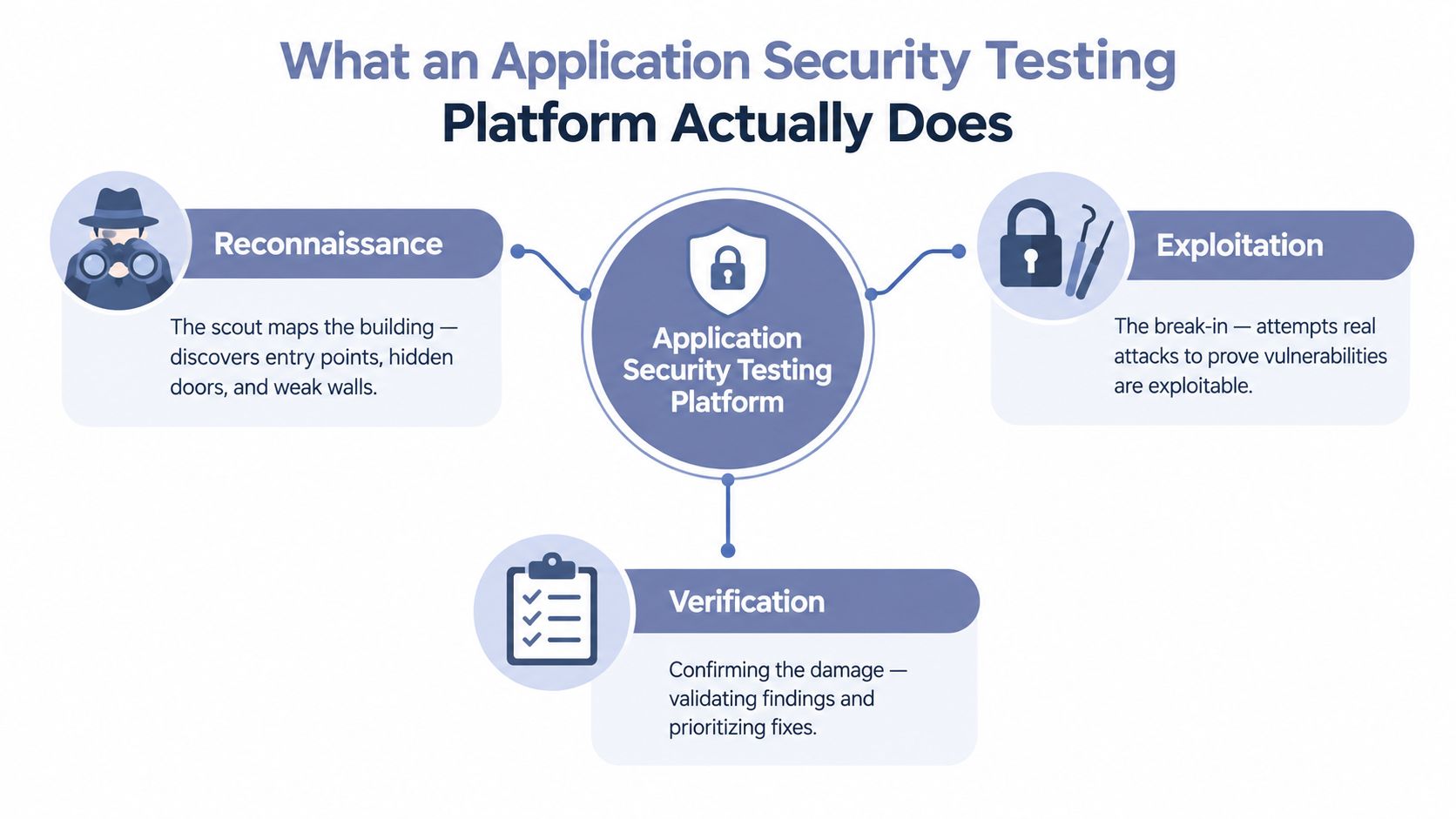
Reconnaissance comes first
Reconnaissance covers asset discovery, attack-surface mapping, and context collection. The platform should identify application logic, entry points, headers, parameters, cookies, APIs, and technology patterns before testing begins. The Web Security Testing Guide describes active testing as starting with passive exploration, because testers need a reliable view of the application before probing it. OWASP WSTG overview
For an MSSP, discovery quality affects more than coverage. It determines whether the team can explain what was tested, identify scope gaps, and produce a report that a client can challenge without sending the engagement back to senior staff. Teams reviewing the audit side of this workflow can browse website security audit insights.
Exploitation is the proof layer
Exploitation tests whether a suspected weakness is reachable and useful to an attacker. That distinction separates an actionable finding from a theoretical match. Service providers need evidence-backed risk that a customer can prioritize, not a long queue of unconfirmed alerts.
Verification closes the loop
NIST assessment guidance includes vulnerability identification, validation where appropriate, retesting, audits, and documentation. Validation may be manual or automated depending on the case. NIST assessment guidance Those records turn a test result into evidence a customer, auditor, or analyst can review and reproduce.
Technique coverage still matters. DAST examines live behavior, SAST supports earlier code review, IAST adds runtime context, SCA identifies dependency risk, and API testing examines authorization paths that standard scanning can miss. The platform earns its place when these methods produce a consistent, reviewable service workflow.
For a vendor-neutral view of how automated web penetration testing is presented in the market, see ThreatExploit AI's automated web application penetration testing resource before a vendor demo.
Detection-only platforms leave the verification loop open. A defensible platform closes it with reproducible evidence that supports the client report and protects MSSP margin.
A finding that cannot be reproduced is noise with a severity label.
Core Capabilities That Separate Real Platforms From Rebranded Scanners
The first question is whether the platform can cover the attack surface you sell. DAST answers what an external attacker can hit right now. SAST answers what a code reviewer should catch earlier. IAST gives runtime context when source alone isn't enough. API testing is where you find the flaws that hide behind authentication. If a vendor pretends those are interchangeable, keep walking.
OWASP's API guidance makes the point bluntly. Broken Object Level Authorization, Broken Object Property Level Authorization, and Broken Function Level Authorization are distinct risks, which means an API can authenticate a user and still expose another user's object, unauthorized fields, or admin functions. A platform that only hits unauthenticated endpoints will miss the exact flaws customers tend to pay for after the incident.
The second question is whether the platform produces evidence your team can defend. That means repeatable requests, response capture, impact notes, and enough context for a client to retest or a consultant to review. If the report just dumps findings without a clean evidence chain, you'll pay for that gap in analyst time and renewal friction.
The third question is operational fit. Integrations with CI/CD and ticketing are not nice extras. They decide whether findings move into the customer's workflow or sit in an inbox until someone forgets them. For an MSSP, that directly affects how quickly a customer can remediate and how often your team gets dragged back into clarification calls.
| Capability | Buyer question it answers | Impact on client deliverable |
|---|---|---|
| DAST | What can an attacker reach in the running app? | Shows live exposure and runtime weakness |
| SAST | What should be caught before release? | Reduces preventable defects earlier |
| IAST | What is reachable in this runtime path? | Adds context for harder-to-validate issues |
| API testing | Can the platform prove authorization flaws? | Exposes object, property, and function abuse |
| Automation | Can the team repeat coverage without reinventing it each time? | Improves consistency across clients |
| Reporting | Can the customer act on the result? | Makes the report usable in audits and tickets |
| Integrations | Does it fit the delivery stack? | Reduces manual handoffs and lost findings |
A platform that gets all seven right is worth serious money. One that nails only detection and leaves you to clean up the rest is just a faster way to create work.
How an Application Security Testing Platform Changes Service Delivery Economics
The old model is familiar to every pentest shop. A senior tester scopes the engagement, spends days poking at the target, writes the report, then spends more time proving the report is sound. The work is high skill, but the economics are brutal because every project leans on scarce people.
A platform-led model changes the math. You still need human judgment, especially for business logic and client-specific severity calls, but the machine handles a bigger share of the repetitive work. That shifts the bottleneck from raw tester time to review quality and customer communication.
Traditional and platform-led delivery are not priced the same
| Dimension | Traditional engagement | Platform-led model |
|---|---|---|
| Cost structure | Per project and heavily labor-driven | More repeatable and easier to standardize |
| Turnaround | Slower because scoping, testing, and reporting are serial | Faster because execution and reporting are compressed |
| Consistency | Varies by tester and methodology | More standardized across accounts |
| Evidence quality | Depends on the individual consultant | More repeatable when the platform captures proof |
| Capacity per senior tester | Low, because senior time is consumed end to end | Higher, because automation absorbs routine work |
Put concrete hours on it. In a traditional engagement, a senior tester can easily spend the bulk of a week on a single mid-sized client: scoping, manual testing, evidence capture, and report writing all billed against the same scarce hours. When a platform absorbs execution and reporting, that same tester's time concentrates on verification and client-specific judgment, which means one senior can cover several clients in the window that used to fit one. Gross margin per client improves twice over: the deliverable costs fewer senior hours, and you can sell more engagements without adding headcount at the same pace.
That doesn't mean automation replaces the consultant. It means the consultant stops wasting time on work a platform can do consistently, and as noted earlier, the cost of incidents makes that trade economically rational.
The catch is real. Automated delivery still needs review for edge cases, and it still needs someone to explain context to the customer. But if a platform can compress execution and reporting from weeks to hours, the service provider can sell more work without adding senior headcount at the same pace.
If the platform only saves time on scanning, it doesn't move your margins much. If it saves time on verification and report writing, it does.
Evaluation Criteria MSSPs and MSPs Should Apply Before Signing
A vendor demo is easy to fake. A production workflow is harder. The safest way to evaluate an application security testing platform is to force it through the same conditions your delivery team faces every week, then judge whether the output is defensible without heroics.
Start with coverage, not claims
Ask what the platform covers across web apps, APIs, and cloud-connected services. Then test whether it discovers authenticated paths, not just public pages. As noted earlier, OWASP's testing guidance treats application security testing as a black-box process that begins with passive exploration, so a platform that ignores authenticated journeys is already behind the standard. Run your own authenticated test app against it during the proof of concept, because that is where weak discovery shows up first.
Verify the verification process
Validation can be manual or automated depending on the issue, and the distinction decides whether your analysts spend their week triaging noise. During the proof of concept, ask the vendor to show exact request and response evidence, plus how findings are retested and normalized over time. If it can't show before-and-after proof, you're buying a noisy list, not a control layer.
Demand a report your customer can use
Ask for a sample report with reproducible steps, affected assets, and mitigation guidance a client can route directly to an owner. Then check whether the output maps cleanly to the frameworks your customers ask about. If the report needs a senior tester to rewrite the language before it goes out, your margins are already leaking.
Test the multi-tenant reality
For MSSPs, multi-client operations matter as much as technical coverage. You need role separation, evidence retention, clear customer boundaries, and consistent reporting across accounts. The ThreatExploit AI evaluation guide for 2026 is a practical reference for how vendors position verification, but make them prove it in your environment.
A vendor that won't show multi-role authorization testing during the demo is telling you exactly what kind of gaps you'll inherit later.
Where Automated Pentesting Products Fit Into the Stack
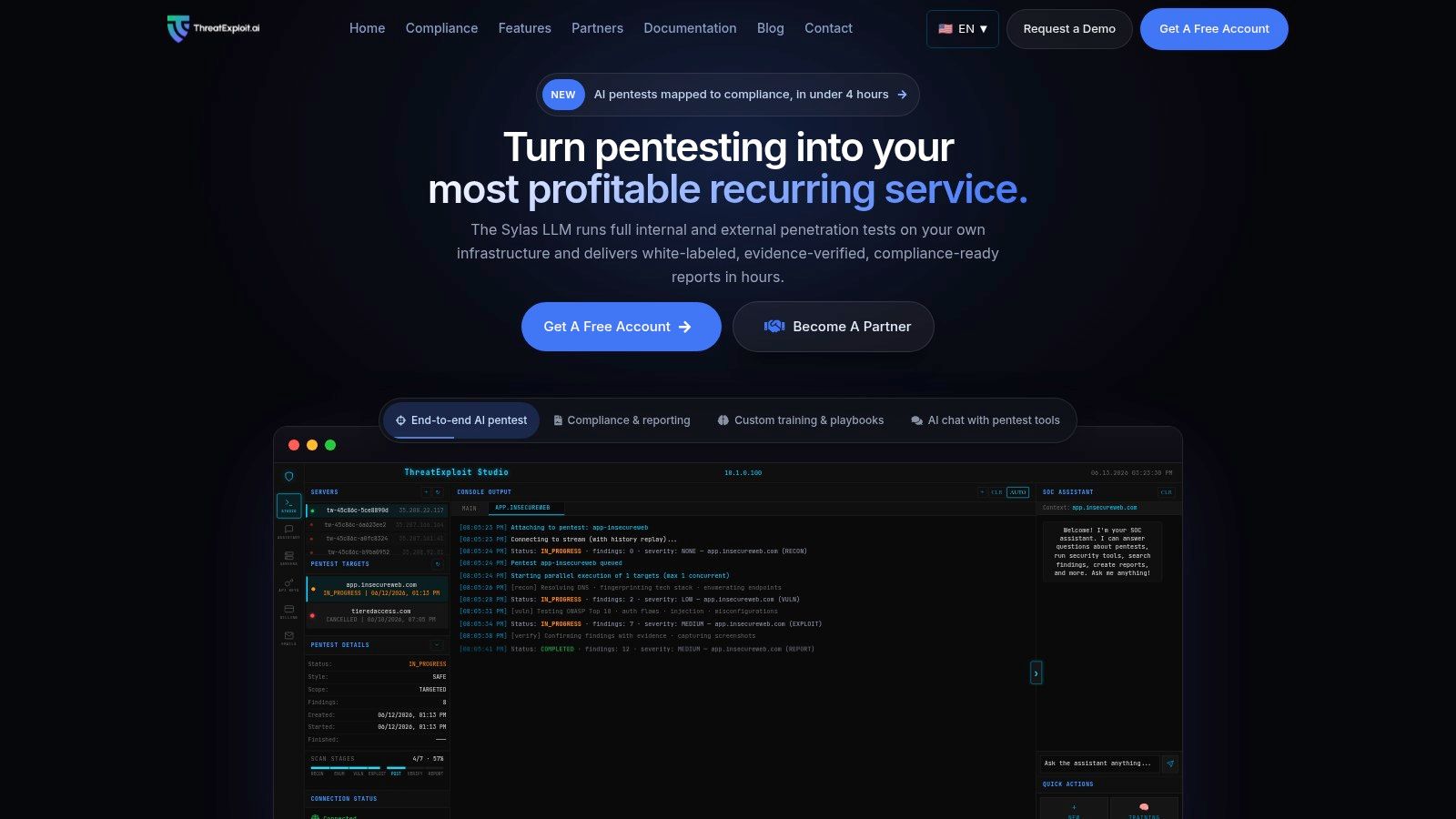
Automated pentesting belongs in the execution and evidence layer, not in a fantasy world where one tool solves every security problem. A product like ThreatExploit AI sits in the middle of the workflow, orchestrating reconnaissance, exploitation, verification, and reporting across web, network, and cloud targets while your analysts stay focused on review and client communication.
A typical engagement starts with scoping a customer, defining the target set, and configuring the run with the right access and guardrails. From there, autonomous subagents coordinate tool use, evidence capture, and report assembly. ThreatExploit AI describes that orchestration as covering 60+ open-source and proprietary tools, with reporting available in PDF and JSON and mapping to HIPAA, SOC 2, PCI-DSS, CMMC, ISO 27001, GLBA, and GDPR control references.
The operational gain is straightforward. Instead of turning every engagement into a manual sprint, the platform can compress execution and reporting into a much tighter window, which gives delivery teams more throughput and fewer handoffs. ThreatExploit AI also describes a verification rate of 95% and 94% overall accuracy, with complete reports in under four hours in typical workflows, plus partner-scoped infrastructure for isolation. ThreatExploit AI automated penetration testing resource
That model also fits prospecting. A lightweight pentest can be used early in the sales cycle to show value without waiting for a full engagement, which is useful when you're trying to close security services into a broader managed account. The point isn't to replace seasoned testers. It's to stop wasting senior talent on work that can be standardized safely.
What Automation Still Cannot Do for Application Security
More findings don't automatically mean better security. In fact, the wrong kind of automation can make the team slower if it floods analysts with duplicate alerts and unverified noise. The test is whether the platform helps you separate exploitable risk from tool chatter without dragging the team back into manual triage.
The survey data make that clear. 54% of security teams say distinguishing real threats from non-exploitable findings is their biggest production-investigation challenge, 46% have dealt with vulnerabilities missed during pre-production testing, and 45% have seen issues that were found but still reached production. That's exactly why raw issue count is a weak buying criterion. The better metrics are verified exploit rate, reproducible proof, analyst time saved, and how often the finding helps the customer remediate. Cloud Security Alliance proof-of-risk article
Human review still matters for business logic, contextual severity, and post-exploitation impact. It matters when the customer's tolerance for risk is unusual. It matters when a platform finds a valid weakness but the business consequence depends on how that environment is used. If the platform can't explain those boundaries, your team will spend too much time cleaning up ambiguity.
Signs the automation is helping
- Reproducible proof is attached: The request, response, and affected asset are clear enough for a second analyst to confirm.
- False positives stay low in practice: The delivery team isn't reclassifying half the queue before a report goes out.
- Coverage follows change: The system tests again when the app, identity layer, or API surface changes.
- Reports need little rewrite: Customer-facing output already contains the evidence and context the client wants.
That's the operational standard. Anything less is just faster noise.
Building a Defensible Application Security Testing Program
The right path depends on where your delivery pain is today. If your scanner-heavy stack already exists, you can extend it with stronger verification and reporting. If your team is drowning in manual work, a dedicated automated pentesting platform can become the execution layer under human review. If neither fits yet, stay manual for the hardest engagements, but tighten methodology and evidence capture before you scale.
The first move should be obvious. Fix the deliverables that currently cause friction, especially audit-ready evidence, repeatable findings, and multi-framework mapping. Then work backward into the platform features that produce those outputs. Recent data show that 53% of organizations experienced a web-application or API-related breach in the previous 12 months, 51% flagged shadow or undocumented APIs as a leading concern, and only 20% detected a breach within hours while 54% needed at least a week. That means your program has to handle change, not just annual review windows. Fortinet web application security report
A strong evaluation answer is simple. Can the platform prove exploitability, keep evidence clean, support multi-client operations, and reduce the time your senior people spend on report defense? If the answer is yes, you've got a delivery asset. If the answer is no, you've got another tool that looks good in procurement and costs you money in operations.
If you want a platform that turns reconnaissance, exploitation, verification, and reporting into a service-provider workflow, look at ThreatExploit AI. It's built for MSSPs and consultancies that need evidence-backed reports, compliance mapping, and repeatable delivery without turning every engagement into a senior tester bottleneck.