

TL;DR: The AI pentesting market consolidated hard in 2026. Horizon3.ai raised $250M at a valuation above $2B in August, XBOW closed a $120M Series C at over $1B in March, and Pentera, Terra Security, RunSybil and Hadrian all shipped agentic products within a nine-month window. Underneath the funding, only six genuinely different architectures exist, and they solve four shared engineering problems: context management, planning, finding validation, and blast radius control. This breakdown ranks all ten leading platforms on how well they solve those problems, with the published evidence for each and the lab-to-real gap that vendor marketing consistently omits -- agents that exploit 87% of one-day CVEs when handed the advisory drop to roughly 13% on the same class of target when they have to find the bug themselves.
ThreatExploit publishes this blog and builds one of the platforms assessed below, where it is ranked first. The ranking criteria are stated in full before the list, every claim about a competitor is sourced to that vendor's own published material or to peer-reviewed benchmarks, and the limitations of our own platform are stated in the same format as everyone else's. Read it as an informed argument from an interested party, not as an independent audit -- and run the bake-off described at the end against your own environment.
Two numbers define the state of AI penetration testing in 2026, and they point in opposite directions.
The first is $665M and rising -- total disclosed venture funding across the autonomous offensive security category, concentrated in a handful of companies that now carry unicorn valuations. Horizon3.ai closed a $250M Series E in August 2026 at a valuation reported above $2B. XBOW closed a $120M Series C in March 2026, bringing total funding to $237M at a valuation above $1B. Pentera crossed $1B earlier. Terra Security, RunSybil, and Hadrian all shipped or expanded agentic offerings in the same window.
The second number is 13%. That is the exploitation success rate the best publicly evaluated agent frameworks achieve on CVE-Bench, a peer-reviewed benchmark of 40 critical-severity real-world web application CVEs, when the agent has to find the vulnerability without being told what it is. Supply the vulnerability description and the same benchmark jumps to roughly 25%.
Both numbers are true. The capability is real and improving fast, and it is also much narrower than the category's marketing implies. This article is a technical breakdown of the ten platforms that matter, written for people who have to make a buying decision and need to know what is actually running under the label.
- ✓Six distinct architectures exist in this market -- purpose-trained models in governed engagement frameworks, deterministic engines with an AI layer, autonomous agentic hackers, white-box code-reasoning agents, AI-target red teamers, and open-source agent frameworks. Comparing across classes is a category error.
- ✓Every one of these systems solves the same four engineering problems: context management, planning, finding validation, and blast radius control. How a vendor answers those four predicts real-world results better than any benchmark score.
- ✓The lab-to-real gap is the single most important number in the category: 87% success on one-day CVEs with the advisory supplied collapses to roughly 7-13% when the agent has to discover the bug itself.
- ✓Validation architecture separates real platforms from demo-ware. Look for discovery and validation separated in software, with reproducibility as the promotion criterion -- automated scanners carry a documented 10-40% false positive rate.
- ✓Scope enforced in code at the tool boundary is structurally different from scope written into a prompt. One is a gate; the other is a request the model can be argued out of.
- ✓Roughly 70% of critical web vulnerabilities are business logic flaws, which no platform in this list detects reliably. Every headline result in 2026 retained human review before publication.
The Six Architectures Behind Every Product in This Market
Most vendor comparisons list features. That is close to useless here, because two platforms with identical feature lists can have completely different failure modes depending on how they are built. There are six architecture classes in this market, and the first job in any evaluation is working out which one you are looking at.
The first class is the newest and the hardest to build, because it requires owning the model as well as the scaffolding around it. The rest of the market either wraps a general model or hand-builds the attack logic. A deterministic engine with an AI layer will never surprise you, which is exactly why it is the architecture people run against production Active Directory. An autonomous agentic hacker will occasionally chain something no human would have tried -- XBOW documented a 48-step chain escalating a blind SSRF to full compromise -- and will occasionally burn an hour convincing itself it succeeded at something it never executed. Those are different risk profiles, not different feature sets.
The Four Problems Every AI Pentester Has to Solve
Underneath the architecture classes, every system in this category is solving the same four engineering problems. Reading a vendor's answer to these four is the fastest way to assess technical seriousness.
Problem 1: Context Management
A real engagement generates far more output than any context window holds. A single nmap sweep of a /16, a directory brute force, and a few hours of HTTP traffic will overflow even a very large context. Naive agents truncate, lose earlier findings, and re-test targets they already covered.
The serious answers decouple long-term memory from the context window. PentAGI, the most-starred open-source project in the category, uses PostgreSQL with pgvector embeddings so the agent recalls prior findings semantically rather than by re-reading raw tool output. VulnBot introduced a Penetration Task Graph -- a directed graph of task dependencies that persists across multi-hour sessions and automatically spawns downstream exploitation when a prerequisite finding lands. Commercial platforms rarely publish their memory design, which is itself a useful signal during a technical evaluation. Ask.
Problem 2: Planning
Published research has converged on a clear ranking of planning architectures, and the gaps are large.
The single-agent ReAct loop -- think, call a tool, observe, repeat -- is where most first-generation tools sit, and it lands around 21% on autonomous pentesting tasks before context overflow degrades it further. Splitting planning from execution helps materially: the HPTSA planner-executor research reported a 4.3x improvement over single-agent baselines on zero-day exploitation, reaching 42% pass@5 and 18% pass@1 across 14 real vulnerabilities. Dynamic swarms that rewrite their own instructions when they detect failure patterns went further still -- D-CIPHER covered 65% more MITRE ATT&CK techniques than single-agent baselines and scored 44.0% on HackTheBox challenges.
The most interesting result is the last one. xOffense, built on a fine-tuned Qwen3-32B, reached 79.17% sub-task completion and beat GPT-4 and Llama 3 baselines. Domain adaptation is outperforming raw model scale in this task family. A hybrid approach called CHECKMATE, where the LLM writes a formal PDDL planning description and a classical planner finds the optimal sequence, reported a 20%+ success improvement alongside a 50%+ cost reduction versus pure LLM planning.
Problem 3: Validation
This is where platforms separate, and it is the question most buyers forget to ask.
Documented across open-source agent evaluations: the agent imagines successful command output instead of executing the command, then reasons confidently on top of fiction. Every finding downstream of that hallucination is invalid. Any platform without programmatic, non-LLM validation of its own findings will produce this failure at some rate, and will not know it did.
XBOW's published design is the clearest counter-example. Findings pass through validators -- automated peer reviewers combining LLM review with custom programmatic checks. For cross-site scripting, a headless browser visits the target and confirms the JavaScript payload genuinely executed. That is a deterministic check, not a model asserting success. XBOW also runs SimHash for content-level similarity and image hashing for visual similarity to deduplicate findings across cloned environments, which is what keeps a high-volume autonomous system from drowning its operators in duplicates.
Horizon3.ai's NodeZero takes the same principle in a different direction: it proves exploitability by executing the chain against the live environment and reporting what it actually achieved -- host compromise, domain control, data exposure -- rather than what it inferred. This is the difference between a real finding and a scanner result with confident prose attached, which we covered in more depth in false positives: scanners versus real pentesting.
Problem 4: Blast Radius
Autonomous exploitation against production is a safety engineering problem before it is an AI problem. The two credible approaches are a deterministic core that will only execute vetted attack logic (Pentera's architecture, where the AI layer adapts targeting but the exploitation engine stays hand-built and auditable), or a production-safe engine hardened by volume (Horizon3.ai states NodeZero was built by running hundreds of thousands of production-safe tests against large, sensitive networks).
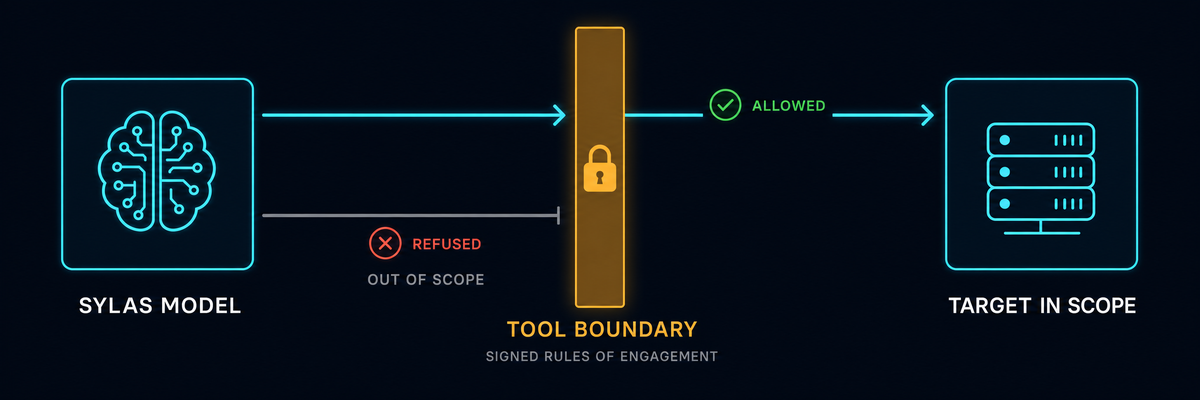 The distinction that matters: scope validated in the execution path, after the model issues an instruction and before it reaches the network. An out-of-scope action is not discouraged -- it is impossible.
If a vendor cannot explain, concretely, what their agent is structurally prevented from doing, they have not solved this. We wrote about the operational trade-offs in safe versus aggressive automated pentesting.
The Benchmark Reality Check
Before the platform-by-platform breakdown, the evidence base needs framing, because benchmark numbers in this category are routinely quoted without the conditions that produced them.
Three things fall out of that table.
Setting determines outcome, by a factor of six. The same class of target moves from 87% to roughly 7% depending on whether the vulnerability advisory is supplied. CVE-Bench moves from ~25% to 13% on the same axis. When a vendor quotes a success rate, the only question that matters is whether the system was told what it was looking for.
Difficulty is a cliff, not a slope. Frontier models perform respectably on easy and very easy HackTheBox machines and score approximately zero on the hard tier. There is no smooth degradation, which means benchmark performance on easy targets predicts nothing about hard ones.
Independent evaluation is scarce. XBOW's benchmark results are self-reported, as are most vendor numbers in this list. The peer-reviewed benchmarks (Cybench, CVE-Bench, NYU CTF Bench) evaluate research agents, not shipped commercial products. Nobody has published a rigorous, independent, head-to-head evaluation of the commercial platforms. Until someone does, your own bake-off is the only evidence that applies to your environment.
The closest thing to a real-world comparison is the ARTEMIS study from December 2025: an AI agent tested against a live enterprise network of roughly 8,000 hosts across 12 subnets alongside human pentesters. The agent found 9 valid vulnerabilities at an 82% valid rate, placed second overall, and beat 9 of the 10 human testers. The top human found 13 through creative exploit chaining. The agent also generated more false positives than every human participant, and the study noted that roughly 70% of critical web vulnerabilities are business logic flaws that AI does not detect reliably. Operating cost was around $18/hour against roughly $60/hour for human testers.
That is the honest state of the art: competitive on breadth and cost, second place on ceiling, and noisier on the way through.
The Top 10, Ranked
Ranking criteria, stated up front, in the order they carry weight: validation architecture (can the platform prove a finding is real without a language model asserting it), control and auditability (is scope enforced structurally, and can the work be replayed for an auditor), model and engagement architecture (purpose-built for multi-day adversarial work, or a general model in a loop), attack surface coverage, and operational fit for the teams that have to run it. Published evidence is weighted throughout, and self-reported numbers are labelled as such -- including our own.
Platforms solving genuinely different problems are ranked on how well they solve their own. A code-reasoning agent and an internal-network exploitation engine are not competing for the same slot, and pretending otherwise would make the list useless.
1. ThreatExploit (Sylas)
Class: Purpose-trained model inside a governed engagement architecture
Architecture. The distinguishing claim is that Sylas is a different model, not a different prompt. It is a domain-specialised language model of approximately 400 billion parameters, trained in-house over roughly six months on owned GPU infrastructure rather than adapted from a general assistant. It uses sparse activation: only the subset of parameters relevant to a given inference is engaged, in the region of 80 billion at any one time. That is what makes continuous testing affordable, because the inference cost of running a frontier-scale model at engagement cadence is the reason competitors push toward infrequent, high-ticket engagements.
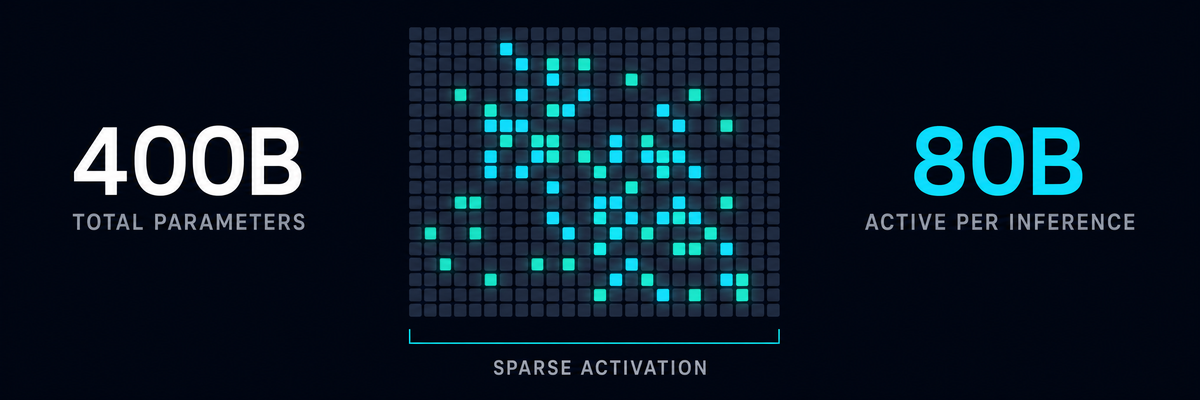 Sparse activation is the economic mechanism. Frontier-scale capability at a fraction of the inference cost dense activation at the same parameter count would demand.
The training corpus matters more than the parameter count. Sylas is trained on approximately six years of real-world attack telemetry gathered from live operations -- full attack chains, from initial compromise on a perimeter device through lateral movement into internal systems. That is longitudinal, chain-level data rather than synthetic scenarios or isolated events scraped from public vulnerability databases. A model trained on write-ups can describe a technique. A model trained on chains has seen what an operator does next when the first three attempts fail.
The model sits inside a state graph that drives every engagement through six phases in a fixed order that cannot be bypassed.
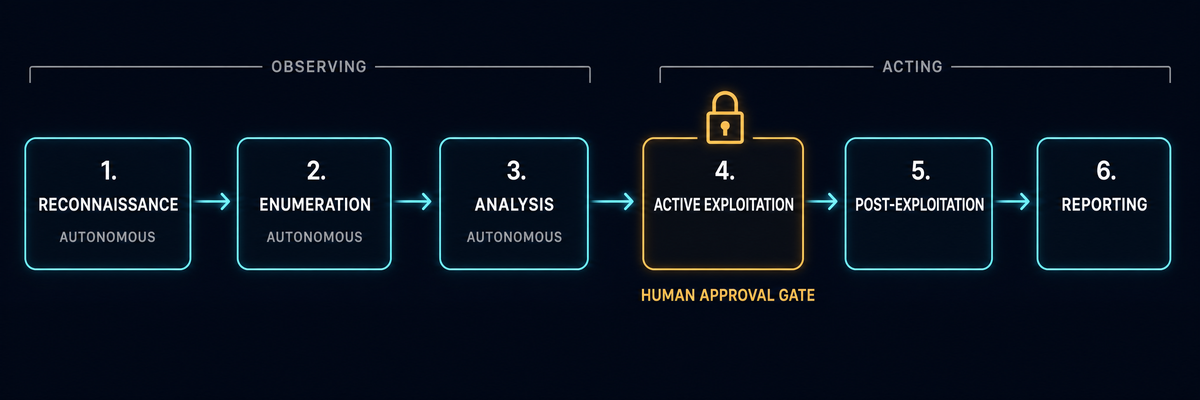 Reconnaissance, enumeration and analysis run autonomously. The transition into active exploitation -- the point where the engagement stops observing and starts acting -- requires explicit human approval.
Engagement state -- authorised scope, host inventory, discovered services, recovered credentials, findings and evidence -- is held in a structured, queryable object rather than a conversation transcript. This is the direct answer to the context-management problem described earlier: on day three of a large test the system is reading from a database, not from an increasingly unwieldy chat log. State is checkpointed continuously, so an interrupted engagement resumes rather than restarting, which means hosts already cleared are not re-scanned and the target estate does not absorb duplicate traffic. Enumeration and analysis fan out to isolated subagents working per host or per service, each in its own fresh context, with results merged back centrally.
Control and evidence. This is where the platform is built to be argued with. Every tool call that touches a target is validated in code against a signed Rules of Engagement object and refused if the target falls outside authorised scope. Scope is not an instruction the model is asked to respect; it is a gate in the execution path the model has no means of talking its way past. An out-of-scope action is not discouraged, it is impossible, and an attempt appears in the trace.
Findings are subject to a deliberate separation of duties in software: the component that discovers a candidate finding does not decide whether it is real. A distinct validation pass re-examines the captured evidence -- request and response pairs, payloads, response artefacts, session capture -- and a candidate is promoted into the report only where the exploit path reproduces against the target. Behaviour observed once and not reproducible is treated as unproven and retained as informational rather than silently discarded. That validation architecture is what produces the 94% finding verification rate, against a documented 10-40% false positive range for automated vulnerability scanners. Every decision and every tool invocation is traced, producing a replayable, timestamped record -- the evidentiary backbone an auditor or insurer asks for when a finding is challenged.
Each engagement runs in its own dedicated hardened container, provisioned at the start and destroyed on completion, with no shared state between clients. Inference runs on owned infrastructure; engagement data does not transit a third-party model provider, and customer data is not used to train the model. For regulated buyers that is usually the first question asked and the one that decides whether the conversation continues.
Where it is different from everything else on this list. Three things. It is the only platform here whose model was purpose-trained on chain-level attack telemetry rather than adapted from a general model. It has first-party intelligence available to the model during the engagement rather than bolted on afterwards -- dark web search for exposed credentials, lookalike and typosquatting domain detection, and continuous external attack surface scanning -- so a test begins already knowing what has been exposed about that business rather than discovering the perimeter cold. And it is built for delivery by service providers: white-labelled reporting in PDF, JSON and structured formats, executive and technical views, dedicated single-tenant servers with deployment across the Americas, Europe and Asia, and role-based permissions with API keys for CI/CD.
Reports map to the frameworks clients are actually assessed against -- ISO 27001 (including Annex A 8.8 and 8.29), SOC 2 (CC4.1 and CC7.1), PCI DSS v4.0 Requirement 11.4, and Cyber Essentials -- following OWASP Testing Guide, OWASP Top 10, NIST SP 800-115 and PTES methodology.
Where it breaks. Stated in the same terms as everyone else's. It does not reliably find the business logic flaws that make up roughly 70% of critical web vulnerabilities, and it does not replace a senior tester's judgment on business impact -- which is why human validation before report release is mandatory rather than optional in the architecture. The human approval gate before exploitation is a genuine control and a genuine throughput constraint: an engagement will wait on a person. There is no published third-party benchmark score for Sylas, so the 94% verification rate is our own measurement and should be treated the way you treat XBOW's self-reported figures -- as a claim to test in a bake-off, not as an audited result. And the platform is aimed at service providers and their clients; a single enterprise testing only its own estate may find the multi-tenant delivery machinery irrelevant.
Best fit. MSSPs, telecoms, hosting providers and compliance firms delivering penetration testing to many client organisations under their own brand, and regulated organisations that need autonomous testing they can defend to an auditor, an insurer or a customer.
2. XBOW
Class: Autonomous agentic hacker (web and API)
Architecture. Fully autonomous agents running in parallel against a target, driving tooling in plan-act-observe loops, with no human input during execution. XBOW's own writing describes model alloys -- calling different models dynamically inside a single conversation thread, with the models unaware of each other -- which lets specialised model strengths be applied to different phases of an attack without fragmenting context. Findings pass through validators: automated peer reviewers combining LLM review with programmatic verification, such as a headless browser confirming a payload actually executed. Domain scoring picks targets using WAF presence, HTTP response codes, authentication surface, endpoint counts, and detected technologies. SimHash and image hashing deduplicate near-identical targets.
Published evidence. The strongest in the category. Over a 90-day window ending June 2025: 1,060 vulnerability submissions on HackerOne, of which 54 critical, 242 high, 524 medium, and 65 low, with 130 resolved and 303 triaged at time of publication, plus 208 duplicates and 209 informative. That last pair is the honest part of the disclosure -- roughly 40% of submissions did not convert. The agent reached #1 on HackerOne's US leaderboard in June 2025. Founded by Oege de Moor, creator of GitHub Copilot and founder of Semmle/CodeQL. $237M raised, $120M Series C in March 2026 at over $1B.
Where it breaks. Web and API focused; not an internal network or Active Directory tool. High submission volume means duplicate and informative rates that a delivery team has to absorb. Results are self-reported and the benchmark suite is XBOW's own.
Best fit. Continuous offensive testing of large external web and API estates, and bug bounty style discovery at volume.
3. Horizon3.ai NodeZero
Class: Autonomous exploitation against production infrastructure
Architecture. NodeZero chains weak credentials, misconfigurations, and identity gaps into working attack paths against live production networks, and reports what it actually achieved rather than what it inferred. Horizon3.ai describes the platform as combining reinforcement learning, graph reasoning, and a continuously expanding corpus of real-world adversarial data collected from production runs. The production-safe engine is the core engineering claim: the company states NodeZero was built by running hundreds of thousands of production-safe tests against large, sensitive networks. In July 2026 the platform added autonomous web application testing that chains application vulnerabilities into infrastructure -- demonstrating how SQL injection or broken access control escalates to host compromise, domain control, or data exposure. Coverage spans OWASP Top 10, complex access-control failures, and credential-based techniques.
Published evidence. $250M Series E in August 2026 co-led by NightDragon and NEA at a valuation reported above $2B; $100M Series D in June 2025. NSA CAPT program participant. Operational scale claims of hundreds of thousands of production tests are company-reported.
Where it breaks. Depth of application-layer testing is newer than its network heritage. Attack path output requires an operator who can read it; the platform assumes internal security maturity.
Best fit. Internal network, Active Directory, identity, and cloud attack path validation at enterprise scale, and organisations that need proof of exploitability against production without an outage.
4. Pentera
Class: Deterministic engine with an agentic AI layer
Architecture. The dual architecture is the point. A deterministic attack engine keeps testing repeatable, auditable, and production-safe, while an agentic AI layer adapts testing and investigation workflows as identities, permissions, and configurations change. The platform is agentless -- no endpoint installation -- and orchestrates full kill-chain attacks from external assets into core infrastructure. Product split: Pentera Core (internal networks), Surface (external assets), Cloud (cloud and hybrid), and Resolve (remediation, with validated findings prioritised, assigned, tracked, and retested to confirm the fix worked). Pentera 8, announced 19 March 2026 with general availability in Q2 2026, introduced Pentera Peer, an embedded agentic interface for guiding adversarial testing and investigating findings in natural language.
Published evidence. Valuation above $1B, roughly $100M ARR, 1,200+ customers reported. Long-running Gartner Peer Insights presence. Individual attack-technique success rates are not published.
Where it breaks. The deterministic core that makes it safe also caps its ceiling -- it will not invent a novel chain the way an unconstrained agent occasionally does. Agentic capability is newer and narrower than the marketing implies: Pentera Peer is primarily a natural-language interface over an existing engine, not an autonomous hacker.
Best fit. Enterprises that need repeatable, auditable validation on a schedule, with remediation tracking and retest built into the same platform.
5. Terra Security
Class: Agentic, human-in-the-loop, continuous
Architecture. Agentic AI pentesting built explicitly around a human-in-the-loop model rather than full autonomy, with agents that build and retain per-target context across continuous testing cycles rather than starting cold each run. Through 2026 Terra extended from web applications outward, announcing continuous agentic internal network pentesting in preview with design partners -- positioning itself as covering all four major attack surfaces continuously.
Published evidence. $30M Series A in September 2025 led by Felicis with Dell Technologies Capital, SYN Ventures, LAMA Partners, and Underscore VC; $38M total. Fortune 500 customers reported. No published benchmark results.
Where it breaks. Youngest platform on this list at scale, with internal network coverage still in preview at the time of writing. The human-in-the-loop design is a genuine strength for finding quality and a genuine constraint on throughput.
Best fit. Security teams that want continuous agentic coverage but will not accept unreviewed autonomous findings.
6. RunSybil
Class: Autonomous agentic hacker (continuous, live applications)
Architecture. Sybil runs continuous autonomous penetration tests against live applications -- finding, exploiting, and documenting vulnerabilities with no human in the loop. The team's provenance is the differentiator worth noting: founded by OpenAI's first security hire, with ex-Meta red team members. That combination -- frontier lab agent engineering plus offensive security practice -- is rare, and it shows in the emphasis on autonomous exploitation rather than assisted workflow.
Published evidence. $40M raised, led by Khosla Ventures. No published benchmark results or independent evaluation available at the time of writing.
Where it breaks. Earliest-stage company on this list. The full-autonomy stance means validation architecture is the entire product risk, and it has not been publicly documented the way XBOW's has. Ask for it directly in an evaluation.
Best fit. Teams comfortable being early, who want continuous autonomous testing of live applications and can validate output themselves.
7. Hadrian Nova
Class: Agentic pentesting layered on external attack surface management
Architecture. Nova, launched at RSAC 2026 in March, extends Hadrian's external exposure management platform with on-demand autonomous penetration testing. The architectural bet is that the discovery layer feeds the exploitation layer: assets and context are already enumerated and continuously monitored, so the agent starts with a context-rich picture rather than cold recon. Nova runs full-scope tests -- reconnaissance, exploitation, validated findings -- in hours, with customer-controlled scoping, repeatability, transparent execution, and human-and-AI collaboration for expert review. Compliance support is built in for audit requirements.
Published evidence. GigaOm ASM Leader three years running for the underlying platform. Nova is new; no benchmark results published.
Where it breaks. External-facing by design -- this is not an internal network tool. The agentic layer is the newest part of a mature ASM product, so evaluate the two separately.
Best fit. Organisations already running continuous external attack surface management that want validated exploitation on the same asset inventory instead of a separate engagement.
8. OpenAI Aardvark (now Codex Security)
Class: White-box code-reasoning agent
Architecture. A fundamentally different approach to everything above. Aardvark continuously analyses source code repositories to identify vulnerabilities, assess exploitability, prioritise severity, and propose targeted patches. It reads the code rather than probing the running system, which means it reaches bug classes that black-box testing structurally cannot -- and misses everything that only manifests at runtime or in deployed configuration. Announced October 2025 as an agentic security researcher powered by GPT-5; as of March 2026 it is called Codex Security, available as a research preview to ChatGPT Enterprise, Business, and Edu customers.
Published evidence. OpenAI has published capability descriptions and preview access details rather than comparative benchmark results.
Where it breaks. Requires source access, so it is useless for testing third parties or black-box scope. Not a penetration test in the compliance sense -- it produces code findings and patches, not demonstrated exploitation of a deployed system. Research preview access limits.
Best fit. Engineering organisations that want continuous security review inside the development loop, running alongside a black-box platform rather than instead of one.
Big Sleep is a DeepMind and Project Zero collaboration targeting memory-safety bugs in production codebases. It is not ranked here because you cannot buy it -- but it defines the ceiling for the white-box class. In November 2024 it found a SQLite buffer underflow that OSS-Fuzz and SQLite's own test suite had both missed, the first credible AI-discovered zero-day in production software. By August 2025 it had reported 20 vulnerabilities in widely used open-source projects including FFmpeg and ImageMagick, and it later found CVE-2025-6965 in SQLite. On CyberSecEval2's buffer overflow tests the underlying approach reported a 20x improvement over baseline.
Its evidence is the strongest in this article and it is not close: real CVEs in real software with public disclosure trails, which is a materially higher standard than any vendor's self-reported benchmark. It is also narrow by design -- memory-safety bug classes, not business logic, not web application authorisation, not identity attack paths. Use it as the yardstick for what rigorous, narrowly scoped agentic discovery can achieve, and be sceptical of any commercial platform claiming comparable evidence quality.
9. Mindgard
Class: AI-target red teamer
Architecture. Mindgard tests AI systems rather than using AI to test conventional systems -- automated red teaming and continuous security testing for LLMs, AI agents, and multimodal models, positioned as DAST for AI. In March 2026 it added a reconnaissance module that discovers AI guardrails, system prompts, tools, integrations, and external services before testing them. Testing is continuous rather than point-in-time, with findings mapped to MITRE ATLAS and OWASP LLM categories for reporting.
Published evidence. Commercial platform with annual subscription pricing in the five figures and managed adversarial testing available. Open-source alternatives in this class are well established: NVIDIA's Garak (50+ probes), Microsoft's PyRIT (multi-turn attack orchestration), and Promptfoo (YAML-defined red teaming in CI).
Where it breaks. Different job entirely -- it will not test your network or your web applications. If your only AI exposure is a chatbot on a marketing site, Garak or Promptfoo in CI probably covers you for free.
Best fit. Organisations shipping LLM or agent features to customers, especially where MITRE ATLAS or OWASP LLM Top 10 mapping is needed for governance. HackerOne reported a 540% year-over-year jump in prompt injection reports, so this surface is being probed whether or not you test it. We covered the attack classes in pentesting agentic AI applications and LLM security.
10. The Open-Source Agent Tier
Class: Self-hosted agent frameworks
Treating this as one entry is deliberate -- these projects move too fast for individual rankings to hold, and the meaningful decision is whether to self-host at all.
PentAGI is the most-starred project in the category (14,700+ stars), written in Go with a React frontend. Four sub-agents (Searcher, Coder, Installer, Pentester), Docker-sandboxed execution, PostgreSQL and pgvector for semantic memory, LiteLLM support across 12+ providers, MIT licensed. Strix (Apache 2.0) provides HTTP proxy manipulation, browser automation, terminal sessions, a Python exploit environment, and CI/CD integration. CAI from Alias Robotics supports 300+ model backends including self-hosted models for air-gapped environments -- the only realistic option when data cannot leave your network. PentestGPT (12,500+ stars, USENIX Security 2024 Distinguished Artifact Award) uses three self-interacting modules and remains human-in-the-loop: it advises, you execute. Shannon reported 96.15% (100/104) on a cleaned version of the XBOW benchmark, the highest publicly disclosed open-source benchmark result.
Also worth knowing: the DARPA AIxCC finalists open-sourced their cyber reasoning systems. Team Atlanta's Atlantis won $4M with multi-agent reinforcement learning combined with symbolic analysis; Trail of Bits' Buttercup took second with a four-part system covering 20 of DARPA's Top 25 most dangerous CWEs, designed to run on a laptop; Theori placed third and open-sourced its full system. Across the finals, detection rose from 37% at semifinals to 86%, at roughly $152 per task.
Where it breaks. You own the orchestration, the model costs, the safety envelope, and the false positive triage. There is no vendor to call, no compliance-ready report template, and no professional indemnity. The engineering time to run these well against client environments usually exceeds the licence cost of a commercial platform.
Best fit. Research, internal red teams with engineering capacity, air-gapped environments (CAI), and anyone who needs to understand these systems from the inside before buying one.
Summary Comparison
Eight Technical Questions That Separate Real Platforms From Demos
Feature checklists do not discriminate here. These eight questions do, because a vendor either has a specific answer or does not have the capability.
Question 4 deserves emphasis. It is the single highest-leverage question in the whole evaluation, and almost nobody asks it. The gap between "found the bug" and "exploited the bug we described to it" is the gap between a penetration test and an automated patch verification tool.
Categories That Get Mis-Shelved as AI Pentesting
Three adjacent categories routinely appear in AI pentesting comparisons. They are useful products answering different questions, and buying one expecting the other is a common and expensive mistake.
Adjacent Categories
Breach and attack simulation -- Picus, Cymulate, SafeBreach, AttackIQ. These replay known attack behaviours against your controls and answer do my defences detect and block this? They do not answer can an attacker compromise this system? Compliance frameworks that require penetration testing generally do not accept simulation output in its place. The distinction matters enough that we wrote a full piece on vulnerability scanning versus penetration testing.
Crowdsourced and hybrid PTaaS -- Cobalt, Synack, Bugcrowd, HackerOne. Human researchers with AI applied to triage, deduplication, and platform management rather than to exploitation. Excellent for creative, business-logic-heavy testing where humans still hold a decisive edge, and priced accordingly. HackerOne reported $81M in bounties in 2025, up 13% year over year, alongside 560+ valid reports from fully autonomous agents -- the two models are converging on the same platforms.
External attack surface management -- Detectify, and Hadrian's underlying platform. Discovery and continuous monitoring of what you expose. Necessary input to a penetration test, not a substitute for one. Knowing an asset exists is not knowing whether it can be compromised.
On Ranking Ourselves First
It is worth addressing directly, because a reader should discount a vendor ranking its own product at the top of its own list, and we would rather argue the point than hope nobody notices.
The case rests on four things that are checkable rather than asserted. Sylas is a purpose-trained model rather than a general model behind a security prompt, and the training corpus -- roughly six years of chain-level attack telemetry from live operations -- is the part of the pipeline that cannot be shortcut. Scope is enforced in code at the tool boundary against a signed Rules of Engagement object, which is a structurally different guarantee from a prompt instruction. Discovery and validation are separated in software, with reproducibility as the promotion criterion, which is what a 94% verification rate has to mean if it means anything. And every decision is traced into a replayable record, which is what an auditor or insurer actually asks for when a finding is disputed.
What that ranking does not claim: that Sylas out-exploits XBOW on external web targets, where XBOW's HackerOne record is the strongest public evidence any platform on this list has produced. That it matches NodeZero's operational history against large production networks. Or that it has a peer-reviewed benchmark score, which it does not. On raw autonomous exploitation of a hard external web estate, XBOW is the one to beat and we would say so to a customer.
The ranking reflects the combination that decides real engagements in regulated delivery: testing you can run continuously, and findings you can defend afterwards. If your problem is purely finding the maximum number of web bugs on an internet-facing estate and you have the internal capacity to triage them, weight the list differently -- and use the eight questions above rather than anyone's ordering, ours included.
How to Run the Bake-Off
Nobody has published an independent head-to-head evaluation of these platforms, so run your own. It takes about two weeks and settles the question definitively for your environment.
Pick a target that a competent human tested recently, so you have a known baseline. Run two or three shortlisted platforms against identical scope and record four things for each: findings that matched the human baseline, findings the human missed, false positives, and proof-of-concept reproducibility. Then look hardest at what each platform missed. Missing business logic flaws is expected and forgivable. Missing standard injection or authorisation bypass in scope is a capability problem, not a limitation of the category.
Fix two findings and retest to see whether the platform correctly identifies the fix and detects an incomplete one. Send a real generated report to whoever signs off your compliance evidence and ask, directly, whether they would accept it. Then price the total cost of operating the platform for a year, including the human hours spent triaging false positives -- the ARTEMIS study found AI agents produced more false positives than every human participant, and that triage time is a real line item that no vendor quote includes.
The Honest Summary
The category crossed a real threshold in the last eighteen months. An AI agent held the top position on HackerOne's US leaderboard. Another found a zero-day in SQLite that professional fuzzing infrastructure had missed. A third beat 9 of 10 human pentesters on a live 8,000-host enterprise network at roughly a third of the hourly cost. None of that was true two years ago.
It is also true that the same systems score approximately zero on hard HackTheBox machines, exploit around 13% of real CVEs when they have to find the bug themselves, and miss the majority of business logic flaws -- which are the majority of critical web vulnerabilities. Every headline result in this article retained human review before submission or publication.
There is also a gap the funding numbers hide. The industry's median time to remediate a finding is 37 days against a 14-day median attacker dwell time, and 31% of high and critical findings from Cobalt's 2026 corpus of more than 16,500 penetration tests were left unresolved entirely. Faster discovery does not help an organisation that cannot close what it already knows about. The platforms worth buying are the ones that shorten the whole loop -- find, prove, fix, retest -- not just the finding half of it.
Pick the platform whose architecture matches the attack surface you actually need covered. Ask the eight questions. Run the bake-off against a known baseline. And discount, heavily, any vendor whose benchmark numbers arrive without the conditions that produced them -- ours included.
For a broader framework on evaluating this category beyond the specific platforms, see our AI pentesting evaluation guide, and for the underlying reason AI testing covers ground humans cannot, see the parallelism advantage.
Frequently Asked Questions
What is the best AI penetration testing platform in 2026?
It depends on what you need the platform to prove. ThreatExploit ranks first on this list for the combination that matters most in regulated delivery: a purpose-trained 400-billion-parameter model rather than a general model behind a security prompt, scope enforced in code at the tool boundary rather than by instructing the model, an explicit human approval gate before any active exploitation, and a fully replayable execution trace behind every finding. XBOW leads on raw autonomous web and API exploitation with the strongest public bug bounty evidence. Horizon3.ai NodeZero leads on internal network, Active Directory and identity attack paths. Pentera leads on deterministic, auditable validation on a schedule. Mindgard leads on testing AI systems themselves. Match the platform class to the attack surface you need covered, then verify with a bake-off against a known baseline.
How accurate are AI penetration testing tools?
It depends entirely on the setting, and the published numbers are far apart. On CVE-Bench, a peer-reviewed benchmark of 40 critical real-world web CVEs, the best agent frameworks exploit roughly 13% of targets with no vulnerability description and about 25% when the description is supplied. Earlier research reported 87% success on one-day CVEs when the advisory text was provided, and about 7% without it. In the December 2025 ARTEMIS live-network study, an AI agent found 9 valid vulnerabilities at an 82% valid rate and outperformed 9 of 10 human testers, while producing more false positives than every human participant. Treat any single accuracy number as meaningless until you know whether the vulnerability was described in advance.
Can AI penetration testing replace human pentesters in 2026?
No, and the measured gap is specific rather than general. AI agents are now competitive or better on breadth, speed, known vulnerability classes, and memory-safety bug discovery. They remain weak on business logic flaws, which account for roughly 70% of critical web vulnerabilities, on exploit chains longer than about five steps, on GUI-dependent flows, and on judging business impact. Every headline result from XBOW, Google Big Sleep, and the ARTEMIS study retained human review before findings were published or submitted.
What is the difference between autonomous pentesting and breach and attack simulation?
Breach and attack simulation platforms such as Picus, Cymulate, and SafeBreach replay known attack behaviors against your controls to answer whether your defenses detect and block them. Autonomous pentesting platforms attempt actual exploitation to answer whether an attacker can compromise the target. The two answer different questions and produce different evidence. Compliance frameworks that require penetration testing generally do not accept simulation output as a substitute for demonstrated exploitation.
Does AI penetration testing need a purpose-built model, or is a general model with a good prompt enough?
A general model with a security prompt fails on three structural grounds rather than on knowledge. First, a penetration test runs for hours or days against an environment that changes underneath it, so engagement state has to live in a structured, queryable object rather than a conversation history that drifts and overflows. Second, scope has to be enforced in code at the tool boundary, because a prompt-level instruction is something a model can be argued out of. Third, every finding has to survive challenge from an auditor or insurer, which requires a replayable trace of the exact calls that produced it. ThreatExploit's Sylas model is trained on roughly six years of chain-level attack telemetry rather than write-ups, so it has seen how attacks actually unfold end to end rather than reading descriptions of them.