
You're three weeks from a PCI review. The application has changed repeatedly, new REST endpoints have appeared, a GraphQL gateway now serves mobile clients, and the testing vendor has delivered a familiar spreadsheet full of scanner alerts. The report is long, but nobody can tell which findings are exploitable, which are false positives, or whether the fixes closed the attack path.
That's the procurement problem with web application testing services in 2026. Buyers don't need more raw coverage claims. They need validated findings, reproducible evidence, coverage across modern APIs and cloud delivery, and documentation that maps to the controls an auditor will examine. MSSPs and consultancies should evaluate providers on those outputs, not on the number of tools in a brochure.
Table of Contents
- Why Web Application Testing Services Are Now Continuous
- What to Evaluate Before You Buy
- How to Compare Providers Without Getting Fooled by Scans
- Procuring Web Application Testing Services Step by Step
- Integrating Automated Pentesting Into Your Service Offering
- Making the Right Choice and Scaling With Confidence
Why Web Application Testing Services Are Now Continuous
An annual penetration test can satisfy a calendar requirement while leaving most of the year unexamined. A development team may change authorization logic, introduce a third-party integration, alter a payment workflow, or expose another API shortly after the assessment ends. Attackers don't wait for the next scheduled statement of work, so a point-in-time report can become stale before remediation is complete.
The pressure is especially clear in cloud-native environments. Applications now depend on front ends, REST services, GraphQL resolvers, identity providers, storage services, queues, and external integrations. Testing only visible pages misses the relationships between those components. A user may be blocked from an account screen while still being able to retrieve another customer's object through an API request, or a resolver may expose data that the interface never displays.
The procurement deadline is usually the wrong starting point
A common buying pattern begins with an audit date. The organization requests three quotes, selects the fastest delivery, and asks for a report that looks acceptable in a compliance portal. That approach treats testing as documentation production rather than adversarial validation.
Compliance still matters. PCI DSS 4.0.1 guidance on penetration testing requires penetration testing at least once every 12 months and after significant changes, while segmentation testing must occur at least every 6 months. The same guidance places the application layer in scope for systems that store, process, or transmit cardholder data, including APIs. Those requirements create a minimum cadence, not a reason to stop testing between engagements.
Procurement rule: Buy a service that can show what it tested, prove what it found, and demonstrate what changed after remediation.
Continuous testing doesn't mean launching uncontrolled exploitation against production every day. It means connecting appropriate assessment depth to application change. Automated discovery and regression checks can run around delivery workflows, while manual review and controlled exploitation focus on authorization, business logic, payment flows, and other areas where context matters.
What a modern service must deliver
A credible program combines multiple methods. NIST's secure web services guidance names penetration testing alongside code review, security fault injection, and fuzz testing as complementary techniques in a broader testing toolbox (NIST Special Publication 800-95). That is a useful procurement test. A provider that offers only a scanner report isn't delivering the full assurance model required for complex services.
For MSSPs and consultancies, the practical evaluation points are:
- Change awareness: Can the provider retest changed applications, APIs, and workflows without treating every engagement as a new manual project?
- Verification: Does every material finding include evidence and a reproducible path?
- API depth: Does the scope include REST and GraphQL behavior, authorization, schema exposure, and object-level access?
- Audit utility: Can the provider map findings to applicable requirements and provide remediation retests?
- Operational scale: Can the service support multiple customers, roles, schedules, and branded reporting?
Teams that also need to validate the reliability of delivery workflows should review resilience testing for developer pipelines. Security testing belongs in the release system, but it must remain controlled, evidence-based, and aligned with the risk of each application.
What to Evaluate Before You Buy
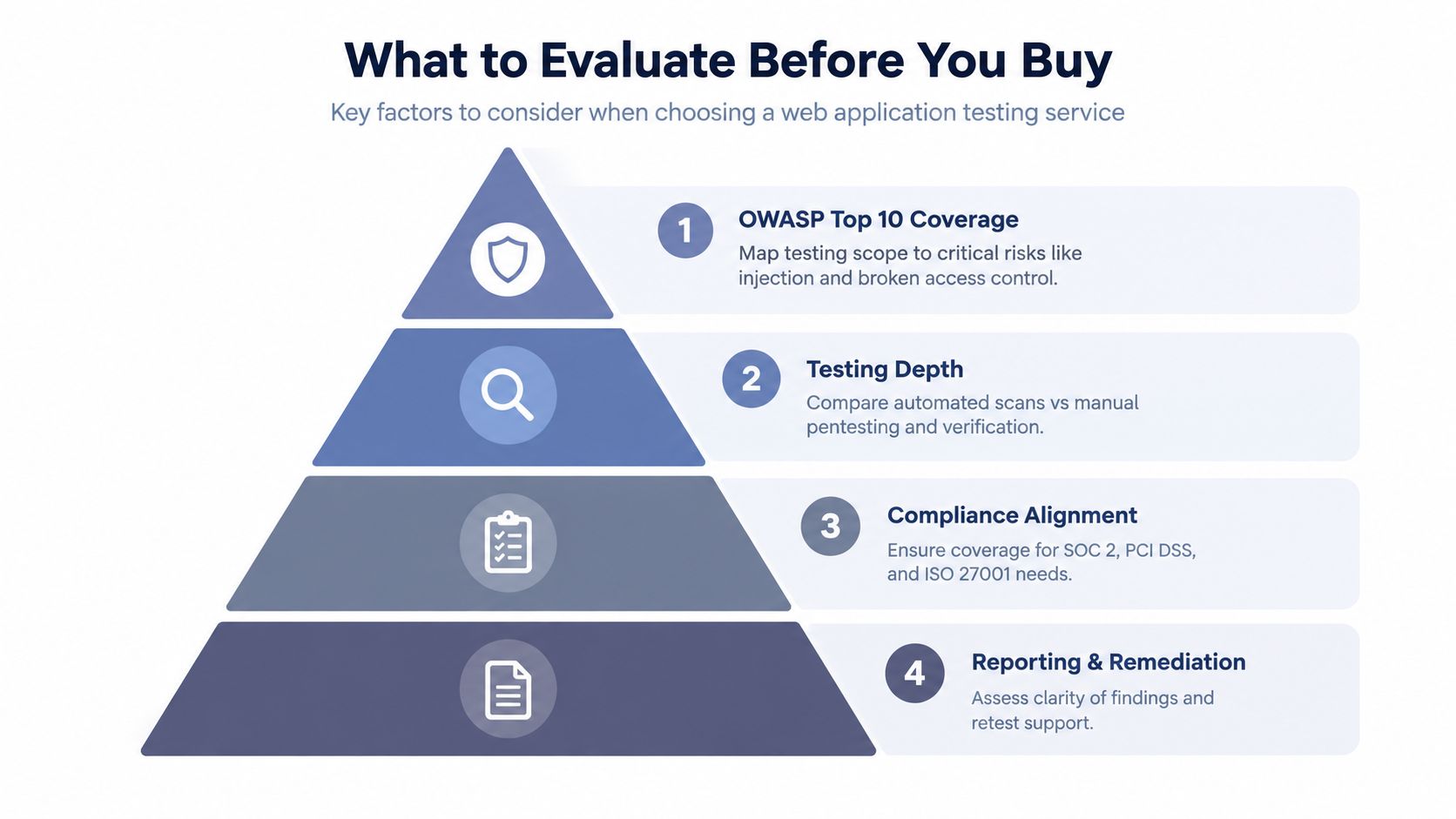
Start with risk coverage, not vendor branding. OWASP's Top 10 has served as a foundational milestone for web application testing services since its first release in 2003, with the latest major edition issued in 2021 and a 2025 release candidate later appearing on the project site (OWASP Top 10 project). The framework is valuable because it gives procurement teams a common language for scoping and comparing assessments.
The 2021 ranking is:
- A01 Broken Access Control
- A02 Cryptographic Failures
- A03 Injection
- A04 Insecure Design
- A05 Security Misconfiguration
- A06 Vulnerable and Outdated Components
- A07 Identification and Authentication Failures
- A08 Software and Data Integrity Failures
- A09 Security Logging and Monitoring Failures
- A10 Server-Side Request Forgery, or SSRF
Require incidence-based scope
Access control deserves disproportionate attention. OWASP reports that Broken Access Control moved from fifth place to first, with an average incidence rate of 3.81% across tested applications and more than 318,000 mapped CWE occurrences in the contributed dataset (OWASP Top 10 2021 introduction). The procurement implication is direct. Ask how the provider tests horizontal access, vertical privilege escalation, tenant isolation, object references, function-level authorization, and API-specific authorization decisions.
Injection remains essential, but buyers should demand more than a checkbox. OWASP's data recorded Injection in 94% of applications tested for that class, with a maximum incidence rate of 19% and more than 274,000 occurrences. Security Misconfiguration affected 90% of applications tested for that issue, with an average incidence rate of 4.5% and more than 208,000 occurrences. These figures justify systematic test coverage, but they don't prove that a vendor tested your application thoroughly. Your proposal should connect each category to concrete test cases, endpoints, roles, inputs, and evidence.
The 2021 framework uses incidence rate, total occurrences, weighted exploit, and weighted impact. It also maps 34 CWEs to Broken Access Control and 33 CWEs to Injection, which shows why category-level claims are insufficient on their own. Request a scope matrix that identifies the relevant CWE families, application components, test accounts, API operations, and exclusions.
Inspect the methodology and evidence
A provider should explain reconnaissance, attack-surface mapping, automated discovery, manual testing, exploitation controls, evidence capture, reporting, remediation support, and retesting. Don't accept “OWASP compliant” as a methodology. Ask how the team handles authenticated sessions, multifactor authentication, rate limits, token rotation, GraphQL introspection, file uploads, asynchronous workflows, and business logic.
Define evidence requirements before signing:
- Reproduction steps: Another tester should be able to repeat the finding without guessing.
- Request and response context: Evidence should show the relevant behavior while protecting secrets.
- Impact explanation: The report should connect technical behavior to data, privilege, or business risk.
- Remediation guidance: Developers need a fix direction, not only a vulnerability label.
- Retest status: Closed, partially fixed, and unresolved findings must be distinguishable.
Use this web application penetration testing resource as a reference point when comparing scope language and application-layer coverage. The right proposal will tell you what happens during testing, what the client receives, and how the provider proves completion.
How to Compare Providers Without Getting Fooled by Scans
Scanner output is useful reconnaissance. It isn't a finished penetration test. Automated tools can identify exposed components, common injection indicators, insecure headers, and other patterns quickly, but they rarely understand whether a user should access a particular object or whether a multi-step transaction can be manipulated.
Independent 2026 coverage highlights scanner false-positive rates of 40% to 70%, making verification the central buyer concern rather than raw alert volume (coverage of agentic validation in web application penetration testing). A report with hundreds of unverified alerts shifts the workload to your security and engineering teams. It may look thorough while providing weak evidence for an auditor or an incident-response decision.
Compare the deliverable, not the dashboard
| Evaluation Criteria | Scanner-Based Service | Evidence-Backed Pentest Service |
|---|---|---|
| Finding validation | Flags suspected issues | Confirms exploitability and records test evidence |
| Business logic | Limited understanding of workflows | Tests authorization, state changes, abuse paths, and role boundaries |
| API coverage | Discovers documented or visible endpoints | Tests authenticated REST and GraphQL behavior, including object-level access |
| False positives | Often passed to the customer for triage | Findings are reviewed, reproduced, and explained |
| Methodology | Tool configuration may be opaque | Scope, techniques, limitations, and test conditions are documented |
| Audit readiness | Vulnerability export with limited context | Executive and technical reporting with evidence and control mapping |
| Remediation | Customer interprets the alert | Provider supplies fix guidance and performs retesting |
| Integration | Scheduled scan or portal upload | API, CI/CD, role controls, scheduling, and structured exports |
A serious evaluation should include a proof of concept. Give shortlisted providers a controlled application or representative staging environment with several roles and API workflows. Ask each provider to demonstrate how it handles an intentionally restricted object, an authorization edge case, and a finding that requires multiple requests to validate.
The purpose isn't to reward the vendor that produces the longest report. It's to expose whether the service can distinguish a theoretical signal from a defensible finding.
Ask uncomfortable questions
Request the provider's verification process in writing. Ask who reviews findings, what evidence is mandatory, how the service marks uncertainty, and whether retesting is included. If the answer is “the scanner assigns severity,” you're buying automated triage, not a mature pentest service.
Also ask about operational isolation. Dedicated infrastructure, customer-specific credentials, access controls, logging, data retention, and regional deployment affect both security and procurement approval. A multi-tenant provider should explain how one customer's test artifacts remain isolated from another's.
Reporting format matters because different stakeholders consume different views. Security engineers may need raw requests, responses, screenshots, and remediation detail. Executives and auditors need concise risk statements, scope, dates, evidence references, and control mappings. PDF and JSON outputs can support both human review and downstream ticketing, but only if the underlying findings are verified.
For a deeper comparison of alert noise and manual validation, review this analysis of false positives from scanners versus penetration testing. Treat the provider's willingness to demonstrate verification as a buying signal. A vendor that avoids a practical pilot is asking you to purchase an assumption.
Procuring Web Application Testing Services Step by Step
Procurement works best when the buyer turns vague expectations into acceptance criteria. The following workflow is designed for an MSSP, consultancy, or internal security team that must defend its vendor choice to engineering, compliance, and finance.
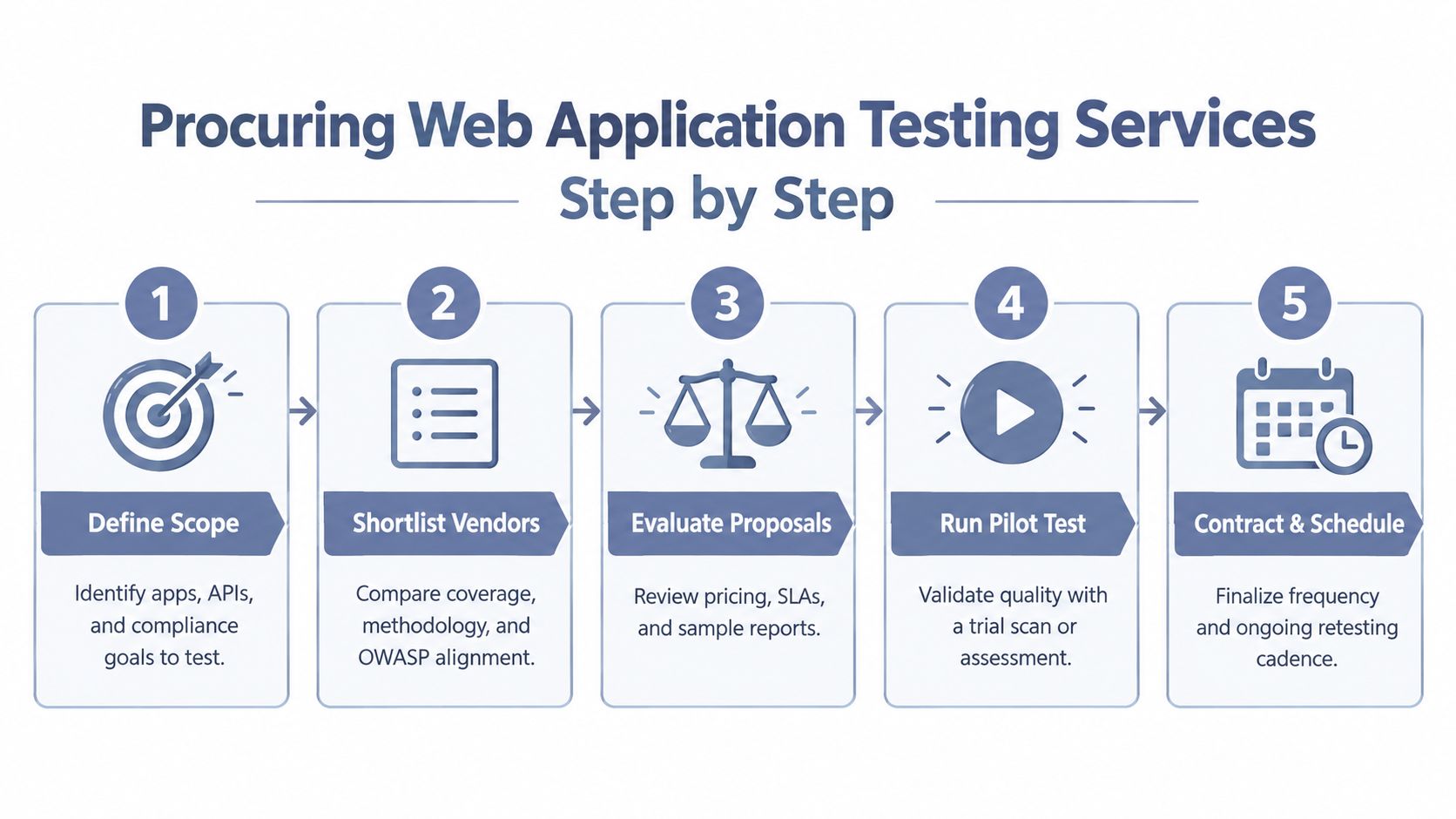
1. Define the attack surface
List every web application, REST API, GraphQL endpoint, authentication path, administrative interface, third-party integration, and environment involved. Identify whether the target is public, internal, staging, or production, and document test windows, rate limits, safe exploitation rules, and emergency contacts.
Include business roles and representative workflows. A test account for a standard user won't validate administrator functions, tenant boundaries, support impersonation, refunds, exports, or privileged API operations. The scope document should also state what isn't included, because exclusions are where audit disputes begin.
2. Set the control and evidence requirements
Map the engagement to the frameworks that matter to the customer. PCI DSS 4.0.1 requires application-layer testing for relevant payment environments, including APIs, and expects testing after significant changes. It also requires segmentation testing at least every 6 months, so a proposal that covers only the web interface may be incomplete for a cardholder environment (PCI DSS testing guidance).
Ask vendors to show how they'll document:
- Scope and authorization: Approved targets, dates, accounts, and exclusions.
- Methodology: Testing phases, tools, manual techniques, and safety controls.
- Evidence: Screenshots, requests, responses, timestamps, and reproduction steps.
- Remediation: Severity rationale, affected components, and practical fix guidance.
- Retesting: Validation method, status tracking, and treatment of residual risk.
- Compliance mapping: Relevant control references for PCI DSS, SOC 2, ISO 27001, or other requirements.
A sample report should be complete enough to assess these details. A polished cover page isn't evidence of delivery quality.
3. Compare proposals on test depth
Build a scoring sheet that separates automated discovery from manual validation. Ask whether the service tests broken access control, insecure design, authentication failures, integrity issues, SSRF, injection, misconfiguration, logging, and vulnerable components. The OWASP Top 10 2021 data and methodology provide a useful benchmark because the framework moved beyond simple ranking and incorporated incidence and impact measures.
For APIs, require endpoint inventory, schema handling, authorization testing, input validation, rate-limit behavior, error handling, and workflow abuse. For cloud-hosted applications, clarify whether the engagement examines application behavior only or also the relevant cloud configuration and trust boundaries.
4. Run a controlled pilot
A pilot should test the provider, not merely the target. Give vendors identical scope information and compare the clarity of their findings, evidence quality, remediation advice, and communication during the exercise. Include a known issue if your rules of engagement permit it, then check whether the vendor can reproduce and explain it without inflating severity.
Red flags include a report with no authenticated testing, generic remediation text, unexplained exclusions, no retest path, or a promise that automation covers business logic automatically. A vendor that can't explain its limitations won't become more transparent after purchase.
5. Contract for repeatability
Specify cadence, change-triggered testing, service levels, support hours, retest terms, data retention, breach notification, infrastructure isolation, and reporting formats. If you're reselling the service, define customer onboarding, white-label permissions, multi-tenant controls, escalation ownership, and who answers technical questions during an audit.
The contract should make evidence a deliverable, not a courtesy. It should also state how the provider handles failed tests, unavailable environments, incomplete credentials, and findings that require customer confirmation. Procurement is finished only when the delivery model is predictable enough for your team to operate repeatedly.
Integrating Automated Pentesting Into Your Service Offering
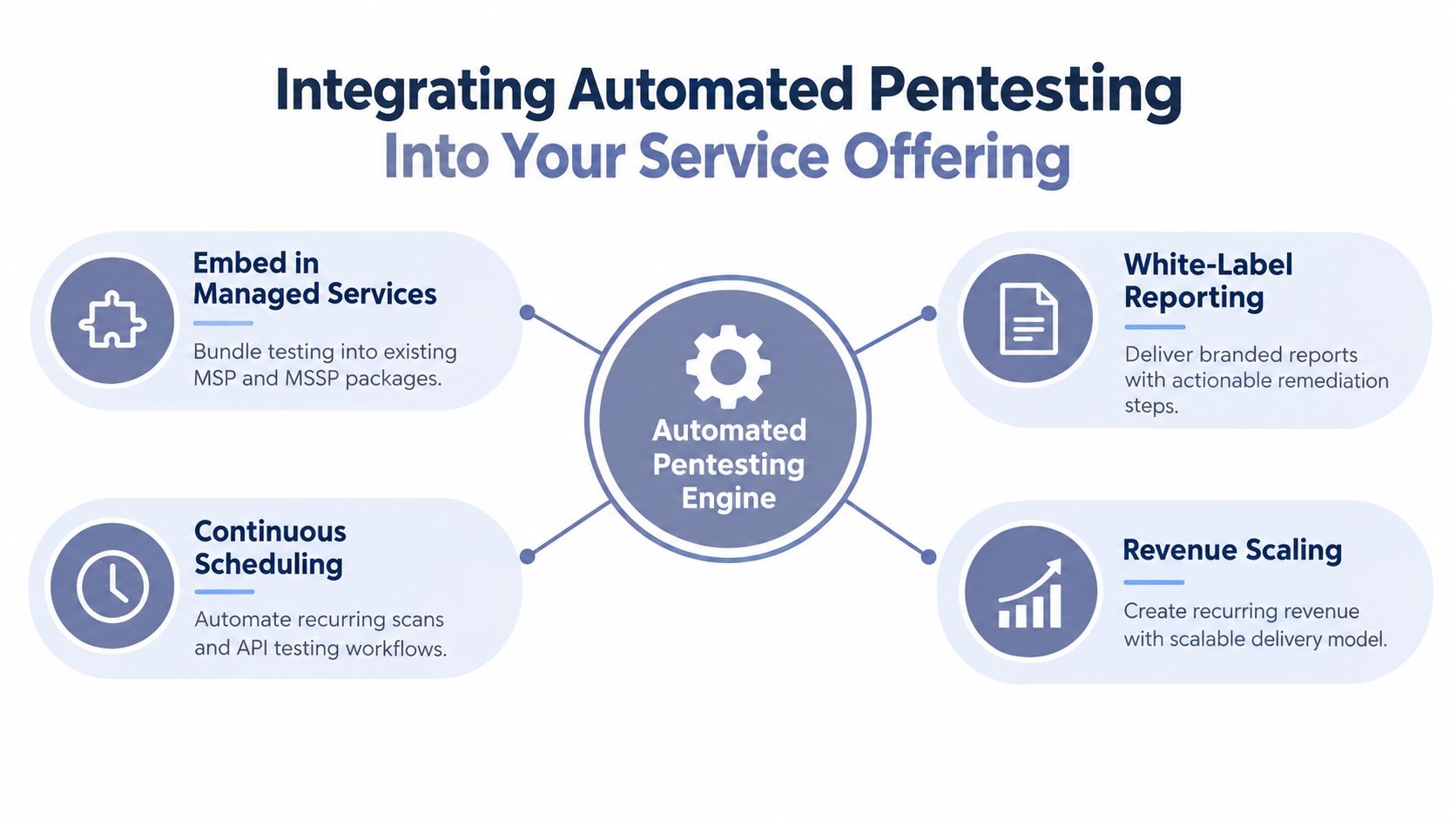
An MSSP that delivers one annual scan creates stale evidence and an awkward customer handoff. Integrate automated pentesting with vulnerability management, cloud monitoring, compliance support, incident readiness, and development governance. The service should produce usable validation whenever application risk changes.
Start with controlled orchestration. An agentic engine can coordinate reconnaissance, discovery, exploitation, verification, and reporting across Nmap, SQLMap, Nuclei, and proprietary tools. Tool count is a weak procurement metric. Require records showing which tool generated each signal, what the agent did next, whether a tester verified the result, and which evidence supports the final finding. This verification layer matters for API-heavy applications, where generic scanners can generate false-positive reports that buyers cannot defend in an audit.
Build around service boundaries
Partners need customer isolation, predictable permissions, and clear ownership. Dedicated partner-scoped infrastructure helps prevent test artifacts from mixing and supports regional governance. Role-based access, API keys, and customer workspaces should separate analysts, account managers, customers, and auditors without forcing staff to maintain manual reporting silos.
Connect the platform to both scheduled and event-driven operations:
- Scheduled assessments: Run recurring web and API tests against approved targets.
- Change-triggered tests: Start focused checks after meaningful application or endpoint changes.
- CI/CD checks: Return structured results to development workflows while restricting sensitive evidence.
- Analyst escalation: Send complex business logic and ambiguous findings to a human tester.
- Compliance reporting: Produce executive and technical views with framework references and traceable evidence.
The application testing services market is projected to expand from USD 13.42 billion in 2025 to USD 28.31 billion by 2033 (application testing services market coverage). The operational implication is straightforward: providers need cloud-based testing, DevSecOps integration, AI-supported automation, and continuous assurance. A disconnected annual scan will not serve API-heavy customers efficiently.
Turn evidence into a repeatable product
ThreatExploit AI is one platform option for providers assessing this model. Its stated capabilities include web application testing for REST and GraphQL APIs, orchestration across 60+ tools, dedicated partner infrastructure, CI/CD and API integrations, role-based controls, and PDF and JSON reporting. It also describes compliance mapping for PCI-DSS, SOC 2, ISO 27001, HIPAA, CMMC, GLBA, and GDPR. For a full breakdown of how automated penetration testing platforms operate, review this guide to automated penetration testing.
Use automation for repeatable checks, then require human judgment for high-risk decisions. A prospecting assessment can demonstrate service value, while production delivery must enforce authorization, scope control, evidence review, customer communication, and remediation follow-up. Standardizing those controls across accounts turns testing into a repeatable service instead of another portal subscription.
Making the Right Choice and Scaling With Confidence
The right provider wins on three linked criteria: speed, verification, and compliance usability. Speed matters because stale results lose value as applications change. Verification matters because unconfirmed alerts consume engineering time and weaken trust. Compliance usability matters because auditors need traceable evidence, not a portal full of unresolved scanner output.
Evaluate the first engagement as an operational trial. Measure whether the provider identified the agreed application and API surface, tested authenticated roles, documented limitations, produced reproducible findings, and handled remediation questions without hiding behind tool output. Check whether the report works for both the engineer fixing the issue and the auditor reviewing the control.
Choose a service that can grow with your delivery model
An internal team may need focused application assessments and retesting. An MSSP needs customer isolation, onboarding workflows, partner reporting, permissions, recurring schedules, and escalation paths. A compliance firm may prioritize control mapping and evidence retention. The same platform can't be evaluated against one buyer profile.
Use a simple decision filter:
- Reject coverage without proof.
- Reject compliance claims without control references.
- Reject API scope that excludes authorization and workflow testing.
- Reject reports that don't support remediation and retesting.
- Prefer repeatable delivery over impressive one-off demonstrations.

Your testing program should reflect how applications are delivered. Establish a baseline assessment, connect recurring tests to meaningful change, reserve manual effort for business logic and complex attack paths, and schedule retesting as part of remediation rather than as an afterthought. For service providers, that structure creates more predictable delivery costs while giving customers evidence they can act on.
ThreatExploit AI provides automated penetration testing for web applications, REST and GraphQL APIs, networks, and cloud environments, with agentic orchestration, evidence-backed findings, and compliance-mapped PDF and JSON reports. Visit ThreatExploit AI to evaluate a repeatable testing model for your customers and request access to the platform.