
A customer asks for proof that your cloud environment is secure. You can produce your provider's certificate, a SOC 2 logo, and a screenshot of a dashboard, but you can't show who owns each control, what you tested, or whether a critical finding was fixed. That's the gap standards for security in cloud computing are meant to close. A standard helps only when a tester can verify it with evidence, not when an organization claims alignment with it.
Table of Contents
- Which Cloud Security Standard Covers What
- Why Cloud Security Needs Written Standards
- Who Owns Each Control Under Shared Responsibility
- Mapping One Finding Across Multiple Frameworks
- Penetration Testing Requirements in PCI DSS and ISO 27001
- Where Standards Fall Short in Practice
- Choose the Right Standards for Your Customers
Which Cloud Security Standard Covers What
Use the table below to place each name before you argue about which one you need.
Cloud security standards at a glance
| Standard | Core focus | Applies to | Scale |
|---|---|---|---|
| NIST SP 800-144 | Security and privacy risks of public cloud, provider accountability | Organizations using public cloud, especially U.S. federal | Guidance document, 2011 |
| NIST SP 800-53 Rev. 5 | Security and privacy control catalog for systems | Federal and commercial systems, cloud included | Broad catalog of control families and enhancements |
| ISO/IEC 27001:2022 | Information security management system certification | Any organization | Certifiable ISMS with Annex A controls, including A.5.23 for cloud services |
| ISO/IEC 27017 | Cloud-specific controls extending ISO/IEC 27002 | Cloud service providers and cloud customers | Cloud controls for public, private and hybrid models |
| CSA Cloud Controls Matrix v4.1 | Cloud-specific control taxonomy with cross-framework mappings | Cloud providers, customers and assessors | 207 controls in 17 domains |
| CIS Controls v8 and CIS Benchmarks | Prioritized safeguards and platform hardening configurations | Operations and security teams | Prioritized controls and safeguards, plus platform benchmarks |
| SOC 2 (AICPA Trust Services Criteria) | Auditor report on controls relevant to service commitments | Service organizations serving customers | 5 categories; Type 1 or Type 2 |
| PCI DSS v4.0 | Protection of cardholder data environments | Merchants, service providers and their cloud hosts | 12 requirements |
Certification, Report or Guidance
These three words aren't interchangeable, and a penetration tester feels the difference immediately. A certifiable standard such as ISO/IEC 27001:2022 can lead to a certificate for a defined scope, so you ask what's inside that scope. A guidance document such as NIST SP 800-144 tells you what to plan and verify, but nobody issues a certificate for following it. An audit report describes what an auditor examined. If you're still weighing the management system against the control catalog, a direct ISO 27001 and NIST 800-53 comparison helps you separate governance from control depth.
Say a SaaS customer asks, "Are you SOC 2 certified?" You're not. SOC 2 is an AICPA auditor report on Trust Services Criteria in five categories, not a certificate. Type 1 describes design at a point in time. Type 2 tests operating effectiveness over a period. A customer asking for proof should ask which type you hold, which period it covers, which services are in scope, and which controls were left to them as complementary user entity controls.
The second row readers misuse is CIS. CIS Controls v8 organizes prioritized controls and safeguards that operations teams can sequence, starting with asset inventory, secure configuration, access management and vulnerability management. CIS Benchmarks are different. They're platform hardening guides a tester can check as configuration state on AWS, Azure or GCP, such as whether root use is alarmed, public storage is blocked, and logging is enabled. One gives you priorities, the other gives you testable settings.
Shortlist Before You Test
After those distinctions, narrow the field to four or fewer standards for one environment with three questions.
- Who are the customers: Do they need a certificate, a Type 2 report, or federal style control evidence?
- What data is handled: Cardholder data points to PCI DSS. Personal or health data adds legal duties on top of any standard.
- Which contracts or regulations apply: A signed customer commitment outranks a standard you picked because it looks familiar.
A standard you can't test is a claim. Keep only the ones you can tie to a control, an owner and evidence.
Why Cloud Security Needs Written Standards
An auditor asks for evidence that a cloud environment is secure. The team shows a provider certificate but nothing about its own identities, storage policies or network rules. The provider's controls may be sound. They're just not the customer's controls. That mismatch is where most cloud audit conversations stall.
The NIST Special Publication 800-144, finalized on December 9, 2011, addressed that problem early. NIST emphasized that customers should plan security and privacy requirements before deployment, understand the provider's operating environment, verify that cloud resources satisfy those requirements, and retain responsibility for protecting data and applications. It followed SP 800-145 from 2011, which standardized cloud terminology. Together they created a common vocabulary and a control oriented foundation for procurement, audits and compliance mappings.
That accountability still matters because adoption runs ahead of readiness. In the Cloud Security Alliance survey conducted in December 2023, 2,037 IT and security professionals participated and 77% of respondents said they felt unprepared to deal with security threats. Running on a major platform doesn't prove maturity. It proves you're renting infrastructure from a mature provider.
What Standards Give a Tester
Written standards provide three things you can't improvise during an audit. First, a shared vocabulary, so provider, customer and tester mean the same thing by tenant isolation or administrative access. Second, a control baseline to test against, such as least privilege, encryption, logging and segmentation. Third, a basis for assessable evidence, meaning artifacts another person can inspect without trusting your verbal assurance.
Before deployment, evaluate a provider against the criteria NIST lists for selection and governance.
- Access and data protection: Logical and network access controls, data protection, configuration and patch management, and backup and recovery.
- Detection and continuity: Security and vulnerability scanning, incident response, and continuity of operations.
- Assurance: Certification and accreditation, assurance levels, and independent auditing of services.
For penetration testing, tie each test to a named provider responsibility, an access condition, the vulnerability management process and independent evidence. Don't attach it to a provider logo. A logo tells you someone was assessed. It doesn't tell you whether your role can write to production storage today.
Who Owns Each Control Under Shared Responsibility
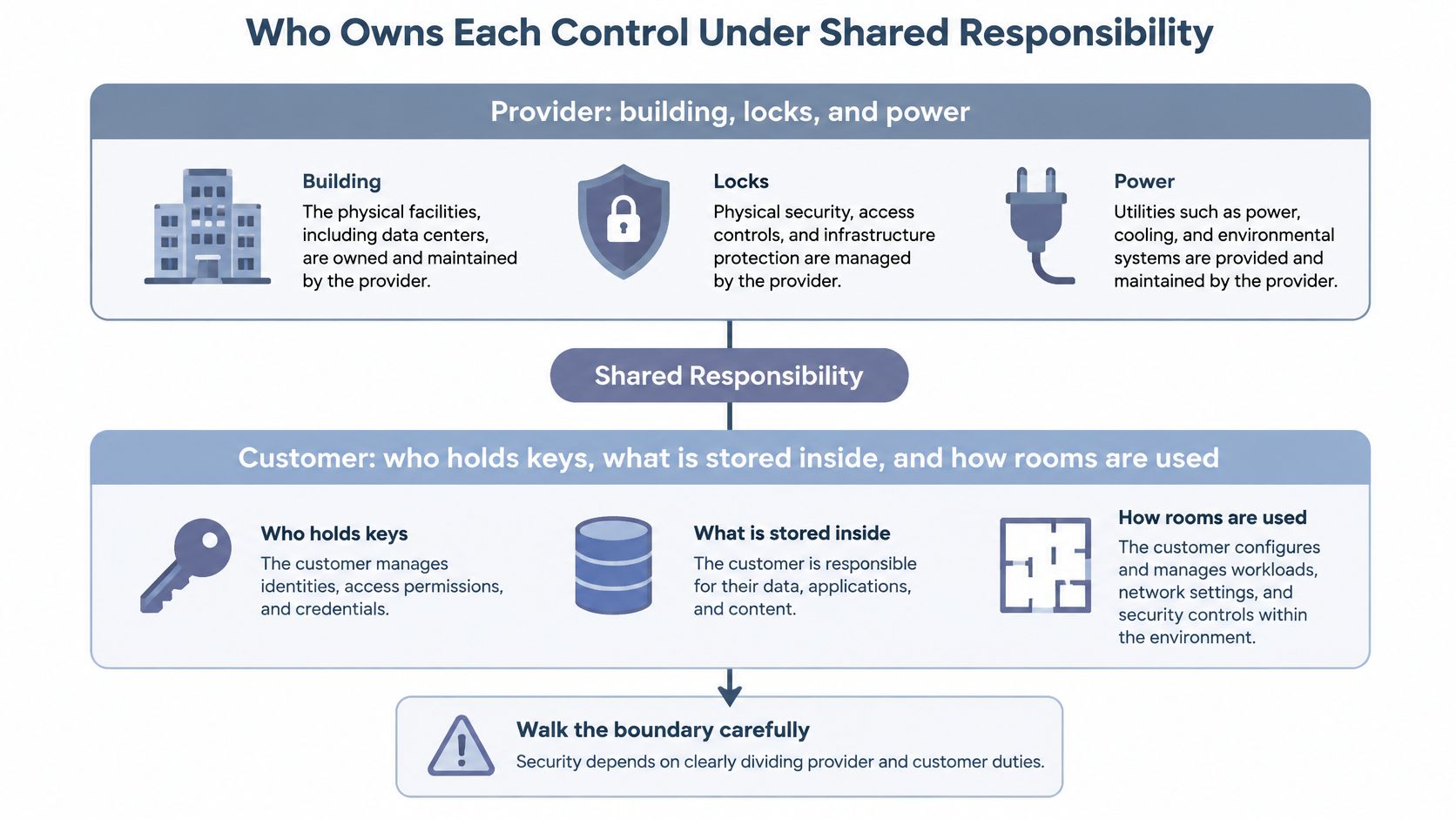
Think of cloud as a building you rent. The provider owns the building, locks and power. You control who holds keys, what is stored inside and how the rooms are used. If you hand copies of your key to every contractor and leave valuables in a public corridor, the landlord's strong front door won't save you.
The diagram below shows that split before the service model detail.
Now take a common failure. A team sets a storage bucket to public read during a migration and forgets to reverse it. Customer records are exposed while the provider's certification remains valid. Nothing is contradictory there. The provider secured its storage platform. The customer misconfigured access to its own data. That's why provider certification can't prove customer controlled configurations are secure.
Ownership by Service Model
Who owns the control by service model
| Service model | Provider owns | Customer owns |
|---|---|---|
| IaaS | Physical facilities, hypervisor and network fabric | Operating system, applications, identities, network configuration and data |
| PaaS | Facilities, hypervisor, network fabric, operating system and runtime patching | Application code, identities and data access rules |
| SaaS | Most of the stack | Users, roles, single sign-on settings and data classification |
Hybrid estates blur these lines across on premise and multiple clouds, which is why a clear view of hybrid cloud security boundaries matters before you assign an owner. The service model tells you the starting point. Your architecture tells you the exceptions.
ISO/IEC 27017 extends ISO/IEC 27002 with cloud specific implementation guidance and additional controls for both cloud service providers and cloud service customers across public, private and hybrid deployment models. Its value is that it makes the boundary explicit. Providers document infrastructure, virtualization, tenant isolation, administrative access and service operations. Customers configure and govern identities, workloads, data and endpoint access.
Make the Boundary Testable
Build a responsibility matrix per service, not one generic matrix for the whole estate. Create separate rows for compute, object storage, managed databases and serverless functions. For each control, name the party, write it as a testable responsibility, and link evidence such as IAM policies, configuration snapshots, access logs, encryption settings, incident records and change approvals. Review it after every architecture or provider change.
Penetration testing verifies both sides of that matrix. Test preventive controls such as least privilege permissions and network segmentation by attempting the actions those controls should block. Test detective controls such as centralized logging, alerting and retention by generating activity and confirming it appears, alerts the right person and stays available. For the detective half, cloud alert monitoring best practices from Fivenines is a useful operational companion because it focuses on making alerts actionable rather than merely present.
Ownership rule: If a control has no named owner and no evidence artifact, you don't have a control. You have an assumption.
Mapping One Finding Across Multiple Frameworks
Start with one verified finding. An overprivileged role in AWS, Azure or GCP can write to a production storage bucket that holds customer exports. Your tester assumes the role from an application instance, writes a harmless test object, reads an existing file listing, and shows that no approval or alert stops the action. That's a technical weakness, not an opinion about identity governance.
Record it once, completely. Capture the affected resource identifier, the policy or configuration state, a timestamp, reproduction steps and remediation status. Add the role policy, the bucket policy, the successful write evidence, the log query you ran and whether an alert fired. Another tester should be able to repeat the test without calling you.
The Two Layer Mapping Method
The Cloud Security Alliance Cloud Controls Matrix v4.1 contains 207 controls organized across 17 security domains and provides mappings to other standards and guidance, including NIST and MITRE ATT&CK. Use CCM first to establish cloud specific coverage and cross framework traceability. This finding touches identity and access management, application security, data security, logging and monitoring, infrastructure security and incident response, but you map only where the control objective applies.
Then use NIST SP 800-53 Rev. 5 to define how much evidence is enough. NIST provides a broader catalog covering cloud systems and threat sources including hostile attacks, human error, natural disasters and privacy risks. In practical terms, its access control, audit and accountability, and configuration management families push you beyond "remove excess permission." You also show who approved the role, how often access is reviewed, what was logged and what changed after remediation.
A simple mapping record looks like this.
- Verified weakness: Application role can write to the production export bucket, reproduced with test object and screenshot.
- CCM mapping: Identity governance and least privilege, logging and monitoring, and change management objectives, each with a control identifier.
- NIST depth: Access control and audit evidence, including policy before and after, review record and log extract.
- Customer reuse: The same access evidence answers a SOC 2 access review question and a PCI DSS assessor's question about who can reach cardholder data, if that bucket is anywhere near the payment environment.
A visual compliance heat map helps customers see where one finding concentrates risk across frameworks instead of reading four disconnected reports. The map is a presentation aid, though. The underlying record still needs identifiers and artifacts.
Where Mappings Go Wrong
Mappings aren't automatic. A spreadsheet can claim that one IAM finding satisfies identity, monitoring, incident response and supplier management, but only a human can confirm that each control objective applies to this resource and this attack path. Map each cloud asset and attack path deliberately. Excessive permissions can be recorded once as a verified technical weakness, then mapped to identity governance, least privilege, change management and monitoring requirements only where the evidence supports it.
Practical rule: One finding, many mappings, each mapping citing a control identifier and an evidence artifact.
That discipline saves time during audits and prevents the opposite problem, testing the same role four times for four frameworks. Fix the role to the minimum API actions on the minimum resources, retest the original steps, and close every mapping with the same verified result. If logging still doesn't alert, keep the monitoring mapping open. The permission is fixed. The detection isn't.
Penetration Testing Requirements in PCI DSS and ISO 27001
PCI DSS is prescriptive about testing. ISO 27001 is prescriptive about justification. Confusing those two styles leads teams to demand a fixed ISO test frequency that doesn't exist, or to treat PCI testing as a flexible risk decision when it isn't.
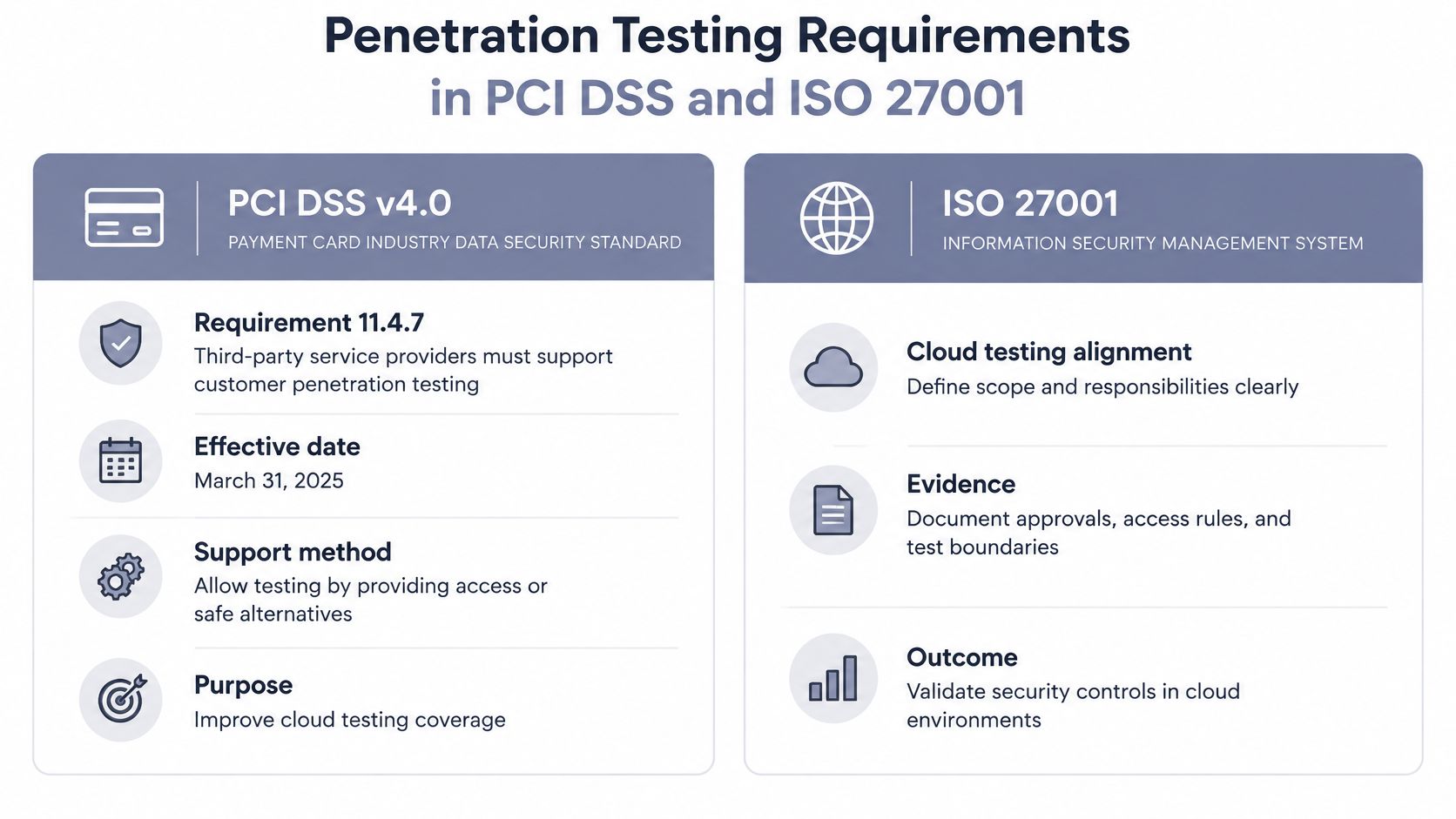
The comparison below summarizes the obligations before the detail.
What PCI DSS v4.0 Requires
Under the PCI DSS 4.0 Requirement 11.4.7 summary from Schellman, effective March 31, 2025, third party service providers must support their customers' penetration testing activities. A multi tenant provider, including a cloud service provider, must either give customers access to the systems needed for authorized testing or provide evidence that comparable penetration testing has already been performed. That's a concrete access and evidence obligation, not a general promise that the platform is secure.
Two related requirements shape the test itself. The SC Media guide to PCI DSS 4.0 penetration testing notes that Requirement 11.4.5 requires annual testing of network segmentation, confirming that out of scope systems remain isolated from the cardholder data environment. Requirement 11.4.4 requires every vulnerability documented in the final penetration test report to be remediated, regardless of severity, with remediation documented and verified by a follow up penetration test.
Read that second point again before you scope. A low severity finding in the final PCI report isn't something you accept and defer. You remediate it, document the fix and retest it. Your workflow therefore needs exploit evidence, scope and segmentation mapping, and repeat verification built in from the start, not added after the assessor asks.
How ISO 27001 Justifies Testing
According to the Software Secured guide to ISO 27001 penetration testing, ISO/IEC 27001:2022 does not impose one universal penetration test frequency or a single mandatory test format. Testing is justified through the organization's risk assessment, Statement of Applicability and applicable Annex A controls. A.5.23 addresses information security for use of cloud services, A.8.8 addresses management of technical vulnerabilities, and A.8.29 addresses security testing in development and acceptance.
That means you defend scope, timing and depth with risk. A cloud API that handles customer data and changes weekly needs a different test rhythm than a static internal tool. Document why you tested storage, identity configurations, APIs, infrastructure and release processes, and what you deliberately excluded. An auditor can challenge weak reasoning even though no universal frequency exists.
Pre Test Authorization Checklist
You may not test third party infrastructure or services such as cloud, hosting, telecom or SaaS providers without complying with those providers' testing policies and obtaining any required authorization. We may require proof of asset ownership, a signed authorization or rules of engagement document, or domain and asset control validation before testing starts.
- Confirm the provider policy: Check permitted techniques, notification rules and prohibited targets for AWS, Azure, GCP or the SaaS vendor.
- Obtain written authorization: Record who can authorize the test and how asset control was proven.
- Define scope boundaries: List accounts, subscriptions, VPCs, applications and third party services in and out of scope.
- Agree rules of engagement: Set test windows, data handling, stop conditions and escalation contacts.
- Schedule the retest first: Book follow up verification before the first test begins, especially for PCI work.
Where Standards Fall Short in Practice
Certification doesn't equal security. A certificate proves an assessed scope met requirements at assessment time. It doesn't prove every new bucket, role and serverless function deployed since then follows those controls.
The team discussion below is the right mental image: standards are a starting point for argument and verification, not a finish line.
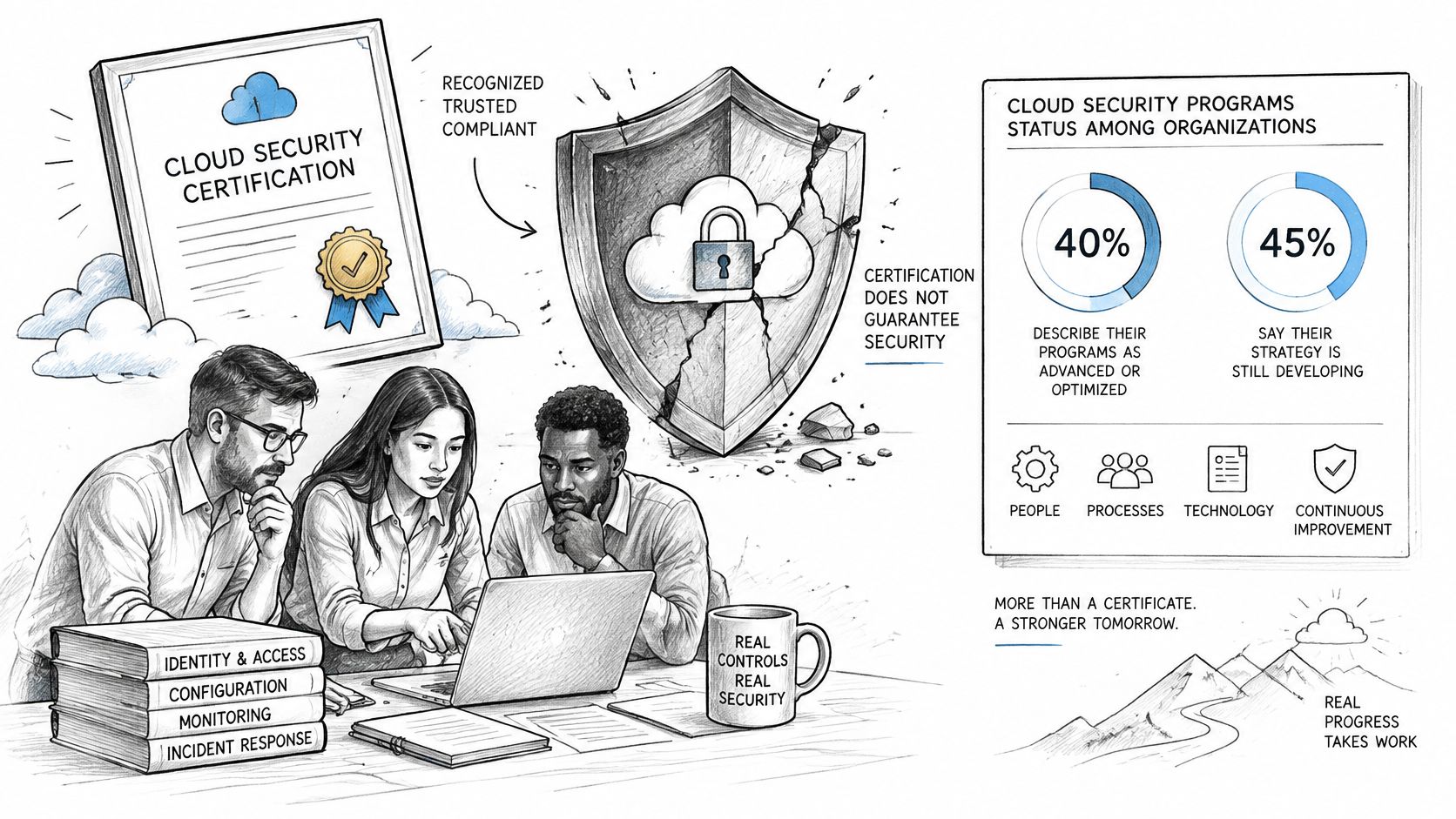
The SANS cloud security maturity announcement reports that only 40% of organizations describe their cloud security programs as advanced or optimized, while 45% say their strategy is defined but only partially implemented. Enforcement splits sharply too: 39% use mandatory automated gates that block noncompliant infrastructure before deployment, while another 39% rely only on advisory scanning that identifies issues without preventing release. Misconfiguration remains the leading cause of critical cloud incidents at 45%, compared with 22% for credential theft, and 49% of organizations require more than 24 hours to close a known critical gap.
Those numbers expose the key questions standards often leave unanswered. Which controls should block deployment? How do you collect evidence continuously in a multi cloud estate? Who owns remediation when a control crosses provider, customer, SaaS and infrastructure boundaries? Judge maturity by preventive enforcement, remediation time and independently verifiable evidence, not by claimed alignment with ISO 27001, NIST, SOC 2 or PCI DSS.
The short video below adds practitioner context on why point in time assurance struggles against fast changing cloud environments.
Sovereignty Breaks the Checklist
A globally certified service can still fail a customer's residency or legal control requirement. The European Commission sovereignty framework document evaluates factors including confinement of storage and processing to European jurisdictions, with no fallback to third countries. A related EU proposal describes four assurance levels and would require sovereignty risk assessments to determine which sectors and use cases need higher protection.
Test those claims directly. Validate actual processing paths, support access, backup locations, subcontractors, incident response authority and portability. A region selection in a console isn't proof if support engineers, backups or logs move elsewhere. More compliant doesn't always mean more suitable.
Finally, respect the limits of testing itself. Our service is provided "as is" and "as available," and security testing cannot identify every vulnerability. Findings can include false positives or false negatives. Standards reduce that uncertainty when they force repeatable tests and closure evidence. They increase risk when teams treat a clean report as a guarantee.
Choose the Right Standards for Your Customers
Run this procedure this week for one environment. Don't start by picking a logo.
- List data and locations: Name data types and every region where they're stored and processed, including backups, logs and support access.
- Name binding obligations: Identify contracts and regulations, such as PCI DSS where cardholder data is stored, processed or transmitted, and residency rules for public sector work.
- Pick one management standard and one catalog: Pair ISO/IEC 27001:2022 with CSA CCM v4.1, for example, so governance and cloud control detail work together and each finding maps once.
- Assign every control: Put a named owner on the IaaS, PaaS or SaaS matrix and review the assignment after each architecture or provider change.
- Test and keep evidence: Run an authorized test and store resource identifier, configuration state, timestamp, reproduction steps and remediation status, with follow up for critical and high findings and for every PCI vulnerability regardless of severity.
For regulated public sector, financial, healthcare and critical infrastructure workloads, attach jurisdiction evidence rather than treating a global certificate as sufficient. Show where data is processed, who can access it for support, where backups sit and which subcontractors are involved. Broader background such as Captiwate security and compliance insights from Captiwate can help nontechnical stakeholders understand why those questions belong in procurement, while your test evidence answers them for a specific system.
At the evidence step, a platform such as ThreatExploit AI runs testing across web, network and cloud environments on dedicated resources and maps reports to PCI DSS, SOC 2 Type 2 and ISO 27001 with control references and screenshots. Our reports are also auto mapped to HIPAA, SOC 2 Type 2, GLBA, PCI-DSS, CMMC and GDPR with specific control references, and include evidence, screenshots and compliance ready documentation. Pick two standards, scope one environment, run one test, and compare each finding with its mapped control identifier. That first verified loop teaches you more than a month of debating frameworks.
Scope one cloud environment this week, map its controls to the standards your customers require, and test whether those controls hold with evidence you can hand to an auditor. ThreatExploit AI runs authorized penetration testing across web, network and cloud targets on dedicated resources and returns compliance mapped reports with control references and screenshots. Visit ThreatExploit AI to start a test and turn claimed alignment into verified proof.