
The usual single vs multi tenant advice gives dedicated infrastructure a security badge and treats shared infrastructure as the budget option. Neither label tells a pentest client whether another customer can reach their evidence, delay their assessment, or receive their report. Tenancy is a claim about boundaries. A provider should be able to demonstrate those boundaries, not just draw them.
Table of Contents
- Why Tenancy Decides What Your Pentest Reports Say
- Single vs Multi Tenant Compared Across Eight Criteria
- Isolation You Can Prove Beats Isolation You Can Explain
- Performance Predictability and the Noisy Neighbor Problem
- What the Difference Costs Over Five Years
- Which Model Fits Your Engagements
- Decide Before You Sign the Next Client Contract
Why Tenancy Decides What Your Pentest Reports Say
Single tenant gives each customer a dedicated application instance, database, and usually a network boundary. Multi tenant runs an application instance for many customers, enforcing separation through identity policies, database permissions, and request-level authorization.
For a penetration-testing provider, that distinction reaches beyond hosting. It affects how many engagements delivery staff can schedule, which artifacts sit alongside client evidence, and what the provider can commit to in a statement of work. A reserved execution environment and a shared queue create different delivery obligations, even when the customer sees the same dashboard.
Separate the platform from the target
The tenancy of your testing platform isn't the tenancy of the application you're assessing. You can use dedicated execution infrastructure to test a client's multi-tenant SaaS product. Equally, a shared management portal can coordinate separate customer execution environments.
Keep those boundaries distinct in the engagement record:
- Execution boundary: Where tools run, credentials are loaded, and working files accumulate.
- Evidence boundary: Where screenshots, findings, exports, and reports are stored.
- Management boundary: Which operators and service accounts can configure or inspect customer work.
An enterprise buyer needs evidence for each boundary, not a blanket assertion that the platform is isolated. Missing that distinction leaves the technical report describing controls the assessor never exercised.
Tenancy is the decision underneath the pricing page. Settle the required boundaries before comparing plans, because a cheaper subscription won't repair an unsuitable delivery model.
Decision rule: Choose the model whose isolation you can demonstrate to a client on request.
Single vs Multi Tenant Compared Across Eight Criteria
Single tenant vs multi tenant across eight delivery criteria
| Criterion | Single tenant | Multi tenant | What it changes for a pentest provider |
|---|---|---|---|
| Isolation boundary | Dedicated application instance, database, and usually a network segment per customer | Shared code and infrastructure, separated through identity policies, database permissions, and request-level authorization | Determines which isolation controls the report must evidence |
| Blast radius of a cross-tenant defect | Customer-specific execution limits exposure, unless shared management services provide a path | A defect can expose tenants across the affected instance or database | Authorization findings need an evidenced account of reachable customer data |
| Performance predictability | Customer-specific compute, connection pools, and queues remove cross-customer contention at those layers | Pooling needs quotas, rate limits, and fair scheduling | Scan-start and report-turnaround commitments need different load tests |
| Cost per customer | Infrastructure, patching, backups, and monitoring repeat per environment | Shared application resources spread costs across customers | Changes price per test and margin on small accounts |
| Operational overhead | Each environment needs patching, upgrades, backups, and monitoring | Common upgrades reduce repetition, but operations must be tenant-aware | Changes maintenance windows and the delivery calendar |
| Compliance evidence | A clearer separation narrative, with customer-specific boundary evidence | Logical separation, tenant-context validation, and cross-tenant testing need proof | Shapes the evidence package for SOC 2, PCI-DSS, and FedRAMP assessments |
| Customization and onboarding | Customer-specific configuration and potentially separate versions | Configuration within shared code limits safe exceptions | Determines how bespoke scope requests create version skew or product work |
| Continuity and exit | Customer-local failures can stay local; exports still need testing | Shared failures can affect many customers; selective recovery and export matter | Shapes recovery objectives, exit clauses, and failover commitments |
Start with isolation boundary and blast radius. Those establish what an authorization defect can reach, which informs severity. Don't assign impact from the architecture label alone.
The underlying trade-off is resource efficiency against separation: customers share code and infrastructure in one model, while dedicated environments multiply operational work in the other, as described in AAG's cloud infrastructure overview.
The rows buyers tend to misread
Compliance evidence isn't a certification shortcut. A dedicated instance doesn't automatically remove shared identity, support, or reporting services from assessment scope. For SOC 2 or PCI-DSS work, prepare a control-specific separation narrative rather than implying either framework mandates dedicated hosting.
Continuity includes leaving. A backup isn't an exit plan if delivery staff can't extract a customer's evidence without recovering the entire platform. Test selective restoration and usable exports.
Customization creates maintenance obligations. A customer-specific tool version may solve an engagement requirement, but somebody must track its patches and reproduce its findings later. Shared code prevents that version sprawl while making unusual requests a product decision.
For MSP teams already administering customer estates, Veevoo, Inc.'s unified Microsoft 365 admin console provides useful management context. Centralized administration is a workflow choice, not proof that underlying customer execution or evidence must be shared.
At modest volume with demanding regulated customers, reserved capacity can justify its premium. Choose the cheapest model that meets the demonstrated boundary, recovery, and delivery requirements, not the cheapest plan carrying a reassuring label.
Isolation You Can Prove Beats Isolation You Can Explain
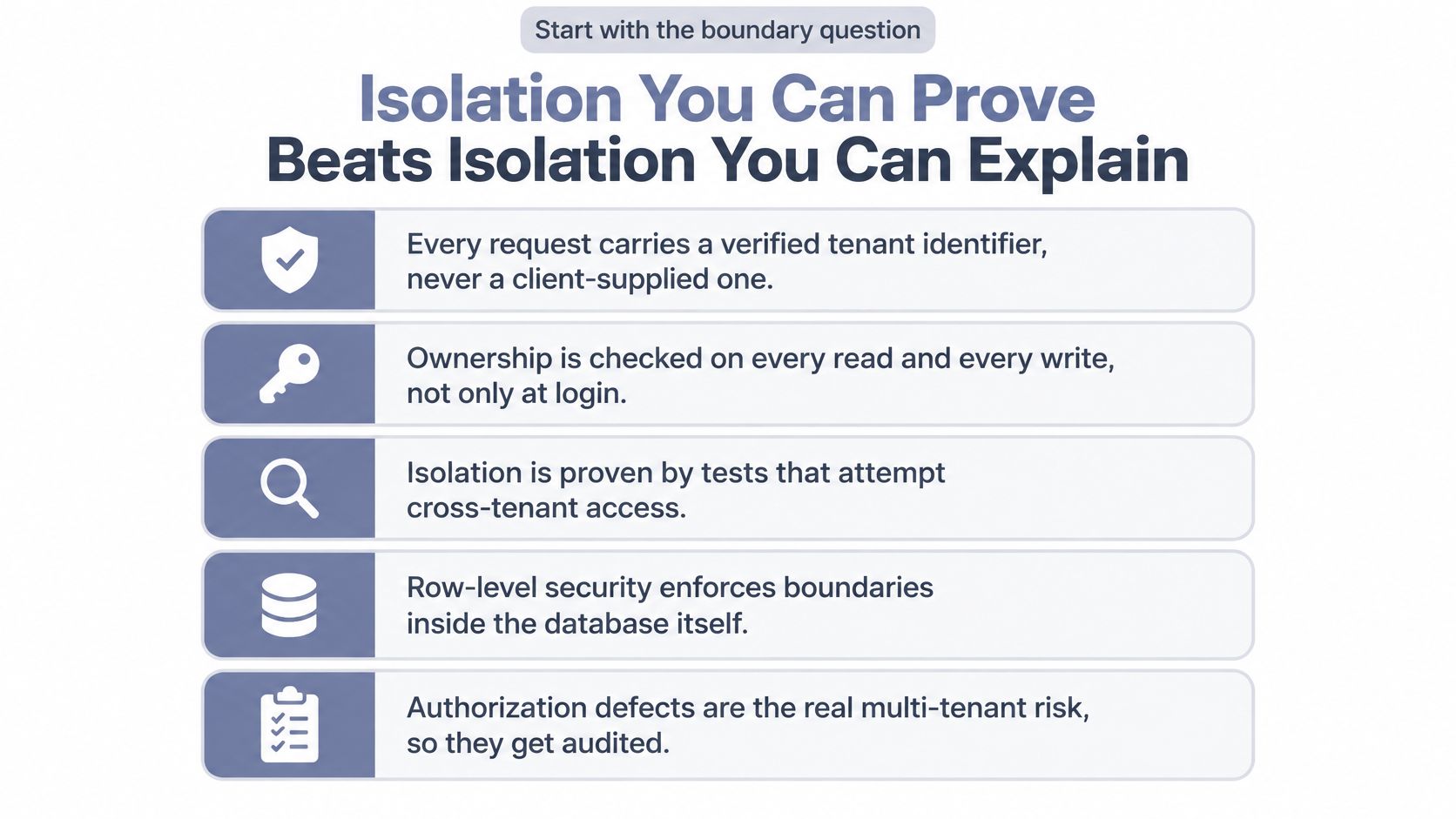
What rejects a request for another customer's resource? That's the boundary question. Authentication alone doesn't answer it.
Trusting a client-supplied tenant identifier or skipping server-side object ownership checks can defeat logical separation. Dedicated deployments still face compromised credentials, privileged administrators, insecure APIs, and cloud misconfiguration, distinctions discussed in Safeguard's SaaS data-isolation guidance.
Use the checklist as a starting point, then demand executable evidence for each claim.
Isolation evidence to demand from each tenancy model
| Control to prove | Single tenant evidence | Multi tenant evidence |
|---|---|---|
| Tenant context on every request | Role and object-ownership checks inside the customer environment | Identifier-injection and substitution tests rejected by server-side ownership checks |
| Cross-tenant access test | Lateral-movement attempts through shared hosting or management services | Production-tenant attack evidence covering authentication, data access, permissions, and sessions |
| Role and connection path used by the application | Tests using the production request role rather than administrator access | Tests using deployed roles and pooling, including alternating customer requests |
| Key and credential separation | Environment-specific keys and privileged-administrator review | Customer-specific keys and audit trails where required |
| Report and export boundaries | Exports demonstrably exclude other customers' information | Reports, exports, and attachments remain tenant-scoped |
| Noisy neighbor controls | Availability and resource-exhaustion results | Disproportionate-load tests demonstrate throttling, quotas, and tiering |
| Administrator and support access review | Privileged-path and credential-compromise tests | Support permissions reject unauthorized customer switching and record authorized elevation |
Run the tests through real access paths
Begin with a valid authenticated request. Inject another tenant's token, substitute its tenant identifier, and attempt reads and writes against known resource identifiers. AWS's SaaS testing guidance recommends these cross-boundary attempts for both application and management roles.
For applicable assessments, FedRAMP penetration-test guidance calls for two full production customer tenants, covering authentication, data access, user permissions, and sessions. It provides a temporary-tenant route when a suitable second customer environment isn't available, with conditions for using a production-to-development arrangement.
Repeat database checks through the deployed application role and connection path. OWASP's multi-tenant security guidance emphasizes production-equivalent pooling and alternating tenant requests to expose retained context; for protected tables, demonstrate both denied cross-tenant operations and successful same-tenant operations.
Then test operational separation. AWS's reliability guidance recommends generating disproportionate load from a subset of tenants to check scaling, throttling, and tiering. An authorization pass doesn't establish availability isolation.
Package the proof, not just the verdict
Dedicated environments need equivalent scrutiny of management-plane lateral movement, administrator credential compromise, and report exports. For identity design discussions, Capgo's guide to RBAC and SSO for mobile apps provides useful access-management context, but role definitions still need negative tests.
Attach the preconditions, sanitized request and response, observed result, and mapped control reference to each finding. Record the role and environment so a reviewer can reproduce the result without receiving live credentials.
For execution-boundary planning, our penetration-testing infrastructure overview belongs alongside the engagement's evidence requirements, not in place of them.
Dedicated infrastructure narrows the blast radius. It doesn't replace a test proving that the boundary holds.
Performance Predictability and the Noisy Neighbor Problem
A scanner can finish its work quickly and still miss the delivery window because it spent most of the engagement waiting to start. Pentest providers need to measure queueing separately from execution.
Dedicated compute, database resources, connection pools, and workload queues remove customer-to-customer contention at those layers. They don't eliminate target-side throttling, network delays, or shared cloud dependencies. Shared execution improves utilization, but the provider must actively constrain competing workloads.
The Cloud Analytics Benchmark found materially worse latency in shared-cluster execution than in comparable dedicated arrangements despite similar compute resources and costs, with queueing a major contributor. That's a warning against treating aggregate throughput as a delivery guarantee.
Measure the customer journey under contention
Define per-customer service-level objectives for scan-start latency, concurrent-agent capacity, report-generation time, and evidence-upload throughput. Separate platform-controlled time from time spent waiting on the authorized target.
Use the following measurement sequence:
- Instrument each stage. Record submission, admission, execution start, completion, and export completion. Otherwise, delivery staff can't explain where an engagement stalled.
- Vary the workload mix. Run reconnaissance, tool execution, target-environment connections, and report exports together. Include long-running jobs alongside lightweight recurring assessments.
- Measure the latency distribution. Capture median and tail latency, including p50, p95, and p99, rather than relying on an average.
- Exercise overload behavior. Increase competing demand until admission controls act. Confirm that delayed work receives an explicit status instead of accumulating.
Preserve customer-scoped telemetry. A healthy platform average can conceal a customer whose exports repeatedly wait behind another customer's evidence uploads.
Control admission before promising turnaround
Apply per-tenant concurrency ceilings, fair scheduling, isolated credentials and queues, and admission control. Tenant-scoped authorization and monitoring must remain effective during load spikes, not only during idle functional tests.
Don't let reconnaissance consume every worker while reports wait for capacity. Reserve resources for the stages that block client delivery, and document what happens when a customer exceeds its agreed concurrency.
For urgent engagements, reserved execution is easier to schedule against a deadline. Pooled execution suits routine workloads only when the scheduler's behavior is demonstrated under competing demand.
A p95 measured on an empty platform tells you nothing about a busy audit deadline.
Put the tested workload conditions beside any timing commitment. Without those conditions, a statement of work contains an aspiration rather than an operational promise.
What the Difference Costs Over Five Years
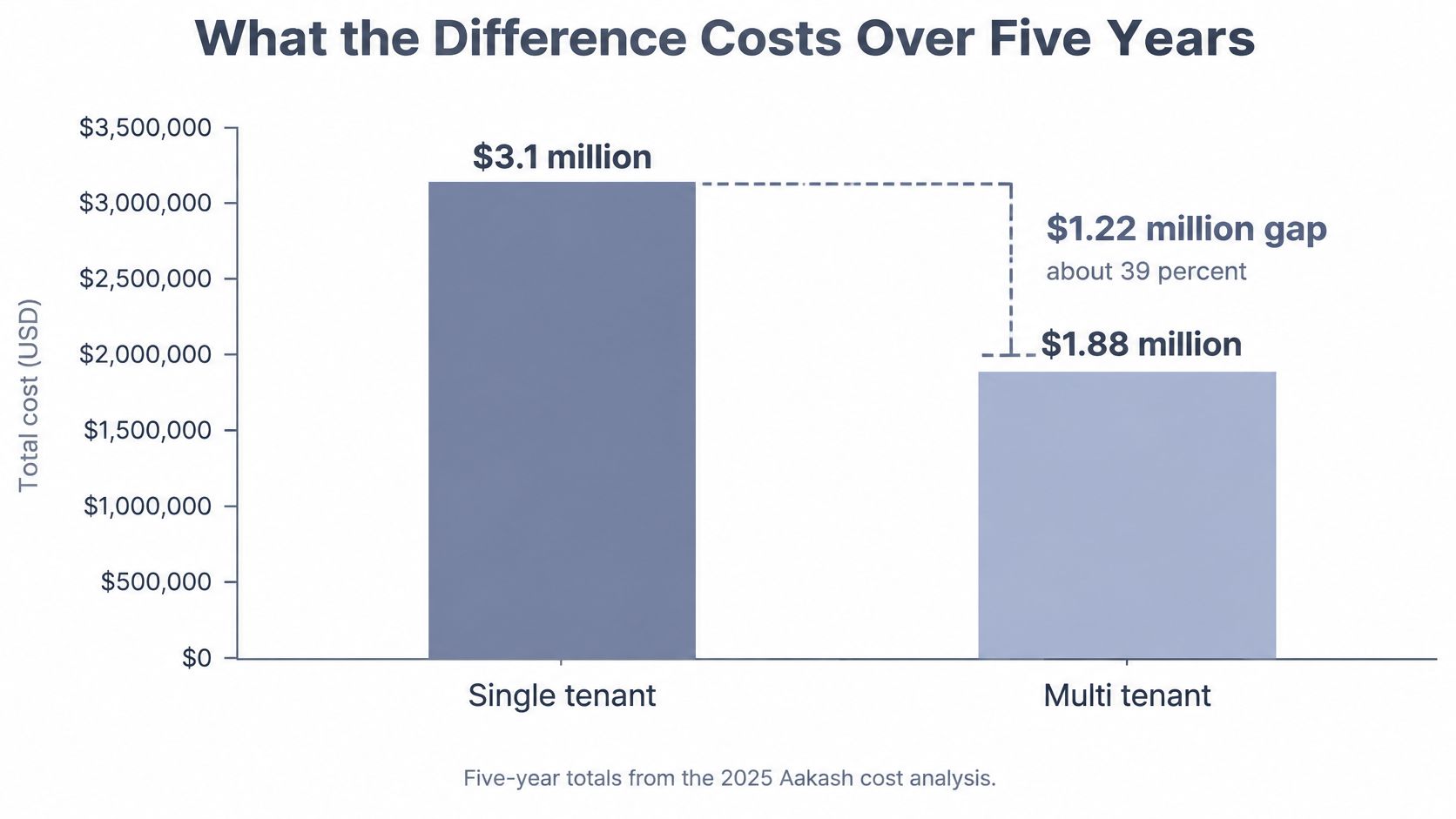
Tenancy does not set the price by itself. It changes which costs need to be covered, and whether utilization or reserved capacity drives the margin. One architecture model estimates five-year operating costs of $3.1 million for single tenant and $1.88 million for multi tenant, a gap of $1.22 million, about 39% of the single-tenant total. The five-year cost analysis provides those modeled figures, not a quote for operating a pentest practice.
Use the comparison to examine cost structure. Actual costs depend on reserved capacity, automation, client requirements, and the work required to demonstrate customer boundaries.
The chart shows the modeled totals.
Put delivery labor into the calculation
Server bills are only one part of delivery cost. For each model, account for:
- Dedicated infrastructure: Customer-specific execution environments, storage, and supporting services.
- Idle peak capacity: Resources held for an audit window but unused between engagements.
- Repeated operations: Patch validation, backup checks, monitoring, and recovery exercises across environments.
- Assessment effort: Time spent documenting boundaries and preparing evidence. Separate environments do not automatically mean separate audits, but evidence work still takes time.
- Correlated disruption: The risk that a shared dependency interrupts several customer deliveries at once.
The cloud cost insights from Server Scheduler offer a useful framework for a total-cost worksheet. Include analyst time spent rebuilding exports, investigating delays, and explaining disputed evidence, alongside infrastructure consumption.
Architecture doesn't dictate the billing unit
A dedicated environment may lead a provider to charge per environment or seat to recover fixed costs. Shared infrastructure may support usage-based pricing. Neither billing approach is determined by tenancy alone.
At ThreatExploit AI, partner pricing is charged per pentest run, not per seat, with volume tiers that lower the cost per test as testing volume increases. Dedicated execution can therefore coexist with usage-based pricing. A managed security service provider pricing guide can help connect delivery costs to the service being sold.
Set prices around authorized scope, review obligations, deliverables, and delivery conditions. Avoid passing an unexplained hosting surcharge to the customer. For modest monthly volume and demanding regulated work, compare the cost of reserved capacity with the revenue at risk if delivery is late or evidence is disputed. Multi-tenancy can improve margins when utilization is high; dedicated capacity can make reservations easier to justify. Either model still depends on disciplined operations.
Which Model Fits Your Engagements
Choose tenancy by the evidence each engagement must produce, not by the architecture label in a sales deck. A model fits when you can demonstrate its boundaries under the tests and operating conditions the client cares about.
Engagement scenarios and the tenancy model that fits
| Engagement scenario | Model that fits | Why it fits |
|---|---|---|
| Regulated enterprise assessment under PCI-DSS, SOC 2, or FedRAMP | Dedicated execution | A defined execution boundary makes it easier to show where test activity and artifacts are separated. |
| Pentest of a client's own multi-tenant SaaS product | Dedicated execution against representative production tenants | Test the authorized cross-tenant paths between distinct customer contexts. Dedicated tooling separates engagement artifacts, but does not prove the target's tenant isolation. |
| MSP or telecom delivering tests under its own brand | Dedicated execution servers with centralized management | Teams can coordinate work centrally while keeping execution and evidence scoped to each customer. See this guide to managing pentest engagements at scale for MSSPs. |
| Burst capacity before an audit deadline | Pooled capacity, if demonstrated headroom meets the schedule | Shared capacity may accept work without provisioning another environment, but require evidence that queueing will not disrupt testing or review. |
| Financial-services clients with DORA obligations | A model with documented third-party risk controls and a tested exit path | The relevant question is whether the provider can document exit arrangements and recover customer work. |
| Client requiring data residency in the EU, US, or Asia | Regional execution with verified storage and processing locations | Execution location alone does not establish where evidence, backups, and exports are handled. |
Match execution to the work
High-volume, recurring SMB assessments may suit pooled execution when tests are standardized and schedules tolerate controlled queueing. For deadline-critical enterprise work, dedicated capacity can make it easier to plan execution around evidence collection and review. In either case, ask for cross-tenant test evidence relevant to the service boundary, rather than accepting an architecture description as proof.
Testing a customer's multi-tenant SaaS product calls for representative tenant contexts inside the target. Dedicated tooling does not create those accounts or authorize testing between them. Define the permitted source and destination tenant contexts in the scope, then ensure the test evidence shows which contexts were exercised.
MSPs and telecoms need to coordinate work across customers without confusing their evidence. ThreatExploit AI lets partners create and manage multiple dedicated pentest servers, with penetration tests run on dedicated resources rather than shared execution infrastructure. Internal and external tests can be run from one portal, and the partner team can run more tests for more clients without increasing staff.
Include failure and departure
An outage makes recovery, not the architecture label, the practical test. Fluent Support's outage coverage discusses disruption during the October 20, 2025 AWS US-East-1 outage. For financial-sector clients subject to DORA, document exit arrangements for critical ICT providers and check whether customers can recover their work when a shared dependency fails.
Test customer-level restoration, regional failover, recovery objectives, and usable JSON or PDF exports. A hybrid design improves resilience only when recovery exercises include shared identity, scheduling, and storage dependencies.
ThreatExploit AI's dedicated pentest servers can be deployed in America, Europe, and Asia. Choosing a regional server does not, by itself, prove that reporting, backups, and support workflows meet residency requirements.
Authorization remains tied to the defined target and scope, regardless of tenancy. Customers must confirm they are authorized to test specified targets, and comply with third-party testing policies and obtain any required permissions before testing third-party infrastructure or services.
Decide Before You Sign the Next Client Contract
A procurement answer should be specific enough to become an acceptance criterion. Replace architecture adjectives with artifacts that the delivery team can inspect before promising a client anything.
Put the boundary into the contract
Use these questions when evaluating the platform and documenting the engagement:
- Where does this client's evidence live? Identify the execution host, storage boundary, reporting database, and administrative access path. A dedicated worker doesn't answer where its screenshots eventually land.
- Can the provider attach a recent cross-boundary test? Require the sanitized request, response, tested role, environment, and mapped control. A pass badge without reproducible evidence isn't enough.
- What happens at this client's peak volume? Request tail-latency measurements for scan starts and report generation under competing workloads, with the workload conditions attached.
- What is the exit path? Establish how findings, reports, configurations, and customer-owned credentials are returned securely. Define revocation and deletion separately from export.
At ThreatExploit AI, penetration tests run on dedicated resources, not shared or multi-tenant execution infrastructure, and customers can create and manage multiple dedicated pentest servers. Those facts identify the execution model; they don't remove the need to document evidence handling and test relevant access paths.
Reject any answer that presents a dedicated server as proof that all boundaries hold. For a multi-tenant target, preserve the token-substitution, representative-tenant, and production-role checks in scope. For dedicated delivery infrastructure, retain management-plane and export-boundary checks.
Run a comparison before assigning client tiers
This month, run the same authorized scope on pooled infrastructure and on a dedicated execution server, using separate approved arrangements where necessary. Keep the target configuration, testing permissions, tool settings, and reporting requirements consistent enough to make the comparison useful.
Compare tail latency, queue time, report completeness, and the isolation evidence package. Record differences that affect the client, such as a missed evidence window or an export that requires manual cleanup, rather than declaring a winner from infrastructure utilization alone.
Map client tiers to execution models only after the results show a defensible difference. The contract should promise what your team can demonstrate and operate, not what an architecture label implies.
ThreatExploit AI offers automated penetration testing on dedicated resources, with multiple dedicated pentest servers available for customer work and evidence-backed reporting. Visit ThreatExploit AI and choose Get a Free Account or Request a Demo to evaluate the execution model against your next authorized engagement's isolation and delivery requirements.