
API security incidents climbed to 87%, yet only 23% of organizations know which APIs return sensitive data, and just 16% fully integrate API security testing into development pipelines, according to Akamai's 2026 API Security Study. That gap changes the pentest question. The problem often isn't whether a scanner can send injection payloads. It's whether the tester has found the right APIs, established the right identities, and verified what each role can do to every object, property, and business workflow.
For MSSPs and penetration testing teams, effective security testing of APIs is an evidence problem built on visibility and authorization. A running API can reject an unauthenticated request and still expose another tenant's records to a legitimate user. It can enforce a schema and still allow a privileged operation through an overlooked HTTP method. The practical method below treats API testing as a full penetration testing discipline, from discovery and scoping through exploitation, verification, reporting, and continuous validation.
Table of Contents
- Why API Security Testing Matters Now for Pentesters
- Planning Scoping and Discovering Every API You Own
- Testing Authentication Authorization and Access Control
- Input Validation Injection Fuzzing and Abuse Testing
- Automating Evidence Collection and CI/CD Integration
- Reporting Compliance Mapping and Tips for Lasting Results
Why API Security Testing Matters Now for Pentesters
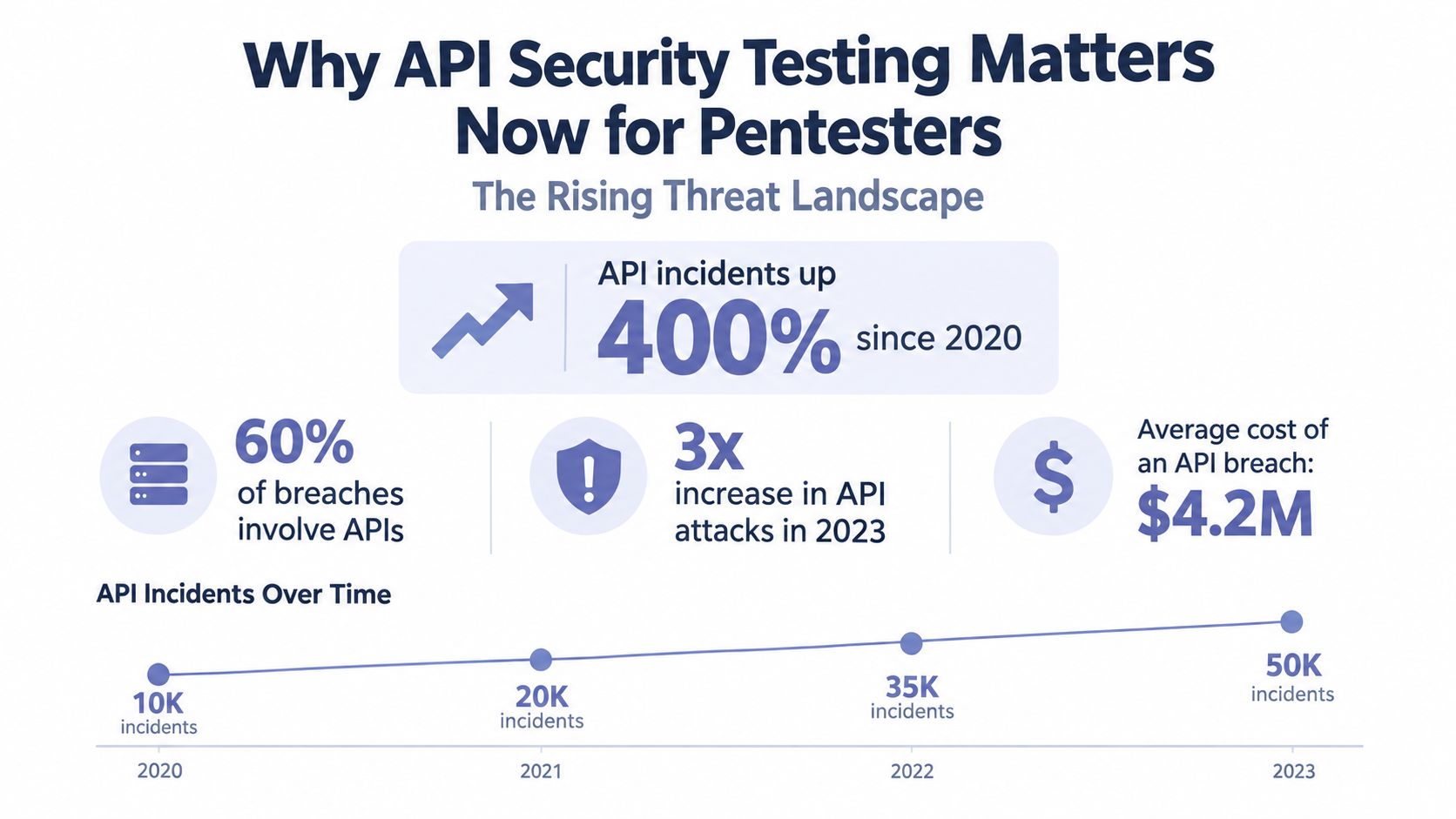
Akamai recorded 108 billion API attacks between January 2023 and June 2024, while web application and API attacks together rose 49% between Q1 2023 and Q1 2024. The 2024 API Security Impact Report also says 84% of organizations reported API security incidents in 2024. For pentesters, those figures describe a practical problem: APIs connect mobile clients, single-page applications, microservices, identity providers, payment systems, and third-party platforms, while much of that exposure remains invisible to users and documentation.
Wallarm's 2024 API ThreatStats reporting describes a 30.15% rise in API-related CVEs in 2024. Its Q3 2024 update reported that API vulnerabilities jumped 21% quarter over quarter, with an average CVSS score of 7, and 32% tied to cloud-native software. Carnegie Mellon University's Software Engineering Institute separately examined 11 common vulnerabilities and 3 related risks. Together, these findings reinforce that API risk extends beyond injection flaws.
OWASP has expanded the tester's remit
OWASP updated its API Security Top 10 in 2023, using issues reported between 2019 and 2022, as documented in the OWASP API Security project. Broken Object Level Authorization remains at the top, alongside Broken Object Property Level Authorization, Unrestricted Resource Consumption, SSRF, Unrestricted Access to Sensitive Business Flows, and Unsafe Consumption of APIs.
That matters because authorization failures often survive basic scanner checks. A request can pass authentication while exposing another tenant's object, allowing a role to change a protected property, or reaching a sensitive workflow through an overlooked method. Teams conducting BUNCH red teaming for AI safety face a related testing requirement: application behavior must be assessed in context rather than inferred from a feature list.
Pentester's rule: Treat the API inventory and role model as test infrastructure. If either is incomplete, the scan result isn't a coverage statement.
Start with attack surface mapping, then test with authenticated identities and explicit role comparisons. The evidence should show what was discovered, which identities were used, which routes and methods were exercised, and how each confirmed issue was reproduced. That record is what distinguishes a useful API assessment from a collection of scanner alerts.
Planning Scoping and Discovering Every API You Own
The first failure in many API engagements happens before the first request is sent. The client supplies an OpenAPI document, the tester imports it, and everyone assumes it represents production. It may omit an older version, an internal route exposed through a mobile client, a GraphQL endpoint, or an API consumed by a partner. Attackers don't limit themselves to the documentation set, so a pentest shouldn't either.
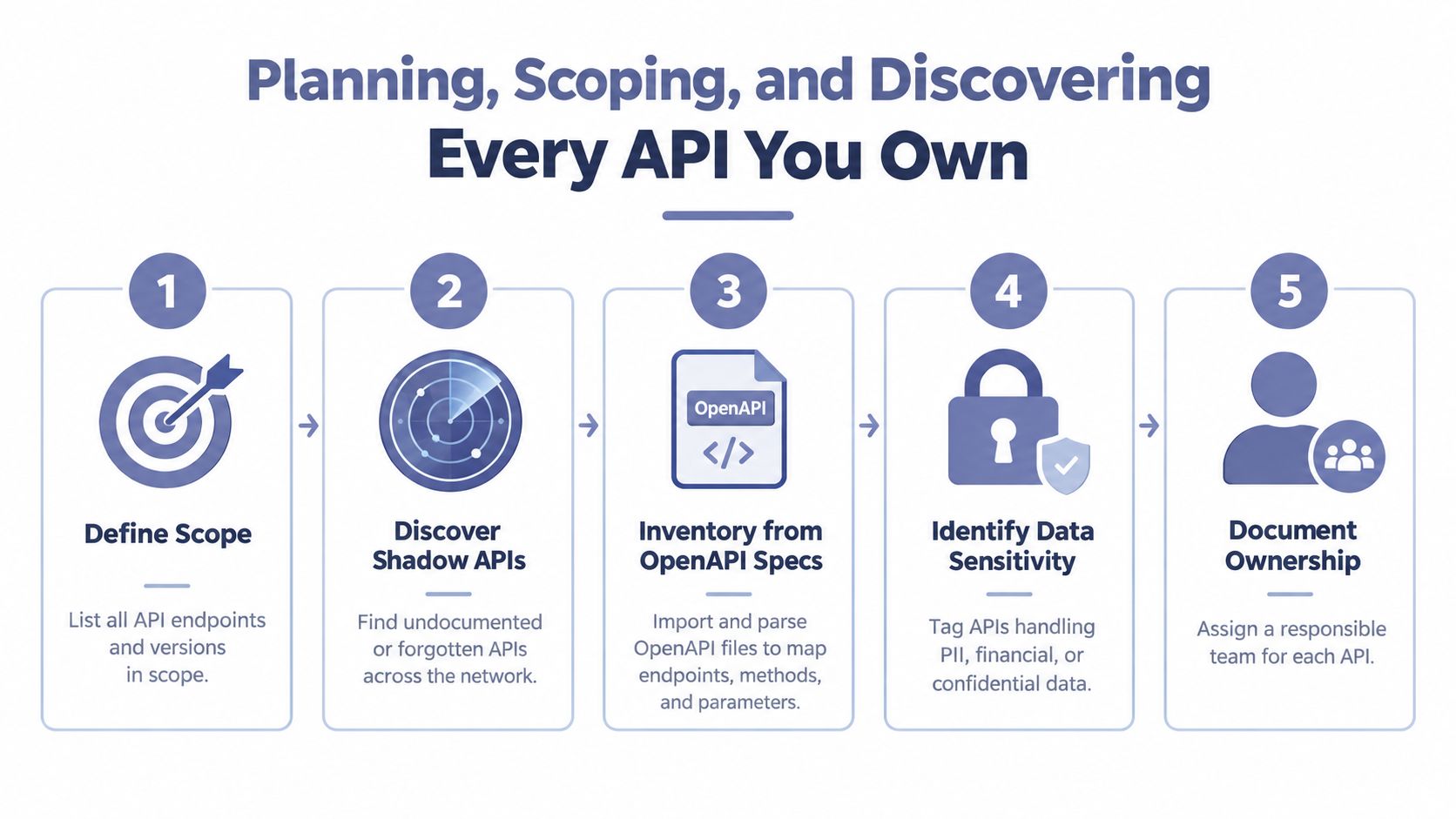
Start by defining scope in terms of assets, environments, identities, data and permitted actions. Record production, staging, development and partner-facing surfaces separately. Confirm whether the engagement includes REST, GraphQL, gRPC, SOAP, webhooks, internal service-to-service calls, and APIs consumed from third parties. For each asset, capture the owner, deployment context, authentication method, version status, data sensitivity and testing restrictions.
Build the inventory from multiple sources
No single discovery source is sufficient. Compare the client's declared inventory against:
- OpenAPI and Swagger files: Parse paths, methods, parameters, schemas, security definitions and deprecated versions.
- JavaScript bundles: Extract route names, API base paths, feature flags and client-side calls that documentation missed.
- Mobile applications: Capture traffic from authenticated workflows and identify endpoints that aren't used by the browser.
- Proxy and gateway logs: Review observed routes, methods, status codes, consumer identities and unusual hosts.
- Cloud and service registries: Reconcile deployed services, ingress routes, API gateways and internal discovery records.
- Third-party integrations: Document what the application trusts, sends, receives and stores from external APIs.
Mark every route as documented, observed, both, or unexplained. An unexplained route isn't automatically vulnerable, but it deserves ownership and an explicit decision. Deprecated versions should remain visible until the owner proves they're removed or inaccessible.
Prioritize data and workflow exposure
Inventory alone doesn't tell you where to spend manual time. Trace sensitive data flows through read, create, update and delete operations. Tag endpoints that handle personal information, financial records, credentials, tokens, confidential business data, administrative functions or irreversible actions. Then identify workflows that have economic or operational value, such as account recovery, refunds, coupon redemption, provisioning, approval and export functions.
Create test identities that represent real boundaries. At minimum, use separate ordinary users, privileged users, administrators and users from different tenants where the application supports tenancy. Keep accounts and data synthetic whenever possible, and agree on rate limits and destructive-action controls before testing.
Practical rule: A test account isn't just a credential. It's a controlled lens for proving whether the API respects ownership, tenancy and privilege boundaries.
End scoping with a coverage register. For each route, record whether discovery is complete, whether authentication is configured, which roles can exercise it, which object identifiers it accepts, whether each HTTP method was tested, and whether response properties were reviewed. That register gives the engagement a defensible answer to the question scanners rarely answer well, which parts of the API were tested.
Testing Authentication Authorization and Access Control
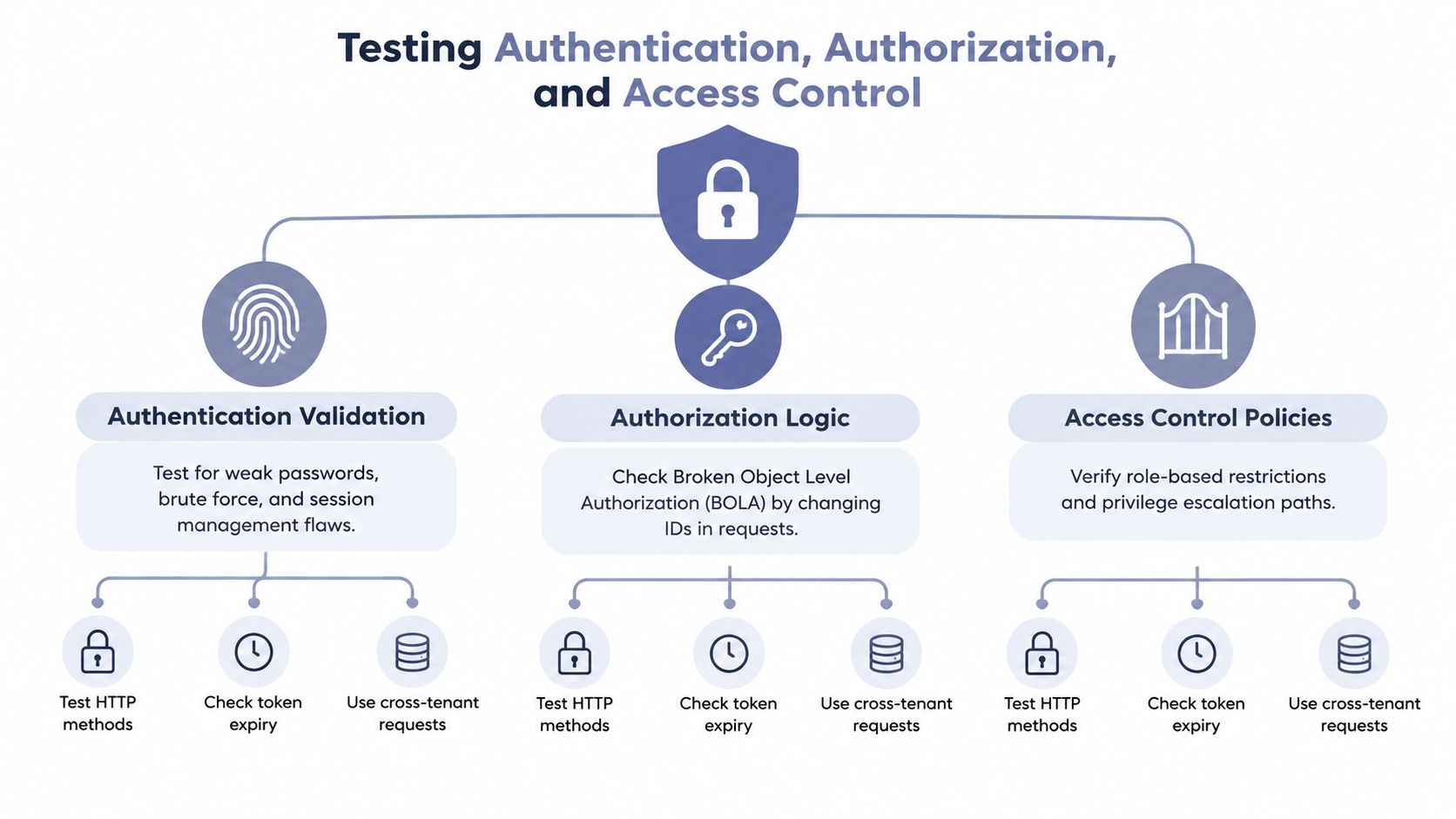
Authentication proves who is making a request. Authorization proves what that identity may access. API penetration tests often spend too much time on the first question because an endpoint that rejects a missing token looks reassuring. The higher-value work starts after a valid login.
Begin with the authentication lifecycle. Test missing, malformed, expired, revoked and altered tokens, along with alternate authentication paths such as refresh endpoints, mobile routes and administrative interfaces. Check whether the API applies the same identity rules across versions and methods. A token that works after logout, remains accepted after expiry, or is honored by an endpoint that uses a different validation path can turn a narrow flaw into account compromise.
Prove object-level boundaries
For BOLA testing, capture a valid request made by User A. Identify every object reference, including IDs in paths, query strings, JSON bodies, headers and nested objects. Replace User A's identifier with an object belonging to User B, then compare status codes, response bodies, headers and side effects. Repeat across tenants, not just users in the same account.
Don't stop at a single GET request. Replay the object mutation against GET, POST, PATCH, PUT and DELETE where the route supports them. A read operation may enforce ownership while an update or delete path trusts the submitted identifier. Preserve the original request and the modified request so the report demonstrates the authorization decision, not merely an unexpected response.
Test properties and functions separately
Broken Object Property Level Authorization requires a different check. Review returned fields for data the requesting role doesn't need, then attempt to submit or modify restricted properties. A user may be allowed to update a profile but not an approval state, ownership field, role flag or account control. Compare the server's accepted fields with the documented contract and with the minimum data required by the client.
Broken Function Level Authorization is about actions rather than records. Take a low-privilege session and call administrative routes, export functions, moderation actions and configuration endpoints directly. Change the HTTP method, route version and content type where relevant. A hidden button isn't an access control, and a client-side role check doesn't protect a route from direct invocation.
GraphQL needs separate attention because one request can traverse many objects and fields. Test field-level authorization, resolver behavior, introspection exposure and nested relationships using users from different roles and tenants. For gRPC, use service definitions to enumerate methods and test whether authorization is enforced consistently across each procedure.
Evidence standard: A strong finding contains the identity, request, object or function targeted, expected authorization result, actual result, response excerpt and a safe reproduction path.
Use a controlled credential workflow rather than sharing secrets in ad hoc notes. Teams that need a repeatable test integration can review how to generate an API key, while API key management guidance helps keep test credentials scoped, rotated and attributable.
The broader evidence supports this prioritization. A 2026 analysis covering 1.4 million test executions across 2,616 organizations found that 38% of security failures were authentication and authorization issues, while fewer than 30% of suites verified that authenticated requests were correctly scoped, according to Kusho's State of API Security report. Authentication checks are necessary, but they don't substitute for cross-user, cross-tenant and cross-function verification.
Input Validation Injection Fuzzing and Abuse Testing
Once access boundaries are mapped, test how the API handles hostile data and hostile behavior. Schema validation can reject an incorrectly typed field while a backend component remains vulnerable to SQL, NoSQL, command, template or expression injection. The tester should mutate inputs according to the processing path, not spray the same payload across every parameter and call the result finished.
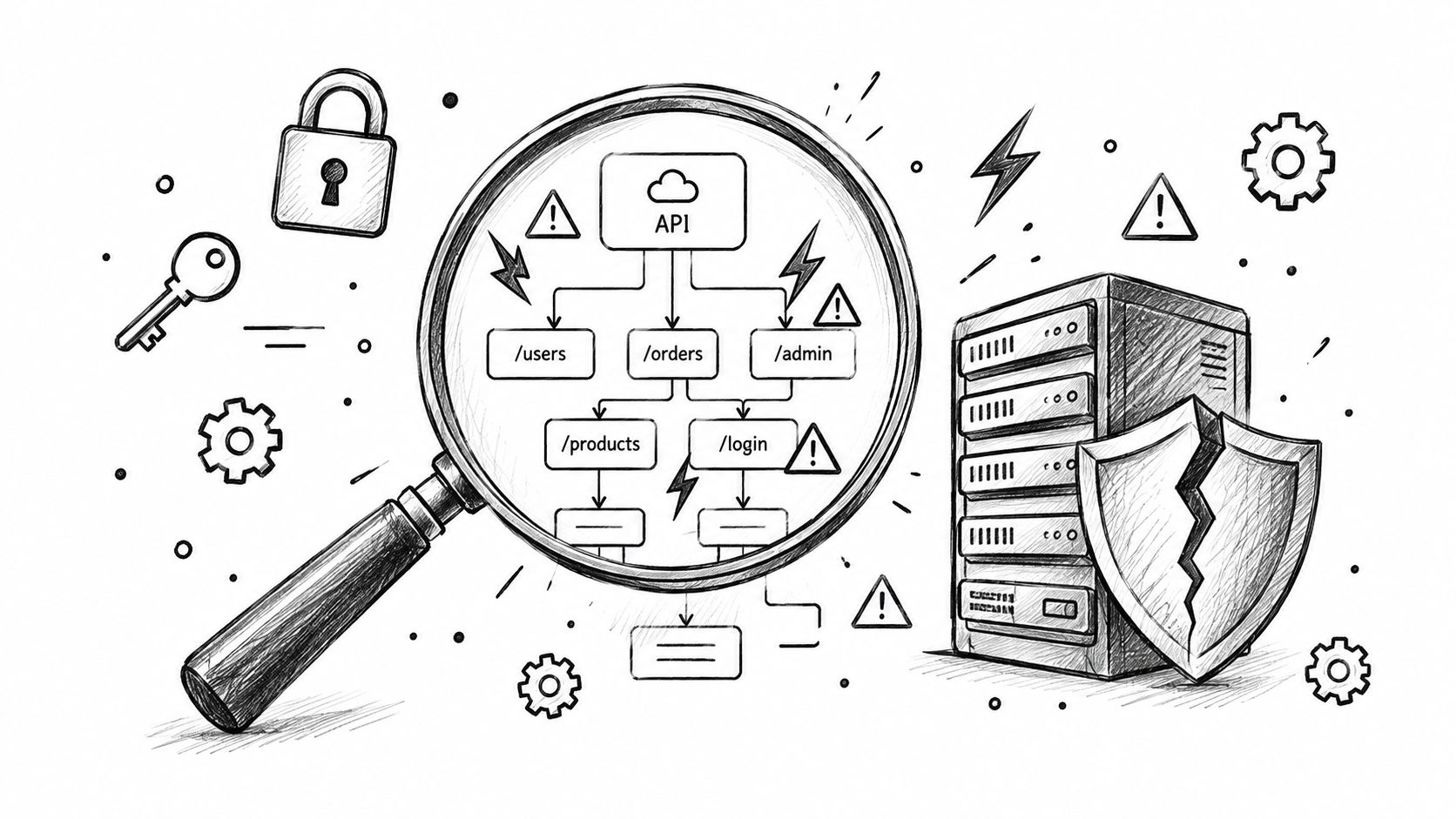
Start with the contract. For each parameter, identify its declared type, length expectations, accepted values, nesting, encoding and downstream use. Mutate one variable at a time with boundary values, unexpected types, nulls, arrays where scalars are expected, duplicate keys, malformed JSON and oversized structures. Compare normal and mutated responses for error disclosures, authorization changes, status anomalies, timing shifts and unintended state changes.
Match payloads to the backend
Injection testing should follow data flow. Database-facing parameters deserve SQL and NoSQL-oriented mutations. Shell or system integration fields need command-separator and argument-handling tests in a safe environment. Template, expression and parser inputs need syntax-aware probes. XML or file-processing routes require parser and external-reference checks that respect engagement controls.
GraphQL adds query structure to the attack surface. Test nested selections, aliases, repeated fields, unexpected variables and introspection behavior. In gRPC, mutate protobuf fields, enum values, metadata and method parameters instead of treating the service like a JSON REST endpoint. OWASP's API Security Testing Framework maps to all 10 categories of the 2023 Top 10 and implements 16 test cases, with coverage for REST, GraphQL, gRPC, mTLS, LLM and general injection. That structure is a useful control against generic scanner coverage claims.
A scanner can generate volume, but it won't understand every workflow consequence. Manually test sequences such as creating an object, changing its ownership, submitting it for approval, cancelling it, and attempting the same operation again. Look for replay, order-of-operations, coupon reuse, quantity manipulation, export abuse and actions that should be mutually exclusive.
Abuse testing asks a different question: not only whether one request is accepted, but whether a user can repeat, combine or reorder valid requests to defeat a business rule.
Check resource consumption without causing harm
Test rate limiting and resource controls with agreed thresholds. Target login, search, password reset, export, report generation and expensive filter operations. Vary identity, token, source context and request shape to determine whether controls apply per user, per credential, per route or only at a superficial network layer. Record response behavior and recovery, and avoid turning a controlled assessment into a denial-of-service event.
The following visual walkthrough can help teams align request mutation, endpoint review and evidence capture with a practical API security audit workflow.
Automating Evidence Collection and CI/CD Integration
Automation is valuable when it preserves pentest judgment instead of hiding uncertainty behind a dashboard. A service provider can orchestrate reconnaissance, specification import, authenticated replay, fuzzing, validation and report generation, but each stage needs a measurable handoff. Discovery should produce routes. Authentication should produce working role contexts. Exploitation should produce candidate findings. Verification should decide whether those findings are real.
A practical MSSP pipeline separates breadth from proof:
- Discover: Collect OpenAPI definitions, proxy traffic, client routes and service metadata.
- Test: Run route, method, authentication, authorization, injection and abuse cases with controlled identities.
- Verify: Reissue successful attacks, compare control requests, confirm impact and remove duplicates.
- Capture: Store request and response pairs, screenshots, timestamps, role context and remediation notes.
- Deliver: Export technical evidence for engineers and an executive summary for decision-makers.
The OWASP Benchmark project offers a useful model for evaluating tool quality. It uses 21,041 total test cases and 2,740 language-specific cases to measure accuracy, coverage and speed. API teams don't need to reproduce that benchmark, but they should maintain known-good fixtures and score true positives, false positives and missed authorization cases before trusting a scanner in production-like assessments.
Fit testing into delivery
Run fast, targeted checks on pull requests when an API contract or authorization path changes. Schedule deeper authenticated assessments against stable environments, and trigger focused regression tests after remediation. A build should fail for issues that the team has defined as release-blocking, while lower-priority findings remain visible with ownership and due dates.
The evidence model matters as much as the execution model. A finding without the original request, altered identifier, role used and observed response forces the client to reproduce the pentest before fixing it. Store redacted evidence, link each result to an endpoint and test case, and keep a clean distinction between confirmed vulnerabilities, environmental observations and unverified leads.
Providers evaluating broader security automation with PushOps should apply the same standard to API workflows. ThreatExploit AI is one option for providers that need automated penetration testing across REST and GraphQL targets, tool orchestration, verification and PDF or JSON reporting. Its relevance here is operational, the platform can place API testing inside a repeatable reconnaissance-to-reporting workflow rather than treating a scan as the finished engagement.
For agile delivery teams, continuous integration in agile is most useful when security checks are attached to ownership, change context and remediation workflow. Automation doesn't remove the need for manual authorization testing. It gives the pentester more time to investigate the edge cases scanners are least likely to understand.
Reporting Compliance Mapping and Tips for Lasting Results
A client-ready API pentest report must show more than a severity label. State the affected route, required role, object or property involved, attack sequence, observed response, business consequence and remediation direction. Include sanitized request and response evidence, explain the access boundary that failed, and identify whether the issue affects one tenant, multiple tenants, privileged functions or sensitive data flows.
Map findings to the client's obligations without turning compliance into a substitute for risk analysis. Authorization failures may support control discussions under HIPAA, SOC 2, PCI-DSS, ISO 27001, CMMC, GLBA or GDPR, but the technical finding still needs its own exploitability and impact assessment. A compliance cross-reference helps auditors and executives locate the issue. It doesn't prove that the underlying API is safe.
Prioritize remediation using the facts established during testing:
- Exploitability: Can a normal authenticated user reproduce it, or does exploitation require privileged access?
- Scope: Does the flaw cross objects, roles, tenants or service boundaries?
- Data and action impact: Does it expose records, alter properties, trigger privileged functions or abuse a sensitive workflow?
- Verification quality: Can engineering reproduce the result from the evidence without guesswork?
- Regression control: Is there a test that will fail if the authorization or validation rule breaks again?
Common delivery failures are predictable. Testers import one specification and call discovery complete. They check bearer-token rejection but skip role switching. They test GET and overlook PATCH, PUT or DELETE. They run a DAST pass, report raw findings and never prove which issues are exploitable. They also close a retest after a status-code change without confirming that the unauthorized data or action is blocked.
The lasting fix is a coverage register tied to recurring tests, ownership and release changes. Re-run authorization permutations when roles, tenancy, schemas, workflows or API versions change. Keep reports evidence-backed and compliance-mapped, but make the primary outcome practical: fewer blind spots, fewer unverified findings and clearer remediation work for the client.
ThreatExploit AI gives MSSPs and security consultancies a way to automate reconnaissance, exploitation, verification and reporting for REST and GraphQL API assessments, with structured evidence and compliance-mapped PDF or JSON outputs. Visit ThreatExploit AI to evaluate how its API testing workflow can support repeatable penetration testing without replacing the manual authorization analysis that production APIs require.