
The audit is close, and the evidence folder looks complete. Policies are approved, screenshots are attached, and the control matrix is populated. Then someone asks the question that changes the meeting: “Can you prove the control worked against a realistic attack?”
That question exposes the gap between paperwork and protection. A policy can require multifactor authentication, privileged access reviews, or centralized logging while the underlying implementation remains incomplete, narrowly scoped, or easy to bypass. A practical security control assessment closes that gap by combining compliance evidence with functional testing, configuration review, and attack simulation.
Table of Contents
- Defining Security Control Assessment in Modern Cybersecurity
- Evaluating Management Operational and Technical Controls
- Navigating Compliance Frameworks and Penetration Testing Mandates
- Executing the Four-Phase Assessment Workflow
- The Shift to Continuous Controls Monitoring and Automation
- Targeting High-Risk Control Failures and Common Pitfalls
- Scaling Assessment Delivery with ThreatExploit AI
Defining Security Control Assessment in Modern Cybersecurity
NIST formally defines security control assessment as the testing and evaluation of management, operational, and technical controls to determine whether they are implemented correctly, operating as intended, and producing the desired outcome for security requirements. The definition matters because it tests more than the existence of a policy. It asks whether the control produces the protection the organization expects, as described in the NIST security control assessment definition.
That makes assessment distinct from several activities that teams often combine under the word “review.” Risk analysis identifies and evaluates risk. Incident response handles an active or suspected event. An audit examines whether requirements and evidence are satisfied. Assessment makes an evidence-based judgment about control performance, using artifacts such as policies, procedures, interviews, system configurations, logs, functional tests, and other documentation.
A security control assessment should answer four practical questions:
- What is the control supposed to do? Define the security objective and intended behavior.
- Where does it apply? Identify the systems, users, applications, cloud accounts, and processes in scope.
- What evidence demonstrates operation? Select artifacts that show the control is active, not merely approved.
- What result counts as effective? Establish a reproducible pass or fail condition before testing begins.
A security risk assessment can identify excessive privilege as a concern. A control assessment tests whether privileged access is constrained, monitored, reviewed, and resistant to practical attack paths. A penetration test can demonstrate that an exposed application allows privilege escalation. The strongest program connects these activities without confusing their purposes. For additional context on how risk evaluation supports broader security planning, see this security risk assessment resource.
Practical rule: Treat every control as a hypothesis about protection. The assessment should test whether the expected protection exists in the environment that attackers can reach.
This distinction separates cosmetic compliance from risk reduction. A document may describe quarterly access reviews, but evidence should show completed reviews, identified exceptions, approvals, and remediation. A cloud baseline may require secure storage settings, but assessors should inspect the deployed configuration and test whether unauthorized access remains possible.
NIST's risk management guidance connects assessment to control selection and implementation before authorization to operate. The assessor therefore evaluates both design intent and operational execution. A control that exists on paper but fails under testing is not an effective control, regardless of how polished the policy appears.
Evaluating Management Operational and Technical Controls
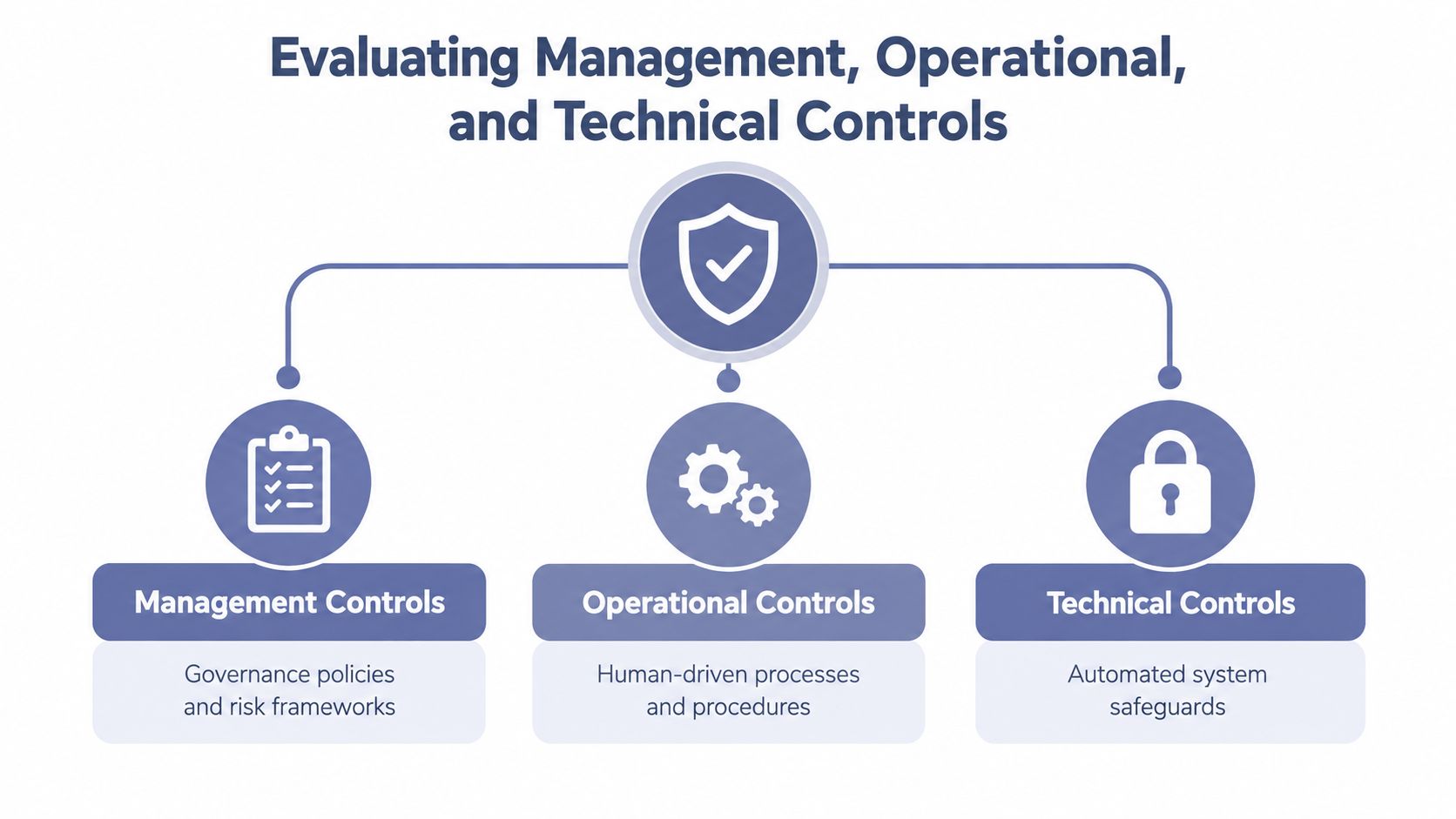
A single security objective can require three different assessment methods. Consider the objective of protecting privileged access. Management controls establish the rules, operational controls govern how staff apply them, and technical controls enforce or resist those rules in systems.
Management controls define intent
Management controls include governance policies, risk frameworks, roles, approvals, and oversight mechanisms. Their evidence usually lives in documents and decisions. An assessor examines whether the organization has defined privileged access requirements, assigned ownership, documented exceptions, and established a review process.
Interviews are useful here, but interviews alone aren't enough. The assessor should compare what stakeholders describe with approved policies, access review records, risk acceptances, and control ownership. If the policy requires prompt removal of leavers, the evidence should connect the requirement to an accountable process and actual records.
Operational controls reveal execution
Operational controls depend on people and repeatable procedures. Joiner, mover, and leaver processes, backup restoration, incident escalation, vendor onboarding, and physical access reviews belong in this category.
The right method is a walkthrough supported by samples and observation. Ask the process owner to demonstrate how a request is received, approved, implemented, checked, and closed. Then inspect whether the recorded workflow matches the documented procedure. For a physical access control, the assessment may include facility inspection, badge administration records, visitor handling, and interviews with staff responsible for access management.
Operational evidence often fails because organizations retain a policy but not the trail of execution. A procedure without tickets, approvals, timestamps, or exception handling proves intent, not performance.
Technical controls need active validation
Technical controls include identity policies, network segmentation, endpoint protection, audit logging, secure configurations, application authorization, and cloud guardrails. Configuration inspection is necessary, but it doesn't always prove that the control withstands an attack.
NIST SP 800-115 describes penetration testing as a validation technique within a broader information security assessment. Assessors mimic real-world attacks to identify ways of circumventing the security features of an application, system, or network, as defined in the NIST SP 800-115 publication.
A technically sound assessment combines several methods:
- Examine policies, configurations, logs, and architecture.
- Interview control owners and operators.
- Test the control through safe functional checks and authorized attack simulation.
- Correlate the result with the expected security outcome.
The mistake is applying one method to every category. A scanner can identify a weak configuration, but it can't confirm that an approval workflow works. An interview can explain a process, but it can't prove that an attacker can't bypass the resulting technical control. Strong assessments use the method that matches the control and then connect the evidence into one defensible conclusion.
Navigating Compliance Frameworks and Penetration Testing Mandates
Compliance frameworks differ in terminology, scope, and testing detail, but auditors consistently need evidence that maps a requirement to an implemented and functioning control. A pentest report becomes far more useful when its scope, method, finding, remediation, and retest result connect directly to that requirement.
NIST SP 800-53 Rev. 5 includes penetration-testing control CA-8. It states that an organization conducts penetration testing at an organization-defined frequency on organization-defined information systems or system components, as specified in the NIST SP 800-53 Rev. 5 publication. The flexibility doesn't make the control optional. It requires the organization to define a defensible cadence and scope.
Start with the control, not the tool
Map the compliance requirement to an assessment objective before choosing scanners, exploitation tools, or manual testing techniques. For example, a requirement concerning access control may need identity configuration review, authorization testing, privilege escalation attempts, and evidence that findings were remediated. A logging requirement may need configuration inspection followed by an attack simulation that verifies whether relevant events are generated and retained.
NIST, ISO 27001, SOC 2, and PCI-DSS use different control structures, so a single technical test can support multiple obligations without satisfying every requirement automatically. The report should state exactly what was tested, what wasn't tested, which systems were included, and how the result supports the mapped control.
Organizations that are building this mapping for the first time may benefit from a practical compliance guide from MR2 Solutions. A compliance matrix can also connect framework language to owners, evidence, test procedures, exceptions, and remediation status without forcing every framework into an identical structure. See this guide to what a compliance matrix is for a useful way to organize that relationship.
Framework Penetration Testing Requirements
| Framework | Testing Mandate | Assessment Focus |
|---|---|---|
| NIST | Define the testing frequency and information systems or components in scope | Control effectiveness, attack paths, evidence, and authorization support |
| ISO 27001 | Demonstrate that relevant information security controls are selected, implemented, and evaluated | Risk treatment, operational evidence, and continual improvement |
| SOC 2 | Support trust service criteria with evidence that controls operate over the assessment period | Logical access, change management, monitoring, and exception handling |
| PCI-DSS | Validate the security of the cardholder data environment through defined testing activities | Segmentation, exposed services, application security, and remediation validation |
The practical workflow is straightforward. Define the framework requirement, identify the control objective, select a test that can challenge the objective, collect evidence during execution, and produce a finding that an auditor can trace back to the requirement. Avoid presenting a generic vulnerability scan as proof of penetration testing. A scan may support discovery, but attack simulation demonstrates whether a weakness can be used and what the resulting impact looks like.
Executing the Four-Phase Assessment Workflow
Manual engagements usually fail at the boundaries. The team begins testing before the target inventory is final, gathers screenshots without recording the related control, or writes findings after the evidence has become difficult to reconstruct. NIST's assessment guidance uses a four-phase workflow, prepare, plan, conduct, and analyze, document, and report, which gives the work a repeatable backbone.
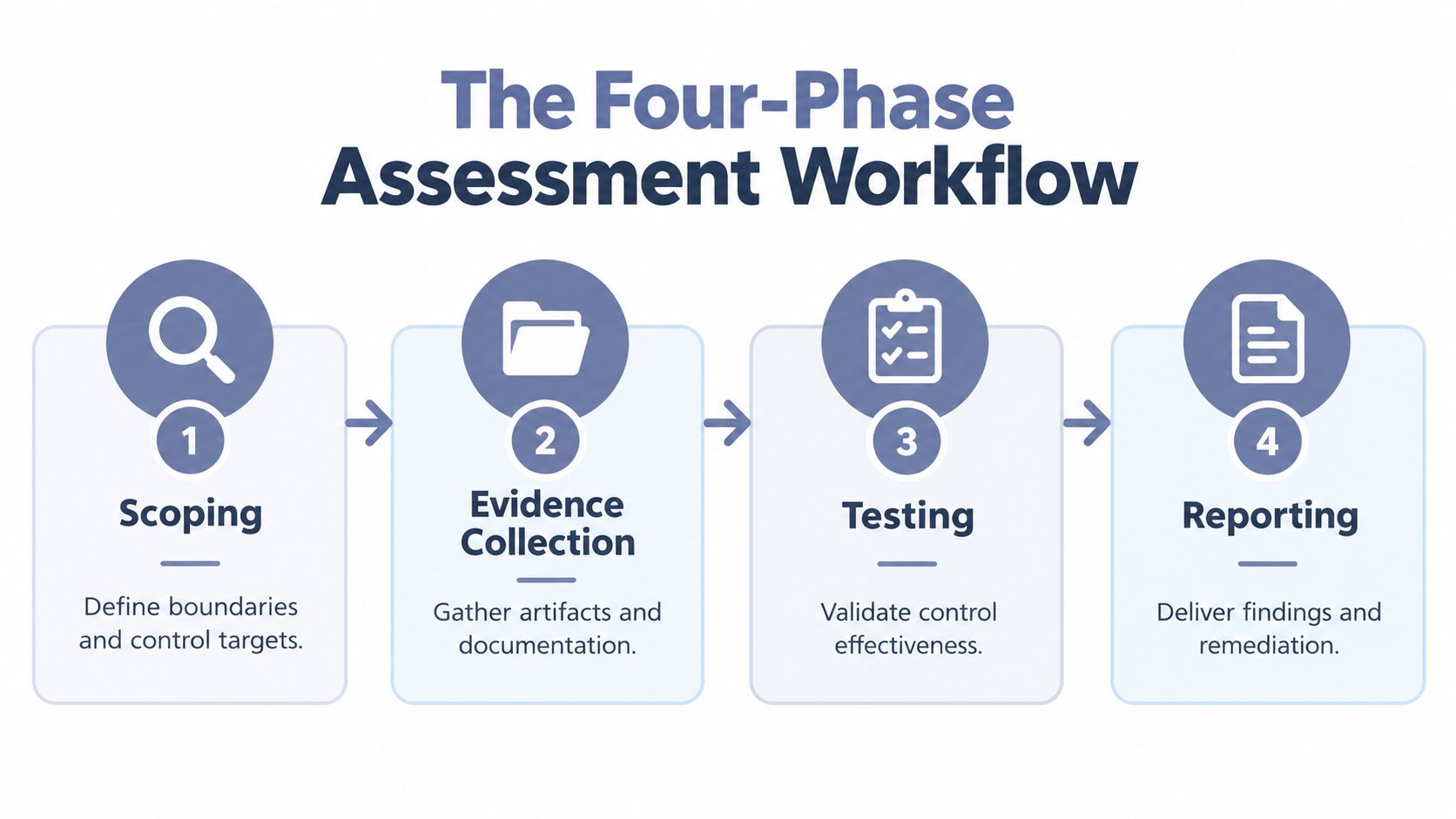
Prepare and plan before touching the target
Preparation establishes authority, stakeholders, architecture, dependencies, and constraints. Confirm the assessment objective, rules of engagement, emergency contacts, credentials, test windows, excluded assets, and data handling requirements. For an MSSP, preparation also needs a clear tenant boundary so that evidence from one customer can never enter another customer's report.
Planning turns that information into testable procedures. For each control, record:
- Assessment object: the application, identity system, network segment, cloud account, process, or facility.
- Expected behavior: the protection the control should provide.
- Evidence source: configuration, ticket, log, interview, screenshot, API response, or test result.
- Pass condition: the observable result that demonstrates effective operation.
- Failure condition: the result that requires remediation or documented acceptance.
This structure prevents a common mistake: collecting evidence first and deciding later what it means. A screenshot of an MFA policy has little value if the assessment doesn't establish which users, applications, authentication paths, and exceptions the policy covers.
Conduct tests that preserve evidence
During the conduct phase, execute functional checks and authorized attack simulations while recording timestamps, target identifiers, requests, responses, screenshots, tool output, and analyst decisions. A finding should contain enough evidence for another qualified tester to understand what happened without relying on memory.
NIST created OSCAL, a machine-readable format for control-based risk assessments. Evidence can be structured in XML, JSON, or YAML and reused across control families, reducing manual re-entry and interpretation drift, as described in the OSCAL documentation.
A useful evidence record links the test action to the control and the outcome:
- The assessor identifies the control and target.
- The platform or tester performs the planned check.
- The system captures raw evidence and supporting context.
- The assessor verifies exploitability or control behavior.
- The result is mapped to the relevant framework reference.
The following video provides additional visual context for organizing a repeatable assessment workflow.
Analyze and report for reuse
Analysis should distinguish a missing control, a poorly designed control, an incorrectly implemented control, and a control that works but doesn't cover the intended scope. Those outcomes demand different remediation. Reporting should preserve that distinction rather than collapsing every issue into a generic “non-compliant” label.
A client-ready report should include an executive conclusion, technical reproduction details, affected assets, control mappings, evidence, risk context, remediation guidance, and retest status. Structured output also lets an MSSP reuse the result in a customer dashboard, a compliance matrix, a ticketing workflow, or a later assessment without rebuilding the evidence manually.
The Shift to Continuous Controls Monitoring and Automation
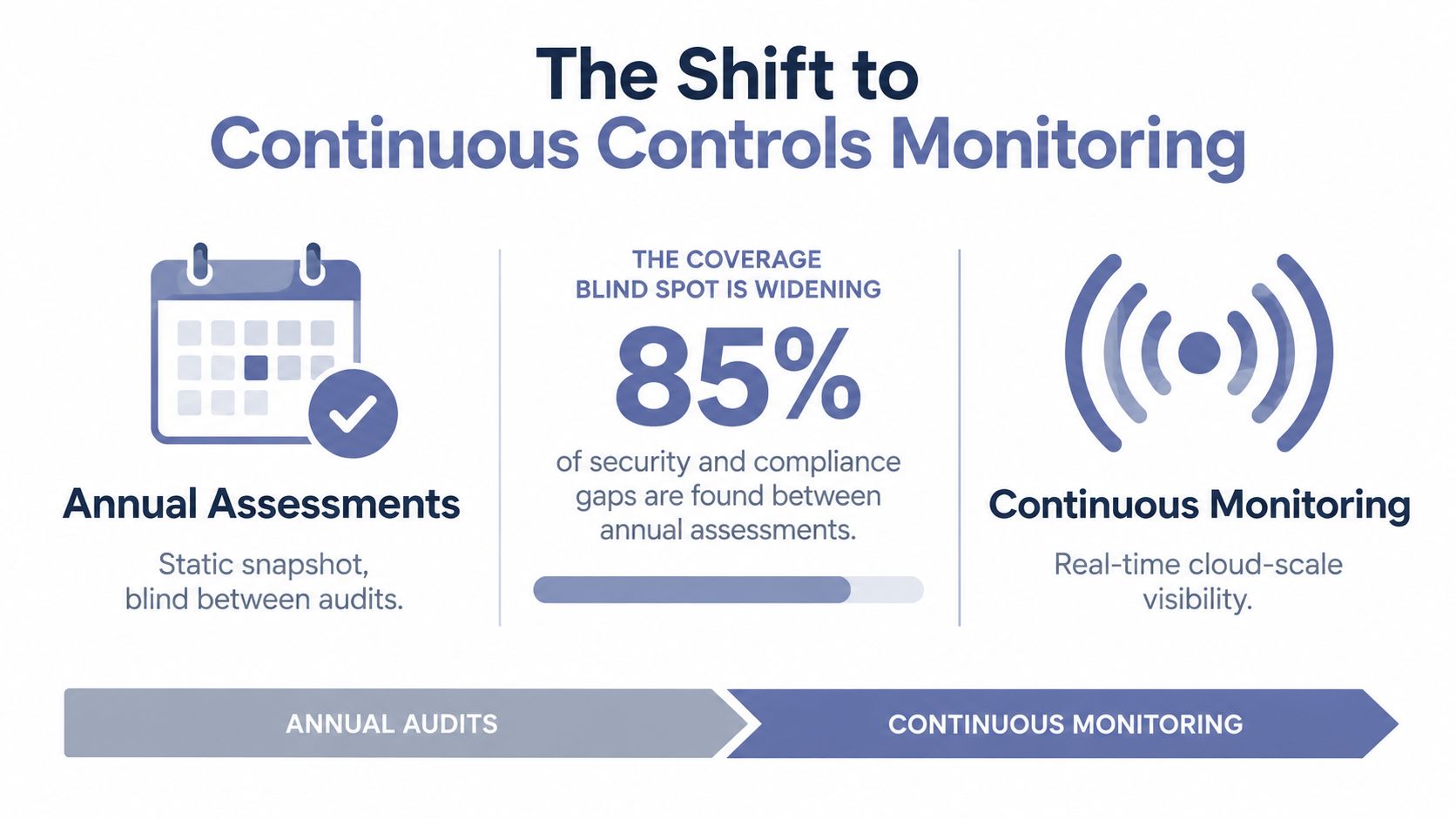
An annual assessment produces a useful snapshot, but cloud resources, identity permissions, application releases, and security configurations change between snapshots. A control that passed during an engagement can later drift because a team changed an access policy, deployed a new endpoint, exposed an API, or altered a logging route.
The gap between agreement and practice is visible in recent continuous monitoring reporting. A 2026 survey of 253 InfoSec leaders found that 94% agreed continuous controls monitoring improves security and compliance, while only 28% said they monitor controls continuously in real time. The same report states that 72% still rely on periodic assessments, and 44% had postponed control testing and monitoring because of resource constraints (2026 State of CCM Report).
Why periodic evidence becomes expensive
Manual evidence collection consumes senior staff time in places that don't improve the test itself. Analysts chase screenshots, reconcile asset lists, request updated exports, compare versions, and translate findings into multiple reporting formats. For an MSSP, every customer adds scheduling and coordination overhead, even when the underlying control procedures are similar.
The answer isn't to automate judgment blindly. It is to automate repeatable collection and verification while keeping human review for scope, impact, safety, and remediation decisions. A platform can collect configuration evidence, run approved checks, preserve raw output, and flag a changed result. A tester still decides whether the result represents a meaningful attack path and how it should be communicated.
Operational visibility also depends on the systems around the control. Teams responsible for application reliability may find useful background in resources covering application debugging for enterprises, particularly where application behavior, observability, and security evidence overlap.
Build near-real-time assurance deliberately
Continuous assessment works best when each control has a defined trigger and response. A cloud configuration change can trigger a reassessment. A new externally reachable service can trigger reconnaissance. A code deployment can initiate application testing. A failed verification can create a ticket with the affected control, evidence, owner, and remediation deadline.
The operating model should include:
- Stable baselines: Record the expected configuration and security behavior.
- Change detection: Identify new assets, permissions, routes, services, and policy changes.
- Targeted retesting: Test the control most likely to be affected instead of rerunning everything without purpose.
- Evidence preservation: Store the result in a structured format with provenance.
- Human escalation: Route ambiguous, high-impact, or destructive scenarios to an experienced tester.
This is the practical value of continuous penetration testing. It turns assessment from a calendar event into a repeatable verification process. The goal isn't endless testing for its own sake. The goal is to reduce the time between a control change, a failure, and a defensible remediation decision.
Targeting High-Risk Control Failures and Common Pitfalls
Equal treatment creates unequal protection. A long checklist may give every control the same review status while missing the few weaknesses that open the most consequential attack paths. Assessment priorities should follow exposure, privilege, exploitability, business impact, and the quality of available evidence.
Independent coverage citing analysis across 1 billion misconfiguration findings reports that 38% of risk concentrated in access control failures, 30.7% in ransomware exposure, and 26% in audit logging gaps (Qualys analysis of continuous audit readiness). The figures point to a practical assessment order: start with identity and access, verify resilience against ransomware-related exposure, and test whether logging supports detection and investigation.
Identity deserves attack simulation
A configuration review may show that MFA is enabled. It doesn't necessarily show that every relevant identity, application, protocol, recovery path, and privileged action is covered. Test the effective policy, not only the intended policy. Examine exclusions, service accounts, emergency access, administrative interfaces, API paths, and privilege transitions.
The same principle applies to authorization. A tester should attempt horizontal and vertical access changes, inspect object-level authorization, and verify whether a low-privilege identity can reach administrative functions. Business logic matters because a technically valid request can still violate the application's intended workflow.
Logging must be tested as a control
Logging is not effective merely because a dashboard contains events. The assessment should generate controlled activity, verify that the right event appears, confirm that important fields are present, and determine whether the monitoring workflow can distinguish normal activity from suspicious behavior.
Avoid these weak substitutes
- Scanner-only conclusions: Vulnerability scanners support discovery, but they don't replace exploitation, authorization testing, or business-logic validation.
- Policy-only evidence: Approved documents show intent. They don't prove deployment, coverage, or operational consistency.
- Unverified findings: A suspected issue without reproduction evidence creates rework and weakens client trust.
- Framework-first scope: Starting with a checklist can hide assets and attack paths that the framework language doesn't describe neatly.
- One-time remediation claims: A closed ticket doesn't prove that the control remains effective after configuration drift or a later release.
Only 5% of organizations say their compliance programs are optimized for efficiency and continuous improvement, while 58% already use GRC tools, according to the same Qualys-cited coverage. The implication is clear. Technology alone doesn't create an effective program. Teams need risk-ranked controls, repeatable tests, evidence that can be reused, and workflows that turn failures into verified remediation.
Scaling Assessment Delivery with ThreatExploit AI
MSSPs and consultancies face a capacity problem, not just a testing problem. A traditional pentest can produce strong insight, but scheduling, environment preparation, tool operation, evidence capture, verification, and reporting can make recurring delivery difficult. Treating every assessment as a bespoke project limits how often providers can validate controls for customers.
The alternative is not to remove expert testers. It is to reserve their time for scope decisions, complex attack paths, business impact, and client communication while software handles repeatable execution. Automated reconnaissance, coordinated toolchains, verification, and structured reporting can create a consistent operating layer for recurring assessments.

ThreatExploit AI is one platform option for this model. It combines a pentest-trained language model with an agentic framework that orchestrates reconnaissance, exploitation, verification, and reporting across web applications, networks, and cloud environments. Its outputs include evidence-backed PDF and JSON reports, with compliance mappings for frameworks such as SOC 2, PCI-DSS, ISO 27001, HIPAA, CMMC, GLBA, and GDPR.
For an MSSP, the relevant design questions are operational:
- Can the platform isolate customer environments? Dedicated partner-scoped infrastructure supports controlled execution.
- Can it preserve evidence? Screenshots, technical details, and structured exports make findings easier to review and map.
- Can it fit existing delivery systems? API access, CI/CD integration, role-based permissions, and multi-tenant operations support repeatable workflows.
- Can experts intervene? Autonomous execution should complement, not replace, tester judgment for sensitive or ambiguous actions.
ThreatExploit AI describes typical workflows that produce complete reports in under four hours, along with a reported 95% verification rate and 94% overall accuracy. Those figures come from the platform information provided by its publisher and should be evaluated against a provider's own targets, test scope, and quality assurance process.
The annual pentest model isn't automatically wrong. It becomes insufficient when customers need assurance after changes, when cloud assets shift faster than audit calendars, or when evidence collection consumes more effort than testing. A scalable program combines periodic deep assessments with recurring, risk-based verification so that compliance evidence reflects how controls operate in the environment today.
ThreatExploit AI provides automated penetration testing across web, network, and cloud environments, with evidence-backed findings and compliance-mapped reporting for security providers. Visit ThreatExploit AI to evaluate how recurring attack simulation can strengthen your security control assessment workflow and expand delivery capacity without relying entirely on manual testing.