
APIs represented 57% of dynamic Internet traffic observed from October 1, 2022, through August 31, 2023, according to Cloudflare's 2024 API Security and Management Report. For an MSSP, that changes what an API pentest must establish. A clean token-validation result isn't enough when the authenticated caller can still retrieve another tenant's records.
Table of Contents
- Why Signature Checks Leave REST APIs Exposed
- The Control Matrix a Pentest Report Must Prove
- How to Harden Design and Deployment
- Runtime Defenses on Live API Traffic
- How to Test Authorization Across Identities
- Scoring Rules That Separate a Real Deny from a Fake Pass
- Map Findings to Compliance Frameworks
- Schedule Recurring API Pentests for Clients
Why Signature Checks Leave REST APIs Exposed
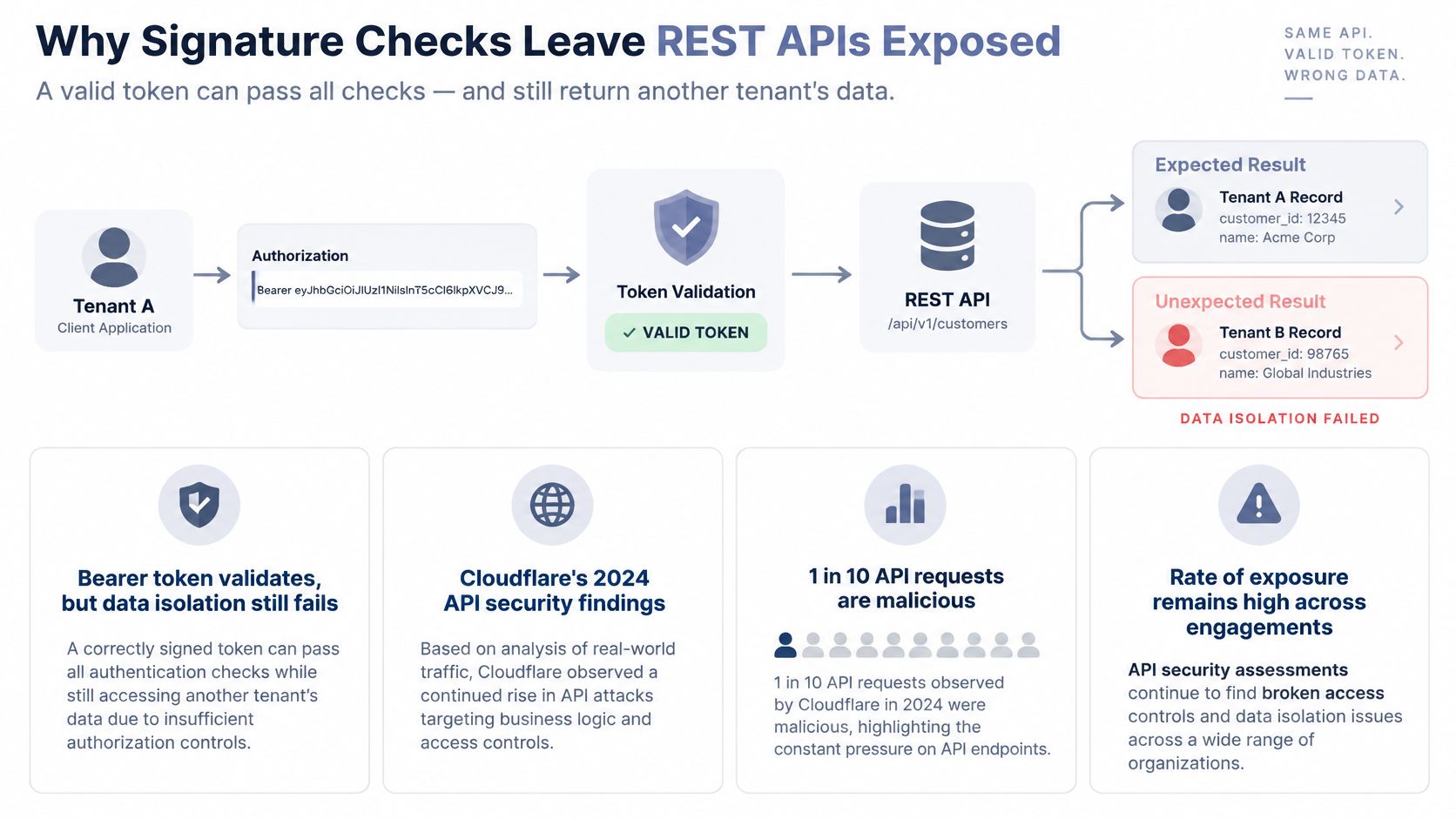
The bearer token validates. The service returns another tenant's invoice. Nothing about that exchange requires a forged signature, a broken encryption algorithm, or an unauthenticated endpoint.
That's the delivery problem: authentication succeeds while authorization fails. A JWT signature establishes that the signed claims haven't been altered and that a trusted signing key produced them. It doesn't establish that the caller owns the requested invoice, may change its payment status, or should receive its internal review notes.
Delivery speed expands the test surface
In Postman's 2024 State of the API survey of more than 5,600 developers and API professionals, 74% worked in organizations describing themselves as API-first, compared with 66% in the previous year; 63% of teams could produce an API in a week or less, up from 47%. The same survey reported that 62% of companies generated revenue from APIs and nearly one-third of API publishers used multiple gateways.
REST was supported by 56% of organizations surveyed in the SANS Institute's 2024 application-security and API survey, making it the second-most common architecture measured. Meanwhile, Wallarm's 2025 API ThreatStats Report counted 239 API vulnerabilities in its measured third quarter, with 33% associated with authentication, authorization, or access-control issues.
Those measurements describe different populations, not a single breach probability. Their practical implication is straightforward: MSSPs need repeatable coverage across changing resources, versions, and identity relationships.
The failure path below shows why passing an edge check doesn't settle the authorization question.
Protect the resource model
To protect REST API resources, test the business relationship behind each request, not only the login. TLS protects transport. A gateway can validate tokens and restrict methods. An OpenAPI document describes an interface. None independently proves ownership, field permissions, or safe consumption limits.
Identity-adjacent integrations deserve the same separation. When email verification participates in signup or recovery, include the provider's security documentation, such as Mailbeam's email verification security, in the integration review. Then test the application's own verification-state transitions rather than treating a provider response as permission to activate an account.
Delivery rule: A report should prove which identity may perform which action on which object and field. A screenshot of gateway settings can't substitute for that evidence.
The Control Matrix a Pentest Report Must Prove
REST API risks, controls, and pentest pass signals
| Risk | Control | Evidence to capture | Pass signal |
|---|---|---|---|
| API1 BOLA | Ownership check on every object identifier at data access | Same request replayed as another tenant | Authorization denial, normally 403, with no foreign data or side effect |
| API2 Broken authentication | Freshness checks, revocation, and restrictive login controls | Expired or revoked token replay; repeated logins | Invalid credentials refused; guessing throttled |
| API3 Broken object property level authorization | Response and writable-field allowlists | Hidden-field read and privileged-field write | Sensitive properties absent; unauthorized writes rejected |
| API4 Unrestricted resource consumption | Page, payload, and costly-operation caps | Oversized requests and controlled bursts | Limits activate before resource exhaustion |
| API5 Broken function-level authorization | Explicit administrative role checks | Ordinary user invokes an admin operation | Forbidden response; function doesn't execute |
| API6 Unrestricted access to sensitive business flows | Workflow-specific anti-automation | Scripted purchase or signup sequence | Challenge or block at the configured threshold |
| API7 SSRF | Destination validation and restricted outbound access | Controlled internal-target probe | No unauthorized internal fetch |
| API8 Security misconfiguration | Restricted methods, minimal errors, disabled debug routes | Verb probes and induced faults | Intended methods only; no internal details |
| API9 Improper inventory management | Owned register of routes and versions | Old and undocumented route probes | Retired routes inaccessible; active routes registered |
| API10 Unsafe consumption of APIs | Upstream schema and trust validation | Malformed or untrusted upstream response | Invalid data rejected or safely excluded before use |
The rows follow the OWASP API Security Top 10 for 2023. Read each row left to right: the risk identifies the failure, the control identifies the enforcement point, the evidence records the test, and the pass signal defines the observable result.
A row isn't closed because someone says the control exists. Authorization rows require distinct identities; authentication and consumption rows require repeated calls within agreed safety limits. Configuration, inventory, and upstream-trust rows also need review evidence that endpoint replay alone can't supply.
How to Harden Design and Deployment
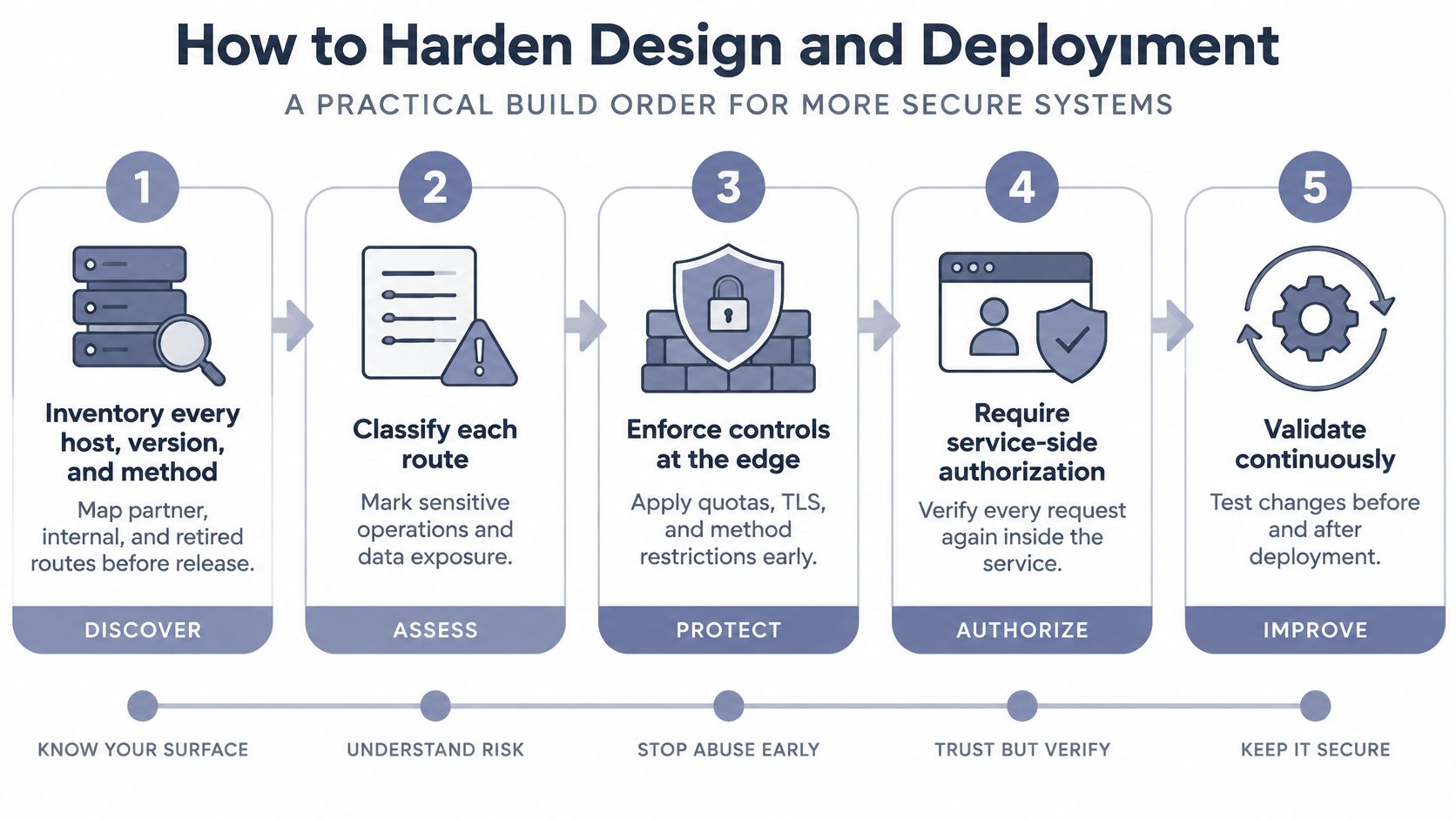
Engineering needs an implementation order, not a collection of gateway toggles. Start with the route register and finish with executable negative tests.
This deployment flow separates shared edge controls from service-owned decisions.
Establish identity and scope
Inventory every host, version, and method. Reconcile OpenAPI files with gateway exports, application routing, and observed traffic. Include partner, internal, and retired routes, then classify each operation by tenant, role, object, and field. The common slip is treating the public specification as the complete attack surface.
Separate user identity from client identity. Use a standard authorization flow such as OAuth with bounded token lifetimes. OWASP's Broken Authentication guidance reserves API keys for API clients rather than user authentication and recommends limiting login attempts to three requests per account, with the enforcement window defined by policy. A shared integration key mustn't become the identity of every end user.
Define freshness requirements explicitly. Specify which credentials support ordinary reuse, which secrets are single-use, and what logout revokes. Add transaction-bound challenges where replay protection is needed. Don't make every bearer token single-use without considering concurrent requests, retries, and client compatibility.
Put controls where the decision belongs
Enforce authorization near data access. Scope lookups to the authenticated tenant and applicable ownership relationship. Check administrative permissions before privileged operations, and serialize responses through explicit field allowlists. Returning a database entity and asking the frontend to hide fields isn't protection.
Reject unsafe input and excessive work. Reject unknown JSON properties, bound pagination, and enforce payload ceilings before expensive parsing or database work. Give login, reset, signup, MFA, and token operations separately configured throttles. Test forwarded-client headers, alternate methods, parallel calls, and account-enumeration differences.
Use the gateway as a layer. Place TLS policy, method restrictions, coarse schema validation, and quotas at the edge, while retaining business authorization inside the service. For platform-specific assumptions, inspect documentation such as AppJet security documentation and verify the deployed configuration. Documentation is a starting point, not pentest evidence.
Ship negative regression tests. In CI, include a foreign object identifier, a privileged property, an admin operation invoked by an ordinary user, and an oversized page. A useful test fails against the vulnerable implementation and passes after the fix. A test that merely expects a successful response won't catch an authorization regression.
Use an engineering checklist such as these API security best practices to assign implementation owners, but keep the acceptance criteria specific to the application's policy. Deployment is ready for assessment when every matrix row has an owner and a negative test that detects the corresponding failure.
For a companion walkthrough, use the video alongside the implementation review.
Runtime Defenses on Live API Traffic
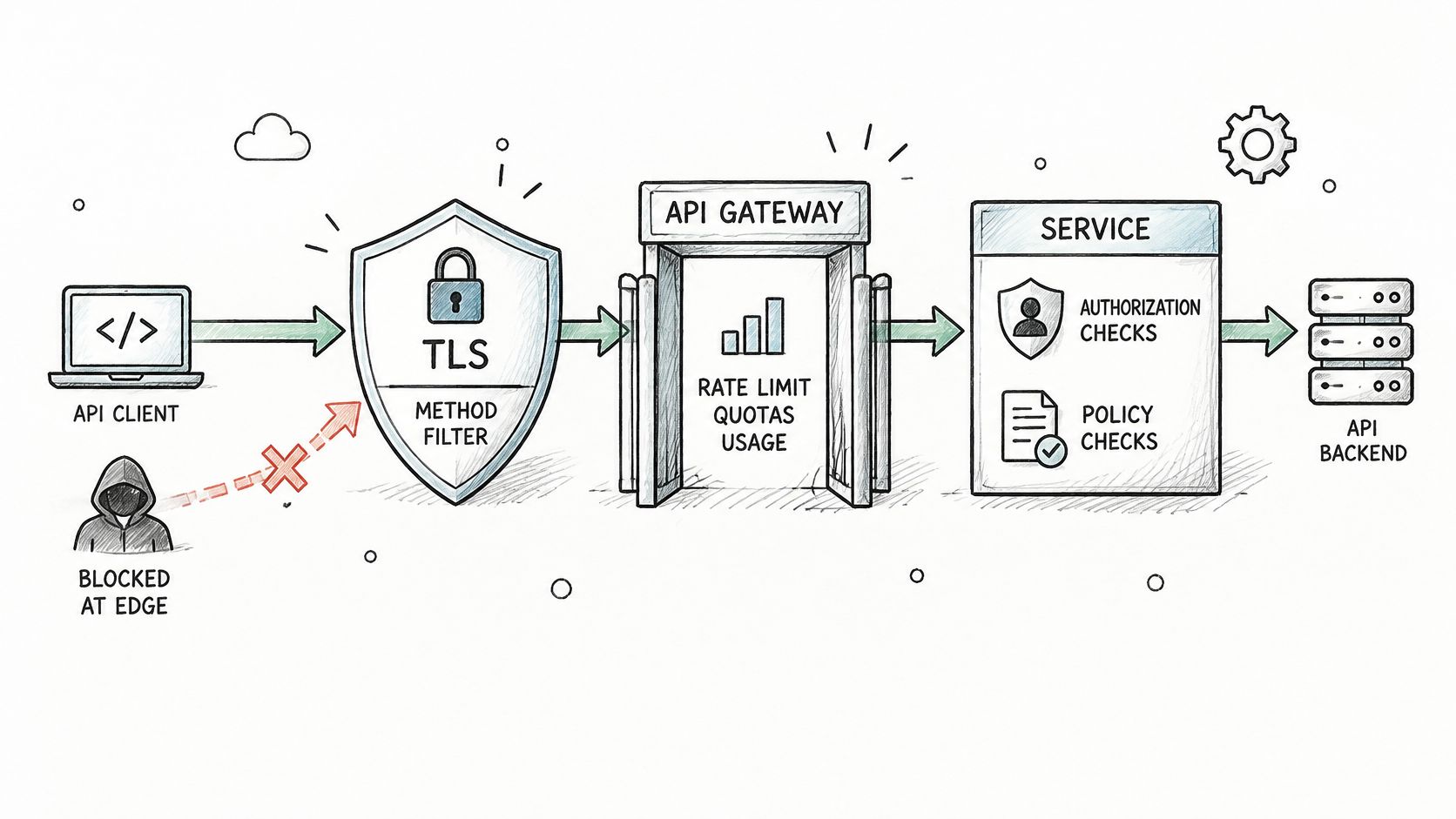
A production request should cross distinct enforcement points: edge transport and method filtering, gateway quota, then service authorization. Prevent direct backend exposure from turning the gateway into an optional path. Where the edge forwards identity context, the service must trust only context supplied through an authenticated, controlled channel.
Revocation needs an operational design. Decide whether services use introspection, a revocation store, session-version checks, or bounded access-token lifetimes with refresh revocation. Short lifetimes reduce exposure, but they don't provide immediate logout invalidation by themselves.
The live request path should make those boundaries visible.
Keep tenants from exhausting shared capacity
Say a support integration uses a service account to list customer records. A client update starts requesting uncapped pages and immediately follows every continuation cursor. Authentication remains valid throughout.
The service should reject or clamp excessive page requests according to its documented contract, while the account quota limits sustained consumption. Tenant-level concurrency and workload budgets should prevent that partner from exhausting the database pool shared by unrelated customers. An edge request counter alone won't distinguish a cheap status check from an expensive export.
Maintain separate buckets for login, password reset, MFA, and expensive reads. Key them to the appropriate account, client, and tenant context, with source-address controls as another layer. An address-only limit won't adequately constrain a distributed caller, while an account-only hard lock can let an attacker disrupt legitimate users.
Make denials observable
- Record the decision context. Log the actor, tenant, operation, object identifier, authorization decision, deny reason, and correlation identifier. Avoid full tokens and unrestricted response bodies.
- Alert on targeted authorization failures. Investigate concentrated forbidden responses against an object or unusual object traversal by a service account.
- Separate authentication noise from route drift. Repeated unauthorized login responses need different triage from calls to a version marked retired.
- Correlate limits with service health. Capture quota decisions alongside database latency and queue pressure so operators can determine whether controls activated early enough.
An alert proves that someone noticed a request. It doesn't prove that the service prevented the read or mutation.
Attach runtime captures to the relevant authorization, authentication, consumption, or inventory finding. Include the actual enforcement point so the client knows whether the fix belongs to the gateway team or the service owner.
How to Test Authorization Across Identities
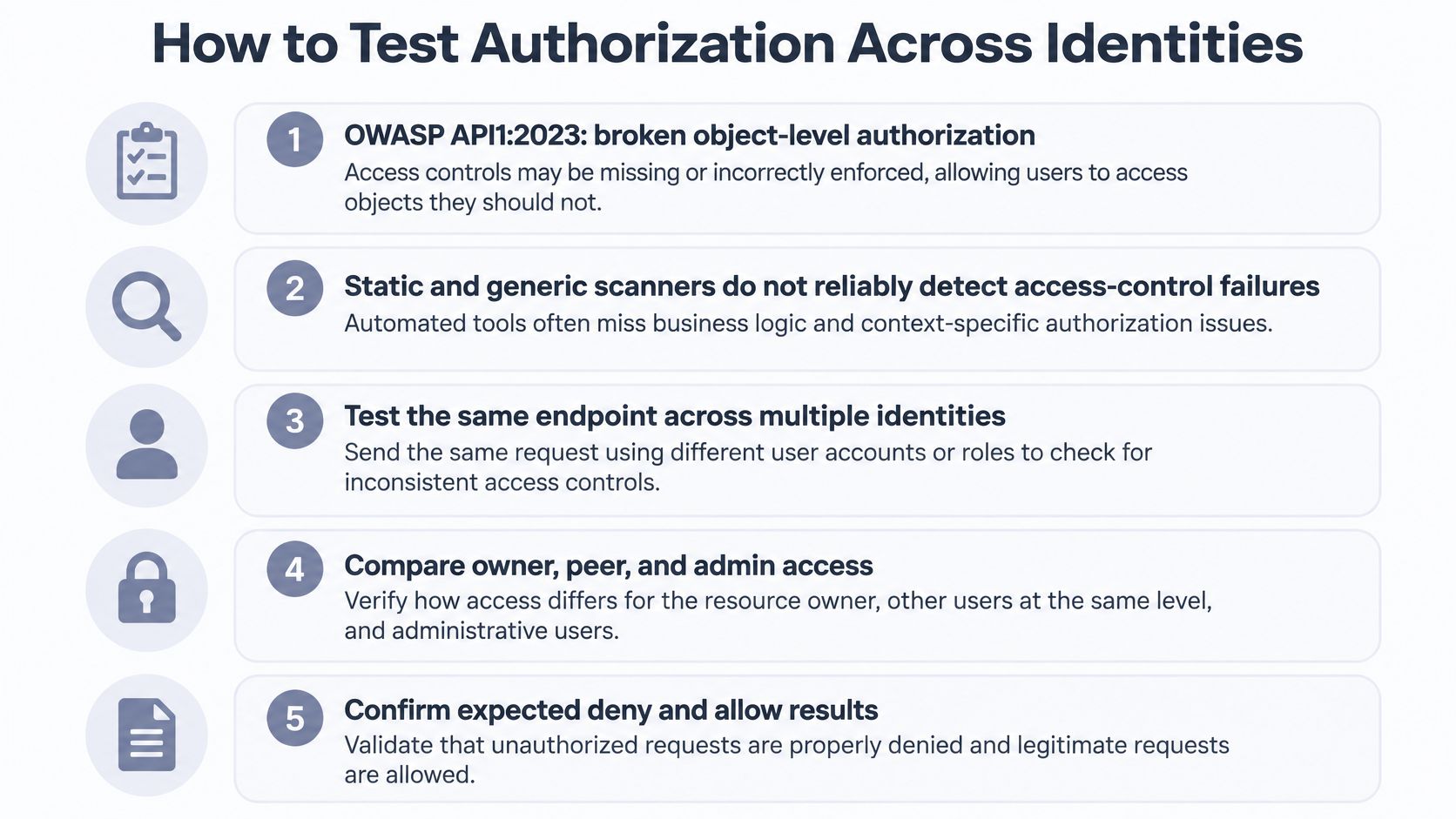
OWASP's BOLA testing guidance identifies broken object-level authorization as API1:2023 and cautions that static or dynamic automation alone doesn't reliably resolve access-control detection. Role-aware cases and human verification remain necessary because a scanner can't infer the application's intended ownership relationships.
A scanner may discover an identifier and replay a request. Without valid accounts, known objects, and a permission model, it can't reliably decide whether the result should have been accessible.
Run a differential workflow
List every object-bearing input. Combine the OpenAPI specification with traffic captured in Burp Suite or an equivalent proxy. Inspect path variables, query parameters, headers, and nested JSON fields. Include UUIDs, opaque strings, parent identifiers, and identifiers inside batch operations.
Create distinct ownership contexts. Prepare separate accounts with known records in different tenants. Add tenant-admin and service-account contexts where supported. Record deliberately shared resources too, so legitimate collaboration doesn't become a false positive.
Authenticate sessions separately. Keep cookie jars and bearer tokens isolated. Use clearly named environments in Postman or separate proxy session rules. Confirm each identity can access its own fixture before attempting a negative case.
Replay reads and mutations. Substitute the foreign object while preserving the rest of the legitimate request. Exercise GET, POST, PUT, PATCH, and DELETE where implemented. For create operations, test foreign parent objects and relationship identifiers rather than assuming creation has no ownership boundary.
Compare the complete outcome. Check status, response fields, durable state, downstream jobs, and audit events. Use disposable fixtures and agreed rollback procedures for destructive tests. A denial body doesn't close the test if the service already queued a forbidden export.
The workflow below emphasizes identity comparison rather than identifier guessing.
Extend the test to roles and fields
Build cases for anonymous, ordinary-user, tenant-admin, support, and service-account contexts against read, create, update, delete, and administrative actions. Mark unsupported combinations explicitly rather than inventing roles the product doesn't have. Support access may legitimately cross tenant boundaries, but it should still obey the client's approved scope and audit requirements.
Property tests need both directions. Submit an administrator-only writable property as an ordinary user, then inspect an otherwise authorized response for hidden properties. Check the persisted record after the write attempt; ignoring a dangerous field and rejecting it are different contracts, and the report should identify which contract applies.
Testing only GET understates integrity impact. A service can protect reads yet leave a mutation handler using an unscoped lookup. Likewise, an opaque identifier changes discoverability, not the requirement to authorize access.
A cross-tenant read, modification, or deletion is a finding. For an authenticated but unauthorized caller, expect the policy's denial response, normally forbidden; unauthorized is appropriate when authentication itself is missing or invalid.
The evidence pack should contain the baseline and substituted request pair, redacted identity context, ownership fixtures, object identifiers, expected versus actual response, and state verification. That lets another tester reproduce the finding without guessing what the original accounts were allowed to do.
Scoring Rules That Separate a Real Deny from a Fake Pass
HTTP 200 with a trimmed payload isn't a pass when the approved policy requires denial. Score against the authorization contract and observed effects, not whether the response looks less sensitive.
Report-ready scoring rules
- Token validity isn't ownership. A valid JWT doesn't authorize a resource; caller-supplied role fields carry no authority.
- Response semantics matter. A success response fails a required forbidden or not-found contract. Record whether any metadata or side effect escaped.
- Opaque identifiers aren't controls. Missing ownership predicates remain defects regardless of identifier format.
- Mutations count independently. A blocked read doesn't compensate for an open update or deletion.
- Throttles need account context. Assess reset, signup, and MFA against their configured abuse policy; flag source-address-only protection and demonstrate its bypass safely.
- Freshness needs the right scope. NIST SP 800-63B requires replay resistance at AAL2 and AAL3, and phishing resistance at AAL3; its single-acceptance rule concerns authentication secrets, not a blanket prohibition on reusable bearer access tokens.
- Validate more than TLS. Check audience, issuer, timestamps, applicable nonces, expiry, and revocation. Acceptance after expiry, or after a promised revocation event, is a finding.
- Unknown routes require disposition. Record unregistered routes for ownership review; report an exposure when a retired or unauthorized route remains reachable.
Scoring boundary: A passing status code can't cancel a forbidden database change. Preserve both the response and the resulting state.
Map Findings to Compliance Frameworks
Framework mapping for matrix evidence
| Framework | Matrix rows it evidences | Evidence artifact |
|---|---|---|
| PCI DSS | API1, API2, API5 | Replay logs and login-cap captures |
| SOC 2 | API2, API4, API9 | Rate-limit captures and inventory register |
| ISO 27001 | API1, API3, API10 | Cross-tenant replay and upstream trust review |
| HIPAA | API1, API3 | Cross-tenant replay and field-filter captures |
| CMMC | API1, API5, API8 | Role-check captures and configuration review |
| GLBA | API1, API2 | Object-access denials and login-window evidence |
| GDPR | API1, API3 | Object-access denials and property-filter captures |
Treat this lookup as an evidence-organizing aid, not an assertion that a passing API test establishes compliance. The client's scope, adopted controls, and auditor determine the final mapping.
Build traceability into delivery
- Identify applicable frameworks. Confirm the systems, data, and business processes included in the client's audit scope.
- Select relevant matrix rows. Match the tested behavior to the control objective, rather than assigning every vulnerability to every framework.
- Attach the artifact. Reference the request pair, replay log, login-cap capture, or configuration review that supports the finding.
- Use the client's control catalogue. Add the exact control identifier approved by the audit owner. Don't substitute a generic severity label or invent a control reference.
Every finding should carry the matrix row, framework control, and evidence filename. Include retest results under the same identifiers so remediation remains traceable. Standardize that handoff with a compliance documentation workflow, while leaving final audit acceptance to the responsible assessor.
Schedule Recurring API Pentests for Clients
A point-in-time checklist becomes unreliable when engineers add routes, change serializers, or revise tenant relationships. Retain a stable authorization fixture set and rerun it alongside discovery of the changed surface.
For an MSSP, recurring delivery works better when the statement of work names the matrix rows, required identities, permitted mutation tests, and evidence standard. That prevents a later engagement from shrinking into unauthenticated scanning because nobody provisioned test accounts.
Make the next assessment repeatable
- Start with a customer API this week. Run the foreign-object substitution test and the account-aware login-throttling check within an approved scope.
- Preserve the evidence pack. Store redacted requests, fixture ownership, observed effects, and expected outcomes under stable finding identifiers.
- Adopt a monthly assessment cadence. Add change-triggered retests for authentication, tenancy, privileged functions, and resource-intensive operations.
- Track coverage as well as findings. Distinguish passed rows from untested rows and tests blocked by missing access.
A continuous penetration testing program can combine scripted regression cases, automated assessment, and senior review of ambiguous business permissions. Automation should reduce repetitive execution, not remove the ownership model that makes a result meaningful.
Before closing an engagement, assign the next run an owner and date. Require proof that each previously fixed control still holds, not merely confirmation that the original ticket was marked resolved.
ThreatExploit AI offers automated web and REST API penetration testing with finding verification, evidence-backed reporting, and compliance mapping for service-provider delivery. Visit ThreatExploit AI to evaluate recurring API assessments through its partner dashboard, using your client's identity fixtures and control matrix as the review standard.