
The senior pentester finishes the assessment, closes the terminal, and opens a Word document. The next few days disappear into screenshot hunting, CVE copy-pasting, severity edits, remediation prose, and formatting fixes. Meanwhile, the next engagement waits, the client asks for an update, and the MSSP leadership team wonders why adding more customers still seems to require adding more senior staff.
That workflow treats reporting as clerical work after the “real” pentest is over. In practice, the report is where technical evidence becomes a business decision, a remediation ticket, and an audit artifact. Pentest report automation is therefore not just a faster document generator. It's a controlled workflow that captures evidence, validates findings, preserves analyst judgment, maps risk to compliance obligations, and produces the right view for each stakeholder.
Table of Contents
- The Reality of Pentest Report Automation
- Why Manual Reporting Bottlenecks Security Providers
- Core Components of Automated Pentest Reporting
- Integrating Automation into Security Workflows
- Measuring the Business Impact of Report Automation
- Implementation Considerations and Best Practices
- Transitioning to Automated Intelligence Delivery
The Reality of Pentest Report Automation
A senior tester's value lies in understanding attack paths, judging exploitability, separating signal from noise, and explaining what a finding means for the client. That value gets diluted when the tester spends the afternoon rebuilding a finding from scattered notes. A screenshot sits in one folder, an HTTP exchange in another, and the final severity rationale exists only in a chat message or personal notebook.
A basic scanner export doesn't solve that problem. It can list a title, a severity, and perhaps a description. It usually can't explain how the issue was reached, whether exploitation succeeded, what evidence proves the result, or how several apparently modest weaknesses combine into material risk.
True pentest report automation connects the assessment record to the deliverable. The workflow should ingest tool output, normalize assets and findings, attach evidence, require validation, and then render multiple report views from the same structured source. The executive summary should describe business exposure without forcing a board audience through raw requests. The technical view should preserve reproduction steps, affected assets, impact, and remediation detail.
A report is a controlled data product
The OWASP Penetration Test Reporting Standard, or OPTRS, was created to address inconsistent penetration test reports across thousands of companies. Its structured JSON-based format gives providers a practical foundation for integrating findings into security workflows through consistent fields and machine-readable data, as described by the OWASP Penetration Test Reporting Standard.
That standardization matters, but structure alone isn't enough. A report also needs the consultant's interpretation. A flat finding record can identify a vulnerability, while the assessor must explain the attack narrative, environmental constraints, confidence, and remediation priorities. The strongest pipeline separates factual assessment data from presentation logic, then adds a human-reviewed context layer before rendering.
Practical rule: automate the movement and presentation of evidence, not the invention of evidence.
An MSSP that automates only PDF formatting will still carry the main bottleneck. A scalable system promotes a finding only after it has a working proof of concept or equivalent validation record. It then uses that confirmed object to produce executive, technical, compliance, and ticketing outputs without asking a senior pentester to rewrite the same facts repeatedly.
A useful data integration and validation playbook can help teams think through the boundary between ingestion, normalization, verification, and delivery. That boundary is the structural fix for scaling. It lets experienced testers spend more time on difficult analysis and less time acting as document operators.
Why Manual Reporting Bottlenecks Security Providers
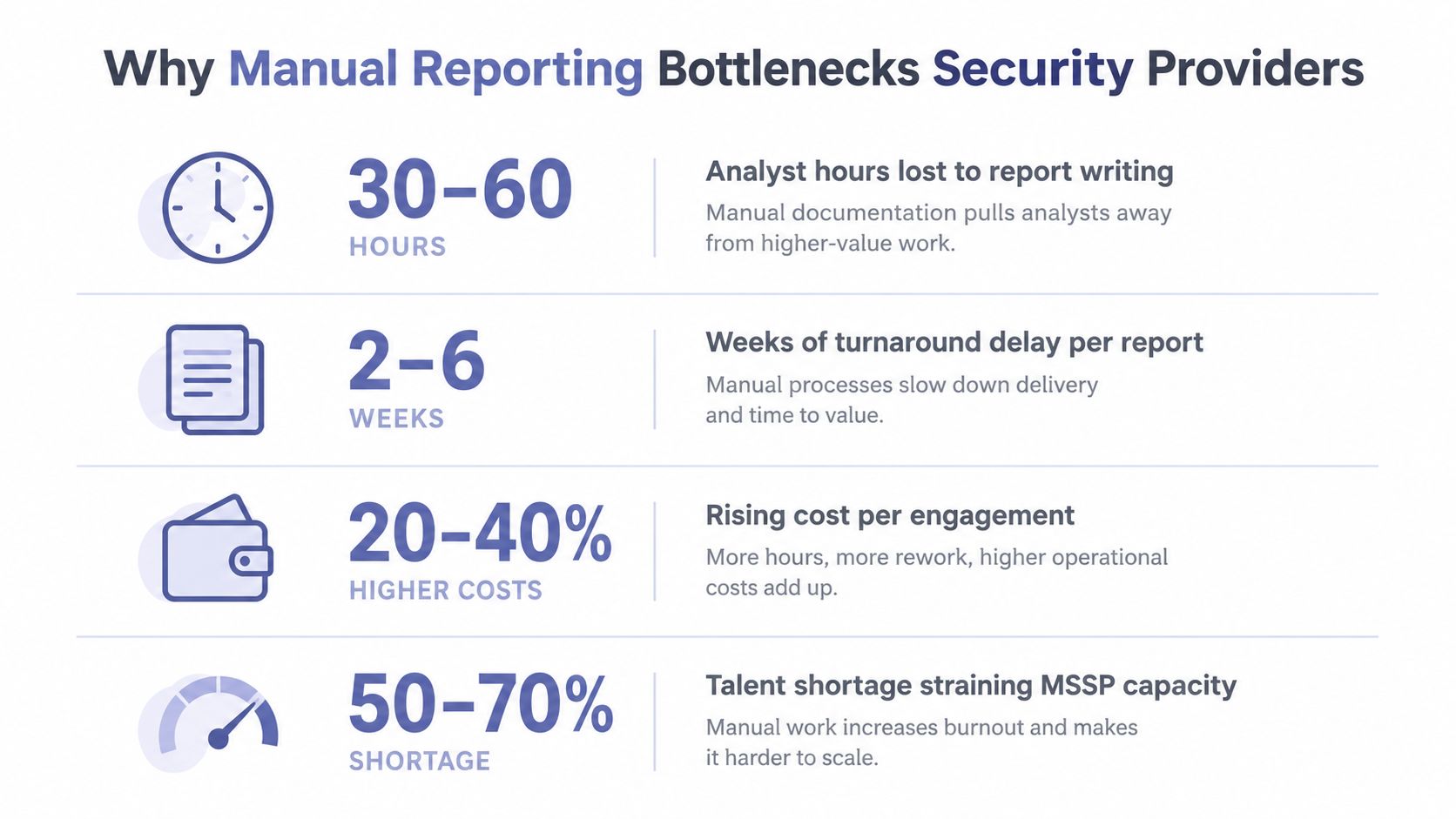
A pentest finishes on Friday, but the report still needs days of senior attention. Testers consolidate evidence, rewrite findings, check asset ownership, update remediation guidance, and prepare client-ready formats. For MSSPs, that reporting queue often limits delivery capacity more than the testing itself.
A 2024 penetration-testing survey reported that reporting consumed 20% to 60% of a pentest team's total time, while 40% of respondents identified copy-pasted CVE descriptions as their biggest time sink, according to survey findings on pentest report automation. The figures point to a scaling problem: a provider may have enough testing demand and technical capability, yet lack the reporting capacity to deliver engagements consistently.
Where the hours go
The hidden labor usually appears in four connected activities:
- Evidence consolidation: Testers gather screenshots, requests, responses, logs, command output, and asset details from separate tools and workspaces.
- Finding normalization: Teams merge duplicates, reconcile naming differences, correct affected assets, and decide which observations warrant separate findings.
- Narrative production: Someone writes the executive summary, attack story, technical explanation, business impact, and remediation guidance.
- Quality assurance: A reviewer checks that claims have support, reproduction paths work, and the report matches the client's format.
These tasks create dependencies across the delivery process. Incomplete evidence forces writers to add caveats. An incorrect asset record can send a remediation ticket to the wrong owner. A late severity change may require manual edits to the executive summary, risk register, and compliance mapping.
The cost is operational as well as financial. A 2024 survey found that enterprises spent an average of $164,400 on manual pentest assessments, representing 12.9% of their total IT security budget, as reported in the pentest report automation analysis. Automation does not remove the cost of skilled assessment work. It reduces the share of delivery time spent repeating information already captured during testing.
Why inconsistency damages trust
Comparable environments can produce reports with different finding names, evidence depth, severity language, and remediation quality when each tester follows a personal process. Clients then spend time interpreting the provider's format instead of acting on confirmed risks. Audit preparation also becomes document reconciliation, while account teams explain why similar engagements look materially different.
The bottleneck sits in the translation from technical evidence to client action. MSSPs scale when that translation becomes repeatable without becoming shallow. Evidence-backed, compliance-mapped outputs give clients consistent decisions and let senior pentesters focus on validation and analysis rather than document rework.
Core Components of Automated Pentest Reporting
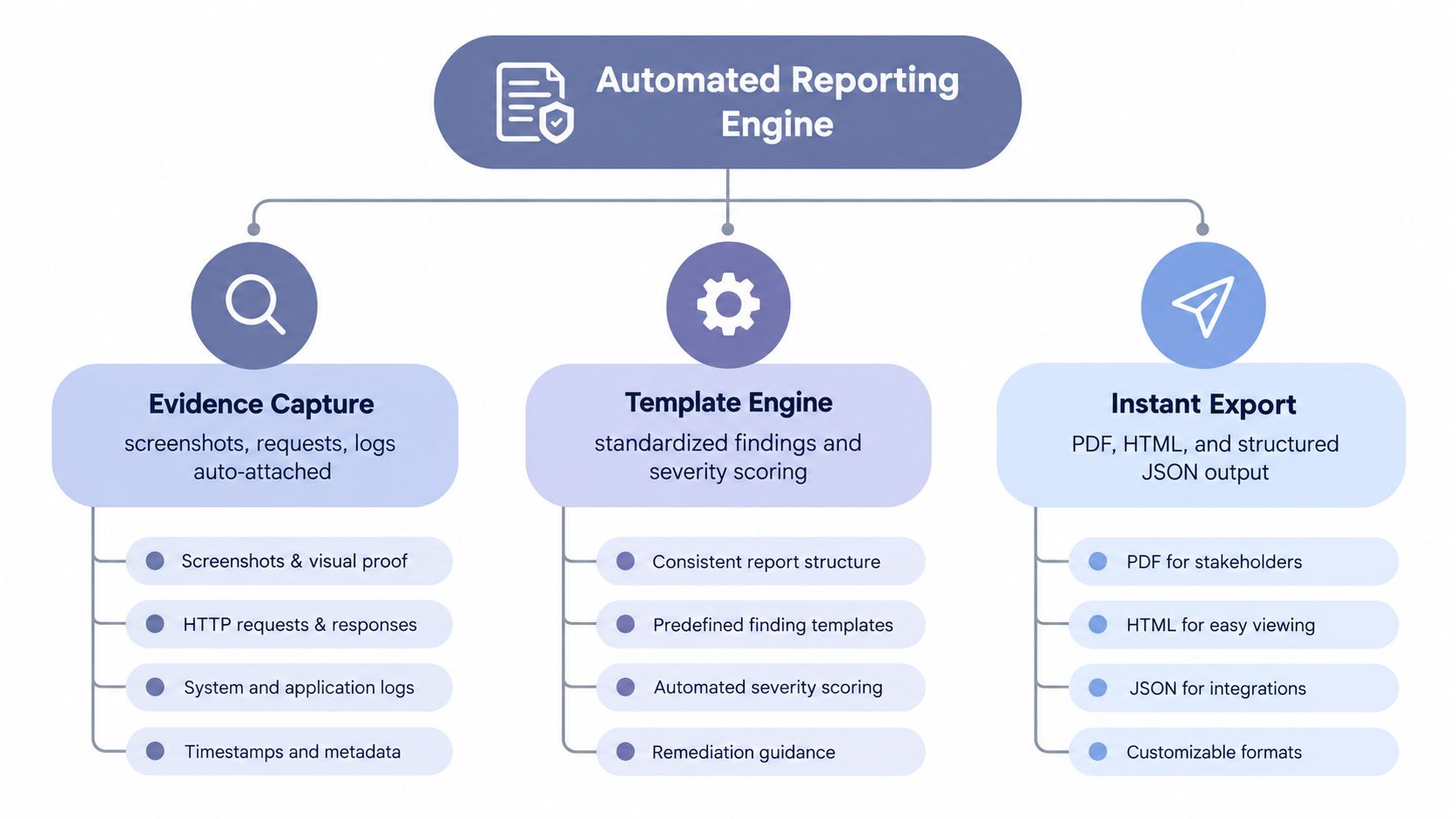
A reliable reporting engine has three functional layers, but they work only when validation sits before publication. The system should treat every finding as a structured object with provenance, evidence, context, and status, rather than as a paragraph waiting to be pasted into a template.
Evidence capture and validation
Start at the moment the tester confirms an issue. Capture the full HTTP request and response where relevant, screenshots that show the condition, logs, timestamps, affected assets, reproduction steps, and exploitation output. Store those artifacts against a stable finding identifier instead of leaving them in a tester's local directory.
The validation gate should ask a simple question: Can another authorized tester reproduce this result from the recorded evidence? A working proof of concept should be required before the issue enters the client-facing finding set. This protects the report from both false positives and vague observations that cannot support remediation.
Published AI-driven pentest research illustrates why the validation layer matters. AutoSecAgent reported a 92.4% vulnerability detection rate, compared with 85.2% for VulnBot and 83.0% for AutoPenBench, in the benchmark described by research on AI-driven penetration testing. The operational lesson isn't to chase the highest raw detection volume. It's to design the pipeline so confirmed evidence determines what gets promoted.
Compliance mapping and contextual risk
Once a finding is verified, map it to the frameworks the client uses. Relevant mappings may include PCI DSS, SOC 2, HIPAA, ISO 27001, CMMC, GDPR, or internal control libraries. The mapping should retain the specific control reference and explain why the finding is relevant, rather than attaching a generic compliance label.
Context still belongs to the assessor. The engine can suggest a control relationship, but the reviewer must confirm that the control applies to the tested scope and that the wording doesn't overstate what the evidence proves.
Templates and stakeholder views
A single structured source should produce several outputs:
- Executive view: Business exposure, major themes, overall risk narrative, and prioritized decisions.
- Technical view: Finding details, evidence, reproduction steps, affected assets, severity rationale, and remediation.
- Compliance view: Control references, evidence status, exceptions, and remediation ownership.
- Machine-readable view: JSON or another structured format for tickets, dashboards, and downstream systems.
Explore complementary penetration testing automation tools when evaluating how evidence capture, orchestration, and structured reporting fit together. The key test is whether the platform keeps facts separate from presentation. If changing a template requires rewriting findings, the system has automated formatting, not reporting.
Integrating Automation into Security Workflows
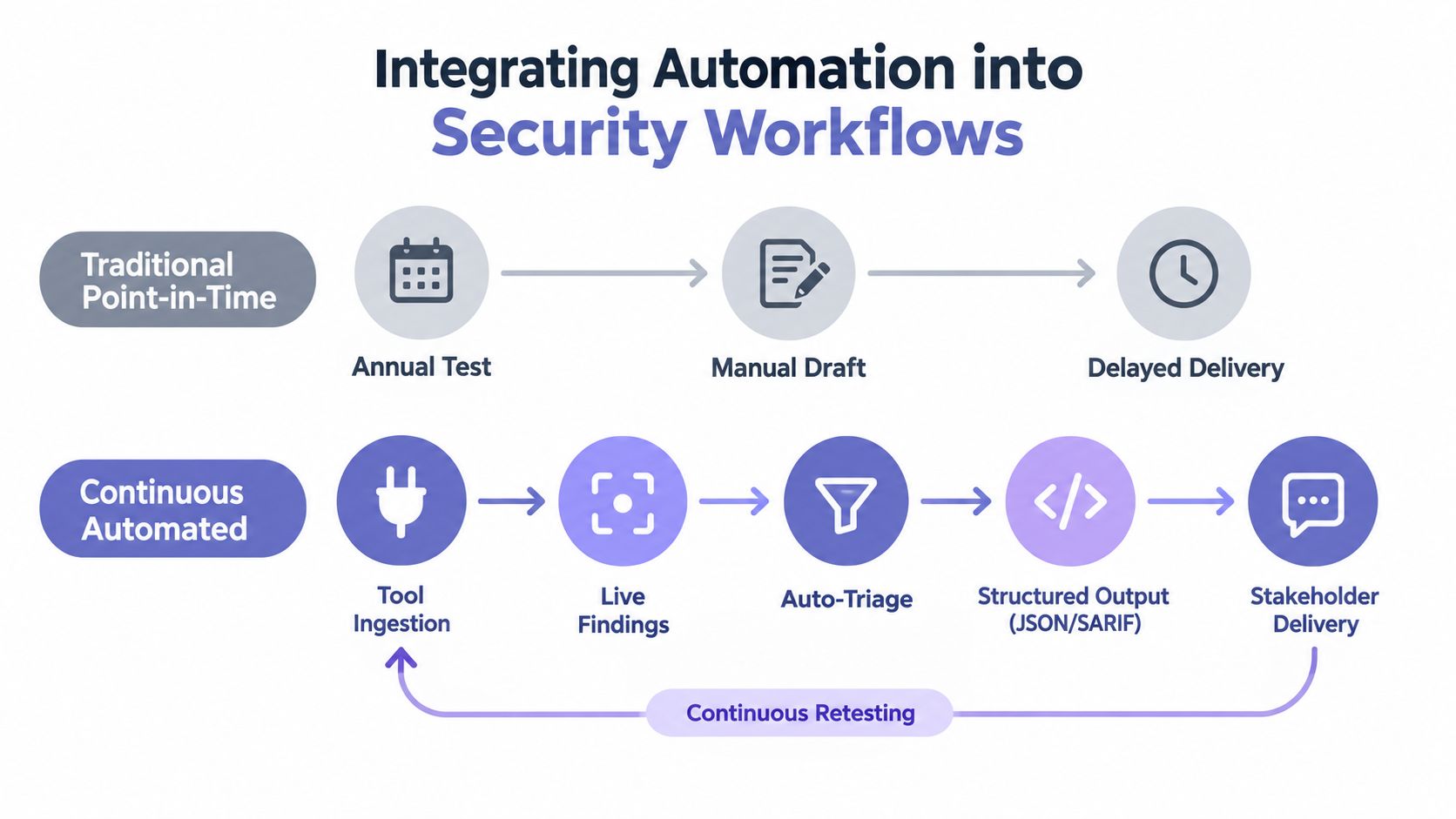
The traditional model ends with a PDF. The testing team performs an assessment, drafts a report, sends it to the client, and waits for a remediation conversation. That document may be clear for humans, but it's difficult for ticketing systems, compliance dashboards, and engineering pipelines to consume reliably.
The integrated model treats the report as a live operational record. Findings enter through APIs or tool connectors, pass through triage and validation, and leave as executive content, technical documentation, structured JSON, or workflow-specific records. The client can then assign ownership, track status, request a retest, and preserve evidence without manually transcribing a PDF.
Point-in-time delivery versus connected delivery
| Traditional workflow | Integrated workflow |
|---|---|
| Annual or scheduled assessment | Recurring or event-driven testing |
| Manual drafting from scattered notes | Structured findings assembled from captured evidence |
| PDF as the primary record | PDF plus JSON and workflow integrations |
| Client interprets and re-enters findings | Findings flow into ownership and remediation systems |
| Retesting starts a new document cycle | Retest status updates the existing finding record |
The distinction isn't that every client needs continuous testing. Some engagements remain deliberately point-in-time because of scope, authorization, or operational constraints. The improvement comes from making the deliverable interoperable even when the assessment itself is periodic.
Multi-tenant operations need controls
MSSPs need strict separation between customers, projects, evidence, and user roles. Role-based permissions should control who can view raw evidence, approve findings, edit templates, export reports, or access client records. API keys need lifecycle management, and integrations should log data movement so an operator can investigate an unexpected change.
A JSON-based reporting structure is especially useful here because it can move findings into ticketing tools and compliance systems without making the PDF do work it wasn't designed to perform. The continuous integration guidance for agile security workflows provides useful context for connecting security results to development processes.
Clients also need to understand what recurring evidence means. A 2026 industry article on automated pentesting connects continuous evidence generation with reporting needs for PCI DSS, SOC 2, ISO 27001, HIPAA, and DORA, as described in automated pentesting and compliance reporting guidance. Providers should still define evidence scope, retention, review responsibility, and exceptions rather than promising that automation alone satisfies an audit.
For buyers comparing service economics, a practical overview of pricing for AI security audits can help frame how reporting effort affects the delivered service, not just the testing tool.
Measuring the Business Impact of Report Automation
The business case begins with senior capacity. If an experienced tester spends less time assembling documents, the provider can use that person's judgment where it matters most, including complex validation, attack-path analysis, scope decisions, and client conversations. The gain isn't merely faster typing. It's a better allocation of scarce expertise.
A reporting pipeline also makes delivery cost easier to manage. Standardized evidence, reusable templates, and automatic exports reduce repetitive work across engagements. That can help an MSSP serve more customers without treating every increase in demand as a hiring project.
Measure throughput without weakening quality
Leadership should track operational measures that connect directly to delivery:
- Time from test completion to reviewer-ready draft: This shows whether automation removes consolidation work or merely changes where it happens.
- Reviewer rework: Count missing evidence, incorrect assets, unsupported severity changes, and remediation edits.
- Finding acceptance: Track how often clients accept findings without clarification or challenge the evidence.
- Retest efficiency: Measure whether the original evidence and remediation context make verification easier.
- Structured delivery rate: Record how often reports leave the platform in formats that clients can ingest.
Avoid measuring success by the number of AI-generated paragraphs. Prose volume is not a security outcome. A shorter report with reproducible evidence and clear ownership is more valuable than a polished document that forces the client to investigate its claims.
Trust is the commercial outcome
False positives create friction for everyone. The client's engineering team spends time disproving a finding, the account team manages the disagreement, and the tester revisits evidence that should have been settled before delivery. Evidence-backed validation reduces that cycle and gives the provider a stronger basis for severity and remediation discussions.
Automation can also improve the buying experience for smaller engagements. A lightweight prospecting pentest becomes easier to scope, deliver, and explain when the provider can generate consistent executive and technical outputs without consuming disproportionate senior capacity. The commercial advantage comes from reliable delivery and credible analysis, not from labeling the report as AI-generated.
The right financial question is not “How much writing did the system automate?” It's “How much senior judgment did the provider recover for testing, review, and customer value?”
Implementation Considerations and Best Practices
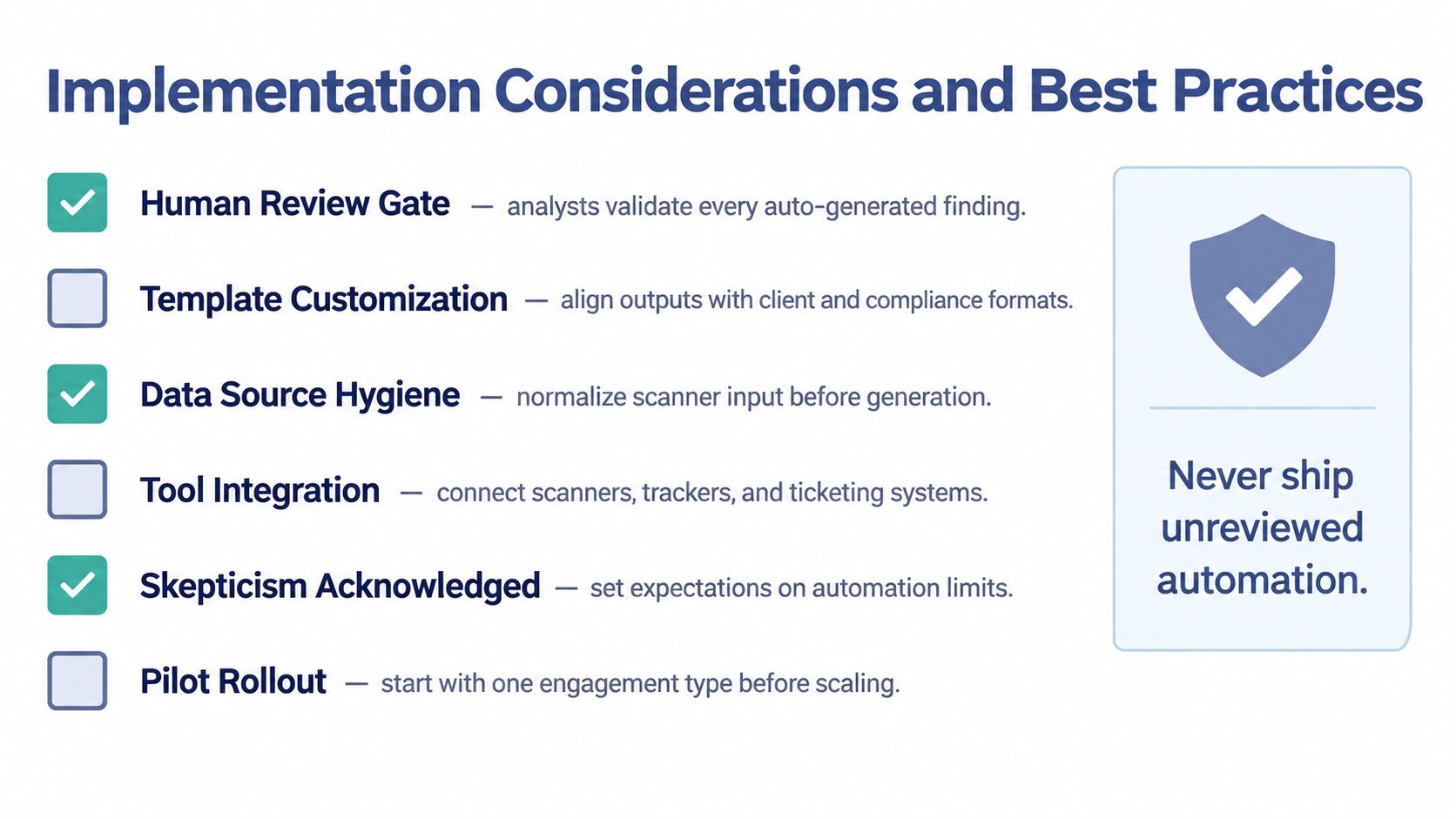
Adoption should begin with controls, not a dashboard demo. A reporting engine will expose weaknesses in source data, evidence discipline, severity governance, and tenant separation. That's useful, but only if the MSSP treats implementation as an operating-model change rather than a template migration.
Keep a human approval gate
Pure, unreviewed automation is the wrong target for high-stakes penetration testing. In 2026, Cobalt's AI and Pentesting Pulse Report surveyed 455 security leaders and practitioners. Only 9% supported relying entirely on AI automation for security testing, down from 29% in 2025; 47% preferred a hybrid approach, and 78% said fully automated scanning tools had produced critical false negatives, according to coverage of the Cobalt automation findings.
The workflow should make review explicit:
- Ingest and normalize: Standardize tool output, asset names, finding identifiers, and evidence types.
- Validate: Require a working proof of concept or documented equivalent before promotion.
- Review context: Confirm severity, business impact, scope, attack narrative, and remediation ownership.
- Render: Generate the approved executive, technical, compliance, and structured outputs.
- Release with auditability: Record approver, version, export, and delivery events.
Select for evidence and interoperability
Evaluate platforms against the work your consultants perform. Ask whether the system preserves raw evidence, supports API access, isolates customer data, offers role-based permissions, and exports structured records. Test whether a finding can move from scanner output to validated report to remediation ticket without manual re-entry.
OPTRS is a sensible interoperability reference because its JSON structure was designed to make penetration test findings more consistent across security workflows. It shouldn't replace analyst context, but it can establish a stable base for identifiers, affected assets, severity, status, and evidence references.
Dedicated infrastructure deserves equal attention. MSSPs need predictable isolation for customer data, controlled retention, tenant-aware access, and clear handling of secrets and API keys. A platform that produces attractive reports but makes data boundaries difficult to verify creates operational risk.
Use established penetration testing best practices as a review baseline, then pilot one engagement type. Start with a narrow scope such as web application reporting, compare the automated draft with the existing process, and expand only after the reviewers trust the evidence and outputs.
Transitioning to Automated Intelligence Delivery
Pentest report automation works when it separates technical execution, evidence management, editorial production, and human judgment without disconnecting them. The tester shouldn't have to choose between hunting thoroughly and delivering on time. The system should preserve the tester's reasoning while removing repeated transcription and formatting.
That shift changes the senior pentester's role. Instead of acting as the final person to touch every sentence and screenshot, the senior reviewer concentrates on attack-path interpretation, uncertainty, severity, client context, and remediation strategy. Automation handles the repeatable mechanics, while the consultant remains accountable for what the report says.
A 2021 academic paper on penetration testing automation described a BDI model that could automatically generate a report containing target information, implementation process, action set, and results, demonstrating that automated reporting can include both execution details and outcomes, as documented in the academic research on penetration testing automation. The practical direction is clear. Reporting systems are moving beyond static scanner summaries toward records that describe what was tested, what happened, what proves it, and what the client should do next.
MSSP leaders should make the transition deliberately:
- Define the evidence contract: Specify what must exist before a finding can be published.
- Standardize the data model: Use stable identifiers, structured fields, and consistent severity governance.
- Protect human accountability: Require analyst approval for findings, risk narratives, and exceptions.
- Integrate the deliverable: Send validated findings into the client's ticketing and compliance workflows.
- Review commercial results: Compare delivery effort, rework, client questions, retest handling, and senior capacity.
The providers that master this model won't compete by producing longer reports. They'll compete by delivering faster, more consistent, evidence-backed intelligence that clients can act on immediately. The report becomes a durable security operations asset rather than the last formatting task of a tiring engagement.
ThreatExploit AI helps security providers automate penetration testing workflows from reconnaissance and exploitation through evidence verification and client-ready reporting. Its outputs include executive and technical views, screenshots, PDF and JSON formats, structured exports, and mappings for frameworks such as PCI DSS, SOC 2, ISO 27001, and HIPAA. Visit ThreatExploit AI to evaluate how an evidence-backed reporting workflow could fit your MSSP delivery model.