
Three weeks before an ISO 27001 surveillance audit, an MSSP lead auditor opens the evidence folder and finds last year's penetration test report. The executive sign-off is missing. Two SaaS migrations have changed the declared scope. The report contains findings, but no proof that anyone retested the fixes.
That situation creates more than an uncomfortable audit meeting. It can trigger scope reduction findings, delay the next assessment stage, or become a major nonconformity when testing coverage doesn't match the operational boundary. ISO 27001 penetration testing is no longer something an MSSP can treat as an isolated annual PDF. It needs to operate as a controlled, repeatable part of the ISMS.
Table of Contents
- Why ISO 27001 Penetration Testing Is Now an Audit Priority
- How ISO 27001 Evolved Into a Testing-First Standard
- Mapping Penetration Testing to Annex A Controls
- Designing a Penetration Testing Program for ISO 27001
- Choosing the Right Testing Mix for ISO 27001 Evidence
- Reporting and Evidence Auditors Want to See
- Moving From Annual Tests to Continuous ISO 27001 Assurance
Why ISO 27001 Penetration Testing Is Now an Audit Priority
Three weeks before a surveillance audit, an MSSP discovers that its penetration test covered a public-facing application, while the customer has since moved authentication to a new identity platform and added another SaaS dependency. The report remains accurate for the systems tested, but it no longer demonstrates control effectiveness across the current operational boundary.
ISO 27001 does not explicitly require penetration testing in every case. That does not justify weak preparation. Auditors commonly expect testing evidence for technical vulnerability management and security testing, particularly Annex A.8.8 and Annex A.8.29 (Blaze Information Security explains the practical ISO 27001 pentest expectation).
The auditor's questions are specific:
- What systems were tested?
- Why were those systems in scope?
- Which risks and control objectives did the test address?
- Who approved the report?
- What happened to the findings?
- How did you verify that remediation worked?
A scanner export cannot answer them. A one-time external assessment also fails when the declared boundary includes internal networks, cloud accounts, applications, APIs, or administrative systems that the engagement never examined.
The surveillance audit scenario MSSPs should avoid
Certification bodies, including UKAS-accredited certifiers, may compare penetration test artefacts with the Statement of Applicability, risk register, remediation records, and internal audit evidence. The problem is not only that a report is old. The problem is that it no longer connects current architecture and risk treatment to tested controls.
Practical rule: Treat every significant architecture, identity, application, or service change as a testing trigger. Record the decision, update scope, and retest affected attack paths before the next assessment.
The 2024 ISO Survey reported 96,709 valid certificates covering 179,877 sites worldwide, compared with 36,362 certificates in the 2019 survey, roughly 2.7 times the certificate count in five years (ISO 27001 certification statistics and survey figures). As certification becomes a procurement requirement, MSSPs need evidence packages that withstand detailed review. The package should connect each Annex A expectation to a test activity, an auditable artefact, and a documented retest decision, rather than relying on a generic annual PDF.
Manual testing remains the reality for many MSSPs. That makes scope control, evidence capture, finding ownership, and retest thresholds the differentiators auditors can verify.
How ISO 27001 Evolved Into a Testing-First Standard
An MSSP can deliver a technically strong penetration test and still leave an auditor with weak evidence. ISO 27001 expects testing to connect to risk assessment, treatment decisions, remediation, and verification. Its history explains why that expectation exists. The lineage begins with BS 7799, first published by the British Standards Institution in 1995. It informed ISO/IEC 17799 in 2000, and ISO formally adopted BS 7799-2 as ISO 27001 in October 2005 (history of ISO 27001 and its control structure).
The major change was the management-system model. ISO 27001 links risk assessment, risk treatment, performance evaluation, and continual improvement. A penetration test therefore has value beyond its vulnerability list. The organization must define why the test is needed, assign ownership, remediate findings, and verify whether the treatment worked.
The 2013 revision strengthened the connection between organizational risk and selected controls. The 2022 revision reduced Annex A from 114 controls to 93, grouping them into four themes:
- Organizational
- People
- Physical
- Technological
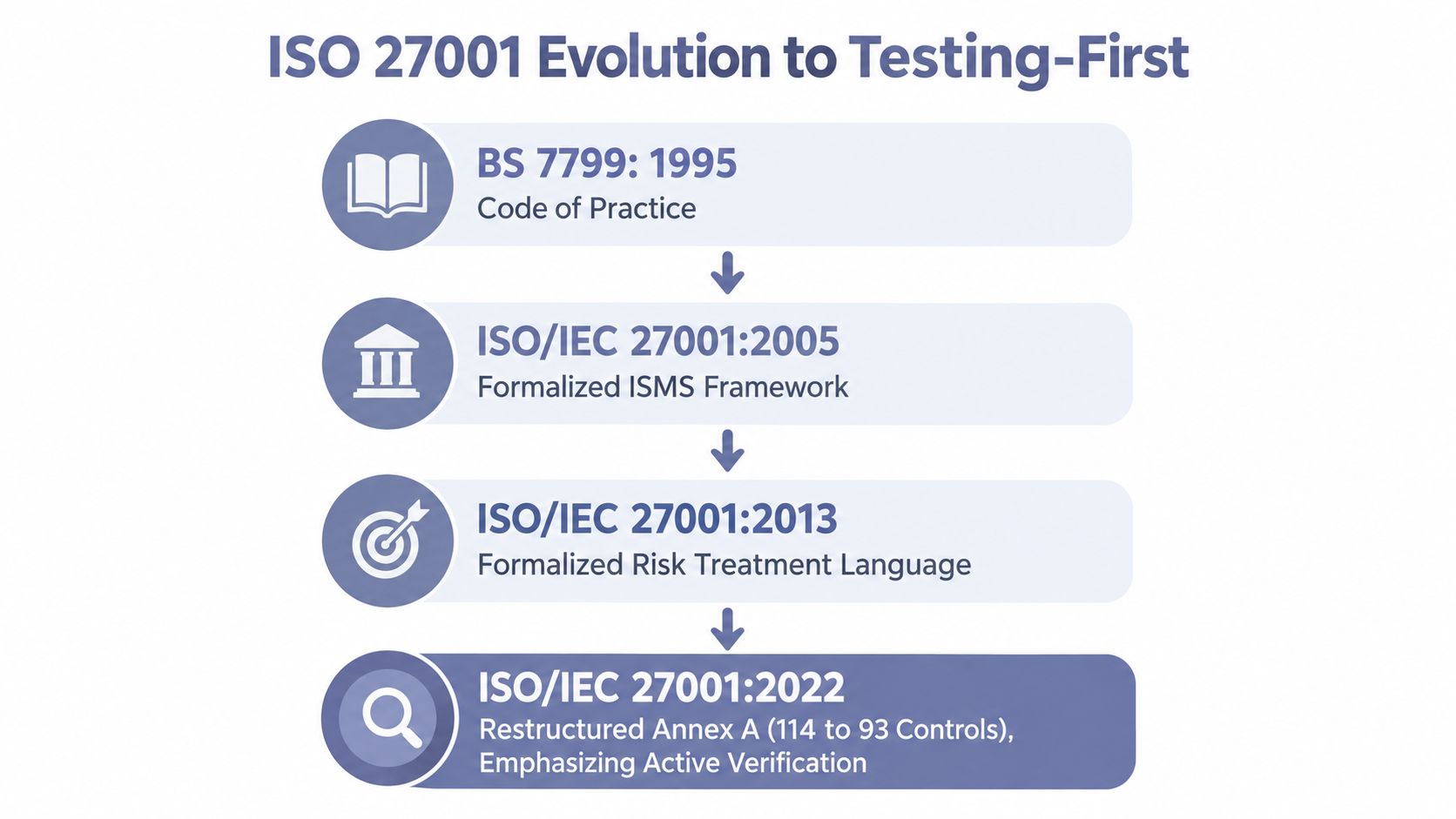
Why the 2022 structure changes audit preparation
Penetration testing appears most directly under the technological theme, especially A.8.8 Management of technical vulnerabilities and A.8.29 Security testing in development and acceptance. Auditors still assess the wider ISMS. Clauses 6.1, 8.1, 9.1, and 10.1 connect risk planning, operational execution, performance evaluation, and continual improvement.
Build the evidence chain before the next assessment:
- The risk assessment identifies technical exposure.
- The treatment plan selects penetration testing or another defined activity.
- The test scope reflects the risk and current architecture.
- Findings receive owners, deadlines, and remediation decisions.
- Retesting confirms whether material attack paths are closed.
- Management and the ISMS use the results to improve future testing.
The current revision, ISO/IEC 27001:2022, was published on October 25, 2022. Certificates based on the 2013 revision had to transition by October 31, 2025, so audit preparation now uses the 2022 control structure.
For MSSPs, label penetration testing as a risk treatment activity, not a standalone technical service. Map each Annex A expectation to a test action, evidence artifact, finding owner, and retest threshold. The ISO 27001:2022 requirements resource supports consistent terminology across delivery, compliance, and customer teams.
Mapping Penetration Testing to Annex A Controls
The strongest ISO 27001 penetration testing program starts with the control objective, not the toolset. A.8.8 Management of technical vulnerabilities requires the organization to obtain vulnerability information in a timely manner, evaluate exposure, and take appropriate action. A test should therefore do more than list weaknesses. It should demonstrate whether the target environment is exploitable and whether remediation changed the risk.
A.8.29 Security testing in development and acceptance requires security testing to be defined and performed through development and acceptance. For an MSSP, that means testing needs to appear in release governance, not only in an annual infrastructure engagement. A significant product change should produce a scope decision, test activity, findings, and a release or remediation decision.
Control-to-evidence mapping
| Annex A Control | Requirement Focus | Test Activity | Audit Artefact |
|---|---|---|---|
| A.8.8 Management of technical vulnerabilities | Identify, evaluate, and address technical vulnerabilities | Test public-facing and critical systems, validate exploitability, prioritize exposure | Scope rationale, findings register, remediation tickets, retest confirmation |
| A.8.29 Security testing in development and acceptance | Define and perform security testing during development and acceptance | Test applications, APIs, authentication, authorization, and material releases | Methodology, release trigger, signed report, control mapping |
| A.5.7 Threat intelligence | Use relevant threat information to inform security decisions | Adjust attack paths and scope using relevant threat scenarios | Threat-informed scope rationale |
| A.8.16 Monitoring activities | Use monitoring information to assess control performance | Review detection and response during controlled attack activity, then retest relevant gaps | Monitoring observations, retest record, improvement action |
| A.8.20 Network security | Protect and define network security boundaries | Assess exposed services, routing paths, access controls, and trust boundaries | Network scope, rules of engagement, technical findings |
| A.8.21 Security of network services | Secure network services and their supporting mechanisms | Test service exposure, encryption enforcement, authentication, and configuration weaknesses | Service inventory, evidence screenshots, remediation record |
| A.8.22 Segregation of networks | Maintain effective network separation | Attempt controlled movement between internal segments and trust zones | Segmentation test narrative, proof of impact, retest evidence |
A.8.8 and A.8.29 are the primary anchors, but supporting controls explain why the test scope looks the way it does. Threat intelligence can justify attack paths. Monitoring can inform retests. Network and service controls define boundaries. Segregation requirements determine whether internal testing must examine movement between environments rather than stopping at the perimeter.
The audit file should contain a signed report mapped to specific Annex A controls, with scope, methodology, severity ratings, remediation guidance, and retesting proof (practical evidence expectations for ISO 27001 pentesting). Link each finding to the risk register, treatment plan, and closure evidence. A risks and controls matrix guide can help teams keep those relationships explicit instead of scattering them across separate spreadsheets.
The ISO 27001 requirements reference can also support control mapping, but don't let a reference page replace your organization's own scope rationale. The auditor needs to see why your selected systems represent the ISMS boundary.
Designing a Penetration Testing Program for ISO 27001
An annual program should be designed as a calendar of decisions, not a recurring purchase order. Set a baseline of annual external testing and annual internal testing, then add event-driven testing after a significant change, a new product release, or a major vulnerability disclosure. The exact schedule should follow your risk assessment, but a program with no defined triggers is difficult to defend under A.8.8 and A.8.29.
Build the program around scope and independence
Start with an asset-led scope rationale. Name the networks, cloud accounts, web applications, APIs, mobile applications, wireless environments, and social engineering activities that fall inside the assessment. If you exclude an asset, record the reason and connect it to the Statement of Applicability, risk acceptance, compensating control, or separate assurance activity.
Use a recognized methodology stack and map it in the report. OSSTMM, PTES, OWASP WSTG, and NIST SP 800-115 are practical choices for different test types. The methodology matters less than the execution, but auditors need to understand how the team moved from reconnaissance to validation, exploitation, reporting, and retesting.
Before signing the statement of work, approve:
- Scope boundaries, including production and staging decisions.
- Rules of engagement, including prohibited actions and escalation contacts.
- Testing objectives, such as authentication bypass, privilege escalation, segmentation, or business logic abuse.
- Data handling requirements, including evidence storage and access.
- Success criteria, including what constitutes a validated finding.
- Retest thresholds, especially for high and critical findings.
- Independence and competence, including conflicts of interest and tester qualifications.
An internal team may be appropriate when it has demonstrable competence and sufficient independence from the system owners. A specialist firm is preferable when the internal team designed, operated, or approved the controls being tested. Cost shouldn't decide that question. Independence and depth should.
Automation can support a repeatable delivery model, especially for MSSPs managing multiple customers. For background on how AI-assisted workflows can fit into reconnaissance, exploitation, verification, and reporting, review this discussion of AI penetration testing from GoReplay. Automation doesn't remove the need for human judgment. It makes scope control, evidence collection, and recurring validation easier to manage.
Your deliverable should connect every test to a risk treatment plan row and a control objective. If the provider can't show that chain before testing begins, the final report will need avoidable repair.
Choosing the Right Testing Mix for ISO 27001 Evidence
Scanning, automated pentesting, and manual testing serve different purposes. Treating them as interchangeable produces weak evidence and confused customer expectations.
| Test type | Annex A coverage | Auditor evidence | Retest time | Cost per asset |
|---|---|---|---|---|
| Authenticated vulnerability scanning | Supports A.8.8 monitoring and vulnerability identification | Scan configuration, authenticated coverage, results, triage, remediation tracking | Usually quick for repeat scans, but closure still requires validation | Lower than hands-on testing, varies with asset coverage |
| Automated pentesting platforms | Adds recurring validation and supports change-aware monitoring | Run record, scope, attack evidence, verified findings, mapped report | Fast when the platform supports repeatable execution | Efficient for recurring asset coverage, subject to scope and platform capability |
| Manual penetration testing | Strongest direct evidence for A.8.8 and A.8.29 | Human attack narrative, proof of exploitability, business impact, screenshots, retest appendix | Depends on remediation coordination and access to the environment | Highest effort, justified for critical and complex assets |
What each method can and can't prove
Authenticated scanning identifies probable weaknesses across known assets. It supports the technical vulnerability management process, but it doesn't establish whether an attacker can chain those weaknesses into privilege escalation, authentication bypass, or material business impact.
Automated pentesting can add cadence and repeatability. It's useful between deeper engagements, particularly when an MSSP needs to monitor changes across web applications, APIs, networks, or cloud environments. The report must still show what ran, against which assets, under what permissions, and with what evidence.
Manual testing remains the auditable anchor. Human testers examine business logic, authorization boundaries, exploit chains, and contextual impact that signature-driven systems may miss. Vulnerability scanning alone is usually insufficient for certification evidence, because it doesn't validate exploitability or prove that a remediation eliminated the attack path (why scanning doesn't replace penetration testing).
The defensible combination is layered:
- Scanning feeds the risk register and baseline vulnerability process.
- Automation increases testing cadence and supports change-aware checks.
- Manual testing supplies exploitation evidence, narrative risk context, and control-effectiveness analysis.
Don't sell a scanner report as a penetration test. Don't sell an automated run as a substitute for manual assessment where business logic or complex privilege paths matter. Give the customer a clear evidence statement for each method.
Reporting and Evidence Auditors Want to See
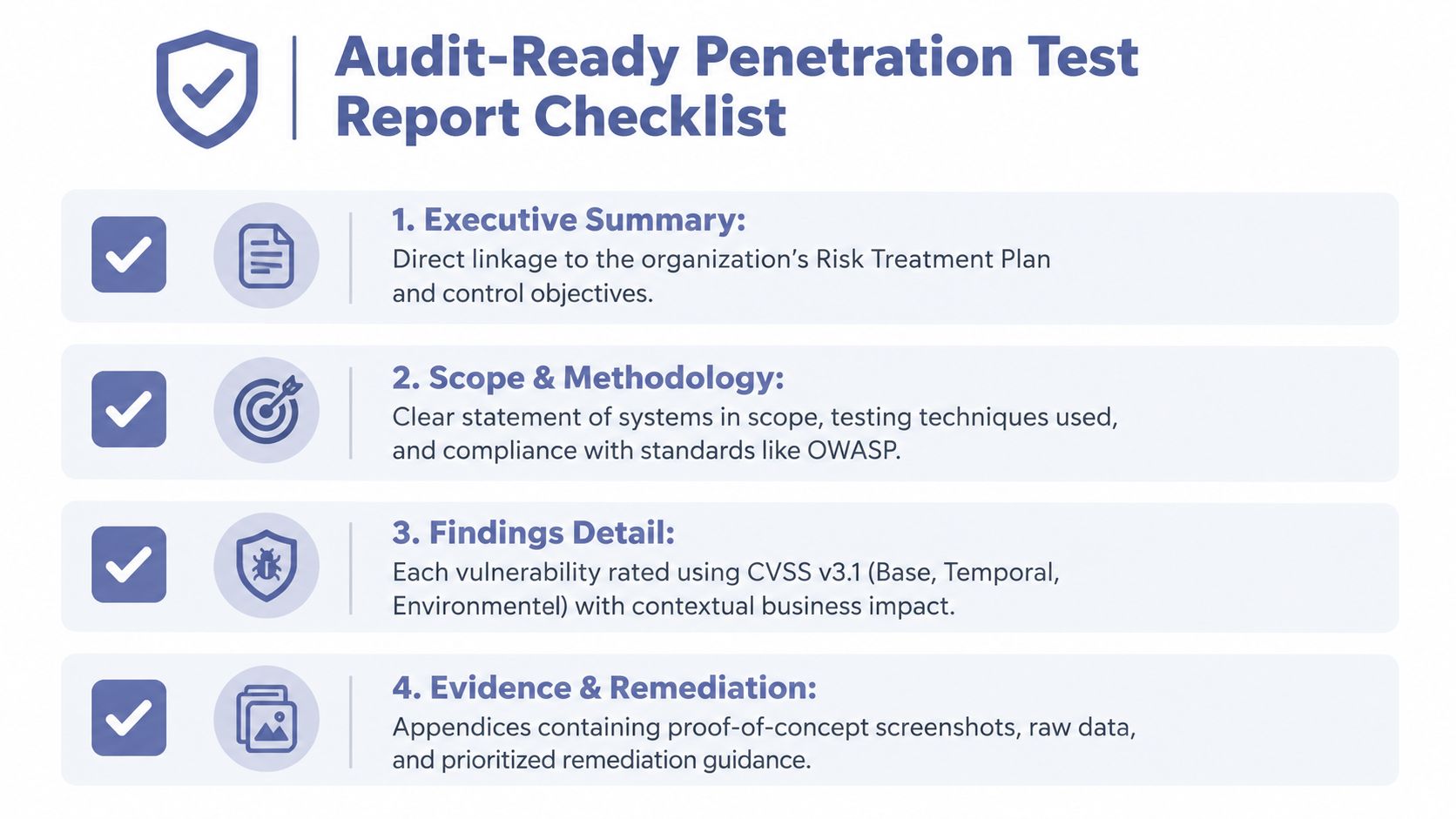
An auditor should be able to select a finding and trace it from discovery to verified closure without asking your team to rebuild the history. Treat the report as control evidence, not a list of vulnerabilities. It must connect the test result to risk treatment, ownership, and control effectiveness.
Open with an executive summary covering the tested systems, material risks, remediation status, and residual risk. Link those conclusions to the risk treatment plan so management can see which decisions remain open.
The report anatomy
State the scope and method precisely. Identify assets, test perspective, assessment dates, authorized boundaries, limitations, and standards used. Name OSSTMM, PTES, OWASP WSTG, NIST SP 800-115, or the combination selected, then explain how the testers applied it.
Rate each finding with CVSS 3.1 or an equivalent formal scale, then add business context. Technical severity does not show whether the asset supports a critical customer process, stores sensitive information, or provides a route into another trust zone. Your evidence package should show both technical severity and organizational impact (ISO 27001 penetration testing evidence and risk-rating guidance).
Every finding needs:
- A precise description, naming the affected asset and security condition.
- An exploitation narrative, showing how the tester validated the issue and any attack path.
- Proof of concept, such as screenshots, relevant command output, or other controlled evidence.
- Business impact, written in the organization's risk language.
- Remediation guidance, with a named owner and target date.
- Control mapping, including A.8.8, A.8.29, and supporting controls where applicable.
Retesting is part of the engagement
Put retesting in a separate appendix. For every remediated finding, record the original condition, corrective action, retest date, procedure, and before-and-after result. Retest high and critical findings to confirm that the fix removed the exploitable condition, rather than hiding only its visible symptom. Apply the documented risk rating and retesting criteria consistently.
Store the signed rules of engagement, raw scanner output, controlled report versions, remediation tickets, risk-register links, management decisions, and retest evidence in a controlled repository. The final package must let an auditor follow each finding through control, risk, treatment, owner, date, and verified closure state.
A clean report is not enough. Build an evidence trail that stands on its own.
Moving From Annual Tests to Continuous ISO 27001 Assurance
An annual penetration test is a useful baseline, but it leaves an evidence gap whenever the environment changes. ISO 27001 expects technical vulnerabilities to be identified, evaluated, and addressed through a defined, risk-based process. A report that accurately describes last year's environment can't prove that today's release, identity change, or cloud integration is secure.
The better model is recurring, change-aware assurance. Keep the annual external and internal tests, then add targeted assessments whenever the threat model or operational boundary changes.
Define triggers that create evidence
Your trigger matrix should cover at least these situations:
- New internet-facing service: Reassess exposure, authentication, authorization, and supporting network services.
- Major code release: Test changed functionality, access paths, APIs, and business logic.
- Firewall or IAM change: Validate trust boundaries, privilege paths, and segmentation.
- M&A integration: Test newly connected networks, identities, cloud accounts, and administrative paths.
- Post-incident remediation: Retest the exploited path and related controls.
A mature quarterly cycle should produce four artifacts:
- A scoped, change-aware test with an approved rationale.
- A CVSS-ranked finding register linked to treatment tickets.
- Retesting of previously identified high and critical findings.
- A signed attestation added to the ISMS evidence file.
| Dimension | Annual Pentest | Continuous Testing |
|---|---|---|
| Scope | Point-in-time environment | Changes and critical assets are assessed as they emerge |
| Evidence | One primary report and remediation trail | Repeated test records, findings, retests, and attestations |
| Change response | Usually waits for the next engagement | Trigger matrix starts targeted testing |
| Management view | Periodic snapshot | Ongoing residual-risk trend |
| Audit value | Establishes baseline assurance | Demonstrates an operating and improving process |
This approach doesn't mean testing everything manually every day. It means matching test depth to risk and change. Scanning can identify new exposure, automation can validate recurring attack paths, and manual testers can investigate complex or material changes.
Use a continuous penetration testing operating model to formalize how triggers, evidence, remediation, and retesting fit into the ISMS. This quarter, define the trigger matrix, connect findings to the risk register, schedule retests for high and critical issues within the agreed remediation window, and brief top management on the residual-risk trend. The next surveillance auditor should find a living program, not a stale PDF.
ThreatExploit AI gives MSSPs an automated platform for reconnaissance, exploitation, verification, and compliance-mapped reporting across web, network, and cloud environments. Use ThreatExploit AI to build repeatable evidence collection into your ISO 27001 testing workflow, then schedule a practical program review before your next assessment.