
A security lead at a mid-size medical practice opens an OCR audit letter and sees a 30-day response window. The practice has signed policies, completed training records, and a risk assessment in its GRC platform. What it doesn't have is proof that a break-glass account was tested, that database audit logs can't be altered, or that a recently added vendor can reach only the ePHI it needs.
That gap appears again after ransomware. An insurer, board, or downstream auditor asks for evidence that safeguards worked before the incident, not a folder of policies that were never exercised. HIPAA compliance testing is how a security team answers that question with reproducible results.
Table of Contents
- What HIPAA Compliance Testing Actually Means
- The Security Rule Foundations Testing Must Verify
- Running the Risk Analysis HHS Expects
- Test Types That Build a Defensible Program
- Sample Test Cases and the Evidence They Must Produce
- Reporting Findings and Driving Remediation
- From Annual Audits to Continuous Testing
- Checklist, Metrics, and Common Questions
What HIPAA Compliance Testing Actually Means
HIPAA compliance testing is the ongoing verification that administrative, physical, and technical safeguards operate as intended in the systems and processes handling ePHI. It isn't an annual attestation, a policy-signature exercise, or a penetration test purchased solely to satisfy a procurement checklist.
A completed training record proves that training occurred. It doesn't prove that a user can't access a patient's chart after a role change. A signed access policy describes minimum necessary access. It doesn't prove that shared service accounts are prohibited, that privileged access is reviewed, or that remote access requires the intended authentication controls.
Paper compliance versus operational proof
Checkbox compliance produces documents. Operational compliance produces test plans, system exports, screenshots, SIEM queries, ticket histories, signed vendor records, and retest results.
A defensible program follows a repeatable loop:
- Scope the environment: Identify systems that create, receive, maintain, or transmit ePHI.
- Select tests: Match each Security Rule safeguard and known threat to a practical validation method.
- Execute safely: Use authorized testing windows, synthetic data where possible, and documented rules of engagement.
- Preserve evidence: Record the test date, tester, scope, method, result, and supporting artifact.
- Remediate findings: Assign ownership, priority, due date, and risk disposition.
- Retest after change: Verify the fix and repeat testing when the environment materially changes.
Practical rule: If a control matters during a breach, test the control in a way that recreates the relevant failure mode.
Physical controls belong in this model too. A device-retirement process, for example, should demonstrate that storage media is sanitized or destroyed and that chain-of-custody records exist. Teams that need to formalize that part of the program can use guidance on compliance for IT asset disposal as a practical reference.
The working definition is simple: HIPAA testing is evidence that safeguards function, findings are managed, and material changes trigger renewed verification.
The Security Rule Foundations Testing Must Verify
The Security Rule's technical safeguard provisions give engineers a useful testing map. Rather than treating HIPAA as a broad compliance label, connect each control to a test that can demonstrate whether it works.
Access control under 45 CFR 164.312(a) covers the mechanisms that limit ePHI access to authorized users and processes. Test role assignments, privileged groups, service accounts, emergency access, and automatic logoff. A stale administrator account or an over-permissioned integration should produce a finding that an engineer can reproduce.
Audit controls under 45 CFR 164.312(b) require mechanisms that record and examine activity in systems containing ePHI. Review whether application, database, identity, and cloud logs capture access, changes, exports, and administrative actions. Then test forwarding, retention, time synchronization, alerting, and tamper detection. A log file that exists but isn't reviewable isn't strong evidence.
Integrity under 45 CFR 164.312(c) concerns protection against improper alteration or destruction. Validate change control, file or database integrity monitoring, backup consistency, and unauthorized modification alerts. The test should show what happens when an unauthorized actor changes a record or attempts to corrupt a recovery copy.
Authentication under 45 CFR 164.312(d) requires a process for verifying that a person or entity seeking access is the one claimed. Test unique identities, MFA enforcement, failed-login handling, session behavior, and break-glass access. Don't assume that an MFA policy applies equally to VPN, administrative consoles, EHR access, and vendor portals.
Transmission security under 45 CFR 164.312(e) addresses protection of ePHI while it moves across networks. Inspect encrypted paths, certificate validation, application interfaces, email workflows, wireless segmentation, and cloud-to-cloud transfers. The point isn't to collect a screenshot of a TLS setting. It's to verify that an unauthorized party can't intercept or alter the relevant traffic.
| Security Rule Provision | Plain-Language Requirement | Primary Test Type | Evidence Artifact |
|---|---|---|---|
| 45 CFR 164.312(a), Access Control | Only authorized identities and processes can reach ePHI | Access review, authenticated testing, privilege validation | Role export, test account results, access review ticket |
| 45 CFR 164.312(b), Audit Controls | Activity involving ePHI is recorded and examined | Log review, SIEM validation, tamper test | SIEM query, alert record, signed log export |
| 45 CFR 164.312(c), Integrity | ePHI and supporting systems resist improper alteration | Configuration review, integrity test, recovery test | Change record, integrity alert, restore evidence |
| 45 CFR 164.312(d), Authentication | Systems verify the identity of users and entities | Authentication testing, MFA review, lockout test | Test results, authentication configuration, screenshots |
| 45 CFR 164.312(e), Transmission Security | Network paths protect ePHI from interception or alteration | External test, API test, encryption validation | Traffic capture summary, configuration export, remediation ticket |
HHS describes these controls through requirements for access control, authentication, audit activity, and transmission security in its Security Rule overview. Testing without this mapping is unfocused. Auditors will ask which requirement a test addressed, what evidence it produced, and how the organization handled the result.
Running the Risk Analysis HHS Expects
A risk analysis isn't a separate document that sits beside penetration testing. It should explain why the team selected particular tests, how the organization rated findings, and which safeguards require remediation.
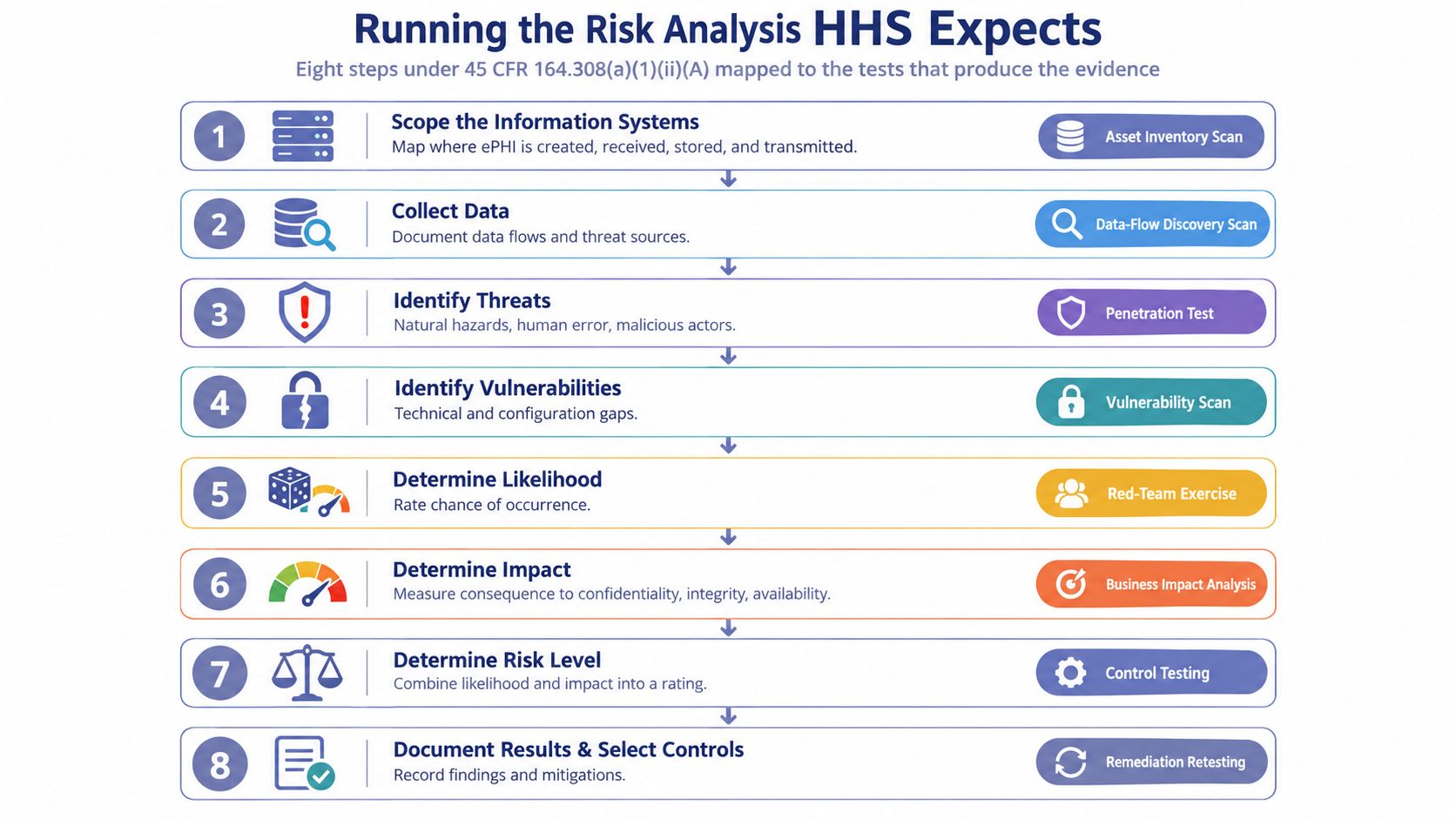
HHS breaks the process into eight steps, including scope, data gathering, threat and vulnerability identification, safeguard assessment, likelihood, impact, risk level, and selection of security measures with final documentation. The HHS risk-analysis guidance provides the underlying structure.
Turn each step into test evidence
- Scope information systems: Build an asset inventory covering EHR hosts, databases, endpoints, cloud workloads, interfaces, backups, and administrative tools. An inventory scan and data-flow review support this step.
- Collect data: Document where ePHI enters, moves, rests, and leaves the environment. Data-flow discovery, architecture review, and vendor questionnaires expose undocumented paths.
- Identify threats: Consider malicious actors, human error, natural hazards, credential abuse, ransomware, and third-party compromise. Penetration testing and tabletop exercises make the threat model concrete.
- Identify vulnerabilities: Use authenticated vulnerability scans, configuration reviews, code or API testing, and access audits to find exploitable weaknesses.
- Determine likelihood: Evaluate exposure, exploitability, existing controls, user behavior, and vendor dependency. A red-team exercise can validate whether the assumed attack path is realistic.
- Determine impact: Assess consequences to ePHI confidentiality, integrity, and availability. Business impact analysis and recovery testing supply operational evidence.
- Determine risk level: Combine likelihood and impact, then map the result to the organization's risk methodology. Control testing confirms whether the safeguard changes that rating.
- Document and select controls: Record findings, owners, mitigations, residual risk, and retest requirements. Remediation tickets and closure evidence complete the record.
OCR's formal audit program was created through the HITECH Act of 2009, and HHS has treated risk analysis as a distinct compliance deliverable. A practical risk assessment for HIPAA compliance can help teams structure the administrative side, while a technical security risk assessment workflow can connect scope and findings to testing activity.
The important distinction is traceability. A risk statement that says “weak access controls” is less useful than one tied to a specific account, system, test result, owner, and retest.
The process can be reinforced with this explainer:
Test Types That Build a Defensible Program
No single assessment proves HIPAA safeguards work. A penetration test can demonstrate an exploitable path, but it won't replace a privileged access review, log validation, vendor assessment, or recovery drill.
Match the method to the failure
Authenticated vulnerability scanning is useful for EHR hosts, database servers, cloud workloads, and supporting infrastructure. It identifies missing patches, unsafe services, weak configurations, and exposed components. The output should include scope, scan configuration, findings, affected assets, severity rationale, and remediation status.
External and internal penetration testing goes further by chaining weaknesses. Test patient portals, APIs, identity boundaries, segmentation, administrative paths, and plausible routes toward PHI. The report should show the attack narrative, reproduction steps, evidence, limitations, and whether the tester accessed or safely simulated access to ePHI.
Configuration reviews work best for cloud controls, endpoint policies, firewalls, databases, identity platforms, and backup services. Compare settings with the organization's baseline, CIS guidance where appropriate, and the relevant HIPAA Implementation Specifications. This method is less dramatic than exploitation, but it catches drift that a point-in-time pen test may not touch.
Access control audits examine minimum-necessary provisioning, joiner-mover-leaver processes, privileged accounts, break-glass access, and third-party identities. Log reviews validate that the organization can detect and investigate activity involving ePHI. Business associate assessments examine BAA scope, responsibility boundaries, incident obligations, and downstream safeguards.
For teams building a repeatable service, a HIPAA penetration testing workflow is most useful when it sits inside this broader control matrix. A role such as a HIPAA engineer often exists to coordinate that matrix across security, infrastructure, compliance, and vendors.
| Test Type | Scope | Evidence Produced | Re-Test Trigger |
|---|---|---|---|
| Authenticated vulnerability scan | EHR hosts, databases, endpoints, cloud workloads | Scan report, asset list, remediation records | Cloud migration, major patch change, new exposed service |
| External penetration test | Patient portals, public applications, APIs, perimeter controls | Attack path, screenshots, reproduction steps, retest report | New portal, API release, firewall or identity architecture change |
| Internal penetration test | Network segmentation, privilege escalation, PHI access paths | Attack narrative, affected systems, validation evidence | Network redesign, EHR change, major IAM update |
| Configuration review | Cloud, identity, databases, firewalls, backups | Baseline comparison, configuration exports, exceptions | Platform migration, policy change, new integration |
| Access control audit | Users, roles, service accounts, break-glass identities | Access export, approval records, test results | New role, IAM provider swap, workforce or vendor change |
| Log and SIEM review | EPHI access, admin actions, alerting, retention | Queries, alert records, retention evidence, time-sync results | SIEM integration, logging architecture change, incident |
| Business associate assessment | BAAs, shared responsibility, vendor controls, downstream parties | Signed BAA, questionnaire, independent evidence, issues | Vendor incident, material service change, new subprocessor |
Cadence should follow risk and change, not habit. A scheduled assessment remains useful, but a new API or cloud migration should trigger testing even if the annual calendar says the last test is recent.
Sample Test Cases and the Evidence They Must Produce
A test plan becomes defensible when another engineer can repeat it and an auditor can trace it to a control. The following cases are designed for that purpose.
Authentication and access
Failed-login lockout validation
- Precondition: Use a non-production account with approved test credentials and documented lockout settings.
- Steps: Submit failed credentials until the configured control activates, then verify recovery and alerting.
- Artifact: SIEM query, authentication event export, configuration screenshot, and test ticket.
- Evidence: 45 CFR 164.312(d), supported by access-control procedures under 45 CFR 164.312(a).
Stale privileged account review
- Precondition: Export active privileged identities from the directory, cloud console, database, and EHR.
- Steps: Compare each identity with an owner, business need, recent activity, and approval record. Disable or remediate unowned accounts through change control.
- Artifact: Signed access review, identity export, disablement ticket, and retest result.
- Evidence: 45 CFR 164.312(a) and 45 CFR 164.308(a)(3).
MFA enforcement for remote PHI access
- Precondition: Identify remote entry points, including VPN, administrative consoles, and vendor access.
- Steps: Attempt access with valid primary credentials but without the required second factor, then verify denial and logging.
- Artifact: Test log, policy export, screenshots, and SIEM event.
- Evidence: 45 CFR 164.312(d).
Logging and transmission
Audit-log integrity and time synchronization
- Precondition: Confirm logging is enabled for an application, database, identity provider, and SIEM.
- Steps: Generate an ePHI access event, attempt an unauthorized log change in a controlled environment, and compare timestamps across systems.
- Artifact: Signed log export, tamper alert, time-sync output, and investigation ticket.
- Evidence: 45 CFR 164.312(b) and 45 CFR 164.312(c).
Encryption for ePHI in transit
- Precondition: Map external and internal transmission paths.
- Steps: Validate encrypted connections, certificate handling, rejection of insecure negotiation, and protection at API or file-transfer boundaries.
- Artifact: Configuration evidence, traffic-validation summary, and remediation record.
- Evidence: 45 CFR 164.312(e).
Vendors and resilience
Critical vendor BAA evidence
- Precondition: Select a vendor that creates, receives, maintains, or transmits ePHI.
- Steps: Confirm the signed BAA, services in scope, incident obligations, subcontractor responsibilities, and available security evidence.
- Artifact: BAA PDF, responsibility matrix, assessment responses, and exception ticket.
- Evidence: 45 CFR 164.308(b).
Backup restoration drill
- Precondition: Select a representative backup and define restoration success criteria.
- Steps: Restore into an isolated environment, validate data integrity, record elapsed time, and confirm application usability.
- Artifact: Restore log, integrity check, recovery ticket, and measured RTO/RPO results.
- Evidence: 45 CFR 164.308(a)(7) and 45 CFR 164.312(c).
Incident-response tabletop
- Precondition: Create a scenario involving credential compromise, suspicious ePHI access, or ransomware.
- Steps: Record decisions, escalation points, containment actions, communications, and time to key actions.
- Artifact: Attendance record, timeline, action register, and follow-up tickets.
- Evidence: 45 CFR 164.308(a)(5) and 45 CFR 164.308(a)(6).
Use synthetic or anonymized information wherever the test objective allows it. A realistic test that creates unnecessary exposure to production PHI is a poor trade-off.
Reporting Findings and Driving Remediation
A raw finding becomes useful only when the organization can reproduce it, assign it, fix it, and prove closure. Reports that list vulnerabilities without control mapping or ownership create audit noise rather than risk reduction.
Start with a finding record containing the affected asset, ePHI relationship, control citation, preconditions, reproduction steps, evidence, likelihood, impact, and recommended treatment. Severity should reflect both exploitability and the possible effect on confidentiality, integrity, and availability, not merely the scanner's default label.
Use a three-party handoff
The tester owns technical accuracy. The finding should explain what happened, how to reproduce it safely, and which artifact proves the result.
Engineering owns the fix. It converts the finding into a ticket with an owner, due date, change record, validation criteria, and dependency notes. If the fix changes authentication, routing, logging, or access roles, the ticket should automatically create a retest requirement.
Compliance owns the control record. It updates the risk register, policies, business associate documentation, corrective-action plan, or formal risk acceptance. Risk acceptance should identify the decision-maker, rationale, compensating controls, expiry or review date, and residual risk.
A closed ticket isn't the same as a closed finding. Closure requires evidence that the control now behaves as expected.
An audit package should contain:
- Test plan: Scope, objectives, rules of engagement, systems, dates, and tester qualifications.
- Executed results: Raw outputs, validated findings, limitations, and affected assets.
- Evidence inventory: File names, timestamps, owners, hashes or signatures where appropriate, and retention location.
- Remediation log: Ticket identifiers, owners, actions, retest results, and closure dates.
- Residual-risk decisions: Approved exceptions and acceptance letters linked to the risk register.
OCR has received over 374,321 HIPAA complaints and initiated over 1,193 compliance reviews since the Privacy Rule compliance date in April 2003. By October 2024, it had resolved 99% of cases and settled or imposed civil money penalties in 152 cases totaling $144,878,972, while more than 31,191 cases required changes in privacy practices, corrective actions, or technical assistance, according to HHS enforcement highlights. The practical lesson is that remediation records need to show decisions and outcomes, not just activity.
From Annual Audits to Continuous Testing
An annual assessment gives you a snapshot. Healthcare environments don't remain still for a year. Cloud migrations, EHR upgrades, IAM provider changes, new FHIR APIs, firewall modifications, and vendor onboarding can alter the attack surface immediately.
HHS's 2024 to 2025 audit plan was scoped to 50 covered entities and business associates, with emphasis on Security Rule provisions most relevant to hacking and ransomware attacks, as described in the HHS audit program. That focus makes change-driven testing more practical than a generic annual checklist. A point-in-time scan won't answer whether yesterday's identity change created a new route to a PHI repository.
Define the trigger before the change ships
A firewall change should produce a targeted rescan. A new patient portal should produce an external application and API test. Adding an EHR role should trigger an access review. A vendor incident should trigger a business associate reassessment and, where relevant, validation of shared access paths.
The testing cadence can be automated without pretending that every control needs the same frequency. Vulnerability scanning, cloud posture checks, SIEM rules, access recertification, targeted penetration tests, recovery drills, and vendor reviews can each have a defined owner and evidence output.
| Dimension | Annual Audit | Continuous Testing |
|---|---|---|
| Trigger | Calendar date | Calendar plus material change |
| Coverage | Point-in-time sample | Repeated and event-driven validation |
| Evidence | Periodic report | Ongoing artifacts, tickets, and retests |
| Weakness | Long gap after system changes | Requires workflow integration |
| Best fit | Formal independent assessment | Operational safeguard verification |
| MSSP delivery | Project engagement | Managed testing and recurring attestations |
OCR's audit history also shows the scale of formal review. The 2016 to 2017 cycle audited 207 organizations, including 166 covered entities and 41 business associates, while the 2024 to 2025 plan focused on a smaller scoped population and specific Security Rule provisions, according to the HHS audit-program reference above. Teams shouldn't infer that a quiet calendar means low exposure.
For a small security team, the transition can be incremental: inventory in-scope assets, automate evidence collection, define change triggers, add targeted retests to release workflows, and preserve an independent penetration test for major applications and external paths. MSSPs can package the same process as recurring testing with monthly attestations and an exception register. A continuous penetration testing model supports that operating pattern when its findings flow into the same remediation and evidence pipeline.
Checklist, Metrics, and Common Questions
A useful checklist states what must be true and how the team will prove it.
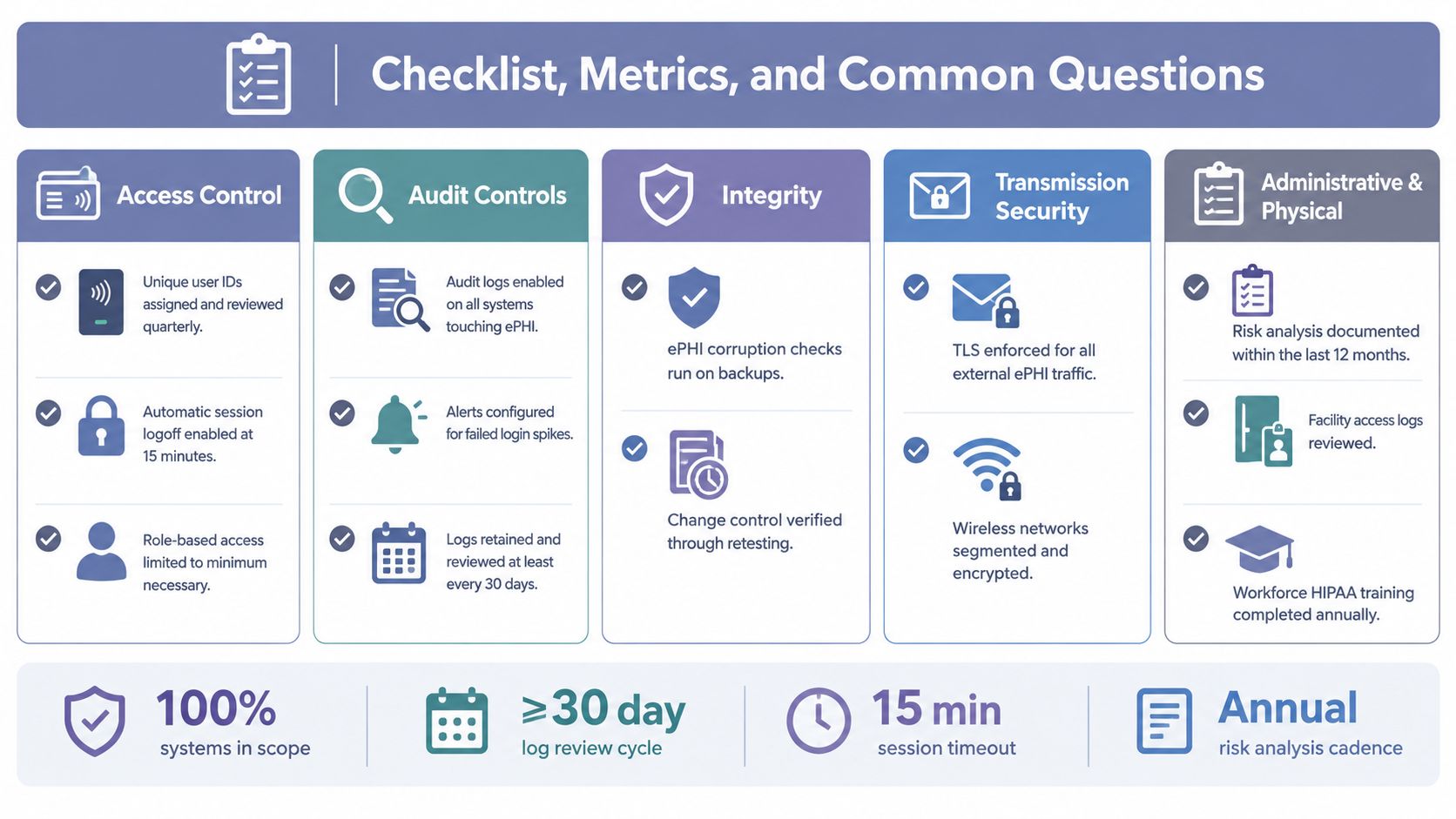
- Access control: Every ePHI system maps identities to approved roles, privileged access has an owner, and break-glass access produces a reviewable event.
- Audit controls: Systems touching ePHI generate usable logs, failed-login spikes alert the SIEM, and reviewers can demonstrate recurring examination.
- Integrity: Unauthorized changes generate evidence, backups undergo corruption checks, and material changes trigger validation.
- Transmission security: External ePHI traffic uses protected paths, API boundaries enforce authentication, and wireless networks are segmented where required.
- Administrative and physical safeguards: Risk analysis, workforce training, facility access, asset disposal, incident response, and business associate records remain current and traceable.
Metrics that show control health
Track mean time to remediate by severity, the percentage of critical systems retested after a material change, evidence artifacts delivered per reporting period, and risk-register velocity. Also record overdue exceptions, repeat findings, failed recovery drills, unowned privileged accounts, and vendors lacking complete evidence.
How often should we run a penetration test? Use risk and change triggers. Recent operational guidance increasingly discusses vulnerability scans at least every six months and penetration tests at least every twelve months, but a material cloud, IAM, API, or vendor change can justify earlier testing. See the HIPAA Journal annual survey for the breach-reality context behind a risk-based approach.
Do vulnerability scans satisfy the technical safeguard? No. Scans identify weaknesses, but they don't replace access testing, authentication validation, log review, transmission checks, or recovery exercises.
What happens when a business associate fails assessment? Limit exposure, document the issue, assign remediation, review contractual rights and the BAA, and decide whether compensating controls or suspension is appropriate.
How do we evidence continuous monitoring to OCR? Preserve dated alerts, review records, escalation tickets, configuration changes, test outputs, remediation evidence, and retests. A dashboard alone isn't an audit trail.
ThreatExploit AI helps security providers automate reconnaissance, exploitation, verification, and reporting across web applications, APIs, networks, and cloud environments, with findings mapped to HIPAA control references. Visit ThreatExploit AI to evaluate how evidence-backed penetration testing can support change-triggered HIPAA testing and recurring client reporting.