

External pentesters breached the network perimeter in 93% of companies tested, reaching the local network. That result makes the practical answer clear: external penetration testing services are necessary to verify whether internet-facing defenses hold under attack, not merely to satisfy an annual checklist.
Firewalls, web application firewalls, cloud controls, and vulnerability scanners all have a role. None of them proves that an attacker can't connect the dots between an exposed service, a weak credential, a flawed application, and sensitive access. A useful engagement turns those possibilities into evidence, prioritizes what matters to the business, and gives engineers a defensible path to remediation.
The buyer's real problem isn't finding a long list of weaknesses. It's reducing risk without consuming scarce senior testing capacity on repetitive work, then producing evidence that auditors, customers, and executives can understand. The strongest external penetration testing services combine broad automated coverage with human or machine-assisted verification, clear rules of engagement, and reporting that supports both remediation and compliance.
Table of Contents
- The Reality of Perimeter Defense Failures
- Defining Scope and Objectives in External Pentesting
- Methodologies and the Automation vs Manual Tradeoff
- Compliance Mapping and Regulatory Requirements
- Selecting the Right External Pentest Provider
- Typical Engagement Flow and Reporting Expectations
- How ThreatExploit AI Solves Common Provider Challenges
- The Future of External Penetration Testing
The Reality of Perimeter Defense Failures
The PT Security 2020 benchmark found that one web-application-related penetration vector appeared in 86% of companies, while 77% of all penetration vectors were linked to insufficient web application protection, according to the benchmark summarized by Mordor Intelligence's penetration testing market research.
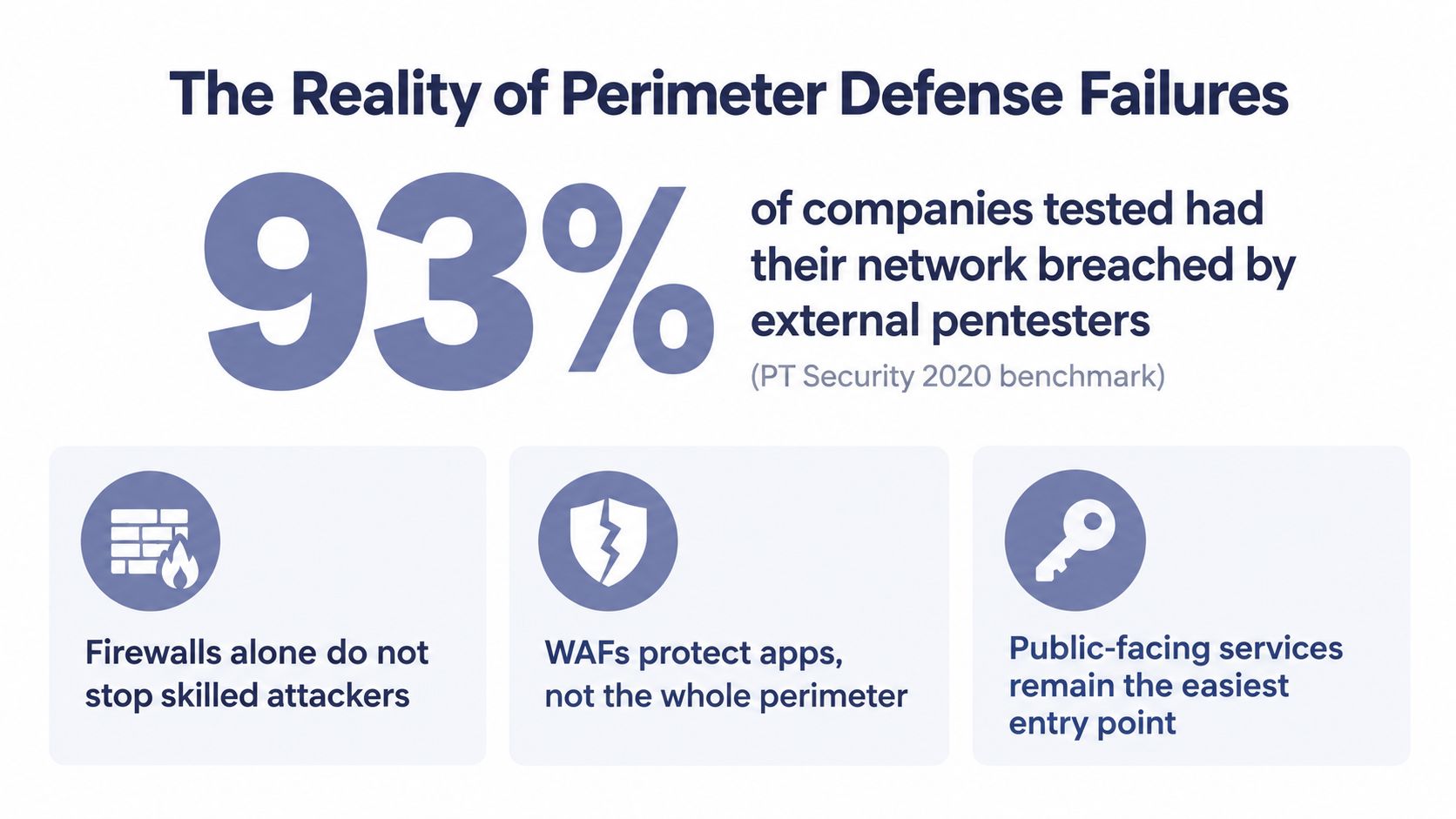
The benchmark also measured an average of four days to reach the local network. One environment was penetrated in 30 minutes, a window short enough to outlast many change-review cycles. The result is a practical warning: perimeter exposure can become an internal access problem before a security team completes its normal review process.
A firewall or WAF can be correctly deployed and still fail against an exposed administrative service, misconfigured application, weak authentication, or an attack path that combines several moderate weaknesses. Controls reduce opportunity; they do not prove that the remaining paths are unusable.
Why point-in-time validation matters
The same benchmark reported traces of previous attacks in about one-sixth of the organizations tested. That evidence makes recurring validation important, because an internet-facing asset can change between assessments through releases, vendor updates, credential changes, or cloud configuration.
A scan identifies a potentially vulnerable service. An external pentest tests what an attacker can accomplish with it. That distinction changes remediation priorities. Demonstrating a reproducible route into a sensitive environment deserves attention before repairing a low-impact issue with no usable attack path.
Practical rule: Treat the perimeter as a claim that requires evidence, not as a collection of products that implies safety.
Buyers should require more than a vulnerability count. The engagement should identify reachable assets, verify findings, explain the business consequence of successful exploitation, and show whether remediation closed the route. That evidence supports engineering decisions, audit requests, and executive risk discussions without consuming senior testers on repetitive validation.
The strongest external penetration testing services connect technical findings to verified risk reduction. Automated coverage can identify breadth, while focused manual analysis confirms attack paths and separates exploitable weaknesses from noise. The result is a defensible record of what was exposed, what changed, and where further investment will reduce external risk.
Defining Scope and Objectives in External Pentesting
A defensible external pentest begins with a question: which exposed paths could produce a business-impacting compromise, and what evidence will prove that remediation reduced the risk? NIST's technical guide to information security testing describes external testing from outside the organization's security perimeter, including external network discovery, port scanning, vulnerability scanning, and attacks that identify and validate exploitable vulnerabilities.
Build the scope from an asset inventory rather than a vendor questionnaire. Include public websites, APIs, cloud endpoints, VPN and remote-access portals, mail infrastructure, DNS, firewalls, load balancers, exposed management interfaces, and approved third-party entry points. Record ownership, authorization, and an escalation contact for each target. An overlooked development host may deserve priority because it receives less monitoring than a documented production system.
Set objectives before tools
A useful scope statement answers four questions:
- Which assets are authorized: List domains, applications, cloud resources, and network ranges, including exclusions and ownership contacts.
- What access is allowed: Define black-box, gray-box, or credentialed testing, plus limits on password attacks, data access, and destructive actions.
- What success means: Specify whether the test must demonstrate unauthorized access, sensitive-data exposure, account compromise, segmentation failure, or another business outcome.
- How disruption is controlled: Identify fragile services, maintenance windows, rate limits, emergency contacts, and stop conditions.
External and internal testing answer different questions. NIST's external attack testing guidance describes external attack simulation as typically starting with target IP addresses or ranges. Testers gather information from outside before attempting attacks, so the engagement should state what reconnaissance is permitted and what evidence must be retained.
Prevent scope ambiguity
A network perimeter test does not automatically provide authenticated web application coverage. If role-based access, business logic, or API authorization matters, include those objectives and provide suitable test accounts. Cloud testing also requires explicit permission for accounts, regions, services, and provider restrictions.
Scope should match the decision the buyer needs to make. A narrow perimeter test can verify exposure and attack paths, while application or identity objectives require different access and effort. Define the outcome first, then choose the depth that can produce remediation evidence without using senior testers for repeatable checks. This makes findings easier to prioritize, retest, and defend during audits.
Methodologies and the Automation vs Manual Tradeoff
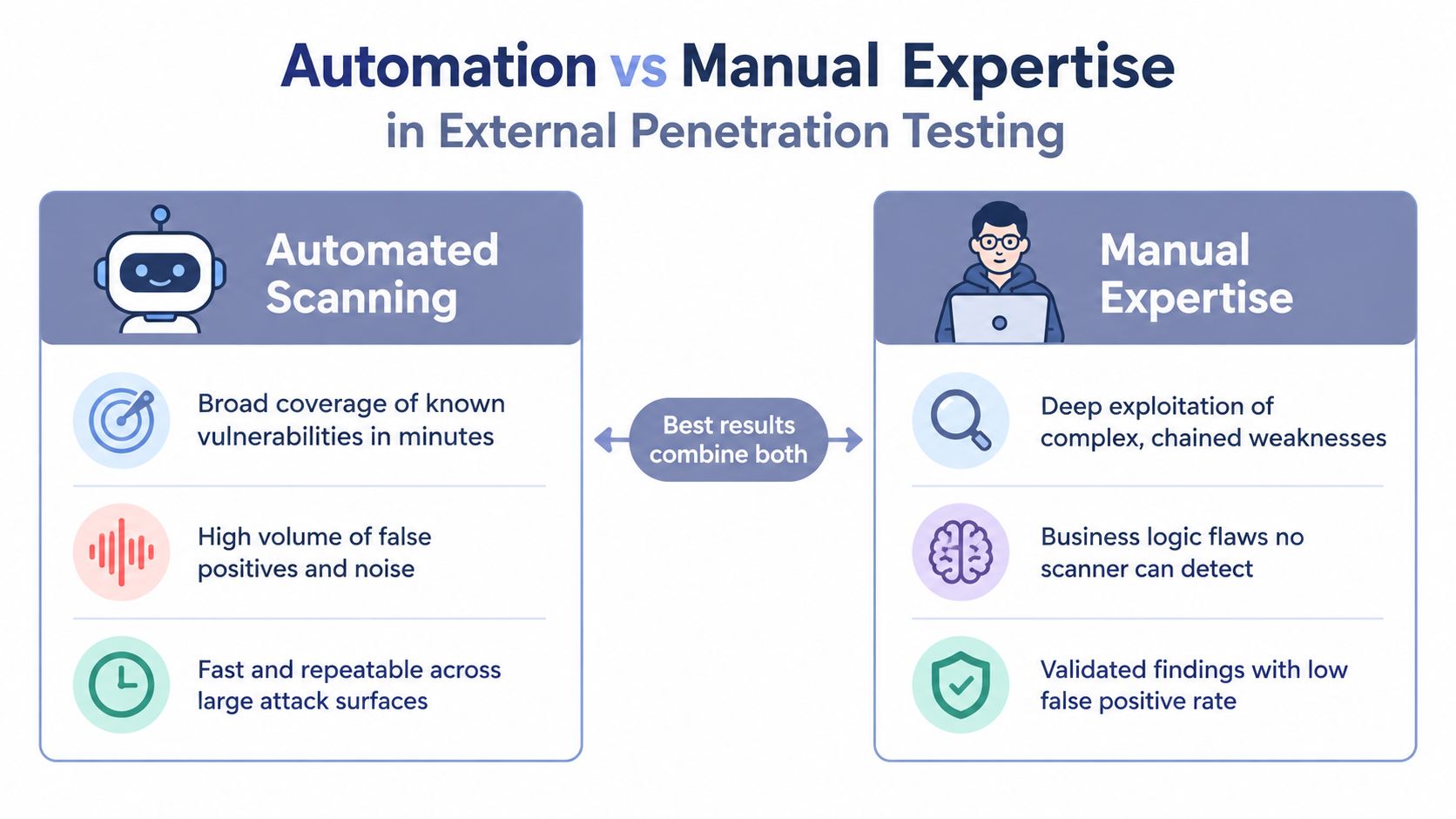
Automation provides breadth, while manual expertise supplies judgment. Effective external penetration testing services combine both so findings become verified attack paths, defensible remediation evidence, and useful input for risk decisions.
Automated scanners can enumerate exposed services, identify known software weaknesses, repeat checks consistently, and cover large environments quickly. Their output remains a set of candidates that testers must interpret. One evaluation reported a 40% false-positive rate. Research comparing automated tools found false positives around 25% for a low-performing scanner, with precision as low as 64% and recall at 62%, documented in the comparative vulnerability discovery research.
What each approach does well
| Approach | Strength | Limitation |
|---|---|---|
| Automated scanning | Broad, repeatable discovery across exposed assets | It may confuse presence with exploitability |
| Manual testing | Business logic analysis, chaining, and contextual judgment | It consumes scarce specialist time |
| Blended testing | Repetitive coverage plus verified attack paths | It needs disciplined orchestration and quality gates |
Manual testing earns its place when a tester examines authentication behavior, follows an unusual redirect, combines information disclosure with an access-control weakness, or determines whether a minor issue can reach sensitive data. These judgments depend on application context rather than signatures alone.
A comparative web-testing analysis found false-positive levels ranging from about 5 to 20 per 100 findings, depending on the tool, with Burp Pro around 5 per 100 and Skipfish around 20 per 100. The comparison showed why validation quality affects the engineering time spent on triage and remediation planning.
A documented process, such as this penetration testing methodology guide, keeps automated breadth and manual judgment within one evidence chain. ThreatExploit AI can coordinate reconnaissance, exploitation, verification, and reporting across external targets, allowing senior testers to focus on ambiguous or high-impact paths. Require request and response traces, screenshots, reproduction steps, affected assets, impact, and remediation guidance for every material finding. Retesting should then verify that the reported exposure is actually reduced.
Compliance Mapping and Regulatory Requirements
Compliance evidence is useful only when it connects the test performed with the control being assessed. A report that says “testing completed” but doesn't identify scope, methodology, limitations, findings, remediation, and retesting leaves auditors and customers to reconstruct the evidence themselves.
PCI DSS v4.0.1 requires penetration testing of in-scope systems at least once every 12 months and after significant changes. When segmentation isolates the cardholder data environment, segmentation testing is also required. For service providers, segmentation testing is required every six months, according to Synack's overview of penetration testing for PCI DSS and related frameworks.
Turn technical findings into control evidence
PCI DSS Requirement 11.4.1 calls for a documented methodology covering the entire cardholder data environment perimeter and critical systems. It also requires testing from inside and outside the network, validation of segmentation and scope-reduction controls, and retention of testing results and remediation records for at least 12 months, as detailed in Microsoft's PCI Requirement 11 guidance.
For SOC 2, ISO 27001, HIPAA, and GDPR programs, the exact evidence expectations vary by scope and assessor. A practical report should still connect each issue to the affected control objective, asset, risk, evidence, owner, remediation status, and retest outcome. That structure lets a security manager use one technical record for engineering, audit preparation, and customer assurance.
Avoid compliance theater
Annual testing can satisfy a minimum requirement while leaving fast-changing cloud and API environments unvalidated for long periods. Compliance should establish the floor, not determine the entire testing cadence. Use significant change triggers, new internet-facing assets, major authentication changes, and material application releases to decide when additional validation is justified.
A structured compliance documentation workflow can reduce the manual effort involved in mapping findings to control references. It doesn't remove the need for qualified review. Automated mapping is valuable when the underlying evidence is accurate, scoped correctly, and traceable to the tested system.
Selecting the Right External Pentest Provider
The cheapest quote often answers a narrower question than the buyer thinks they asked. A provider may deliver a scanner export when the business needs validated attack paths, evidence for an assessor, and remediation support that engineers can act on.
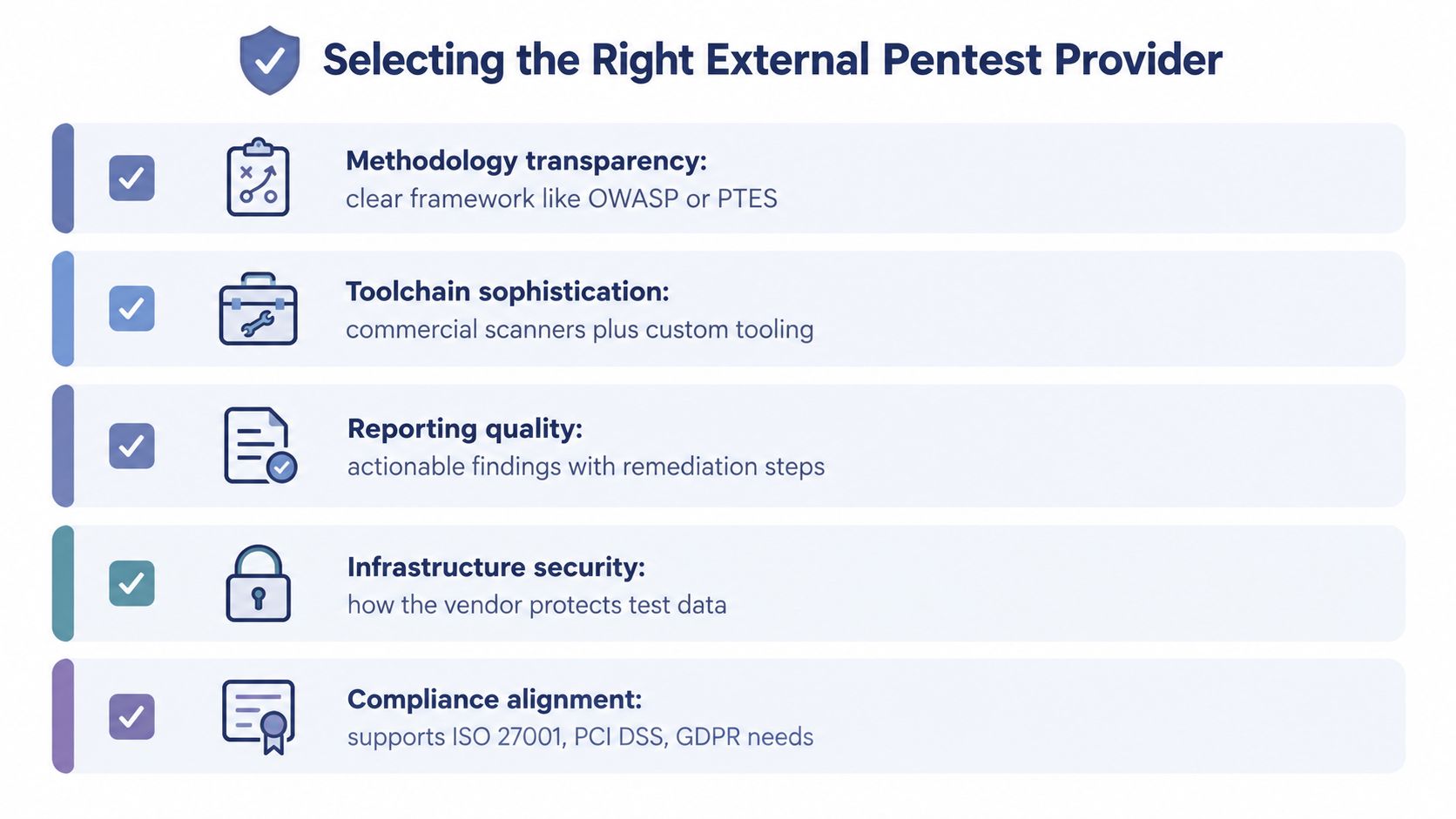
Evaluate the service across five dimensions:
- Methodology transparency: Ask whether the provider uses a recognizable framework such as OWASP, PTES, or NIST, and request the phases, exclusions, assumptions, and stop conditions.
- Toolchain sophistication: Look for commercial scanners, custom scripts, web testing tools, cloud checks, and a process for correlating their output.
- Reporting quality: Require executive and technical views, reproducible evidence, risk context, remediation steps, affected assets, and a clear retesting process.
- Infrastructure security: Understand how the provider isolates customer data, controls access, protects credentials, and disposes of artifacts after delivery.
- Compliance alignment: Confirm that reports can support the frameworks and control references relevant to your customers and auditors.
Questions that expose weak delivery models
Ask who validates scanner findings, how the provider handles suspected false positives, whether testers can demonstrate exploitability without unnecessary data access, and what happens when scope changes during testing. Ask for a sample redacted finding, not just a sample executive cover page.
The provider should also explain how it scales. A team that depends on one senior tester for every reconnaissance task may produce excellent work but struggle with recurring demand. A fully automated service may move quickly but leave your engineers with noisy output. A blended penetration testing as a service model can work when automation handles repeatable operations and experienced analysts control risk decisions.
For broader security planning, buyers may also compare pentesting with compliance-ready security solutions, especially when an organization needs testing, governance, and audit support from a wider service partner. Keep the procurement question precise: you're buying trustworthy evidence about external risk, not a tool logo or a thick report.
Typical Engagement Flow and Reporting Expectations
A well-run engagement feels controlled from the first authorization email. The provider confirms targets, contacts, exclusions, credentials if applicable, testing windows, emergency procedures, and the format of the final deliverables before any active probing begins.
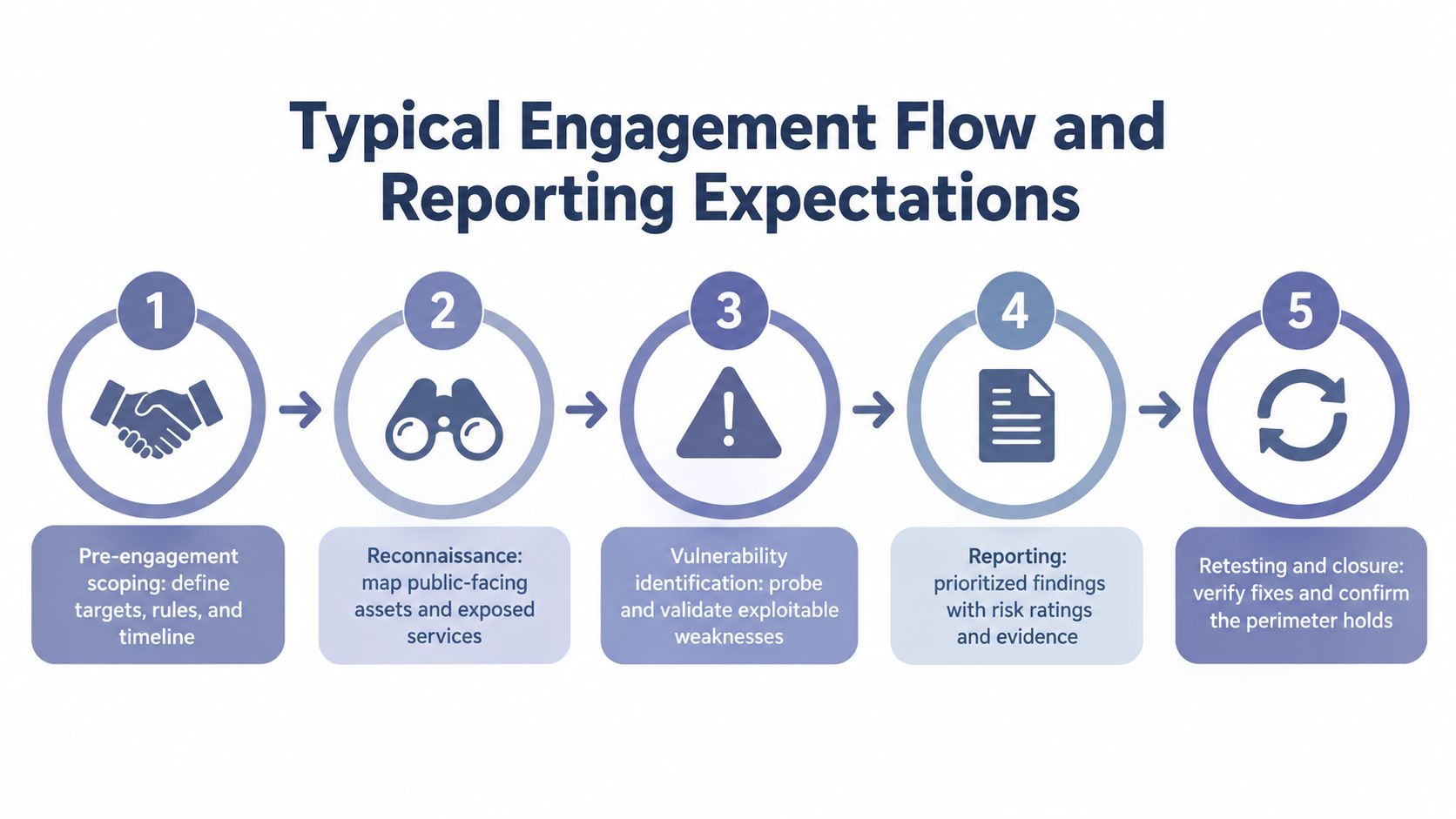
The execution usually follows a recognizable sequence:
- Scoping: Confirm authorization, assets, objectives, exclusions, and communication rules.
- Reconnaissance: Discover public-facing services, technologies, and information that can shape attack paths.
- Identification and exploitation: Use automated checks and manual techniques to validate weaknesses and assess impact.
- Verification: Reproduce findings, remove unsupported alerts, document evidence, and confirm the affected asset.
- Reporting and retesting: Deliver prioritized findings, remediation advice, executive context, and later confirmation that fixes work.
NIST's external testing model supports discovery, scanning, and attack validation, but the commercial experience depends on communication. Buyers should receive a start notice, progress updates when material access is found, immediate escalation for dangerous conditions, and a clear explanation of what wasn't tested.
Most external pentests are completed in about 3 to 5 business days, according to Bright Defense's penetration testing statistics overview. That doesn't mean every engagement fits the same schedule. Asset count, application complexity, authentication requirements, cloud permissions, reporting depth, and retesting can extend the work.
A usable report should let an engineer reproduce the issue without a call to the tester. It should also tell leadership which attack path matters most, what business exposure it creates, who owns the fix, and whether the provider verified closure.
How ThreatExploit AI Solves Common Provider Challenges
MSSPs and consultancies face a capacity problem before they face a tooling problem. Senior testers need to make judgment calls, but they shouldn't spend every engagement repeating asset discovery, launching standard checks, formatting screenshots, and copying control references into a report.
ThreatExploit AI addresses that delivery model with an autonomous penetration testing engine built for service providers. Its PTES-trained LLM and ROOT Controller coordinate reconnaissance, exploitation, verification, and reporting across the engagement. The platform orchestrates 60+ tools, including tools such as Nmap, SQLMap, and Nuclei, through autonomous subagents.
Where the operating leverage appears
A provider can use automation for repeatable reconnaissance, external network checks, web and API testing, cloud assessment tasks, evidence collection, and report assembly. Senior staff can then review high-risk attack paths, handle exceptions, tune engagement rules, and communicate business impact to the client.
That division matters because consistency is difficult to maintain when every consultant follows a slightly different process. A controlled workflow can standardize scope intake, evidence requirements, finding structure, and compliance references while preserving expert review where the result is ambiguous or consequential.
The platform supports web applications, REST and GraphQL APIs, internal and external networks, and cloud infrastructure across AWS, Azure, and GCP. It produces PDF and JSON outputs with executive and technical views, screenshots, and structured exports, while compliance mapping covers frameworks including HIPAA, SOC 2, PCI-DSS, CMMC, ISO 27001, GLBA, and GDPR.
What it doesn't replace
Automation doesn't replace authorization, careful scoping, client communication, or accountability for a dangerous test. It also can't make an unsupported finding trustworthy just because a workflow generated it. Providers still need quality gates that examine exploitability, impact, evidence, and remediation advice.
The sensible use case is operational efficiency. Let the platform absorb repetitive work and preserve a senior tester's attention for chained weaknesses, sensitive targets, business logic, and decisions that require context. That gives an MSSP a path to recurring external penetration testing services without treating quality as an unavoidable casualty of volume.
The Future of External Penetration Testing
External penetration testing is shifting from an annual snapshot toward a recurring process. One industry forecast projects growth from USD 1.82 billion in 2023 to USD 5.24 billion by 2030, with a projected 16.6% CAGR from 2024 to 2030, according to Grand View Research. A separate forecast from the same source estimates USD 2.72 billion in 2026 and USD 5.54 billion by 2031, with a projected 15.29% CAGR. It identifies North America as the largest market and Asia Pacific as the fastest-growing region.
Those figures do not mean every organization needs continuous, full-scope exploitation. They do explain the commercial shift toward recurring services that account for changing attack surfaces, cloud adoption, regulatory pressure, and the need for current security evidence.
From reports to control loops
The practical model is a feedback loop:
- Discover: Track newly exposed assets, services, APIs, and cloud changes.
- Test: Run repeatable checks against approved targets, then escalate complex attack paths.
- Verify: Demand evidence-backed findings instead of accepting scanner output without review.
- Remediate: Assign issues to owners with business context and control references.
- Retest: Confirm that the fix closes the attack path rather than changing only the visible symptom.
AI-driven attack simulation can expand coverage, while business logic and identity abuse still require close human attention. Those weaknesses often depend on how a system is used, not only on its software version. DevSecOps integrations can bring external validation closer to releases. Providers serving many customers will also need isolated tenants and dedicated infrastructure.
Where senior time is freed up
The strongest providers will sell dependable answers, not larger finding counts: what can an outsider reach, what could that access become, and can the organization prove the path is closed? Automation should handle repeatable discovery, testing, evidence collection, and report preparation. Senior testers should focus on chained weaknesses, sensitive targets, business logic, and findings where context changes the risk decision.
ThreatExploit AI provides automated external and internal penetration testing with reconnaissance, exploitation, verification, evidence collection, and compliance-mapped reporting for security service providers. See ThreatExploit AI to assess how its recurring workflow may increase delivery capacity while keeping expert review focused on decisions that require judgment.