
Gartner put worldwide end-user spending on information security at $183.9 billion in 2024 and forecast $212 billion in 2025, a 15.1% jump. In that same Gartner forecast, security software is the fastest-growing major segment, from $76.574 billion in 2024 to $87.481 billion in 2025 (14.2%), then a projected $100.692 billion in 2026, another 15.1%.
That budget doesn't buy proof by itself. Most cyber security software in an MSSP stack prevents or detects. It does not show that a flaw is reachable. I would not add another alert feed until the toolchain can validate exploitability and keep the evidence for the next test.
Table of Contents
- Cyber Security Software Categories and What Each One Does
- How Prevention Detection and Testing Work Together
- Evaluation Criteria for Testing Software
- MSSP and MSP Situations That Need Testing Software
- Where Automated Pentesting Fits the Toolchain
- Beliefs That Waste a Security Software Budget
- Run a Proof of Concept Before You Buy
Cyber Security Software Categories and What Each One Does
Cloud moves multiply identities, APIs, and edge devices, so the spend above is structural, not a one-year spike. An MSSP or MSP doesn't resell "security." It runs a short list of classes, each with one job. Drop any vendor pitch into a single row before you compare features. If it doesn't fit, you're looking at a bundle, not a control.
Smaller clients still need a plain starting point. The security software guidance for Edmonton businesses from Nerds 2 You is a useful baseline for endpoint choices before you layer managed detection on top.
Seven classes and the job each owns
Endpoint detection and response stops and investigates malware on hosts. The client sees a containment timeline and host telemetry. It prevents and detects. It does not prove that an exposed VPN is exploitable.
Identity and access management decides who can reach which system. Access reviews and MFA coverage are the visible outcome. The role is prevention. A perfect directory still leaves an unpatched edge appliance alone.
Cloud security posture management finds misconfigured cloud resources. Exposed buckets, over-broad roles, and drift are what the client can point at. That is detection of configuration, not a demonstrated break-in.
SIEM and SOAR correlate alerts and drive response playbooks. The client gets an incident timeline and ticket actions. Detect and respond. Playbooks fire on candidates. A security orchestration platform only helps if the inputs are worth acting on.
Vulnerability management inventories known weaknesses and patch status. CVE lists and patch SLAs are the deliverable. Detection again. A version match is a candidate, not evidence the bug is reachable.
Email and web gateways block phishing and malicious traffic. Blocked-threat counts are easy to show a board. Prevention. Block counts say nothing about an internet-facing admin panel.
Penetration-testing platforms are the class built to prove. The job is to validate whether a weakness is exploitable. The client-visible outcome is evidence, impact, and retest status. Scanners and detection products produce candidates and alerts. Only testing software is built to show a weakness is reachable.
| Software class | Primary job | Client-visible outcome | Role |
|---|---|---|---|
| Endpoint detection and response | Stop and investigate malware on hosts | Containment timeline and host telemetry | Prevent and detect |
| Identity and access management | Control who can reach which system | Access reviews and MFA coverage | Prevent |
| Cloud security posture management | Find misconfigured cloud resources | Exposed buckets, roles, and drift | Detect |
| SIEM and SOAR | Correlate alerts and drive response playbooks | Incident timeline and ticket actions | Detect and respond |
| Vulnerability management | Inventory known weaknesses and patch status | CVE lists and patch SLAs | Detect |
| Email and web gateways | Block phishing and malicious traffic | Blocked-threat counts | Prevent |
| Penetration-testing platform | Validate whether a weakness is exploitable | Evidence, impact, and retest status | Prove |
If a demo can't name its row, don't score its feature list. You're comparing different jobs.
How Prevention Detection and Testing Work Together
Treat the stack like a building. Locks, badges, and cameras are the preventive and detective layers. Identity controls, gateways, EDR, and SIEM. A penetration test is a supervised attempt to open a door, walk the hallway, and photograph the open safe. Cameras tell you something moved. The photograph tells you the safe was reachable.
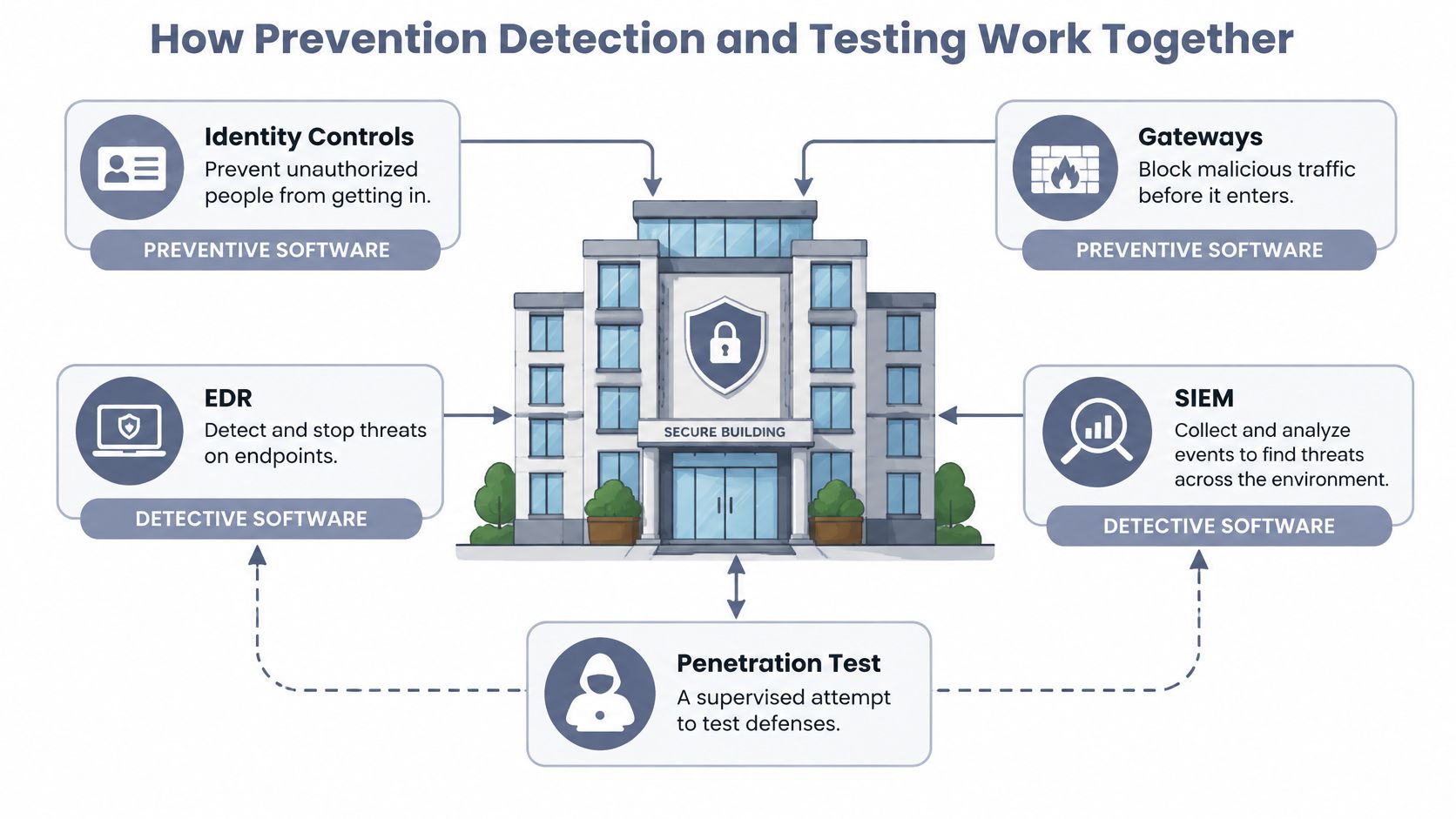
NIST Special Publication 800-115 defines the execution phase as identifying vulnerabilities and validating them when appropriate. Penetration testing and application-security testing are the validation techniques it names. That maps cleanly onto three software stages.
What each stage must leave behind
Discovery produces candidates. A vulnerable version, a suspicious response, an open service. Output is a list, not a conclusion.
Controlled exploitation checks whether the weakness is reachable and materially exploitable. The payload stays inside the written scope. Output is a yes, a no, or a stop because the test would be destructive.
Verification stores reproducible evidence. HTTP requests, response differences, command output, affected assets, and timestamps. Without the middle and last stages, a tool can report a CVE that isn't reachable, and the client spends remediation time on theory.
Reports should label findings detected, validated, or not exploitable, and keep the exact conditions so the same test can run after a fix. A production platform has to enforce written target authorization, rate limits, non-destructive payloads, rollback, and immutable audit logs.
The same flaw changes risk with exposure, authentication, privileges, and compensating controls. Web apps, APIs, networks, and cloud assets need that staged model, not one generic severity score. Email is a good miniature of the same idea. Gateway blocks are prevention, while you should verify your DMARC policy before you treat "we filter mail" as proof the domain can't be spoofed.
A severity score without a rerun condition is a note. It is not a test.
A vulnerability management program still owns the CVE inventory. It doesn't replace the validation stages. The criteria below are how you test whether a product separates them.
Evaluation Criteria for Testing Software
Buyers keep scoring AI features. Governance is the gap. The 2026 World Economic Forum–Accenture cybersecurity outlook found organizations that review AI-tool security periodically rose from 24% to 40%, while roughly one-third still had no process to validate AI security before deployment. Insufficient expertise was the leading adoption barrier at 54%, then human oversight at 41%, and uncertainty about risk at 39%.
Score a proof of concept on evidence, not on an autonomous claim. CISA's penetration testing service rules require rules of engagement signed by both parties, agreed times, predetermined systems, a live technical contact, and verification such as a file or screenshots when access is gained. OWASP's security-testing guidance expects the report to show how a vulnerability was exploited, and allows an application-security engineer to strip false positives before developers are assigned work.
Pass or fail language for a POC
| Criterion | What good looks like | Red flag |
|---|---|---|
| Authorization | Signed rules of engagement, agreed windows, named targets, live contact | Testing starts from a target list with no written scope |
| Verification states | Detected, validated, and not exploitable kept distinct | Every CVE is reported as confirmed |
| Evidence | Requests, screenshots, command output, timestamps, retest conditions | A severity score with no reproduction steps |
| Surface coverage | Web, REST and GraphQL APIs, internal and external networks, AWS, Azure, and GCP | Web-only scanner sold as full pentesting |
| Authenticated versus external | Separate unauthenticated attack-surface and authenticated admin checks | One scan mode for every asset |
| Compliance mapping | Control references for SOC 2, PCI DSS, ISO 27001, HIPAA, CMMC, GLBA, and GDPR | A generic risk paragraph with no control IDs |
| Human oversight | Named reviewer before findings reach developers | Claim that the model acts with no approval |
| Recurrence and AI assurance | Retests, a cloud-frequency option, a log of what was not tested and who approved it | Annual PDF and an AI badge with no change log |
Authorization fails if the vendor starts from a hostname list and calls the contract later. Verification fails if every CVE is "confirmed." Evidence fails when you can't rerun the exact request. Coverage fails when REST and GraphQL, internal networks, or AWS, Azure, and GCP are a slide, not a target type. Keep unauthenticated and authenticated runs in separate outputs so external attack surface isn't mixed with admin-only issues.
Compliance mapping has to cite control IDs an auditor already uses. A risk paragraph won't survive sampling. Human oversight means a named approver. AI assurance means you can see what data the model touched, where that data went, how behavior is rechecked, and what the system could not test.
If a vendor can't show evidence, scope limits, and a reviewer, treat the product as a scanner regardless of the AI label.
MSSP and MSP Situations That Need Testing Software
Senior testers are scarce and expensive. A careful manual assessor finishes only a few thorough tests a month. One resignation stops the pipeline for every client on that person's book. Software has to add throughput without a new hire per logo. That is a delivery constraint, not a staffing slogan.
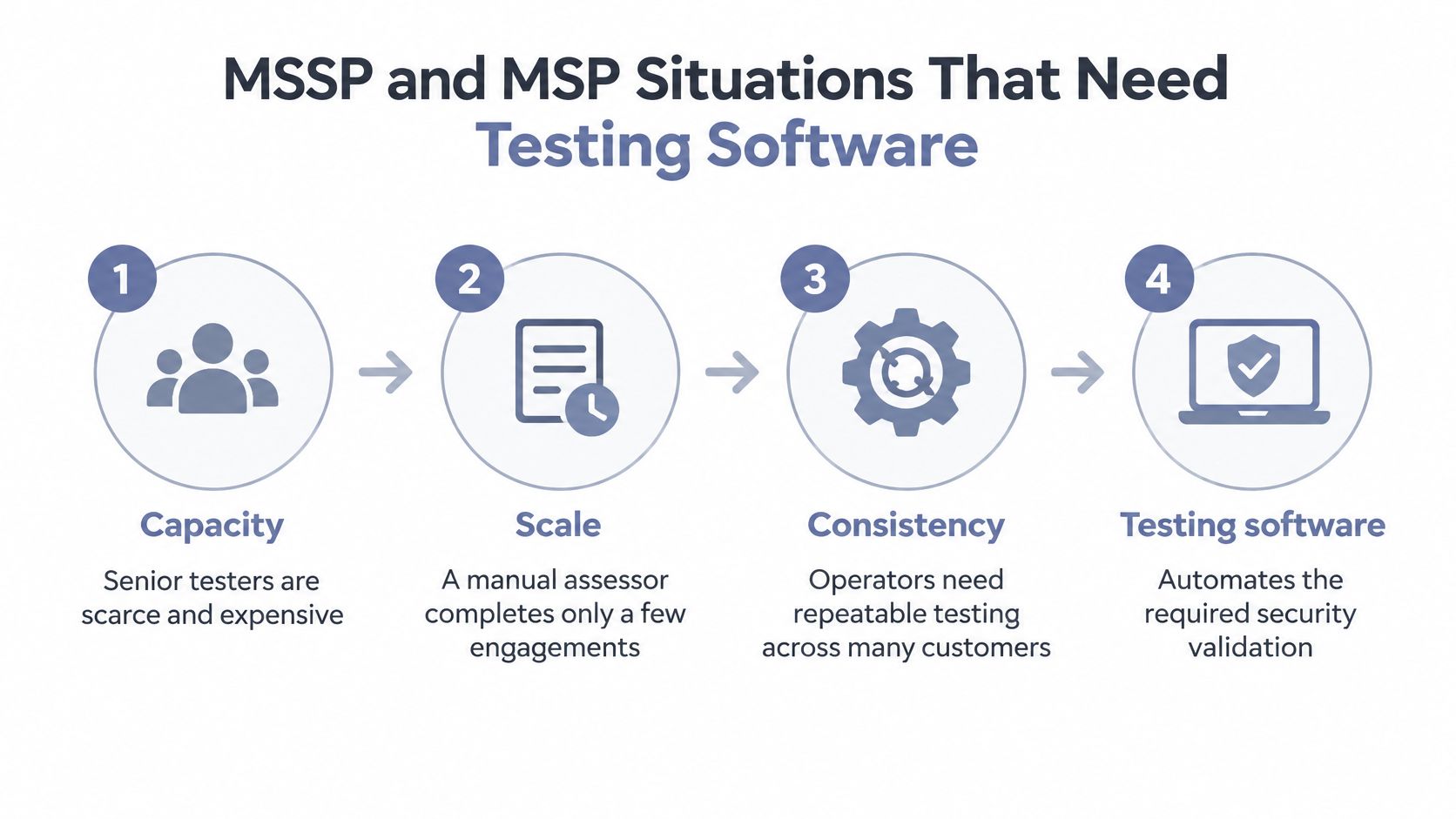
Four jobs the calendar actually creates
Capacity. You already sold recurring tests. The bench can't absorb the next ten tenants. The software job is repeatable execution against a locked scope so seniors review evidence instead of rediscovering open ports.
The deadline that moved. A SOC 2 auditor wants something current in days. A deal needs a test by Friday. A PCI DSS assessor adds external testing mid-audit. A multi-week scheduling queue can't answer that. The platform has to scope the same day and return an evidence-backed report in hours to a few days.
The sales motion. A short prospecting test that shows one verified issue opens a managed-service conversation. A slide of alert volume doesn't. The software job is a small, authorized proof, not a fear deck.
Edge and VPN exposure. In Verizon's 2025 Data Breach Investigations Report, exploitation of vulnerabilities accounted for 20% of initial access, and edge devices and VPNs were 22% of vulnerability-exploitation targets, up almost eight-fold from 3%. Verizon analyzed more than 22,000 incidents, including 12,195 confirmed breaches.
So inventory internet-facing appliances, VPN gateways, and remote-access versions continuously. Correlate that inventory with known vulnerabilities, exploit availability, authentication, and compensating controls. A severe CVE on an isolated host can wait behind a moderate flaw on an exposed VPN concentrator. Run authenticated and unauthenticated tests separately. Unauthenticated work measures the outside. Authenticated checks find issues behind admin interfaces. Safe proof stays minimally invasive and explicitly authorized.
CISA's supply-chain guidance for developers says test as routinely as possible and not less than once a year, more often for cloud products, with announced and unannounced exercises plus an assumed-breach path. High-impact findings from earlier tests should be fixed and should not reappear.
This is for MSSPs, MSPs adding security testing, telecom and hosting providers, and audit firms running PCI DSS, SOC 2, or ISO 27001 work.
Where Automated Pentesting Fits the Toolchain
The other tools already alert. Many still miss the application and API surface, and they leave teams sorting exploitable bugs from theory. The recurring complaints are practical: limited visibility across apps and APIs, noisy findings, and weak integration with the systems that carry tickets and release work.
Automated pentesting sits in the middle, after vulnerability and exposure data, before human sign-off and the client report. It adds proof where monitoring stops.
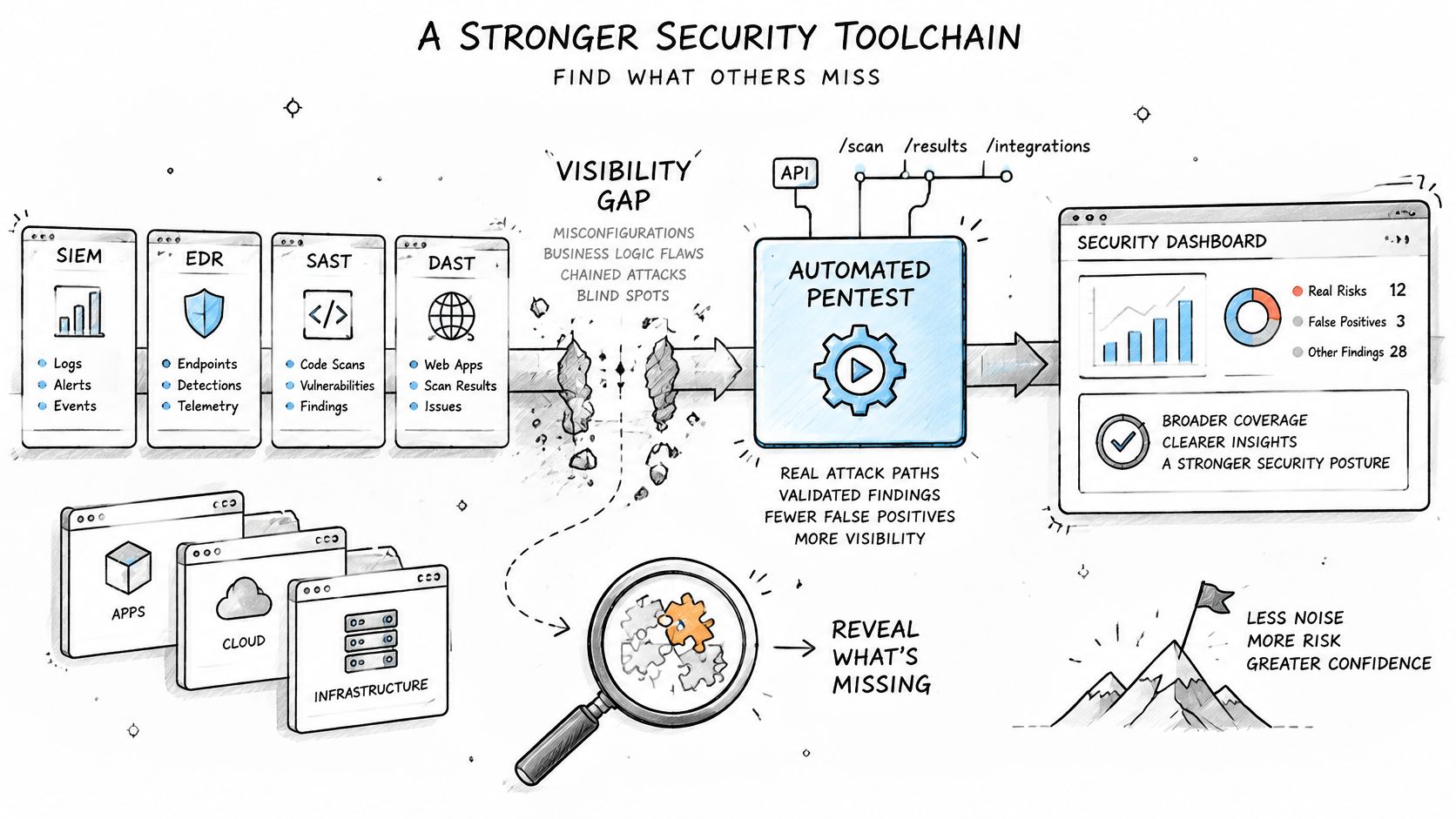
Seven steps and one output each
- Onboard the tenant. Lock scope, windows, and written authorization. Output is a signed target list.
- Reconnaissance. Inventory web apps, APIs, networks, and cloud accounts. Output is an asset map tied to that tenant.
- Candidate generation. Orchestrated utilities such as Nmap, SQLMap, and Nuclei propose candidates. Output is an unconfirmed list.
- Scoped exploitation. An agentic controller runs penetration-testing phases only inside that scope. Output is an attempted path, stopped at the boundary.
- Verification. Keep a finding only when evidence exists. Output is requests, screenshots, and timestamps, or a discard.
- Human review. A reviewer drops anything still uncertain. Mandatory for business logic and creative attack chains. Output is an accept or reject with a name on it.
- Reporting. PDF and JSON, executive and technical, mapped to the client's framework and exported to ticketing or CI/CD. Output is something an auditor can sample.
Automation covers breadth, speed, and the same method on every tenant, with retests on a schedule. It reaches its limit at novel business-logic abuse and unusual attack chains. Those judgment calls stay with the tester. If you want a plain account of scope and authorization before you automate any of this, how authorised network testing works is a clear walkthrough of what a customer should expect.
ThreatExploit AI is one MSSP-oriented option in that middle slot. It pairs a pentest-trained model and a ROOT Controller across PTES phases, runs partner-scoped servers in America, Europe, and Asia, keeps tenants separate, and maps output to compliance controls.
Scanners feed it. Humans approve it. Auditors sample the mapped evidence.
The short walkthrough below shows how a scoped automated run is meant to look in practice, from authorization through a reviewed report.
Beliefs That Waste a Security Software Budget
Vendor decks repeat four claims. Each one has an operational cost.
"More alerts mean more security." Unvalidated findings become developer time. The cost is rework, and the queue fills with theory while the exposed appliance waits.
"A scanner is a penetration test." A version match is a candidate. The cost is a missed external attack surface, because the report never tried the door.
"AI replaces the tester." Very few teams trust a model to act alone, and business logic still needs a person. The useful model is hybrid. The cost of skipping review is inconsistent reports across tenants, which is fatal when two auditors compare your work.
"Once a year is enough." Edge and VPN exploitation grew sharply, and cloud products need a shorter cycle. A finding that returns means the control failed. The cost is a compliance file that is fourteen months old when the auditor arrives.
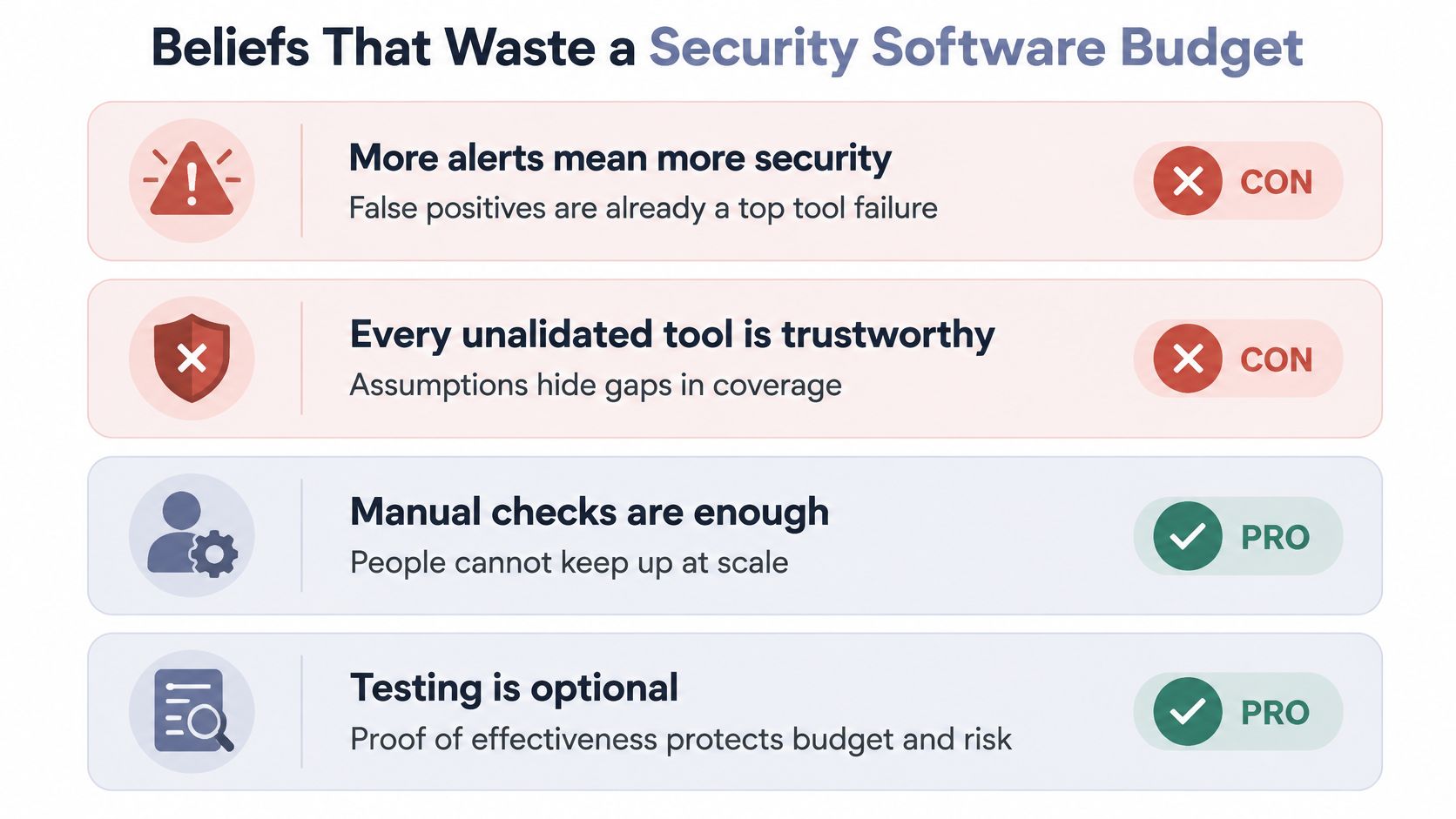
Judge the software by what it could not test and who signed the result, not by how autonomous the brochure sounds.
Price the review time before you price the license. A managed security service provider pricing model that ignores retest labor will look cheap until the second cycle. Run a short proof of concept. Don't buy from a feature matrix.
Run a Proof of Concept Before You Buy
Give the vendor one week and one real scope. Don't sit through another taxonomy.
- Pick a client-like target. One external web app or API, plus one VPN or edge appliance. Written authorization and a maintenance window come first.
- Demand three outputs before the demo ends. A validated finding with screenshots, one item marked not exploitable or out of scope, and a control mapping an auditor would recognize.
- Time the run. A platform aimed at service providers should return an evidence-backed report in hours, not a multi-week queue.
- Make a human accept or reject each finding. Record what the system could not test. That log is part of the product.
- Check the operations you'll live with. Tenant onboarding, role-based access, API or CI/CD hooks, PDF and JSON delivery, and whether infrastructure is dedicated rather than shared across strangers.
ThreatExploit AI is built for that provider workflow. It runs reconnaissance through reporting on web, network, and cloud targets, maps findings to compliance controls, and gives partners a dashboard. Plans run from Starter through Enterprise, with a free trial and optional on-premise deployment. Use the trial on the scoped target from step 1.
Keep the engagement only if the evidence, the human review trail, and the retest are all present. If a product can only export a CVE list, leave it in the vulnerability-management row and buy a testing platform separately.
ThreatExploit AI gives MSSPs and MSPs an automated penetration-testing workflow that validates exploitability, keeps the evidence, and maps results to the frameworks your clients already audit against. It sits in the gap between vulnerability lists and a signed human review, on web, network, and cloud targets. Visit ThreatExploit AI and run the trial against one authorized scope before you add another alert feed.