
Audit week has a predictable breaking point. Your Qualified Security Assessor (QSA) or ISO lead auditor opens the evidence request list and asks for proof that the high-severity findings from last quarter's penetration test were remediated and retested inside the review window. Your engineering lead drops a zip folder of unnamed screenshots into chat, someone else forwards a three-month-old PDF report, and a Slack message from six weeks ago says the patch went live.
None of those fragments answer the auditor's actual question. They show that a test happened once and that someone claims a fix shipped, yet nothing connects a specific regulatory clause to an affected asset, a named owner, an immutable proof artifact, and a verified retest date. That disconnect is where penetration testing stops supporting compliance and turns into a last-minute scramble.
A practical compliance matrix example solves that gap by treating penetration-test findings and their follow-up retests as a living evidence trail. Instead of marking a control "compliant" because a requirement appears on a spreadsheet, each row proves whether the underlying safeguard operated during the audit period. What follows is a working template built from real penetration-testing mechanics, complete with the exact columns, multi-framework mapping rules, and PCI DSS testing triggers assessors look for.
Table of Contents
- A Compliance Matrix Example You Can Copy
- Why a Compliance Matrix Beats a Checklist
- The Columns Every Reusable Template Needs
- Mapping One Pentest Finding to Several Frameworks
- Proving Controls Operated and What Tests Cannot Prove
- Testing Frequency Rows for PCI DSS Matrices
- Choosing a Spreadsheet or GRC Platform
- Build Your Matrix Before the Next Audit
A Compliance Matrix Example You Can Copy
Say an auditor asks for proof that the findings from last quarter's web portal penetration test were fixed. The security team has a shared drive full of raw Burp Suite screenshots and command outputs, yet no single document ties those files to PCI DSS or ISO/IEC 27001 clauses. Rebuilding that traceability under a 48-hour audit deadline wastes senior engineering time and often leaves remediated bugs looking unresolved.
Here is a working compliance matrix example built from a single penetration test of a client web portal. Every row follows the same six-column structure you can drop straight into any engagement.
| Requirement ID | Test performed | Evidence ID | Owner | Status | Next action |
|---|---|---|---|---|---|
| PCI DSS v4.0.1 Req 6 | SQL injection on login form | EV-014 (SQLMap output, screenshot) | AppSec lead | Open | Retest after patch |
| PCI DSS v4.0.1 Req 8 | Password reset lacks lockout | EV-019 (Auth trace, retest log) | Identity owner | Closed | Verified, date recorded |
| PCI DSS v4.0.1 Req 11.4 | Guest VLAN reaches cardholder network | EV-022 (Packet capture, route trace) | Network lead | Failed, fix scheduled | Segmentation retest within six months |
| PCI DSS v4.0.1 Req 11.4 | External penetration test | EV-001 (Signed report, scope sheet) | Compliance manager | Passed | Next test within 12 months |
| ISO 27001 Annex A access control | Authenticated object-reference flaw in REST API | EV-027 (HTTP request/response) | Platform team lead | Open | Retest 14 days after fix |
Walk across the first row to see how the template works in practice. The finding maps to PCI DSS v4.0.1 Requirement 6, which governs secure systems and software across the standard's 12 principal requirement areas outlined in the PCI Security Standards Council summary of changes. During active testing, the pentester exploited a SQL injection vulnerability on the portal's login form and saved the SQLMap command output alongside a timestamped browser screenshot under artifact EV-014.
That row assigns clear accountability to the AppSec lead, keeps the status explicitly Open, and sets the next action as a targeted retest once the parameterized query patch reaches production. As detailed in Synack's guide to PCI compliance penetration testing, audit-ready documentation goes beyond proving a report exists by linking each exploitable finding to the affected attack path, observed proof such as request data or command output, remediation progress, and follow-up verification.
Three Habits That Keep the Template Working
Copying the table layout takes two minutes, yet the template only holds up under assessor scrutiny when your team enforces three strict operating habits:
- Lock the requirement ID with the framework version: Never write "PCI Req 6" in a matrix cell. Testing expectations shifted between PCI DSS v3.2.1, v4.0, and v4.0.1, so pinning the exact version prevents an auditor from rejecting valid evidence as outdated or misclassified.
- Use one evidence ID per artifact instead of folder paths: Shared drive folders drift when teammates rename directories or overwrite files. Giving each screenshot, packet capture, or log file a permanent identifier like
EV-014guarantees that the matrix row points to the exact proof observed during the test. - Change a row's status only when a retest produces new evidence: A closed Jira ticket or a developer's confirmation in Slack doesn't close a compliance row. The status moves from Open to Closed only after a tester verifies the patch and logs a fresh retest artifact.
Before handing any matrix to an assessor, run a quick sanity check across every line. If a single row can't immediately tell you who owns it, what was tested, what artifact proves the result, and when it was last verified, the row isn't finished yet.
Why a Compliance Matrix Beats a Checklist
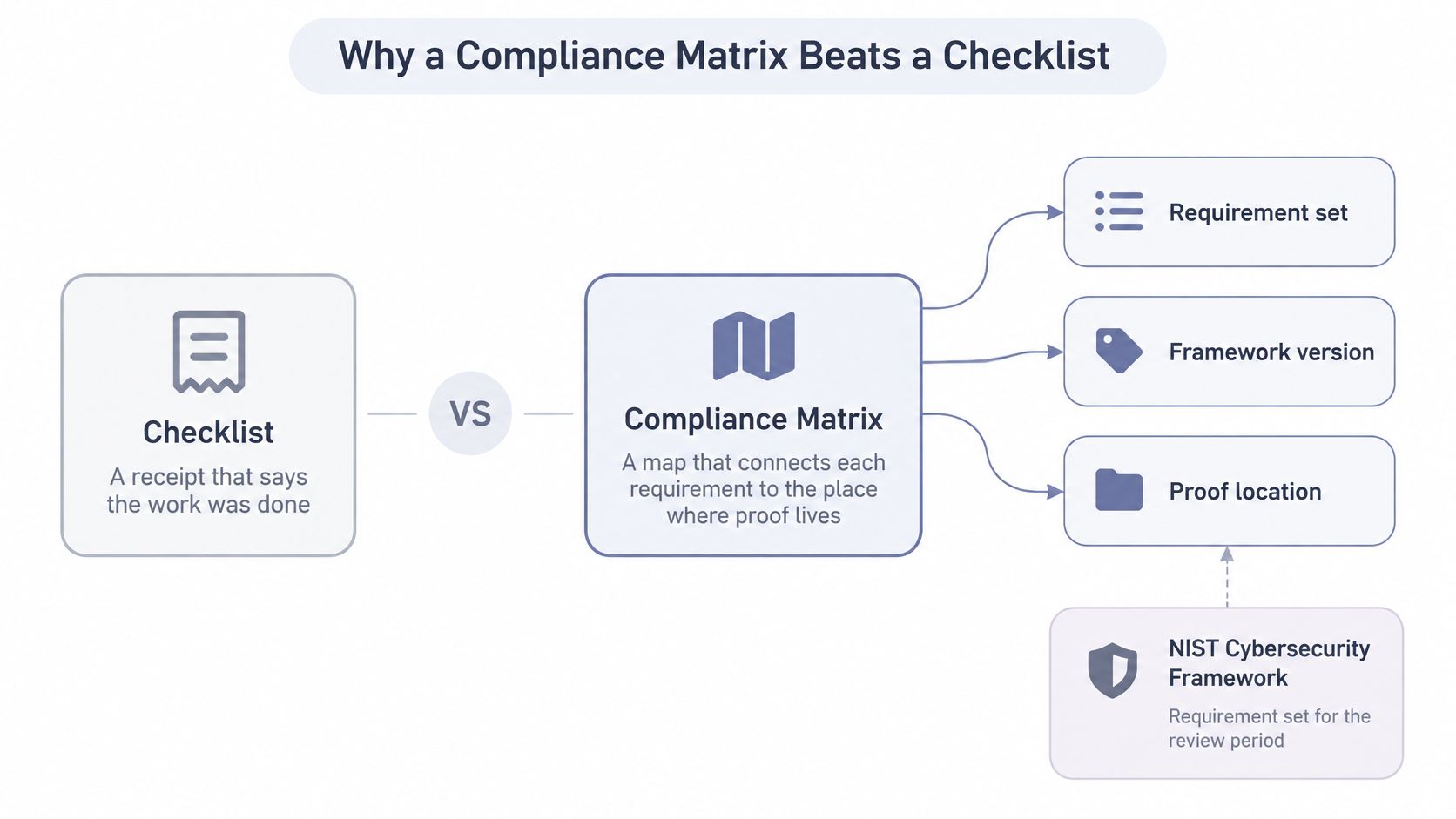
A checklist is a receipt that says someone finished a task. A compliance matrix is a map that connects each regulatory obligation to the exact place where verifiable proof lives. In penetration testing, that difference decides whether an audit closes in one afternoon or triggers weeks of follow-up sampling.
Modern security frameworks are designed for structured traceability, not binary yes-or-no checkboxes. The NIST Cybersecurity Framework (CSF) 2.0, published on February 26, 2024, organizes cybersecurity outcomes into six Functions (Govern, Identify, Protect, Detect, Respond, and Recover) and 22 Categories, including Asset Management, Risk Assessment, Identity Management, Data Security, Continuous Monitoring, Incident Management, and Incident Recovery Plan Execution. Adding the Govern Function expanded the framework beyond isolated technical safeguards to bind policy, risk strategy, roles, and supply-chain oversight directly to operational security work.
Because CSF 2.0 separates outcomes cleanly, a single matrix row can carry both a Function and a Category right beside the technical penetration-test finding. For instance, a broken access-control flaw discovered during a web application test maps directly to Identity Management, Authentication, and Access Control. Meanwhile, an engagement where active exploitation triggered zero SIEM alerts maps straight to Continuous Monitoring.
Structured tracking remains far less common than most engineering leaders expect. According to the UK Department for Science, Innovation and Technology 2025 Cyber Security Breaches Survey, only 29% of surveyed UK businesses reported conducting cybersecurity risk assessments in 2025, compared with 31% in 2024. When organizations skip structured assessment tracking, they usually fall back on static compliance checklists right before an audit deadline.
Traceability Versus a Green Checkmark
A green tick next to "Annual Penetration Test Complete" hides everything an assessor cares about. It conceals whether the test covered the production API, whether exploitable vulnerabilities were discovered, who accepted remediation responsibility, and whether the fixes held. By contrast, a matrix acts as a traceability mechanism uniting the observed technical condition, the exact framework requirement, the named owner, the immutable evidence ID, and the verified outcome on one readable line.
Security teams looking to standardize how raw technical outputs feed executive and audit deliverables often pair their matrix templates with structured processes for building audit-ready reporting workflows from Nutmeg Technologies. Keeping those workflows tightly coupled prevents penetration-test artifacts from sitting in an isolated security repository while compliance managers manually guess at control statuses.
Audit reality check: Pick one green checkmark on a checklist your team already maintains. If you can't name the exact file proving that control worked, the person who reviewed it, and the date it was last verified in under thirty seconds, that checklist won't survive a thorough audit.
The Columns Every Reusable Template Needs
The six-column matrix from the web portal scenario gets a single engagement off the ground fast. When you run recurring tests across multiple clients, cloud accounts, or audit standards, you need a slightly deeper schema that survives personnel turnover and strict assessor sampling. A reusable nine-column template captures every detail required to turn raw testing into defensible evidence.
Start with Requirement ID and Control statement. The Requirement ID pins the exact framework version and clause, such as PCI DSS v4.0.1, Req 11.4, while the Control statement translates that obligation into plain language describing what your organization runs. Keeping your own control phrasing separate from verbatim standard text stops engineers from guessing how an abstract regulatory clause translates to their production stack.
Next, anchor the test legally and technically using Scope and asset, Authorization, and Test method. Scope and asset name the exact target system, environment tier, and system owner so nobody confuses a staging sandbox with a live production portal. Following the planning phase outlined in NIST Special Publication 800-115, which divides penetration testing into four phases (planning, discovery, attack, and reporting), teams must establish authorized scope, management approval, and rules of engagement before any technical probing starts.
In the Authorization column, cite the signed permission file proving the tester had the legal right to target that asset. Accepted authorization documents include ownership records, a signed authorization or rules-of-engagement document, or domain/asset control validation. Right beside it, Test method specifies the exact technical procedure performed, such as an authenticated black-box API test or internal network pivoting, replacing vague labels like "security review."
| Column | What to record | Example value |
|---|---|---|
| Requirement ID | Exact clause and framework version | PCI DSS v4.0.1, Req 11.4 |
| Control statement | Your own control in plain words | Quarterly external attack surface review |
| Scope and asset | System, environment and owner | Customer portal, production, owned by platform lead |
| Authorization | Document proving the right to test | Signed rules-of-engagement file, dated |
| Test method | Procedure used | Authenticated black-box API test |
| Evidence ID | Immutable artifact reference with timestamp and tester identity | EV-2025-041, 2025-03-14T16:20Z, Tester A. Chen |
| Result | Observed outcome | Exploited, partially exploited or not exploited |
| Owner and due date | Accountable person and remediation deadline | Platform lead, 14 days |
| Retest and applicability | New evidence ID and reason for any exclusion | EV-2025-058 (retest passed); N/A rationale logged if out of scope |
The final four columns handle proof and remediation discipline. Evidence ID links each row to an immutable artifact stamped with the UTC timestamp and tester identity. As NIST SP 800-53A specifies, keeping assessment determination statements directly linked to underlying control functionality and retaining assessment records ensures repeatable assessor actions and audit trails that support evidence reuse.
Result records the objective technical outcome as exploited, partially exploited, or not exploited, stripping out subjective grading. Owner and due date pair one named individual with a concrete remediation deadline, eliminating the classic trap where a team alias like "DevOps" lets critical patches slip past SLA.
Why Applicability Rationale Belongs in Its Own Column
The Retest and applicability field does two jobs that auditors inspect closely. For remediated findings, it logs the brand-new evidence ID produced by the follow-up verification test so the original discovery proof stays untouched. For controls intentionally excluded from your environment, it records the explicit applicability rationale.
Under the ISO/IEC 27001 Statement of Applicability auditing guidance, organizations compare their necessary controls against Annex A while preserving applicability rationale separately from implementation status. An excluded control isn't the same thing as an implemented control, and conflating the two is one of the fastest ways to trigger a nonconformity. Once you lock these nine columns, the schema stays identical across SOC 2, ISO 27001, PCI DSS, and NIST CSF engagements. Only the requirement IDs change.
Mapping One Pentest Finding to Several Frameworks
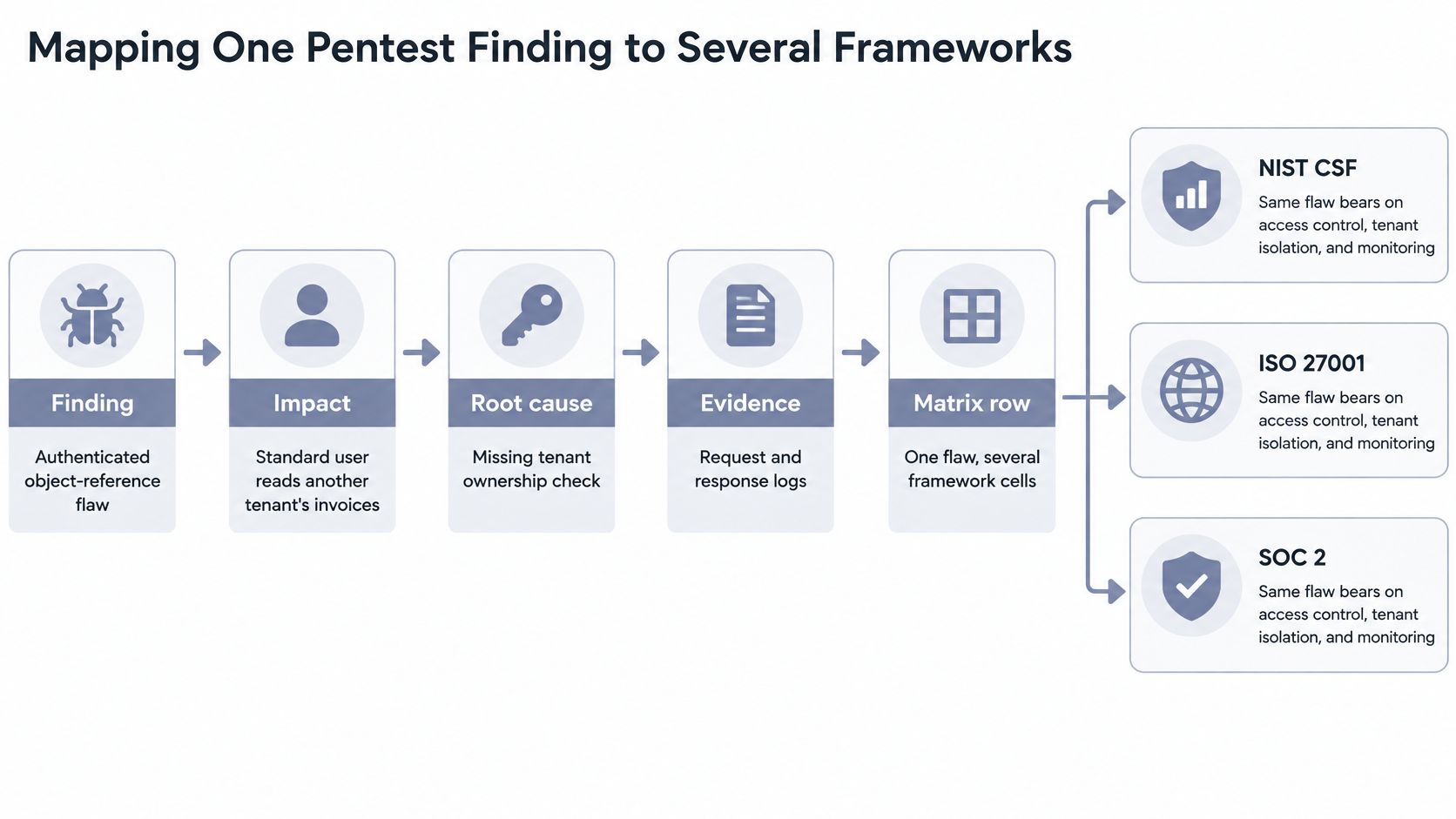
Most security teams waste dozens of hours re-running or re-documenting the same technical tests for separate audits. Consider one concrete finding from an API engagement: an authenticated object-reference flaw (IDOR) in a multi-tenant REST API that allows any logged-in standard user to view another tenant's billing invoices by incrementing the invoice identifier in a GET request.
During active testing, a senior tester doesn't label this generically as "OWASP tested." The OWASP Web Security Testing Guide breaks active web-application security testing into 12 distinct categories, including authorization, authentication, session management, injection, business logic, and API testing, following a passive stage that maps endpoints, HTTP headers, parameters, and cookies. Tagging the invoice flaw under OWASP authorization and API testing establishes exactly which security domain failed.
That single broken ownership check ripples across multiple compliance frameworks at once. It bears directly on ISO/IEC 27001 Annex A access-control objectives, triggers PCI DSS Requirements 6, 7, and 8 (secure software development, restricting access by business need-to-know, and identifying and authenticating users), impacts logical access criteria under SOC 2, and maps to Identity Management, Authentication, and Access Control in NIST CSF. Teams aligning overlapping audit scopes can streamline this crosswalk by pairing technical findings with a structured SOC 2 to ISO 27001 control mapping so one verified fix feeds both programs.
Six Steps to Map One Finding Across Standards
Rather than cloning the same bug across four disconnected spreadsheets, manage the multi-framework mapping on one canonical row using this sequence:
- Record the finding once with a unique evidence ID: Anchoring the bug to one master ID prevents conflicting remediation statuses across separate audit trackers.
- Attach the raw HTTP request/response capture and affected endpoint: Storing the exact API route and tenant-swapped payload proves exploitation without forcing the auditor to interpret a prose summary.
- Map the finding to every applicable framework clause: List the exact ISO 27001, PCI DSS, SOC 2, and NIST CSF identifiers affected by the missing tenant check.
- Tag each framework cell with a relationship label: Mark every cell as direct, partial, inherited, compensating, or not applicable so nobody mistakes a narrow code test for total control coverage.
- Assign distinct owners per framework cell when accountability splits: The platform engineering lead may own the API patch for PCI DSS Requirement 6, while the security operations lead owns the related SOC 2 access-monitoring control.
- Link one remediation ticket and one verification retest across all mapped cells: When the engineering team adds server-side tenant validation and the tester confirms a
403 Forbiddenresponse on retest, that single new evidence ID updates every linked clause together.
Partial Mappings and Cloud Shared-Responsibility Limits
Marking relationship types saves you from awkward auditor pushback. In our invoice IDOR example, the SOC 2 logical access cell must be tagged partial, not direct. Proving that the REST API now rejects cross-tenant invoice requests verifies application authorization logic, yet it says nothing about employee background checks, onboarding approvals, quarterly access reviews, or timely offboarding.
Multi-tenant SaaS, cloud, and managed-hosting architectures add another layer of nuance. For every mapped cell, record the exact scope, the shared-responsibility boundary, and the expected evidence cadence, because a cloud or managed-service provider's penetration test supports only the slice of the control they operate.
Testing rules also stop sharply at provider boundaries. Customers may not test third-party infrastructure or services such as cloud, hosting, telecom, or SaaS providers without complying with those providers' testing policies and obtaining any required authorization. Recording that third-party boundary directly in the matrix's authorization column explains to assessors why certain underlying infrastructure layers are marked inherited or not applicable rather than tested directly.
Proving Controls Operated and What Tests Cannot Prove
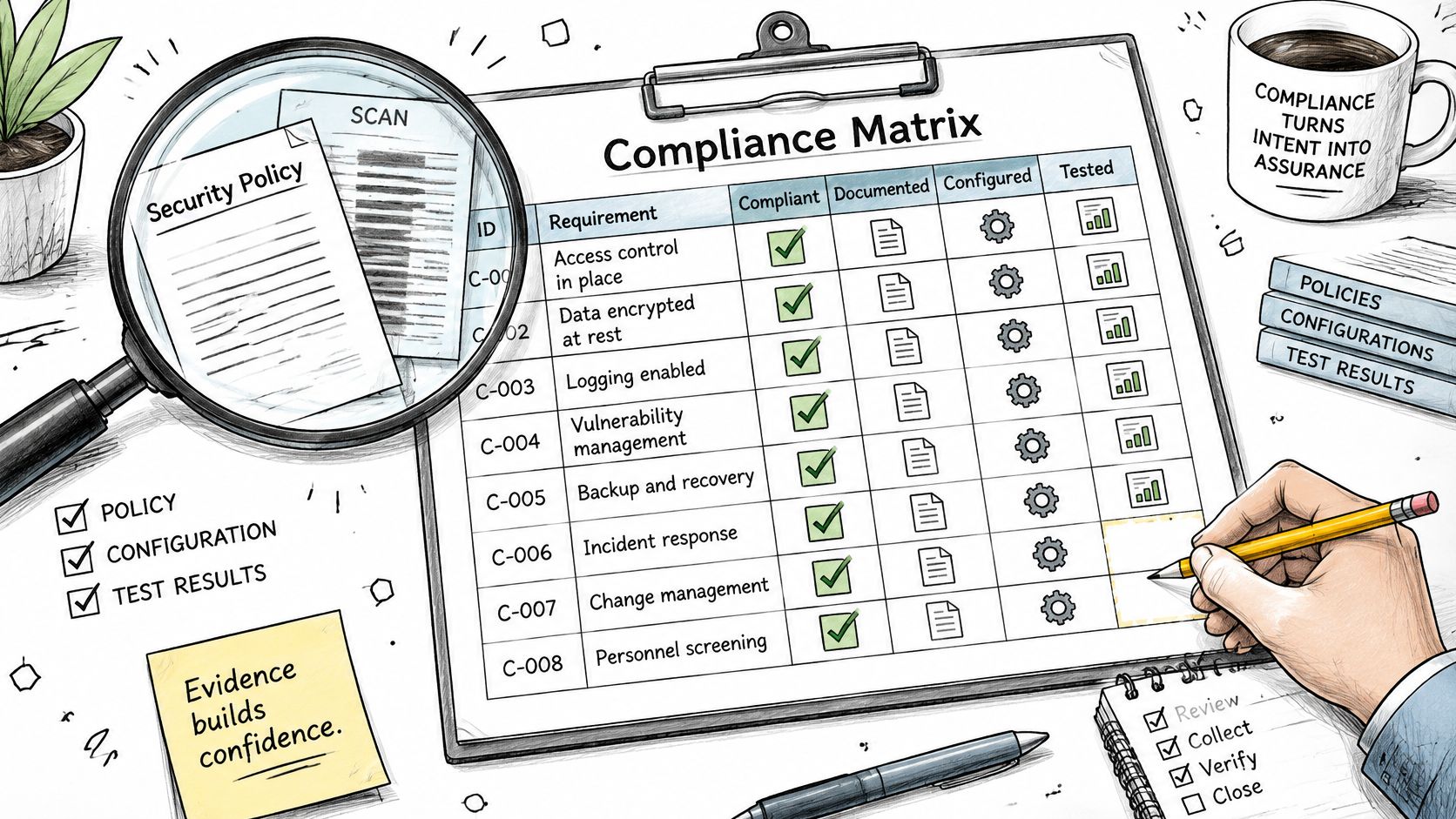
The single most common audit failure in penetration-testing compliance matrices looks deceptively healthy at a glance. Every row is shaded green and reads "Compliant" because someone uploaded a written policy document or ran a single vulnerability scan nine months earlier. When an assessor asks how the team knows that control worked throughout the entire audit window, the green spreadsheet collapses.
As audit guidance from Lazarus Alliance emphasizes, a policy PDF, static screenshot, or one-off scan may demonstrate control design, yet it fails to prove operating effectiveness over the review period. Adding dozens of superficial framework crosswalks doesn't strengthen audit readiness. Tight evidence traceability and fresh, dated verification matter far more than how many regulatory clauses you manage to cram into a workbook.
Three Evidence States That Stop False Assurance
To stop teams from confusing paperwork with proof, replace generic "Compliant" statuses with three strict evidence states:
- Documented: A written policy, standard, or architecture diagram exists. This confirms control design only and never satisfies operating effectiveness on its own.
- Implemented: The safeguard is actively configured in the target system, backed by a configuration export, IaC manifest, or dated console screenshot captured inside the review period.
- Verified: Current, repeatable evidence demonstrates that the control operated across the review period, backed by dated penetration-test results, remediation ticket closures, retest artifacts, and timestamped monitoring logs.
Test those three states against a real control like outbound network segmentation. A written network isolation policy puts the row at Documented. Exporting the active firewall rule table during Q2 moves it to Implemented. Running segmentation penetration tests across the review window, paired with a targeted retest after every firewall rule change, is what earns a Verified status.
A point-in-time penetration test demonstrates design and technical behavior at one specific moment. A documented retest after a fix proves that the patch closed the attack path. Together, they establish a verifiable timeline, yet even the cleanest technical test stops short of full compliance coverage.
Where Penetration-Test Evidence Stops
Security teams frequently ask whether one penetration-test report can satisfy all mapped compliance controls across a framework. The candid answer is no. As demonstrated by the NIST Privacy Framework CCPA regulations crosswalk, framework mappings are directional references rather than universal equivalences, and a crosswalk never proves compliance by itself. Every mapped cell still requires its own supporting artifact, such as a system log, remediation ticket, or signed review, alongside documented exceptions and residual risk.
Penetration testing validates technical conditions and proves that active security testing took place. What a pentest report cannot prove is just as important to record explicitly in your matrix:
- Executive governance and policy approval: An exploit test doesn't confirm that leadership reviewed, signed, and distributed security policies on schedule.
- Personnel screening and security awareness training: Scanning an API won't tell an assessor whether engineers completed annual secure-coding training or passed pre-employment checks.
- Periodic administrative reviews: Verifying tenant isolation in code doesn't prove that IT managers executed quarterly user access reviews or revoked terminated accounts on time.
- Vendor risk management and continuous daily operation: A quarterly or annual test can't confirm that you assessed upstream SaaS vendors or maintained clean configurations every day between test windows.
Organizing technical test artifacts alongside those administrative records requires disciplined compliance documentation practices so auditors see both sides of the control clearly.
Never mark a matrix row verified unless it cites dated evidence inside the review period plus a retest or repeated operational log. If a penetration test supports only the technical slice of a control, label that cell partial, never covered.
Testing Frequency Rows for PCI DSS Matrices
Compliance matrices built for payment card environments break down fast when teams try to cram all testing obligations into a single "Annual Pentest" row. Under PCI DSS v4.0.1 Requirement 11.4, applicable organizations must perform internal and external penetration testing at least once every 12 months and after any significant changes to infrastructure, applications, or network segmentation, as detailed in Software Secured's PCI DSS penetration testing guide.
Where network segmentation isolates the cardholder data environment (CDE) from corporate networks, teams must also test those segmentation controls to verify that out-of-scope systems can't reach the CDE through any unintended route. Service providers carry an even tighter obligation: they must test segmentation controls at least every six months and after any changes to the segmentation controls or methods.
If your matrix tracks only one annual completion date, two things happen. First, service providers routinely miss their six-month segmentation window. Second, major cloud migrations, firewall overhauls, or new payment API deployments go live without generating a traceable change-triggered test row.
To keep recurring engagements on schedule, split PCI DSS Requirement 11.4 into five distinct row types: external testing, internal testing, segmentation testing, change-triggered testing, and remediation retesting. Structuring your PCI DSS compliance testing program around separate trigger rows turns your compliance matrix into an operational calendar instead of an after-the-fact archive.
PCI DSS Triggers Mapped to Matrix Rows
Use the reference table below to set recurring calendar triggers and next-due dates for every payment environment in scope.
| Trigger | Required test | Matrix row | Evidence to store |
|---|---|---|---|
| Every 12 months | Internal and external penetration test | One row per test type | Signed report and scope list |
| Significant change to infrastructure, applications or segmentation | Retest of affected systems | New row linked to the change ticket | Change record and retest output |
| Every six months for service providers | Segmentation control test | Separate segmentation row | Test results and firewall rule differences |
| Remediation of an exploitable finding | Follow-up test confirming the fix | Finding row updated, original kept | New evidence record with date |
Pay close attention to the final row. Whenever engineers patch an exploitable vulnerability, the follow-up test must generate a new evidence record rather than overwriting the original finding's screenshot or command output. Preserving both artifacts side by side allows your QSA to verify initial discovery, root-cause remediation, and post-fix exploitation resistance as three distinct, timestamped events.
Choosing a Spreadsheet or GRC Platform
Decide where your compliance matrix will live before row counts multiply across frameworks and cloud accounts. Industry adoption has already tilted heavily toward dedicated tooling for multi-client operators. In 2025, 66% of managed service and security providers surveyed by Apptega reported primarily using a GRC or compliance-automation platform, while 16% relied mainly on spreadsheets.
Still, I wouldn't automatically buy an enterprise GRC tool for a single small engagement. A locked Excel or Google Sheets workbook works well for one target environment and one framework, provided you freeze the nine columns, enforce data validation on status and relationship labels, and link every evidence ID to a read-only artifact repository from day one.
The tipping point arrives as soon as your matrix stretches across multiple frameworks, shared controls, service-provider six-month schedules, or distributed cloud estates. Cloud misconfigurations and fragmented ownership are already driving audit failures at scale. In 2025, 37% of the 655 security professionals surveyed by Prowler said their organizations had failed a compliance audit because of cloud-security issues during the previous 12 months.
Protecting Evidence Links in Cloud Environments
When your scope covers AWS, Azure, or GCP workloads, never lump multiple environments into one generic "Cloud Production" line item. Split matrix rows by individual cloud account or subscription ID, assign the specific account owner, and document the cloud provider's testing boundary directly inside the authorization column.
Tool selection litmus test: Before committing to any spreadsheet template or GRC platform, run a mock auditor export of five closed findings. If the exported CSV, PDF, or JSON package strips immutable evidence IDs, UTC timestamps, relationship labels, or separate retest records, fix the export schema before your next test begins.
Build Your Matrix Before the Next Audit
Waiting until an auditor issues an evidence request turns routine penetration testing into forensic archaeology. Setting up a working compliance matrix takes less effort during a quiet week than reconstructing three quarters of missing screenshots under an audit clock.
Start by mapping your existing testing pipeline into a clean, repeatable workflow.
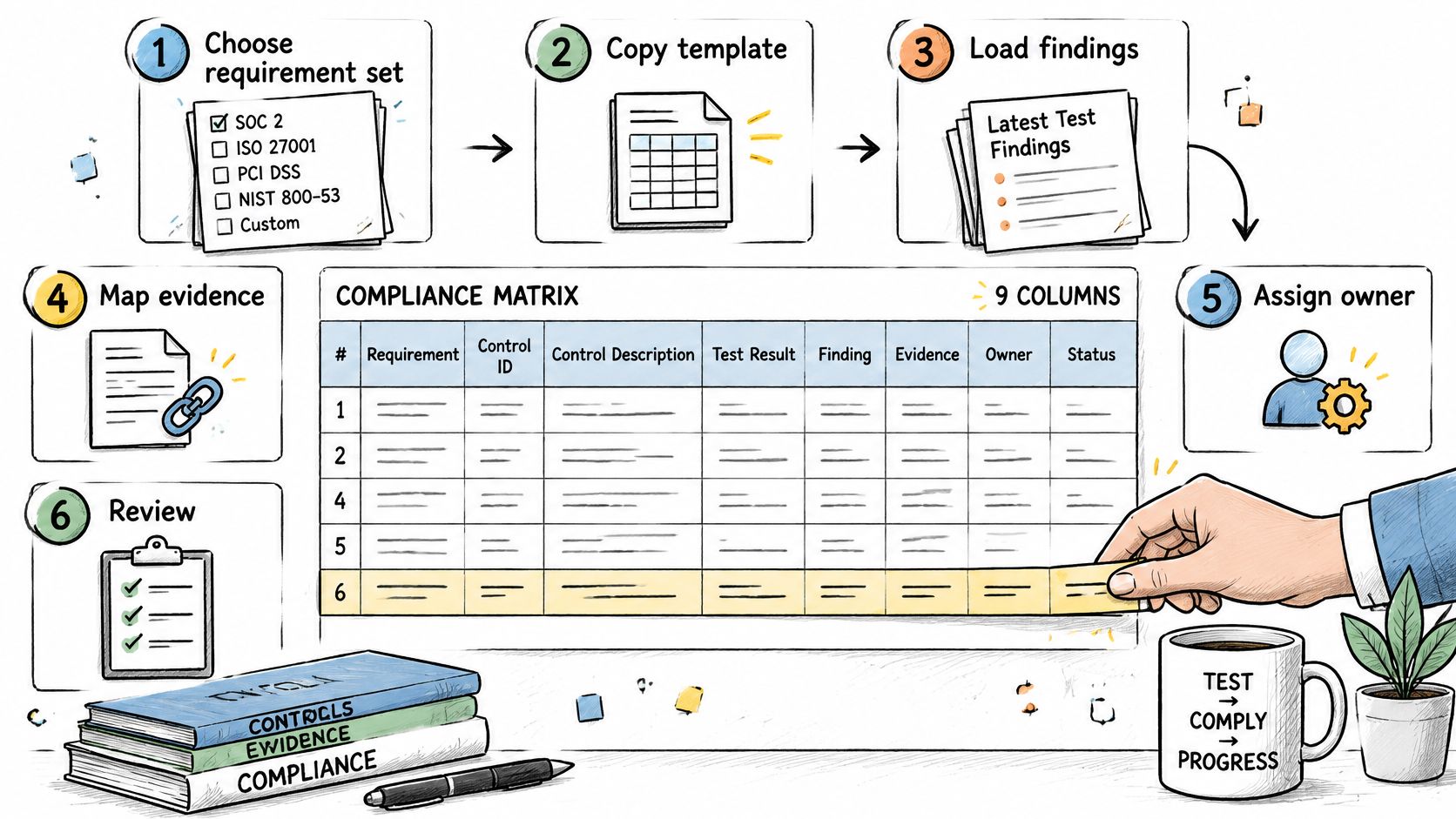
Work through these six steps this week using the artifacts you already have on hand:
- Lock your requirement set and version: Pick the exact standard versions (such as PCI DSS v4.0.1, ISO/IEC 27001, or NIST CSF 2.0) governing your next review period.
- Load your latest test into the nine-column template: Enter one row per finding from your most recent penetration test instead of summarizing the whole report on a single line.
- Stamp immutable evidence IDs on every artifact: Assign permanent identifiers to every screenshot, HTTP trace, and scan output, verifying that timestamps fall squarely inside the active audit window.
- Assign accountable owners and relationship labels: Put one named person and remediation deadline on every open row, and mark each mapped framework cell as direct, partial, inherited, compensating, or not applicable.
- Put PCI DSS triggers on the team calendar: Create separate tracking rows for annual external, annual internal, change-triggered, and six-month service-provider segmentation tests.
- Verify every closed finding with fresh retest proof: Run a targeted retest on every remediated vulnerability and log the output as a brand-new evidence record alongside the original discovery.
For a quick visual walkthrough of how evidence-backed testing workflows come together in practice, watch this overview before building your first template.
Once those six steps are complete, every single row in your matrix answers the four questions auditors care about most: who owns the control, what was tested, what artifact proves the result, and when it was last verified. If you want to see how automated penetration testing feeds structured, control-mapped findings straight into that workflow, bring one real finding from your last engagement and request a ThreatExploit AI demo to walk through the full platform together.
ThreatExploit AI runs automated penetration tests across web applications, APIs, networks, and cloud environments, delivering evidence-verified reports in under four hours with screenshots, remediation steps, and auto-mapped control references for PCI DSS, SOC 2, ISO 27001, HIPAA, CMMC, GLBA, and GDPR. Instead of manually stitching raw screenshots into spreadsheets before every audit, your team gets structured technical proof ready to drop straight into an audit-ready compliance matrix. Explore the platform or request a walkthrough at ThreatExploit AI.