
You're on a Monday morning engagement call, the scope is approved, the client has supplied an asset list, and the first useful clue is an ICMP anomaly from a building-management console. The appliance was exposed for vendor support, the interface looked dated, and a hostname field accepted more than a hostname should. That's the kind of foothold that turns a routine external assessment into a serious penetration test.
A command injection vulnerability isn't just a defect in an old web form. In modern red-team work, the highest-impact targets are often internet-facing appliances, administrative consoles, automation interfaces, and API-driven infrastructure that construct operating-system commands behind a polished interface. The technical flaw is familiar. The operational consequences still surprise teams.
Table of Contents
- The Engagement That Started with a Ping
- What Command Injection Actually Is
- Mapping the Attack Surface Beyond Web Forms
- Payloads and Exploitation Patterns You Will See
- Detection and Verification for MSSP Workflows
- Remediation That Actually Sticks
- Compliance Mapping and the Pre-Engagement Checklist
The Engagement That Started with a Ping
The scenario began with a regional hospital's outsourced MSSP flagging an unusual ping from a building-management console during after-hours maintenance. Treat this as a representative engagement scenario, not a claim about a specific incident. The console had been published for vendor remote support, and its diagnostic page accepted a hostname parameter used to test connectivity.
During the kickoff, the senior tester marked the console as a priority asset. The junior testers initially treated it as low risk because it exposed only a ping function and a small set of environmental controls. That assumption changed when a controlled input showed that the value flowed into a shell command without adequate separation between the intended hostname and additional shell instructions.
The first proof was deliberately narrow. The tester established command execution without touching patient systems, then documented the request, response behavior, account context, and process privileges. From there, the authorized chain in the exercise showed how a seemingly limited diagnostic function could expose local credentials, support lateral movement toward an Active Directory controller, and provide a route to sensitive patient scheduling data.
Practical rule: A diagnostic function is still code execution if the server passes its input to an interpreter.
The important lesson isn't the dramatic chain. It's the starting point. The console was an edge device with a management interface, not a conventional business application. Its ping feature had become a productized command interpreter, and the organization's normal web-application assumptions didn't cover it.
What the kickoff should establish
Before testing payloads, the team should confirm:
- Ownership and authorization: Identify the appliance owner, remote-support vendor, maintenance window, and written permission for command-injection testing.
- Safety boundaries: Exclude destructive commands, production data access, persistence, and uncontrolled lateral movement unless the rules of engagement explicitly permit them.
- Privilege context: Record the service account, filesystem access, network reachability, and available binaries without altering the host.
- Evidence expectations: Agree on what constitutes a confirmed finding, who receives urgent notification, and how screenshots and logs will be handled.
Command injection has persisted through multiple generations of development practice. OWASP describes the historical arc from early OS command-injection guidance, including CVE-1999-0067 and Shellshock, which became the first OS command-injection flaw to reach internet-scale mass exploitation. A 2024 U.S. government alert also noted that manufacturers continued producing affected products after more than two decades of documentation and mitigations.
That history explains the tester's posture. Don't downgrade a management console because its interface is small. Small interfaces often expose privileged operations with fewer controls, weaker monitoring, and longer patch cycles.
What Command Injection Actually Is
CWE-78 defines the core issue as improper neutralization of special elements used in an OS command. In plain terms, an application receives untrusted input, places it into a command intended for the operating system, and allows an interpreter to treat part of that input as instructions rather than data. CWE-78's technical description also makes clear that direct operating-system access isn't required. A web application can provide the vulnerable path, especially when the process runs with high privileges.
Think of the application as a translator carrying notes between a user and a shell. The application intends to pass one message, such as a hostname, filename, or diagnostic option. If it concatenates raw input into a shell string, the translator hasn't marked where the user's data ends. Shell metacharacters can then change the meaning of the message.
That differs from related injection classes:
- OS command injection: The application invokes an operating-system command or shell, and attacker-controlled input changes what the OS executes. CWE-78 is the relevant weakness classification.
- Code injection: The application evaluates attacker-controlled content as source code inside a programming-language runtime. It may lead to code execution, but it isn't automatically an OS command-injection finding.
- Argument injection: The attacker changes the arguments supplied to an otherwise intended executable. This may not invoke a shell, yet it can still alter behavior or access dangerous options.
- CWE-77 context: OWASP uses the broader command-injection family to cover improper handling of commands and command arguments. The distinction matters in reporting because a safe process-spawn API can still be abused if it accepts attacker-controlled arguments.
OWASP's command-injection guidance describes common input paths, including forms, cookies, HTTP headers, URLs, JSON, SOAP, and XML. Once an interpreter recognizes metacharacters, the attacker may gain arbitrary command execution, upload programs, or extract credentials, with the actual impact constrained by the vulnerable process's privileges.
Why the defect survives
Framework defaults help, but they don't repair every boundary. Legacy codebases preserve string-building patterns, rapid prototypes become permanent administrative tools, and vendors ship embedded web interfaces with limited security review. Developers may understand input validation while operations teams understand the appliance's command behavior, but neither group always reviews the handoff between them.
A useful resource for teams documenting operational workflows and command-center ownership is the RapidStart Command Center overview. It's valuable context because command injection assessments often fail when nobody can identify which team owns the console, its scripts, or its remote-support exposure.
Linters also have limits. A static rule can flag system() or a shell-enabled child process, but it may not understand whether a value is attacker-controlled through a reverse proxy, a vendor API, or a hidden administrative route. Penetration testers have to trace the value from ingress to interpreter, then verify the execution context.
Mapping the Attack Surface Beyond Web Forms
The old mental model starts with a text box and ends with a shell. Real assessments need a broader map. A REST query parameter may reach a network diagnostic utility, a GraphQL variable may populate a maintenance task, and an XML element may become an argument in an appliance script.
OWASP's injection data shows why this family deserves priority. In OWASP Top 10:2021 A03, 94.04% of tested applications were tested for some form of injection, with an average incidence rate of 3.37%, 274,228 total occurrences, and 32,078 CVEs mapped to the category. In OWASP Top 10:2025, injection testing covered 100% of applications, with 1,404,249 total occurrences, 62,445 CVEs, and 37 mapped CWEs, including CWE-77 command injection, as reported in OWASP's 2025 injection category.
Those figures describe injection broadly, not command injection alone. They still show the scale of the family and the amount of attention it receives from security testers.
Where testers should look
| Surface Type | Example Sink | Typical Interpreter | Frequency |
|---|---|---|---|
| REST API | Diagnostic hostname or archive path | POSIX shell or utility parser | Common |
| GraphQL | Maintenance or import variable | Application process API | Context-dependent |
| XML or SOAP | Device-management element | Shell script or system utility | Common on appliances |
| HTTP header | User-Agent or Referer copied into a log command | Shell or logging wrapper | Often overlooked |
| File upload | Filename passed to conversion or scanning tool | Shell, batch file, or utility | Common in automation |
| Management console | Ping, traceroute, backup, or firmware task | Embedded shell | High-impact |
| Infrastructure API | Job name or repository path | CI runner shell | Context-dependent |
A serious attack-surface review includes GraphQL variables, XML and SOAP envelopes, filenames, server-side template strings, and headers that developers assume are harmless. It also includes firewalls, NAS devices, IPMI interfaces, printers, VPN gateways, and building-management systems.
F5 Labs reported that web-based remote-code-execution vulnerabilities represented more than 24% of CISA KEV entries as of July 31, 2025, and observed that many actively scanned CVEs shared HTTP-based vectors that culminated in command injection. The F5 Labs analysis of web-based RCE vulnerabilities supports a practical prioritization decision: inventory exposed management planes before spending the whole assessment on ordinary application forms.
For repeatable discovery, teams can pair authenticated crawling with attack-surface mapping workflows. The mapping output should identify not only URLs, but also the device function behind each endpoint, the privilege required, and whether the service is reachable from the internet, a partner network, or an internal segment.
Modern web frameworks close many straightforward form-based sinks. Embedded web UIs often lag behind because the interface is only a thin layer over shell scripts written for an operating system image that receives less scrutiny than the customer-facing application.
Payloads and Exploitation Patterns You Will See
Payload selection starts with the interpreter boundary, not with a favorite string. A semicolon, ampersand, pipe, backtick, or $() substitution can have different effects depending on whether the application invokes sh, Bash, Windows cmd, a direct executable, or a language runtime with shell behavior enabled.
In an authorized test, begin with a harmless proof that distinguishes normal input from command interpretation. For an in-band sink, a tester might use a benign separator followed by an identity or environment check approved by the rules of engagement. For a blind sink, a controlled delay or callback is more useful than relying on a response body that the application never returns.
In-band, blind, and out-of-band paths
In-band command injection returns output in the HTTP response, an error message, a downloadable file, or a visible change in the application. It's the easiest form to demonstrate, but it can mislead testers when the application filters output, normalizes errors, or runs the command asynchronously.
Blind injection produces no useful command output. A time-based proof uses a deliberate delay, such as a shell sleep or a platform-appropriate pause, then compares the response timing against a clean baseline. A ping-based delay can work where sleep is unavailable, but it must be carefully bounded because network behavior can create noisy results.
Out-of-band verification uses a controlled collaborator service over DNS or HTTP, and sometimes ICMP, to confirm that the target executed a callback. Burp Collaborator and interactsh are common choices. Never use an external callback without authorization, and don't send sensitive data in the callback. The goal is execution proof, not collection.
Common sink patterns
Look for these code shapes during review and testing:
exec()orsystem()with a string assembled from request data.- Java
Runtime.getRuntime()calls where user input is included in a command string. - Python
os.popen()orsubprocesscalls that enable shell interpretation. - Node.js
child_process.exec()or shell-enabled spawn behavior. - Jenkins Groovy console workflows that pass job parameters into operating-system utilities.
- Router administration pages that wrap
ping,traceroute, backup, or firmware commands.
| Metacharacter | Bash/Shell Example | Windows Cmd Example | Blind Variant |
|---|---|---|---|
; |
value; benign-check |
value & benign-check |
Append a controlled delay |
&& |
value && benign-check |
value && benign-check |
Execute only if the first command succeeds |
| |
value | benign-check |
value | benign-check |
Pipe into a delay or callback utility |
| Backticks | value`benign-check` |
Not equivalent in cmd |
Use only where the shell supports substitution |
$() |
value$(benign-check) |
Not supported in standard cmd |
Substitute a controlled callback where permitted |
The table shows syntax patterns, not a license to spray payloads across production. A router admin panel may normalize whitespace, a Jenkins console may apply Groovy parsing first, and a Node.js child_process call may bypass a shell entirely if the developer used an argument-array API.
A short decision tree
- Does the value reach a shell command string? Test a safe stacked-command separator, then verify in-band, by timing, or out-of-band.
- Does it reach a direct executable with separate arguments? Investigate argument injection and option parsing instead of assuming shell metacharacters will work.
- Does a filter block obvious characters? Test whether canonicalization happens before validation, and assess encoding, quoting, delimiter handling, and whitespace normalization without turning the exercise into an uncontrolled bypass contest.
- Is the command asynchronous or outputless? Prefer a bounded timing proof or a scoped collaborator callback with full request and server-log correlation.
Keyword filters fail because they search for a few obvious tokens while the interpreter handles quoting, encoding, substitutions, alternate separators, and whitespace in its own way. A filter can reduce noise, but it isn't command and data separation.
Detection and Verification for MSSP Workflows
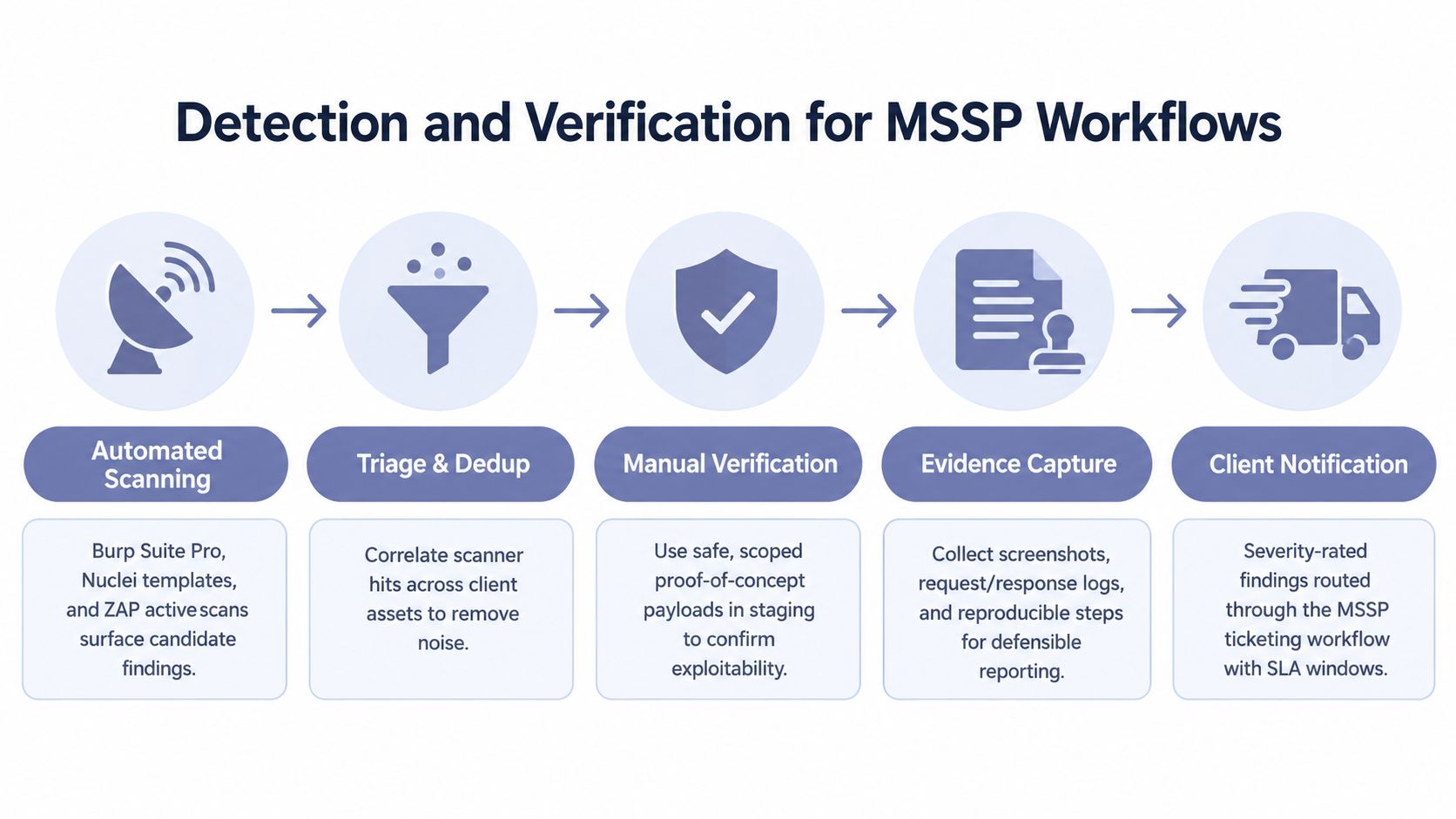
An MSSP needs more than a scanner finding. It needs a repeatable path from candidate signal to evidence-backed conclusion. Burp Suite Pro, Nuclei templates, and ZAP active scans can surface suspicious parameters, response differences, and known appliance behaviors, but none of them automatically understands every command-construction path.
Start by normalizing scanner output by client, asset, endpoint, parameter, and suspected interpreter. Deduplicate equivalent hits before manual testing. Then assign a tester to confirm whether the value is reflected, passed to a process, interpreted by a shell, or merely rejected by application validation.
Build proof that survives review
For in-band findings, capture the complete request and response, the harmless control request, the verification request, and the resulting output. For blind findings, record clean and test timings under comparable conditions, then correlate them with application and server logs.
A useful confirmation packet contains:
- Scope reference: Asset, endpoint, parameter, account, and authorization boundary.
- Payload annotation: What the separator or substitution was intended to test, without including destructive actions.
- Reproduction record: The exact request, timestamp, response behavior, and test conditions.
- Execution context: Process identity, privilege level, and observed operating-system behavior.
- Impact statement: What the vulnerable account could access, not what an unrestricted administrator might do.
Potential findings need escalation when the input appears to reach a command-building path but execution hasn't been proven. Confirmed findings should ship when the team can reproduce command interpretation safely and can show a credible impact path. Don't call a response-time anomaly confirmed just because one request was slow.
A 2025 guide on AI-assisted coding noted that these tools can increase the volume of code capable of introducing command injection. Separately, an arXiv meta-analysis of agentic coding assistants reported attack success rates above 85% against state-of-the-art defenses when adaptive strategies were used. Those claims point to a scaling problem, but they don't remove the need to validate individual findings.
Detection research also shows promise. A 2024 Scientific Reports study described a deep-learning detector reaching 99.3% accuracy and 98.2% recall on a real-world dataset, as summarized in StackHawk's command-injection guide. Accuracy and recall on a dataset don't answer the operational questions MSSPs face, including false positives, deployment cost, and generalization beyond benchmark traffic.
The practical model is therefore hybrid. Automation triages volume, manual testing establishes context, and evidence capture makes the conclusion defensible. Teams evaluating MSSP models for GCC enterprises should ask how detection findings move through validation, ticketing, escalation, and client reporting, not just how many endpoints a scanner can touch.
False-positive reduction depends on disciplined correlation, not a single confidence score. A useful workflow for reducing false positives should preserve uncertain candidates for human review while preventing duplicate alerts from consuming senior tester time.
Remediation That Actually Sticks
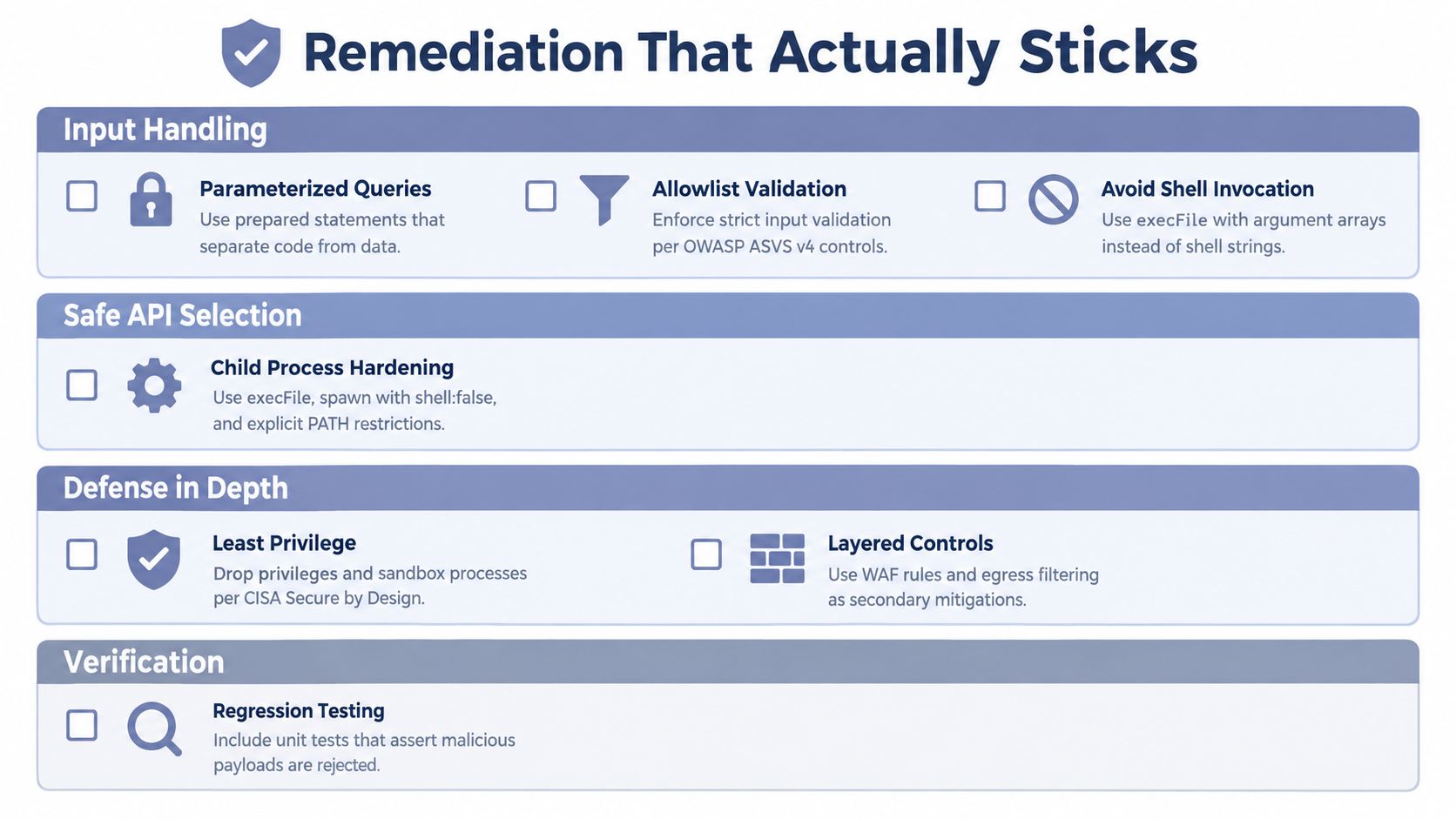
The durable fix is to stop treating user input as part of a command string. CISA recommends using built-in library functions that separate commands from arguments and applying parameterization so data remains separate from commands, as described in its Secure by Design alert on OS command injection.
Start at the API boundary. In Node.js, prefer execFile or spawn with an argument array and shell execution disabled where appropriate. In Python, use subprocess with shell=False and a list of arguments. In other languages, choose native library functions that perform the required operation without invoking a shell at all.
A layered fix
- Parameterize process calls: Keep the executable, options, and user-controlled value in separate arguments. Don't build a single command string and hope escaping will cover every interpreter.
- Allow only expected input: A hostname field should accept the format the application requires. A filename should follow the application's filename rules. Reject unexpected characters rather than trying to remove known metacharacters after the fact.
- Constrain the service account: Run the operation with a dedicated identity that has no unnecessary shell access, limited filesystem permissions, restricted network egress, and read-only mounts where the function allows it.
- Remove shell invocation: If a library can perform ping, archive, conversion, or file operations directly, use it. Every shell handoff adds parsing behavior that developers must secure.
- Add defense in depth: A WAF can detect shell metacharacters in query strings, headers, and JSON bodies, but it isn't the primary control. WAF rules can miss encoding and alternate syntax, and they can break legitimate administration workflows.
- Harden edge devices: Keep management interfaces off the WAN, restrict vendor access through controlled paths, use strong certificate validation for administrative connections, and remove debug endpoints from production images.
- Catch dangerous calls before merge: SAST rules should flag string concatenation into process APIs, shell-enabled child processes, unsafe Groovy execution, and command construction in scripts. Code review should trace whether the value is externally controllable.
Why common fixes fail
Replacing semicolons without changing the process API is cosmetic. Blocking a few keywords with a regular expression creates a moving target, and placing a WAF in front of a vulnerable appliance leaves internal callers, trusted proxies, and alternate management paths exposed.
Remediation also needs regression tests. Include malicious separators, quoting variations, unexpected argument prefixes, encoded input, and values arriving through headers or structured API bodies. Assert that the application rejects the input or treats it as literal data, then repeat the test after dependency, firmware, and configuration changes.
The closing loop matters as much as the patch. A documented remediation workflow for pentest findings should connect the developer fix, appliance configuration change, retest result, owner approval, and residual-risk decision. If the original vulnerable endpoint remains reachable, a code change alone hasn't closed the finding.
Compliance Mapping and the Pre-Engagement Checklist
A CWE-78 finding becomes useful to auditors when the technical proof connects to a control objective and a remediation decision. The exact control language and evidence expectations vary by assessment, so confirm the client's current control set before promising a particular artifact.
| Framework | Control Reference | Requirement Summary | Evidence Artifact Required |
|---|---|---|---|
| PCI-DSS | Requirement 6.2.4 | Review software security weaknesses and address them through a secure development process | Reproduction payload, affected hostname, timestamped request and response, remediation sign-off memo |
| SOC 2 | CC6.1 | Restrict logical access and protect systems from unauthorized activity | RCE proof, access context, screenshots, logs, ticket history, and approval record |
| ISO 27001 | A.8.28 | Apply secure coding principles throughout development and maintenance | CWE-78 finding, code or configuration evidence, test result, corrective-action record |
| HIPAA | Security Rule 164.308(a)(1)(ii)(A) | Conduct a risk analysis of threats and vulnerabilities affecting electronic protected health information | Repro payload, affected host, impact analysis, screenshots, mitigation evidence, and sign-off memo |
The pre-engagement crib sheet
Before the first request leaves the test workstation, confirm:
- Target scope: List web applications, APIs, firewalls, NAS devices, IPMI interfaces, printers, management consoles, and vendor-support paths that are explicitly in scope.
- Authorization letters: Verify the legal entity, dates, source addresses or testing infrastructure, permitted techniques, emergency contacts, and stop conditions.
- Baseline dashboards: Record normal response timing, authentication state, alerting behavior, and relevant maintenance windows before testing.
- Payload selection: Prepare safe in-band, timing, and out-of-band checks for the suspected interpreter. Keep destructive and persistence techniques out of the crib sheet unless separately authorized.
- Evidence hashing: Generate hashes for captured request and response files, screenshots, logs, and exported reports so later reviewers can verify that evidence wasn't altered.
- QA cross-check: Have another tester confirm scope, reproduction steps, severity, impact, remediation, timestamps, and control mapping before delivery.
An MSSP's internal reviewer should be able to reproduce the conclusion from the packet without relying on the original tester's memory. Include the hostname, endpoint, parameter, account context, exact payload, observed result, and the limitation that prevented broader testing.
That discipline protects the client and the testing team. A command injection vulnerability may be technically simple, but the quality of the engagement depends on whether the team proves the boundary, limits impact, and translates the result into an action that survives development, operations, and audit review.
ThreatExploit AI offers automated penetration testing across web, network, and cloud environments, with reconnaissance, exploitation, verification, evidence collection, and compliance-mapped reporting for security service providers. Use it to scale command-injection discovery and verification across authorized client assets, then visit ThreatExploit AI to review the platform.